Oliver Goldsmith has been quoted as saying, “I love everything that’s old… old friends, old times, old manners, old books, old wine.”
We here at Tavistock Books couldn’t agree more, especially with the latter two, and this month offer a list of old books [et al] that deal with old wines. or at least wine produced decades, if not a centuries, ago. Many of the 44 items on the list are ephemeral in nature, since the list’s genesis comes from buying a small cache of California wine ephemera from one in the business prior to WWII.
Speaking of which, indulge me an aside, wherein I puff our state’s viticultural products even though wine came to California with the Spaniards in the eighteenth century; Sonoma & Napa didn’t enter the game until 1857 and 1859 respectively. And they didn’t get any international respect until 1976, when California wine swept the competition at “The Judgement of Paris” in 1976. The rest, as they say, is “vintage” history.
On perusing the list, you’ll see diverse references cited. These refer to:
(1) James Gabler. WINE INTO WORDS. A History and Bibliography of Wine Books in the English Language. 2nd Ed [2004].
(2) Maynard Amerine & Axel Borg. A BIBLIOGRAPHY On GRAPES, WINES, OTHER ALCOHOLIC BEVERAGES, And TEMPERANCE [1996].
(3) Lavonne Axford. ENGLISH LANGUAGE COOKBOOKS, 1600-1973. [1976].
(4) Katherine Bitting. GASTRONOMIC BIBLIOGRAPHY. 1939 [2004].
(5) Bob & Eleanor Brown. CULINARY AMERICANA.
(6) William Cagle & Lisa Stafford. AMERICAN BOOKS On FOOD & DRINK 1739 – 1950. A Bibliography. [1998].
(7) William & Liselotte Glozer. CALIFORNIA In The KITCHEN. [1960].
(8) National Union Catalogue.
So enjoy the bouquet, have a sip and let us know how you like our vintage selections. Below you’ll find a few selected titles from the list.
How to Wine Friends and Affluent People
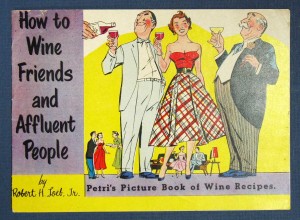 “In case some ‘gourmet-monger’ discouraged you with some obsolete ‘wine-ology’ such as: ‘Unless you serve the correct wine with the correct food… in the correct glass… at the correct temperature, you’d best stick to your old hosting habits…’ FORGET THAT – and him too!”
It seems as though this fun and colorful pamphlet (advertising the Petri Wine Co.) was the predecessor to the 1965 book published under the same name. It’s quite rare; none are found on OCLC, nor as we write this do we find any other copy on the market. Details>>
Annotated Bibliography of California Viticulture
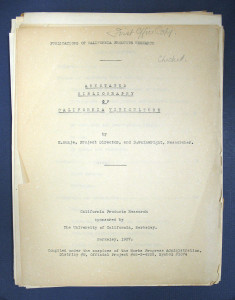 “This bibliography represents an effort to list the various sources of information regarding California Viticulture. It is necessarily a selected list… an attempt has been made to arrange the data in a logical manner. A general point of view has been followed in the selection of the material, and if the layman becomes aware oft he multiplicity of factors imporant to the California Viticulturist, this compilation will have served the purposed for which it is primarily intended. This is the first work of its kind on California viticulture…”
Research suggests that this bibliographical work, compiled “under the auspices of the Works Progress Administration, District #8 (Official Project #65-3-4225, Symbol #1874), was never formally published. The Project Director & author was prolific, and wrote many works about California, including “Russian California 1805-1841,” “The Story of Japanese Farming in California,” and “Pre-Marshall Gold in California.” We were unable to find information on the “Researcher” D. Wainwright. Only one other archival copy is known [Bancroft], per OCLC. Details>>
Health’s Highway to Longevity
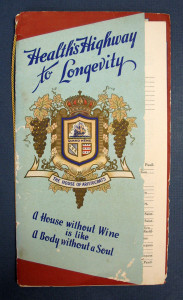 Probably published in the early 1930’s Health’s Highway to Longevity bears the drop title “A House Without Wine is Like a Body Without a Soul.” The book’s color pictorial stiff paper printed wrappers are tied with a gold cord. This copy has some evidence of biopredation, particularly on the rear wrapper. Otherwise, there is only modest wear to the wrappers, making this withal a good example. The title is rare in the trade. Details>>
The Bordeaux Wine and Liquor Dealers’ Guide
 This book was written for a group of ‘chemists’ involved with the adulteration and imitation of wines and liquors. It is prefaced: ‘In this book not one article in the smallest degree approximating to a poison is recommended, yet it teaches how Cognac, Brandy, Scotch and Irish Whiskey, Foreign and Domestic Rum, all kinds of wines from the choicest to the commonest, can be imitated to the perfection that the best judges cannot detect the method of manufacture.” (Gabler). This copy has modest wear to the binding, and the front end-papers are age-toned and stained. The front fly-leaf bears a previous owner’s inscription. Rare in the trade. Details>>
“Home Brewed” Wines and Beers and Bartenders Guide
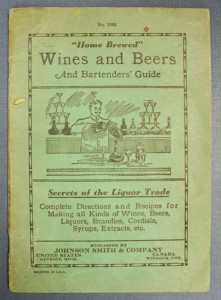 “A generation or two ago every house-wife who prided herself on her catering ability had a choice of home-made wines and cordials in her cellar, and she was always able to offer her friends one or other of her special delicacies. Of late years, however, the custom of making wine at home has to a large extent died out, and to those living in towns without fruit gardens, and only a limited amount of space for storage purposes, the occupation is hardly a feasible one… Home-made wines are particularly good and wholesome, and with a reasonable amount of care their manufacture is not difficult. The secret of success lies in using good materials, in measuring accurately, in observing strict cleanliness in every detail, and in not trying to hurry the process.”
“Home Brewed” Wines and Beers includes recipes for beverages such as Cider Champagne, Black-Currant Wine, Monongahela Whiskey, Dandelion Wine, Walnut Mead, Tomato Wine, Sloe Gin, Beef Tea, Potass Water & Port Wine Punch. In addition to the many interesting wine, beer & liquor recipes, this handy booklet includes directions for making “cement for the mouths of corked bottles”, “wax putty for leaky cans, bungs”, etc., and how to “restore wine that has turned sour or sharp”. P. 31 begins the conclusion of the booklet with a poem titled “Toasts for All Occassions”. We find no listings of this title on OCLC, nor the NUC. Not found in Gabler, nor Simon. Rare. Details>>
Grape Syrup
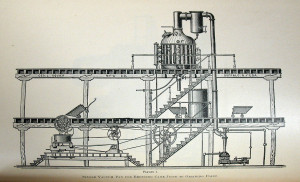 “It has only been within the past two or three years that any particular attention has been given to the production of grape syrup in California in considerable commercial quantities…. There are many wine makers in California who have rigged up machines of one sort or another, to make syrup, either for wine making, or as, in the last two or three years, for table purposes.”
This title comprises Appendix A to the Annual Report of the Board of State Viticultural Commissioners for 1893.Chapters include: Properties of grape sugar, Apparatus for making syrup, Vacuum pans, American Concentrated Must Company’s Works, Yaryan system, Sanders’ syrup machine, Open pan and tub processes. Rare in the trade. OCLC records eight institutional holdings of this single volume. Details>>
Viticulture and Viniculture in California
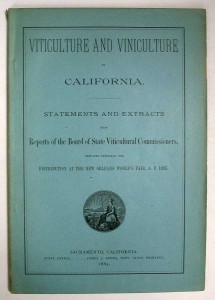 This small text contains a wealth of information regarding California viticulture and the defense of the wine-making community. For example: “Viticulture, in professing to fulfill all the proper demands of the people as a progressive industry, conducive to public prosperity, happiness, and civilization, bases its claims for popular recognition, and State and National encouragement and protection, on the principles comprised in the foregoing general propositions. It has its enemies among political economists, who do not rightfully share our happy conditions of progress; and among reformers, whose notions of political power would lead them, if successful, to add to their present follies the religious intolerance of the past… In the near future the wine dealers may prepare also to provide a market for clarets of high Medoc character, true high class Burgundy, true Sauternes, and Cognac types that will rival the best produced and surpass any in general commerce… It is to the physicians and scientific students of life, who do not expect any millennium, that society should look for the reform of alcoholic abuses; and to the wholesome restraints and discipline of youth in homes that permanent progress in social growth and healthfulness must be traced. As to criminal acts committed during alcoholic excesses, we may assume that intemperance is the result of criminal conditions of the mind, which sets no restraints upon ambition and desire. As to insanity, who can tell whether it is not the insane disposition that leads to alcoholism? …Our industry is forced to a consideration of these questions, not only in self-defense against erratic and impractical reformers, but also because our success largely depends upon the general good and prosperity of the people.”
Subject headings include Viticulture Considered Industrially from the Standpoint of National Importance, the Growth and Present Condition of Viticulture in California, the Question of Over Production, Shipping Grapes and Raisins, Extent of Possible Viticulture in California, Select Locations for Viticulture, the Chemical Constituents of Soils & Suggestions Concerning the Development of Commerce in Viticultural Products in the United States (Prepared Especially for this Edition). An important California wine item for dedicated collectors and institutions. Rare in the trade. Details>>
Thanks for reading! Love our blog? Subscribe via email (right sidebar) or sign up for our newsletter--you’ll never miss a post.