On June 17, 1579, Francis Drake claimed California for England. He anchored his ship, the Golden Hind, just north of present-day San Francisco and named the new territory “Nova Albion.” But despite Drake’s claim in the name of Queen Elizabeth I, he was not the first European to explore California.
Drake Lays Claim to California
Drake set out from England on December 13, 1577 with five ships. His mission was to raid Spanish holdings along the Pacific coast in the New World. Drake was forced to abandon two ships during the Atlantic crossing. Then the expedition encountered a series of storms in the Strait of Magellan. One ship was destroyed, and the other returned to England. Only the Golden Hind reached the Pacific. Drake raided Spanish settlements and captured a heavy-laden Spanish treasure ship.
Drake continued up the West Coast of North America in search of the fabled Northwest passage. He got as far north as present-day Washington, stopping near the San Francisco Bay in June 1579. In July, Drake’s expedition set off across the Pacific, eventually rounding the Cape of Good Hope and returning to England. Drake returned to Plymouth, England on September 26, 1580. Queen Elizabeth I knighted him the following year on a visit to his ship.
A Portuguese Explorer for the Spanish Crown
California gets its name from a mythical island populated by Amazon women who use golden tools and weapons. It appeared in a popular romance novel called Las Sergas de Esplandian by Garci Rodriguez de Montalvo. The book went through several editions, though the earliest extant copy dates from 1510. When Spanish settlers explored what’s now Baja California, they believed that they’d discovered the mythical island.
It was Portuguese adventurer Joao Rodruigues Cabrilho, better known as Jose Rodriguez Cabrillo, who disabused the Spaniards of the notion that California was an island. Little is known of Cabrillo’s life before 1519, when his name first appears in the ranks of those serving conquistador Hernan Cortes. Cabrillo participated in the conquests of both Mexico and Guatemala. He was also involved in military expeditions to southern Mexico, Guatemala, and San Salvador.
Cabrillo eventually settled in Guatemala and by 1530 had established himself as a leader of Santiago, Guatemala. He returned to Spain briefly to find a wife, marrying Beatriz Sanchez de Ortega. The couple would have two sons. Then in 1540, a major earthquake destroyed Santiago. Cabrillo’s report to Spain on the devastation is considered the first piece of secular journalism published in the New World.
Soon Spain was looking to expand northward. Francisco de Ulloa had recently explored the Gulf of California and proven that California was not an island after all (though the misconception persisted back in Spain). Now, Guatemala governor Pedro de Alvarado commissioned Cabrillo to lead a mission up the coast. He believed that Cabrillo and his men would find the fabled wealthy cities of Cibola, which were thought to be somewhere along the Pacific coast north of New Spain. The explorers also held out hope of discovering the “Straits of Arain,” rumored to connect the North Pacific and the North Atlantic.
Cabrillo Travels up the California Coast
On June 24, 1542, Cabrillo sailed out of the port of Navidad (modern-day Manzanillo). He took with him a crew of soldiers and sailors, along with merchants, a priest, slaves, livestock, and enough provisions to last two years. By September 28, 1542, Cabrillo had reached a “very good enclosed port,” now known as San Diego Bay. He and his crew stayed there for several days before heading up the coast. They visited a number of islands before turning around due to adverse weather conditions.
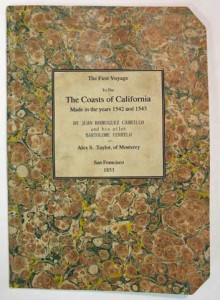 Cabrillo died of complications from a broken leg on January 3, 1543. His exploration helped to dispel geographical misconceptions and to expand the Spanish empire. Over three centuries later, Alex S Taylor, a resident of Monterey, California, wrote the history of Cabrillo’s expedition. First published separately in 1853, The First Voyage to the Coasts of California is considered an important work, indeed; it was the first work of California history actually published within California.
Other Works of Californiana
The Pony Express Courier
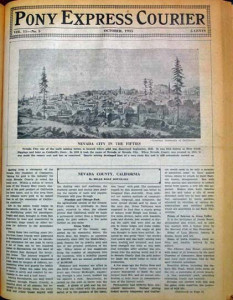 In 1860, countless men responded to advertisements for riders in the new Pony Express. At any one time, only about eighty men would actually be riders, though another 400 employees supported the operation. The Pony Express was a truly ambitious project, connecting the East coast with California. Mark Twain was lucky enough to witness the Pony Express in action, observing that the rider was “usually a little bit of a man.” The Pony Express Courier, published in Placerville, first appeared in 1934. It’s a wonderful resource for students of Western America, full of interviews, reminiscences, and more. This set includes 16 of 18 total issues, bound in eight books. They are custom bound in blue “marbled” cloth with gilt stamped lettering to the spine and front board. Details>>
Wi-Ne-Ma (The Woman Chief) and Her People
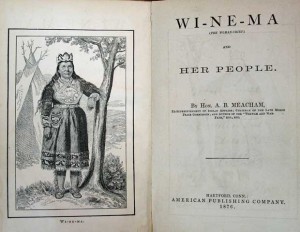 Also known as the Lava Beds War, the Modoc War began in 1872, making it the last of the Indian Wars to occur in California and Oregon. Wi-Ne-Man acted as interpreted for the peace commission during the conflict. Her efforts saved the life of Alfred Benjamin Meachum, Indian Superintendent of Oregon, Meachum would go on to write an account of the chieftainess called Wi-Ne-Man (The Woman Chief) and Her People. The first edition was published in 1876. APBC shows this title at auction last in 1997, with only one prior occurrence in 1991. Details>>
Documents in Relation to Charges Preferred by Stephen J Field and Others…
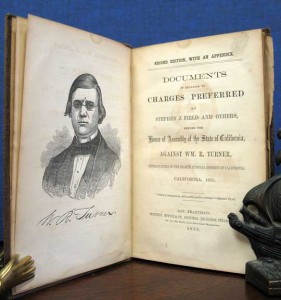 The Field-Turner feud is renowned in the annals of California history. Judge William R Turner had Field, an attorney, disbarred; Field ultimately got his revenge by, on election to the California Assembly, arranging Turner’s banishment, via judicial reorganization, to a remote “region in the northern part of the state.” [DAB]. This second edition includes testimonial and affidavits in Judge Turner’s defense from a host of local officials as well as a few national notables, including Andrew Jackson & Henry Clay. Furthermore, this copy contains rare associated ephemera: a handbill reprinting a contemporaneous review of the book entitled, “Judge Turner’s Book,” as published in the San Francisco Herald of Dec. 30, 1856; as well as a legal circular containing a statement by Judge Turner relating to his candidacy for re-election to the office of District Judge for the 8th District, dated Arcata, July 14, 1863. Additionally, contained within the circular are reprinted two letters with respect to Turner’s case before the Supreme Court, the latter advising Judge Turner “of the favorable and final decision of the Supreme Court in your case.” Details>>
All About California and the Inducements to Settle There
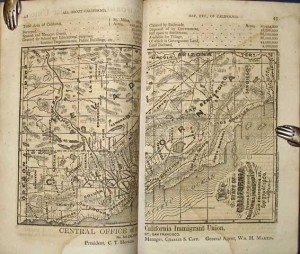 Attributed to JS Hittel, All About California includes the drop title “For Gratuitous Circulation.” The propaganda piece was designed to encourage settlement in California, and it’s full of pertinent data and factoids of the era. This, the second edition, was issued in 1870 just like the first. It includes a folding map of the railroad route for the “Chicago, Rock Island, and Pacific RR Line,” along with a two-page map of California, a full-page wood engraving of the Grand Hotel, and a two-page map of “JT Little’s San Joaquin Valley.” This copy bears the stamp of the California Immigrant Union in the upper right corner of the front wrapper. There’s a small bit of bio-predation on the top pages of the last eight pages, but no text is affected. Details>>
An Historical Sketch of Los Angeles County, California
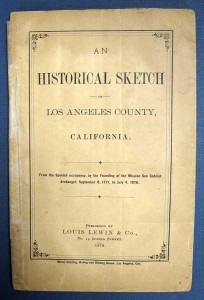 This account of California history stretches from the Spanish Occupancy, by the founding of the Mission San Gabriel Archangel, September 8, 1771, to July 4, 1876. This copy is a first edition, second issue, published in 1876. The volume is in its original printed paper wrappers. The wrapper edges chipped, with the upper corner lacking from front wrapper. A Japanese paper repair has been made to the spine. There’s occasional pencil marginalia. Overall, this is an about very good copy. Details>>
Related Posts:
The California Gold Rush, Slavery, and the Civil War
L Frank Baum’s Forgotten Foray into Theatre
Elias Samuel Cooper: Renowned and Controversial Surgeon
Thanks for reading! Love our blog? Subscribe via email (right sidebar) or sign up for our newsletter--you’ll never miss a post.


