April 3 marks the birthday of Washington Irving, American author, historian, and diplomat. Though best known for his short stories “Legend of Sleepy Hollow” and “Rip Van Winkle,” Irving was a prolific writer who also penned several historical fiction books and biographies.
 Childhood and Education
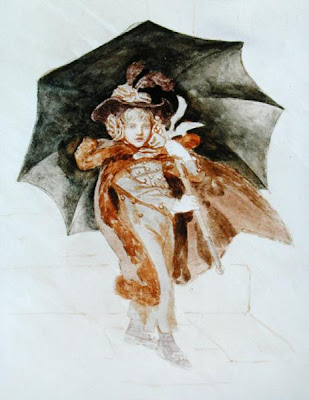
Irving was born the same week that Britain’s ceasefire ended the American Revolution, and his joyful parents decided to name their new son after George Washington. Young Irving got to meet his namesake when Washington was inaugurated president in 1789, an event that Irving would later commemorate with a watercolor painting. Irving was an unenthusiastic student; by age fourteen, he was already skipping evening classes to attend the theater. Luckily for him, his older brothers were successful merchants who would later support his budding career as a writer.
Irving began submitting pieces to the New York Morning Chronicle in 1802, when he was nineteen years old. Published under the pseudonym Jonathan Oldstyle, the articles focused on New York’s theater and social scenes. They were quite an impressive debut: Aaron Burr, then the magazine’s co-publisher, snipped several of the articles to send to his daughter Theodosia. And Charles Brockden Brown journeyed from Philadelphia to New York to convince Oldstyle to write for Brown’s literary magazine.
Shortly thereafter his brothers sent him to Europe–only to be disappointed that Irving skipped all the “high spots.” He concentrated instead on accumulating an impressive social circle. The charismatic young man soon earned a reputation for congeniality and was a much sought after dinner guest. Irving also forged a close friendship with Washington Allston, who almost convinced him to give up writing for a career as a painter.
Authorial Success
Irving returned to New York, where he founded “The Lads of Kilkenny,” a group of young literati from the city. In 1807, he founded the literary magazine Salmagundi with his brother William and fellow Lad James Kirke Paulding. Even though Irving again wrote under pseudonyms, the magazine helped spread his name outside of New York. And it was in the November 11, 1807 issue of Salmagundi that Irving referred to New York as “Gotham.” Anglo-Saxon for “Goat’s Town,” the nickname wasn’t intended to be flattering. But for some reason it stuck, and Gotham has been used to refer to New York ever since.
Two years later, Irving perpetrated what was one of the greatest literary hoaxes of his time. He placed a series of missing person advertisements in the local papers, asking for information about the whereabouts of historian Diedrich Knickerbocker. Irving also fabricated a notice from a hotel proprietor, threatening to publish the manuscript that Knickerbocker left behind in the hotel room, if the historian failed to surface and pay his bill. The ploy was so effective that New York officials actually considered offering a reward for Knickerbocker’s safe return.
Irving published A History of New-York from the Beginning of the World to the End of the Dutch Dynasty by Diedrich Knickerbocker on December 6, 1809. The book was an instant success. “It took with the public and gave me celebrity, as an original work was something remarkable uncommon in America,” Irving commented. Over time the name “Knickerbocker” became a name for New Yorkers in general; it has since been shortened to “Knicks,” for which the city’s basketball franchise is named.
Financial Struggles and International Copyright Battles
Despite Irving’s fame, he still struggled financially. For a time Irving was editor of Analectic Magazine, where he wrote biographies of naval war heroes. He was among the first to reprint Francis Scott Key’s “Defense of Fort McHenry,” now famous as “The Star-Spangled Banner.” Then the War of 1812 destroyed his family’s finances, and he went to England to keep the family trade business afloat. Irving would remain in Europe for the next seventeen years.
Irving declared bankruptcy and had trouble finding a job. In the meantime, he kept writing at a furious pace. In summer of 1817, he penned “Rip Van Winkle” during an overnight stay with his sister and her husband in Birmingham. By spring of 1819, Irving had sent a set of short stories to his brother Ebenezer. These would become the first installment of The Sketchbook of Geoffrey Crayon, Gent. It met with instant success, and Irving published seven more installments in New York. The stories were reprinted in two volumes in London.
Irving’s bi-continental reputation introduced a significant challenge: literary bootleggers, who would republish his works without permission, particularly in England. Like Charles Dickens, Irving spoke out about the need for international copyright law, but made little progress. Dickens and Irving corresponded on the topic, and Dickens would stay with Irving during his 1842 American tour. But they still grappled with international copyright issues on both sides of the pond. Irving’s stopgap solution: he hired London publisher John Murray to distribute his books in England and made sure to release all his works concurrently in both the US and Britain.
Travel to Spain
Thanks to an invitation from Alexander Hill Everett, the American Minister to Spain, Irving found himself in Spain in 1826. Many manuscripts regarding the Spanish conquests in America had recently gone public, and soon Irving was working on multiple books simultaneously. He wrote The Life and Voyages of Christopher Columbus (1828; his first work not published using a pseudonym); Chronicles of the Conquest of Granada (1829); and Voyages and Discoveries of the Companions of Columbus (1831). These books were historical fiction, rather than biography or history. Irving made one mistake; he helped to perpetuate the myth that scholars of the Middle Ages thought the world was flat. But he wasn’t alone; other authors who promoted this misconception were John William Draper and Andrew Dickson White.
Irving soon moved into the Alhambra, where he expected to finish several writing projects. Instead he was appointed to the American Legation in London. He returned to England to serve as an aide-de-campe to American Minister Louis McLane. Irving helped to negotiate a trade agreement between the US and the British West Indies. He resigned from the post in 1832, returning to the States to publish Tales of the Alhambra.
Western Exploration
That same year, Irving accompanied US Commissioners for Indian Affairs Henry Leavitt Ellsworth and Charles la Trobe, along with his friend Count Albert-Alexandre de Pourtales to survey Indian Territory. The expedition inspired A Tour of the Prairies. Irving also met fur magnate John Jacob Astor during the trip, and Astor convinced Irving to write his biography. Astoria was published in February 1836. Meanwhile Irving encountered Benjamin Bonneville and, fascinated with his tales, convinced Bonneville to sell his maps and notes for $1,000. Irving used these as the basis for The Adventures of Captain Bonneville (1837).
Irving undertook these works, often called his Western series, for a few reasons. First, he was broke. Second, he’d been criticized for becoming a more European writer. Both James Fenimore Cooper and Philip Freneau thought he’d turned his back on America. Fortunately for Irving, the books were received well in the States, though predictably less so in Britain.
After a stint as the American Minister to Spain, Irving returned to his Tarrytown, NY property, called Sunnyside, in 1846. He worked on the “Author’s Revised Edition” of his works for publisher George Palmer Putnam. Irving also turned his attention to biographies, writing about Oliver Goldsmith, the Islamic prophet Muhammed, and George Washington. His biography of Washington was released in five volumes, and Irving died within months of its completion.