Author Archives: tavistock_books

Snap Back to Reality… with J.R.R. Tolkien!


Now that your holidays are over, it’s time to leave your dreams of sugarplums and fantasies in the past and get back to… reality. And who better to discover reality with than J.R.R. Tolkien!? After all, you know as well as we do that he detested his cult fantasy following and wished only to bring awareness to the Catholic church… right? Oh, no? Well then, allow us to enlighten you!

tolkien5John Ronald Reuel Tolkien was born on January 3rd (yes, yes – we are one day late with this… so sue us!) 1892 in South Africa. Born to English parents, Ronald (as he was known) was followed by a brother just a couple years later. When he was only three years old, his mother took the sons on what was intended to be a long vacation in England to meet their family. While away, Ronald’s father took ill and passed away from rheumatic fever, and the Tolkien family, left without income, did not return to South Africa. His mother Mabel taught Ronald and his brother Hilary from home. Ronald showed an adept interest in languages early on, and was reading and writing around the age of four. His mother became a devout catholic in his early life, and when she passed away when Ronald was twelve years of age, he and Hilary became wards of her trusted advisor, catholic priest Father Francis. Francis would have a profound influence on Tolkien throughout his life. 

tolkien 2During his teenage years, Tolkien and two of his female cousins had a unique pastime… making up languages. Their languages, Animalic, Nevbosh and Naffarin varied in complexity and drew their roots from Latin, which his mother taught him as a young boy. Tolkien eventually began attending Oxford, at first studying Classics but soon realizing that his interests and talents lay in studying the English language and literature. He graduated in 1915 with first-class honors, a rarity for the year as it was looked down upon for Tolkien to have completed his studies before enlisting as a soldier in World War I. 

In his early twenties, Tolkien married Edith Bratt – a “childhood” sweetheart (in quotes because they met when Tolkien was 16 years old and Bratt 19, but “teen” sweethearts just sounds ridiculous). Shortly thereafter Tolkien was deployed to France to fight in the war. However, Tolkien was to count himself lucky (if you can call it so) as he suffered from so many infections and illnesses throughout his service that he was considered unfit for service and was often between hospitals and off-the-field duties. Upon his final return to England, all but one of his friends had perished in the war. 

After the war in 1920, Tolkien went to work (appropriately so) for the Oxford English Dictionary, then shortly thereafter became the youngest professor at the University of Leeds, taking up a post as Reader there. While working there, Tolkien produced his version of Sir Gawain and the Green Knight, a medieval work that his involvement on would become the academic norm for decades to come. 

tolkien3

At the onset of World War II, Tolkien was approached by the British government and asked if he would consider working as a cryptographer and codebreaker in the Foreign Office, in the event of an emergency. Tolkien replied that he would be honored to do so, though it would turn out that his services would not be necessary. In 1945 Tolkien began his term as the Merton Professor of English Language and Literature at Oxford, a post he would remain at until his retirement in 1959. After retirement, Tolkien and Edith set-up house in Bournemouth, England, not only because Edith was delighted to live there, but because in the 1960s the counter-culture movement saw a rapid increase in interest in Tolkien’s fantasy work and his popularity began to be distressing, with unwanted visits and phone calls, and the rise of a cult-following. Family being the main interest of the couple, they relocated. Truthfully, I feel as though I cannot do re-working Humphry Carpenter’s statement on the Tolkien’s relationship justice, so I copy it here:

tolkien6“Those friends who knew Ronald and Edith Tolkien over the years never doubted that there was deep affection between them. It was visible in the small things, the almost absurd degree in which each worried about the other’s health, and the care in which they chose and wrapped each other’s birthday presents; and in the large matters, the way in which Ronald willingly abandoned such a large part of his life in retirement to give Edith the last years in Bournemouth that he felt she deserved, and the degree in which she showed pride in his fame as an author. A principal source of happiness to them was their shared love of their family. This bound them together until the end of their lives, and it was perhaps the strongest force in the marriage. They delighted to discuss and mull over every detail of the lives of their children, and later their grandchildren.” Now if that doesn’t make you want to cry, then I don’t know what to tell you.

tolkien1Edith passed away two years before Tolkien. While he lived those years pleasantly enough in very nice rooms provided him at Oxford and honored by the Queen in that time, Tolkien’s grandson Simon would go and visit his grandfather and Tolkien would speak of how he missed his wife and Simon would remark that he seemed “sad”. Tolkien is buried with his wife in Wolvercote Cemetery in Oxford, wanting to be buried in countryside (not in London, etc.) as he disliked industrialization and favored a quieter, country life. These facts were not what you were expecting from the man famed for creating the destructive and warring, mystical and fantasy world of Middle-Earth, now were they? In any case, Happy Birthday to J.R.R. Tolkien! Your work is still remembered and revered today. 

(But sorry, there is definitely still a cult following, there is really probably no way of getting around that by now.)


Share

OTD in 1577, Sir Francis Drake Sets Sail from England on a Circumnavigation of the World

drake2

On this day exactly 440 years ago, an English nobleman named Francis Drake left on a mission that would take him three years and would win him a knighthood by Queen Elizabeth I of England. (I’m not entirely sure that people “win” those, but you know what I mean.) Now, Sir Francis Drake wasn’t always the historical explorer and hero we know him as today. Before he was chosen for the expedition that would win him his lordship, Drake was a pirate and slave trader. Woah!

Francis Drake was born in 1540 in Tavistock (that is NOT lost on us), Devon, England. He was the eldest of twelve sons, born to a farmer in Devon. Not much is known about his early life, as is pretty expected of someone living at that time. In 1549 the Drake family moved to Kent due to religious persecution, and Edmund Drake apprenticed his eldest son out to a neighbor – a captain of a large sailboat. This was Francis’ first introduction to the sea – and the neighbor was so pleased with Drake’s attitude and abilities that, being without children of his own, he gave the barque (a sailing vessel with three or more masts) to Drake when he died. Drake spent his twenties sailing to and from the Americas with his second cousin John Hawkins – the first known English slave trader.

drake1After a few adventures with his cousin, Drake spent much of the early 1570s living along the “Spanish Main” or the Panama Isthmus, attacking Spanish vessels and small settlements. During this time, fun fact, Drake climbed a tree on the Isthmus of Panama and looked out over the Pacific – being the first Englishman to ever behold the Pacific Ocean. Drake and his men eventually made it back to Plymouth, England, having captured much in Peruvian gold but having been forced to bury it along the way to avoid its recapture by the Spanish.

drake4In 1577, Elizabeth I sent Drake (because of his “success” with the Isthmus raids) on an expedition to sail along the Pacific coast of the Americas. After one false start due to bad weather, the crew set final sail on the 13th of December, 1577. Drake set out with five ships (which soon became 6) and 164 men. The crew made it around Cape Horn, and went alongside the coast of South America pillaging and looting Spanish towns and ships along the way. Drake restocked and rested his ships on the Coast of California for a time, and then continued on to the Molucca islands in what is now known as Indonesia. Eventually Drake rounded the Cape of Good Hope – the southernmost tip in Africa, and made his way back to Plymouth, having circumnavigated the globe and made it around two of the most treacherous sailing spots in the world (both Capes) in just under three years.

Upon Drake’s return to Plymouth, the half share of his pillaged cargo that was to be Queen Elizabeth’s actually exceeded all the other income the crown had that entire year. Hence the knighthood.

drake3

Drake became an active political member of the British aristocracy, being a member of Parliament on three occasions and even mayor of the coastal town of Plymouth from where he set sail. Drake led further attacks against the Spanish under the Queen’s command in the mid-1580s, and in 1588 he was vice-admiral to the English fleet that destroyed the Spanish Armada in a nightly attack. In 1596, on a voyage to capture San Juan (Puerto Rico), Drake failed to take the city, and after suffering terrible blows to his ship and crew, came down with dysentery and passed away onboard. Just goes to show you… doesn’t matter who you are you are still subject to the same perils that the lowest members of your crew are subject to! In any case, Drake is still remembered today for his bravery, amazing sea-faring abilities, and indefatigable hatred of the Spanish.

Just kidding!

Share

Booksellers, Raffles and Wine, Oh My!

IMG_20171205_192040

                        The Berkeley City Club – a beautiful venue, as usual!

What could be better than a group of bibliophiles gathered together in a single room to celebrate the holiday season? A group of booksellers gathered together in a single room celebrating the holiday season with good food and a raffle of lots of alcohol, that’s what! Just kidding! In all honesty though we all (as adults) enjoy our bottles of wine and bourbon, what we truly enjoy is spending time with like-minded individuals. The NCC Chapter of the ABAA Holiday Dinner was no exception!

IMG_20171205_192028This year the bar, being held in the same large room as the dinner, seemed to be a bit more of an intimate affair (which I rather enjoyed). The large table of donations for the Elizabeth Woodburn / ABAA Benevolent Fund raffle was overflowing – as usual with impressive selections of beverages, but with also some fun gift baskets and chocolates, 2018 SF Giants baseball tickets, etc., etc!  Many raffle tickets were sold (most to our table mates John Windle and co., in my opinion – winners galore!!!) But I get ahead of myself. 

First things first Michael Hackenberg, the Chapter Chair, introduced the evening with his wit and charm. Minutes of the last meeting were approved, and one great new piece of information that was praised was the recent repeal of the most egregious parts of the California law on signed material. Unfortunately getting the bill repealed has cost quite a bit of funds for the ABAA, most of which were spent on lobbyists! But in any case, everyone is quite happy that we are on our way to normality back in the signed and autographed world of rare books. Another topic of interest covered is that the ILAB Congress in LA next year is close to being sold out! There are possibly one or two more seats to be had, and those who have been agree that it is a wonderful destination work-trip for any book related people. Over 100 people have signed up thus far. 

IMG_20171205_190223

An image of a very happy (possible) ABAA President?!

New members of the ABAA board will soon be voted on! Members of the NCC that are up for nomination in different positions include our very own Vic Zoschak [as President], Michael Hackenberg [as our Chapter Rep],  Brad Johnson & Scott deWolfe are both competing for the ABAA VP slot, and Peter Blackman is on the ballot as Association Treasurere. The NCC Board includes Andrew Langer as the new treasurer, Alexander Akin continuing on as Secretary, Laurelle Swan as the new Vice Chair, and Ben Kinmont as the new Chair! Congratulations to these four! Another interesting topic included the different showcases touted by several booksellers for this upcoming year include the Bibliography week showcase in January and the RBMS showcase in New Orleans! Last but not least, the upcoming fair in Pasadena in February has one of the highest registrations for several years, with over 200 booksellers registered to exhibit at this time. Woohoo!

In all, the dinner, the chat, the raffle interspersed between rounds of discussion (a great new idea, in my not so humble opinion), and the camaraderie always found in this group of people made for a wonderful holiday evening. 

And to all a good night! (Or afternoon… you catch my drift.)

Share

A How-To Guide for Buying Antiquarian Books as Christmas Presents

holidays5

Here we present to you a (bit of a tongue-in-cheek) guide for buying Christmas gifts this holiday season… in an antiquarian fashion, of course!

1. Know your Subject.

Not your book subject, that is. We mean your audience, your gift taker, the subject of your love, attention and wallet. They may not be readers! (We hope they are, but in all fairness not everyone is as book obsessed as we are – you catch my drift?) If they are readers, you likely know the genre they prefer. If they aren’t self-professed bibliophiles, perhaps you can deduce what they might enjoy from their other interests. Are they political? Perhaps they might enjoy a set of pamphlets on Communism from the 1970s! Are they classicists? Well then perhaps a Dickens would suit them (given that you also provide a box of some wonderful Twinings tea along with it.) Get to know your subject, I mean friend, in an unconventional way!

holidays6

2. Know your Books!

So you aren’t an expert antiquarian book hunter and gatherer… so what? That is what we booksellers are here for! Not only do we find exceptional items for our customers and even put together collections for them, but we are experts in our chosen fields. So what does that mean? Well, if you’re stuck pick up the phone and give us a call! It doesn’t hurt to ask the opinions of those surrounded by unique items every day.

3. Know your Budget.

We know, better than most, how easy it is to be lured to certain items in the antiquarian book world. A beautiful piece of incunabula catches your eye and BAM! Suddenly you have taken a second mortgage out on your house! (Just kidding. We hope.) But when it comes to gifts for others, it is always a good idea to think about how much that friendship is worth to you before beginning your search for that perfect item.

holidays3

4. Know your Bookseller.

We booksellers are often elusive beings. For some, we exist on their computer when they order a book and it arrives (very well packaged, if it has been purchased from Tavistock Books) on their doorstep. But don’t just assume that when you order a book online it will come the way you want it. Feel free to do a bit of research on your bookseller! Go to their website, see where they are located… give them a call and ask about their shipping process or their opinion on your gift. We guarantee that not only will you have a better story to tell your gift recipient than “Oh, I found this online.” but you will also meet some spectacular bibliophiles in the process!

5. Enjoy the Process of Giving!

Don’t miss one of our favorite quotes by one of our favorite authors… “A day wasted on others is not wasted on one’s self.”

You thought we were going to go with a Christmas-y Dickens quote, didn’t you? We love to surprise!

Oh fine, and here’s this one just to warm the cockles of your bookish hearts…

“I will honor Christmas in my heart, and try to keep it all the year.”

holidays 2

Share

We Have NOT Come to Suck Your Blood

stoker2

What are the greatest parts about fall? The crisp smell of apples, the chill in the air, the colors of the leaves… and the somewhat spooky feeling all around us! Just kidding, that’s just near Halloween. But you must admit, there is something about this season that may inspire you to revisit some of Poe, of the gothic masters, or of our blog subject for today – Bram Stoker.

Stoker is, of course, best known for his novel Dracula – a tale of a blood-thirsty beast in love (classic), but who was he otherwise? Here are some facts that you probably didn’t know about this Irish author!

1. He was Irish. I realize I gave that away in the previous sentence, but still. Stoker was born in Dublin in 1847, and lived in the county of Dublin all his life, even attending Trinity College for his higher education. Though graduating with a degree in mathematics, he showed prominence in the humanities as the auditor of the College’s Historical Society and president of the University Philosophical Society.

stoker1

2. Interested in theater from a young age, Stoker became a theater critic for the Dublin Evening Mail early on. After writing a favorable review of Henry Irving’s Hamlet, he was invited to London to become his new friend Irving’s theater business manager at the Lyceum Theater.

3. Bram Stoker’s wife Florence Balcombe was a previous suitor of Oscar Wilde. It may be strange for me to be so impressed by this, but nevertheless…

Dracula1st.jpeg

4. Stoker worked on several novels while managing the Lyceum, Dracula being one of his first. After its publication, the novel received quite a bit of literary and critical acclaim, but did not shoot him to fame, despite the fact that it is now a story known worldwide. There are over 200 films and over 1000 novels written about Dracula alone!

5. Most people assume that Vlad the Impaler was the inspiration for the character of Dracula. However, recent scholarship suggests that, though Stoker may have borrowed the somewhat gothic and creepy name from the historical Romanian, he most likely based more of the facts on his own ancestor, Manus O’Donnell – or Manus the Magnificent – an Irish clan leader.

6. Complications and vagueness around Stokers death has sparked all kinds of discussion in his fans – some say he died from another stroke (after living several years after his first), others say syphilis. Even others say he is not dead at all… but still walks along the living! (Only at night, of course.)

Bonus fact: Through his friend and employer Henry Irving, Stoker met two US Presidents – William McKinley and Theodore Roosevelt. Crazy!

This fall we invite you to grab a cup of tea, cozy up next to the fire, and pick up a scary classic… we promise you will thank us for it!

stoker3

Share

Happy Birthday to the Ever-Young Stephen Crane

crane4

At the tender age of 28, author Stephen Crane succumbed to tuberculosis and passed away at a German health spa. Despite his young age, Crane had accomplished what many take several decades of adulthood to achieve – fame, success, scandal, sickness and health. He lived a full life and was not afraid of standing up for himself and for others. Let’s learn a bit more about this famed American author, shall we?

crane5Crane was born on November 1st, 1871 in Newark, New Jersey, the 14th child (of only 8 surviving children) to a clergyman and daughter of a clergyman. Crane began writing at an early age, and when he was eight years old he wrote his first surviving poem – “I’d Rather Have A-” – a poem about wanting a dog for Christmas! One year later he began formal schooling and completed two grades within a six week period. Throughout Crane’s education he was a slightly erratic student, if intelligent and somewhat popular. This could be put down to the fact that by the time Crane was a teen, quite a few members of his family (his father and siblings) were dead – leading to a very different childhood than his classmates.

Crane was interested in baseball, the military, and writing. After enrolling in college under an engineering degree, he eventually left at the age of 20, declaring college a waste of time! He moved in with his older brother Edmund in New Jersey, but made frequent trips into The Bowery slums of New York City where he found human nature to be open and unaffected. He entered into a brief relationship with a married woman and wrote some controversial free-lance work on local events – beginning to make a name for himself solely out of scandal. In the next two years, after moving to New York, Crane worked on what would become his first novel, A Girl of the Streets (the Maggie would be added later). The novel about the girl who becomes a prostitute out of pitiable circumstances unfortunately needed to be self-published privately by Crane himself. He printed 1,100 copies and spent $869 to do so. Despite Maggie receiving praise for its truthful account of life in the slums, it did not garner the enthusiasm or scandal that Crane hoped for and he ended up giving away the last hundred copies for free. 

stephen crane 3In 1893 Crane became frustrated with stories written about the Civil War, stating “I wonder that some of those fellows don’t tell how they felt in those scraps. They spout enough of what they did, but they’re as emotionless as rocks.” Crane decided to write an account of a soldier in the war, and began work on what would become The Red Badge of Courage, Crane’s most beloved work to date. His story would be different from his contemporaries – for he wanted desperately to present a “psychological portrayal of fear” by describing a young man disillusioned by the harsh truths of war. He succeeded and a year later his novel began to be published in serial form by the Bacheller-Johnson Newspaper Syndicate. It was heavily edited for publication in the serial, though it did begin to cause a stir in its readers. Crane then worked on a book of poetry, which was published to large amounts of criticism due to his use of free verse, not then a common convention. Crane was not bothered by its unpopular reception – he was instead quite pleased that the book made “some stir” and caused a reaction of any sort. In 1895 Appleton published The Red Badge of Courage, the full chapters, in book form – and Crane became a household name overnight. The book was in the “top six on various bestseller lists around the country” for months after its publication. It even became popular abroad and was widely read in Great Britain as well. Crane was only 23 years old at the start of his fame. 

At 24, Crane was involved in a scandal that shaped his reputation for life. While accompanying two young ladies home in the evening, one of the ladies was arrested by an undercover policeman on charges of attempted prostitution. The woman was charged and Crane remained adamant that the ladies he was with were innocent – leading the world to remark on his Courage at standing by the alleged prostitute. The praise for Crane quickly turned sour, however, when the arrested lady pressed charges against the policeman that solicited her and Crane was called on to be a witness. Police of New York wrecked havoc on Crane’s life when he was targeted by the Defense – they sought to portray him as immoral and a frequent visitor of brothels and drug addicted – Crane’s courageous reputation was stripped quite quickly. Crane escaped to Cuba to work as a war correspondent at the age of 25. While awaiting his trip to Cuba in Jacksonville, Florida, Crane met the slightly older brothel owner Cora Taylor and began a relationship with her. However, after a few months Crane was granted travel to Cuba on the SS Commodore and he left Cora to travel. After only 2 days on the Commodore, the ship struck ground twice and began to sink. Crane and other men on the vessel boarded a 10-foot dinghy and attempted for days to land the boat on Daytona Beach. The waves were large and the boat eventually overturned and the men swam to shore. Cora traveled to Daytona to bring the weary Crane back, and eventually Crane would recount the event in his famous story “The Open Boat”, published in 1897. 

stephen crane 1Crane became a war correspondent alongside Taylor in the Greek-Turkish War of 1897, and then the Spanish-American War in 1898. Unfortunately for Crane this year was the beginning of the end, as his health worsened and none of his work ever sold as well as The Red Badge of Courage. He was a few thousand dollars in debt and worked writing feverishly to try to support both him and Taylor, who was living in England. He moved to England in January of 1899, writing for literary magazines there, but his health rapidly declined and by June of 1900 he was in a health spa in Germany, dictating his work to Taylor. He passed away from tuberculosis the same month, and left all of his work and livelihood to Taylor. Despite dying at such a young age, Crane, whose work was re-birthed in the 1980s after suffering a spell of unpopularity, is now taught in high schools across the country, as his most famous work is recognized as a highly naturalistic and realistic view of war through the eyes of a young American. Happy Birthday to Stephen Crane! 

Share

(SPOILER ALERT) Antiquarian Nursing Material Isn’t Just for Nurses

We recently wrote a short and sweet blog post on “Why You Should Be Collecting Antiquarian Cookery.” Now, we do enjoy getting Cookery items in and we do have quite a bit of knowledge around them, but technically speaking, cookery is not one of our ‘specialties’. However… Nursing is. We often have customers exclaim surprise at our little-known specialty, followed by a slightly confused look as to why we might carry such things. You yourself might be wondering how many nurses are also antiquarian book collectors. We must confess that we do not know those numbers. (However, if you know those numbers, please feel free to share.) So for this week’s blog post we thought we would share why you don’t have to be a nurse to collect antiquarian nursing material!

Before you remind us, yes, Vic began collecting nursing material because his wife, Ellen, was a head nurse! So yes, occasionally there are nurses involved. Just thought we would get that over with before we get any “Wait up, we know that Ellen was involved in that field…” emails. However, Vic knowingly went into the field, as he realized that there weren’t many out there specializing particularly in nursing material over a more generalized medical genre.

Screen Shot 2017-10-11 at 2.01.39 PM

Although the U.S. Army Medical Department was one of the slowest to integrate women, when over 5,000 of its combat-ready men — including many trained technicians and orderlies — were forced to transfer to the Infantry in early 1944, the department began a major push to recruit women to fill the positions. The Female Medical Technician campaign, as pictured here, was hugely successful. See this Fine condition WWII poster here.

Nursing material tells us about just as much of history as other items in the medical field. Nurses were often called upon to step in and help in times of war and devastation, and, in some instances, were in even higher demand than doctors. Antiquarian nursing material often teaches the reader (albeit briefly) the best ways to care for wounds, different illness, and even mental “defects”. They are particularly interesting as, despite what western medicine looks like today, many antiquarian nursing items were published before the heavy use of medication. Nursing materials can teach how to care to the sick without Advil – which many would argue is more important than knowing how to hand over a pill!

Screen Shot 2017-10-11 at 2.01.52 PM

Check out this 1804 1st US edition of FRIENDLY CAUTIONS To The HEADS Of FAMILIES And OTHERS, Very Necessary to be Observed in Order to PERSERVE HEALTH And LONG LIFE: with Ample Directions to NURSES WHO ATTEND The SICK” – a manual for nurses from over two centuries ago! See it here.

Antiquarian nursing items are therefore of interest to any of those looking to see cultural and scientific differences in levels and quality of medical care over the past two hundred years. It is also interesting to use the materials to see how nurses were trained, what they were trained in, and what they were called on to do. Now if you don’t find that interesting, then we don’t know what else to tell you!

Screen Shot 2017-10-11 at 2.02.00 PM

Check out this 1868 1st edition of “On Nurses and Nursing by Dr. Horatio Storer – a leading physician in the 19th century who, in 1857, started the “physicians’ crusade against abortion” both in Massachusetts and nationally, and persuaded the American Medical Association to form a Committee on Criminal Abortion. The Committee Report was presented at the AMA meeting in Louisville, Kentucky in 1859 and accepted by the Association. Woah! Check it out here.

Share

Welcome to Tavistock Books, Cassie Leone!

Tavistock Books is proud to announce a new member of the team – Cassie Leone! Cassie will be working part-time at Tavistock Books and we are glad to welcome her to the fold.

Cassandra_Leone_23

Welcome to Tavistock Books, Cassie! How long have you been involved in the antiquarian book world for now?

Thank you! I began working for antiquarian booksellers last September, a few months after completing my undergraduate degree in English at Smith College. I’ve worked for Brick Row Books, and John Windle Antiquarian Bookseller. I’m currently also working part-time with Swan’s Books. 

What is your favorite aspect of working in the book trade? Does this coincide with what you will be doing at Tavistock?

I really enjoy cataloging books. I find it to be similar to academia in that you are researching and writing about literature, except that what you are writing is more geared toward sales. I especially love illustrated books, and books with provenance. When a book has an inscription I think its fun to do some detective work on its past owners.

What made you first become interested in the book trade?

When I was at Smith I concentrated in book studies. I loved learning about the history of books and the technology of reading and writing. One of my professors told us stories about his experiences working for antiquarian book sellers in Chicago, and I thought that sounded like intriguing work. 

Could you give us a slight background on you, yourself? Where did you grow up, what activities or hobbies do you enjoy, etc. 

I grew up in the Bay Area, and I’m originally from Walnut Creek. I moved to Oakland in 2003, which is where I currently reside. I’m a writer, and I’m currently applying to graduate schools for an MFA in Creative Writing, specifically poetry. I’m an amateur book collector; I also collect comics, records, Victorian greeting cards, antique oil lamps, and antique coffee pots. I enjoy baking and I ferment my own kombucha. Over the summer I got married in Berkeley, and I have a dog named Winston.

Last, but certainly not least… how do you feel about Charles Dickens and the San Francisco Giants? 🙂

While I was working for John Windle I catalogued a collection of Charles Dickens, and I became pretty familiar with his work and Dickensiana in general, but I have to admit I’ve never read any of his books! I plan to change that status in the near future. I did enjoy A Muppet Christmas Carol though. As a Bay Area native I of course love the Giants, I even have a few Barry Bonds baseball cards from when I was a kid.

Share

“Monsters are real, and ghosts are real too. They live inside us, and sometimes, they win.”

We don’t often report on modern literature here at Tavistock Books, as that is not our speciality! However, you may have noticed that we occasionally like to branch out and discuss authors – specialty or not – in honor of their birth or death anniversary. We are happy to report to you good, book-fearing folk, that todays is a birth anniversary! Yay! We are not so pleased to report that book-fearing folk you really should be… since his work has been terrifying people since 1967. Be afraid… be very afraid.

Screen Shot 2017-09-19 at 9.40.34 PM

Stephen Edwin King was born on September 21st, 1947 in Portland, Maine. His father, stepping out for a pack of cigarettes when King was only two years old, never returned and King’s mother raised him and his brother on her own for the rest of his youth. King showed an early interest in the genre of horror, writing while still in school – winning himself a Scholastic Art and Writing Award and being published in different fanzines, such as “Stories of Suspense”, before the age of 20. King’s daughter was born the year he graduated from the University of Maine in 1970. Though he initially wished to teach high school, he was unable to find an immediate job and instead supplemented his income by selling stories to men’s magazines. Throughout this time, King nursed an alcohol dependency that would torment him for many years. 

In 1973, just three years out of University, King’s first novel, Carrie, was published. Fun fact: it is rumored that King initially found it so difficult to write about a teenage girl with psychic abilities that he threw out his original drafts! His wife, Tabitha (whom he is married to to this day), brought it back to him and almost forced him to finish it! His first advance on the novel got him $2,500. Imagine that, with how popular Carrie has remained over the years? Unfathomable!

Screen Shot 2017-09-19 at 9.39.39 PMKing then had his novel The Shining published in 1977, and The Stand in 1978. In the late 1970s King began a series, eventually known as The Dark Tower, a series which would span the next four decades of King’s life finally ending in 2004. In 1980 King’s novel Firestarter was published, and in 1983 his novel Christine was published – both by the large and well-known publisher Viking. He tried his hand at working on comic books, writing a bit for the X-men series Heroes for Hope in 1985. King published under several pseudonyms for various reasons (now keep a lookout for these names, you hear?) including Richard Bachman (after Bachman-Turner Overdrive), John Swithen (a character out of Carrie) and Beryl Evans (which King used to publish the book Charlie the Choo-Choo: From the World of the Dark Tower). Though he has written many, many works over the years (54 novels, 6 non-fiction books and 200 short stories, to put it bluntly), some of the more popular stories whose names you might recognize (due to their being transferred to the big screen or otherwise) are Children of the Corn (1977), Rita Hayworth and Shawshank Redepmtion (1982), Misery (1987), The Man in the Black Suit (1994), The Green Mile (1996), Bag of Bones (1998), and his memoir On Writing (2000). And this doesn’t even scratch the surface of the volume of work King has produced over the past many decades.

stephenking

He has been heralded as both the most beloved horror and supernatural fiction author in the genre and also mocked for his writing as “pop” and not “serious” literature. Despite how you may view the genre, you must admit – the man has done more for those genres than many of his contemporaries! Give him some respect! (Especially on his birthday. And especially because if you don’t IT may come after you… Best play it safe, no?) 

Share

Vic Visits the Wine & Viticulture Collection of the UC Davis Shields Library


IMG_3694 (1)

Who has the greatest collection of wine & viticulture literature in the world?  The Shields Library at UC Davis, that’s who!  To quote the August 22nd BCC announcement of this 15 September field trip, “The wine library at UC Davis houses more than 30,000 books in more than 50 languages, manuscripts, historic records, research data, and materials in every medium, from wine labels to videos.”

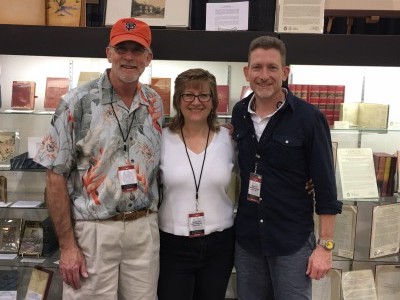
IMG_3691Yours truly, along with 14 other BCC members, on our 9:30 arrival at the library, were greeted by Axel Borg, the library’s wine & food science bibliographer, and spent the next 4 and a half hours being regaled with all the treasures that this library has amassed over the years.  We started in the Maynard Amerine room, named after the man who exerted a profound influence on the collection.  Amerine [1911 – 1998] was a “pioneering researcher in the cultivation, fermentation, and sensory evaluation of wine.”  No doubt many of the booksellers & collectors reading this blog will hold one of publications, the 1996 BIBLIOGRAPHY On GRAPES, WINES, OTHER ALCOHOLIC BEVERAGES, And TEMPERANCE [co-authored by Axel by the way].

IMG_3698After giving us an overview of the collection, and its history, we eventually found our way to Special Collections, where Axel tantalized us with one interesting & fascinating item after another…  here I wish I’d taken notes, for memory fails me as to most specifics, other than the 1287 deed for a vineyard land transfer & a cute little accordion miniature that on first blush appears to be a wine cork.  That said, my fellow attendee, Anne Smith, did, however, take notes, so see her soon-to-be-published BCC piece for more specifics on the books Axel had at show-n-tell.

IMG_3731Next on the agenda was a buffet lunch, which, given we were a willing captive audience, included a presentation on projects UC Davis has in the works… one is a interactive social map showing wine-related connections.  Intriguing, to say the least.  Another is the digitization & searchable compilation of wine price lists, et al.  For food & drink historians, invaluable.

We ended the day in the Harrison Western Research Center, which holds more than 21,000 volumes related to the history of the Trans-Mississippi West, collected by Michael & Margaret Harrison.  Noteworthy in that collection were Catlin’s North American Indians, and Ansel Adams & Mary Austin’s Taos Pueblo.  I confess, the bookseller in me was covetous, but I also assure you, I left empty-handed.

IMG_3733

And so ended this engrossing trip.  My thanks to all the staff at the BCC & UC Davis who made this day possible.  It was wonderful.

IMG_3717


Share