Author Archives: tavistock_books

New Acquisitions at Tavistock Books

Before the hectic Book Fair season begins, we thought we’d give a quick run-down of a few of our most interesting acquisitions in the recent past! Click on the pictures or follow the links to be directed to the item in question. Enjoy!

blog1Ambrotype of Mr. & Mrs. James M. Lilley of Virginia, circa 1860s: This VG set of Ambrotypes are of a prominent Virginian and his wife. Mr. Lilley, a surveyor by trade, served in the Civil War as a colonel of the 93rd Regiment of the Infantry of the Line (yes, that is a mouthful!). In 1857 Lilley was granted a patent for an “Improved Instrument for Surveying and Calculating Areas.” This “Compass” was intended to facilitate calculation of oblique-angled trigonometry and finding the area of triangles.” It seems Lilley was simply a mouthful all the time! $275. See it here>

Blog3


Songs Against Evil, Childrens Songster circa 1879: I don’t know about you, but I happen to love Children’s Songsters! Especially when they have amusing front covers. This 12-page songster published in New York by McLoughlin Brothers contains 5 chromolithographic images. Check out our homepage ‘Childrens’ section to see similar recently catalogued songsters! Our listings are automatically shown by the latest items to enter our inventory. Check out this one here>


Blog2James Lilley’s Arithmetic Book, circa 1812: Yes, this manuscript codex on arithmetic is written by Mr. James Lilley (mentioned above) as a child! This notebook begins with Lilley as a 10-year old boy in early 19th century Virginia, and covers all manner of mathematical topics, from Subtraction and Compound Division to Extracting the Roots of all Powers! The journal follows Lilley over a span of 7 years, and after the lessons contains ledgers of a neighboring schoolhouse and farm, as well as documentation on family births and deaths in that time. Also included are his geometry and land survey problems for the year of 1823 to 1824. A fascinating, unique primary source documenting this individual’s mathematical schooling (including current thought and practice) as well as local county history and family geneology. See it here>

Blog4


Bohemian Club Broadside, Olde Goats Night: This Bohemian Club broadside, printed recto only, was printed circa 1940. “Inspired by the season to a renewal of youth, a select company of ‘Old Goats’ will gambol, cavort and bleat for your amusement on Bohemia’s own green.” This broadside was illustrated, quite humorously, by Francis Todhunter, a California artist often noted for his landscape paintings and architecture sketchings. Check out this scarce WWII-era Bohemian Club item here>

This codex begins with James but 10 years old, as he begins arithmetic instruction under Mr Tilford. The volume continues with Lilley’s voluminous notes for the next seven years, covering a number of mathematical topics, from Subtraction, Dry Measure, Apothecaries Weight, Compound Division, Of Rebate or Discount, Inverse Proportion, A General Rule for Extracting the Roots of All Powers, Promiscuous Questions, etc. This is followed by a 2ll ledger for Lancaster Schoolhouse, then a 5ll ledger for Surry Farm, then a 10ll general ledger. Next are 4ll recording family births & deaths beginning with John Lilley [b. 1772] to James Campbell Lilley [d. 1901 (some later entries obviously recorded in a different hand)]. Next are Lilley’s 6 leaves of pen trials, with the repetition (21x, in this instance) of such phrases as “Contention and Strife make uneasy our life James Lilley 1820” The volume concludes with 43 ll of geometry & land survey problems, cases, etc, dated 1823 – 1824.A fascinating, unique primary source documenting this individual’s mathematical schooling [including current thought & practice], as well as local county history & family genealogy. – See more at: http://www.tavbooks.com/pages/books/41788/manuscript-codex-1802-1875-james-m-lilley/james-lilleys-arithmetic-book-taught-under-the-tuition-of-nicholas-tilford-teacher-of-the#sthash.MAGeqLXe.dpuf

In 1857, Lilley was granted a patent for an “Improved Instrument for Surveying and Calculating Areas.” The text of the patent refers to a new and improved “Compass” that is “intended to facilitate calculation of oblique-angled trigonometry and finding the area of triangles.” – See more at: http://www.tavbooks.com/pages/books/41790/james-m-lilley-mrs-j-m-1802-1875-lilley-mary-c/ambrotype-photograph-s-with-decorative-brass-surrounds-in-union-case#sthash.w69g77Mo.dpuf
Share

“Knowledge Comes, but Wisdom Lingers”: An Inside Look at One of the Most Quoted Writers of All Time

By Margueritte Peterson

In August of 1809, a boy was born in Lincolnshire, England, who would go on to become one of Britain’s best loved poets. This boy was talented as a writer early on, and together with two of his brothers published a local book of poetry by the time he had turned 17. His family grew up rather close, and though he enrolled in Trinity College, Cambridge in 1827, he was forced to drop out before getting his degree and return home when his father passed away four years later.

Tennyson2Do you know who it is yet? Some of you may have guessed, given the title quote of this blog. Once dropping out of Cambridge, Alfred Tennyson spent the next few years of his life taking care of his family. His second book of poetry, published in 1833, was met with quite a large amount of criticism from readers – despite it having the masterpiece “The Lady of Shalott” in it! Unfortunately Tennyson was not able to take the criticism in stride, and was put off of publishing again for a decade. Though not much time was spent above on detailing Tennyson’s rather homely and happy childhood, it should be noted, due to the fact that it helped inspire much of his creative writing, that within this decade he experienced quite a few hardships – his close friend (and soon to be brother-in-law) Arthur Hallam died suddenly. Not only did his death shake the core of the family, but they then moved to Essex where they lost a large portion of their fortune in a bad investment. Tennyson moved to London, and lived modestly while continuing to write poetry.

After the sting of negativity from his other publication had worn off in 1842, Tennyson published two volumes of poetry, the first with his prior works and the other with all new poetry. This time, he did not need to worry about criticism! The books were regarded as masterpieces and Tennyson enjoyed overnight fame. Throughout the 1840s he continued to publish, and was consistently regarded as one of England’s most talented poets. In 1850 Tennyson published In Memoriam A.H.H. – one of his crowning achievements. Dedicated to Arthur Hallam, his friend from many years before, the poem (133 cantos long) is a meditation on great loss and the search for hope after experiencing such tragedy. Some of its lines are often quoted as Tennyson’s most famous stanzas, such as: “I hold it true, whate’er befall;/ I feel it when I sorrow most;/ ‘Tis better to have loved and lost,/ Than never to have loved at all.”

Tennyson with his wife and sons in the 1860s.

Tennyson with his wife and sons in the 1860s.

The year that In Memoriam was published held many interesting events for Tennyson, including his marriage in June to Emily Sellwood, a lady (who was 37 when they married) whom Tennyson had known since childhood. Also in 1850 Tennyson was given one of the biggest honors of his career, succeeding William Wordsworth as Poet Laureate (a position he held until his own death in 1892 – the longest tenure of any Poet Laureate before or since). Though he was, given the position, often forced to churn out works for notable British events, he also endured success in the next few decades of his life. In 1855 he wrote one of his most famous pieces, “The Charge of the Light Brigade.” In fact, this piece was so popular that later in Tennyson’s life Thomas Edison used somewhat new technology (wax cylinder recordings) to make some of his earliest recordings – of Tennyson reading his own poetry, this piece in particular. (Listen to it here, though please ignore the creepy animation of Tennyson’s face!)

Our 6 volume holding of Tennyson's Select Works, including Idylls of the King! Click the image to view.

Our 6 volume holding of Tennyson’s Select Works, including Idylls of the King! Click the image to view.

Tennyson passed away at the age of 83 in 1892. He wrote his whole life, even until his last few years, and (as previously stated) held his royal position as Poet Laureate until his death. He authored dozens of poems, received awards, honors, and was even a favorite poet of Queen Victoria, whom he met on two occasions – the second of which was spent with the Queen explaining to Tennyson how comforted she was by In Memoriam after the death of her husband, Albert. Tennyson and his wife Emily had two sons, Hallam and Lionel, Hallam going on to take over his father’s Baronecy and publish the authorized biography on his father after Tennyson passed away. To this day, lines of Tennyson’s works are often well-known, if not always appropriately attributed to their rightful author. After all, how many of you knew that it was Tennyson who wrote “‘Tis better to have loved and lost, than never to have loved at all”?

Share

A Warm Welcome to Kate Mitas, Tavistock Books’ Latest (and Most Valuable) Acquisition!

In late July, Tavistock Books gained a new member of the team, Ms. Kate Mitas. We give you the inside scoop on this bibliophile and what made her travel across the country to Alameda, California!

What drew you to rare books in the very beginning? Was it before your first ever bookstore job?

I didn’t really come into contact with rare books much before my first bookstore job. I come from a family of readers, so there were always books in the house growing up, but no one was a collector. When I did see rare books, it was usually in museums, and they seemed interesting but remote – I think in general I need a certain amount of tactile experience in order to really appreciate a book, rare or not. Also, I had an early, scarring experience with perceived rarity: when I was about seven, I had $3 to spend at a street fair, and I blew it all on some Grosset and Dunlap children’s reprint that came out in the 1950s, just because it looked “old.” And then it turned out to be devastatingly dull, and I swore I’d never judge a book by its cover again. It took a long time, and actually handling some remarkable books, for that promise to become the epic fail it is now.

Time to pry! Where are you from? What’s your background in the book business?

I grew up outside of Dayton, Ohio, and have lived and worked in various places around the country since then. About eight years ago I landed a job at Cellar Stories Bookstore, in Providence, R.I., whose rare book room finally made me reconsider my staunch anti-collecting position. I started out doing the shelving and shipping, and otherwise being a general minion, then became the manager there a year later (a.k.a., Chief Minion). The store has been around for 34 years and is pretty beloved by the community, so it was a great opportunity to learn the basics of the trade – cataloging, buying, sourcing books for customers, and all the rest of it – from an established dealer, many of whose long-standing customers I now consider friends.

About a year and a half ago I moved back to Dayton and put my skills to use assisting at Blue Jacket Books, in Xenia, O.H., which went into new ownership four years ago and has already come into a couple of nice collections. For what it’s worth, during my time there I also learned the knack of herding the owners’ three goats (should anyone wish to know: stuff your pockets with alfalfa and stride purposefully in whatever direction you want them to go, like a general marching into battle at the head of an army that may or may not have gone into full retreat behind her – occasionally it even works!). All in all, it’s been a privilege to work at two shops so dedicated to continuing the trade.

Ms. Mitas herself! Hard at work at her new desk in Tavistock Books.

Ms. Mitas herself! Hard at work at her new desk in Tavistock Books.

What would you say is the coolest or most interesting bookstore/library that you have ever been inside of? (I know, I know… left field!)

Hmm . . . that’s a tough one, since I tend to love just about every bookstore or library I’ve been in for one reason or another. I’m going to opt for a small treasure: the Adams family library in Quincy, MA. It was built out of stone by Charles Francis Adams, John Quincy’s son, in order to be fireproof, which sounds formidable, but, covered with ivy and surrounded by a garden in full summer bloom, is remarkably unprepossessing. And inside it’s got to be the most reader-friendly presidential library (and was used for that reason by succeeding generations of Adamses, including Henry): it’s a single large room filled with couches and writing tables, and has books lining the walls two stories high – no second floor, just a balcony running alongside the upper tier for browsing ease, as well as maximum natural light. Most of John Adams’s books are in the special collections of the Boston Public Library, but the rest of the family weren’t exactly slouches, and, really, it just seems like a delightful place to hunker down with a good book. I kind of want to live there, in fact. Minus the huge portrait paintings.
What are you most looking forward to with the position at Tavistock Books?

I have an enormous amount to learn about the antiquarian side of the trade, so . . . pretty much everything! I’m incredibly lucky to have Vic as a teacher, and I’ll get to work with amazing material. What more could I ask for?

Just to be even… what are you least looking forward to with the position? 🙂

Having to pretend I don’t hate the San Francisco Giants. (You said Vic wasn’t going to read this, right?)

What is your favorite book and why? Do you have a favorite literary genre?

I’m terrible at culling my favorites down to one, so I’ll call your favorite book and raise you two of my favorite authors, instead: Italo Svevo and Flannery O’Connor. I love mordant, absurdist humor, and both authors utilize it in very different ways, with very different ends in mind. I do tend to lean more towards modern literature and poetry, but am interested in a lot of genres and periods. Ask me again in a few months, and I”ll probably have different answers for you.


Where do you eventually hope to take the position? What will you do with the knowledge of the rare book trade?

Eventually, I’d like to open a shop of my own, but at this point, that’s very much an “eventually.” In the meantime, I’m going to focus on building up my expertise, do as much as I can to help keep the shop running smoothly, and simply enjoy the education I’ll be getting along the way. I think I’m in for some interesting and fun times, whatever they may bring!

Share

An Interview with… A Record Breaking Rare Book School Attendee! (Who also Happens to be the Head of Tavistock Books)

The Lord and Master of Tavistock Books recently finished his 21st course at Rare Book School in Charlottesville, Virginia, having started this love-affair back in 1998! To know more, read on!

So, Vic, you’ve just finished another summer at RBS! How was it?

Let’s start with the word, “Inauspicious.”  Not a word one would normally associate with Rare Book School, at the University of Virginia, Charlottesville [or, to those with some familiarity, C’Ville].  But the word applies this year.  Why?  Because after flying 5 hours Saturday from SFO to IAD, then waiting another 7-1/2 hours for the regional flight down to C’Ville [scheduled 10 pm departure, delayed 3 times], IT WAS CANCELLED BY UNITED AT 12:30 am that night!  Can you say Super Shuttle?  The end result- I didn’t get to sleep till 3 am that Sunday morning.  Yikes, was I a tired puppy that day!
However, as in most such situations, there was a silver lining.  Guess who was also waiting for the flight to C’Ville?  Terry Belanger, Founding Director of Rare Book School.  So, at least, during that ‘delay’ time Terry & I were able to converse on many divers topics.
And you ask, “How was it?”   Simply…  great.  I’ve taken a goodly number of courses [21, since 1998], and all have had aspects of greatness.  This one, THE HANDWRITING & CULTURE OF EARLY MODERN ENGLISH MANUSCRIPTS, taught by the paleography expert, and very personable, Heather Wolfe, Curator of Manuscripts of the Folger Shakespeare Library, I would rate in my Top Ten.
How many times have you been to RBS? You hold the record for attendance, no?

Yes, with 21, I’ve been told I now hold the record for “Most courses attended”.

The beautiful Alderman Library, where, deep down inside you can find dozens of RBS students!

The beautiful Alderman Library, where, deep down inside you can find dozens of RBS students!

Why go every year?

A couple reasons…  first, RBS is the premier place where one can find week-long subject-specialty courses on the many divers aspects of the ‘Rare Book World’.  And I believe knowledge is a ‘critical success factor’ for those in the antiquarian book trade, so these courses add to my  knowledge base.

Second, there are few other places where you’ll find, all at one time, ~ 60 other like-minded folks all not only willing, but eager, to discuss rare books.  Such not the case in Alameda CA, where on a given day, I’ll see Steve the Postman & that’s about it!  So in C’Ville, one can’t help but make bookish friends…  I’m still in touch with folk I met at RBS in 1998, and subsequently.
Third, it’s just plain fun!  C’Ville is a fantastic college town, with some wonderful restaurants, and a goodly number of bookstores.  What’s not to like?
What, in your opinion, was the best thing about the course you took this summer?

The course focused on the English Secretarial hand, a script, for the most part, totally impermeable to me prior to July 20th.  This not to say I’m now fully conversant, not by a long shot, but now I have the tools to decipher much of what I’ll find in front of me.  The challenge going forward will be to maintain that little progress I made during the week.

As to the day-to-day schedule, I haven’t detailed that here, for Cynthia Gibson did it recently for an ABAA blog post.  My day-to-day was similar, albeit with a different subject.
Not that it’s a contest, but could you tell us your favorite course ever taken?

Probably ILLUSTRATIVE PROCESSES, my first course, taught by Terry Belanger, taken back in 1998.

Would you tell every book enthusiast to go to RBS every year?

Well, certainly I advocate it.  I so much believe in what RBS can provide to an antiquarian bookseller that I established the Tavistock Books Educational scholarship back in 2011 [2012?].  For a young bookseller, I’ll pay the tuition to the RBS course REFERENCE SOURCES FOR RESEARCHING RARE BOOKS, taught by Joel Silver, Directory of the Lilly Library [for those interested, details can be found on the RBS website].  So yes, you could say I would tell all to go every year, as I certainly follow my own advice!

When book-minded people get together, dinners and drinks are common occurrences! What is your favorite social aspect of the weeks?

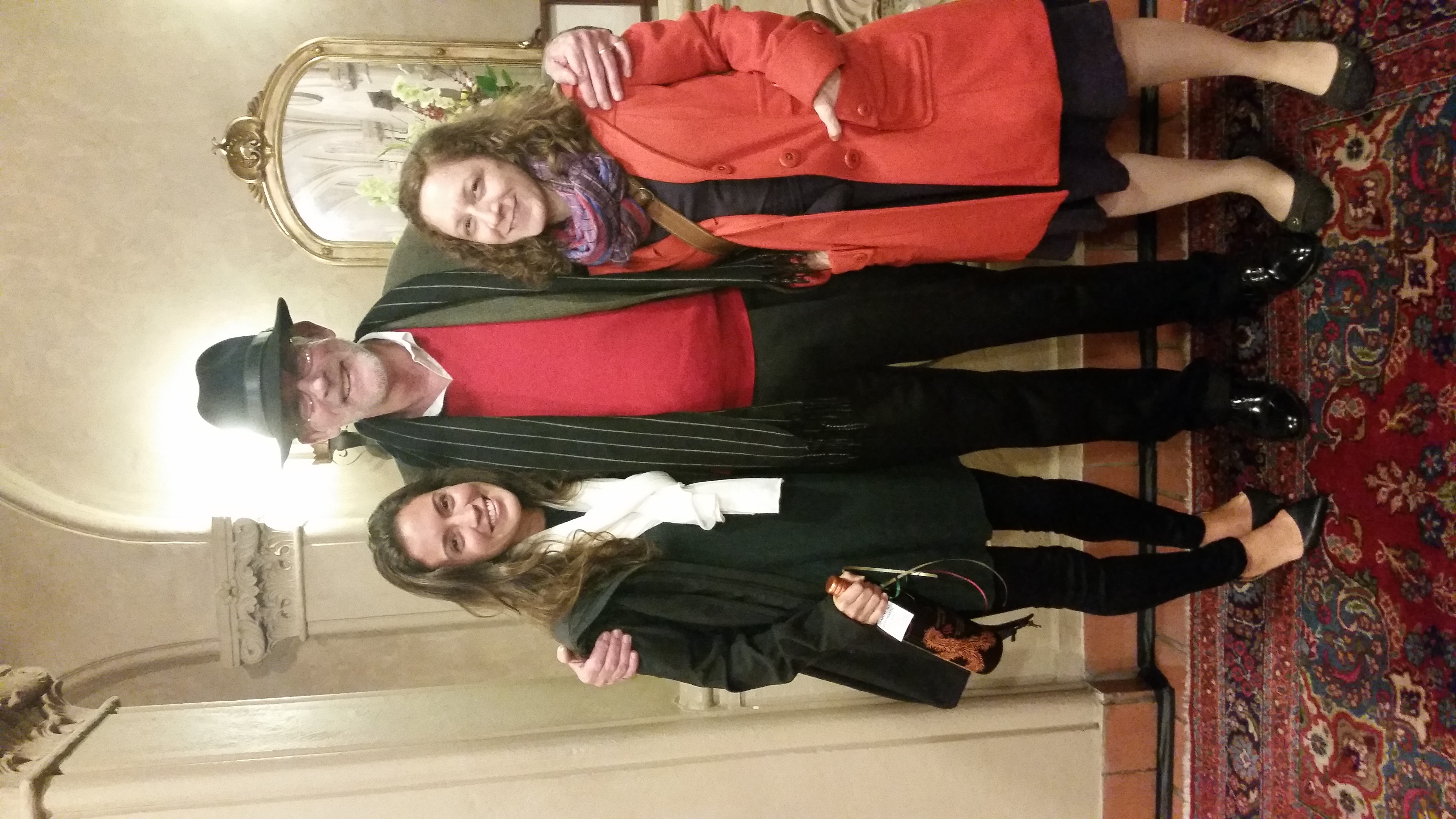
Vic (far rear on the right) and clan at Hamilton's on the last night of RBS!

Vic (far rear on the right) and clan at Hamilton’s on the last night of RBS!

Sunday night, after the opening reception/talk, folks sign up for a meal at a nearby restaurant.  It’s a great ice-breaker for ~ 10 people to get to know each other, as well as sample the fare of the local eateries.  Our 10 ended up at Michael’s Bistro & Taproom, a C’Ville institution.  And then Thursday night is bookseller night, where the local bookstores stay open a bit later to accommodate the RBS student’s schedule.  After, I always get a half-dozen or so folk to join  me at Hamilton’s on the Mall.  Been going there since ’98, and haven’t ever had a bad meal, not even a so-so one.

If you stay on the Lawn, then one social aspect is the gathering of folk outside one room or another, and drinking, talking, playing music.  Very social…  and one can always tell the next morning those that joined in!
All-in-all, a lovely week, and I met some terrific folks I know will be friends for a long time.  And while I’m a bit wistful that it’s all over so quickly, I look forward to next October, when the RBS staff announces the 2016 schedule.  I’ll be there, you?
Click here to learn more about Rare Book School!
Share

Dire Circumstances at Tavistock Books (Humorous Relief for Your Reading Pleasure)

Something that has happened often enough at Tavistock Books to admit (as long as my boss does not read this blog) is the dropping of books. My first week Vic left me alone with the store (let’s not even talk about how I neglected to charge a guy spending $600 sales tax or that I accidentally tripped over a globe and bled on the carpet) and while he was out at a Giants game, enjoying the sunshine and the hot dogs, I was pretending I knew how to do leather dressing on a book. I was startled by a customer (you know… human interaction frightens me), and the book slipped out of my hand, slammed to the ground, and both boards snapped off the spine and lay in a messy heap at my feet.

So, logically, the next thing I did was to call my father immediately (meanwhile the book is still on the ground, in case you were wondering) and cry a bit and tell him that I was going to get fired. After about 10 minutes of whining to a parent who was, at that point, probably more than a bit concerned about my overall mental health and what the California air was doing to my brain, I acted my age and called my boss. With only minor cracking in my voice I told him I had dropped a book and broke it. Vic, of course, couldn’t be less concerned and simply said, “okay so… we’ll get it fixed?” I did neglect to mention on the phone that it was a $1000 book, but oh well! I didn’t get fired (clearly).

The point of this blog is to inform other young booksellers the proper etiquette when dropping a book, this especially for all the assistants out there. Once a book is dropped, the first thing you should do is look around to see if anyone saw and/or heard the book being dropped. If the answer is no, breathe a sigh of relief and then pick it up quickly. While casually looking like you’re inspecting the state of the mylar dust jacket cover or the age-toning of the endpapers, inspect the book for any bumping or creasing you may have caused that you could not definitively say was there before. If any disfigurements are found, the first thing you should do is put it in a pile somewhere where human customers go, and leave it out for a day or two. Then, when your boss is sitting right in front of you, casually find it and exclaim over the horrifying tear or crease and start calling customers names in your anger at their casual manhandling of your precious books. The madder you get, the better. Your boss may think you have anger management problems, but so be it. He’ll never know the difference. You could take my route and hyperventilate instead, but it’s really not a good idea. Salt-water wrecks havoc on paper and if you cry on the book it will just make it worse.

(This is, of course, a joke, and I have always told my boss when I drop things.)

(I almost always tell my boss when I drop things.)


(Customers should really be more careful around Tavistock Books.)

Share

The Brothers Fleming: Peter & Ian and a shared Bond

Everyone knows the name Ian Fleming. It is not, by any means, a new name to the 20th century reading public and almost all could tell you that the great Ian Fleming was the creator of the dashing James Bond and all his escapades. However, all may not know Ian Fleming was not only the author of the Bond novels, but also an English journalist and naval intelligence officer. But he is primarily remembered as an author, who sold thirty million books during his lifetime, with double that sold in just the two years following his death.  Made into films, by 2012 the Bond series movies were the second highest grossing film series of all time, trailing only behind Harry Potter.

Peter and Ian as youngsters - so close that it is hard to tell them apart!

Peter and Ian as youngsters – so close that it is hard to tell them apart!

We know Ian Fleming was one of five children, grandchild of Robert Fleming (a wealthy merchant banker, founder of Robert Fleming & Co.). But what is known about Ian’s older brother Peter Fleming? Many today may not know or remember this name, but in his time Peter Fleming too rocked the literary world, just as his younger brother would a decade or so later. Peter Fleming, born in May 1907, was an adventurer, a travel writer, and a heartthrob throughout the 1930s and 40s. How then did this popular, adventurous author become overshadowed by his younger brother to the point where almost ten years after James Bonds’ author Ian died young, Peter’s modest gravestone in a quiet town in the Oxfordshire countryside read, “He travelled widely in far places; Wrote, and was widely read. Soldiered, saw some of danger’s faces, Came home to Nettlebed. The squire lies here, his journeys ended – Dust, and a name on a stone – Content, amid the lands he tended, to keep this rendezvous alone.” How one goes from stardom to a modest, quiet life is a very good question indeed!

Our 1st edition listing of Peter's first book.

Our 1st edition listing of Peter’s first book.

Peter and Ian Fleming grew up one year apart, from a well-to-do family, in the United Kingdom. Though it must have been difficult growing up so close in age as sibling rivalries took place, the brothers seemed not to let it get in the way of their relationship and throughout their lives were steady supporters of each others’ careers. Both were trained in intelligence during the course of World War II, both were star pupils at Eton (though where Peter seemed to glide through, Ian was a more difficult case). This, unfortunately, seemed a usual ritual. Ian struggled to make a living as a stockbroker, while a 24 year old Peter was working as the assistant literary editor at The Spectator. Peter answered an advertisement looking for a adventurous soul for an expedition through Brazil, and began his travel writing career. The resulting book, Brazilian Adventure, launched the elder Fleming’s literary career. He married the beautiful film actress Celia Johnson, and for a while his fame was more intense and well-known than Ian ever dreamed he could experience. Unfortunately, in 1947, Peter fell from a horse and suffered a crushed pelvis. After this incident he wrote no more travel books in far-off places, and retired to a somewhat more modest and quiet life.

Goldfinger - one of Ian Fleming's most beloved stories. Our holding signed by Bond movie stars!

Goldfinger – one of Ian Fleming’s most beloved stories. Our holding signed by Bond movie stars!

Peter was the instigating force behind the publication of Ian’s first novel, Casino Royale. It was Peter who suggested the change of M’s secretary to Moneypenny. Peter went over Ian’s manuscripts with such a fine-toothed comb that it “earned him the nickname Dr. Nitpick” (Telegraph.co.uk). So why then – if Peter was the accomplished literary scholar, the responsible adventuror, the charming author – is it more his younger brother we remember today? Ian Fleming wrote Casino Royale in 1952, and finished the novel within a short span of a couple months. The resulting story was immediately popular and three print runs were necessary to cope with the large demands made for the book at its publication. Casino Royale introduced the character of James Bond, a handsome and charming MI6 Secret Intelligence Officer, known by his code name “007.” The Bond stories center around this daring spy’s exploits, often involving ruthless villains and pretty women. Ian Fleming enjoyed a decade of immense success following the quick publication of his first five Bond novels, a period which went into a short decline after his popularity suffered a blow under a harsh criticism of his book Dr. No. However, it bounced back once knowledge that his novel From Russia, With Love was hailed as one of John F. Kennedy’s favorite books of all time. At this time Fleming began work on the screenplay of Thunderball, Goldfinger, Dr. No and From Russia, With Love, while also taking the time to publish a beautiful children’s story, Chitty-Chitty-Bang-Bang.

Unfortunately for Ian, his life was cut short. A life-long drinker and smoker, Ian suffered a fatal heart attack on August 12th, 1964 and passed away on his son Caspar’s 12th birthday.  For the years remaining to him, Peter struggled to be a father-figure to the troubled Caspar (who committed suicide at the age of 23), but Peter also succumbed to a heart attack 7 years later, while out shooting with friends. Hunting game was one of Peter’s greatest joys in life, and a primary he pursued the Brazilian adventure mentioned earlier. It seems only appropriate that he would die doing something he loved.

What then, of the intense similarities and differences between these two brothers? Both magnificently talented, if not in similar writing styles, but more their ability to make a splash. Both dependent on the other for support and friendship throughout their lives. On one hand you could make the argument that it is unfair for so much literary popularity to reside in one family. On the other… how lucky we are to have experienced both of their styles and careers from their literary remains!

Share

We Hold These Truths to be Self-Evident… that Thomas Jefferson was the Rockstar of the Non-Digital Age

On this here week of Independence, we do hereby pronounce our forefathers to have been a great many things. Determined, Intelligent, Eloquent, and… Romantic. Bear with me here – this blog will be mainly a professional, research-filled and patriotic discussion of the drafting of our Declaration of Independence and one of its main men, Thomas Jefferson. However, a paragraph devoted to the man’s love life may or may not have slipped in through the cracks. Don’t judge me, this is as close to a soap-opera as I dare to get and I was not the spark igniting the fireworks between two unlikely candidates. (I slipped a 4th of July joke in there. Get it? God I’m dazzling.) (See there, I did it again.)

image

Thomas Jefferson is often known as a kind of “Renaissance Man,” but not many people who could tell you that he helped change the United States into the democracy that we know today could tell you that he was born on April 13th, 1743, the third of ten children. His father, dying when Jefferson was only 16, ended up leaving his estate (roughly 10,000 acres of Virginia and around 80 slaves – no small inheritance) to be divided between his two sons – Thomas and Randolph. Independently wealthy as a teenager, Jefferson was able to take ownership of the land when he turned 21. By the time he gained that land, Jefferson was in the midst of his studies at the College of William and Mary in Williamsburg. For a time after his graduation he worked as a law clerk for one of his law professors, George Wythe. In 1767 he was admitted to the Virginia Bar and himself became a lawyer.

In 1772 Jefferson married his third cousin Martha Wayles Skelton, a 23-year-old widow, who just happened to be beautiful, accomplished, and intelligent. Seemingly a perfect match for Thomas, the two seemed to get along very well and in a short ten years of marriage, Martha bore 6 Jefferson children (though only the two girls survived to adulthood). Unfortunately this frequent child-birthing weakened her and she died at the young age of 33.  Jefferson never married again, reputedly as a result of a promise made Martha, as she had been raised by stepmothers and couldn’t bear to have her children raised the same way.

During his practices as a lawyer in colonial Virginia, Jefferson was one of the main advocates for the abolition of slavery in the states. Some see an element of hypocrisy to this, as Jefferson himself owned over a hundred slaves even while petitioning to have the slave trade outlawed. The simple truth of the matter seems to be that Jefferson, never having been a good one with savings, could not have run his home with so many acres without substantial help. Jefferson’s sure belief that all men should be free also helped lead him to his views on the governing of the states. He did not think that the King of England should have governance over the states any longer, as they were not treated as equally as British citizens seemed to be. They were stopped at every turn from bettering themselves if it was outlawed by the crown. In fact, part of the Declaration of Independence, drafted first by Thomas Jefferson himself, is a list of the wrongs the British government had done the states since they were first colonized.

Mentioning this historical document gets us into the patriotism of this Fourth of July blog – the drafting of the Declaration of Independence. In 1775, Jefferson began to serve as a delegate to the Second Continental Congress, soon after the onset of the Revolutionary War. Toward the beginning of his interaction in the political world, Jefferson began a lifetime friendship with John Adams. It was, in fact, Adams himself who volunteered Jefferson for the job of writing the Declaration, against Jefferson’s will! Though many thought that Adams should be the one to write the proclamation, Adams insisted Jefferson would be the right man for the job with some guidance from himself. Under these conditions, Congress was persuaded to let a somewhat unknown barrister draft the statement asserting the Independence of a new nation.

image

Jefferson wrote the first draft of the Declaration in a short seventeen days, and the draft was edited by some of the founding fathers of this country – John Adams and Benjamin Franklin, in particular – before the final revision was presented to Congress on June 28th, 1776. After a final revision in which Congress edited out a section on the slave trade in America (probably much to Jefferson’s annoyance), it was ratified and signed by the delegates on July 4th, 1776. Hence the tradition of celebrating our Independence on July 4th began. (Though, in reality, our Independence took another 7 years and numerous thousands of lives before it was won.)

The Declaration itself caused a great stir, just as one would have expected it to. Supposedly, after hearing the Declaration read aloud by town officials (or even zealous citizens), angry mobs across the states destroyed signs or statues representing “royal authority.” The official copy of the Declaration that hundreds of thousands flock to see in the National Archives in Washington D.C. each year is known as the “engrossed” or “parchment” copy, as it is slightly different from the very first version printed by Dunlap on July 4, 1776. The engrossed version is the copy the members of the Congressed signed.

One of the main effects of the Declaration’s publication was its direct influence on the leaders of the French Revolution, the influence clearly observed in the French Declaration of the Rights of Man & Citizen printed in 1789. In fact, Jefferson himself, while staying in France, helped Marquis de Lafayette with the main drafts before the overthrow of the French monarchy.

Returning to Thomas Jefferson, this author of the Declaration was elected President and took the oath of office on March 4th, 1801, under less than perfect circumstances. According to Wikipedia, when Jefferson took office he was facing an $83 million national debt and an intense battle between the Democratic-Republican and Federalist parties over the Federalists idea of a central bank and tax laws. Jefferson, ever the humble “People’s President” as he was fondly known to the American people, showed up to his inauguration alone on horseback and set his own horse up in a nearby stable. His modest and easy-going nature helped soothe the tensions throughout the country and he experienced very little intense problems throughout the 8 years he spent as president. In fact, his intellectual abilities helped him reduce the national debt, as well as taxes. He won the First Barbary War on North African pirates who were kidnapping and enslaving American Naval Crews. Jefferson arranged the Louisiana Purchase – he spent $15 million and acquired almost a third of what is now regarded as the United States – and also simultaneously considered one of the most fertile tracts of land on the continent. He also helped establish West Point, the United States Military Academy.  All of these successes and important moments in United States history occurred simply between 1801 and 1809, during Jefferson’s two terms in office.

Towards the end of his life, Jefferson did not slow down as one might expect someone in his position to have done. He began work on the University of Virginia, believing that unlike Britain, America ought to have an institute of higher learning without the constraints of religious rule. We should also note that the Library of Congress’ great collection began, in large part, with Jefferson’s impressive library, which was sold to the Library of Congress. Nevertheless, by his death Jefferson was in great debt (possibly in part due to his at least $25,000 book collection – this bibliophile sure knew how to collect).

image

This blog was not meant to be a comprehensive look at the founding of our country, but rather a quick look at an exciting time in the history of the United States of America, mainly through the eyes of our 3rd President, so if you take away anything in anticipation of your Fourth of July weekend, let it be this…

“We hold these truths to be self-evident, that all men are created equal, that they are endowed by their Creator with certain unalienable Rights, that among these are Life, Liberty and the pursuit of Happiness.”

Happy 4th of July!

Share

Find Another! A Short Summer Miscellany

Announcing the upload of our newest PDF catalogue: Find Another! A Short Summer Miscellany.

rarecatgrab


In these days of internet bookselling, with thousands of booksellers listing millions of books for sale, it is said to be successful in such a competitive environment, one must routinely offer

1. the cheapest copy, or,

2. the best copy, or,

3. the only copy.

Here at Tavistock Books we prefer, when able, to pursue the 3rd option as our primary business paradigm, for, by definition, the 3rd tenet encompasses the first two. Here then is our Summer list, which is comprised of 30 items, each of which is the only copy currently offered on the market.* Or, borrowing Peter Howard’s slightly more emphatic expression, “Find Another!”.

We time the issuance of this list to coincide with the convening of this year’s RBMS Conference, whose attendees we welcome to Oakland, home of the World Champion Golden State Warriors, and a scant 2 mile 51A bus ride from Alameda, where one will find Tavistock Books, soon to celebrate our 18th anniversary on Webster Street. We also welcome your visit to the shop, should you care to come browse 15,000 other books, et al, in addition to the 30 items found in this catalogue.

Enjoy – both the list, as well as your stay in Oakland, should you be one of the many visiting our lovely San Francisco Easy Bay.

*a recent point-in-time determination made by searching viaLibri.net, with the full realization that the market is dynamic, and other copies may come and go over a given period of time.

<http://www.tavbooks.com/tavistock/images/pdfcatalogs/11_catalog.pdf>

Enjoy.

Vic Zoschak, Principal

Margueritte Peterson, Aide-de-Camp

Share

Handel This! A Brief Biography of the Baroque Composer

Handel, later in life.

                   Handel, later in life.

The year 1685 was monumental in the world of classical music. Domenico Scarlatti, Johann Sebastian Bach, and George Frederich Handel were all born within a few months of each other, and all came to be titans of the Baroque era. Unlike such composers as Bach, Mozart and Beethoven, whose stories are considerably well-known in the musical world, to those outside the classical arena, Handel’s life is somewhat of a lesser-known story. Though many people walking on the street (at least the streets that I walk around) could tell you that by the end of his life Beethoven was deaf, or that Mozart was a child prodigy, one with an annoying laugh at that (oh wait, that’s just the movie Amadeus)… what can you tell me about Handel? Not much right? So let’s start with this… he was born in Halle, Germany, he once challenged another musician to a duel over said musician’s opera, and he wrote some of the most beloved pieces of classical music now enjoyed in this day.

Compared to Mozart’s father, who forced him to perform, blindfolded, for royalty, Handel’s family was not quite of the same level of musical motivation. Handel’s father wished him to study Civil Law, and was highly distressed by George’s propensity toward music, even going so far as to forbid him to have anything to do with musical instruments, of any kind. Handel could not abide by these strict rules, and said to have snuck a clavichord into an upstairs room in his family’s home in order to teach himself the keyboard instrument. As a young boy, Handel and his strict father traveled to Weissenfels to visit a relative who was serving as valet to Duke Johann Adolf I. Much to everyone’s surprise (given the secretive lessons in the attic), when lifted onto an organ stool he astonished the small crowd with his musical talent (and such with little to no formal musical training whatsoever). The duke himself helped convince Handel’s father that music lessons for the young boy were imperative. As a result, Handel began training with the oboe, violin, harpsichord and organ with the organist of their local church. By 1698, at the age of 13, Handel had played for royalty – Frederick I of Prussia.

An excerpt from Handel's own composition of "Messiah".

An excerpt from Handel’s own composition of “Messiah”.

Handel enjoyed early successes after his first posting as an organist in 1702, and as he took positions throughout Germany and Italy, and then in England, where he spent the most of his life, he composed a grand total of “42 operas, 29 oratorios, more than 120 cantatas, trios and duets, numerous arias, chamber music, a considerable amount of ecumenical pieces, odes and serenatas, and 16 organ concerti” (Wikipedia). His opera Rinaldo, performed in 1711, impressed English audiences so much that Handel was able to make a permanent move to London and a few short years later composed his famous Water Music for a royal boat outing of King George I. He enjoyed mass popularity throughout the 1720s and 30s, composing many of his operas and oratorios in that time. By the time he composed his oratorio “Messiah” (his 6th composition in English – most of his work to that time had been in Italian language and style) in 1741, he had a statue honoring him in the royally maintained Vauxhall Gardens (to say the least, an unusual privilege for a living person). His Messiah initially experienced an modest public reception, but steadily rose in popularity and it is now “one of the best- known and most frequently performed choral works in Western music” (Wikipedia).

Unlike many other composers throughout history, Handel, to this very day, has been continuously revered by his colleagues and contemporaries. “Bach attempted, unsuccessfully, to meet Handel while he was visiting Halle. Mozart is reputed to have said of him, ‘Handel understands affect better than any of us. When he chooses, he strikes like a thunder bolt.’ To Beethoven he was ‘the master of us all… the greatest composer that ever lived. I would uncover my head and kneel before his tomb… Go to him to learn how to achieve great effects, by such simple means.’” (Wiki). For living in such a musically-charged era, Handel achieved successes that many others never were able to experience.

Our holding of an 1835 holding of Acis & Galatea. Click on the image to find out more!

Our holding of an 1835 holding of Acis & Galatea. Click on the image to find out more!

Share

Dickens’ Final Chapter: The End of His Life and His Last (Unfinished) Work, The Mystery of Edwin Drood

Charles Dickens was only 58 years old when he passed away. He had long pushed himself too hard for the love of his work and his followers, and in the summer of 1870 (June 9th, to be exact) he succumbed to the exhaustion and after experiencing a fatal stroke, was laid to rest. His work, however, has gone on to be remembered since, and the author has never been out of print. His final work, The Mystery of Edwin Drood, has long fascinated fans, as the murder mystery was unfinished at his death and Dickens never [formally] named the murderer. On this the 145th anniversary of the author’s death, we look at his last years and his final work – a novel that he persisted on writing, even while suspecting his end was near.

Dickens, toward the end of his life.

Dickens, toward the end of his life.

Dickens’ health began to decline when he was involved in the Staplehurst rail accident on June 9th 1865 (5 years to the day before his death, coincidentally). On his return from Paris with his young mistress Ellen Ternan and her mother, the train they were traveling on plunged off a cast iron bridge that was under repair. Luckily, the only 1st class carriage to remain on the track was that one in which Dickens was traveling. Until more aid arrived to tend to the victims, Dickens scrambled around the horrific scene offering brandy and a hat with water, looking after the dead, dying and wounded around him. The tragic incident cast a shadow on Dickens’ life – the horror and absolute panic he experienced led to sleepless nights and night terrors for the rest of his short life. Always the author, however, before leaving the scene of the accident he remembered his unfinished manuscript of Our Mutual Friend was on board and went back to retrieve it.

Though the Staplehurst accident could be viewed as the “beginning of the end” for Dickens, what truly sapped the author’s strength and health was his insistence on the readings that he provided for his fans all over England and United States. These readings were not Dickens merely climbing up to a stage and reading his work aloud to audiences. The author planned his every look and every nuance, practiced scenes until he had them perfect, and left an impression with his audiences that they had just seen the characters they knew and loved on the stage before them. Quite the actor, Dickens had auditioned for a stage career as a young man, but when a cold prevented him from making the tryout, he turned toward a journalism career. In any event, the public readings took much more out of him than his audience realized, and Charles Dickens slowly succumbed to the stress he placed on himself. His farewell readings, lasting from the 6th of October 1868 to the 22nd of April, 1869, took the last of his energy. He began to experience fits of giddiness and paralysis and even collapsed while on tour in Lancashire; Doctors ordered the rest of his “performances” to be cancelled. Dickens retreated to his house, Gad’s Hill Place, in Kent, and under instructions to rest and recover, he began work on what was to be his final novel, The Mystery of Edwin Drood.

Drood was set to be published in only twelve installments, a shorter publication decision than his usual 20 printed parts of a couple chapters each. Though Dickens supposedly mentioned that the murderer was $#&@%#^$ in the @&#^*#*$&@* with the $*#&@*#$& (wouldn’t want to “kill it” for the rest of you), that information is based on the statements of Dickens’ son and also of his close friend John Forster (not unimaginable divulges, but still not ever found to be public knowledge from the author himself). This open-ended story yielded an amazing treat to the public – the chance to finish a Dickens book themselves! Strangely, the first three attempts to complete Dickens’ original tale were written by Americans. The first of them, published in 1870, was more of a farce than a continuation, with the author not even trying to continue Dickens’ style or even storyline (he even magically transported the characters to finish their mystery in the United States ). The second attempt was slightly more serious, a New York journalist named Henry Morford liked the story so much that he traveled to Rochester and published his ending serially from 1871 to 1872, and allowed the character of Edwin Drood to survive the murder attempt. The third effort, which to me seems to prove the gullibility of humans, was written by a Vermont printer named Thomas James. James claimed to have been a “ghost-writer” of sorts (pun intended)… by channeling Charles Dickens’ departed spirit.

Drood4

                   A performance of “Drood.”

In 1914, London’s ‘Dickens Fellowship’ held a mock-trial for Drood’s uncle John Jasper (oh, whoops… did I ruin it for you?). A group of well-known writers made up the characters (G. K. Chesterton stood as the judge, George Bernard Shaw the foreman of the jury, etc.). The jury returned with a ruling of manslaughter, and in a great dramatic ending, Chesterton “ruled that the mystery of Edwin Drood was insoluble, and fined everyone, except himself, for contempt of court.” (Wikipedia). There have been four film adaptations of the book, a two-part television drama, a radio reading, and perhaps most interestingly, a musical comedy based on the book. As to this latter, Rupert Holmes wrote the script, music and lyrics to the musical with a twist – at the end of the play, the audience decides by vote which of the characters is the murderer. Not only that, but the audience also picks a romantic ending between two characters of their choice! Holmes wrote alternate endings for every possible voting outcome, even the most unlikely. The actors must memorize and rehearse each possible ending before performing in front of a live audience with an opinion! The production, now titled “Drood,” was first performed in 1985 and was quickly opened on Broadway for a total of 608 performances. It won five 1986 Tony awards, including the award for Best Musical.

A theatre production of "Drood" when the audience is helping choose the ending themselves!

A theatre production of “Drood” when the audience is helping choose the ending themselves!

Now I may not be one for assumptions, but in my personal and ridiculously humble opinion I believe that Dickens would be ecstatic about this new development in the reading of his novel. As I said earlier, the author was always a fan of the stage and wore himself ragged engaging his audiences in a way that no readings had ever done before. In a way, above the movies and the television spots and the proposed written endings for the novel, the musical arrangement of his last and mysterious work with the alternate endings and the audience’s participation seems to me like exactly what the author would have wanted. Engagement, imagination and creativity as a group – just what Dr. Dickens prescribed.

In any event, Dickens clearly left behind a great impression on many future generations of readers and writers. His last work has sparked more investigation and speculation than any of his other works, due to the fact that it remained unfinished – an invitation for his admirers to become involved in a story of (partly) their own making. A more important notion to take away from his final days, however, is that the author loved his work and his readers so much that he didn’t stop working until the very end. And just think, all for our enjoyment! Even now, 145 years to his dying day, enthusiasts and admirers continue to devote their academic and creative minds to understanding the man and his final, unfinished novel.

A page from Dickens' unfinished manuscript of The Mystery of Edwin Drood.

A page from Dickens’ unfinished manuscript of The Mystery of Edwin Drood.

Share