Category Archives: History

Happy Birthday, F. Scott Fitzgerald!

By Margueritte Peterson

September 24th is the anniversary of the birth of one of the most well-known Western writers of the 20th century. Notice I did not say one of the most prolific writers in history, as this novelist only published 4 titles throughout his (unfortunately brief) lifetime. However, it must be said that though these titles garnered only modest success throughout his short life, F. Scott Fitzgerald has since become internationally famous and is known as one of the most important voices of the Jazz Age… not to mention a front-runner of Modern American Literature.

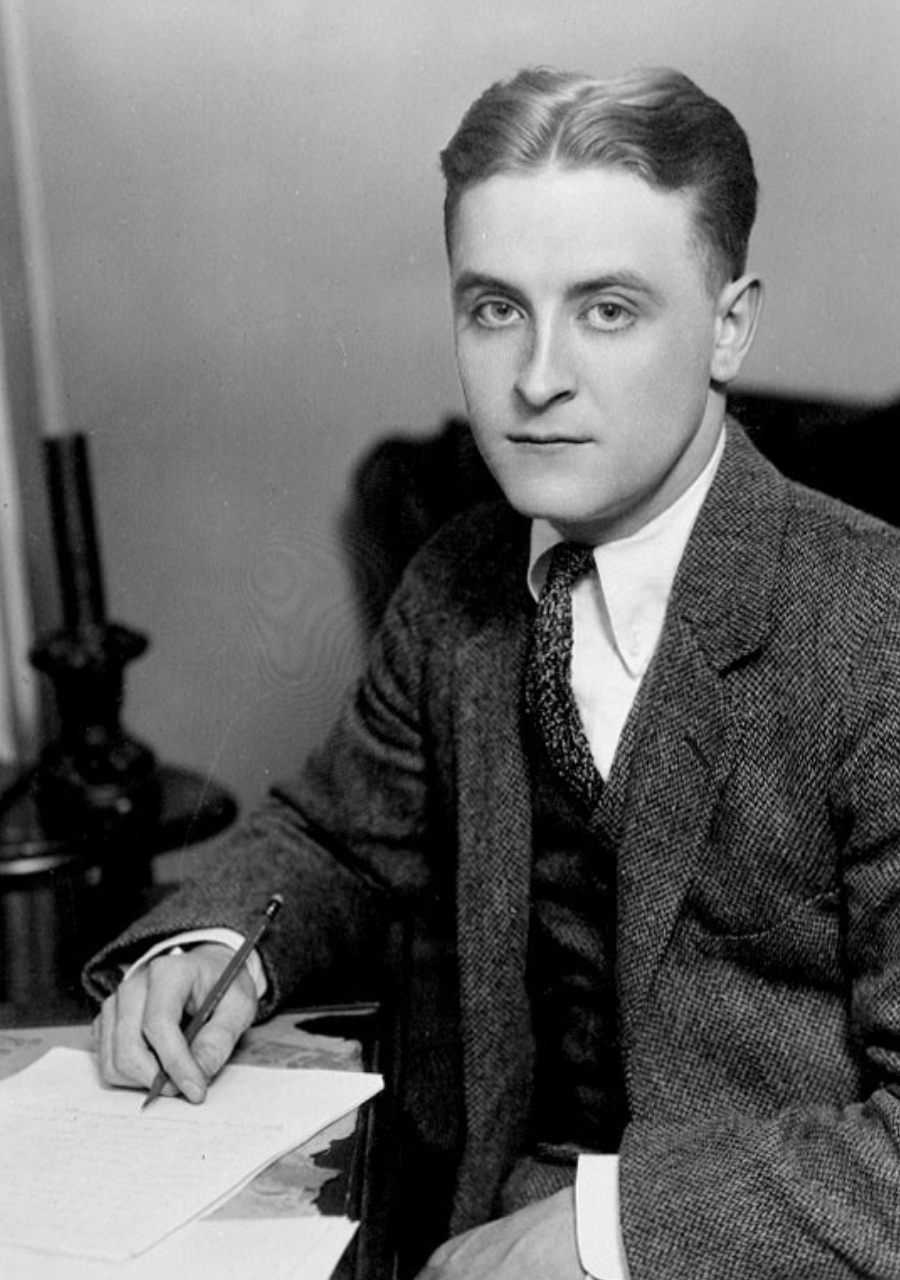
A young Fitzgerald at his desk.

A young Fitzgerald at his desk.

Born in St. Paul, Minnesota in 1896, Fitzgerald was loosely related (second cousin three times removed kind of loose… the kind that you can marry in any state, really) to Francis Scott Key – the composer of the national anthem – and was named in his honor. A few months before he was born, his two older sisters died before their 5th birthdays. Fitzgerald cited their death, while he was still in the womb, to be the moment when he became a writer. After spending a few years of his childhood living in Buffalo, New York with his doting parents, the family moved back to Minnesota. At the age of 13 Fitzgerald saw his first work published – a detective mystery in his school newspaper. He continued to write throughout his few years at Princeton University, where, as young men are wont, he eventually came to be on academic probation and consequently dropped out of school to join the army. Around this time, Charles Scribner’s Sons rejected two of his early works, one of which is The Romantic Egotist.

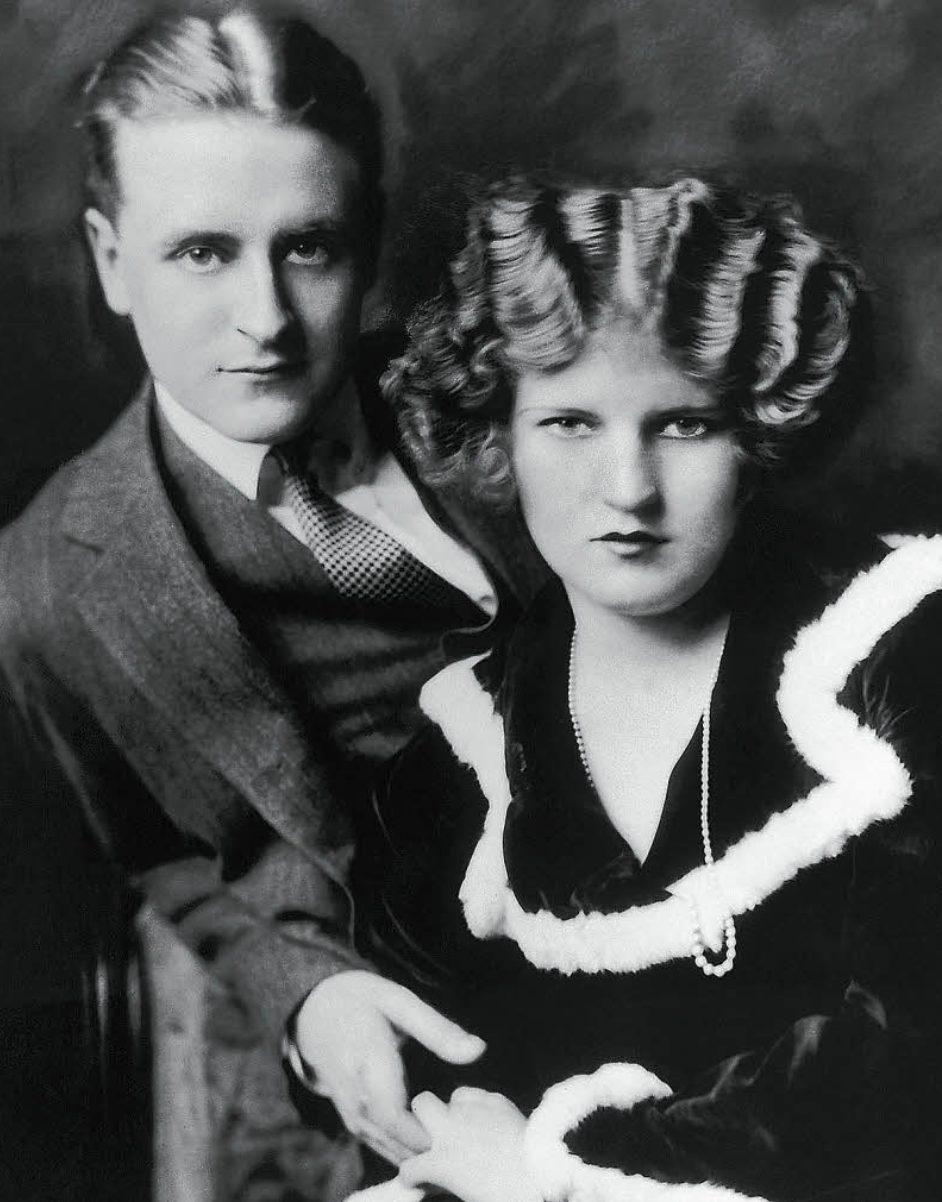
Scott and Zelda after their marriage.

Scott and Zelda after their marriage.

As a young lieutenant stationed in Alabama, Fitzgerald met and fell in love with the daughter of the Alabama Supreme Court Justice. Though Zelda initially accepted a marriage proposal from Fitzgerald, she eventually changed her mind under the impression that he would not make enough money to support the lifestyle she was used to. Once Fitzgerald was discharged from the army, he moved to New York, desperate to make enough money to impress Zelda and win her back. (I feel like nowadays that kind of spoiled behavior wouldn’t fly… unfortunately). Fitzgerald worked full-time for an advertising agency and even repaired automobiles on the side to save as much as he could. However, he was unable to convince the beautiful Alabama socialite, and returned home disheartened. In St. Paul, Fitzgerald took the time to revise his earlier novel The Romantic Egotist into what he renamed This Side of Paradise. This time around, Scribner’s accepted the novel and when it was published in March of 1920 the title sold over 41,000 copies in the first year alone. Fitzgerald became famous overnight – and with the steady income from the book and the demands for more literature, he suddenly was in a position Zelda could accept – the two were married only a week after and by October of 1921 their daughter “Scottie” was born.

In the 1920s the Fitzgeralds spent a significant amount of time in Paris – enjoying themselves with the other American expatriates living there (most notably Ernest Hemingway). Though Hemingway did not approve of Fitzgerald’s marriage to Zelda (supposedly calling her “insane” and believing that she stifled Fitzgerald’s talent out of jealousy), the friendship between Hemingway and Fitzgerald was one of the most important in FItzgerald’s short life. Though they eventually drifted apart, Fitzgerald held Hemingway’s work in the highest regard and strove to achieve the same success his friend experienced.

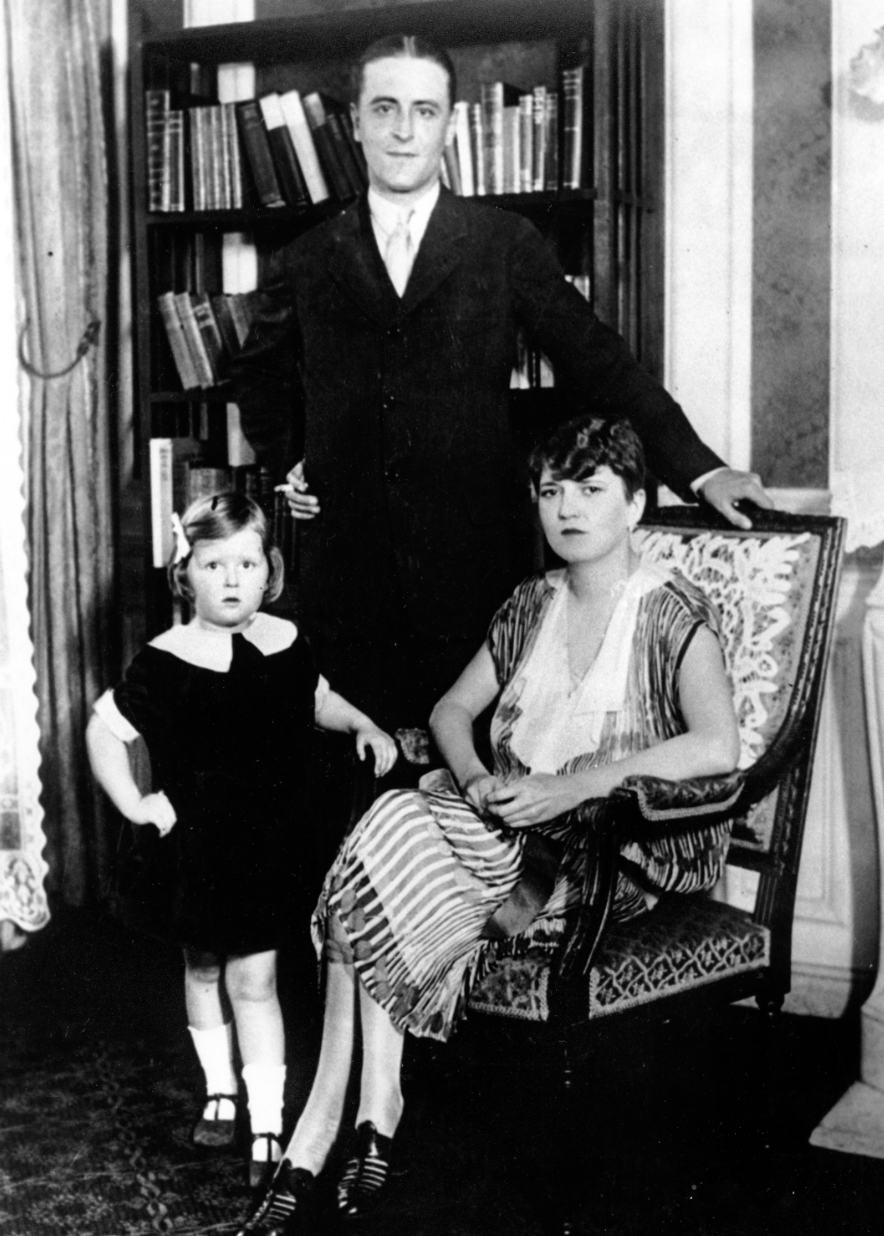
The young family, in the hold of financial difficulties.

The young family, in the hold of financial difficulties.

Despite the author’s fame and talent, the Fitzgeralds were in a constant state of financial worry. Throughout his life, F. Scott borrowed money from friends and took out loans – as only his first novel made enough money to support their lifestyle. Though his passion lay in writing novels, Fitzgerald made most of his money by publishing short stories in journals and periodicals – a few notable stories being “The Diamond as Big as the Ritz”, “The Curious Case of Benjamin Button”, “The Last of the Belles” and “The Camel’s Back.” They were well-known as great partiers and drinkers, and as the “belles” of the Jazz Age, they lived up to their reputations. Around 1930 Zelda began to suffer from schizophrenia, an illness that took a great toll on their relationship as well as Scott’s writing. For the rest of her life, Zelda would be treated in Psychiatric Hospitals and wards in both America and Europe (the pair moved back to Maryland in the 30s to give themselves a more stable lifestyle – one that would hopefully allow Fitzgerald a better chance at writing more steadily. These years were far from easy for the pair, and in 1937 Scott moved to Los Angeles to work on (what he considered degrading) film scripts and commercial short stories. He and Zelda’s fiery relationship became too hard to bear and for the rest of his short life he and his wife would be estranged, with her living in and out of mental hospitals on the east coast.

In his years in Hollywood Fitzgerald suffered two heart attacks, the second being the cause of his death at the young age of 44. He was, at that time, working on his fifth novel, The Love of the Last Tycoon, which remained unfinished at his death. A literary critic and personal friend of Fitzgerald, Edmund Wilson, published the work in 1941 after Scott’s death as The Last Tycoon, but an unedited version surfaced in 1994 and was published under the original title. Fitzgerald, though now recognized as one of the most influential authors of the Jazz Age, was not necessarily recognized in his lifetime as such. As stated, only his first novel was as commercially successful as one would expect, given his fame in recent day. (EvenThe Great Gatsby was not the front-runner Jazz Age title we know it as today.) Now, on his 119th birthday, he is one of the most famous American authors ever known. Why is that, you may ask? Well, you’ll have to check back next September 24th on his 120th birthday, when we examine why humanity likes to change its mind!

Screen Shot 2015-09-24 at 6.18.09 AM

Just kidding. I have no idea what will be being written next September 24th. Doesn’t mean you shouldn’t check back though!

Share

The Brothers Fleming: Peter & Ian and a shared Bond

Everyone knows the name Ian Fleming. It is not, by any means, a new name to the 20th century reading public and almost all could tell you that the great Ian Fleming was the creator of the dashing James Bond and all his escapades. However, all may not know Ian Fleming was not only the author of the Bond novels, but also an English journalist and naval intelligence officer. But he is primarily remembered as an author, who sold thirty million books during his lifetime, with double that sold in just the two years following his death.  Made into films, by 2012 the Bond series movies were the second highest grossing film series of all time, trailing only behind Harry Potter.

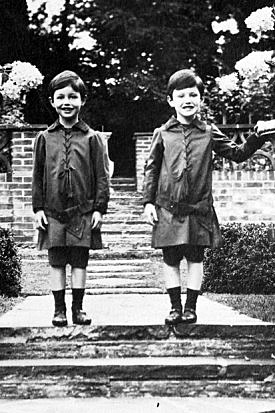
Peter and Ian as youngsters - so close that it is hard to tell them apart!

Peter and Ian as youngsters – so close that it is hard to tell them apart!

We know Ian Fleming was one of five children, grandchild of Robert Fleming (a wealthy merchant banker, founder of Robert Fleming & Co.). But what is known about Ian’s older brother Peter Fleming? Many today may not know or remember this name, but in his time Peter Fleming too rocked the literary world, just as his younger brother would a decade or so later. Peter Fleming, born in May 1907, was an adventurer, a travel writer, and a heartthrob throughout the 1930s and 40s. How then did this popular, adventurous author become overshadowed by his younger brother to the point where almost ten years after James Bonds’ author Ian died young, Peter’s modest gravestone in a quiet town in the Oxfordshire countryside read, “He travelled widely in far places; Wrote, and was widely read. Soldiered, saw some of danger’s faces, Came home to Nettlebed. The squire lies here, his journeys ended – Dust, and a name on a stone – Content, amid the lands he tended, to keep this rendezvous alone.” How one goes from stardom to a modest, quiet life is a very good question indeed!

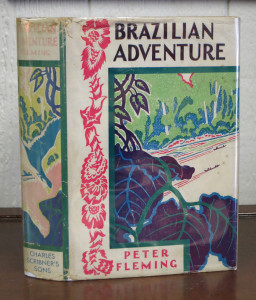
Our 1st edition listing of Peter's first book.

Our 1st edition listing of Peter’s first book.

Peter and Ian Fleming grew up one year apart, from a well-to-do family, in the United Kingdom. Though it must have been difficult growing up so close in age as sibling rivalries took place, the brothers seemed not to let it get in the way of their relationship and throughout their lives were steady supporters of each others’ careers. Both were trained in intelligence during the course of World War II, both were star pupils at Eton (though where Peter seemed to glide through, Ian was a more difficult case). This, unfortunately, seemed a usual ritual. Ian struggled to make a living as a stockbroker, while a 24 year old Peter was working as the assistant literary editor at The Spectator. Peter answered an advertisement looking for a adventurous soul for an expedition through Brazil, and began his travel writing career. The resulting book, Brazilian Adventure, launched the elder Fleming’s literary career. He married the beautiful film actress Celia Johnson, and for a while his fame was more intense and well-known than Ian ever dreamed he could experience. Unfortunately, in 1947, Peter fell from a horse and suffered a crushed pelvis. After this incident he wrote no more travel books in far-off places, and retired to a somewhat more modest and quiet life.

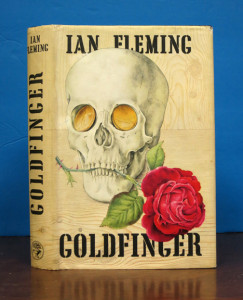
Goldfinger - one of Ian Fleming's most beloved stories. Our holding signed by Bond movie stars!

Goldfinger – one of Ian Fleming’s most beloved stories. Our holding signed by Bond movie stars!

Peter was the instigating force behind the publication of Ian’s first novel, Casino Royale. It was Peter who suggested the change of M’s secretary to Moneypenny. Peter went over Ian’s manuscripts with such a fine-toothed comb that it “earned him the nickname Dr. Nitpick” (Telegraph.co.uk). So why then – if Peter was the accomplished literary scholar, the responsible adventuror, the charming author – is it more his younger brother we remember today? Ian Fleming wrote Casino Royale in 1952, and finished the novel within a short span of a couple months. The resulting story was immediately popular and three print runs were necessary to cope with the large demands made for the book at its publication. Casino Royale introduced the character of James Bond, a handsome and charming MI6 Secret Intelligence Officer, known by his code name “007.” The Bond stories center around this daring spy’s exploits, often involving ruthless villains and pretty women. Ian Fleming enjoyed a decade of immense success following the quick publication of his first five Bond novels, a period which went into a short decline after his popularity suffered a blow under a harsh criticism of his book Dr. No. However, it bounced back once knowledge that his novel From Russia, With Love was hailed as one of John F. Kennedy’s favorite books of all time. At this time Fleming began work on the screenplay of Thunderball, Goldfinger, Dr. No and From Russia, With Love, while also taking the time to publish a beautiful children’s story, Chitty-Chitty-Bang-Bang.

Unfortunately for Ian, his life was cut short. A life-long drinker and smoker, Ian suffered a fatal heart attack on August 12th, 1964 and passed away on his son Caspar’s 12th birthday.  For the years remaining to him, Peter struggled to be a father-figure to the troubled Caspar (who committed suicide at the age of 23), but Peter also succumbed to a heart attack 7 years later, while out shooting with friends. Hunting game was one of Peter’s greatest joys in life, and a primary he pursued the Brazilian adventure mentioned earlier. It seems only appropriate that he would die doing something he loved.

What then, of the intense similarities and differences between these two brothers? Both magnificently talented, if not in similar writing styles, but more their ability to make a splash. Both dependent on the other for support and friendship throughout their lives. On one hand you could make the argument that it is unfair for so much literary popularity to reside in one family. On the other… how lucky we are to have experienced both of their styles and careers from their literary remains!

Share

We Hold These Truths to be Self-Evident… that Thomas Jefferson was the Rockstar of the Non-Digital Age

On this here week of Independence, we do hereby pronounce our forefathers to have been a great many things. Determined, Intelligent, Eloquent, and… Romantic. Bear with me here – this blog will be mainly a professional, research-filled and patriotic discussion of the drafting of our Declaration of Independence and one of its main men, Thomas Jefferson. However, a paragraph devoted to the man’s love life may or may not have slipped in through the cracks. Don’t judge me, this is as close to a soap-opera as I dare to get and I was not the spark igniting the fireworks between two unlikely candidates. (I slipped a 4th of July joke in there. Get it? God I’m dazzling.) (See there, I did it again.)

image

Thomas Jefferson is often known as a kind of “Renaissance Man,” but not many people who could tell you that he helped change the United States into the democracy that we know today could tell you that he was born on April 13th, 1743, the third of ten children. His father, dying when Jefferson was only 16, ended up leaving his estate (roughly 10,000 acres of Virginia and around 80 slaves – no small inheritance) to be divided between his two sons – Thomas and Randolph. Independently wealthy as a teenager, Jefferson was able to take ownership of the land when he turned 21. By the time he gained that land, Jefferson was in the midst of his studies at the College of William and Mary in Williamsburg. For a time after his graduation he worked as a law clerk for one of his law professors, George Wythe. In 1767 he was admitted to the Virginia Bar and himself became a lawyer.

In 1772 Jefferson married his third cousin Martha Wayles Skelton, a 23-year-old widow, who just happened to be beautiful, accomplished, and intelligent. Seemingly a perfect match for Thomas, the two seemed to get along very well and in a short ten years of marriage, Martha bore 6 Jefferson children (though only the two girls survived to adulthood). Unfortunately this frequent child-birthing weakened her and she died at the young age of 33.  Jefferson never married again, reputedly as a result of a promise made Martha, as she had been raised by stepmothers and couldn’t bear to have her children raised the same way.

During his practices as a lawyer in colonial Virginia, Jefferson was one of the main advocates for the abolition of slavery in the states. Some see an element of hypocrisy to this, as Jefferson himself owned over a hundred slaves even while petitioning to have the slave trade outlawed. The simple truth of the matter seems to be that Jefferson, never having been a good one with savings, could not have run his home with so many acres without substantial help. Jefferson’s sure belief that all men should be free also helped lead him to his views on the governing of the states. He did not think that the King of England should have governance over the states any longer, as they were not treated as equally as British citizens seemed to be. They were stopped at every turn from bettering themselves if it was outlawed by the crown. In fact, part of the Declaration of Independence, drafted first by Thomas Jefferson himself, is a list of the wrongs the British government had done the states since they were first colonized.

Mentioning this historical document gets us into the patriotism of this Fourth of July blog – the drafting of the Declaration of Independence. In 1775, Jefferson began to serve as a delegate to the Second Continental Congress, soon after the onset of the Revolutionary War. Toward the beginning of his interaction in the political world, Jefferson began a lifetime friendship with John Adams. It was, in fact, Adams himself who volunteered Jefferson for the job of writing the Declaration, against Jefferson’s will! Though many thought that Adams should be the one to write the proclamation, Adams insisted Jefferson would be the right man for the job with some guidance from himself. Under these conditions, Congress was persuaded to let a somewhat unknown barrister draft the statement asserting the Independence of a new nation.

image

Jefferson wrote the first draft of the Declaration in a short seventeen days, and the draft was edited by some of the founding fathers of this country – John Adams and Benjamin Franklin, in particular – before the final revision was presented to Congress on June 28th, 1776. After a final revision in which Congress edited out a section on the slave trade in America (probably much to Jefferson’s annoyance), it was ratified and signed by the delegates on July 4th, 1776. Hence the tradition of celebrating our Independence on July 4th began. (Though, in reality, our Independence took another 7 years and numerous thousands of lives before it was won.)

The Declaration itself caused a great stir, just as one would have expected it to. Supposedly, after hearing the Declaration read aloud by town officials (or even zealous citizens), angry mobs across the states destroyed signs or statues representing “royal authority.” The official copy of the Declaration that hundreds of thousands flock to see in the National Archives in Washington D.C. each year is known as the “engrossed” or “parchment” copy, as it is slightly different from the very first version printed by Dunlap on July 4, 1776. The engrossed version is the copy the members of the Congressed signed.

One of the main effects of the Declaration’s publication was its direct influence on the leaders of the French Revolution, the influence clearly observed in the French Declaration of the Rights of Man & Citizen printed in 1789. In fact, Jefferson himself, while staying in France, helped Marquis de Lafayette with the main drafts before the overthrow of the French monarchy.

Returning to Thomas Jefferson, this author of the Declaration was elected President and took the oath of office on March 4th, 1801, under less than perfect circumstances. According to Wikipedia, when Jefferson took office he was facing an $83 million national debt and an intense battle between the Democratic-Republican and Federalist parties over the Federalists idea of a central bank and tax laws. Jefferson, ever the humble “People’s President” as he was fondly known to the American people, showed up to his inauguration alone on horseback and set his own horse up in a nearby stable. His modest and easy-going nature helped soothe the tensions throughout the country and he experienced very little intense problems throughout the 8 years he spent as president. In fact, his intellectual abilities helped him reduce the national debt, as well as taxes. He won the First Barbary War on North African pirates who were kidnapping and enslaving American Naval Crews. Jefferson arranged the Louisiana Purchase – he spent $15 million and acquired almost a third of what is now regarded as the United States – and also simultaneously considered one of the most fertile tracts of land on the continent. He also helped establish West Point, the United States Military Academy.  All of these successes and important moments in United States history occurred simply between 1801 and 1809, during Jefferson’s two terms in office.

Towards the end of his life, Jefferson did not slow down as one might expect someone in his position to have done. He began work on the University of Virginia, believing that unlike Britain, America ought to have an institute of higher learning without the constraints of religious rule. We should also note that the Library of Congress’ great collection began, in large part, with Jefferson’s impressive library, which was sold to the Library of Congress. Nevertheless, by his death Jefferson was in great debt (possibly in part due to his at least $25,000 book collection – this bibliophile sure knew how to collect).

image

This blog was not meant to be a comprehensive look at the founding of our country, but rather a quick look at an exciting time in the history of the United States of America, mainly through the eyes of our 3rd President, so if you take away anything in anticipation of your Fourth of July weekend, let it be this…

“We hold these truths to be self-evident, that all men are created equal, that they are endowed by their Creator with certain unalienable Rights, that among these are Life, Liberty and the pursuit of Happiness.”

Happy 4th of July!

Share

Dickens’ Final Chapter: The End of His Life and His Last (Unfinished) Work, The Mystery of Edwin Drood

Charles Dickens was only 58 years old when he passed away. He had long pushed himself too hard for the love of his work and his followers, and in the summer of 1870 (June 9th, to be exact) he succumbed to the exhaustion and after experiencing a fatal stroke, was laid to rest. His work, however, has gone on to be remembered since, and the author has never been out of print. His final work, The Mystery of Edwin Drood, has long fascinated fans, as the murder mystery was unfinished at his death and Dickens never [formally] named the murderer. On this the 145th anniversary of the author’s death, we look at his last years and his final work – a novel that he persisted on writing, even while suspecting his end was near.

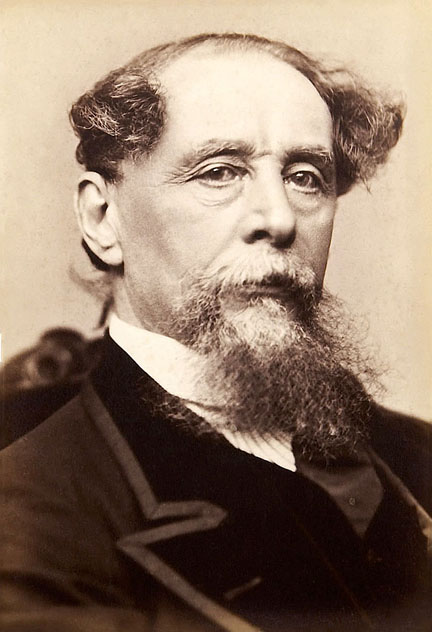
Dickens, toward the end of his life.

Dickens, toward the end of his life.

Dickens’ health began to decline when he was involved in the Staplehurst rail accident on June 9th 1865 (5 years to the day before his death, coincidentally). On his return from Paris with his young mistress Ellen Ternan and her mother, the train they were traveling on plunged off a cast iron bridge that was under repair. Luckily, the only 1st class carriage to remain on the track was that one in which Dickens was traveling. Until more aid arrived to tend to the victims, Dickens scrambled around the horrific scene offering brandy and a hat with water, looking after the dead, dying and wounded around him. The tragic incident cast a shadow on Dickens’ life – the horror and absolute panic he experienced led to sleepless nights and night terrors for the rest of his short life. Always the author, however, before leaving the scene of the accident he remembered his unfinished manuscript of Our Mutual Friend was on board and went back to retrieve it.

Though the Staplehurst accident could be viewed as the “beginning of the end” for Dickens, what truly sapped the author’s strength and health was his insistence on the readings that he provided for his fans all over England and United States. These readings were not Dickens merely climbing up to a stage and reading his work aloud to audiences. The author planned his every look and every nuance, practiced scenes until he had them perfect, and left an impression with his audiences that they had just seen the characters they knew and loved on the stage before them. Quite the actor, Dickens had auditioned for a stage career as a young man, but when a cold prevented him from making the tryout, he turned toward a journalism career. In any event, the public readings took much more out of him than his audience realized, and Charles Dickens slowly succumbed to the stress he placed on himself. His farewell readings, lasting from the 6th of October 1868 to the 22nd of April, 1869, took the last of his energy. He began to experience fits of giddiness and paralysis and even collapsed while on tour in Lancashire; Doctors ordered the rest of his “performances” to be cancelled. Dickens retreated to his house, Gad’s Hill Place, in Kent, and under instructions to rest and recover, he began work on what was to be his final novel, The Mystery of Edwin Drood.

Drood was set to be published in only twelve installments, a shorter publication decision than his usual 20 printed parts of a couple chapters each. Though Dickens supposedly mentioned that the murderer was $#&@%#^$ in the @&#^*#*$&@* with the $*#&@*#$& (wouldn’t want to “kill it” for the rest of you), that information is based on the statements of Dickens’ son and also of his close friend John Forster (not unimaginable divulges, but still not ever found to be public knowledge from the author himself). This open-ended story yielded an amazing treat to the public – the chance to finish a Dickens book themselves! Strangely, the first three attempts to complete Dickens’ original tale were written by Americans. The first of them, published in 1870, was more of a farce than a continuation, with the author not even trying to continue Dickens’ style or even storyline (he even magically transported the characters to finish their mystery in the United States ). The second attempt was slightly more serious, a New York journalist named Henry Morford liked the story so much that he traveled to Rochester and published his ending serially from 1871 to 1872, and allowed the character of Edwin Drood to survive the murder attempt. The third effort, which to me seems to prove the gullibility of humans, was written by a Vermont printer named Thomas James. James claimed to have been a “ghost-writer” of sorts (pun intended)… by channeling Charles Dickens’ departed spirit.

Drood4

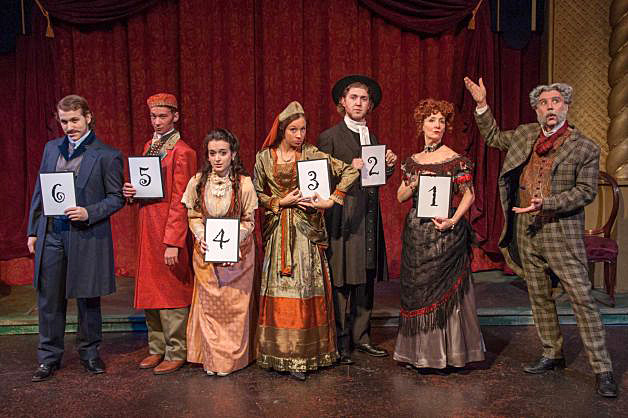
                   A performance of “Drood.”

In 1914, London’s ‘Dickens Fellowship’ held a mock-trial for Drood’s uncle John Jasper (oh, whoops… did I ruin it for you?). A group of well-known writers made up the characters (G. K. Chesterton stood as the judge, George Bernard Shaw the foreman of the jury, etc.). The jury returned with a ruling of manslaughter, and in a great dramatic ending, Chesterton “ruled that the mystery of Edwin Drood was insoluble, and fined everyone, except himself, for contempt of court.” (Wikipedia). There have been four film adaptations of the book, a two-part television drama, a radio reading, and perhaps most interestingly, a musical comedy based on the book. As to this latter, Rupert Holmes wrote the script, music and lyrics to the musical with a twist – at the end of the play, the audience decides by vote which of the characters is the murderer. Not only that, but the audience also picks a romantic ending between two characters of their choice! Holmes wrote alternate endings for every possible voting outcome, even the most unlikely. The actors must memorize and rehearse each possible ending before performing in front of a live audience with an opinion! The production, now titled “Drood,” was first performed in 1985 and was quickly opened on Broadway for a total of 608 performances. It won five 1986 Tony awards, including the award for Best Musical.

A theatre production of "Drood" when the audience is helping choose the ending themselves!

A theatre production of “Drood” when the audience is helping choose the ending themselves!

Now I may not be one for assumptions, but in my personal and ridiculously humble opinion I believe that Dickens would be ecstatic about this new development in the reading of his novel. As I said earlier, the author was always a fan of the stage and wore himself ragged engaging his audiences in a way that no readings had ever done before. In a way, above the movies and the television spots and the proposed written endings for the novel, the musical arrangement of his last and mysterious work with the alternate endings and the audience’s participation seems to me like exactly what the author would have wanted. Engagement, imagination and creativity as a group – just what Dr. Dickens prescribed.

In any event, Dickens clearly left behind a great impression on many future generations of readers and writers. His last work has sparked more investigation and speculation than any of his other works, due to the fact that it remained unfinished – an invitation for his admirers to become involved in a story of (partly) their own making. A more important notion to take away from his final days, however, is that the author loved his work and his readers so much that he didn’t stop working until the very end. And just think, all for our enjoyment! Even now, 145 years to his dying day, enthusiasts and admirers continue to devote their academic and creative minds to understanding the man and his final, unfinished novel.

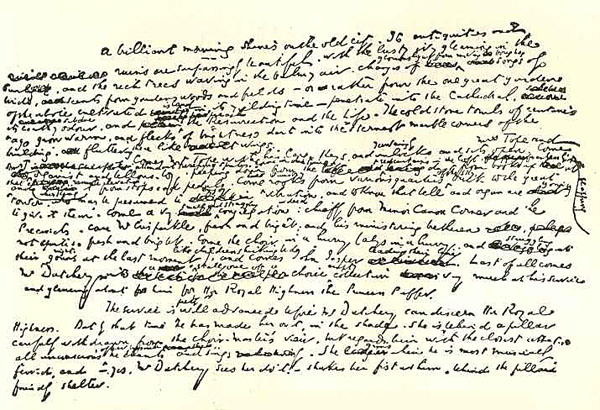
A page from Dickens' unfinished manuscript of The Mystery of Edwin Drood.

A page from Dickens’ unfinished manuscript of The Mystery of Edwin Drood.

Share

A Donation to Children’s Illustration: A Short Tribute to Randolph Caldecott

Randolph Caldecott was born in March of 1846 in a city called Chester, England. He left school at the tender age of fifteen and went to work in a bank branch. In 1861 he saw published his first drawing – and despite the fact that he was to be most remembered for his humorous depictions and lively countryside scenes, Caldecott’s first published work would be of a catastrophic fire at the Queens Railway Hotel in Chester which, along with his write-up of the event, appeared in the Illustrated London News. In his early twenties Caldecott was able to transfer to the Manchester & Salford Bank in the thriving Northern city and began to take night classes at the Manchester School of Art, all while continuing to have his sketches published locally. Upon making the acquaintance of Henry Blackburn and getting published in the London Society, Caldecott realized his talent could be enough to support him and at the young age of 26, he quit his banking job to move to London. In 1869 Caldecott exhibited an illustration in the Royal Manchester Institute, and 7 years later was displayed once more, this time at the Royal Academy. In 1872 he was elected to the Royal Institute of Watercolour Painting.

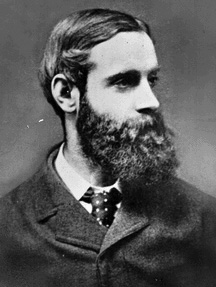
Randolph Caldecott.

One of the only surviving images of Randolph Caldecott. 

In 1877 Caldecott’s life would change forever, as he filled in for Walter Crane’s absence in the production of two small children’s Christmas Books – The House that Jack Built and The Diverting History of John Gilpin with color printer Edmund Evans. He would go on to create/illustrate two children’s stories for Evans at Christmastime until his death in 1886. These children’s stories became standards as Christmas annuals and were immensely popular, bringing Caldecott fame from around the world. As an enterprising young man, he also became quite wealthy from his work. As the website randolphcaldecott.org.uk states, “Randolph Caldecott is believed to be the first author/illustrator to have negotiated with his publisher to receive, instead of a fixed fee, a ‘Royalty’ per book sold: he received one old penny per book (there were 12 pence to the shilling). The first print run was a cautious 10,000 copies. They were so popular that by July 1886, 5 months after his death, over 800,000 copies had been sold.

Caldecott often visited warmer climates in the winter months, due to consistently bad health (after an illness at a young age the illustrator continuously suffered from a heart condition and gastritis). The last winter of his life, he and his wife Marian Brind traveled to New York and down to Florida. Unfortunately it was an abnormally cold winter, even in Florida, and Caldecott took ill and never returned to the United Kingdom. His last days were lived in St. Augustine, where he died on February 12th, 1886.

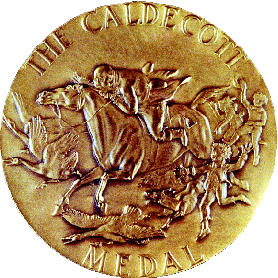
The Caldecott Medal with it's replication of The Diverting History of John Gilpin illustration.

The Caldecott Medal with its replication of The Diverting History of John Gilpin illustration.

Let us now turn to the story behind the annual award to a children’s book illustrator named in Caldecott’s honor. Rene Paul Chambellan, an American architectural sculptor who specialized in the Art Deco style, designed the medal in 1937. The medal itself depicts two of Caldecott’s most famous illustrations – a scene from his work The Diverting History of John Gilpin and one of his nursery rhyme “Song of Sixpence.” After the Newbery medal was created (also in 1937 – as an award for distinguished children’s literature), “many persons became concerned that the artists creating picture books for children were as deserving of honor and encouragement as were the authors of children’s books, Frederic G. Melcher suggested in 1937 the establishment of a second annual medal. This medal is to be given to the artist who had created the most distinguished picture book of the year” (ALA.org – American Library Association). The rules of the Caldecott award are quite simple, really. It must be a book with original work (whether also written by the illustrator or not) by an American citizen or resident (or in a U.S. Commonwealth) that distinguishes itself in the field of children’s illustration. The medal itself weighs just over 3 pounds, and is not worn but rather presented in a box for display.

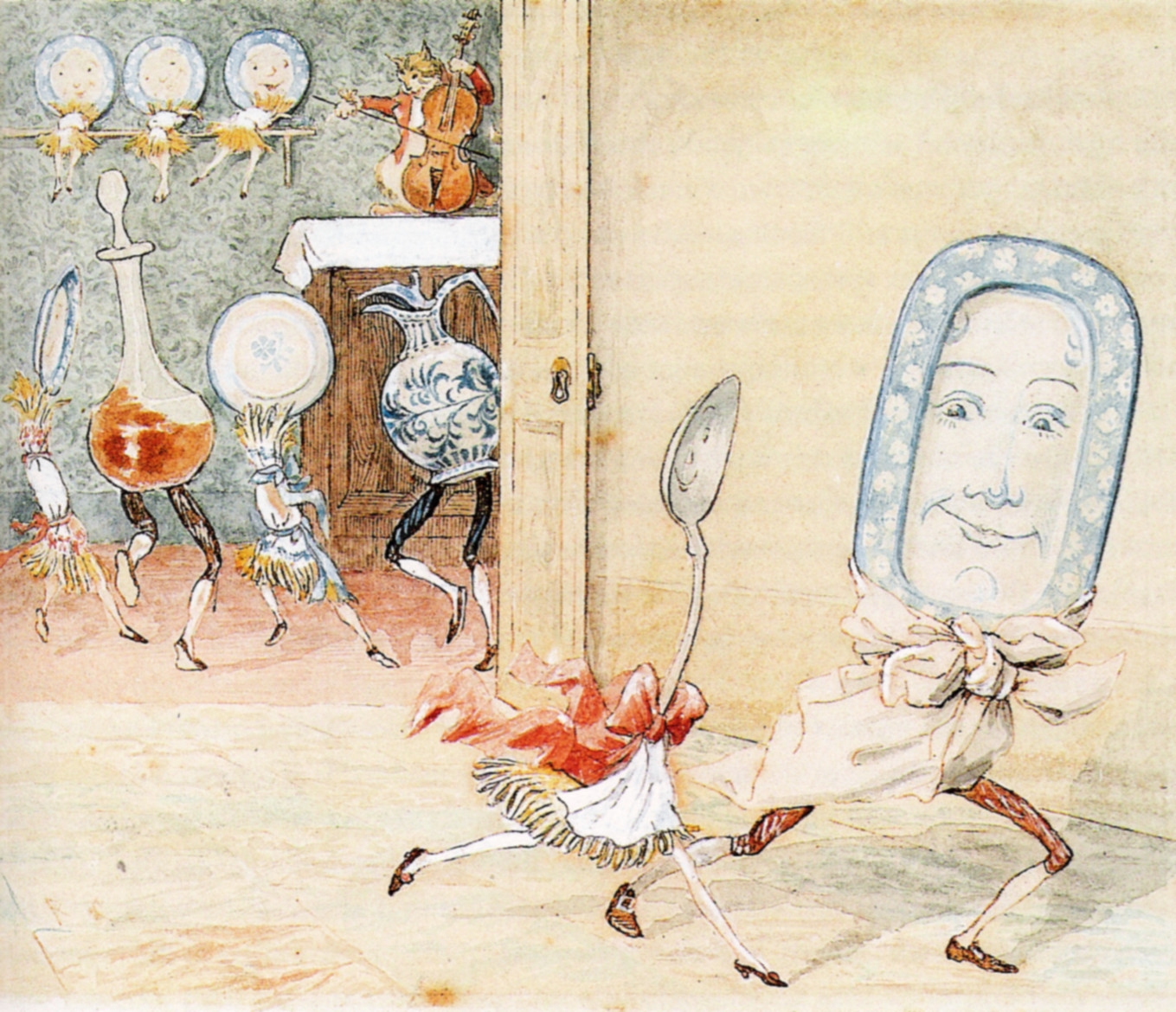
"And the Dish ran away with the Spoon!" An Illustration by Caldecott, demonstrating his humorous, exciting and moving illustrations.

“And the Dish ran away with the Spoon!” An Illustration by Caldecott, demonstrating his humorous, exciting and moving illustrations.

Though the reason for a British illustrator being chosen as the figurehead/namesake of an American award continues to confuse some of the American public, the American Library Association website claims (rightly so) that Caldecott was one of three of the most influential children’s illustrators working in the 19th century. Along with Walter Crane and Kate Greenaway, Caldecott helped shape an entirely new generation of children’s illustration with his humorous visuals. As ALA states, “his illustrations for children were unique to their time in both their humor, and their ability to create a sense of movement, vitality, and action that complemented the stories they accompanied.” We cannot deny the fame that Caldecott experienced, even in his short period as an artist, but we also cannot deny the influence he exerted on illustrating for children and the importance of humor, color and excitement in his pieces. Thank you Randolph Caldecott!

Share

“Words don’t change their shape, they change their meaning, their function…” Marguerite Duras and the Minimal Novel

Throughout history, writers have been known to cause a stir. The Marquis de Sade was incarcerated in an insane asylum for his erotic tales. Oscar Wilde self-exiled himself to Paris for the unimaginable treatment he received for the “crime” of homosexuality. Harriet Beecher Stowe caused a flurry of activity around the anti-slavery act in the United States. Vladimir Nabokov’s Lolita was banned in many different countries, including France (you know it’s controversial when even the French consider it obscene…). In modern day we have parents and schools banning books by authors like Judy Blume and Laurie Halse Anderson because they deal with sex and coming-of-age experiences in young adult fiction. We can only imagine the hell-fire that would begin to burn should any school library choose to keep a holding of The Lover or The Ravishing of Lol Stein on hand! Marguerite Duras, a French novelist, essayist, playwright and film director, could certainly be considered controversial in both work (like the Marquis) and life (like Wilde). Despite the often explicit and controversial themes and plots in her novels, many of which were drawn from her real-life experiences, Duras has been a beloved figure in the field of “serious literature” (a genre I just made up, you’ll be pleased to know) for decades.

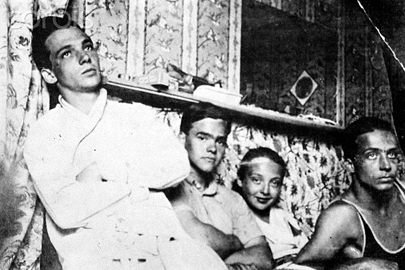
Margueritte as a young girl in Indochina, pictured here with her brothers Pierre and Paulo and a friend.

Marguerite as a young girl in Indochina, pictured here with her brothers Pierre and Paulo and a friend.

Marguerite Donnadieu (pen name Duras, taken after the French town where her father passed away) was born in Saigon (at that time in an area called Gia-Dinh), French Indochina in April of 1914. Duras’ father died when she was only 4, and Duras and her two brothers were raised in relative poverty by her mother. Duras made frequent allusions to having always wanted to be a writer, though had fewer literary influences on her writing in early life than other children her age. It is very likely that this lack of a compass for creative writing helped shape her singular style later. Duras’ childhood was anything but average, as growing up French but poor in Indochina was far from ideal. According to Duras, her older brother Pierre had a mean streak and bullied his two younger siblings mercilessly. Her younger brother Paulo seemed a touch mentally challenged and was, supposedly, the only thing she cared for as a child and teenager. As a teenager, Duras began an affair with an older Chinese merchant, Huynh Thuy Le, a time in her life that would often be revisted in her later work. Two of the works she is most famous for, in fact, are her novels The Lover and The North China Lover, throughout both of which she uses her minimal style to describe her teen years and her sexual awakening with Huynh Thuy Le.

Duras around the age of 17.

Duras around the age of 17.

When Duras was 17 she left Saigon for Paris, where she began studying for a degree in mathematics (before changing her mind and trying political science and law, as well). She was an active supporter of the French Communist Party (the PCF), and in her mid to late twenties she worked representing the colony of Indochina for the French government. A member of the French Resistance during World War II, Duras experienced even further pain and hardship when her brother Paulo died in 1942, and then when her new husband Robert Antelme was deported to Buchenwald concentration camp for his involvement with the Resistance, and scarcely survived the experience.

By the 1950s, Duras had established herself as a writer and has continued to be published ever since. In the 1960s, she began to write plays and film scripts, but also continued writing essays and novels. As Leslie Garis of the New York Times writes, “The form of a typical Duras novel is minimal, with no character description, and much dialogue, often unattributed and without quotation marks. The novel is not driven by narrative, but by a detached psychological probing, which, with its complexity and contradictory emotions, has its own urgency… a chronic underlying panic…” Though often Duras’ work is considered part of the Nouveau Roman literary movement begun in the 1950s, the truth is that, though appreciating and using the conceptual flowing of time as modern literature often did, she was not preoccupied by some of the more grammatical and literary principles as other writers of the movement were. Once again, perhaps this disinterest in contemporary writing styles, fads or “correctness” can be attributed to her meager literary influences as a young girl.

Duras later in life.

                 Duras later in life.

Some of Duras’ other well-known works include Moderato Cantabile (1958), Hiroshima Mon Amour (1960), The Ravishing of Lol Stein (1964), India Song (1976), The Malady of Death (1982), The Lover (1984), and No More (1995 – published just a year before the author’s death). Many of her works deal with sexuality, but a central theme in her works is transition – whether it be the growth of her characters from children to adult, from place to place or even from “normal” to “artist” (one could argue that her novel The Lover encompasses all of these themes). Her film scripts are well-known, the most famous of which is her film adaptation of her own novel Hiroshima Mon Amour, with striking dialogue that not all authors of novels could have produced. Duras felt that words were in constant fluctuation, that words themselves had more power than the author wielding them did, as books and stories of the same writer could be read differently by many. In her novel Summer Rain (1992), Duras writes, “Words don’t change their shape, they change their meaning, their function… They don’t have a meaning of their own any more, they refer to other words that you don’t know, that you’ve never read of heard… you’ve never seen their shape, but you feel… you suspect… they correspond to an empty space inside you… or in the universe.”

Duras struggled with alcoholism her whole life. In October of 1988 at the age of 74, Duras fell into a coma that she miraculously woke up from 5 months later. The author continued to write, and to fight, until she died in 1996 of throat cancer. Her legacy as one of the great writers of the 20th century is not soon to be forgotten, and her stories (of love, lust, awakening, transition, madness and pain) speak to readers across the world.

Share

“Get me the Hell ‘Outta Here!” Or, a Typical Miner’s Thoughts on the California Gold Rush

The fact that a typical miner would probably be horrified to discuss his thoughts or feelings to anyone in close proximity to his person matters not to us, because, boy, did they ever write home about it. The California Gold Rush began on January 24th, 1848, when American carpenter and sawmill operator James W. Marshall found gold while working on John Sutter’s property in Coloma, California. Though neither Marshall nor Sutter ever profited from the finding of gold in California (can someone please explain this to me), their findings sparked a movement the likes of which America had never seen. From all over the world, some 300,000 people migrated to California to “strike it rich”. The question we’d like to ask here is: were they glad they made the trip?

An example image of miners in the California Gold Rush. An interesting image, especially as there is a young girl front and center!

An example image of miners in the California Gold Rush. An interesting image, especially as there is a young girl front and center!

Though complaining seems to come naturally to all members of the human race, perhaps the miners in the Gold Rush weren’t complaining, so much as explaining the horrible situations they found themselves in once they got to the extolled beautiful “California”. It is widely accepted that conditions in the mining camps around Northern California were somewhat, for lack of a better word, atrocious. Miners arrived at places with little shelter, a lack of sanitation systems (leading to quickly spreading diseases), and then proceeded to find prices for any and all items to purchase (from food to laundering services to panning materials) inflated to a ridiculous sum. Fledgling miners were indeed in for a rude awakening, one that more often than not led to hardship and difficulty. Many men suffered in cramped and filthy living quarters, surrounded by saloons for drinking and gambling, and prostitutes for loneliness.

"I dislike it most profoundly..."

“I dislike it most profoundly…”

So how did these awful conditions affect the “49ers’” view of the Golden State? One way for those of us in the 21st century to tell is to read their carefully preserved letters home. In 1854, towards the end of the Gold Rush, young William S. Patterson wrote a letter home to his “Dear Sister”, and described life in San Francisco during the Gold Rush years. Patterson dislikes much about San Francisco, especially the “Jews, Chinese and barbarians of all shades and varieties, for all these things I dislike it most profoundly, and would fwiw [for what it’s worth? Really? Was that already a thing?] give it a wide berth, caring little whether I ever saw it henceforth…” Of course, Patterson was also pretty hung up on a lady-friend living in the city whose mother refused to allow them to be together (like, 4 pages worth of bitter about it), so while that could be a part of his urge to leave the city, it sounds like the “fog & its chilling winds” were helping drive him away. Hundreds of thousands of men like Patterson arrived to an extremely rural environment, with very, very few of them taking any riches home from the goldfields. Internet resources claim that possibly only half of miners made a small profit in the Gold Rush, those arriving in the later years of the Rush mostly ending up losing money.

Our jacketed first book edition of "The Shirley Letters" by Louise Amelia Knapp Smith Clappe, published in 1922.

Our jacketed first book edition of “The Shirley Letters” by Louise Amelia Knapp Smith Clappe, published in 1922.

Another first-hand account from the California Gold Rush years is a title called The Shirley Letters from California Mines in 1851 -52 – written right at the height of the Gold Rush. They are a collection of letters from Dame Shirley (aka Mrs. Louise Amelia Knapp Smith Clappe) to her sister in Massachusetts that were seen by a friend of the family’s and immediately noted for their accurate and detailed descriptions of pioneer life and printed, anonymously at the time, in the Pioneer Magazine. Arguably one of the most valuable views of the California Gold Rush, especially as it was told from the decidedly uncommon woman’s point of view, Clappe’s letters cover all manner of topics, from the roles of women and children in San Francisco, to the perils of mining and other everyday matters. “Dame Shirley’s” anecdotes became the inspiration for a number of Bret Harte’s stories, they were so well told and reported so thoroughly. One of her decisions on mining goes thus: “…in truth, the whole mining system in California is one great gambling or, better perhaps, lottery transaction. It is impossible to tell whether a claim will prove valuable or not. F. has invariably sunk money in every one that he has bought… A few weeks since, F. paid a thousand dollars for a claim which has proved utterly worthless. He might better have thrown his money into the river than to have bought it, and yet some of the most experienced miners on the Bar thought that it would pay” (Shirley Letters, p. 82). In this same letter, Clappe bemoans the obscene amount of profanity used in the mining towns and camps, “whether there is more profanity in the mines than elsewhere, I know not; but, during the short time that I have been at Rich Bar, I have heard more of it than in all my life before.”

Through accounts such as Clappe’s letters, it is clear to see that mining towns and cities were not known for their moral stature and goodliness. The gambling, drinking and violence known in these somewhat remote (to the rest of the US, at least) areas clearly influenced views of mid 19th century California. After all, when the gold rush began, California had yet to become one of the United States and when miners first arrived it was still an isolated and lawless area. San Francisco in the 1840s was a small tent-town of only 200 people, and grew to almost 300,000 in less than ten years once gold was discovered on Sutter’s property. California had become a destination for emigrants from all over the world. The unfortunate state almost had to learn how to be a state in the midst of fury and unnatural excitement. For example, in the midst of the Gold Rush, towns and cities were chartered, a state constitutional convention met for the first time, a state constitution was written, elections held, and representatives were sent to Washington D.C. to negotiate the admission of California as a state, rather than a property owned by the US. Their negotiations proved successful, as California became the 31st state on September 9th, 1850.

In all, I guess you could say that conditions during the California Gold Rush were harsh at best and dreadful at worst. The fact that very few people who migrated to Gold Country ever saw a “return on their investment” goes to show how disappointing and fruitless many of their efforts were. However (since there is always a silver-lining, if you dig deep enough), due to the Gold Rush, California became one of the fastest-growing states in the US, and, due to the permanent settling in California of many of the 49ers, their families and like-civilians, the state’s accelerated development gave it a boost that many other states were not able to experience. It is therefore due in part (even if the miners would laugh to hear it) to the Gold Rush that the ideal of California – of the sunshine, the beaches, the gold, Hollywood, the business – has persevered to this day.

A humorous pun on the Bible’s Ten Commandments, for Miners! (Placerville, CA: 1853). “Thou shalt have no other claim than one”, “Thou shalt not make unto thyself any false claim”, “Thou shalt not remember what they friends do at home on the Sabbath day, lest the remembrance may not compare favorably with what thou doest here”, “Thou shalt not steal a pick, or a shovel, or a pan, from thy fellow miner”, “Thou shalt not tell any false tales about ‘good diggings in the mountains’ to thy neighbor”.


Share

Possible Effects of Prohibition on 1920s American Literature and Wit (Dorothy Parker and her Vicious Circle, in Particular)

“I love to have a martini, two at the very most. Three and I’m under the table…

Four and I’m under the host!”

An "Everything Must Go!" Prohibition Sale, June 24th, 1920.

An “Everything Must Go!” Prohibition Sale, June 24th, 1920.

Though we don’t expect you all to know this, we recently acquired (in collaboration with The Book Shop, LLC) a large collection of Temperance-related material. We have songbooks, cookbooks, pamphlets, announcements, postcards – all devoted to the righteous Temperance movement! The sheer amount of information on the dangers of alcohol got us thinking about the Prohibition and the 1920s. How was the lifestyle of some of the literary geniuses of “the day” influenced by the government’s chains? More specifically, did it actually affect the writing of the “Algonquin Round Table” – a group of popular and (usually) similar-minded 1920s authors, playwrights, actresses & editors who met daily at New York’s Hotel Algonquin and traded barbs, insults and witticisms until the entirety of America was aware of their eccentric and deviant lifestyle. The unofficial daily luncheon of the Algonquin table began 1919. Just one year later the Prohibition Ban was instituted, and remained in effect until 1933, long after the “Vicious Circle” had dispersed. Is it merely coincidence that the rise of the group known for their wit and sharp tongues coincides with the onset of a strict government law? Or did interference of administration in the personal lives of the American people somehow help these writers achieve the greatness they were to be known for?

Art Samuels, Charles MacArthur, Harpo Marx, Dorothy Parker & Alexander Woollcott - some of the founding members of the Algonquin Round Table or the "Vicious Circle" as they came to be known.

Art Samuels, Charles MacArthur, Harpo Marx, Dorothy Parker & Alexander Woollcott – some of the founding members of the Algonquin Round Table or the “Vicious Circle” as they came to be known.

As to a small background on the Algonquin Round Table mentioned above, the members included several well-known names, not only Dorothy Parker but also Robert Benchley, Franklin Pierce Adams, Marc Connelly, Ruth Hale, Robert E. Sherwood, John Peter Toohey, Harold Ross (founder of The New Yorker magazine), Harpo Marx, Edna Ferber & Alexander Woollcott. Other members drifted in-and-out of the original circle throughout the years. The daily luncheon was not the only interaction of these people, however. They constantly wove through each other’s circles, working together, playing together, writing together… basically they never left each other’s sides (or stayed out of each other’s personal lives, it seems). What does the Prohibition have to do with the Vicious Circle, you may ask?

Dorothy Parker in 1943.

                  Dorothy Parker in 1943.

Kathleen Morgan Drowne has written a book entitled Spirits of Defiance: National Prohibition and Jazz Age Literature, 1920 – 1933. Not only is it an easy read, it is a fantastic fount of information about the references to the Prohibition and illegal behavior in Jazz Age Literature. She mentions members of the Algonquin Round Table, with a slight focus on Dorothy Parker. Parker, as one of the founders of the Vicious Circle, was becoming well-known for her quick wit, thinly veiled barbs and sardonic one liners (“You can lead a horticulture, but you can’t make her think” is one of the many attributed to Dottie Parker), as well as her often scathing performance reviews, such as the ones she wrote for Vanity Fair at the beginning of her career. It is well-known that members of the Vicious Circle frequented New York speakeasies (of which, throughout the 1920s numbered above 30,000… and no, that is not a typo). Drowne argues that Parker and her contemporaries used speakeasies “as places where their characters willingly make themselves vulnerable to the consequences of law enforcement… important spaces in which they can act outside the law, demonstrate their disdain for outdated behavioral codes, boost their social status in certain circles, and, of course, satisfy their desire to drink… demonstrat[ing] how characters who defy Prohibition by patronizing speakeasies come to see lawbreaking itself as casual – even insignificant- behavior” (Drowne, p. 99). Many of Dorothy Parker’s poems and short stories contain alcohol references (to champagne, “bathtub gin”, and martinis, specifically), and the Algonquin Round Table group were regulars at speakeasies throughout the Prohibition (Dorothy Parker’s signature drink apparently a Johnny Walker whiskey, neat… in case you were wondering). Parker’s slightly crude and roguish attitude towards sex and drinking made her immensely popular at the height of the Jazz Age. Using Parker as an example, you could argue that wit, a sense of humor, a caustic style of writing and an affinity for breaking the rules (the author even divorced in the late 20s) seemed the recipe for success within the Vicious Circle.

Did Prohibition suddenly become an obsolete subject in literature once the repeal was enacted? Of course not! The intense interference of the government in the personal lives of Americans and the fanatical response it triggered in the desperation for alcohol and breaking the rules cannot deny having endured. Times like the magnificent yet seedy house-parties held by Jay Gatsby in F. Scott Fitzgerald’s most famous work were later recalled by authors who wrote about the 30s as full of corruption and alcoholism. Drowne mentions John O’Hara’s 1934 work Appointment in Samarra, for example, and the explicit portrait the writer paints of seedy and unprincipled American following the Prohibition. Not seemingly written as a knock on the repeal, but more as a telling of what government interference in the personal lives of it’s citizens can accomplish in just a few years – a rise in degradation, desperateness, corruption and immoral behavior. Was this the attitude of the Round Table members? Who can tell! Parker went on to Hollywood following the demise of the Algonquin Vicious Circle and wrote screenplays (many of which see actors at bars with a martini, a choice not unnoticed when delving into the psyche of thoughts on alcohol), her love for drink continuing until her death in 1967.

A Famous Caricature of the Vicious Circle, from a 1962 piece by Al Hirschfeld.

       A Famous Caricature of the Vicious Circle, from a 1962 piece by Al Hirschfeld.

Prohibition was repealed in December of 1933, a few years after the disintegration of the Round Table. Though it caused a good few years of strife in the lives of many average American citizens, it was not to the detriment of all (gangster boss Al Capone reportedly made $60 million a year, untaxed, throughout the Prohibition years). Not only did Al Capone make a splash throughout these years, but perhaps the Prohibition was not the worst thing for these authors to have experienced, seeing as it sharpened their wit & style. Parker’s attitude and behavior (characteristics which one could argue were partially shaped during the Prohibition) were some of the things that made the author so interesting to the general public. In this vein, perhaps the Vicious Circle’s wish to break against the chains of the 1920s and be witty, crude and sometimes even inappropriate is, even if only partially, indebted to the law of Prohibition itself.


No, we are not sure what exactly this picture is about, for or against.

No, we are not sure what exactly this picture is about, for or against. It simply makes me giggle.

Fun Facts About Prohibition:

  • 18,000 people CURRENTLY live in “dry counties” throughout the United States, where Prohibition is virtually still in effect! (Who would’ve thought?!)
  • Some desperate and rather unfortunate people during Prohibition falsely believed that the undrinkable alcohol in antifreeze could be made safe and drinkable by filtering it through a loaf of bread. It couldn’t.
  • In Los Angeles, a jury that had heard a bootlegging case was itself put on trial after it drank the evidence. The jurors argued in their defense that they had simply been sampling the evidence to determine whether or not it contained alcohol, which they determined it did. However, because they consumed all the evidence, the defendant charged with bootlegging had to be acquitted.
  • Prohibition, though cutting down on the amount of liquor consumed in many areas of the United States, corresponded with a startling rise in crime in the US, as gangsters fought over bootlegging rights and butted-heads with the US government on many occasions, and regular civilians were put in jail for trying to have a good time. Not only were the gangsters and bootleggers in constant conflict, but the sudden desperate desire for illegal substances placed thousands of lives at stake due to the imperfect or contaminated bootlegged alcohol that was consumed. Thousands died, went blind or were paralyzed from imbibing contaminated bootlegged liquor throughout the United States.
  • After Prohibition was repealed (at 4:31pm on December 5th, 1933… not that we’ve been counting the minutes since or anything), President Franklin D. Roosevelt is said to have declared, “What America needs now is a drink.” (ProhibitionRepeal.com)


Share

Theatrically Speaking: Charles Dickens, his Amateur Theatricals & his Performances at the Podium

No one reading a Dickens novel can deny the author’s enthusiasm for the theatrical. To see a young orphan used and abused by adults at every turn, to have to bear a young girl dying and her desolate grandfather withering away by her grave, or a miser being shown the error of his ways by ghosts… Dickens captured the hearts and attention of readers all over the world, and was, quite arguably, the most popular writer throughout the Victorian period. However, Dickens “the author” was not merely that – he was a man of many talents, much of which sat in the dramatic arts. A known producer of amateur theatrics, an actor himself, and performer until the day he died – Dickens captivated the world and unfortunately paid the ultimate price for living for his audiences.


A youthful Dickens.

Dickens as a Young Performer

Charles John Huffam Dickens was born in Portsmouth, England in 1812 into what started out as an idyllic childhood that soon turned into a slightly unstable family situation. Because of his father’s debts, the author was forced to leave school at the age of 12 to work in a blacking warehouse where he earned six shillings a week pasting labels on pots of boot blacking. This formative time in Dickens’ childhood gave inspiration to many of the traumas portrayed in his works – most notably Dombey & Son and Old Curiosity Shop. Later on in life, Dickens would live with a fear of his literary talent failing him, and the constant looming possibility of ruin and poverty. One could argue that these fears, when present in the most popular celebrity of Victorian England, stemmed from this early age and his abbreviated childhood, as he was called upon at an early age to contribute to the family earnings.

Dickens grew up with a love of performing, and in 1832 at the age of 20 Dickens gave serious thought to becoming an actor. He went so far as to arrange an audition for himself at the Lyceum Theatre through the help of the then-current stage manager. Unfortunately (for Dickens, rather than for us), he came down with a severe cold the day of the audition and was unable to attend. Dickens continued with a steadfast love of theater and attended as often as he could.


Dickens’ Theatricals and The Frozen Deep

Once Dickens achieved great success with his writings (beginning with Pickwick Papers and Oliver Twist and only becoming more intense and thrilling as installments of his novels went on), his almost super-human energy (the author reportedly walked about 12 miles every day) allowed him to humor his theatrical side and stage amateur performances with the help of family and friends. In 1852, after the author and his family moved to Tavistock House in London, Dickens converted the schoolroom into a miniature theater, “capable of holding an audience of ninety” (Fitzsimmons, The Charles Dickens Show p. 26). He and his children, along with their friends, put on performances every few weeks, and Dickens excelled in as many aspects of the theater as he did in literature. His longtime friendship with Wilkie Collins was often a great inspiration in these times, and Collins even wrote some plays specially to be performed by the Dickens household.

Engraving of the end scene in "The Frozen Deep", Dickens as the wild Wardour lying on the frozen ground. (Illustrated London News, 17th Jan. 1857).

Engraving of the end scene in “The Frozen Deep”, Dickens as the wild Wardour lying on the frozen ground. (Illustrated London News, 17th Jan. 1857).

One of the last amateur performances Dickens was to participate in was The Frozen Deep, a tragic theatrical written by Collins (with the significant editing and assistance of Dickens) in which Dickens played the role of Richard Wardour, as well as stage manager. Not only would this production prove to be significant in the way of theater (its success warranted a performance in front of Queen Victoria and Prince Albert), but it also was the momentous occasion that brought Dickens together with his later love, Ellen Ternan. Ellen, an 18-year-old young actress that was hired by Dickens, along with her mother and older sister Maria to play in The Frozen Deep, would soon become the scandal that the public blamed for the dissolution of Charles’ marriage to his wife, Catherine Hogarth.

Though the home theatricals soon dissipated, as Dickens bought the country home “Gad’s Hill Place” in Kent and, though very much frowned upon, separated from his wife, Dickens was soon to begin the next phase in his thespian career with a series of Reading Tours that he would continue until a few months before his death.


Dickens and his custom-made podium, specially designed by himself so as to not cut his body language off from his audience!

Dickens and his custom-made podium, specially designed by himself so as not to cut his body language off from his audience.

A One Man Show

“For the readings were an entertainment. They were not readings in the literal sense of the word. Dickens was a magnificent actor, with a wonderful talent for mimicry. He seemed able to alter not only his voice, his features and his carriage but also his stature. He disappeared and the audience saw, as the case might be, Fagin, Scrooge, Pickwick, Mrs. Gamp… or a host of others. Character after character appeared on the platform, living and breathing in the flesh” (Fitzsimmons p. 15). Dickens began reading professionally at a time when some say his literary powers were beginning to decline. Though he got some serious negative feedback from a few close friends about the idea (his longtime friend John Forster, for one, told Dickens that it was demeaning for an author to perform his own work), Dickens persisted. After reading in Edinburgh to an audience of over 2000, Dickens explained his euphoria at performing his work to Forster in a letter, “I must do something, or I shall wear my heart away. I can see no better thing to do that is half so hopeful in itself, or half so well suited to my restless state.” Fitzsimmons attributes much of Dickens’ wish to read (and possibly rightfully so) to its use as an outlet for his restlessness and miserable situation at home, and to the idea that he could make use of his theatrical talents and desire to be a thespian, all the while earning money to assuage his fear of living in poverty.

Dickens’ readings, however, exacted a great emotional strain on the author, and were obviously a direct contributor to his much too early demise. He performed many “shows” in a very small period of time, and the constant traveling, worry and keeping up of a charming & animated façade took its toll. However, Dickens refused to relent and disappoint his audiences. Reportedly, while giving a reading in Baltimore on his birthday in February of 1868, the distinguished statesman Charles Sumner came to visit the author at his hotel at 5 in the afternoon, and found Dickens in a right state, “covered in mustard poultices and apparently voiceless” (Fawcett, Dickens the Dramatist p. 171). At Sumner’s protestations against the author performing that evening, Dickens’ traveling manager George Dolby stated that, though he had told the author that it was ill-advised to perform that evening, Dickens would take the stage despite his ill health. In the words of Dolby to the statesman, “You have no idea how he will change when he gets to that little table.”

It was during this intense scheduled period of readings that Dickens was involved in the Staplehurst rail crash, an incident that left the author in even poorer health from the strain on his nerves and his subsequent mistrust of the rail system. Directly after the accident, Dickens helped tend to the wounded and dying, and got back on the train to rescue his unfinished manuscript of Our Mutual Friend. Little known to the public, Ellen Ternan and her mother were traveling with Dickens from Paris when the accident happened, and Dickens was able to avoid an appearance at the inquest in order to save Ternan the scandal such a fact would immediately produce.

The front page of The Penny Illustrated Paper, dated March 19th, 1870 - just four days after Dickens' final public reading.

The front page of The Penny Illustrated Paper, dated March 19th, 1870 – just four days after Dickens’ final public reading.

One of the continued strains on the author, with regard to his reading performances, was his portrayal of Nancy’s murder by Bill Sikes, taken from Oliver Twist. The absolute terror and melodrama of the scene took a great toll on Dickens, so much so that Dolby wrote, “That the frequency with which he persisted in giving this Reading was affecting him seriously, nobody could judge better than myself, living and travelling with him as I was.” Disregarding this constant strain on his nerves and his extreme bouts of depression and illness, Dickens persisted. If anything, this obsession with portraying the murder scene with voice as well as action just perfectly for his audiences shows the energetic state of his mind, despite a failing body and spirit.

Ignoring his declining health and personal turmoil, Dickens continued to read publicly until just three months before he suffered a fatal stroke, with his last public reading given on 15 March 1870. Dickens was to conduct reading tours for over a decade – and not any single performance to less than a full house. There is no doubt in our minds that should this literary icon have chosen the stage rather than the pen, he would have found similar great success and admiration for his work.


Dickens the Renaissance Man

Dickens will always be remembered for his literary genius – the man who created universal and beloved characters and stories, the man who became the face of English literature. Additionally, Dickens should also be remembered for his all-around charm and allure, for his ability to captivate audiences with more than just words, but with his entire being.

Tavistock Books maintains a specialty in the works of Charles Dickens – first editions of his work, Dickens in parts, his plays, his biographical works, and even letters, pictures, and items related to the author and his life. Hence the name of our shop after the London home Dickens turned into an amateur theater for his friends and family. Look out next week for our monthly list of “Select Acquisitions”, also titled “Theatrically Speaking” – a list of crossovers between literature and the performing arts. Email Margueritte at msp@tavbooks.com to be added to our Mailing List! 

An older Charles Dickens.

Click here to see our Dickens items in shop –>

Share

On Identifying Photographic Prints and the History of Early Photography

 Photographic Prints in an Antiquarian Bookshop

Without a doubt, every antique store and flea market from California to New York somewhere has a box of photographs – black and white, early Kodaks, or even tintypes… often warped, mirrored, faded – if you are reading this blog it is assumed that at some point or another your interest in antiquarian books and materials has drawn you to such an establishment, and you have at least fingered through a box of photographs labeled “.10 each or 15 for $1.00”. Why is it, then, that those photographs are (seemingly) worthless, while there are photograph albums offered by booksellers with the same types of prints for thousands of dollars? As with all things antiquarian – provenance, condition and interest levels dictate the differences between a bin full of late 19th century silver-gelatin prints and an album full of un-faded, unaltered albumen photographs.


Photography in the Early 19th Century

William Henry Fox Talbot in 1864

William Henry Fox Talbot in 1864 by Moffat.

The name William Henry Fox Talbot is known throughout the world as a British inventor, author and photographer of great significance. Talbot claimed experiments in photography as early as 1834, and in 1841 announced his invention of the calotype (also called the Talbotype) process, a process that reflected the work of many of Talbot’s predecessors, such as John Herschel and Thomas Wedgwood. One of Talbot’s main contributions to this fledgling art included creating a photographic image through the use of a negative from which a positive print could be made (though those terms were previously coined by Herschel, Talbot demonstrated the technique with ease). Talbot’s early discoveries culminated in his pioneer finding that silver chloride was the silver compound “most suitable for photographic printing, and to discover how to use it most effectively” (O’Reilly, p. 1). Talbot’s negative to positive printing could also be said to be one of the most important inventions in the field of photography as it allowed the photographer to create numerous prints off of a single negative, simply by exposing more paper to the image. As you will see later, other early forms of photography (such as the popular Daguerreotype process), were not able to form several images from a single exposure.

Now, the art of photography has developed significantly since Talbot began his experiments in rural England. If this blog were to describe every type of photographic print process and the differences and nuances between them all, we would quickly lose the followers we have so far gained. Suffice to say, the history of photographic prints is as diverse and intricate as any popular invention might be. Unfortunately, identifying photographic prints is particularly difficult for the untrained eye as even the slightest changes in the process (and in the final product) can be difficult to observe if you are not sure what to look for.


Identifying Photographic Prints in the Late 19th and Early 20th Centuries

Photography in this time falls into two distinct categories, True Photographs and Photomechanical Prints. Photomechanical Prints are images not formed directly from exposure to light or from a negative, and are rather more often “mass-produced.” These mechanical techniques include Halftone Illustrations (which some may recognize by their dotted appearance when viewed with a scope) and Photogravure, among others. These prints, while still able to be artistic and popular in their own right, are not usually as desirable as True Photographs when it comes to collectors and institutions. True Photographs encompass many other types.

Evidence of Silver Mirroring is seen in the darker portions of this image (IPI).

Evidence of Silver Mirroring is seen in the darker portions of this image (IPI).

True Photographs include, as stated, many other processes. Some of their results may sound familiar, some not so much. Salted Paper Prints, Cyanotypes, Platinotypes, Albumen Prints, Gelatin and Collodion Printing-Out Papers, Gelatin Developing-Out Papers… all of these, despite their somewhat extreme differences, are examples of True Photographs. They are placed into categories depending on characteristics such as the appearance of their paper fibers, their hues, and, most interestingly, their condition. Signs of fading, mirroring (the slight silvery hue to the darker areas of the photograph due to silver oxidation), warping and cracking can all contribute to telling the difference between the many types of “true” photography.


Curious about an image you have? Try http://www.graphicsatlas.org/ to help you identify your items.


Photography as a Popular Pastime
A typical Albumen Cabinet Card

A typical 19th century Albumen Carte-de-Visite.

The Daguerreotype studio boomed early in the photographic print age in the mid 1800s. Other early photographic processes included the Salted Paper Print and the Albumen Print. Albumen Prints were quite possibly the most popular type of photographic process, as they are the most widely found today. Around the 1860s and 1870s a certain type of photographic style emerged, a Carte de Visite (quite literally, a Visiting Card) that was traded between friends and family, and most notably took the place of the general “Calling Card” that social guests would deliver to households they stopped in to see. Along with these Cartes de Visite and their cousins “Cabinet Cards”, photography moved into an age of cabinet cards and other studio portraits. Silver gelatin and Matte Collodion Printing-Out Papers and Developing-Out Papers (whose main differences lie in the process by which the image appears – DOP images appear during chemical development, whereas POP images appear on their exposure to sunlight) were quite popular as forms of portraiture, and were also some of the most popular forms of photography for the average civilian to produce at home.


Photography in Books

The first book ever to be illustrated through the photographic process was produced by none other than William Henry Fox Talbot, with his book The Pencil of Nature, published in 1844 with his own calotypes pasted into the book. The text within the book details Talbot’s calotype process used for each individual photograph. Each photograph within Talbot’s work were laid in and pasted by hand, not to mention taken and developed by the inventor as well. Though the book was less popular than Talbot expected, it paved the way for an idea that (eventually) became a bit of a phenomenon – illustrating books with photographic prints. Despite the fact that many “jumped on the bandwagon” and illustrated works with photography in mid-to-late 19th C, “in many traditional libraries the illustrations to a book, and its illustrator, were often placed in a role secondary to the author – even in situations when the illustrations were the dominant concern of that work” (Johnson, Nineteenth-Century Photography). This is no longer so. The book trade often sees works collected solely for the photographer or the images represented within a work, the text often being of little to no concern to such a collector.

One of the photos included in Talbot's "Pencil of Nature", published in 1844

One of the photos included in Talbot’s “Pencil of     Nature”, published in 1844.

Photograph albums, on the other hand, can be a different story. Eugenia Parry Janis writes “A love of subject matter leads the bookseller to photographs. He is satisfied to present photographic discoveries which have engaged his attention as they act in collaboration with needs of descriptive science, exploration, documentation or poetic evocation. It is a special quality of photographs to be able to enter into reciprocal relationships with words… The most discriminating private collections of photographs today owe much to booksellers’ at times obsessive, and even indiscriminate salvaging and rescuing of photographs destined for the incinerator. Photographs were not saved because they necessarily conformed to prevailing standards of beauty; they were saved for the richness of what they presented.” (Charles B. Wood III, Catalogue 37). Therefore, when looking through photographic albums, individual photographs, and books illustrated with photographs, it is a great find when the photos are in impeccable condition. However, more often than not, photographs are collected for what they represent – a moment in history, a fashion style, an area of the world, a political event – rather than because of their condition and artistic beauty.

In a catalogue later this month we will offer examples of all of the above – individual photographs, photo albums, and books illustrated with true photographs. Featuring a wide range of subjects, from military bases to train catalogues to family vacations, there is certain to be something of interest to everyone.

*The only reason we at Tavistock Books know any of this information on Photographic Prints is from taking James M. Reilly and Ryan Boatright’s course on these processes at University of Virginia’s Rare Book School. A fair warning – this has been a highly condensed and extremely terse outline in comparison to their course, a course officially endorsed by Tavistock Books!

Photo-WHFTalbot


Share