Category Archives: Antiquarian Books

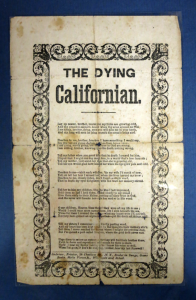
The Dying Californian, or, Kate’s 1st Book Fair!

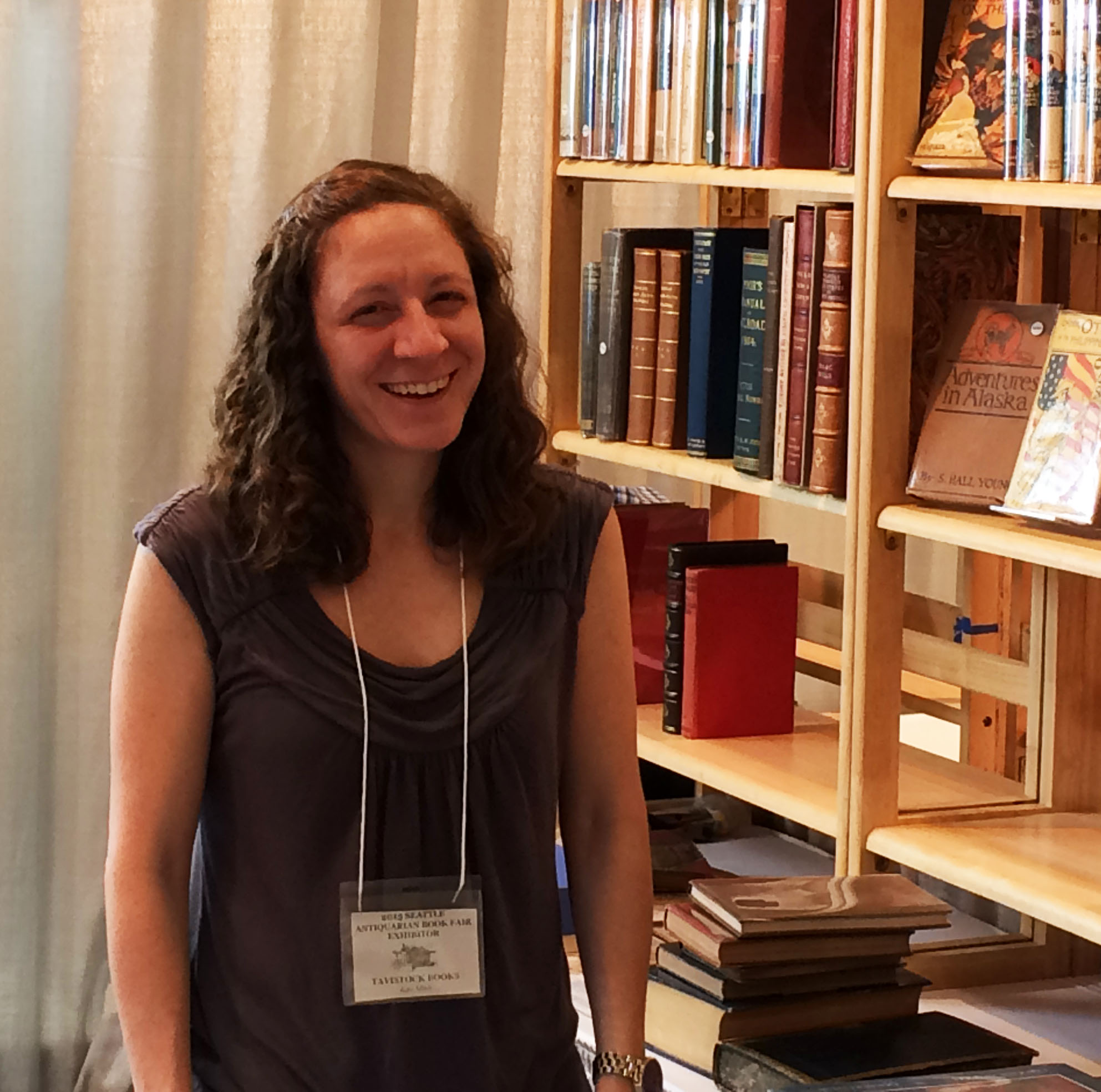
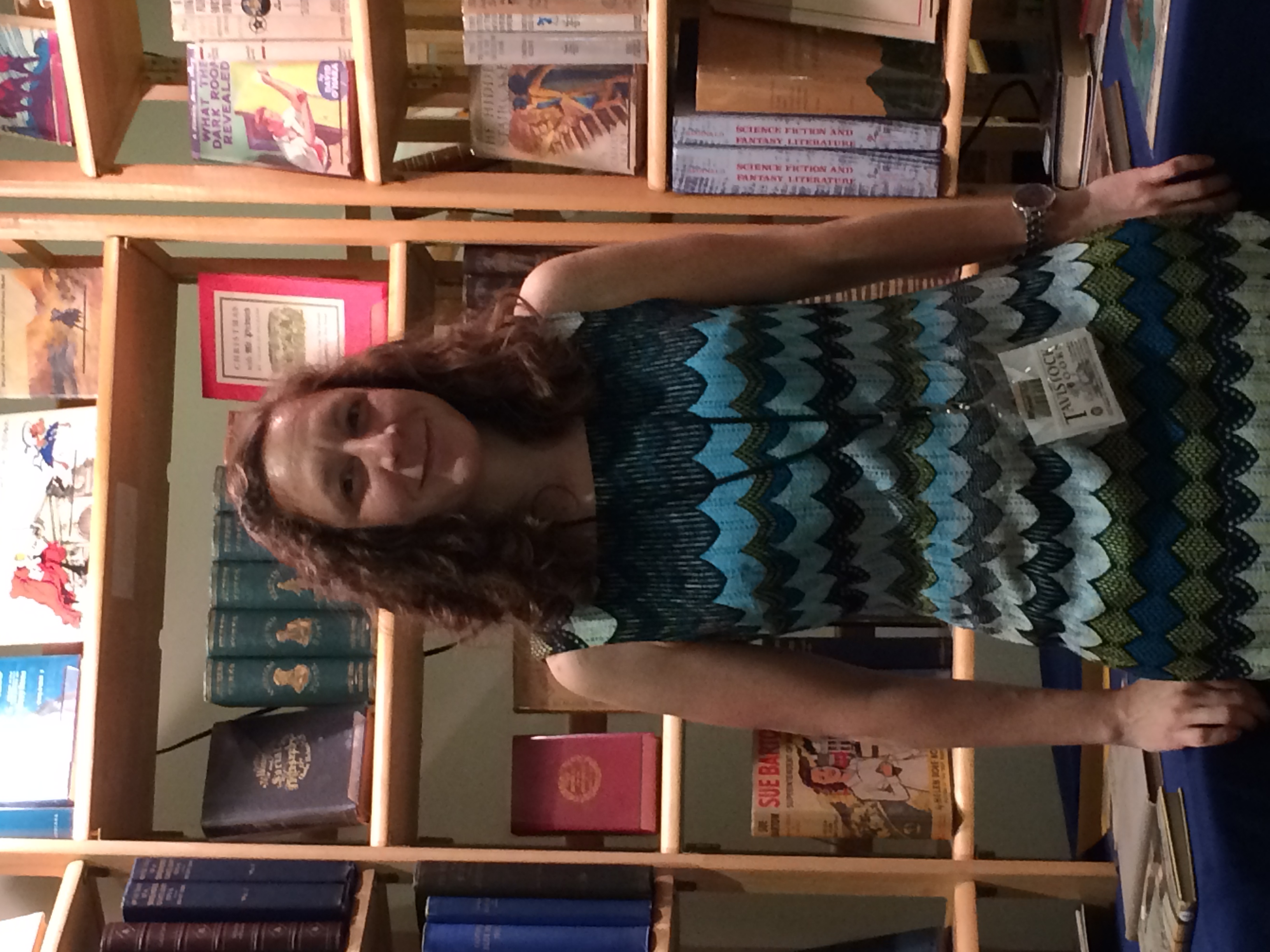
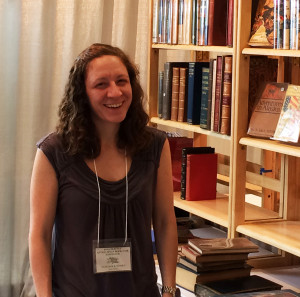
 Kate Mitas, Tavistock Books’ New Right-Hand (Wo)Man, has returned from the Sacramento Antiquarian Book Fair… her first fair (as a worker-bee, that is), and reports back. Beware, readers, as what follows may be a sweetly written, if perhaps slightly disheartening tale!

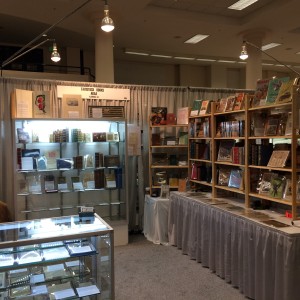
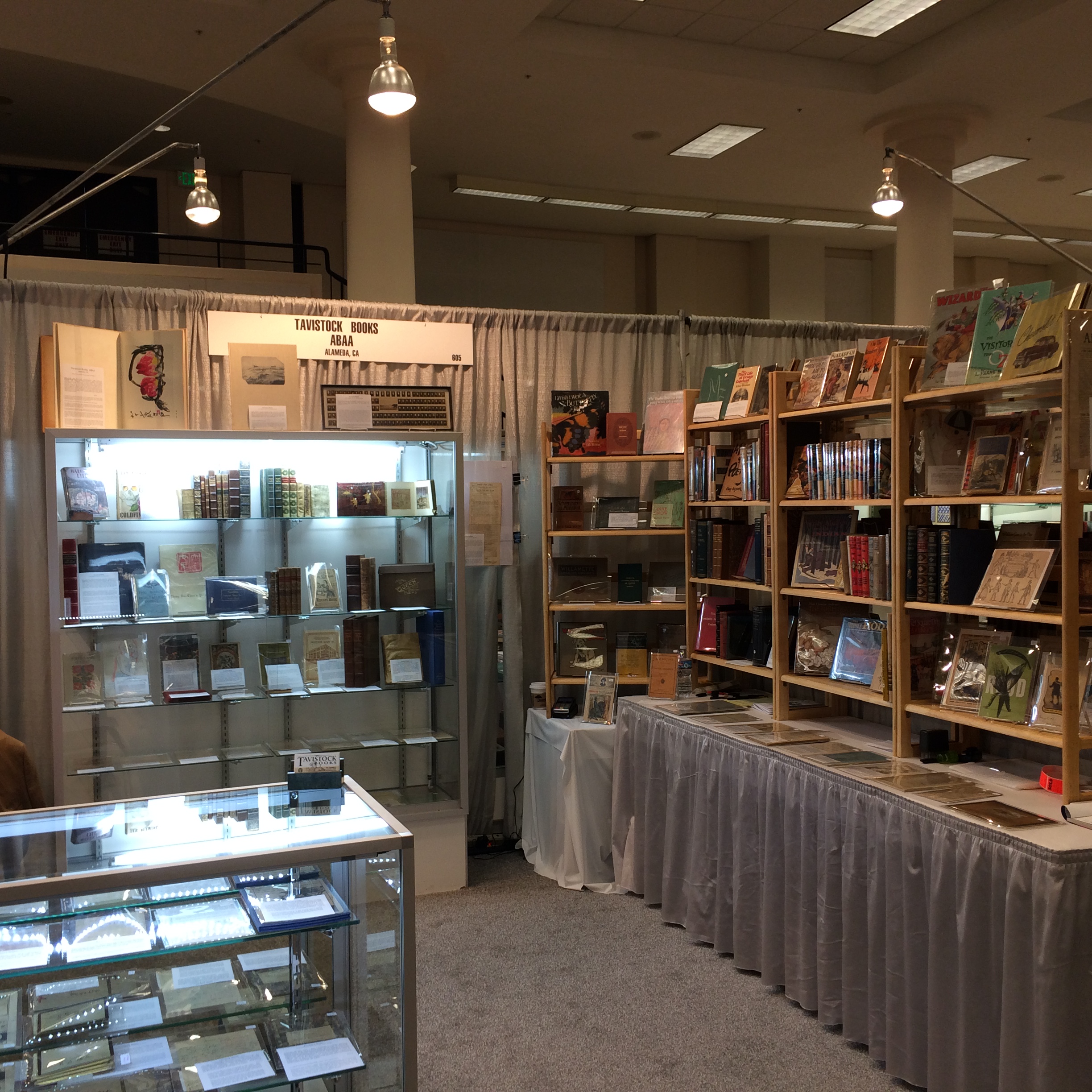
A lovely setup by Ms. Mitas! 1st Tavistock Books booth done - many more to follow!

A lovely setup by Ms. Mitas! 1st Tavistock Books booth done – many more to follow!

By Kate Mitas

The Sacramento Antiquarian Book Fair was a great place for a beginner to become acquainted with the book fair circuit, because it’s one of the smaller, low-key venues, as book fairs go (or so I’m told). A blog post by a certain predecessor of mine had actually alerted me to the casual atmosphere ahead of time, but I was still wired going into it: I hardly slept the night before, and so was more than a bit punchy by the time we started setting up our booth on Friday. And by “we” I mean “I,” since Vic mostly left me to my own devices on that score while he browsed other dealers’ booths – much to the amused commiseration of Bill Bastick from Asian Steppes, situated across the aisle from us, who jokingly referred to me as “slave” for the remainder of the weekend. Nevertheless, I eventually managed to get things set up well enough for a first-timer, I think, and did so just in time for free pizza, courtesy of the show’s tireless coordinator, Jim Kay.

As for the fair itself on Saturday? Well . . . it was a little slow for us. Okay, more than a little: if you must know, it was woefully slow. In short, Tavistock Books had a bad fair.

The day started off promising enough: right out of the gate, a nice woman and her granddaughter purchased a hefty five-volume set of California history. Not only did these two ladies seem intent on reading their books from cover to cover together, but, equally delightful, the set’s departure created a spacious gap on the shelves, which I promptly scurried to fill. Then: nothing, sales-wise. Despite heading the next blank invoice “Sacto Fair” in accordance with Vic’s belief that it would lure the fickle gods of consumerism, despite endlessly cleaning the glass display cases and straightening description labels, Booth #37 remained lamentably quiet. Customers squinted at our shelves and even picked up a book from time to time, but almost always put it back, in some cases repeating this procedure with the same book multiple times throughout the course of the day. Passerby lingered over the rarities in the display cases just long enough to raise our hopes, then moseyed on with nary a backward glance while nonchalantly swinging their regulation white shopping bags, each of which was ostentatiously marked “Sold.” The boxes of Americana we’d hauled out for California ephemera enthusiasts were apparently too daunting, or perhaps too tall, for most. Some of the coolest items, the ones I’d imagined would draw hordes of admirers – like our archive of Gold Rush letters and photographs, or a Steamship Yankee Blade ticket – weren’t  graced with so much as an appreciative sigh, much less a truly interested customer.

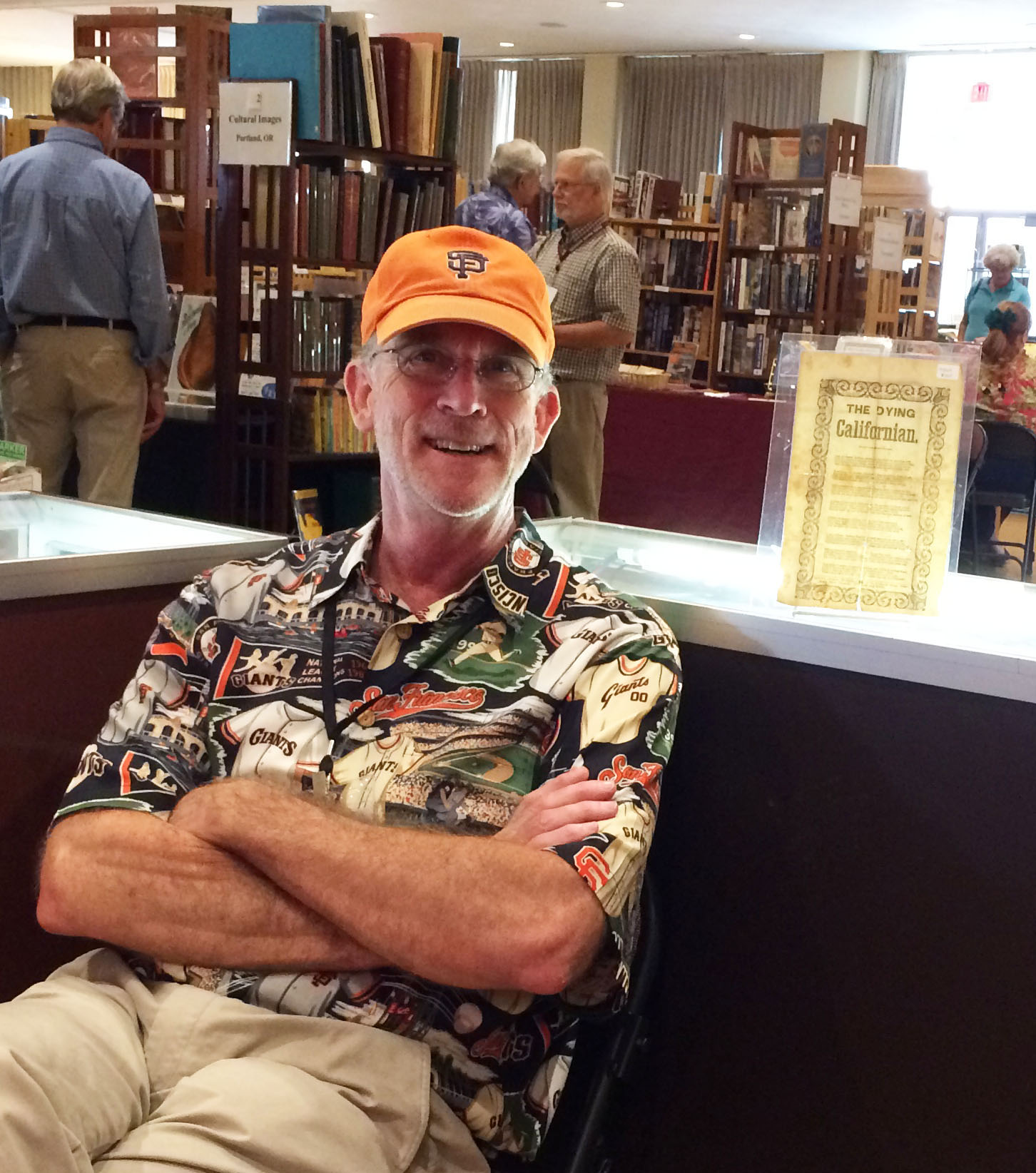
Let’s not forget the King of Tavistock Books… in a surprising choice of an orange Giants baseball cap! (Oh wait… did I say surprising?)

It was hard, I’ll admit, not to feel like the lone museum guard on duty in an empty exhibition hall, especially as many fellow dealers in the surrounding area seemed to be doing just fine. One dealer, in fact, who is a dear and deserving colleague and shall remain nameless, was even doing “just fine” with stock bought, not long ago, from us! We were, and are, sincerely glad for this colleague’s success, of course, but . . . oh, the agony, and the irony. Every now and then, a sale lifted us out of the doldrums and turned us into booksellers again, grateful for the chance to put good material into the hands of people who’d take pleasure in it; one regular at our shop stopped by, and was kind enough to give me props within earshot of Vic (thanks, Jim – don’t spend it all in one place!). But then, inexorably, we’d drift back to our becalmed waters, cursing our luck.

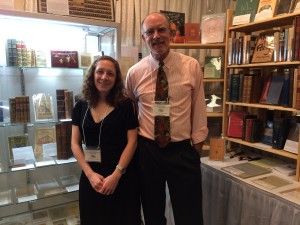
Hard at work!

Hard at work!

The one perk of all the deathly quietude was that Vic let me roam the fair, too. For a so-called small fair, there were enough vendors for the main area of the venue to feel almost too packed, and a decent-sized crowd milling about, as well. The best part, for me, was the sheer range of books on display: from Ken Karmiole’s (Kenneth Karmiole, Bookseller, Inc.) impeccable “old books” – his term, by the way, for the lovely array of pre-1800 material at his booth – to pulp fiction and modern firsts at Magus Books and several others, to Andrew Langer’s (Andrew Langer, Bookseller) collection of quirky ephemera and Elizabeth Svendsen’s (Walkabout Books) assortment of uncommon travel-related books, and so much more. Two of my fellow CABS grads this year, Morgan Brynnan (Uncommon Works) and Bill Wickoff (Ephemeriana), had booths, and I was glad to see them again; C-SPAN even showed up and interviewed (at least) Ken Sanders (Ken Sanders Rare Books) and Nick Aretakis (Nick Aretakis, Bookseller).

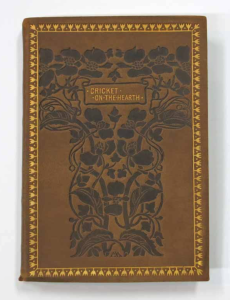
The unrecorded Armstrong found at the fair. Click for more info!

The unrecorded Armstrong found at the fair. Click for more info!

I wish I could say I scored something amazing, as some of the other dealers reportedly did, and as Vic discovered once back in the shop on Monday, in that he bought an apparently unrecorded Margaret Armstrong binding. But, I didn’t, at least not in that sense. Instead, I rediscovered something I’d already known: the incredible generosity of booksellers. Zhenya Dzhavgova (ZH Books) and Kim Herrick (The Book Lair), sharing the booth beside ours (and doing an enviously far brisker business), popped over from time to time to make sure my first fair was going okay and to provide extremely helpful tips (i.e., “Vic hates it when you stand in front of the display cases too long”). Stephanie Howlett-West (S. Howlett-West Books) explained the miraculous business card system of purchasing; David Smith (D.J. Smith Books) told me about other Sacramento fairs I might want to check out, and gave me a cookie, to boot. Andrew Langer even passed along buying tips – as I was in the process of buying from him. And there were more friendly gestures and kindnesses, too many, from too many people, to list them all. Simply listening to the abundance of trade talk – from Ken Karmiole and Vic discussing the possibility of partnering on a particular item, to Laurelle Swan (Swan’s Fine Books) musing about whether she should have brought more things – was an education in itself.

Some booksellers, smarter and savvier than I, can perhaps make it in this business on their own. For this bookseller, however, who needs all the help she can get, it’ll take a village. Or, maybe, a book fair (or a hundred book fairs).

And as for the persnickety little problem of having had a bad book fair? Vic is teaching me well: we’re acknowledging the hit, reassessing, and getting ready to come out swinging next time.

Seattle, here we come.

-Kate Mitas

The day's mascot itself!

         The day’s mascot itself!

Share

An Interview with… A Record Breaking Rare Book School Attendee! (Who also Happens to be the Head of Tavistock Books)

The Lord and Master of Tavistock Books recently finished his 21st course at Rare Book School in Charlottesville, Virginia, having started this love-affair back in 1998! To know more, read on!

So, Vic, you’ve just finished another summer at RBS! How was it?

Let’s start with the word, “Inauspicious.”  Not a word one would normally associate with Rare Book School, at the University of Virginia, Charlottesville [or, to those with some familiarity, C’Ville].  But the word applies this year.  Why?  Because after flying 5 hours Saturday from SFO to IAD, then waiting another 7-1/2 hours for the regional flight down to C’Ville [scheduled 10 pm departure, delayed 3 times], IT WAS CANCELLED BY UNITED AT 12:30 am that night!  Can you say Super Shuttle?  The end result- I didn’t get to sleep till 3 am that Sunday morning.  Yikes, was I a tired puppy that day!
However, as in most such situations, there was a silver lining.  Guess who was also waiting for the flight to C’Ville?  Terry Belanger, Founding Director of Rare Book School.  So, at least, during that ‘delay’ time Terry & I were able to converse on many divers topics.
And you ask, “How was it?”   Simply…  great.  I’ve taken a goodly number of courses [21, since 1998], and all have had aspects of greatness.  This one, THE HANDWRITING & CULTURE OF EARLY MODERN ENGLISH MANUSCRIPTS, taught by the paleography expert, and very personable, Heather Wolfe, Curator of Manuscripts of the Folger Shakespeare Library, I would rate in my Top Ten.
How many times have you been to RBS? You hold the record for attendance, no?

Yes, with 21, I’ve been told I now hold the record for “Most courses attended”.

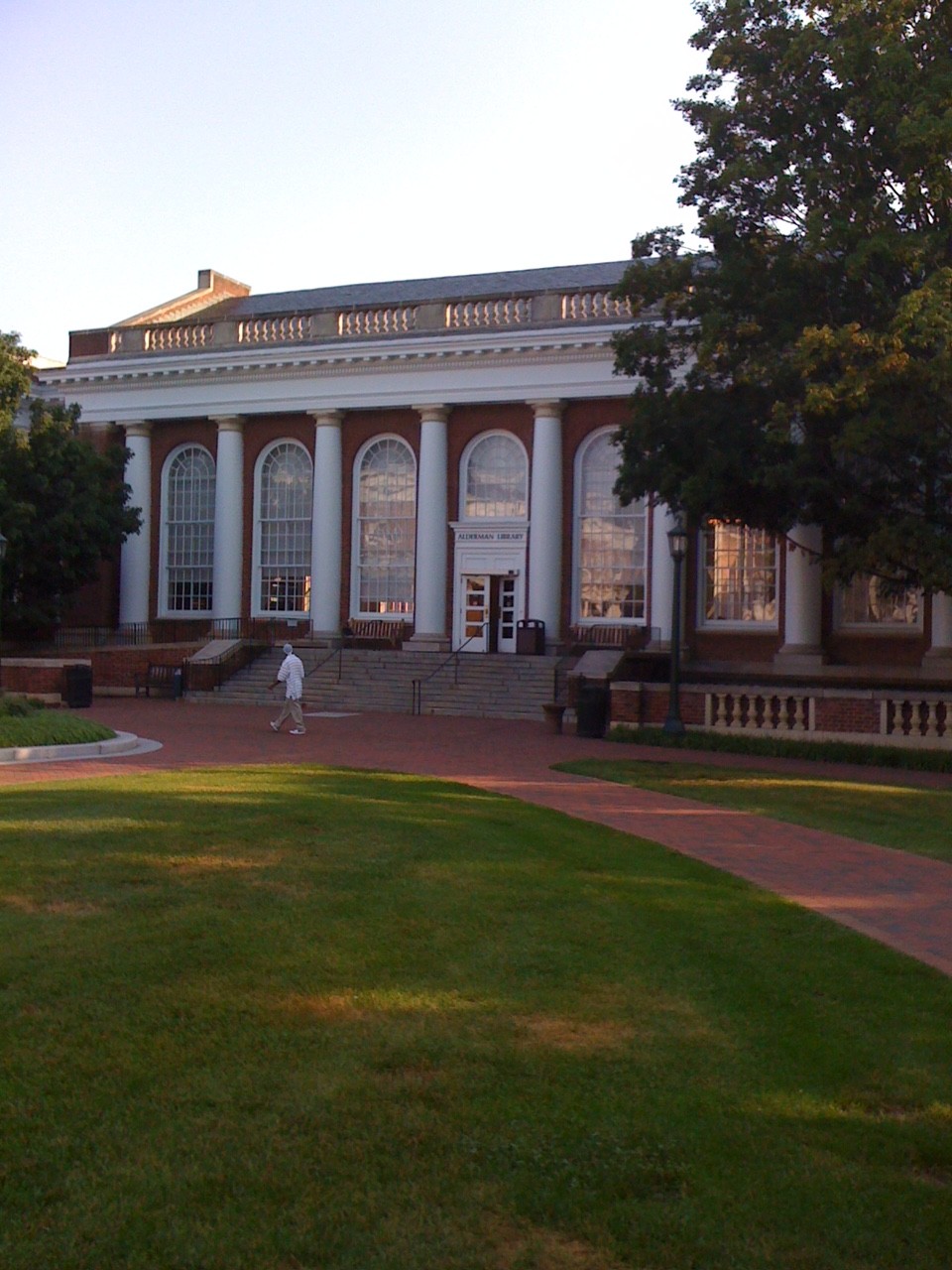
The beautiful Alderman Library, where, deep down inside you can find dozens of RBS students!

The beautiful Alderman Library, where, deep down inside you can find dozens of RBS students!

Why go every year?

A couple reasons…  first, RBS is the premier place where one can find week-long subject-specialty courses on the many divers aspects of the ‘Rare Book World’.  And I believe knowledge is a ‘critical success factor’ for those in the antiquarian book trade, so these courses add to my  knowledge base.

Second, there are few other places where you’ll find, all at one time, ~ 60 other like-minded folks all not only willing, but eager, to discuss rare books.  Such not the case in Alameda CA, where on a given day, I’ll see Steve the Postman & that’s about it!  So in C’Ville, one can’t help but make bookish friends…  I’m still in touch with folk I met at RBS in 1998, and subsequently.
Third, it’s just plain fun!  C’Ville is a fantastic college town, with some wonderful restaurants, and a goodly number of bookstores.  What’s not to like?
What, in your opinion, was the best thing about the course you took this summer?

The course focused on the English Secretarial hand, a script, for the most part, totally impermeable to me prior to July 20th.  This not to say I’m now fully conversant, not by a long shot, but now I have the tools to decipher much of what I’ll find in front of me.  The challenge going forward will be to maintain that little progress I made during the week.

As to the day-to-day schedule, I haven’t detailed that here, for Cynthia Gibson did it recently for an ABAA blog post.  My day-to-day was similar, albeit with a different subject.
Not that it’s a contest, but could you tell us your favorite course ever taken?

Probably ILLUSTRATIVE PROCESSES, my first course, taught by Terry Belanger, taken back in 1998.

Would you tell every book enthusiast to go to RBS every year?

Well, certainly I advocate it.  I so much believe in what RBS can provide to an antiquarian bookseller that I established the Tavistock Books Educational scholarship back in 2011 [2012?].  For a young bookseller, I’ll pay the tuition to the RBS course REFERENCE SOURCES FOR RESEARCHING RARE BOOKS, taught by Joel Silver, Directory of the Lilly Library [for those interested, details can be found on the RBS website].  So yes, you could say I would tell all to go every year, as I certainly follow my own advice!

When book-minded people get together, dinners and drinks are common occurrences! What is your favorite social aspect of the weeks?

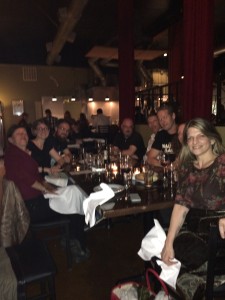
Vic (far rear on the right) and clan at Hamilton's on the last night of RBS!

Vic (far rear on the right) and clan at Hamilton’s on the last night of RBS!

Sunday night, after the opening reception/talk, folks sign up for a meal at a nearby restaurant.  It’s a great ice-breaker for ~ 10 people to get to know each other, as well as sample the fare of the local eateries.  Our 10 ended up at Michael’s Bistro & Taproom, a C’Ville institution.  And then Thursday night is bookseller night, where the local bookstores stay open a bit later to accommodate the RBS student’s schedule.  After, I always get a half-dozen or so folk to join  me at Hamilton’s on the Mall.  Been going there since ’98, and haven’t ever had a bad meal, not even a so-so one.

If you stay on the Lawn, then one social aspect is the gathering of folk outside one room or another, and drinking, talking, playing music.  Very social…  and one can always tell the next morning those that joined in!
All-in-all, a lovely week, and I met some terrific folks I know will be friends for a long time.  And while I’m a bit wistful that it’s all over so quickly, I look forward to next October, when the RBS staff announces the 2016 schedule.  I’ll be there, you?
Click here to learn more about Rare Book School!
Share

Dire Circumstances at Tavistock Books (Humorous Relief for Your Reading Pleasure)

Something that has happened often enough at Tavistock Books to admit (as long as my boss does not read this blog) is the dropping of books. My first week Vic left me alone with the store (let’s not even talk about how I neglected to charge a guy spending $600 sales tax or that I accidentally tripped over a globe and bled on the carpet) and while he was out at a Giants game, enjoying the sunshine and the hot dogs, I was pretending I knew how to do leather dressing on a book. I was startled by a customer (you know… human interaction frightens me), and the book slipped out of my hand, slammed to the ground, and both boards snapped off the spine and lay in a messy heap at my feet.

So, logically, the next thing I did was to call my father immediately (meanwhile the book is still on the ground, in case you were wondering) and cry a bit and tell him that I was going to get fired. After about 10 minutes of whining to a parent who was, at that point, probably more than a bit concerned about my overall mental health and what the California air was doing to my brain, I acted my age and called my boss. With only minor cracking in my voice I told him I had dropped a book and broke it. Vic, of course, couldn’t be less concerned and simply said, “okay so… we’ll get it fixed?” I did neglect to mention on the phone that it was a $1000 book, but oh well! I didn’t get fired (clearly).

The point of this blog is to inform other young booksellers the proper etiquette when dropping a book, this especially for all the assistants out there. Once a book is dropped, the first thing you should do is look around to see if anyone saw and/or heard the book being dropped. If the answer is no, breathe a sigh of relief and then pick it up quickly. While casually looking like you’re inspecting the state of the mylar dust jacket cover or the age-toning of the endpapers, inspect the book for any bumping or creasing you may have caused that you could not definitively say was there before. If any disfigurements are found, the first thing you should do is put it in a pile somewhere where human customers go, and leave it out for a day or two. Then, when your boss is sitting right in front of you, casually find it and exclaim over the horrifying tear or crease and start calling customers names in your anger at their casual manhandling of your precious books. The madder you get, the better. Your boss may think you have anger management problems, but so be it. He’ll never know the difference. You could take my route and hyperventilate instead, but it’s really not a good idea. Salt-water wrecks havoc on paper and if you cry on the book it will just make it worse.

(This is, of course, a joke, and I have always told my boss when I drop things.)

(I almost always tell my boss when I drop things.)


(Customers should really be more careful around Tavistock Books.)

Share

The Brothers Fleming: Peter & Ian and a shared Bond

Everyone knows the name Ian Fleming. It is not, by any means, a new name to the 20th century reading public and almost all could tell you that the great Ian Fleming was the creator of the dashing James Bond and all his escapades. However, all may not know Ian Fleming was not only the author of the Bond novels, but also an English journalist and naval intelligence officer. But he is primarily remembered as an author, who sold thirty million books during his lifetime, with double that sold in just the two years following his death.  Made into films, by 2012 the Bond series movies were the second highest grossing film series of all time, trailing only behind Harry Potter.

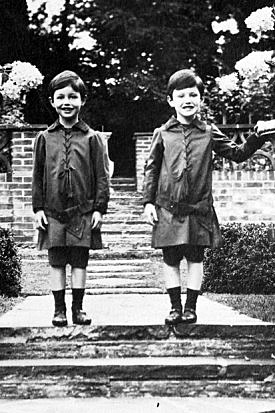
Peter and Ian as youngsters - so close that it is hard to tell them apart!

Peter and Ian as youngsters – so close that it is hard to tell them apart!

We know Ian Fleming was one of five children, grandchild of Robert Fleming (a wealthy merchant banker, founder of Robert Fleming & Co.). But what is known about Ian’s older brother Peter Fleming? Many today may not know or remember this name, but in his time Peter Fleming too rocked the literary world, just as his younger brother would a decade or so later. Peter Fleming, born in May 1907, was an adventurer, a travel writer, and a heartthrob throughout the 1930s and 40s. How then did this popular, adventurous author become overshadowed by his younger brother to the point where almost ten years after James Bonds’ author Ian died young, Peter’s modest gravestone in a quiet town in the Oxfordshire countryside read, “He travelled widely in far places; Wrote, and was widely read. Soldiered, saw some of danger’s faces, Came home to Nettlebed. The squire lies here, his journeys ended – Dust, and a name on a stone – Content, amid the lands he tended, to keep this rendezvous alone.” How one goes from stardom to a modest, quiet life is a very good question indeed!

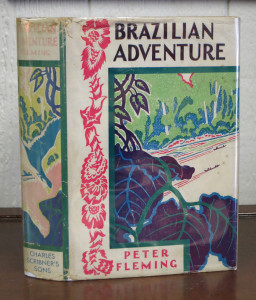
Our 1st edition listing of Peter's first book.

Our 1st edition listing of Peter’s first book.

Peter and Ian Fleming grew up one year apart, from a well-to-do family, in the United Kingdom. Though it must have been difficult growing up so close in age as sibling rivalries took place, the brothers seemed not to let it get in the way of their relationship and throughout their lives were steady supporters of each others’ careers. Both were trained in intelligence during the course of World War II, both were star pupils at Eton (though where Peter seemed to glide through, Ian was a more difficult case). This, unfortunately, seemed a usual ritual. Ian struggled to make a living as a stockbroker, while a 24 year old Peter was working as the assistant literary editor at The Spectator. Peter answered an advertisement looking for a adventurous soul for an expedition through Brazil, and began his travel writing career. The resulting book, Brazilian Adventure, launched the elder Fleming’s literary career. He married the beautiful film actress Celia Johnson, and for a while his fame was more intense and well-known than Ian ever dreamed he could experience. Unfortunately, in 1947, Peter fell from a horse and suffered a crushed pelvis. After this incident he wrote no more travel books in far-off places, and retired to a somewhat more modest and quiet life.

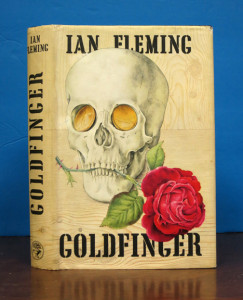
Goldfinger - one of Ian Fleming's most beloved stories. Our holding signed by Bond movie stars!

Goldfinger – one of Ian Fleming’s most beloved stories. Our holding signed by Bond movie stars!

Peter was the instigating force behind the publication of Ian’s first novel, Casino Royale. It was Peter who suggested the change of M’s secretary to Moneypenny. Peter went over Ian’s manuscripts with such a fine-toothed comb that it “earned him the nickname Dr. Nitpick” (Telegraph.co.uk). So why then – if Peter was the accomplished literary scholar, the responsible adventuror, the charming author – is it more his younger brother we remember today? Ian Fleming wrote Casino Royale in 1952, and finished the novel within a short span of a couple months. The resulting story was immediately popular and three print runs were necessary to cope with the large demands made for the book at its publication. Casino Royale introduced the character of James Bond, a handsome and charming MI6 Secret Intelligence Officer, known by his code name “007.” The Bond stories center around this daring spy’s exploits, often involving ruthless villains and pretty women. Ian Fleming enjoyed a decade of immense success following the quick publication of his first five Bond novels, a period which went into a short decline after his popularity suffered a blow under a harsh criticism of his book Dr. No. However, it bounced back once knowledge that his novel From Russia, With Love was hailed as one of John F. Kennedy’s favorite books of all time. At this time Fleming began work on the screenplay of Thunderball, Goldfinger, Dr. No and From Russia, With Love, while also taking the time to publish a beautiful children’s story, Chitty-Chitty-Bang-Bang.

Unfortunately for Ian, his life was cut short. A life-long drinker and smoker, Ian suffered a fatal heart attack on August 12th, 1964 and passed away on his son Caspar’s 12th birthday.  For the years remaining to him, Peter struggled to be a father-figure to the troubled Caspar (who committed suicide at the age of 23), but Peter also succumbed to a heart attack 7 years later, while out shooting with friends. Hunting game was one of Peter’s greatest joys in life, and a primary he pursued the Brazilian adventure mentioned earlier. It seems only appropriate that he would die doing something he loved.

What then, of the intense similarities and differences between these two brothers? Both magnificently talented, if not in similar writing styles, but more their ability to make a splash. Both dependent on the other for support and friendship throughout their lives. On one hand you could make the argument that it is unfair for so much literary popularity to reside in one family. On the other… how lucky we are to have experienced both of their styles and careers from their literary remains!

Share

Dickens’ Final Chapter: The End of His Life and His Last (Unfinished) Work, The Mystery of Edwin Drood

Charles Dickens was only 58 years old when he passed away. He had long pushed himself too hard for the love of his work and his followers, and in the summer of 1870 (June 9th, to be exact) he succumbed to the exhaustion and after experiencing a fatal stroke, was laid to rest. His work, however, has gone on to be remembered since, and the author has never been out of print. His final work, The Mystery of Edwin Drood, has long fascinated fans, as the murder mystery was unfinished at his death and Dickens never [formally] named the murderer. On this the 145th anniversary of the author’s death, we look at his last years and his final work – a novel that he persisted on writing, even while suspecting his end was near.

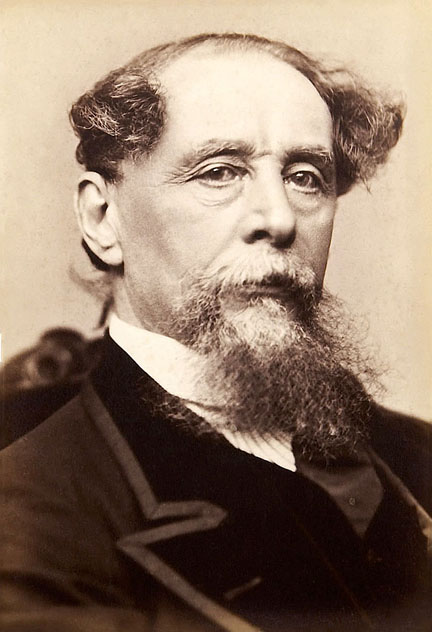
Dickens, toward the end of his life.

Dickens, toward the end of his life.

Dickens’ health began to decline when he was involved in the Staplehurst rail accident on June 9th 1865 (5 years to the day before his death, coincidentally). On his return from Paris with his young mistress Ellen Ternan and her mother, the train they were traveling on plunged off a cast iron bridge that was under repair. Luckily, the only 1st class carriage to remain on the track was that one in which Dickens was traveling. Until more aid arrived to tend to the victims, Dickens scrambled around the horrific scene offering brandy and a hat with water, looking after the dead, dying and wounded around him. The tragic incident cast a shadow on Dickens’ life – the horror and absolute panic he experienced led to sleepless nights and night terrors for the rest of his short life. Always the author, however, before leaving the scene of the accident he remembered his unfinished manuscript of Our Mutual Friend was on board and went back to retrieve it.

Though the Staplehurst accident could be viewed as the “beginning of the end” for Dickens, what truly sapped the author’s strength and health was his insistence on the readings that he provided for his fans all over England and United States. These readings were not Dickens merely climbing up to a stage and reading his work aloud to audiences. The author planned his every look and every nuance, practiced scenes until he had them perfect, and left an impression with his audiences that they had just seen the characters they knew and loved on the stage before them. Quite the actor, Dickens had auditioned for a stage career as a young man, but when a cold prevented him from making the tryout, he turned toward a journalism career. In any event, the public readings took much more out of him than his audience realized, and Charles Dickens slowly succumbed to the stress he placed on himself. His farewell readings, lasting from the 6th of October 1868 to the 22nd of April, 1869, took the last of his energy. He began to experience fits of giddiness and paralysis and even collapsed while on tour in Lancashire; Doctors ordered the rest of his “performances” to be cancelled. Dickens retreated to his house, Gad’s Hill Place, in Kent, and under instructions to rest and recover, he began work on what was to be his final novel, The Mystery of Edwin Drood.

Drood was set to be published in only twelve installments, a shorter publication decision than his usual 20 printed parts of a couple chapters each. Though Dickens supposedly mentioned that the murderer was $#&@%#^$ in the @&#^*#*$&@* with the $*#&@*#$& (wouldn’t want to “kill it” for the rest of you), that information is based on the statements of Dickens’ son and also of his close friend John Forster (not unimaginable divulges, but still not ever found to be public knowledge from the author himself). This open-ended story yielded an amazing treat to the public – the chance to finish a Dickens book themselves! Strangely, the first three attempts to complete Dickens’ original tale were written by Americans. The first of them, published in 1870, was more of a farce than a continuation, with the author not even trying to continue Dickens’ style or even storyline (he even magically transported the characters to finish their mystery in the United States ). The second attempt was slightly more serious, a New York journalist named Henry Morford liked the story so much that he traveled to Rochester and published his ending serially from 1871 to 1872, and allowed the character of Edwin Drood to survive the murder attempt. The third effort, which to me seems to prove the gullibility of humans, was written by a Vermont printer named Thomas James. James claimed to have been a “ghost-writer” of sorts (pun intended)… by channeling Charles Dickens’ departed spirit.

Drood4

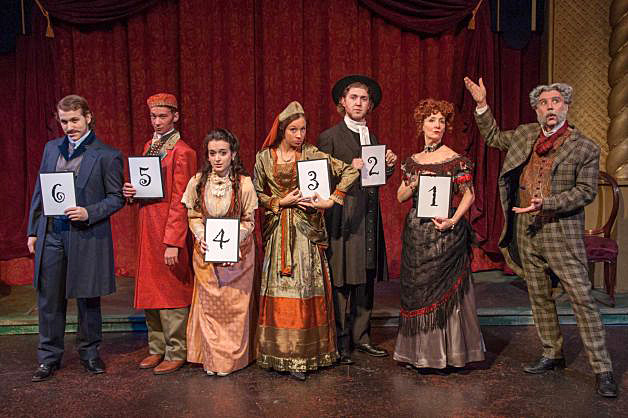
                   A performance of “Drood.”

In 1914, London’s ‘Dickens Fellowship’ held a mock-trial for Drood’s uncle John Jasper (oh, whoops… did I ruin it for you?). A group of well-known writers made up the characters (G. K. Chesterton stood as the judge, George Bernard Shaw the foreman of the jury, etc.). The jury returned with a ruling of manslaughter, and in a great dramatic ending, Chesterton “ruled that the mystery of Edwin Drood was insoluble, and fined everyone, except himself, for contempt of court.” (Wikipedia). There have been four film adaptations of the book, a two-part television drama, a radio reading, and perhaps most interestingly, a musical comedy based on the book. As to this latter, Rupert Holmes wrote the script, music and lyrics to the musical with a twist – at the end of the play, the audience decides by vote which of the characters is the murderer. Not only that, but the audience also picks a romantic ending between two characters of their choice! Holmes wrote alternate endings for every possible voting outcome, even the most unlikely. The actors must memorize and rehearse each possible ending before performing in front of a live audience with an opinion! The production, now titled “Drood,” was first performed in 1985 and was quickly opened on Broadway for a total of 608 performances. It won five 1986 Tony awards, including the award for Best Musical.

A theatre production of "Drood" when the audience is helping choose the ending themselves!

A theatre production of “Drood” when the audience is helping choose the ending themselves!

Now I may not be one for assumptions, but in my personal and ridiculously humble opinion I believe that Dickens would be ecstatic about this new development in the reading of his novel. As I said earlier, the author was always a fan of the stage and wore himself ragged engaging his audiences in a way that no readings had ever done before. In a way, above the movies and the television spots and the proposed written endings for the novel, the musical arrangement of his last and mysterious work with the alternate endings and the audience’s participation seems to me like exactly what the author would have wanted. Engagement, imagination and creativity as a group – just what Dr. Dickens prescribed.

In any event, Dickens clearly left behind a great impression on many future generations of readers and writers. His last work has sparked more investigation and speculation than any of his other works, due to the fact that it remained unfinished – an invitation for his admirers to become involved in a story of (partly) their own making. A more important notion to take away from his final days, however, is that the author loved his work and his readers so much that he didn’t stop working until the very end. And just think, all for our enjoyment! Even now, 145 years to his dying day, enthusiasts and admirers continue to devote their academic and creative minds to understanding the man and his final, unfinished novel.

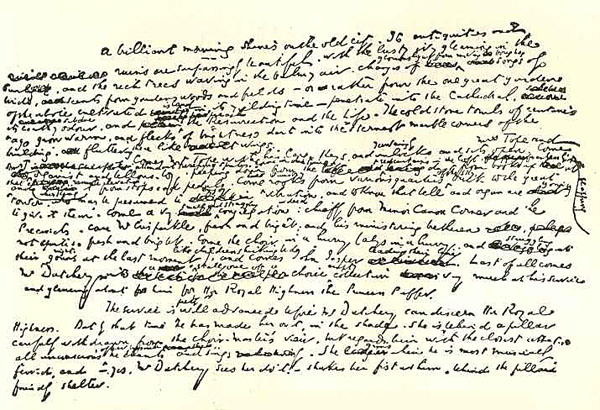
A page from Dickens' unfinished manuscript of The Mystery of Edwin Drood.

A page from Dickens’ unfinished manuscript of The Mystery of Edwin Drood.

Share

A Donation to Children’s Illustration: A Short Tribute to Randolph Caldecott

Randolph Caldecott was born in March of 1846 in a city called Chester, England. He left school at the tender age of fifteen and went to work in a bank branch. In 1861 he saw published his first drawing – and despite the fact that he was to be most remembered for his humorous depictions and lively countryside scenes, Caldecott’s first published work would be of a catastrophic fire at the Queens Railway Hotel in Chester which, along with his write-up of the event, appeared in the Illustrated London News. In his early twenties Caldecott was able to transfer to the Manchester & Salford Bank in the thriving Northern city and began to take night classes at the Manchester School of Art, all while continuing to have his sketches published locally. Upon making the acquaintance of Henry Blackburn and getting published in the London Society, Caldecott realized his talent could be enough to support him and at the young age of 26, he quit his banking job to move to London. In 1869 Caldecott exhibited an illustration in the Royal Manchester Institute, and 7 years later was displayed once more, this time at the Royal Academy. In 1872 he was elected to the Royal Institute of Watercolour Painting.

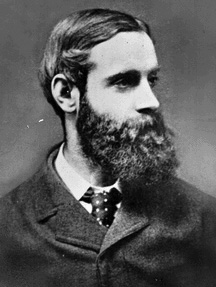
Randolph Caldecott.

One of the only surviving images of Randolph Caldecott. 

In 1877 Caldecott’s life would change forever, as he filled in for Walter Crane’s absence in the production of two small children’s Christmas Books – The House that Jack Built and The Diverting History of John Gilpin with color printer Edmund Evans. He would go on to create/illustrate two children’s stories for Evans at Christmastime until his death in 1886. These children’s stories became standards as Christmas annuals and were immensely popular, bringing Caldecott fame from around the world. As an enterprising young man, he also became quite wealthy from his work. As the website randolphcaldecott.org.uk states, “Randolph Caldecott is believed to be the first author/illustrator to have negotiated with his publisher to receive, instead of a fixed fee, a ‘Royalty’ per book sold: he received one old penny per book (there were 12 pence to the shilling). The first print run was a cautious 10,000 copies. They were so popular that by July 1886, 5 months after his death, over 800,000 copies had been sold.

Caldecott often visited warmer climates in the winter months, due to consistently bad health (after an illness at a young age the illustrator continuously suffered from a heart condition and gastritis). The last winter of his life, he and his wife Marian Brind traveled to New York and down to Florida. Unfortunately it was an abnormally cold winter, even in Florida, and Caldecott took ill and never returned to the United Kingdom. His last days were lived in St. Augustine, where he died on February 12th, 1886.

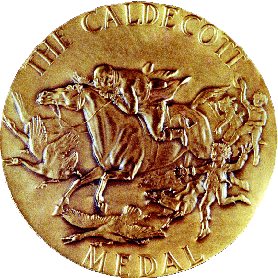
The Caldecott Medal with it's replication of The Diverting History of John Gilpin illustration.

The Caldecott Medal with its replication of The Diverting History of John Gilpin illustration.

Let us now turn to the story behind the annual award to a children’s book illustrator named in Caldecott’s honor. Rene Paul Chambellan, an American architectural sculptor who specialized in the Art Deco style, designed the medal in 1937. The medal itself depicts two of Caldecott’s most famous illustrations – a scene from his work The Diverting History of John Gilpin and one of his nursery rhyme “Song of Sixpence.” After the Newbery medal was created (also in 1937 – as an award for distinguished children’s literature), “many persons became concerned that the artists creating picture books for children were as deserving of honor and encouragement as were the authors of children’s books, Frederic G. Melcher suggested in 1937 the establishment of a second annual medal. This medal is to be given to the artist who had created the most distinguished picture book of the year” (ALA.org – American Library Association). The rules of the Caldecott award are quite simple, really. It must be a book with original work (whether also written by the illustrator or not) by an American citizen or resident (or in a U.S. Commonwealth) that distinguishes itself in the field of children’s illustration. The medal itself weighs just over 3 pounds, and is not worn but rather presented in a box for display.

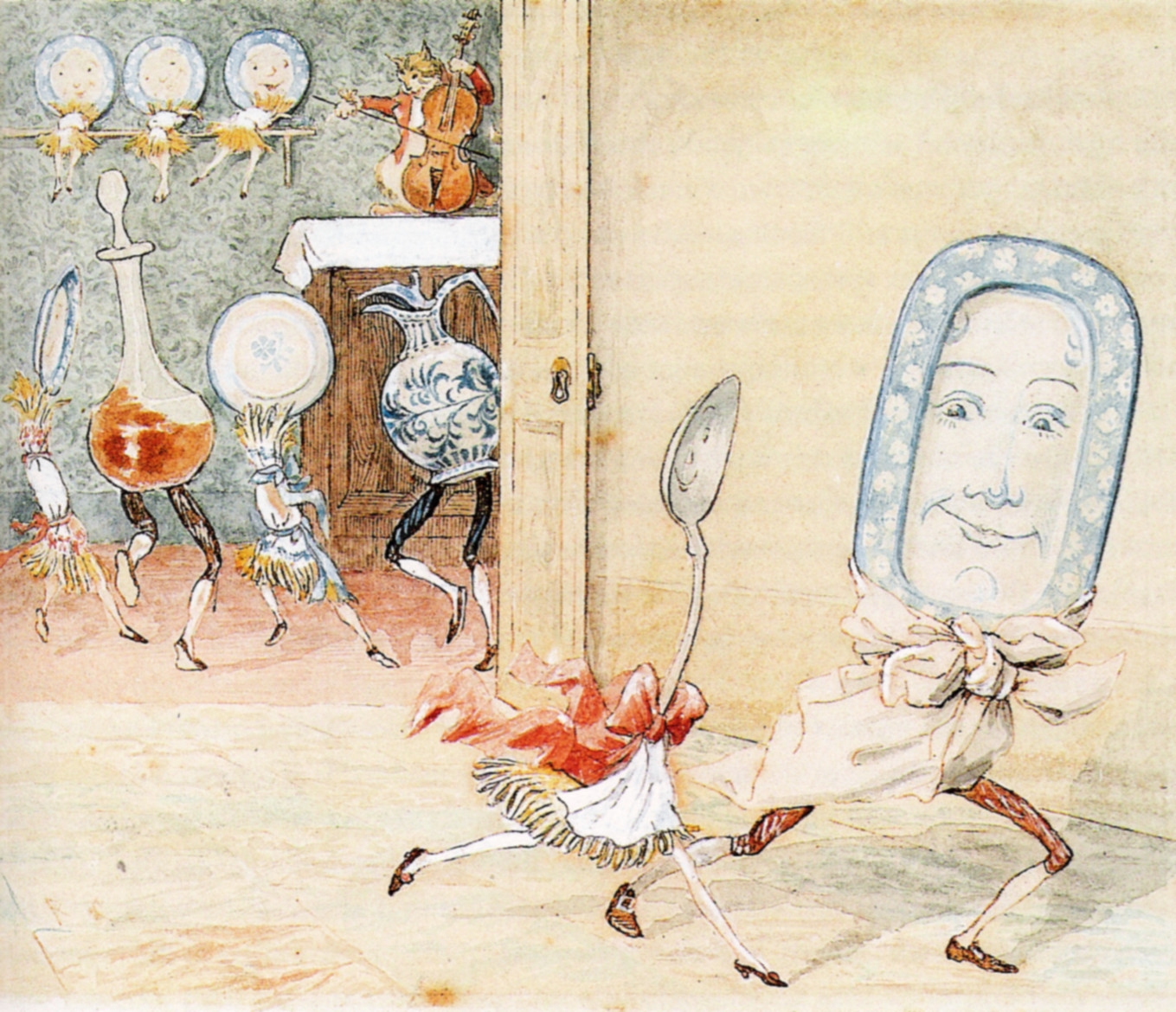
"And the Dish ran away with the Spoon!" An Illustration by Caldecott, demonstrating his humorous, exciting and moving illustrations.

“And the Dish ran away with the Spoon!” An Illustration by Caldecott, demonstrating his humorous, exciting and moving illustrations.

Though the reason for a British illustrator being chosen as the figurehead/namesake of an American award continues to confuse some of the American public, the American Library Association website claims (rightly so) that Caldecott was one of three of the most influential children’s illustrators working in the 19th century. Along with Walter Crane and Kate Greenaway, Caldecott helped shape an entirely new generation of children’s illustration with his humorous visuals. As ALA states, “his illustrations for children were unique to their time in both their humor, and their ability to create a sense of movement, vitality, and action that complemented the stories they accompanied.” We cannot deny the fame that Caldecott experienced, even in his short period as an artist, but we also cannot deny the influence he exerted on illustrating for children and the importance of humor, color and excitement in his pieces. Thank you Randolph Caldecott!

Share

A Gathering in Albany: the Quarterly Meeting of the ABAA’s Northern California Chapter

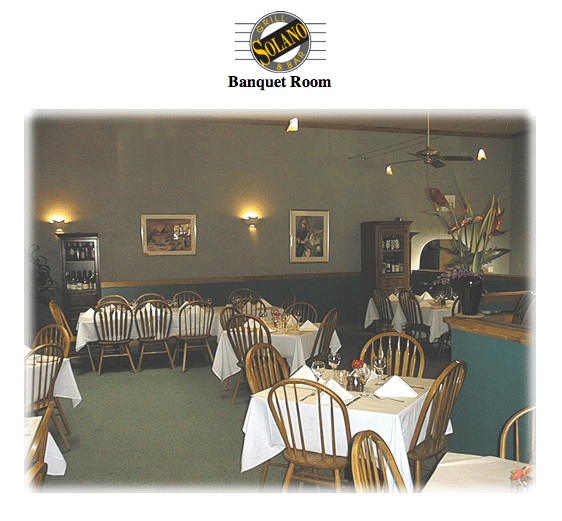
The Banquet Room of the Solano Grill & Bar in Albany, California.

The Banquet Room of the Solano Grill & Bar in Albany, California.

The Solano Grill & Bar, on Solano Avenue in Albany, is now used to hordes of booksellers crowding their bar area and taking up the entire top floor for their quarterly meeting. A great gathering of ABAA booksellers and their guests, it gives booksellers a chance to talk about business, upcoming & past fairs, and share recent anecdotes about the goings-on in the antiquarian book trade.

Beginning with cocktail hour starting at 6pm (which is great, unless you are stuck in rush hour traffic near Emeryville and happen to be 40 minutes late to cocktail hour), booksellers eventually take their seats in the Banquet Room (good & liquored up, at this point), and the meeting begins. The food is more than acceptable at Solano, especially given the sheer number of orders they are passing out to one (rather large) table. After salad and entrees (of which the booksellers could choose, in advance, from 4 options), Michael Hackenberg, Steve Blackmer, John Windle and our own Vic Zoschak took the stage to discuss recent booktrade events. First there was the introduction of guests (of which Tavistock Books, as always, had a healthy helping – Kim Herrick of The Book Lair, Zhenya Dzhavgova of ZH Books, Andy Langer Bookseller, and, of course, me), and then Chair of the NCC Michael Hackenberg took the stage. Over the course of the evening Mr. Hackenberg discussed the recent Oakland fair (and the exciting news that we turned a profit at such, despite being 10% down in the exhibitor category) and showed us a memento that will be sent to Oakland mayor Libby Schaaf as a thank you for attending opening night of the Oakland ABAA fair this past February. Hackenberg also discussed the upcoming NCC Scholarship for educational opportunities for Northern California booksellers, where a lucky nominee will win tuition to a Rare Book course of their choosing (be is RBS, CalRBS or CABS).

Steve Blackmer, treasurer of the NCC, and owner of Chanticleer Books, stated the chapter’s solvent status (yay!), and John Windle (John Windle Antiquarian Bookseller) made a few headline announcements! Rachel Eley (of John Windle Antiquarian Bookseller) has given birth to a healthy baby boy (a future bookseller, hopefully!), and also has recently been made an Associate Member of the ABAA. Windle also proudly announced the great news that his Tour-de-Force wife Chris Loker, curator of the recent Grolier Exhibition “One Hundred Books Famous in Childrens’ Literature”, has now sold out of the printed catalogue of the exhibition after only a short 4 months! Vic, as Vice Chair and chapter representative to the ABAA board, then advised the chapter that the minutes were out and available on the website, that RBMS (the Rare Book & Manuscript Society conference) will be in June and held in Oakland at the Marriott Convention Center (the same as was used recently for the Oakland fair), and therefore holds a possible sponsorship opportunity for the chapter. Also, Vic spoke of the current ABAA investigation of a possible educational opportunity for RBS that hopefully we will be able to hear more of in the coming months.

NCCpicNCCpicAs the dinner came to a close and all of us booksellers returned to our caves (just kidding… I sleep in a display case), another get-together had come and gone in the blink of an eye. Luckily, however, booksellers get together somewhat often, as book fairs and events are spread out throughout the year. Next up: the Sacramento Antiquarian Book Fair on Saturday, March 28th! Come out and support your local booksellers!

Share

New News from Tavistock Books!

First off, we’d like to wish each and every one of you a very Happy New Year from Tavistock Books! Whether you are a customer, colleague, pure bibliophile, or my mother and father, we have appreciated your attention and custom this past year and wish you all the best of luck in 2015! There are a lot of things happening around here in the near future, and we thought we’d send out this update from TB to keep you in the loop.

Most importantly! Upcoming Antiquarian Book Fairs:

Later this January and early February features the annual California book fairs – the 48th California International Antiquarian Book Fair to be held in Oakland, CA (right near us! Check it out here: http://sfbookfair.com/) from February 6th to the 8th, and the Pasadena Book, Print, Photo & Paper Fair the previous weekend (at the Pasadena Convention Center, January 31st & February 1st). The fairs are a great chance to meet with like-minded book-loving folk from all over the United States, and both fairs will be host to a handful of international booksellers as well. Tickets are available for purchase online as well as at the fairs. Come on out and support your local booksellers! OR ELSE.  

A Recent Acquisition:

Why yes, you can purchase me! Please, sir, I need a new home.

Why yes, you can purchase me! Please, sir, please, I need a new home.

Beaumont, Francis [1585? – 1616]. Fletcher, John [1579 – 1625]. Massinger, Philip [1583 – 1640] – Bush attributed to.  BEGGARS BUSH.  A Comedy.  [bound with] The MAID’S TRAGEDY.  London:  Printed for J. T. And Sold by J. Brown at the Black Swan without Temple-Bar. 1717.  56; 64 pp.   Typographical ornaments to t.p.  4to: A – G^4; A – H^4.  8-1/2″ x 6-1/8″.   Early full leather boards, with modern respiniing to style.  Renewed eps.  Raised bands.  Red leather title label in second compartment; author label in 4th compartment.  Date gilt stamped at spine base. Wear & staining to boards, with front paste-down showing faint evidence of prior damping.  Paper aged, with foxing & staining.  Running title occasionally closely trimmed.  An About Very Good – Very Good copy.

Bush: 1st edition thus, the unaltered version (NCBEL I, 1712; Tannenbaum 7).  Maid: 1st edition thus (NCBEL I, 1711; Tannenbaum 293).   Regarding Bush, authorship attributed to Fletcher & Philip Massinger by John H. Dorenkamp in his 1967 edition of the play. The play is one of several works of English Renaissance drama that present a lighthearted, romanticized, Robin Hood-like view of the world of beggars, thieves, and gypsies; in this respect it can be classed with plays of its own era like The Spanish Gypsy, Massinger’s The GuardianSuckling’s The Goblins, and Brome’s A Jovial Crew… Yet the play also contains serious aspects that have caused it to be classified as a tragicomedy by some commentators; ‘Through mixed modes Beggars Bush exhibits serious sociopolitical concerns to earn a classification that at first seems incongruous — a political tragicomedy'” (Clark, The Moral Art of Phillip Massinger, p. 116). Click on the picture to see more!

Lists & Blogs on the Horizon:

Dame Agatha Christie

              Dame Agatha Christie

And folks, despite an upcoming busy schedule for us here at Tavistock Books, we still want to take a little time to give you a short overview of what to expect in your inboxes from us in the near future. Our monthly Tavistock Books newsletter will go out next Tuesday, January 13th. January 21st will be a large blog on the English crime author Agatha Christie, the best-selling novelist of all time (according to the Guinness Book of World Records).  A list of Select Book Fair Highlights featuring a few of the items that we will be presenting at the California fairs will be announced on the 27th of January, closely followed by a small recap blog of the Pasadena Book Fair on February 3rd. Then look out on the 11th of February for our monthly newsletter once more with a large feature on the Oakland ABAA fair front and center!

We do hope to see you all at the California Book Fairs later this month and early next – just remember, these are the biggest book fairs on the west coast of the United States! Feel free to contact us with any questions – and definitely stop by the Tavistock Books (Pasadena Booth #L1 & Oakland Booth #100) booths to say hi!

Share

Top 10 Things We Hear at Tavistock Books

With an open shop since 1997 on a main mercantile street in California’s sunny Alameda, we hear some extremely interesting things from the general public who wander in, not quite sure what antiquarian books are all about… Some of the most popular questions and comments by our shop visitors are included below. Enjoy!

1. “Do you sell books here?” [… No, not nearly often enough.]

2. “I have this really, really old Bible, like from 1850 or something. Is it worth anything?”

3. “My mother left me some old books.” [To which the possibly only sane reply is a very eloquent, “Cool. I mean, I’m sorry for your loss.”]

"Yes, so expensive, in fact, that we make our customers sign a Give-us-your-First-Born-Child agreement when they walk in the door, so we are insured if they break anything."

“Yes. So expensive, in fact, that we make our customers sign a Give-Us-Your-First-Born-Child agreement when they walk in the door, so we are insured if they should break anything. Got a pen?”

4. “So, is like, everything in here really expensive?”

5. “Do you have any books on mushrooms?” [Only in California, right?]

6. “Your blinds are always closed & I never see you open. How do you make any money?” [Appropriate-but-probably-should-not say-it response: “It’s just a front, actually. We’re a drug cartel.”]

7. “I’m looking for a book. It was red. No, sorry, don’t remember the author or title.”

8. “Do you buy books?” [I should preface this one with the fact that any who ask this in person walked past a 3 ft. long sign on our front window that says WE BUY BOOKS.]

9. “I came in here, like, 10 years ago I think. It hasn’t changed at all.” [Umm… thank you?]

10. “Wow. You have some old books in here.” [Really? We hadn’t noticed.]

and an extra for good-luck:

11. “I’ll come back when I have more time to browse.” [If we only had a nickel…]


Strategies for the Antiquarian Bookseller to Not Lose One’s Tolerance for Having an Open Shop

1. Hire an assistant that you pay to be nice to people who walk in the door, especially the ones that ask questions you personally could not possibly answer without copious amounts of sarcasm.

OR

2. Put up the “Closed to the Public” sign when you’ve had all you can take for the day. Even if it is only 9:23 AM, and you started at 9.

Don’t get us wrong, however, we are very thankful for our walk-in customers. If not for their custom, then for the giggles they grant us!

Happy Thanksgiving!

Share

Recent Happenings at Tavistock Books

At the Store:

At Tavistock Books we are experiencing a problem that many booksellers before us have seen and many after will encounter. Space. Similar to the phrase “there is not enough time in the day,” there are not enough shelves in our store! We have filled every nook and cranny with books, with dogs, or with Giants bobbleheads. As it stands, in early December we are planning on doing some re-vamping in our store. Mainly, we will be building UP! Come check out our new, organized & feng shui-ed brick-and-mortar in the new year!

Book Fairs to Watch Out For:

In the Golden State in January & February 2015? Don’t miss out on the 48th California International Antiquarian Book Fair to be held in Oakland, CA February 6th to 8th, and the Pasadena Fair January 31st & February 1st – both of which, you’ll be pleased to know, will sport a Tavistock Books booth!

A Recent Acquisition:

"Men and Memories of SF"

     “Men and Memories of SF”

Barry, T[heodore]. A[ugustus. 1825 – 1881]. Patten, B[enjamin]. A[dam. 1825 – 1877]. Phelan, James Duval [1861 – 1930] – Former Owner.   MEN And MEMORIES Of SAN FRANCISCO, in the “Spring of ’50.”  San Francisco: A. L. Bancroft & Company, 1873. 12mo. 7-5/8″ x 4-7/8″.  Green cloth binding with gilt stamped title lettering to spine & front board. Green eps. Gilt bright. Slight lean, small abrasion to cloth at top of front joint. Foxing to edges. Bookplate of James D. Phelan [former mayor of San Francisco, 1897 – 1902] to front paste-down. Period ownership signature of Mrs M. G. Willson. Withal, a VG+ copy with a nice, associated provenance.  $275.

1st edition (Cowan II, 36; Graff 197; Howes B-192; Kurutz 38a; Rocq 8248; Wheat 12).   Per Cowan I, “a most brilliant panorama of the times…”, and per Wheat, “Informative and engaging gossip respecting old-time personalities and events.” The authors arrived in their adopted state before January 1, 1850 & proudly answer to the moniker, “pioneer”. This book gives those that came later, and without such status, “a detailed picture of the city as it existed a few months before California statehood. They describe the streets and the residences and business that lined each thoroughfare and alley as well as the men and women who owned those homes, boarding-houses, hotels, restaurants, saloons, stores, offices, and shops. They also chronicle the fire of May 1851 which destroyed so many of the structures they describe. While they focus on the city as it was in early 1850, their sketches of its residents extend further, often forming capsule biographies of their subjects.” [OCLC].

Lists & Blogs on the Horizon:

Next Tuesday, the 18th, will see our annual “Holiday List” once more filling your inbox with goodies. Definitely won’t want to miss this one – the pictures are spectacular, as usual! Our next blog will be sent out on November 26th, all about Children and the Christmas Spirit. Be sure to sign up for our mailing list if you would like to be informed of each new blog post from Tavistock Books. Email msp@tavbooks.com here.


Share