Tag Archives: collecting

Oscar Wilde, Dickens Detractor and “Inventor” of Aubrey Beardsley

“I’ll be a poet, a writer, a dramatist. Somehow or other I’l be famous, and if not famous, I’ll be infamous.” –Oscar Wilde
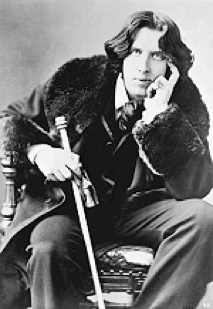
Oscar-WildeBorn on October 16, 1854 in Dublin, Ireland, Oscar Wilde is perhaps remembered more for his sparkling wit, larger-than-life personality, and historic trial than for his literary achievements. But the author made his mark on the literary world not only through his prolific career as a journalist, novelist, and dramatist, but also through his sometimes bizarre relationships with other literary figures. These interactions make collecting Wilde an even more engaging pursuit.

Love Lost between Wilde and Bram Stoker

Wilde’s mother, Lady Jane, was a formidable author in her own right. She often kept literary company, and her circle of friends soon came to include Bram Stoker. Stoker soon met Florence Balcombe, a legendary beauty who had previously been involved with Wilde. Accounts of Balcombe’s relationship with Wilde vary; he claimed the two had been engaged. At any rate, Wilde was less than pleased when he learned that Stoker had proposed to Balcombe. He wrote to Balcombe, stating that he would never return to Ireland again. Wilde mostly kept to his word, returning to Ireland only for brief visits.
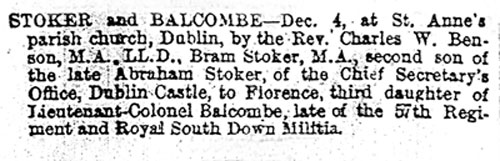
Bram-Stoker-Wedding-Announcement

But Stoker and Wilde’s relationship stretched beyond this inopportune love triangle. The two had gone to school together; Stoker even recommended Wilde for membership into the university’s Philosophical Society. And after Stoker and Balcombe had been married and Wilde had had sufficient time to lick his wounds, Stoker reinitiated the relationship. After Wilde was convicted of sodomy, Stoker even visited him. Yet Stoker also fastidiously removed all mention of Wilde from his published and unpublished texts, and it’s only recently that critics have begun to see Wilde’s influence in Stoker’s great novel Dracula.

Wilde Rejects Dickens’ Legacy…Or Does He?
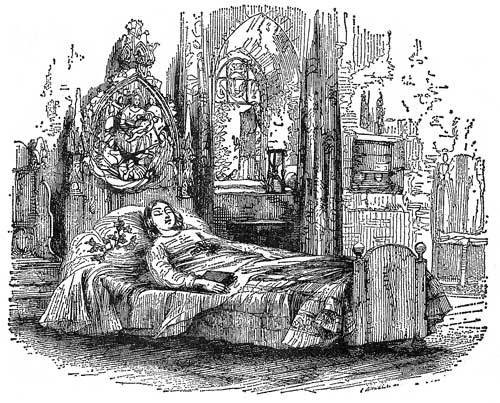
Old Curiosity Shop-Little NellWilde heaped praise upon Matthew Arnold, Robert Browning, and Elizabeth Barrett Browning. He even called Aurora Leigh “the greatest work in our literature.” But he was less than complimentary when it came to the great Charles Dickens; Wilde is famous for saying of Charles Dickens The Old Curiosity Shop, “One would have to have a heart of stone to read the death of Little Nell and not to dissolve into tears…of laughter.” Wilde found Dickens overly sentimental and wished to separate himself from this aspect of Dickens’ Victorian England. Yet he never fully succeeded in escaping Dickens’ shadow (indeed, few authors of the century did).

Critics have pointed to similarities in the ways that Wilde and Dickens portray London, and Wilde even makes allusions to Dickens’ works–most notably Little Dorritt. Little Dorritt’s Mrs. General repeats the phrase “Papa, potatoes, poultry, prunes, and prism” to her young charges, and the phrase “prunes and prism” soon became closely associated with her character. Is it any coincidence, then, that Wilde chooses the name “Ms. Prism” for the proper governess in The Importance of Being Earnest? Even though Wilde didn’t subscribe to Dickens’ sentimental style, it’s likely that he had great respect for Dickens, as Wilde himself aspired to the same international acclaim that the Inimitable One had achieved.

An Outlandish Claim Spurred by Public Rivalry
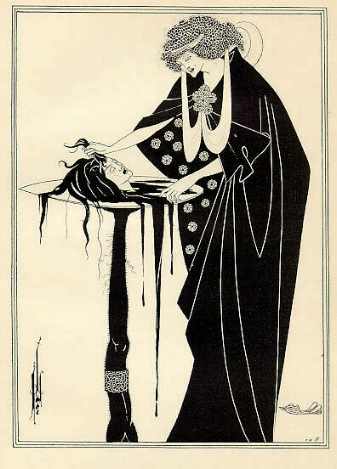
Beardsley-Salome-WildeIn April 1893, an up and coming artist was moved by the French publication of Oscar Wilde’s Salome. He drew Salome with St. John’s head, and the illustration became one of several that would accompany Joseph Pennell’s article on him in the first number of The Savoy. The artist, Aubrey Beardsley, contacted Wilde about illustrating the translation of Salome. Wilde responded in kindness, sending Beardsley an inscribed edition that read “For Aubrey: for the only artist who knows what the dance of seven veils is, and can see that invisible dance. Oscar” It wasn’t outright rejection, but it wasn’t an enthusiastic invitation, either.

Then Beardsley was contracted to illustrate Lord Alfred Douglas‘ English translation of Salome. Wilde initially called Beardsley’s illustrations for the work “too Japanese,” pointing out that the work was more Byzantine. Wilde then took his criticism a step further, saying that Beardsley’s art resembled “naughty scribbles a precocious boy makes on the margins of his copybook.” The rivalry exploded; Beardsley published caricatures of Wilde, and Wilde made the preposterous claim that he had “invented Aubrey Beardsley.” In reality, Wilde had simply worried all along that Beardsley’s brilliance would overshadow his own.

Mutual Admiration from a Distance

In November 1879, George Bernard Shaw met Oscar Wilde at Lady Jane’s London home. The two had trouble interacting, though Wilde clearly had good intentions toward Shaw. A few years later, on July 6, 1888, Wilde attended a meeting of the Fabian Society, likely at Shaw’s invitation. Artist Walter Crane spoke on “The Prospects of Art under Socialism,” which soon moved Wilde to write The Soul of Man under Socialism. Meanwhile over the years Shaw and Wilde maintained a pleasant relationship, albeit from a distance. They frequently exchanged books and letters and openly complimented each other’s works.

Shaw frequently defended Wilde against his critics, and he again rallied to Wilde’s defense when he was arrested for sodomy. Shaw was adamant that “never was there a man less an outlaw” than Wilde. Shaw and other writers put together a petition for Wilde’s early release, but it found surprisingly little support and was eventually dropped. As public opinion turned against Wilde and eventually forgot him entirely, Shaw still insisted on reminding people of Wilde’s greatness. He regularly mentioned him in drama reviews and remained fascinated with Wilde’s work for the rest of his life. When Frank Harris undertook his (somewhat controversial) biography of Wilde, Shaw edited it with the assistance of Lord Douglas.

Collecting Oscar Wilde

For collectors, Oscar Wilde is the ideal case study in how a single-author collection can–and should–come to include materials by a variety of other authors. A comprehensive Oscar Wilde collection would encompass the works of Wilde, not only his major literary pieces, but also the articles he penned as a journalist and critic. And a truly comprehensive collection would have a second layer: other authors’ reactions to and interactions with Wilde. For example, Shaw’s reviews mentioning Wilde are scarce because they were printed in periodicals on cheap paper, making them a challenging item for collectors to acquire. And Aubrey Beardsley’s caricatures of Wilde are sought after by both Beardsley and Wilde collectors alike, making them a desirable addition to an Oscar Wilde collection.

Oscar Wilde certainly left his mark on the world as an author and public figure. He will undoubtedly remain a popular figure among rare book collectors for generations to come.

Share

Chapbooks: Short Books with Long History

Scholars debate over the etymology of the term “chapbook.” Some argue that “chap” is derived from “cheap,” surely an accurate description of chapbooks, since they were indeed cheap little publications. But the more widely accepted explanation is that “chap” comes from the Old English “céap,” meaning “barter” or “deal.” Peddlers came to be known as chaps, and they were the primary purveyors of chapbooks. Whatever the origin of their name, chapbooks became a vital tool for dissemination of information and promotion of literacy. As publishing and readers’ tastes evolved, chapbooks also provided an ideal means of addressing an increased demand for children’s literature.

Since the Middle Ages, traveling peddlers provided many necessary wares to rural communities–and that included the news. They would often regale their customers with the latest in politics, entertainment, and gossip. Then in 1693, England repealed the Act of 1662, which had limited the number of Master Printers allowed in the country. The number of printers exploded. Meanwhile, charity schools emerged, making education and literacy more accessible to the poor. The demand for cheaply printed reading materials drastically increased as a result, and all the new printers were happy to supply their needs.

By 1700, chapmen regularly carried small books–usually about the size of a waistcoat pocket–on virtually every topic imaginable. The books were generally coverless, and their illustrations were made of recycled (and irrelevant) woodcuts from other publications. In the absence of copyright laws, printers would steal illustrations or even large chunks of text from other chapbooks and reproduce them in their own editions. Early chapbooks weren’t even cut; the purchaser would cut apart the pages and either pin or stitch the book together to read.

Dr Watts-Divine SongsChapbooks grew into an incredibly powerful tool for disseminating new ideas. When Thomas Paine published The Rights of Man, he suggested that the second edition be made available in chapbook form. The book went on to sell over two million copies, an incredible feat in those days, when the average publishing run might be only a few hundred or thousand copies. Religious organizations used the form to publish religious tracts, nicknamed “godlinesses” or “Sunday schools.” There were even chapbooks for the chapmen themselves, containing information about different towns, dates for local fairs, and road maps.

The Industrial Revolution, however, brought a revolution in the printed word as well. People flocked to the cities, reducing chapbooks’ role in news delivery. Newspapers had also become cheaper to produce, so they were no longer relegated to the upper class. And chapbooks’ days seemed numbered when public solicitation was outlawed and peddlers could no longer distribute them. Meanwhile people’s tastes were changing. As the decades of the 1800’s passed, the novel was emerging as a new, preferred form, and in terms of “cheap” literature, chapbooks eventually gave way to “penny dreadfuls,” the dime novel, and other such low-brow forms.

But changing reading habits and higher literacy rates also meant an increased demand for children’s literature. From around 1780, most booksellers offered a variety of children’s chapbooks, which included ABC’s, jokes, riddles, stories, and religious materials like prayers and catechism. Thanks to improved printing techniques, this generation of chapbooks was printed with relevant illustrations and attached colored paper or card wrappers.

Juvenile-Pastimes-Baseball-Chapbook

Though we think of chapbooks as a distinctly British form, they emerged in various forms around the world. Harry B. Weiss writes in A Book about Chapbooks, “The contents of chapbooks, the world over, fall readily into certain classes and many were the borrowings, with of course, adaptations and changes to suit particular countries.” And despite their variant forms and culturally specific content, chapbooks consistently served as a democratizing force in the dissemination of ideas.

Collectors may build entire collections around chapbooks, or they may find that certain chapbooks fit in well with their collections. For example, the 1849 edition of Juvenile Pastimes includes a rare early pictorial depiction of baseball, making it an ideal addition to a collection of baseball books. Collectors of erotica may enjoy Dumb Dora: Rod Gets Taken Again, an adult chapbook with suggestive, but not pornographic, illustrations. The variety of chapbooks means there’s a little book for everyone!

This month’s select acquisitions are a short list of delightful chapbooks. Please peruse them and contact us if you have any inquiries. As cataloguing chapbooks is quite the endeavor, we’ve also put together an article about the resources used to catalogue the items on the list, which includes our bibliographic sources at the end.

Share

Chapbooks: A [Short] List for September

Chapbooks.

A meanly produced publishing phenomenon, Carter & Barker, in the 8th ABC, describe them thusly: “Small pamphlets of popular, sensational, juvenile, moral or educational character, originally distributed by chapmen or hawkers, not by booksellers.”

If one dips into Neuberg’s CHAPBOOK BIBLIOGRAPHY, we find this genre had “by 1700, [become] an important part of the [chapman’s] stock-in-trade … whose varied subject matter included devils, angels, scoundrels, heroes, love, hate, fairy tales, religion, fables, shipwreck, executions, prophecies and fortune telling. …  During the eighteenth century chapbooks formed the main reading matter for the poor.”  Though around for centuries, the chapbook, as a viable publishing genre, had mostly expired towards the end of the 19th C, except as Carter noted, “as a conscious archaism.”

Despite oft being an object of acquisition by collectors, one can still find these little volumes floating about, and offered at [comparatively] modest prices such that building a pleasing & extensive collection of these modest works is not beyond the means of the ‘average’ person [however such a term may be defined].

Here then is Tavistock Books’ list for September.  A small cache of 30 chapbooks, primarily for children, primarly American, primarily 19th Century.  Prices range from a modest $45 to a decidely robust $2000, for one that will be found in David Block’s ground breaking work, BASEBALL BEFORE WE KNEW IT.  Many titles offered are the only copy on the market; one or two not found on OCLC.

Should you have queries regarding any of this material, or other listings you may find on our site, please contact us.  We thank you for your attention, and we hope you find something of interest while browsing these offerings.

REFERENCES CITED

Cataloguing chapbooks is a task both challenging and engaging, as evidenced by the list of sources used to catalogue this month’s list of select acquisitions.

American Imprints AMERICAN BIBLIOGRAPHY. A Preliminary Checklist. 1801 – 1846.  NY [et al]: Scarecrow Pres, 1958-1997.

Arndt & Eck The FIRST CENTURY Of GERMAN LANGUAGE PRINTING In The UNITED STATES Of AMERICA.  Göttingen: 1989.

BAL.  Blanck, Jacob [et al].  BIBLIOGRAPHY Of AMERICAN LITERATURE.  New Haven: 1955 – 1991.

Block, David.  BASEBALL BEFORE WE KNEW IT.  A Search for the Roots of the Game.  Lincoln: (2005).

Cappon & Brown NEW MARKET, VIRGINIA, IMPRINTS 1806 – 1876.  A Check-list.  Charlottesville: 1942.

Church.  Cole, George Watson – Compiler.  A CATALOGUE Of BOOKS Relating to The Discovery and Early History of North and South America Forming a Part of the Library of E. D. Church.  NY: Peter Smith, 1951.

Cropper, Percy J.  The NOTTINGHAMSHIRE PRINTED CHAP-BOOKS, with Notices of Their Printers and Vendors. 1892. 

Davis, Roger.  KENDREW Of YORK and His Chapbooks for Children.  Elmete Press, 1988.

ESTC ENGLISH SHORT TITLE CATALOGUE.  http://estc.bl.uk

Gumuchian Les LIVRES De L’ENFANCE du XVe au XIXe Siècle.  London: Holland Press, 1985.

Hamilton, Sinclair.  EARLY AMERICAN BOOK ILLUSTRATORS And WOOD ENGRAVERS. 1670-1870.  Princeton: 1968.

Heartman, Charles F.  The NEW ENGLAND PRIMER Issued Prior to 1830.  1922.

[-].  AMERICAN PRIMERS. INDIAN PRIMERS. ROYAL PRIMERS.  And Thirty-Seven Other Types of non-New-England Primers Issued Prior to 1830.  Highland Park: 1935.

NCBEL The NEW CAMBRIDGE BIBLIOGRAPHY Of ENGLISH LITERATURE.  Cambridge: 1969 – 1977.

NUC NATIONAL UNION CATALOGUE.  Pre-1956 Imprints.

Opie, Iona & Peter.  The OXFORD DICTIONARY Of NURSERY RHYMES.  Oxford: (1951).

Osborne.  The OSBORNE COLLECTION Of EARLY CHILDREN’S BOOKS 1566-1910.  Toronto: TPL, 1975.

Rosenbach, A.S.W.  EARLY AMERICAN CHILDREN’S BOOKS.  NY: Dover, 1971.

Spencer A CATALOGUE Of The SPENCER COLLECTION Of EARLY CHILDREN’S BOOK And CHAPBOOKS.  Preston: 1967.

Weiss, Harry B.  SAMUEL WOOD & SONS. Early New York Publishers of Children’s Books.  NY: 1942.

Welch, d’Alté A.  A BIBLIOGRAPHY Of AMERICAN CHILDREN’S BOOKS Printed Prior to 1821.  Worcester: AAS, 1972.

Wust.  THREE HUNDRED YEARS Of GERMAN IMMIGRANTS In NORTH AMERICA 1683-1983  1983.


Share

Rare Books about Baseball Are a Home Run!

The first book devoted exclusively to the sport of baseball was The Base Ball Player’s Pocket Companion, published in Boston in 1859. Since then America’s love of baseball has continued to grow, establishing the sport as America’s pastime. Now baseball is also the most popular subject among collectors of rare books in sports. Because of the breadth of baseball literature, most collectors of rare baseball books narrow their focus to a specific aspect of the literature or sport.

Early History

The game of baseball has evolved considerably since its beginnings. Consider, for instance, that there were originally two sets of rules for baseball: one from Boston, and the other from New York. Thus books from baseball’s early history are often quite fascinating, detailing a sport that varies widely from the one we know today.

Beadle's Dime Base-Ball Player

Beadle’s Dime Base-Ball Player


Spalding's Base Ball Guide

Spalding’s Base Ball Guide

Hidden Histories

The All-American Girls Professional Baseball League began during World War II and operated from 1943 to 1954. The history of this league and its players don’t receive much attention today, but the league was quite popular at the time. Meanwhile, both the Negro Leagues and African-American players were frequently overlooked; few books exist about either before the 1970’s. One notable exception is Sol White’s Official Base Ball Guide (1907), sometimes called the “holy grail” of baseball book collecting because it’s so scarce. It’s both challenging and engaging to build a collection around these hidden histories in baseball.

“Get that Nigger off the Field!”

Voices from the Great Black Baseball Leagues

Voices from the Great Black Baseball Leagues

Regional Leagues

As baseball’s popularity spread, smaller leagues began popping up all around the country. Although these leagues may not have boasted star players, they offered one means of local entertainment. Teams were sometimes formed around occupation or work location, as illustrated by the photograph of the New Almaden Quicksilver Mine Baseball Team.

New Almaden Quicksilver Mine Baseball Team

New Almaden Quicksilver Mine Baseball Team

Official Baseball Program-Pacific Coast League, 1934 Season

Official Baseball Program-Pacific Coast League, 1934 Season

Middle Atlantic League 25th Anniversary Souvenir Book

Middle Atlantic League 25th Anniversary Souvenir Boo

Biographies and Autobiographies

In the early days, baseball players were frequently illiterate. Their autobiographies were therefore frequently ghostwritten. Both autobiographies and biographies were also “cleaned up”; they tended to be much more inaccurate than modern biographies, sanitizing the players’ lives to make them more acceptable to middle-class readers.

Mickey Mantle of the Yankees

Mickey Mantle of the Yankees

Baseball Fiction

Likely the first novel primarily devoted to baseball was Noel Brooks’ Our Base Ball Club (1884). The genre has grown considerably. It includes dime novels, comic books, and modern first editions. Some collectors focus on a particular series, while others explore the limits of baseball fiction and collect a wider variety of examples.

The Big League

The Big League


Double Curve Dan the Pitcher Detective

Double Curve Dan the Pitcher Detective

The Pick-Up Nine

The Pick-Up Nine

How-To Guides

With the establishment of official rules and leagues, the art of playing baseball became much more standardized. That certainly didn’t mean that opinions never differed on the right form and approach for skills like pitching, batting, and fielding.

Spalding's Baseball for Beginners

Spalding’s Baseball for Beginners


The Science of Baseball

The Science of Baseball

Individual Teams

If you love to “root for the home team,” it makes sense to build your baseball collection around them. You’ll likely find a wealth of programs, statistics, and score cards. Some items, such as the New York Giants’ Press Radio TV from 1956, include a list of players, schedules, and statistics. A collection built around a single baseball team also encompasses biographies and memoirs from team players.

Press Radio 1956-Giants

Press Radio 1956-Giants

New York Giants 1954 Training Season

New York Giants 1954 Training Season

Bibliographies

Regardless of your area of expertise, it’s important to learn all you can about the rare books of baseball, and about your specialization. And that means one thing: getting the right bibliography! A terrific place to start is David Block’s Baseball Before We Knew It: A Search for the Roots of the Game (1995). In addition to offering a great print history of the game, it also has a bibliography of pre-1850 books that treat baseball in some way. For baseball fiction, you’ll want Andy McCue’s Baseball by the Books (1991). And a more general bibliography is Myron Smith’s Baseball: A Comprehensive Bibliography (1986). Smith has since published supplements to include later material.


Share

Astronomy, Astrology, Potato, Po-tah-to?

New-Astrology

From ‘The New Astrology’ (1786)

Since the Neolithic age, humans have attempted to track lunar cycles and understand their relationship with natural phenomena like the changing tides. From these rudimentary attempts, the fields of astrology and astronomy were eventually born. The two disciplines evolved together, but our changing understanding of the universe has relegated astrology to the world of superstition and folklore. The world of rare books offers an interesting glimpse into these parallel studies.

An Ancient Science

Astrology evolved from our desire to better understand changing seasons, weather patterns, and other natural phenomena. It proved useful in agriculture, and astrological predictions were soon applied to other aspects of life. Eventually kings and emperors even had astrologers as The first evidence of astrology as a discipline comes to us from the Babylonians. The Venus tablet of Ammisaduqa, compiled in Babylon around 1200 BCE is one of the oldest known astrological references. For almost 2,000 years, astronomy and astrology were synonymous. Astrology was introduced to the ancient Greeks around 400 BCE. Respected thinkers like Plato and Aristotle incorporated astrology in their works, giving it credibility. The Romans eagerly adopted astrology, and the practice endured through the ages.

It’s from the Romans that we get our modern-day names for the signs of the Zodiac, which means “circle of animals” in Greek. Early astrologers knew that it took twelve lunar cycles (now known as months) for the sun to return to its original position in the sky. They then identified twelve constellations that were linked to the progression of the seasons and assigned these the names of animals or figures. For example, during the rainy season, the corresponding constellation was Aquarius, which means “water bearer.”

Horoscope charts relate the position of the sun, moon, planets and stars to a particular time, place. Astrologers don’t use horological time, but rather “sidereal time,” which is based on the sun’s position at the spring equinox. They consult an astrological ephemeris, a table listing the positions of the sun, moon, planets, and constellations at any given time. The information they gather helps them make predictions about finances, relationships, and other life events, along with inferences about personality traits.

The Advent of Heliocentrism

In many ways, astrology drove discoveries in astronomy, and the two were regarded as the same discipline for centuries. Then in the medieval period, when we knew more about the stars and solar system, astronomy was seen as a means for gaining a greater understanding of astrology. Some concepts from astrology also influenced the study of alchemy, meteorology, and even medicine. But a basic premise of astrology conflicted with emerging knowledge; scientists were beginning to realize that the Earth was not the center of the universe.

As scholars came to realize that the sun was the center of the universe (a theory known as heliocentrism), astrology naturally came under fire. Though the study persisted, it has since been relegated to the realm of superstition and novelty; to this day, people still read their daily horoscopes, though more for fun than anything else. Meanwhile, astronomy has proven itself as an academic discipline. For instance, scholars have applied principles of calculus to the function of the cosmos, lending validity to the science.

Rare Books about Astrology and Astronomy

A Briefe and Most Easie Introduction to the Astrological Judgement of the Starres (1598)
Noted French physician Claudius Dariot practiced in the tradition of Paracelsus, the Renaissance physician, botanist, and astrologer who founded the discipline of toxicology. Paracelsus and his followers divined their patients’ treatments from astrological readings. Dariot applied astrology in a new way, for horary astrology (using astrological readings to answer specific questions). His Introduction was a seminal work in the field of astrology and remains a principal authority in its field. This edition of the book contains two texts. The first is a revised and expanded translation of Dariot’s work by Fabian Wither, including a brief treatise on electoral astrology. The second is the first edition of an original text on medical applications, written by G.C., an unidentified Englishman who was also responsible for the revisions and expansions of Dariot’s original text.

The New Astrology; or, The Art of Predicting or Foretelling Future Events, by the Aspects, Positions, and Influences of the Heavenly Bodies…In Two Parts (1786)
The real Sir Christopher Heydon was a Member of Parliament, solider, and astrology writer. He died in 1623, and the author of The New Astrologerevidently used his name as a pseudonym. The author’s use of a false name indicates that the field of astrology wasn’t necessarily considered “respectable.” The work includes 17 tables and diagrams. OCLC shows three institutional holdings, none in the US; ESTC shows two copies in the US; and ABPC shows no copies at auction in the last thirty years.

A Collection of Examples of the Applications of the Calculus of Finite Differences and Examples of the Solutions of Functional Equations (1820)
John Herschel, William Frederick, and Charles Babbage were distinguished mathematicians who contributed to a mathematical revival in England. Hershel, a member of the Royal Society since 1813, had a brilliant career in astronomy, while Babbage (also elected to the Royal Society in 1816) would go on to pursue analytical and difference engines–the precursors to the modern computer. The close relationship between mathematics and astronomy, so eloquently explored by these scholars and others, would distance it from the formerly synonymous field of astrology.

The Unseen World: Communications with it, Real or Imaginary, Including Apparitions, Warnings, Haunted Places, Prophecies, Aerial Visions, Astrology, &c &c (1847)
Educated at Trinity College, John Mason Neale was an Anglican priest, scholar, and hymn writer. The author of famous holiday carols like “Good Christian Men, Rejoice” and “Good King Wenceslas” seems an unlikely author for a book on astrology. Indeed, Neale’s views were quite high church, but he also wrote a devotional and mystical commentary on the Psalms. The Unseen World (1847) illustrates the ways that mysticism (of which astrology can be considered a part) often commingled with religion–as it still does to this day.

Share

Planes, Trains, and Automobiles!


Summer is officially underway, and the season is synonymous with family vacation, road trips, and carefree adventures. Though the ways we travel have evolved over time, the thrill of the journey endures.

Planes

Since the beginning of time, humans have been obsessed with flight. At first, their attempts were based on the way birds flew. Next the hot air and hydrogen balloons gave us a means of navigating the skies. But it was two bicycle manufacturers from Dayton, Ohio who would introduce the airplane. The Wright brothers revolutionized travel, war, and commerce with their invention.

The Call of the Clouds

CAll-Clouds-GallaudetEdson Gallaudet formed the first aircraft engineering office in 1908. Two years later, Gallaudet Engineering Office had begun building planes under contract. The company was reorganized as the Gallaudet Aircraft Corporation in 1917 and offered its first product, the Curtis floatplane, the following year. This rare trade catalogue, The Call of the Clouds, presents the Gallaudet Chummy Flyabout Sport Model–which sold for the low price of $3,500. We’ve found no evidence that this plane was ever actually produced, making the catalogue a fascinating record of a machine that could have been.

Pilot’s Flight Operating Instructions

Pilots-Flight-ManualsOur collection includes three pilot’s’ flight operating instructions for Army planes, published in 1945. These flight manuals address both American and British planes used during the World War II era, such as the P-51 and B-29. They incorporate numerous charts and graphs for pilots, along with a few annotations from the original owner. For those interested in aviation or military history, this collection of documents are quite fascinating.

Aeroplanes

AeroplanesA rare early aviation trade catalogue, Aeroplanes presents models manufactured by Aug. C. Gomes & Cie, with specifications, illustrations, and performance records for Henry Farman, Sommer, Bleriot, Tellier, Voisin, Antoinette, Maurice Farman, REP, and Hanriot models. A powerplant section follows, and the catalogue concludes with a variety of other aircraft accessories and components. The company even offers hangar facilities for some airplane models. We’ve found no listing for this particular catalogue in either OCLC or KVK.

Trains

As early as 1550, roads with wooden rails were built in Germany to make it easier for horse-drawn carriages to move. These wagonways, as they were called, were the precursor to the modern railroad. Two centuries later, iron had replaced wood. But the railroad truly became an efficient means of transportation with the introduction of the steam locomotive. Today, trains evoke the romance and nostalgia of leisurely travel.

Baldwin Locomotive Works Photographs

This photo album apparently belonged to SM Vauclain, locomotive designer and eventual president of Baldwin Locomotive. It’s possibly unique, with 18 pasted-in albumen prints of various Baldwin locomotives. Identified models include “Nacional Mexicano,” “Northern Pacific,” “Companhia Paulista,” “EFOM,” “Ramal Dumont,” “WNY & PRR,” and “Estrada de Ferro Central do Brazil.” The photo quality is very good to fine.

Baldwin-Locomotive-Works

War of the Gauges

IWar-Gauges-Railroad-Erie-Pennsylvanian December, 1853, the city of Erie and its neighboring township Harborcreek waged an interesting battle against rail travel. They tore up tracks of the Erie and North-East Railroad, wherever the tracks intersected the public highway or city streets. While their actions were ostensibly promulgated by a debated over track width, it indicated an underlying struggle for economic advantage. For two months, rail travel between New York and the West was interrupted, but the inconveniences lasted a full two years. The War of the Gaugesis the first book publication documenting this exciting time in Erie history, complete with court testimony and individual statements.

The Union Pacific Railroad

Union-Pacific-Railroad-BrochureThis Union Pacific Railroad brochure served as both a progress report and a promotional brochure. Because the railroad fell under the auspices of the federal government, it issued regular updates for Congress. Issued in 1868, this one includes information through December, 1867. It outlines the progress of the railroad west of Omaha, Nebraska, which resulted in an unbroken line from the Atlantic to the Pacific. The report’s frontis features a “Map of the Union Pacific Rail Road and its connections.”

Automobiles

Though Henry Ford is widely credited with inventing the automobile, the machine’s history is actually much more complex. Back in the 15th century, Leonardo da Vinci created designs and models for vehicles that foreshadow the modern-day automotive. Many suggest that Karl Benz actually invented the first true automobile, and it was his wife, Bertha, who undertook the first road trip to demonstrate the road-worthiness of her husband’s invention.

Locomobile

LocomobileFounded in 1899, the Locomobile Company manufactured small, affordable steam cars for only four years before offering only internal combustion-powered luxury cars. This brochure, one of the first the company issued, notes the demand for “a self-propelling vehicle that will combine the qualities of lightness, speed, economy, and ease of operation.” It describes the advantages and attributes of the vehicle and includes images of several models. The last, Model 6, is billed as “the Fastest Racing Machine in the World.” OCLC records only three institutional holdings of this item, making it uncommon in the trade.

A Joy Ride of 1911

Joy-Ride-Chalmers_1911Generously illustrated with both photographs and postcards, “A Joy Ride of 1911” is a charming amateur account of one family’s Chalmers automobile trip through New Jersey up through New England. Their objective is to reach the White Mountains. Recorded by the anonymous wife/mother of the family, the vacation is engagingly chronicled.

1936 Report of Bonneville Salt Flats Speed Runs

JB Jenkins Robinson made a typewritten report to HC Bougey, Chief Chemist of General Motors, detailing the results of sponsored speed runs in 1936. Their aim: “To establish Worlds’ speed records with a view of utilizing results for advertising and sales promotion.” Over four testing periods, 19 speed records were set. Seven carbon copies of Robinson’s report exist; this one is bound in a manilla folder along with a facsimile log-sheet for Jenkins’ 24-hour run (Sept 21-23) and 16 captioned black-and-white snapshots.

Bonneville-Salt-Flats-Speed

 As we look back in time at the history of transportation, we wonder what the future holds. What mode of transportation will be next to captivate the world with its promise of adventure?

Share

The Two Endings of Charles Dickens’ ‘Great Expectations’

Charles-Dickens

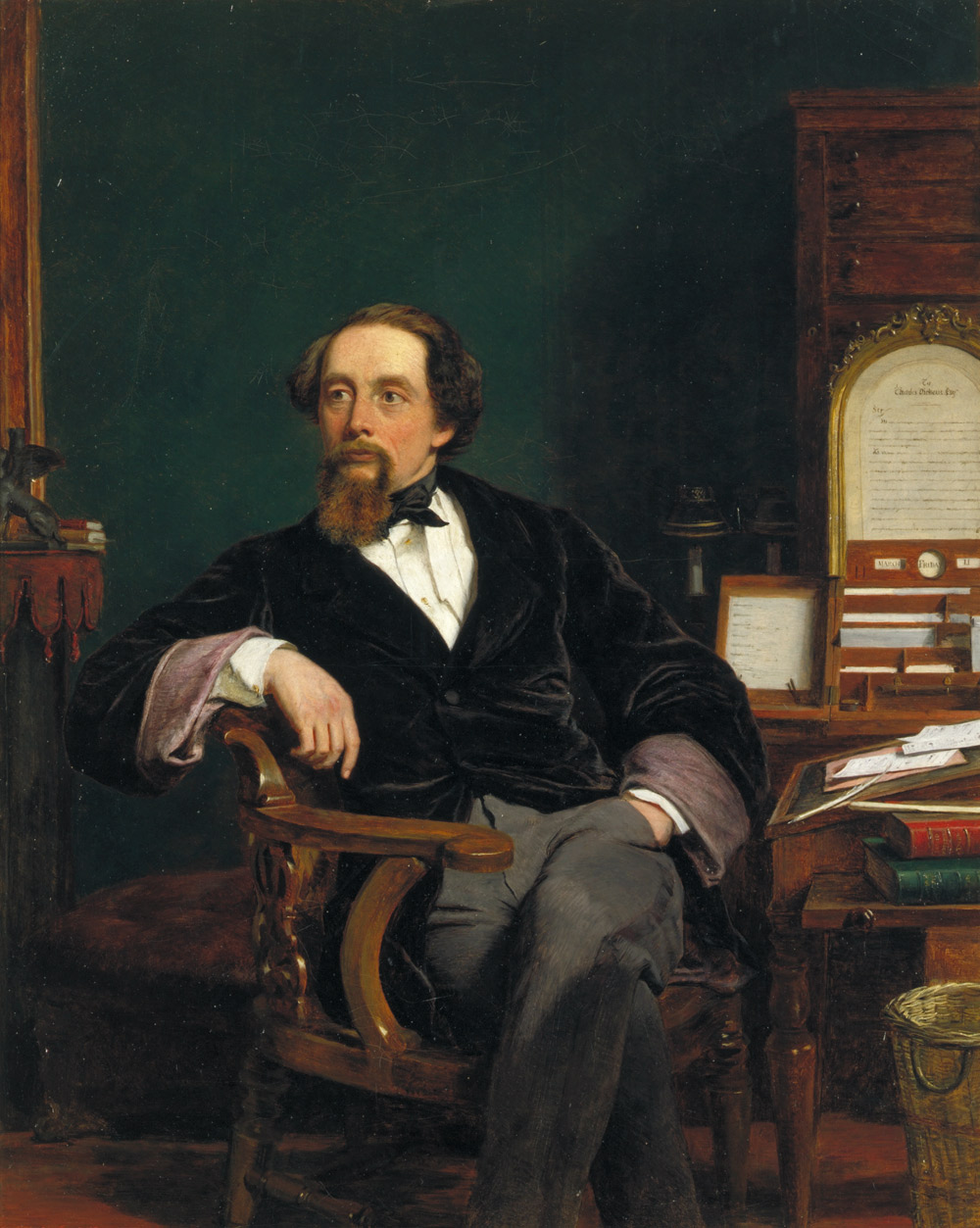
Charles Dickens, oil painting, William Powell Frith, 1859. (Victoria & Albert Museum)

Surely Charles Dickens took many secrets to his grave, but one of those secrets didn’t last long. Dickens made a significant change to the ending of Great Expectations–and in the nick of time! He’d already sent his manuscript off to the publisher when he decided on the change. Dickens’ indecision means that collectors have a few different editions of this great novel to add to their personal libraries.

A Considerable Emendation

It was relatively common for authors to change their work, sometimes even between printings. Henry James, for instance, was notorious for updating his drafts multiple times. So Dickens’ last-minute emendation to Great Expectations isn’t entirely unheard of–he, like James, actually made such changes with relative frequency.

However, Dickens had also originally promised that Great Expectations would be lighter fare than its predecessor, Tale of Two Cities. In an October 1860 letter to John Forster, Dickens wrote “You will not have to complain of the want of humor as in Tale of Two Cities. I have made the opening, I hope, in its general effect exceedingly droll.”* The novel took a different turn, and Dickens’ original ending was melancholy indeed.

“I was in England again–in London, and walking along Piccadilly with Little Pip–when a servant came running after me to ask would I step back to a lady in a carriage who wished to speak to me. It was a little pony carriage, which the lady was driving; and the lady and I looked sadly enough on one another.

‘I am greatly changed, I know, but I thought you would like to shake hands with Estella too, Pip. Lift up that pretty child and let me kiss it!’ (She supposed the child, I think, to be my child.)

I was very glad afterwards to have had the interview; for, in her face and in her voice, and in her touch, she gave me the assurance, that suffering had been stronger than Miss Havisham’s teaching, and had given her a heart to understand what my heart used to be.”

Edward-Bulwer-Lytton

Edward Bulwer-Lytton

Dickens submitted Great Expectations with this ending in 1861 and went to visit his friend and fellow author Edward Bulwer-Lytton. Lytton was a popular figure in his own right as a writer of crime historical and crime novels. He was also a man of privilege, and it’s likely that Dickens respected Lytton as both an author and as a gentleman. Probably on these grounds, Dickens shared the Great Expectations manuscript with Lytton.

He may have been surprised with Lytton’s reaction. Rather than wholeheartedly praising Dickens’ latest novel, Lytton urged Dickens to rewrite the ending completely. Dickens intimated that “Bulwer was so very anxious that I should alter the end…and stated his reasons so well, that I have resumed the wheel, and taken another turn at it.” What Dickens came up with has been the standard ending since 1862:

“‘I little thought,’ said Estella, ‘that I should take leave of you in taking leave of this spot. I am very glad to do so.’

‘Glad to part again, Estella? To me, parting is a painful thing. To me, the remembrance of our last meeting has been ever mournful and painful.’

‘But you said to me,’ returned Estella, very earnestly, ‘”God bless you, God forgive you!'”And if you could say that to me then, you will not hesitate to say that to me now–now, when suffering has been stronger than all other teaching, and has taught me to understand what your heart used to be. I have been bent and broken, but–I hope–into a better shape. Be as considerate and good to me as you were, and tell me we are friends.’

‘We are friends,’ said I, rising and bending over her, as she rose from the bench.

‘And will continue friends apart,’ said Estella.

I took her hand in mine, and we went out of the ruined place; and, as the morning mists had risen long ago when I first left the forge, so the evening mists were rising now, and in all the broad expanse of tranquil light they showed to me, I saw no shadow of another parting from her.

In his manuscript, the final line reads “I saw the shadow of no parting from her, but one.” And the first edition offers yet another variation of that closing line: “I saw the shadow of no parting from her.” Dickens was clearly ambivalent about the novel’s ending. But his eye for the market probably led him to write an ending that can be interpreted as Estella and Pip “walking off into the sunset” together. If he’d wanted that, wouldn’t he have made the ending more obviously happy, as he did in Bleak House, Little Dorrit, and David Copperfield?

Complications for Dickens Critics and Collectors

Critics have been rehashing the endings of Great Expectations since the book was published. The dual endings also create a bit of a complication for collectors; ordinarily the first edition of a work is enough for a collector to “check something off the list.” In the case of Great Expectations, however, true Dickens collectors will want a few more items.

Because Dickens slightly changed the wording of the ending after the first edition, most collectors look for both the first edition and the 1862 edition, which was the first to include the now-ubiquitous ending. Forster’s biography, where the alternate ending made its first appearance in print, is also a highly desirable volume. And finally, Dickens’ original ending did not appear alongside the text of Great Expectations until 1937, when George Bernard Shaw included it in his preface for the Limited Editions publication of the novel.

This is one example of an instance where collectors would seek both a first edition and subsequent editions for a complete collection of an author’s oeuvre. It also shows us the value of basic bibliographic resources that can identify and elucidate these kinds of circumstances, along with working with an expert professional bookseller who can guide your collecting efforts.


*This letter is apparently not currently extant, though we know of it through Forster’s Life of Dickens (vol 3, p 329). 

Share

A Brief History of Broadsides

“Broadsides are the most legitimate representatives of the most ephemeral literature, the least likely to escape destruction, and yet they are the most vivid exhibitors of the manners, arts, and daily life, of communities and nations. They imply a vast deal more than they literally express, and disclose visions of interior conditions of society, such as cannot be found in formal narratives.”

-Samuel F Haven

Samuel F Haven, former librarian for the American Antiquarian Society, presided over one of the largest collections of broadsides in the world. Historians and rare book collectors alike cherish broadsides because they offer snapshots of moments in time, helping us to understand the zeitgeist of that era. Broadsides make ideal complements to a rare book collection, granting the collection greater depth and context.

  • Drosera-Heart-Palpitations-Broadside
  • Thrilling-Aviation-Stunts-Broadside
  • Perpetual-Almanack
  • NYME-Minstrels-Broadside
  • Prince-Charles-Broadside
  • Better-Days-Broadside

What a Broadside Is (and Isn’t)

Broadsides are single-sheet documents that are printed on only one side. They’re sometimes also called broadsheets. They’re different from handbills, which are smaller and printed on both sides. Broadsides should also not be confused with leaflets or booklets, which are folded from a single sheet of paper. The size of broadsides varies greatly, but they are generally smaller than posters and billboards.

Early broadsides didn’t include illustrations. They were simple documents printed in black ink. As printing processes got more sophisticated over time, the broadside also evolved. They began to include stock illustrations done from copper or wood engravings and eventually bore more intricate and relevant illustrations.

The Emergence and Decline of Broadsides

In Europe, broadsides came into use almost as soon as the printing press was invented. They first appeared in the United States during the seventeenth century, which the technology of moveable type and the printing press finally made its way to the colonies. For centuries, the broadside was the preferred format for delivering public announcements. They were also a cost effective way to distribute poetry, songs, and satire.

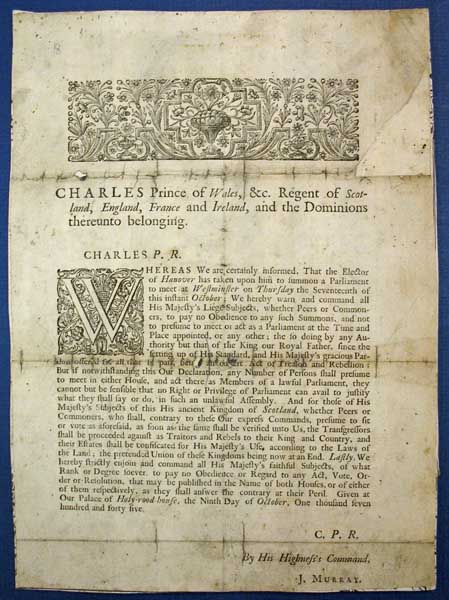
Prince-Charles-Broadside

Bonnie Prince Charlie declares the illegitimacy of Parliament and calls all its attendees traitors. A fantastic artifact from the Jacobite rebellion.

Perhaps the most famous broadside in the United States is the broadside version of the Declaration of Independence published by John Durham on July 4 and 5, 1776. Thanks to this document, news of the declaration swept through the colonies. The John Durham broadside is a perfect example of how these artifacts can encapsulate a pivotal moment in history. Only a few decades earlier, Prince Charles of Wales had used a broadside to make a truly shocking announcement. He declared Parliament illegitimate and branded its participants as traitors. The broadside captures the heat of the Jacobite rebellion.

Before the end of the nineteenth century, broadsides had begun to fall into disuse. They’d been replaced by newspapers and radio for delivering news. Posters and billboards had replaced broadsides as advertisements. Today the occasional fine press artist produces a broadside, but the form has been rendered obsolete by technology.

Preserving and Collecting Broadsides

Broadsides fall into the category of ephemera because they weren’t made to last long. They were intended for quick consumption and therefore were often printed on cheap paper. Few people thought to keep broadsides, and the ones that did get saved are often in less than ideal condition. They may have folds and rips, or they may have been poorly repaired using the wrong materials. To protect broadsides from further damage, it’s important to protect them with a mylar sheath. Your broadsides can then be stored flat in a climate controlled environment.

George-Macdonald-Song-Christmas

The broadside edition of Macdonald’s “A Song for Chistmas” is incredibly rare. This is an inscribed presentation copy.

Meanwhile the ephemeral nature of broadsides is what makes them so valuable to rare book collectors. Some people actually specialize in broadsides. But the avid collector may supplement works by a favorite author with related broadsides. For example, a collector of George Macdonald would be interested in the broadside edition of Macdonald’s poem “A Song for Christmas.” Published around 1887, the broadside is the first appearance of the poem. It’s not published again until the 1890’s, when it appears in a collected volume. Macdonald’s “A Song for Christmas” broadside is now extremely rare; OCLC and KVK document only one other copy, at the Library of Scotland.

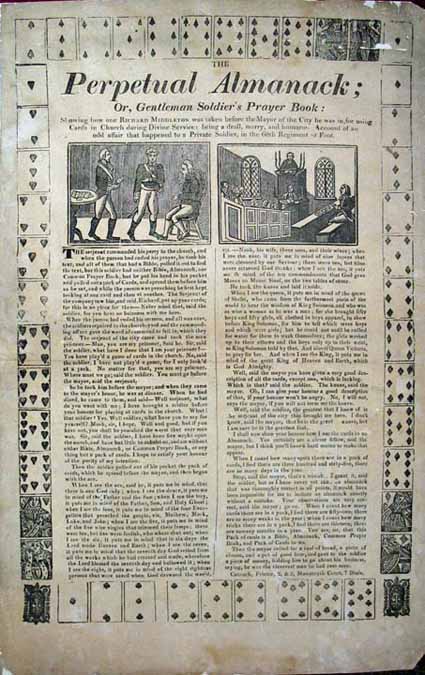
Perpetual-Almanack

Chatto referred to this very broadside in his “Facts and Speculations on the Origin and History of Playing Cards”

Sometimes broadsides even served as sources for authors. William Andrew Chatto wrote about leisurely pursuits such as fly-fishing, smoking, and playing cards. In his 1848 Facts and Speculations on the Origin and History of Playing Cards, Chatto cites a Catnatch broadside called “The Perpetual Almanack; or, Gentleman Soldier’s Prayer Book.” The broadside tells the tale of Richard Middleton, who was taken before the mayor for using cards during a church service. Chatto notes that his own cards have been a “moral monitor and help to devotion.”

As your rare book collection progresses, incorporating broadsides is an excellent step to broaden the scope of the collection. What was the first broadside in your collection? And why did it appeal to you?

Share