Category Archives: Collecting

Dire Circumstances at Tavistock Books (Humorous Relief for Your Reading Pleasure)

Something that has happened often enough at Tavistock Books to admit (as long as my boss does not read this blog) is the dropping of books. My first week Vic left me alone with the store (let’s not even talk about how I neglected to charge a guy spending $600 sales tax or that I accidentally tripped over a globe and bled on the carpet) and while he was out at a Giants game, enjoying the sunshine and the hot dogs, I was pretending I knew how to do leather dressing on a book. I was startled by a customer (you know… human interaction frightens me), and the book slipped out of my hand, slammed to the ground, and both boards snapped off the spine and lay in a messy heap at my feet.

So, logically, the next thing I did was to call my father immediately (meanwhile the book is still on the ground, in case you were wondering) and cry a bit and tell him that I was going to get fired. After about 10 minutes of whining to a parent who was, at that point, probably more than a bit concerned about my overall mental health and what the California air was doing to my brain, I acted my age and called my boss. With only minor cracking in my voice I told him I had dropped a book and broke it. Vic, of course, couldn’t be less concerned and simply said, “okay so… we’ll get it fixed?” I did neglect to mention on the phone that it was a $1000 book, but oh well! I didn’t get fired (clearly).

The point of this blog is to inform other young booksellers the proper etiquette when dropping a book, this especially for all the assistants out there. Once a book is dropped, the first thing you should do is look around to see if anyone saw and/or heard the book being dropped. If the answer is no, breathe a sigh of relief and then pick it up quickly. While casually looking like you’re inspecting the state of the mylar dust jacket cover or the age-toning of the endpapers, inspect the book for any bumping or creasing you may have caused that you could not definitively say was there before. If any disfigurements are found, the first thing you should do is put it in a pile somewhere where human customers go, and leave it out for a day or two. Then, when your boss is sitting right in front of you, casually find it and exclaim over the horrifying tear or crease and start calling customers names in your anger at their casual manhandling of your precious books. The madder you get, the better. Your boss may think you have anger management problems, but so be it. He’ll never know the difference. You could take my route and hyperventilate instead, but it’s really not a good idea. Salt-water wrecks havoc on paper and if you cry on the book it will just make it worse.

(This is, of course, a joke, and I have always told my boss when I drop things.)

(I almost always tell my boss when I drop things.)


(Customers should really be more careful around Tavistock Books.)

Share

The Brothers Fleming: Peter & Ian and a shared Bond

Everyone knows the name Ian Fleming. It is not, by any means, a new name to the 20th century reading public and almost all could tell you that the great Ian Fleming was the creator of the dashing James Bond and all his escapades. However, all may not know Ian Fleming was not only the author of the Bond novels, but also an English journalist and naval intelligence officer. But he is primarily remembered as an author, who sold thirty million books during his lifetime, with double that sold in just the two years following his death.  Made into films, by 2012 the Bond series movies were the second highest grossing film series of all time, trailing only behind Harry Potter.

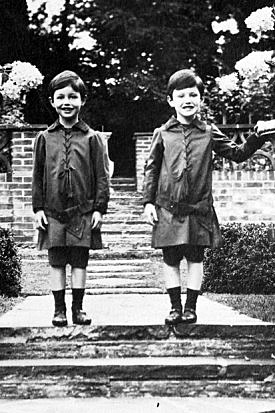
Peter and Ian as youngsters - so close that it is hard to tell them apart!

Peter and Ian as youngsters – so close that it is hard to tell them apart!

We know Ian Fleming was one of five children, grandchild of Robert Fleming (a wealthy merchant banker, founder of Robert Fleming & Co.). But what is known about Ian’s older brother Peter Fleming? Many today may not know or remember this name, but in his time Peter Fleming too rocked the literary world, just as his younger brother would a decade or so later. Peter Fleming, born in May 1907, was an adventurer, a travel writer, and a heartthrob throughout the 1930s and 40s. How then did this popular, adventurous author become overshadowed by his younger brother to the point where almost ten years after James Bonds’ author Ian died young, Peter’s modest gravestone in a quiet town in the Oxfordshire countryside read, “He travelled widely in far places; Wrote, and was widely read. Soldiered, saw some of danger’s faces, Came home to Nettlebed. The squire lies here, his journeys ended – Dust, and a name on a stone – Content, amid the lands he tended, to keep this rendezvous alone.” How one goes from stardom to a modest, quiet life is a very good question indeed!

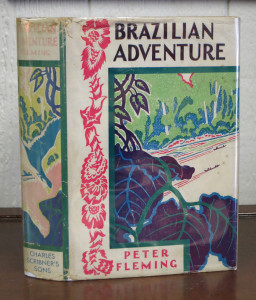
Our 1st edition listing of Peter's first book.

Our 1st edition listing of Peter’s first book.

Peter and Ian Fleming grew up one year apart, from a well-to-do family, in the United Kingdom. Though it must have been difficult growing up so close in age as sibling rivalries took place, the brothers seemed not to let it get in the way of their relationship and throughout their lives were steady supporters of each others’ careers. Both were trained in intelligence during the course of World War II, both were star pupils at Eton (though where Peter seemed to glide through, Ian was a more difficult case). This, unfortunately, seemed a usual ritual. Ian struggled to make a living as a stockbroker, while a 24 year old Peter was working as the assistant literary editor at The Spectator. Peter answered an advertisement looking for a adventurous soul for an expedition through Brazil, and began his travel writing career. The resulting book, Brazilian Adventure, launched the elder Fleming’s literary career. He married the beautiful film actress Celia Johnson, and for a while his fame was more intense and well-known than Ian ever dreamed he could experience. Unfortunately, in 1947, Peter fell from a horse and suffered a crushed pelvis. After this incident he wrote no more travel books in far-off places, and retired to a somewhat more modest and quiet life.

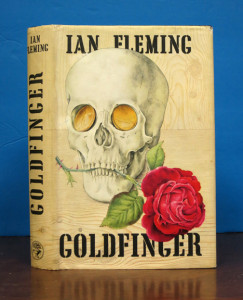
Goldfinger - one of Ian Fleming's most beloved stories. Our holding signed by Bond movie stars!

Goldfinger – one of Ian Fleming’s most beloved stories. Our holding signed by Bond movie stars!

Peter was the instigating force behind the publication of Ian’s first novel, Casino Royale. It was Peter who suggested the change of M’s secretary to Moneypenny. Peter went over Ian’s manuscripts with such a fine-toothed comb that it “earned him the nickname Dr. Nitpick” (Telegraph.co.uk). So why then – if Peter was the accomplished literary scholar, the responsible adventuror, the charming author – is it more his younger brother we remember today? Ian Fleming wrote Casino Royale in 1952, and finished the novel within a short span of a couple months. The resulting story was immediately popular and three print runs were necessary to cope with the large demands made for the book at its publication. Casino Royale introduced the character of James Bond, a handsome and charming MI6 Secret Intelligence Officer, known by his code name “007.” The Bond stories center around this daring spy’s exploits, often involving ruthless villains and pretty women. Ian Fleming enjoyed a decade of immense success following the quick publication of his first five Bond novels, a period which went into a short decline after his popularity suffered a blow under a harsh criticism of his book Dr. No. However, it bounced back once knowledge that his novel From Russia, With Love was hailed as one of John F. Kennedy’s favorite books of all time. At this time Fleming began work on the screenplay of Thunderball, Goldfinger, Dr. No and From Russia, With Love, while also taking the time to publish a beautiful children’s story, Chitty-Chitty-Bang-Bang.

Unfortunately for Ian, his life was cut short. A life-long drinker and smoker, Ian suffered a fatal heart attack on August 12th, 1964 and passed away on his son Caspar’s 12th birthday.  For the years remaining to him, Peter struggled to be a father-figure to the troubled Caspar (who committed suicide at the age of 23), but Peter also succumbed to a heart attack 7 years later, while out shooting with friends. Hunting game was one of Peter’s greatest joys in life, and a primary he pursued the Brazilian adventure mentioned earlier. It seems only appropriate that he would die doing something he loved.

What then, of the intense similarities and differences between these two brothers? Both magnificently talented, if not in similar writing styles, but more their ability to make a splash. Both dependent on the other for support and friendship throughout their lives. On one hand you could make the argument that it is unfair for so much literary popularity to reside in one family. On the other… how lucky we are to have experienced both of their styles and careers from their literary remains!

Share

New News from Tavistock Books!

First off, we’d like to wish each and every one of you a very Happy New Year from Tavistock Books! Whether you are a customer, colleague, pure bibliophile, or my mother and father, we have appreciated your attention and custom this past year and wish you all the best of luck in 2015! There are a lot of things happening around here in the near future, and we thought we’d send out this update from TB to keep you in the loop.

Most importantly! Upcoming Antiquarian Book Fairs:

Later this January and early February features the annual California book fairs – the 48th California International Antiquarian Book Fair to be held in Oakland, CA (right near us! Check it out here: http://sfbookfair.com/) from February 6th to the 8th, and the Pasadena Book, Print, Photo & Paper Fair the previous weekend (at the Pasadena Convention Center, January 31st & February 1st). The fairs are a great chance to meet with like-minded book-loving folk from all over the United States, and both fairs will be host to a handful of international booksellers as well. Tickets are available for purchase online as well as at the fairs. Come on out and support your local booksellers! OR ELSE.  

A Recent Acquisition:

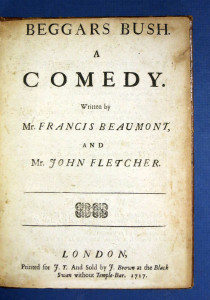
Why yes, you can purchase me! Please, sir, I need a new home.

Why yes, you can purchase me! Please, sir, please, I need a new home.

Beaumont, Francis [1585? – 1616]. Fletcher, John [1579 – 1625]. Massinger, Philip [1583 – 1640] – Bush attributed to.  BEGGARS BUSH.  A Comedy.  [bound with] The MAID’S TRAGEDY.  London:  Printed for J. T. And Sold by J. Brown at the Black Swan without Temple-Bar. 1717.  56; 64 pp.   Typographical ornaments to t.p.  4to: A – G^4; A – H^4.  8-1/2″ x 6-1/8″.   Early full leather boards, with modern respiniing to style.  Renewed eps.  Raised bands.  Red leather title label in second compartment; author label in 4th compartment.  Date gilt stamped at spine base. Wear & staining to boards, with front paste-down showing faint evidence of prior damping.  Paper aged, with foxing & staining.  Running title occasionally closely trimmed.  An About Very Good – Very Good copy.

Bush: 1st edition thus, the unaltered version (NCBEL I, 1712; Tannenbaum 7).  Maid: 1st edition thus (NCBEL I, 1711; Tannenbaum 293).   Regarding Bush, authorship attributed to Fletcher & Philip Massinger by John H. Dorenkamp in his 1967 edition of the play. The play is one of several works of English Renaissance drama that present a lighthearted, romanticized, Robin Hood-like view of the world of beggars, thieves, and gypsies; in this respect it can be classed with plays of its own era like The Spanish Gypsy, Massinger’s The GuardianSuckling’s The Goblins, and Brome’s A Jovial Crew… Yet the play also contains serious aspects that have caused it to be classified as a tragicomedy by some commentators; ‘Through mixed modes Beggars Bush exhibits serious sociopolitical concerns to earn a classification that at first seems incongruous — a political tragicomedy'” (Clark, The Moral Art of Phillip Massinger, p. 116). Click on the picture to see more!

Lists & Blogs on the Horizon:

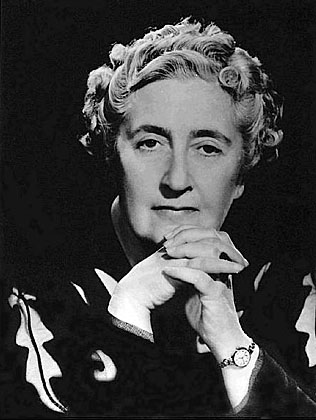
Dame Agatha Christie

              Dame Agatha Christie

And folks, despite an upcoming busy schedule for us here at Tavistock Books, we still want to take a little time to give you a short overview of what to expect in your inboxes from us in the near future. Our monthly Tavistock Books newsletter will go out next Tuesday, January 13th. January 21st will be a large blog on the English crime author Agatha Christie, the best-selling novelist of all time (according to the Guinness Book of World Records).  A list of Select Book Fair Highlights featuring a few of the items that we will be presenting at the California fairs will be announced on the 27th of January, closely followed by a small recap blog of the Pasadena Book Fair on February 3rd. Then look out on the 11th of February for our monthly newsletter once more with a large feature on the Oakland ABAA fair front and center!

We do hope to see you all at the California Book Fairs later this month and early next – just remember, these are the biggest book fairs on the west coast of the United States! Feel free to contact us with any questions – and definitely stop by the Tavistock Books (Pasadena Booth #L1 & Oakland Booth #100) booths to say hi!

Share

Top 10 Things We Hear at Tavistock Books

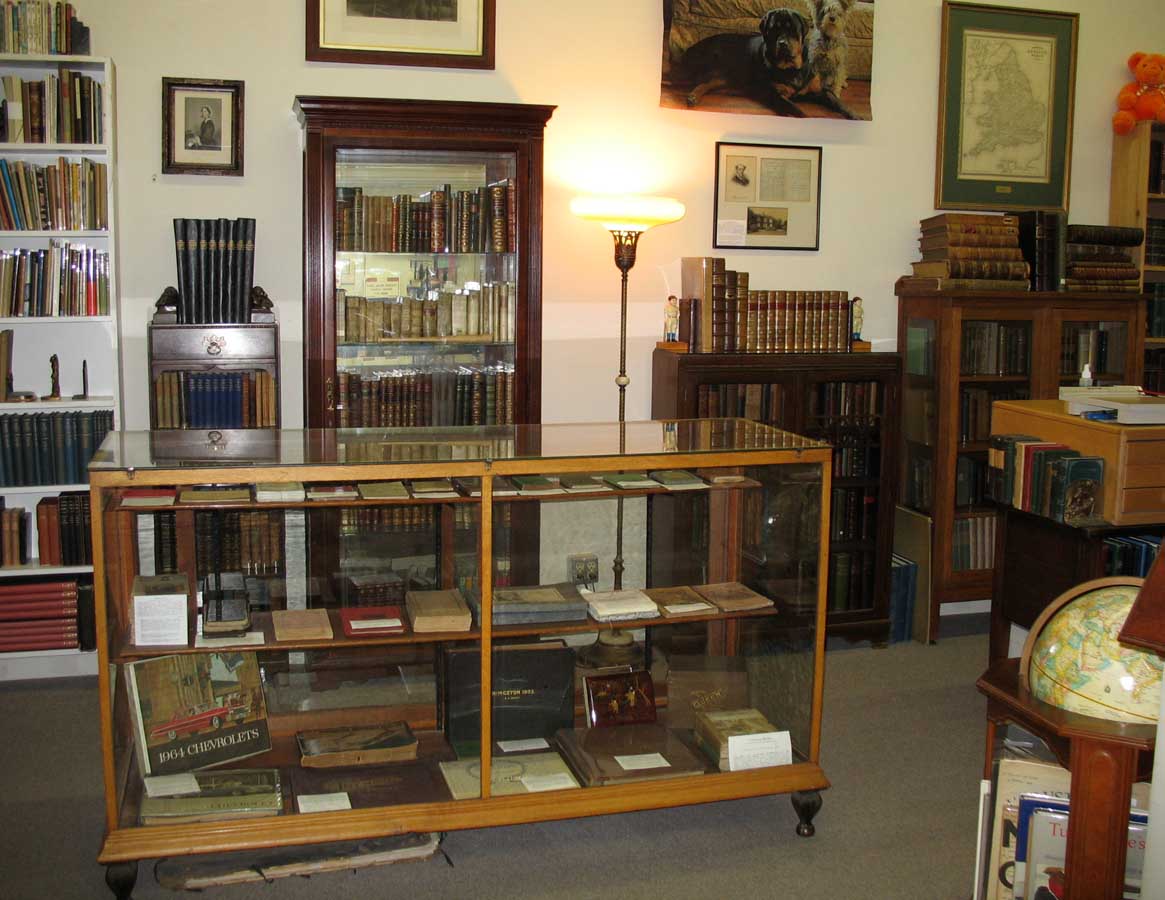
With an open shop since 1997 on a main mercantile street in California’s sunny Alameda, we hear some extremely interesting things from the general public who wander in, not quite sure what antiquarian books are all about… Some of the most popular questions and comments by our shop visitors are included below. Enjoy!

1. “Do you sell books here?” [… No, not nearly often enough.]

2. “I have this really, really old Bible, like from 1850 or something. Is it worth anything?”

3. “My mother left me some old books.” [To which the possibly only sane reply is a very eloquent, “Cool. I mean, I’m sorry for your loss.”]

"Yes, so expensive, in fact, that we make our customers sign a Give-us-your-First-Born-Child agreement when they walk in the door, so we are insured if they break anything."

“Yes. So expensive, in fact, that we make our customers sign a Give-Us-Your-First-Born-Child agreement when they walk in the door, so we are insured if they should break anything. Got a pen?”

4. “So, is like, everything in here really expensive?”

5. “Do you have any books on mushrooms?” [Only in California, right?]

6. “Your blinds are always closed & I never see you open. How do you make any money?” [Appropriate-but-probably-should-not say-it response: “It’s just a front, actually. We’re a drug cartel.”]

7. “I’m looking for a book. It was red. No, sorry, don’t remember the author or title.”

8. “Do you buy books?” [I should preface this one with the fact that any who ask this in person walked past a 3 ft. long sign on our front window that says WE BUY BOOKS.]

9. “I came in here, like, 10 years ago I think. It hasn’t changed at all.” [Umm… thank you?]

10. “Wow. You have some old books in here.” [Really? We hadn’t noticed.]

and an extra for good-luck:

11. “I’ll come back when I have more time to browse.” [If we only had a nickel…]


Strategies for the Antiquarian Bookseller to Not Lose One’s Tolerance for Having an Open Shop

1. Hire an assistant that you pay to be nice to people who walk in the door, especially the ones that ask questions you personally could not possibly answer without copious amounts of sarcasm.

OR

2. Put up the “Closed to the Public” sign when you’ve had all you can take for the day. Even if it is only 9:23 AM, and you started at 9.

Don’t get us wrong, however, we are very thankful for our walk-in customers. If not for their custom, then for the giggles they grant us!

Happy Thanksgiving!

Share

Recent Happenings at Tavistock Books

At the Store:

At Tavistock Books we are experiencing a problem that many booksellers before us have seen and many after will encounter. Space. Similar to the phrase “there is not enough time in the day,” there are not enough shelves in our store! We have filled every nook and cranny with books, with dogs, or with Giants bobbleheads. As it stands, in early December we are planning on doing some re-vamping in our store. Mainly, we will be building UP! Come check out our new, organized & feng shui-ed brick-and-mortar in the new year!

Book Fairs to Watch Out For:

In the Golden State in January & February 2015? Don’t miss out on the 48th California International Antiquarian Book Fair to be held in Oakland, CA February 6th to 8th, and the Pasadena Fair January 31st & February 1st – both of which, you’ll be pleased to know, will sport a Tavistock Books booth!

A Recent Acquisition:

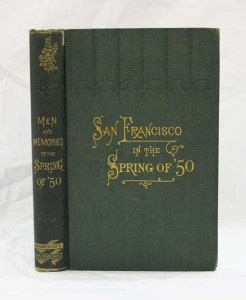
"Men and Memories of SF"

     “Men and Memories of SF”

Barry, T[heodore]. A[ugustus. 1825 – 1881]. Patten, B[enjamin]. A[dam. 1825 – 1877]. Phelan, James Duval [1861 – 1930] – Former Owner.   MEN And MEMORIES Of SAN FRANCISCO, in the “Spring of ’50.”  San Francisco: A. L. Bancroft & Company, 1873. 12mo. 7-5/8″ x 4-7/8″.  Green cloth binding with gilt stamped title lettering to spine & front board. Green eps. Gilt bright. Slight lean, small abrasion to cloth at top of front joint. Foxing to edges. Bookplate of James D. Phelan [former mayor of San Francisco, 1897 – 1902] to front paste-down. Period ownership signature of Mrs M. G. Willson. Withal, a VG+ copy with a nice, associated provenance.  $275.

1st edition (Cowan II, 36; Graff 197; Howes B-192; Kurutz 38a; Rocq 8248; Wheat 12).   Per Cowan I, “a most brilliant panorama of the times…”, and per Wheat, “Informative and engaging gossip respecting old-time personalities and events.” The authors arrived in their adopted state before January 1, 1850 & proudly answer to the moniker, “pioneer”. This book gives those that came later, and without such status, “a detailed picture of the city as it existed a few months before California statehood. They describe the streets and the residences and business that lined each thoroughfare and alley as well as the men and women who owned those homes, boarding-houses, hotels, restaurants, saloons, stores, offices, and shops. They also chronicle the fire of May 1851 which destroyed so many of the structures they describe. While they focus on the city as it was in early 1850, their sketches of its residents extend further, often forming capsule biographies of their subjects.” [OCLC].

Lists & Blogs on the Horizon:

Next Tuesday, the 18th, will see our annual “Holiday List” once more filling your inbox with goodies. Definitely won’t want to miss this one – the pictures are spectacular, as usual! Our next blog will be sent out on November 26th, all about Children and the Christmas Spirit. Be sure to sign up for our mailing list if you would like to be informed of each new blog post from Tavistock Books. Email msp@tavbooks.com here.


Share

On Identifying Photographic Prints and the History of Early Photography

 Photographic Prints in an Antiquarian Bookshop

Without a doubt, every antique store and flea market from California to New York somewhere has a box of photographs – black and white, early Kodaks, or even tintypes… often warped, mirrored, faded – if you are reading this blog it is assumed that at some point or another your interest in antiquarian books and materials has drawn you to such an establishment, and you have at least fingered through a box of photographs labeled “.10 each or 15 for $1.00”. Why is it, then, that those photographs are (seemingly) worthless, while there are photograph albums offered by booksellers with the same types of prints for thousands of dollars? As with all things antiquarian – provenance, condition and interest levels dictate the differences between a bin full of late 19th century silver-gelatin prints and an album full of un-faded, unaltered albumen photographs.


Photography in the Early 19th Century

William Henry Fox Talbot in 1864

William Henry Fox Talbot in 1864 by Moffat.

The name William Henry Fox Talbot is known throughout the world as a British inventor, author and photographer of great significance. Talbot claimed experiments in photography as early as 1834, and in 1841 announced his invention of the calotype (also called the Talbotype) process, a process that reflected the work of many of Talbot’s predecessors, such as John Herschel and Thomas Wedgwood. One of Talbot’s main contributions to this fledgling art included creating a photographic image through the use of a negative from which a positive print could be made (though those terms were previously coined by Herschel, Talbot demonstrated the technique with ease). Talbot’s early discoveries culminated in his pioneer finding that silver chloride was the silver compound “most suitable for photographic printing, and to discover how to use it most effectively” (O’Reilly, p. 1). Talbot’s negative to positive printing could also be said to be one of the most important inventions in the field of photography as it allowed the photographer to create numerous prints off of a single negative, simply by exposing more paper to the image. As you will see later, other early forms of photography (such as the popular Daguerreotype process), were not able to form several images from a single exposure.

Now, the art of photography has developed significantly since Talbot began his experiments in rural England. If this blog were to describe every type of photographic print process and the differences and nuances between them all, we would quickly lose the followers we have so far gained. Suffice to say, the history of photographic prints is as diverse and intricate as any popular invention might be. Unfortunately, identifying photographic prints is particularly difficult for the untrained eye as even the slightest changes in the process (and in the final product) can be difficult to observe if you are not sure what to look for.


Identifying Photographic Prints in the Late 19th and Early 20th Centuries

Photography in this time falls into two distinct categories, True Photographs and Photomechanical Prints. Photomechanical Prints are images not formed directly from exposure to light or from a negative, and are rather more often “mass-produced.” These mechanical techniques include Halftone Illustrations (which some may recognize by their dotted appearance when viewed with a scope) and Photogravure, among others. These prints, while still able to be artistic and popular in their own right, are not usually as desirable as True Photographs when it comes to collectors and institutions. True Photographs encompass many other types.

Evidence of Silver Mirroring is seen in the darker portions of this image (IPI).

Evidence of Silver Mirroring is seen in the darker portions of this image (IPI).

True Photographs include, as stated, many other processes. Some of their results may sound familiar, some not so much. Salted Paper Prints, Cyanotypes, Platinotypes, Albumen Prints, Gelatin and Collodion Printing-Out Papers, Gelatin Developing-Out Papers… all of these, despite their somewhat extreme differences, are examples of True Photographs. They are placed into categories depending on characteristics such as the appearance of their paper fibers, their hues, and, most interestingly, their condition. Signs of fading, mirroring (the slight silvery hue to the darker areas of the photograph due to silver oxidation), warping and cracking can all contribute to telling the difference between the many types of “true” photography.


Curious about an image you have? Try http://www.graphicsatlas.org/ to help you identify your items.


Photography as a Popular Pastime
A typical Albumen Cabinet Card

A typical 19th century Albumen Carte-de-Visite.

The Daguerreotype studio boomed early in the photographic print age in the mid 1800s. Other early photographic processes included the Salted Paper Print and the Albumen Print. Albumen Prints were quite possibly the most popular type of photographic process, as they are the most widely found today. Around the 1860s and 1870s a certain type of photographic style emerged, a Carte de Visite (quite literally, a Visiting Card) that was traded between friends and family, and most notably took the place of the general “Calling Card” that social guests would deliver to households they stopped in to see. Along with these Cartes de Visite and their cousins “Cabinet Cards”, photography moved into an age of cabinet cards and other studio portraits. Silver gelatin and Matte Collodion Printing-Out Papers and Developing-Out Papers (whose main differences lie in the process by which the image appears – DOP images appear during chemical development, whereas POP images appear on their exposure to sunlight) were quite popular as forms of portraiture, and were also some of the most popular forms of photography for the average civilian to produce at home.


Photography in Books

The first book ever to be illustrated through the photographic process was produced by none other than William Henry Fox Talbot, with his book The Pencil of Nature, published in 1844 with his own calotypes pasted into the book. The text within the book details Talbot’s calotype process used for each individual photograph. Each photograph within Talbot’s work were laid in and pasted by hand, not to mention taken and developed by the inventor as well. Though the book was less popular than Talbot expected, it paved the way for an idea that (eventually) became a bit of a phenomenon – illustrating books with photographic prints. Despite the fact that many “jumped on the bandwagon” and illustrated works with photography in mid-to-late 19th C, “in many traditional libraries the illustrations to a book, and its illustrator, were often placed in a role secondary to the author – even in situations when the illustrations were the dominant concern of that work” (Johnson, Nineteenth-Century Photography). This is no longer so. The book trade often sees works collected solely for the photographer or the images represented within a work, the text often being of little to no concern to such a collector.

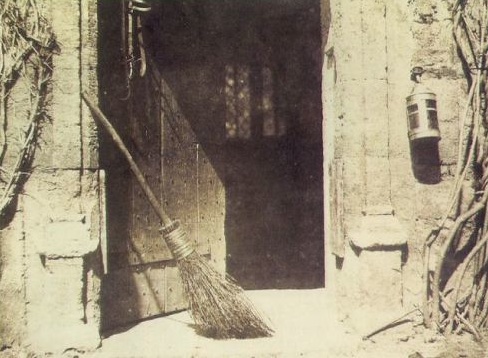
One of the photos included in Talbot's "Pencil of Nature", published in 1844

One of the photos included in Talbot’s “Pencil of     Nature”, published in 1844.

Photograph albums, on the other hand, can be a different story. Eugenia Parry Janis writes “A love of subject matter leads the bookseller to photographs. He is satisfied to present photographic discoveries which have engaged his attention as they act in collaboration with needs of descriptive science, exploration, documentation or poetic evocation. It is a special quality of photographs to be able to enter into reciprocal relationships with words… The most discriminating private collections of photographs today owe much to booksellers’ at times obsessive, and even indiscriminate salvaging and rescuing of photographs destined for the incinerator. Photographs were not saved because they necessarily conformed to prevailing standards of beauty; they were saved for the richness of what they presented.” (Charles B. Wood III, Catalogue 37). Therefore, when looking through photographic albums, individual photographs, and books illustrated with photographs, it is a great find when the photos are in impeccable condition. However, more often than not, photographs are collected for what they represent – a moment in history, a fashion style, an area of the world, a political event – rather than because of their condition and artistic beauty.

In a catalogue later this month we will offer examples of all of the above – individual photographs, photo albums, and books illustrated with true photographs. Featuring a wide range of subjects, from military bases to train catalogues to family vacations, there is certain to be something of interest to everyone.

*The only reason we at Tavistock Books know any of this information on Photographic Prints is from taking James M. Reilly and Ryan Boatright’s course on these processes at University of Virginia’s Rare Book School. A fair warning – this has been a highly condensed and extremely terse outline in comparison to their course, a course officially endorsed by Tavistock Books!

Photo-WHFTalbot


Share

Tavistock Books’ Almost-Annual Reference Book Workshop

There is a significant difference between booksellers who advertise their wares with professional descriptions, a clear understanding of the item in question, an honest assessment with regard to the item’s condition… and your typical eBay/Amazon blasters: “FREE SHIPPING! May or may not have highlighting and/or missing pages.” The pride in being a Good (or VG+) bookseller comes from the ability to sell something about which you are knowledgeable and which is priced confidently and accurately.

Oftentimes, as booksellers, we hear the question “Why?” Why is this book worth $495? Why would I pay that much for a book which Joe Shmoe, Bookseller offers for $29.99? There is no shame in asking these questions. Even booksellers can look at their colleagues’ wares and stare confusedly at the screen while waiting for the computer to sprout tiny-computer legs and giggle, while simultaneously erasing that last 0 or two. All that being said, however…. what can give booksellers the ability to price confidently and describe accurately? Two words.

Reference Books.Reference Books

If you are reading this blog, there is a good chance you have looked at listings of antiquarian books before and have noticed some crazy notations in our write-ups. What is a BAL11092? Or a Gabler G2390? An average person has a good chance of not particularly understanding what the numbers mean. Heck, another bookseller might not even have a clue to what you are referring. A good bookseller will know, however, that the inclusion of those small jumbles of letters and numbers beyond their edition statements represent the dedication and honesty of the person offering the item. They have gone to the trouble of understanding what they hold in their hands, so that their customer can have the guarantee and peace-of-mind that they are buying a 1st/1st, a 1st edition thus, or a reprint. What allows a reference book to (sometimes) up the price or (often) lower the price? Well… I guess you’ll just have to take the Tavistock Books’ Reference Book Workshop to find out!

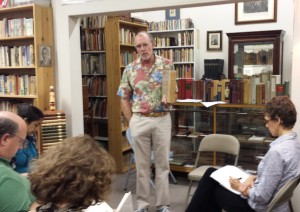
This year’s course took place this past Saturday, the 23rd of August. The day-long course consists of an intense look at different genres of reference books, their scope, and their usefulness to the book-selling, book-collecting and book-cataloguing trades. Sections covered include Literature (do the acronyms NUC or NCBEL mean anything to you? Here’s where you will find them explained!), Americana (with an emphasis on Western Americana & California… can you say Kurutz three times fast?), Children’s Books, Early Printed Books, and Online Reference Tools. This course is a fast-paced survey, useful for any bookseller, collector, or librarian interested in understanding the tools booksellers use to identify and price their books.

Workshop 2014

This year’s workshop was attended by 4 booksellers (some new, some slightly seasoned), two librarians, and a lover of all things book-related. Intelligent questions were asked, anecdotes shared, and quite a bit of knowledge imparted on these smiling (though, by the end of the day, slightly haggard) faces. Due to the limited amount of space in the shop (where the workshop is held), we cap the number of “pupils” at 7 per year. Should you be interested in attending, please email msp@tavbooks.com and ask to be included on our mailing list, so that when the reminder comes about next spring to sign up, you can be first on the list!

The workshop truly is helpful to those dealing with the book-trade, and the Tavistock Books Reference Collection of over 3,000 reference volumes alone are worth the trip to see! And, as per tradition, lunch is on us at a great sushi place on our charming island of Alameda, CA. Interested in attending a workshop one day? Let us know!


Share

Unique? A List for June

Unique.

A compelling word, and one that certainly can, and should, stand on its own, though frequently we find unnecessary modifiers employed to make the unique even more so, if such is at all possible…  more unique, highly unique, uniquely unique….  you get the drift.

So with this in mind then, and without modifying hyperbole, we issue this list for June, wherein each of the 60 items displays an aspect of uniqueness… whether by definition, inscription or perhaps being the only copy on the market.  As is our practice, the list is eclectic in nature-  from air to water, original art to original mss, from Nevada to Massachusetts.  Temporally, the items reach back to the 1770s, and continue on until the mid-20th C.  Prices range from $75 to $7500.

Winning Independence: An Illustrated Address Describing the “Parlor Profession”
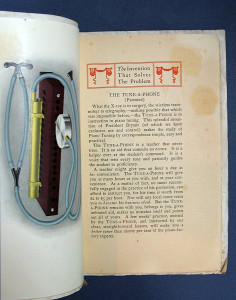
Bryant_Winning_ProfessionNiles Bryant, the President & Founder of the Niles Bryant School of Piano Tuning, and enjoys some recognition in the music world for his 1906 publication, Tuning, Care and Repair of Reed and Pipe Organs, which was reissued in 1968 by Vestal Press. “Through the profession of piano tuning, I offer you indestructible resources, good fortune and permanent independence.” So Bryant opens this publication, which is a promotional piece for the profession of piano tuning, and even more specifically, the advantages of attending his school to learn the profession, as well as to puff his invention, “The Tune-a-Phone”. This publication is tot located on OCLC, nor found in the NUC. Details>>

Mr. Thackeray, Mr. Yates, and the Garrick Club Affair
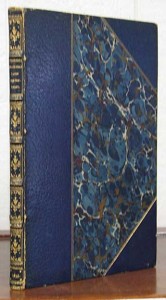
Yates_Thackeray_Garrick_Club_AffairThe notorious quarrel between two of England’s most popular authors began with Yates’ critical review, in Town Talk, of Thackeray’s English Humourists of the Eighteenth Century. Thackeray, as might be expected, was a bit affronted at what he viewed as a slanderous insult by this fellow member of the Garrick Club; believing much of Yates’ information came from club meetings, he took his grievance to the club committee. The committee sided with Thackeray and instructed Yates to apologize. Yates refused and was forcibly barred from club premises, subsequently bringing charges against the club Secretary.

Charles Dickens, absent from London as this brouhaha was brewing, returned to find all in full force. He offered to mediate, though primarily siding with Yates, which Thackeray viewed as treachery. The ill feelings between the two did not abate for years, until shortly before Thackeray’s death in 1863. (More about the Garrick Club Affair>>)

Herein Yates recounts the history and evidence of the disagreement, with, not unexpectedly, a bias to his own case. This copy was presented to Edward Bradley, presumed to be the Victorian novelist, who wrote under the pen name Cuthbert M. Bede. Known in Wise facsimiles (cf Todd 425c), the first edition, as here, has been just twice at auction in the last 30+ years, the last being 1977. It’s a rare piece of Dickensiana; this is the first time we’ve ever been able to offer the item. Details>>

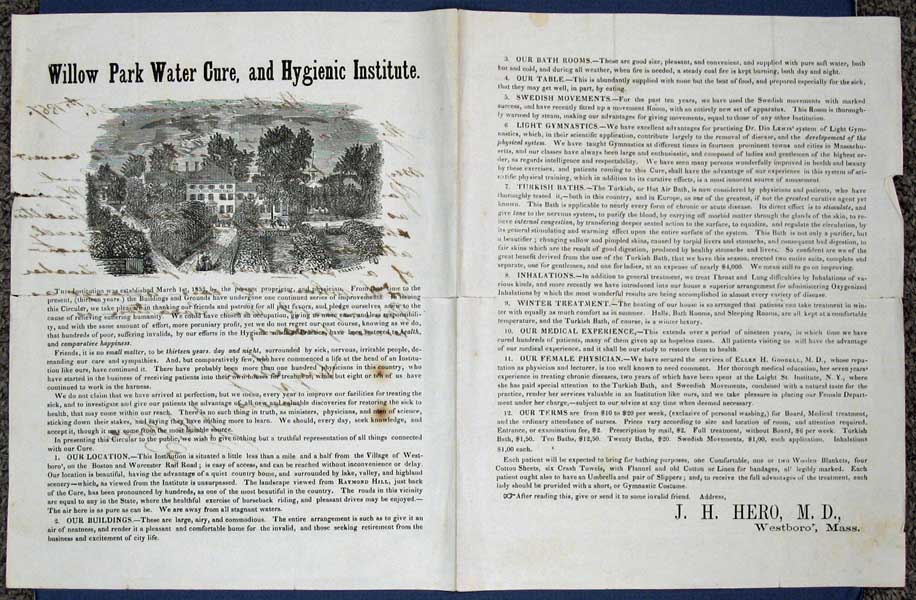
Willow Park Water Cure, and Hygienic Institute

On March 1, 1853, John Henry Hero established the Willow Park Water Cure, with himself as proprietor and attending physician, for the treatment of chronic diseases through the “water cure.” Treatments of Swedish movements, light gymnastics, Turkish baths, and inhalations were also employed, to considerable success–though this success did not come without a personal price; as Hero writes in this circular “Friends, it is no small matter, to be thirteen years, day and night, surrounded by sick, nervous, irritable people, demanding our care and sympathies.” Hero seeks a change, and it is to this latter Hero addresses himself in this circular’s holograph letter: “I intend to convert / my Institution into a School / for young Ladies.” Later in the year, Dr. Hero did found the Willow Park Seminary for young women “where the Physical as well as the Intellectual facilities [were] faithfully and equally attended to.” OCLC does not record this particular broadside, though two others are found, each in one copy only. Details>>
Hero_Willow_Park_Water_Cure

BF Keith’s Grand Educational Demonstration
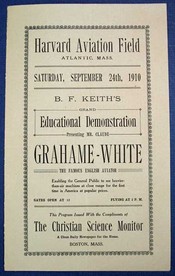
BF_Keith_Grand_Educational_DemonstrationClaude Grahame-White was the Glamour Boy of early aviation, somewhat of a playboy, with no engineering background whatsoever, Grahame-White became enamored of flying when, in 1908, he saw the Wright’s demonstrate their invention to the French crowds at Camp d’Auvours. Within a relatively short time, self-taught, Grahame-White soloed without a formal lesson. He quickly made a name for himself as a dashing aviator. In 1910, JV Martin of the Harvard Aeronautical Society, invited him to compete in the first Boston-Harvard Meet. With the promise of a $50,000 retainer & expenses, Grahame-White accepted. Grahame-White won that one, and others, as he thrilled spectators with his races & aerial exhibitions such as that announced in this “One-man Show” program.

This rare survivor lists the diverse aerial stunts to be performed by Grahame-White during the day… “With the Bleriot Monoplane” includes a dive from 4000 feet “with engine stopped.” “With the Farman Biplane,” the twelve planned events include “Aerial switchback flying”; “The corkscrew glide [spin?] from a high altitude”; and  “Knocking down ninepins placed on the ground, without alighting.” With this sort of exhibition, and his dashing and flamboyant personality, the handsome Grahame-White gave the new aviation field, previously dominated by engineers, something that had been lacking to date: a ‘sexy’ nature. Details>>

Salesman’s Album with Sixty Photographic Images of Indian Motorcycles

This a presumed company-issued production, no doubt targeted for those who already owned an Indian Motorcycle franchise, or generated for traveling company reps, allowing prospective buyers, such as police departments, to view the entire product line. We find no bibliographical record of another such album being offered, and believe the album to have been produced in limited numbers. 
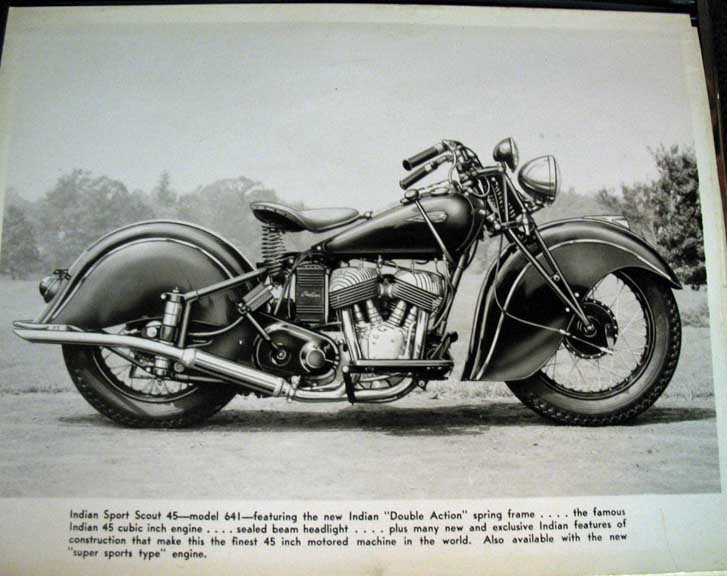
Salesmans_Album_Indian_Motorcycles

 In 1940, Indian sold nearly as many motorcycles as its major rival, Harley-Davidson. At the time, Indian represented the only true American-made heavyweight cruiser alternative to Harley-Davidson. Indian’s most popular models were the Scout, made from 1920 to 1946, and the Chief, made from 1922 to 1953. Unfortunately, the company went bankrupt in 1953. Today, the vintage cycle enjoys much popularity amongst enthusiasts, with models from the era displayed herein being offered for five-figure sums. A fascinating and well-preserved original photograph album, which visually documents the late ’30s and early ’40s Indian Motorcycle company, and its impressive product line, as existed during the company’s heyday. Details>>

Correspondence, Including LaGuardia’s Wedding Invitation
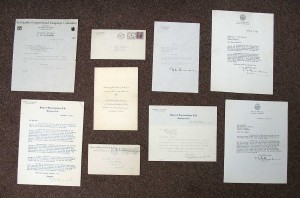
Correspondence_Fiorello_LaGuardiaFiorello LaGuardia, or “Little Flower,” is widely regarded as one of the best mayors in New York City history, whose tenure redefined the office. He was the 99th mayor of the “Big Apple”, serving his populace from 1934 to 1945. For those twelve years, the 5’2″, sometimes belligerent, chief executive dominated life in New York City as if he was 7″2′. Unlike many politicians today, he fulfilled many of his pledges, especially the ferreting out of corruption in the city’s government. Such earned him a reputation for placing the city’s interests ahead of political considerations, and in the same vein, although technically a Republican, he worked closely with the New Deal administration of President Franklin Roosevelt to secure funding for large public works projects. These federal subsidies enabled New York City to create a transportation network the envy of the world, and to build parks, low-income housing, bridges, schools, & hospitals. Furthermore, he achieved the unification of the city’s rapid transit system, a goal that had long eluded his predecessors, and he reformed the structure of city government by pushing for a new City Charter. LaGuardia presided over construction of New York City’s first municipal airport on Flushing Bay, later to become his namesake. As a result of all his efforts, LaGuardia’s psychological effect on New York City was nothing short of profound, restoring faith in city government by demanding excellence from civil servants. Details>>

The Life of The Right Honourable Arimanes, Typhon, Thammuz, Beelzebub, Ashmodaus, Sammael, Daemon, Lucifer the Great, of the Dark Infernal Empire Count of Sheol and Gehenna, Baron of Hades &c., &c., &c
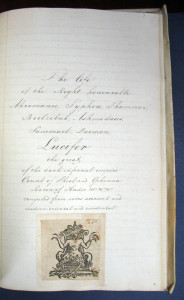
Life-Right_Honourable_Beezlebub_LuciferThis eighteenth-century codex is an entirely holograph history of Lucifer, wherein the anonymous author tells us in his Preface, “Lucifer … is a spiritual being. That is true; but far from being considered here in that light, he is represented plainly terrestrial. He is not the Lucifer as Vondel, Milton and Klopstock described him, but exactly as he is shown in magick lanthorns for the amusement of the spectators. … My Lucifer is of Ethereal breed and Ether is and remains material. …. mine is of a persian and chaldean race.”

Though the volume bears no date, it bears the Pro Patria “Maid of Dort” watermark, circa 1760’s. Affixed under the holograph title is an extracted woodcut image [ca 1550, cf. Sebastian MŸnster’s “Cosmographia” (1544)] of the ‘God Deumo (Demus or Deumus) of Calicut.’ The volume has a full vellum binding and yapp edges. Details>>


Thanks for reading! Love our blog? Subscribe via email (right sidebar) or sign up for our newsletter--you’ll never miss a post.

Share

Why California Isn’t Called “Nova Albion”

On June 17, 1579, Francis Drake claimed California for England. He anchored his ship, the Golden Hind, just north of present-day San Francisco and named the new territory “Nova Albion.” But despite Drake’s claim in the name of Queen Elizabeth I, he was not the first European to explore California.

Drake Lays Claim to California

Drake set out from England on December 13, 1577 with five ships. His mission was to raid Spanish holdings along the Pacific coast in the New World. Drake was forced to abandon two ships during the Atlantic crossing. Then the expedition encountered a series of storms in the Strait of Magellan. One ship was destroyed, and the other returned to England. Only the Golden Hind reached the Pacific. Drake raided Spanish settlements and captured a heavy-laden Spanish treasure ship.

Drake continued up the West Coast of North America in search of the fabled Northwest passage. He got as far north as present-day Washington, stopping near the San Francisco Bay in June 1579. In July, Drake’s expedition set off across the Pacific, eventually rounding the Cape of Good Hope and returning to England. Drake returned to Plymouth, England on September 26, 1580. Queen Elizabeth I knighted him the following year on a visit to his ship.

A Portuguese Explorer for the Spanish Crown

California gets its name from a mythical island populated by Amazon women who use golden tools and weapons. It appeared in a popular romance novel called Las Sergas de Esplandian by Garci Rodriguez de Montalvo. The book went through several editions, though the earliest extant copy dates from 1510. When Spanish settlers explored what’s now Baja California, they believed that they’d discovered the mythical island.

It was Portuguese adventurer Joao Rodruigues Cabrilho, better known as Jose Rodriguez Cabrillo, who disabused the Spaniards of the notion that California was an island. Little is known of Cabrillo’s life before 1519, when his name first appears in the ranks of those serving conquistador Hernan Cortes. Cabrillo participated in the conquests of both Mexico and Guatemala. He was also involved in military expeditions to southern Mexico, Guatemala, and San Salvador.

Cabrillo eventually settled in Guatemala and by 1530 had established himself as a leader of Santiago, Guatemala. He returned to Spain briefly to find a wife, marrying Beatriz Sanchez de Ortega. The couple would have two sons. Then in 1540, a major earthquake destroyed Santiago. Cabrillo’s report to Spain on the devastation is considered the first piece of secular journalism published in the New World.

Soon Spain was looking to expand northward. Francisco de Ulloa had recently explored the Gulf of California and proven that California was not an island after all (though the misconception persisted back in Spain). Now, Guatemala governor Pedro de Alvarado commissioned Cabrillo to lead a mission up the coast. He believed that Cabrillo and his men would find the fabled wealthy cities of Cibola, which were thought to be somewhere along the Pacific coast north of New Spain. The explorers also held out hope of discovering the “Straits of Arain,” rumored to connect the North Pacific and the North Atlantic.

Cabrillo Travels up the California Coast

On June 24, 1542, Cabrillo sailed out of the port of Navidad (modern-day Manzanillo). He took with him a crew of soldiers and sailors, along with merchants, a priest, slaves, livestock, and enough provisions to last two years. By September 28, 1542, Cabrillo had reached a “very good enclosed port,” now known as San Diego Bay. He and his crew stayed there for several days before heading up the coast. They visited a number of islands before turning around due to adverse weather conditions.

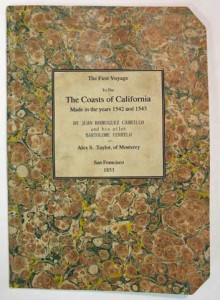
Taylor_First_Voyage_California_CabrilloCabrillo died of complications from a broken leg on January 3, 1543. His exploration helped to dispel geographical misconceptions and to expand the Spanish empire. Over three centuries later, Alex S Taylor, a resident of Monterey, California, wrote the history of Cabrillo’s expedition. First published separately in 1853, The First Voyage to the Coasts of California is considered an important work, indeed; it was the first work of California history actually published within California.

Other Works of Californiana

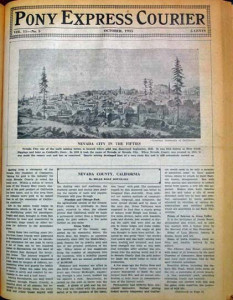
The Pony Express Courier 
Pony_Express_CourierIn 1860, countless men responded to advertisements for riders in the new Pony Express. At any one time, only about eighty men would actually be riders, though another 400 employees supported the operation. The Pony Express was a truly ambitious project, connecting the East coast with California. Mark Twain was lucky enough to witness the Pony Express in action, observing that the rider was “usually a little bit of a man.” The Pony Express Courier, published in Placerville, first appeared in 1934. It’s a wonderful resource for students of Western America, full of interviews, reminiscences, and more. This set includes 16 of 18 total issues, bound in eight books. They are custom bound in blue “marbled” cloth with gilt stamped lettering to the spine and front board. Details>>

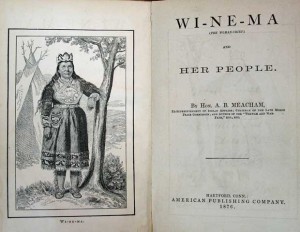
Wi-Ne-Ma (The Woman Chief) and Her People
Meacham_Wi_Ne_Ma_PeopleAlso known as the Lava Beds War, the Modoc War began in 1872, making it the last of the Indian Wars to occur in California and Oregon. Wi-Ne-Man acted as interpreted for the peace commission during the conflict. Her efforts saved the life of Alfred Benjamin Meachum, Indian Superintendent of Oregon, Meachum would go on to write an account of the chieftainess called Wi-Ne-Man (The Woman Chief) and Her People. The first edition was published in 1876. APBC shows this title at auction last in 1997, with only one prior occurrence in 1991. Details>>

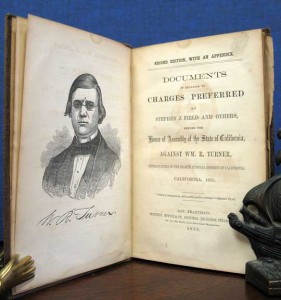
Documents in Relation to Charges Preferred by Stephen J Field and Others…
Field_Turner_Documents_Charges_PreferredThe Field-Turner feud is renowned in the annals of California history. Judge William R Turner had Field, an attorney, disbarred; Field ultimately got his revenge by, on election to the California Assembly, arranging Turner’s banishment, via judicial reorganization, to a remote “region in the northern part of the state.” [DAB]. This second edition includes testimonial and affidavits in Judge Turner’s defense from a host of local officials as well as a few national notables, including Andrew Jackson & Henry Clay. Furthermore, this copy contains rare associated ephemera: a handbill reprinting a contemporaneous review of the book entitled, “Judge Turner’s Book,” as published in the San Francisco Herald of Dec. 30, 1856; as well as a legal circular containing a statement by Judge Turner relating to his candidacy for re-election to the office of District Judge for the 8th District, dated Arcata, July 14, 1863. Additionally, contained within the circular are reprinted two letters with respect to Turner’s case before the Supreme Court, the latter advising Judge Turner “of the favorable and final decision of the Supreme Court in your case.” Details>>

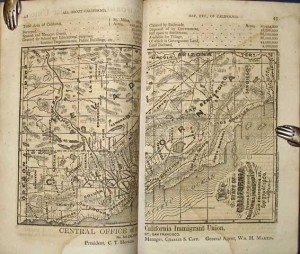
All About California and the Inducements to Settle There
All_About_CaliforniaAttributed to JS Hittel, All About California includes the drop title “For Gratuitous Circulation.” The propaganda piece was designed to encourage settlement in California, and it’s full of pertinent data and factoids of the era. This, the second edition, was issued in 1870 just like the first. It includes a folding map of the railroad route for the “Chicago, Rock Island, and Pacific RR Line,” along with a two-page map of California, a full-page wood engraving of the Grand Hotel, and a two-page map of “JT Little’s San Joaquin Valley.” This copy bears the stamp of the California Immigrant Union in the upper right corner of the front wrapper. There’s a small bit of bio-predation on the top pages of the last eight pages, but no text is affected. Details>>

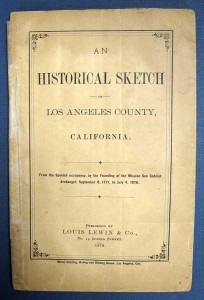
An Historical Sketch of Los Angeles County, California
Historical_Sketch_Los_Angeles_CountyThis account of California history stretches from the Spanish Occupancy, by the founding of the Mission San Gabriel Archangel, September 8, 1771, to July 4, 1876. This copy is a first edition, second issue, published in 1876. The volume is in its original printed paper wrappers. The wrapper edges chipped, with the upper corner lacking from front wrapper. A Japanese paper repair has been made to the spine. There’s occasional pencil marginalia. Overall, this is an about very good copy. Details>>


Related Posts:
The California Gold Rush, Slavery, and the Civil War
L Frank Baum’s Forgotten Foray into Theatre
Elias Samuel Cooper: Renowned and Controversial Surgeon

Thanks for reading! Love our blog? Subscribe via email (right sidebar) or sign up for our newsletter--you’ll never miss a post.
Share

Horatio Alger, Jr: Failed Minister Turned Juvenile Fiction Author

Today we remember Horatio Alger, Jr for his numerous children’s novels–and often little else. The prolific author’s life was shrouded in mystery and fabrication for decades, making him an even more fascinating figure for collectors of rare and antiquarian books.

A Childhood of Privation

Born on January 13, 1832 in Chelsea, Massachusetts, Alger was the son of Reverend Horatio Alger and Oliv (Fenno) Alger. His mother was the daughter of a wealthy local merchant, but the Alger family always struggled financially. Reverend Alger was an able minister, but the post didn’t pay much. After all, as the saying goes, “A doornail is as dead as Chelsea.”

To supplement his pastoral income, the elder Alger served as the town’s postmaster, tended a small farm, and even occasionally taught grammar school. These various pursuits left little time for educating his son; Alger supposedly did not learn his alphabet until he was six years old or receive any formal education until age ten. his education was also skewed toward algebra and Latin.

Alger's work first appeared in print when he was only seventeen years old, in 'Chivalry & Voices of the Past' in Pictorial National Library.

Alger’s work first appeared in print when he was only seventeen years old, in ‘Chivalry & Voices of the Past’ in Pictorial National Library.

Ultimately Reverend Alger’s efforts were insufficient, and he had to surrender the family’s land to creditors in 1844. The family moved to Marlborough, about halfway between Boston and Worchester. Alger attended Gates Academy there for three years, from 1845 to 1847, graduating at age fifteen.

The following year, Alger attended Harvard University. He paid for tuition by acting as the “President’s freshman,” that is, the student who runs errands for the president. Alger’s uncle Cyril Alger, a wealthy industrialist, also contributed to his tuition. Alger distinguished himself as a student, winning numerous academic awards and prizes for his essays. After Alger graduated in 1852, he reflected, “no period in my life has been one of such unmixed happiness as the four years which have been spent within college walls.”

An Uncertain Future

In September 1853, Alger entered Harvard Divinity School–but soon withdrew to take a position as assistant editor of the Boston Daily Advertiser. He soon left that position as well, taking a series of jobs as teacher, principal, and private tutor. During this period, Alger published two hardcover books: a collection of previously published works, Bertha’s Christmas Vision (1856); and the satirical poem Nothing to Do (1857). Even with both teaching and writing, Alger couldn’t earn a decent living. He reentered Harvard Divinity School in July 1857 and graduated on July 17, 1860.

Horatio_Alger_JrAlger’s first assignment was a congregation in Chicopee, Massachusetts. He took the post and immediately started planning a grand tour of Europe. To fund the trip, Alger agreed to write travel columns for the New York Sun. He set off in September 1860 and would remain in Europe for ten months. Alger returned to an embattled country at the dawn of the Civil War.

Though he was drafted, Alger’s poor health and diminutive stature kept him on the home front. Meanwhile, Alger was increasingly frustrated with his inability to make a living as a writer. At this point, the majority of his works had been comedic sketches for adults. Many of them were published under pseudonyms because Alger himself thought them second-rate.

Noting that books for children weren’t exactly in great supply, Alger decided to shift his focus to writing children’s dime novels. He contacted AK Loring with an outline for Frank’s Campaign, a story about a boy who assembles a junior army while his father is fighting in the Civil War. The book was published in 1864. In November of that year, Alger accepted a new ministerial position in Brewster, Massachusetts. While still fulfilling all his pastoral responsibilities, Alger wrote Paul Prescott’s Charge (1865), which received favorable reviews.

In January 1866, two boys in Alger’s congregation accused the minister of having molested them. Alger admitted that his behavior had been “imprudent” and immediately submitted his resignation. Though the congregation wanted to charge Alger publicly, the American Unitarian Association convinced them to keep the matter quiet and be satisfied with Alger’s resignation and the assurance that he would never be a minister again. The congregation acquiesced, and after a brief stint at his parents’ home, Alger moved to New York City.

New Start in the Big Apple

That year Alger published three books: Timothy Crump’s Ward, Charlie Codman’s Cruise, and Helen Ford. The first two were merely revisions of earlier serial strories. The books were well received, but they didn’t generate particularly strong sales. In 1867, Alger submitted Ragged Dick, or Street Life in New York to Student and Schoolmate magazine. Ragged Dick recounted the tale of a young bootblack living on the streets of New York.

The story built on Alger’s fascination with boys who lived on the city’s streets, then known as “street Arabs.” Alger visited the places these boys frequented, including the Newsboys’ Lodging House, where the boys could get a meal and a bed for whatever they could afford to pay. Alger often championed their cause and also took boys in himself. These boys often served as the inspiration for his stories.

Ragged Dick was so popular that Student and Schoolmate invited Alger to be a regular contributor, and Loring published an expanded version later that year. Alger signed on with Loring to write five more books in the Ragged Dick series: Fame and Fortune (1868); Mark the Match Boy (1869); Rough and Ready (1869); Ben the Luggage Boy (1870); and Rufus and Rose (1870). None of these were anywhere near as popular as Ragged Dick. But Alger, determined to make his living as an author, wrote at an incredible pace. He submitted articles to a number of magazines, from Ballou’s and Harper’s, to New York Weekly and Young Israel.

Alger_Brave_Bold_Stanford

Photo Credit: Stanford University

He also agreed to write more series for Loring. These included the “Luck and Pluck Series,” the “Brave and Bold Series,” and the “Tattered Tim Series.” Many of these remained in print for quite a while. It’s evident, too, from the cover of the Boy’s Home Weekly (pictured at right), that Alger’s name sold magazines; that’s why it appears not once, but twice on the magazine’s cover.

Meanwhile Alger still aspired to write for adults–a dream he’d never fully realize. Though a few pieces were published, children’s dime novels financially sustained him. He published a poetry collection, Grand’ther Baldwin’s Thanksgiving in 1875 and a novel called The New Schoolma’am; or, A Summer in North Sparta in 1877.

Alger also wrote a novel called Mabel Parker but decided to wait to publish it because of a slump in the book trade. It would be published posthumously by Edward Stratemeyer with revisions and under the title Jerry, the Backwoods Boy (1904). Gary Scharnhorst published the original version in 1986 under the Archon Books imprint.

Time for Reinvention as an Author

In 1873, Alger took a second tour of Europe, this time returning in time for the stock market crash of 1874. Soon after, he departed on a tour of the western United States. Alger found himself running out of ideas, so he shifted his books’ settings, placing them in new locales rather than big cities. These works sold well, but by this time Alger was publishing to a saturated market. Dime novels for children had proliferated, and Alger’s sales began to drop.

Deadwood_Dick_Denver_DollsTo keep up with the market, Alger began making his stories more lurid. He incorporated violence and criminal activity, similar to what one would find in Edward S Ellis’ Deadwood Dick stories. This proved an ill-advised move. Newspapers, schools, and other organizations had begun protesting violent literature for children.

The Boston Herald editors specifically called out Alger, noting that “boys who are raw at reading [and want] fighting, killing, and thrilling adventures…go for ‘Oliver Optic’ and Horatio Alger’s books.” Clearly this strategy was not the answer Alger had been looking for.

When President James Garfield died in 1881, Alger’s friend John R Anderson suggested that Alger write a biography of the president for children. By this time, sales were flagging, and Alger needed a new source of income. He reasoned that critics could hardly say something terrible about a presidential biography without seeming unpatriotic, so he gave it a try. Alger put together the manuscript in only fourteen days, using other biographies and news clippings. From Canal Boy to President got good reviews, so Alger wrote two more biographies. From Boy to Senator (about Daniel Webster) was published in 1882, and Abraham Lincoln, the Backwoods Boy came out in 1883.

Alger increasingly spent time out of the city to protect his lungs from smoke and soot. When his health began failing in 1898, he permanently relocated to his sister’s farm. Alger desperately wanted to keep writing, but he simply couldn’t. He decided to hire a ghostwriter to complete the manuscript of Out for Business, settling on editor Edward Stratemeyer. Stratemeyer was ill as well, and was not able to begin work on the manuscript until after Alger had died on July 18th, 1899. By the time Stratemeyer finished the book (both parts – Out for Business and Falling in with Fortune) in 1900, the book would be published posthumously in Alger’s name.

Collecting Books by and about Horatio Alger, Jr

When Alger passed away, his sister respected his wishes that his diaries and personal correspondence be destroyed. That left a momentous task for any would-be biographers. In 1927, Herbert Mayes was commissioned to write Alger’s biography but quickly grew frustrated with the task; there was little extant record of Alger’s life, and his contemporaries were reluctant to share information.

Mayes gave up. He decided to write a parody of Alger instead, opting for the scandalous tell-all format so popular in that era. “All I had to do was come up with a fairy tale…the going was easy, particularly when I decided to write copiously from Alger’s diary. If Alger kept a diary, I knew nothing about it,” Mayes admitted in an introduction to a reissue of his Alger: A Biography Without a Hero.

Mayes did not admit the book was a fake until the 1970’s. By then, plenty of revisions–equally fallacious–had been written. A true biography would not emerge until 1985, with Gary Scharnhorst and Jack Bales’ The Lost Life of Horatio Alger, Jr. For collectors of the author, this plenitude of biographies makes for a fascinating collection in its own right, and the biographies certainly complement a collection of Alger’s literature.

Meanwhile Alger was an incredibly prolific author; by the time of his death, Alger’s name was on 537 novels and short stories (including variant titles); 94 poems; and 27 articles. He also wrote under a number of pseudonyms (the ones we know: Carl Cantab, Harry Hampton, Caroline F Preston, Charles F Preston, Arthur Lee Putnam, and Julian Starr).

It’s likely that Alger used other pseudonyms we don’t know about, so some of his works may be lost forever. It’s also possible that a savvy collector or scholar could eventually identify other works that should be attributed to Alger. Collectors rely on bibliographies by Bob Bennett and Ralph D Gardner, but sometimes these experts even disagree on bibliographic points. Bennett’s bibliography, A Collector’s Guide to the Published Works of Horatio Alger, Jr 1832-1899 is considered the definitive bibliography.

Because of the sheer number of various Alger editions, a bibliography is indispensable to Alger collectors. It’s important to identify the right points of issue, which may be as obvious as a different title or minute as a tiny artistic detail on the book’s dust jacket. Some books may not be true first editions, but really “first editions thus,” that is, they represent the first time a book was published in a particular format. In some cases, for instance, the paperback edition was published before the hardback, so the hardback book is not the true first edition, but it could still be the first edition thus, meaning it was the first hardback edition. The Horatio Alger Society offers a terrific online guide to identifying first editions, which is a wonderful supplement to a full bibliography.

Ultimately, however, collecting Horatio Alger books will indeed require a bibliography because he so frequently published serially in magazines and other periodicals. These items can be tough to track down because they were not meant to last a long time and were generally printed on very cheap paper. This scarcity is yet another reason why so many find collecting Alger a challenging and engaging pursuit.

Have a question about collecting Alger? Interested in building a personal library of juvenile fiction? We’re happy to help! Please feel free to contact us with inquiries.

Related Posts:
The In’s and Out’s of Collecting Serial Fiction for Children
A Panoply of Primers
Irwin and Erastus Beadle: Innovators in Publishing Popular Literature
Three Pioneering Authors Who Used Pseudonyms

Thanks for reading! Love our blog? Subscribe via email (right sidebar) or sign up for our newsletter--you’ll never miss a post.


Share