Author Archives: tavistock_books

This Thanksgiving, Be Thankful You Aren’t… David Colbreth Broderick, Victim of America’s Last Notable Duel
On September 13, 1859, the “last notable American duel” took place in a ravine just outside San Francisco. Duels were illegal in California, but that didn’t stop David Colbreth Broderick and David Terry from squaring off to resolve their personal and political differences.

The Honorable David Culbreth [Colbreth] Broderick.

The Honorable David Colbreth Broderick.

In 1849, David Colbreth Broderick came to California from New York with the Gold Rush. By 1857, he’d established himself as a political don of San Francisco; in 1851, the “free-soil” Democrat was named Lieutenant Governor of California after his predecessor, John McDougal, was promoted to Governor when Peter Burnett resigned. Friends considered Broderick an honest man and pointed to his humble upbringing as the son of a stonecutter. But Broderick’s rivals saw him as a conniving saloonkeeper who picked up politics in Tammany Hall. David Terry, on the other hand, hailed from Kentucky and was a proud Southern Democrat. He came to California after the Mexican-American War. In 1855, he was appointed Justice of the California Supreme Court. By 1857, Terry was Chief Justice. Though Broderick and Terry disagreed over slavery, the two were friends.

That all changed in 1859, when Terry ran for reelection as chief justice and lost, presumably due to his pro-slavery stance. He blamed the opposing faction of the Democratic party—which was led by Broderick. Terry insisted on delivering a speech denouncing his abolitionist opponents, alleging that they were all “personal chattels of a single individual” and belonged “heart, soul, body, and breeches to David C Broderick.” When Broderick heard about Terry’s comments, he called Terry a “damned miserable wretch” and retorted, “I have said that I considered him the only honest man on the Supreme Court bench, but I now take it all back.” Terry immediately demanded a retraction, which Broderick refused to provide. Terry then immediately wrote a letter to “demand the satisfaction usual among gentlemen.”

The two men scheduled the duel for September 12, 1859. But news of the duel had spread, and the local sheriff showed up to intercede. He concluded that no law had been broken (yet) and went on his way. Broderick and Terry rescheduled the duel for the following morning. At the appointed time, a crowd gathered. Broderick and Terry took .58 caliber Belgian pistols and assumed their positions. Broderick fired first, but his shot landed in the grass short of Terry. Terry returned fire and struck Broderick. He initially thought he’d hit “too far out” to mortally wound Broderick.

The injured Broderick was taken to the home of Leonidas Haskell. Doctors confirmed that the bullet had penetrated Broderick’s lung. He died in the Haskell home three days later, on September 16, 1859, and to this day, the house is reportedly haunted by Broderick’s ghost. Over 30,000 people attended the senator’s funeral. Broderick’s death ultimately aided the Union cause by garnering popular support for the abolitionists. Historians consider the Broderick-Terry duel a critical factor in California’s remaining free of slavery.

Broderick had amassed quite the estate, mostly because he sold state positions of authority during his tenure as president of the state senate. His extensive real estate holdings—a total of 362 properties–were finally auctioned off on November 30, 1861. They included properties in prime locations like Larkin, Howard, and Mission Streets. If they were sold on today’s market, they’d undoubtedly fetch a nine- or ten-figure sum.

David Terry!

                 David Terry!

Terry was arrested and tried for participating in a duel, but was found innocent and released. He left California after the duel and later joined the Confederate Army during the Civil War, serving as a colonel in the Texas Calvary. Following the war, Terry returned to Stockton, California to practice law.

Terry is perhaps best remembered for representing Sarah Althea Hill Sharon in a lawsuit brought by her husband, Senator William Sharon. The senator sought to have the marriage canceled, and the California Supreme Court ruled in his favor after his death. Terry (who later married Sarah) blamed US Supreme Court Justice Stephen Fields for his loss. Then on August 14, 1889, Terry encountered Fields in the breakfast room of a railroad hotel. He slapped the justice across the face. Fields’ bodyguard, David Neagle, immediately shot and killed Terry. Neagle’s actions led to a jurisdiction dispute; state authorities claimed that the field marshal had committed murder, while federal authorities argued that he had killed Terry in the line of duty.


Related Rare Books and Ephemera

Documents in Relation to Charges Preferred by Stephen J FieldPublic Auction of the Beidman EstateRelacion de los debates de la Convencion de CaliforniaSan Francisco Semi-Annual Trades Guide & Pacific Coast DirectorySteamship Yankee BladeThoughts of Idle Hours

Share

Booming Boston!

Our fearless leader, Vic Zoschak, took on the Boston Antiquarian Book Fair this past weekend (as a shopper and explorer). Known as a fantastic event hosted by the ABAA, this year was no different – packed to the brim with interesting items and perhaps even more interesting people! See V’s thoughts below, along with a couple fabulous items he took home with him!

The amazingly long entry line!

The amazingly long entry line!

Boston was Booming!  Well, perhaps I should qualify…  the Boston Book Fair was Booming.  Capital B.  As is my wont & practice, every fall we head back east to attend the ABAA’s Boston Book Fair, et al.  This year, the fair entry line STRETCHED all the way up to the mall entryway.  Unprecedented in my experience [which goes back, ahem, a ways].  From the prospective of this shopper, the entire week was a success.  Not only did I come home with lots of goodies [a presentation copy of OLD CURIOSITY SHOP, a lovely copy of NOTES ON NURSING, an 1847 gift book in jacket and other treasures to be named at a later date], the visit began Wednesday with fully subscribed all-day educational seminar jointly sponsored by the ABAA & Rare Book School.  

Looking for an amazing seafood dinner? Check out the 2016 Boston Antiquarian Book Fair and you'll be sure to get your fix!

Amazing seafood dinner!

Followed Thursday by a day of scouting & the ABAA Board meeting, followed by the Friday ABAA fair opening, followed Saturday by the shadow fair and more main event, with the week capped Saturday night by the Grolier reception & an excellent dinner at Oceanaire Seafood. I need a week to recover from my week.  Which is a good thing.  Put it on your calendar for 2016.

The 2015 Boston Antiquarian Book Fair saw 122 booksellers from 10 different countries take over the Veterans Memorial Convention Center from November 13 to the 15th. Want to be involved in the 2016 show? Keep checking the website for the fair, http://bostonbookfair.com/, to learn more about the 2016 fair! In the meantime, check out these FABULOUS items we brought back below!

dickensCheck out this Presentation Copy of The OLD CURIOSITY SHOP, inscribed by the author himself! “Mrs. McIan with the involuntary remembrances of Charles Dickens, New Year’s Night, 1842.” Bound in at the front flyleaf is an autograph note on coated paper by Dickens, also addressed to Mrs. McIan on New Years Night 1842. It reads: “The inclosed book belongs of right to you for you have beautifully perpetuated it. You who have done so much for the love of the fiction…” With the exception of some scuffing, the case and book VG to VG+. Come back soon to see our full catalogue description!

36960.2_2Do you collect Nursing items? Well then we’re the place for you! We are known (in certain circles, of course) for our lovely first editions of NOTES On NURSING – and here is no exception! Soon to be uploaded on our website – check back in shortly to get first shot at it!

Share

Robert Louis Stevenson’s Shocking Christmas Tale

We Interrupt your Weekend Activities to Bring You this Very Important Blog Honoring this Friday the 13th Birthday…

Scottish Writer

By Margueritte Peterson

On November 13, 1884, Robert Louis Stevenson received a request from the Pall Mall Gazette. The editors wanted a sensational story to publish in its special Christmas issue, and they offered Stevenson a generous £5 per 1,000 words. Woozy with morphine taken for a chronic cough, Stevenson complained that he wasn’t up to the task of writing something new. So he dusted off a piece he’d written back in 1881: The Body-Snatcher.

While the book fit into the long-standing tradition of telling scary stories at Christmas, it also went far beyond the spooks of Charles Dickens’ A Christmas Carol or The Haunted Man and the Ghost’s Bargain. The Pall Mall Gazette ran ever increasingly dramatic advertisements for the story, which finally appeared in its 1884 Christmas Special. In fact, some of the advertisements were so graphic, police actually stripped the signs from the sandwich-board men. Both grotesque and horrifying, Stevenson’s The Body-Snatcher  was not only shocking for its lurid content, but also because in its pages Stevenson accused a highly respected surgeon of committing murder.

A Novella Ripped from the Headlines

In The Body-Snatcher, the character of Wolfe Macfarlane is a wealthy, fashionable London surgeon who hails from Edinburgh. Early in his career, he had served as assistant for a Dr. K…, who purchased the bodies of murder victims killed specifically for the sale of their corpses. Macfarlane himself even commits one of these murders.

Stevenson draws the novella’s inspiration directly on the true story of the Burke and Hare murders, which implicate a real-life Dr. K…., along with his assistant, Sir William Fergusson, who rose to the rank of surgeon to Queen Victoria. The implication that Fergusson might have committed murder like his fictional counterpart scandalized Stevenson’s readers. By this time, Fergusson had passed away, protecting Stevenson from a libel suit—and ensuring that the truth remained buried.

The Real Dr. K…

Dr. Knox, circa 1830.

Dr. Knox, circa 1830.

During the 1820’s, Robert Knox ran the most successful anatomy school in Edinburg. At the height of his career, the school had over 500 students. Endlessly ambitious, Knox wasn’t satisfied. He also built a private anatomy museum and pursued his own research interests. All these activities left Knox with one significant challenge: he couldn’t get enough cadavers.

At that time, the only cadavers that could legally be used for dissection were those of prisoners who were condemned to death and dissection—which wasn’t very many. Many doctors and medical students resorted to purchasing bodies from so-called “resurrectionists,” who were really grave robbers. They would remove bodies from cemeteries during the night and sell them to anatomy schools. Numerous doctors and medical students were actually charged with misdemeanors for possession of these ill-begotten bodies.

Given the shortage of bodies, a fresh cadaver garnered a high price: sometimes as much as £10. When a boarder died at William Burke’s lodging house, he and his associate William Hare decided to try selling it. It was so easy and lucrative, the pair decided to, in Burke’s words, “try the murdering for subjects.” They would go on to kill three men, twelve women, and one child. Robert Knox purchased every single one of these bodies.

Knox was especially pleased with the corpse of Mary Paterson. Her body was so flawless, he preserved it in whisky for three months before dissecting it and invited artists to capture her likeness. But there was one problem: when Burke and Hare brought Paterson’s corpse, one of Knox’s assistants recognized it: Fergusson. In his confession, Burke said that Fergusson “was the only man who ever questioned me anything about the bodies” and noted that he’d particularly inquired about Paterson’s.

A Sensational Court Case

But it wasn’t Paterson’s murder that drew the police’s attention, even though anatomy students recognized her. Rather, it was Madgy Docherty, one of Burke’s boarders. When Docherty went missing, two other boarders went looking for her…and found her body stashed under a bed. They immediately went to the police.  Mary Paterson and James Wilson were also named as victims on the murder indictment against William Burke, Helen M’Dougal, William Hare, and Margaret Hare.

The press jumped to publish every bit of information available about the victims. Paterson was a resident at Magdalene Asylum, a home for at-risk girls similar to Charles Dickens’ Urania Cottage. James Wilson was a well-known street figure survived by his mother and sister. And Madgy Docherty was the only victim whose body was examined by the police. A thriving trade in hand-colored portraits of the victims quickly emerged, although only the ones of Wilson were actually drawn by someone who knew him.

burke1Before the trial, the Hares agreed to testify for the prosecution in exchange for immunity. Burke and M’Dougal were tried on December 24, 1868. M’Dougal was acquitted, but Burke was convicted. On January 28, 1829, he was executed. In a turn of rather poetic justice, Burke’s body was dissected and exhibited publicly.

Knox Falls from Grace

Meanwhile, Knox was vilified for having purchased Burke and Hare’s bodies. He denied all knowledge of the murders, though his detractors pointed out that someone so accomplished in anatomy should easily identify a body that has died through violence. Furthermore, it’s simple to notice when a body hasn’t been pulled from a grave. Many researchers argue that Knox probably had an extensive network of body snatchers, supplying him with corpses not only from Edinburgh but also from Glasgow, Dublin, and Manchester. However, Knox claimed that his assistants (including Fergusson) handled cadaver acquisition on his behalf, so they were the ones who had actually purchased the bodies.

The public was unconvinced. On February 12, 1829, an effigy of Knox was publicly hung and quickly torn to pieces in the street. Popular ballads and caricatures reviled the formerly respected figure. Though Knox was cleared of any knowledge of the crime, his career crumbled. Unable to establish a new anatomy school, Knox resorted to translating French anatomy textbooks and writing for medical journals.

His assistant Fergusson fared much better. Despite the fact that he had even questioned Burke about the bodies, Fergusson was not called to task for his probable role in the entire affair. On the contrary, he moved to London and eventually established himself as a preeminent surgeon. It was not until Stevenson published The Body-Snatcher in 1884 that the public reevaluated Fergusson’s potential role in the whole debacle.

Legislation Quells Practice, But Not Public Fascination

burke2The Burke and Hare murders, and others like them, paved the way for the Anatomy Act of 1832. As the cadaver shortage reached crisis in 1828, a Select Committee on Anatomy reported to Parliament. Chairman Henry Warburton drafted an Anatomy Bill that would allow schools access to unclaimed bodies of people who died in workhouses and hospitals. It failed in the House of Lords. But in 1832, John Bishop and Thomas Williams were also convicted of committing murder to get cadavers. Fearing an epidemic of similar murders, Parliament passed the Anatomy Act of 1832, expanding access to cadavers and establishing a system for documentation and inspection. The Anatomy Act did little to actually resolve the issues surrounding cadaver acquisition because many parts were intentionally vague. However, because a record of cadavers was created, it did eliminate the possibility of murder for cadaver sale.

By 1884, five decades had passed since the Anatomy Act went into effect. Yet the public still had an insatiable thirst for shocking episodes like the Burke and Hare murders, so it’s no surprise that The Body-Snatcher proved an overnight success. (And Stevenson probably regretted having refused the entire £40 payment for the work.) Stevenson would go on to explore the grotesque successfully in The Strange Case of Dr. Jekyll and Mr. Hyde, now perhaps his most famous work.

Related Books and Ephemera

College Papers No 1The Master of Ballantrae. A Winter’s Tale,  The Haunted Man and the Ghost’s Bargain
A Christmas Carol in Prose. Being a Ghost Story of Yule Tide.Silverado SquattersThe Sea Fogs
New Arabian Nights


Share

Giving Thanks to Your Local Bookseller: A Quick Guide using Collectible Books to Answer the Most Important Question of all… “Why?”

By Margueritte Peterson

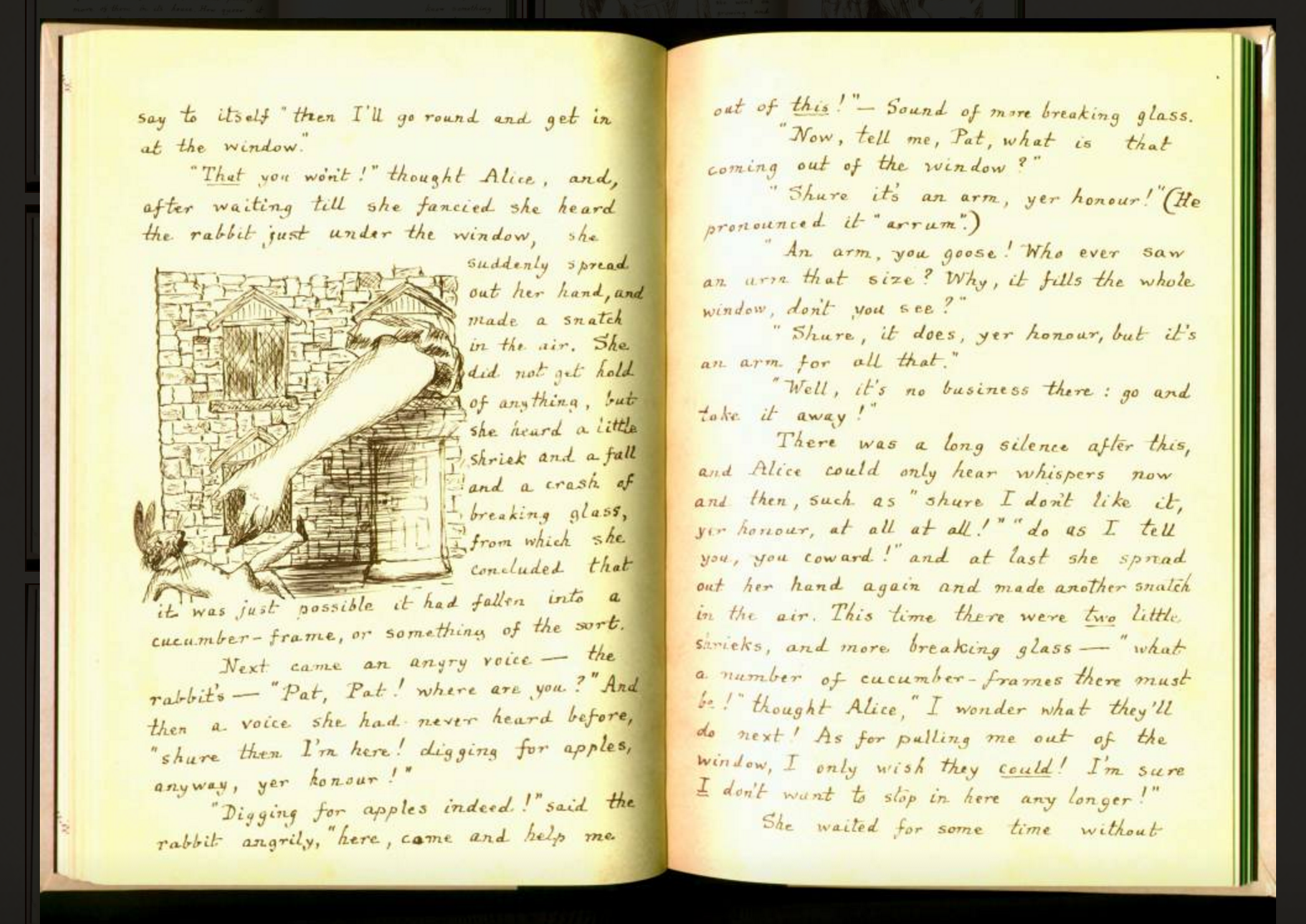
When I first became interested in rare books I took myself to as many antiquarian book fairs as I could. My first fair was in London, where I sheepishly wandered around as silently and as invisibly as possible and tried to pretend that I belonged in the same room as a million dollar manuscript of Alice in Wonderland by Charles Dodgson. I left the fair and called everyone I knew (so, basically, the five people on my speed-dial list) to tell them what I’d seen. They were all flabbergasted and amazed that I had seen an original, marked-up copy of the famous children’s story. But even I had to ask myself the question that everyone asked me (apparently they knew no one else in the business)… why a million dollars? Why? This is a question I’d like to briefly handle, in my own words, by discussing the main components of what gives books value (a question that is answered in-depth by our very own Vic Zoschak during his seminars at select California ABAA fairs… which you should all attend).

Screen Shot 2015-11-03 at 11.20.42 AMEdition. We all know that a 1991 paperback copy of F. Scott Fitzgerald’s The Great Gatsby sells for about $1.50 on Ebay to ten thousand US high schoolers every year. Why then are there copies of the same book selling for over $100,000 online? Those are first editions. We at Tavistock Books consider first editions as first printings of the first edition. The true first time the book was ever printed. Now, these copies are not only selling for so much because they are first editions. After all, sometimes you can find a much sought after first edition, first printing at a local used bookstore for the bargain price of $10! This point leads us to the next deciding factor, which is…

Condition. Condition of titles are essential to the demand for a certain book. The $10 bookstore copy of Gatsby is tattered, smelling of cigarette smoke, foxed throughout (foxing being the term for those brown spots that come up on book pages – a curious phenomenon between the ink, paper and chemical reactions), and with crayola markings where a desperate mother pushed her book into her sons hands for a moment of peace on the telephone. Condition, akin to location in real-estate, is of great importance in giving value to rare books – as it is very hard to sell a book that is in desperate need of a make-over unless it has a wonderful quality I like to call…  

gutenbergRarity. Every bookseller has heard this phrase a thousand times from clients wishing to sell us books… “but it’s really old…” Yes, you may have a book from 1913 with a lovely gilt illustrated binding. But a quick search online shows hundreds of copies exactly the same, none fetching more than $30! Now, you think you may have an intact (or even not intact… for this example that doesn’t really matter) Gutenberg Bible sitting on the shelf in your grandma’s garage? The phrase should be “Now that’s a horse of a different color!” Only 48 known copies of the earliest moveable-type printed book are known to man, only 31 of which are perfect (complete). That type of rarity is far different than so many online and probably double that amount still sitting in your grandma’s garage. (I’m sure she’s a lovely lady but what she got doesn’t interest me and that leads us to my last point which is…)

Desire. Another instance of disappointment to clients wishing to sell booksellers their items is when they realize that even we couldn’t sell the book – meaning that booksellers try not to buy books when there are no customers for the title. You may have an interesting archive (from your grandfather’s family, which your grandmother gave you after he passed away) of family pictures from 1875. But a bookseller can only justify using his company’s funds to buy said archive if there is a desire for such a collection! Does he have a customer that would be interested? Does he know where he can find someone who fits the bill? If the answer to these questions are both “no”, then we won’t take the archive off your hands… no matter how cute your great grandmother was in her wedding dress.

I tried to keep this blog short and sweet – a basic overview to our customers and other bibliophiles out there – as to what it is that antiquarian booksellers do and how they are able to figure out the pricing that they do. An essential part of the job is having an amazing research ability, not to mention the knowledge of the trade that comes from years of experience. Is there a National Antiquarian Bookseller month? Perhaps November would be a good time to give thanks for your local booksellers! 

P.S. If learning more tricks of the trade is interesting to you, look into taking one of the courses Vic Zoschak leads – an annual reference book workshop giving you the basics of how booksellers begin their research, or the Book Collecting 101 workshop mentioned earlier and offered at Bay Area ABAA book fairs! You won’t be sorry…

Share

Happy Birthday, Lady Lazarus

By Margueritte Peterson

“I am terrified by this dark thing/ That sleeps in me; / All day I feel its soft, feathery turnings, its malignity.” The author of this quote, and many similar to it, was a haunted being. She struggled with depression throughout her life and eventually succumbed to the constant pain she felt and ended her life. Many think of her and immediately think “that lady put her head in an oven” (don’t lie… you did, didn’t you?). Banish it from your mind for a moment! Today, we’d rather focus on her fascinating life and haunting poetry instead. Her being, of course, Sylvia Plath.  Though you may not think that writing a blog on Sylvia Plath at Halloween-time is very… original, we are going to do it – as today would have been her 83rd birthday. Plath was an extremely influential person – not just in words, but in her struggle to have her poems heard – despite seeming to have the world against her!

0115549_H

A young Sylvia Plath.

Sylvia Plath was born in October of 1932 and was raised in Massachusetts. Despite her father’s sudden death shortly following her 8th birthday, Plath did not begin to show signs of her mental illness until college. As an 8 year old child Plath survived and thrived through a tumultuous year – first with her father’s death, then her family’s relocation to Wellesley, MA, and also with her first published poem in the Boston Herald’s Children’s Section. Sylvia blossomed in academic environments and in 1950 when she began to attend Smith College in Northampton, Massachusetts, she discovered a whole new world, finding she loved being a part of an academic community. She became editor of The Smith Review and interned, as a guest editor, at Mademoiselle magazine during the summer after her junior year – a highly sought after position. Her mental illness finally seemed to surface during this time, when Plath was distraught after not meeting poet (and one of her idols) Dylan Thomas during one of his trips to New York. She quickly spiraled into depression, and at the end of the summer she made her first documented suicide attempt by taking sleeping pills and laying down in the crawl space beneath her mother’s house – where she was found 3 days later.

A happy Plath and Hughes after the birth of their daughter, Freida, in 1960.

A happy Plath and Hughes after the birth of their daughter, Freida, in 1960.

Now, I know I said that we would be focusing on her fascinating life and poetry rather than her suicide, but bear with me! The events in this particular summer were of great inspiration a decade later when Plath began and published her first and only novel, The Bell Jar. (There is a method to my madness, you can see.) But let us not get ahead of ourselves. Despite her intense summer and a stay at McLean Hospital receiving insulin and electric shock therapy in the fall, Plath recovered and graduated the following June with high honors. She received a Fulbright Scholarship to study at Newnham College, Cambridge, where she continued to study poetry and was constantly published in the university paper, Varsity. The following February, Plath’s life would be turned upside down by her passionate romance with a fellow poet, Ted Hughes. The pair were married after a short four-month courtship. Hughes was described by Plath as a singer, story-teller, lion and world-wanderer with “a voice like the thunder of God” (Oxford Dictionary of National Biography). Plath and Hughes moved to Massachusetts shortly after their wedding so that Plath could teach creative writing at her alma mater, Smith College. Hughes, during this time, taught at the University of Massachusetts in Amherst. After spending a couple years in America, the couple moved back to London, where their first child, Freida Hughes, was born in 1960.

plath3It was at this time that Sylvia’s first large book of poetry was published by William Heinemann, named The Colossus and Other Poems. It received mixed reviews (overall better in the UK than it was received in the US), but did not gain enough enthusiasm to raise Sylvia Plath to the point of literary fame. She finished her novel The Bell Jar in 1962 (though it would not be published for another year) and the couple moved to Devon, England, to a small house in the English countryside. Later on in 1962, Plath and Hughes separated after she became aware of his affair with Assia Wevill, the beautiful woman renting their old flat in London with her husband. After moving back to the city with the children, Plath rented a small flat in a house that was once lived in by William Butler Yeats. Plath, renting the flat on a five year lease, thought this a good omen. The poet experienced a final burst of creative energy in the winter of 1962, writing many of the poems that would eventually be contained in Ariel, her posthumously published book of poetry. The Bell Jar finally hit the shelves in January of 1963, published under a pseudonym, but, like The Colossus, was not the great success Plath’s ego needed. In February of 1963, Plath ended her life.

Her work continues to be immensely popular, but many fans of the author’s brutal poetry know very little of her previous works. By the time Plath entered Smith College, she had written over 50 short stories and had them published in local papers and school publications. Also part of her poetry works were her “landscape poetry” – much of which was centered around Northern England (Yorkshire) and is not given as much credit as her later works. Much of her writing is also contained in her private diaries, which were first published in 1982, though her mother published a book of her correspondence home, letters Plath wrote between 1950 and 1963. In 2000 a new book of Plath’s journals was published, when Hughes gave the rights to publish the journals still in his possession (as executor of Plath’s estate), of which over half was new material to the public eye. Though the last of Plath’s journals were destroyed by Hughes, an act condemned often by Plath’s fans – as he said he did not ever want his children with Plath to see her desperate and depressed last months of thought.

plath5Plath’s style has been difficult for scholars to describe, as her writings ran the gamut of emotion and subject. Death and resurrection was a consistent theme throughout her writings in The Colossus, where as in Ariel her more vengeful poems focus more on the rage and despair she felt as she coped with her mental illness. Her poems are almost autobiographical in nature, as she used herself as the subject for almost all of her work. Perhaps this is why she is so popular with readers – though Plath struggled using her personal self as fodder for her poems, she continued to do so. She unabashedly offered herself as a model for her poems – a difficult undertaking for any author. On this her 83rd birthday, we honor Plath and her contribution to the world of poetry – for giving other writers (as many have since given her credit in helping shape their own work) the strength to delve into their own psyche and use it in their compositions.

Share

Fair Acquisitions at Tavistock Books! (Seattle items found here…)

It’s that time of year again… the time after our exhibiting fairs of Sacramento and Seattle… the time when we place our new items up on our website and tempt you to look at them with blog posts, that is! Check out this post for an in-depth view of some of our newest (and hottest) items!

Screen Shot 2015-10-22 at 9.23.04 AMDickens’s Works, Diamond Edition (1880). An original Dickens in original publisher’s binding in an original publisher’s box! Yes, that’s right ladies and gents… we nabbed a 1st edition thus of Chapman and Hall’s Diamond Edition of Dickens’s [sic] Works! This 16 volume set shows only modest wear, garnering it our VG+ rating! As we tell you, this economical edition in pocket format quite rare as it is offered here – a complete set with the original publisher’s box. You know what? I’m not doing it justice. See it here>


Screen Shot 2015-10-22 at 9.31.39 AMOur next item [regrets, this item now SOLD]: The Old Manor House (1822) in Two Volumes… Did you know that the founder of the famous Chiswick Press is often credited as one of the first printers to come up with the idea of printing cheaper, handy editions of standard authors for the common man? Even stated on the rear panel of a volume here is “[The publisher] means that his edition shall combine correctness, neatness, portability and cheapness…” This set a rare double-survivor, as the cheapness of the printing meant being issued in drab boards and on cheaper paper. Read more here>

Screen Shot 2015-10-22 at 9.38.12 AMNow, are you one of those collectors who like the more personal items? Are photograph albums and inscriptions your thing? Check out our Personal Guest Book of Ralph and Violette Lee. This guest book belonged to a California jeweler and art patron, and the founder of the Gensler-Lee Jewelry Company, one of the largest jewelry chains in the state of California around the beginning of the 20th century. This guest book is filled with personal signatures and inscriptions praising the patrons and their beautiful California home! See more on it here>

Screen Shot 2015-10-22 at 10.01.10 AMA 1st edition of David Copperfield from 1850? Sounds great! This 1st volume edition a VG+ copy in a later full blue calf binding (binding by Bayntun), spine only slightly sunned. Did you know that David Copperfield is a primarily autobiographical novel? In the preface to the 1867 edition, Dickens went so far as to state “like many fond parents, I have in my heart of hearts a favourite child. And his name is David Copperfield.” This eighth novel of Charles Dickens is beloved by many. Is it beloved by you? Look at it here>

Screen Shot 2015-10-22 at 9.49.16 AMAre you expecting? We don’t mean to be intrusive, but take a look at our Mother’s Book! This 1831 1st edition by Mrs. Lydia Maria Francis Child is a primer for the new mother! Our attention is held by Chapter VII: “Advice Concerning Books” followed by “List of Good Books for various ages” where Child gives 10 pages full of recommended titles for ages 4 to 16. This title has everything a lady would need to know in the early 19th century about the “joys” of motherhood! Read more here>

Share

Sleepless in Seattle: Kate’s Second Book Fair

By Kate Mitas

Our smiling blog author and Aide-de-Camp, Kate Mitas!

Oh, Seattle. Coffee wellspring of the Pacific Northwest, home to too many musicians and artists for a mere blog post to recount, and, it almost goes without saying, annual host to a much-loved regional book fair. Which, of course, is why I found myself in the Emerald City last Thursday for my first visit to Seattle (not counting layovers or bleary-eyed glimpses from I-5) and the Seattle Antiquarian Book Fair.

Between the abundance of flannel and the Space Needle dominating the horizon, Seattle is just waiting to be cast as the setting for a hipster version of the Jetsons: its city center glass, its art postmodern, and its denizens often bearded, bookish, and/or bespectacled, thereby rendering the game of “spot the bookseller in the bar” next to impossible to play. Did they see us coming, I wondered, these intellectual-looking, future-minded Seattleites, and would they care that a book fair was in their midst?

Trunks of books arrived and piled up in the FedEx store, belonging not just to Tavistock Books but also to our booth-mates, Books Tell You Why (and I think I can safely say that Joachim’s mammoth double-wide trunks plagued the erstwhile FedEx folks even more than ours did). Assorted vehicles packed high with boxes commandeered the hotel parking lots, including the white behemoth driven by the incredibly generous and possibly a bit cracked Brad Johnson (The Book Shop, LLC) and Jesse Rossa (Triolet Rare Books), who hauled the combined stock of eleven booksellers up the coast in one mad fell swoop (and then, astonishingly, brought it down again). Overloaded dollies trundled down the ramps of Seattle’s Exhibition Hall and returned empty. Slowly but surely, booksellers descended on the city from every part of the country and even from overseas, like a horde of collegial, misinformed locusts, who, rather than decimating the surrounding crops, amiably offer themselves up to be devoured instead.

But would it work, that was the question. Would a plain white banner tied to the Exhibition Hall’s railing alert people to our presence? Would the rain forecast for the weekend keep potential customers away? Most importantly, for this newbie to the fair circuit, who woke up at four in the morning most days of the fair with these questions in mind, would Seattle be a repeat of Sacramento for the good ship Tavistock?

The trip didn’t start off very promising, frankly. Two days before we left, Vic’s van got totaled in a car accident as he was on his way to the shop (everyone unhurt, humans and pets alike, thank goodness). I somehow forgot until the last minute that I would need something nicer than usual to wear, and spent a frantic few hours the night before our flight at my trusty local thrift stores, manically amusing myself with thoughts of showing up in various ridiculous prom dresses for the first day of the fair (a.k.a., “fancy day,” when Vic planned to wear a suit and informed me that I should have on something complementary), before scrounging up a couple of things that I hoped would suffice. The airline misrouted Vic’s suitcase and then informed us that they wouldn’t be able deliver it to the hotel until midnight; the rental car service didn’t have the car we’d ordered. By the time we got a different car, picked up our trunks of books, and grabbed a bite to eat, we were grumpy and beleaguered. The fair, it seemed, was already taking a turn for the doomed. 

IMG_2570 (1)

The Tavistock Book In all its glory!

Nevertheless, we rallied and for a time not all was sad in Mudville. Vic’s suitcase arrived at the hotel sooner than expected, and this time around at setup, on Friday, when Vic left me to ready the booth while he scoured the wares of fellow dealers, I managed to get things situated with a little less agonizing than last time. The wonderful crew from Books Tell You Why — Joachim Koch, Andrea Koczela, and Brian Hoey — were, well, wonderful, and I was grateful to have them around for suggestions and shared laughs (not to mention book recommendations). We even sold a few things that day, and bought a few things, which I’m learning is the way book fairs should go. So, hurrah for us . . . right?

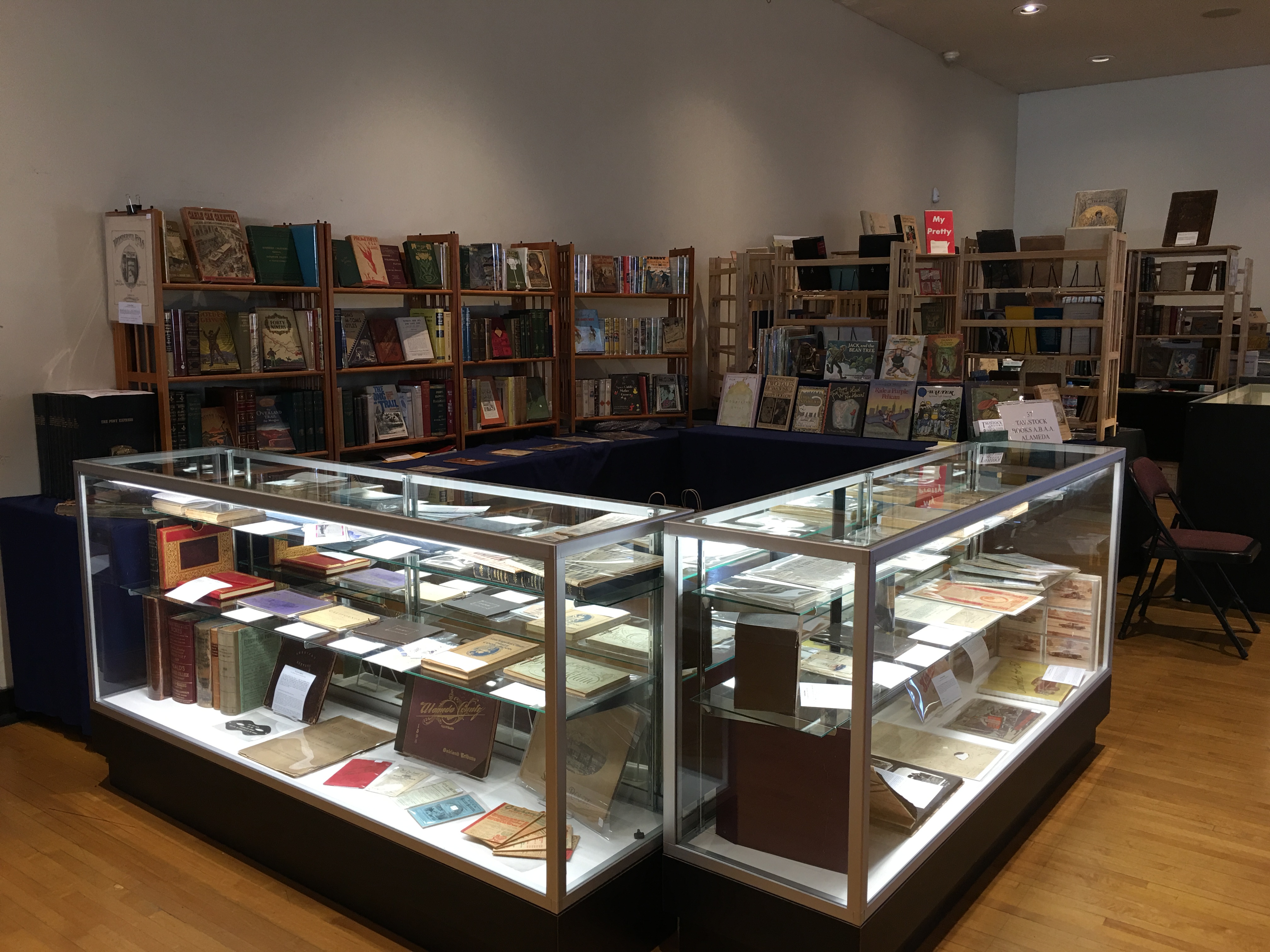
Well, let me back up a minute to say that for anyone who has been to the Sacramento but not the Seattle Antiquarian Book Fair, or vice versa, there is a world of difference between the two. Sacramento is smaller, hotter, more tightly packed, and far, far more relaxed. Seattle, admirably well-organized by Louis Collins, while still not the creme de la creme of book fairs (or so I’m told), is certainly more imposing. Glass cases predominate and even have their own special crews, roving bands of handymen who do everything from adjust shelves to clean the doors with a bottle of zealously-guarded Windex. More importantly, dealers come from farther away, with better books and higher expectations. It costs more, so you have to sell more. Plain and simple. 

And that, dear readers, is where the crux of the problem lies. 

IMG_2573

Like a pro – not showing any uncomfortable-ness! The Tavistock Team on Saturday morning, excited for a day of bookselling!

Saturday dawned cool and rainy, but I should have known that a little rain wouldn’t keep Seattleites away. It poured, and they still came flocking to the book fair. (I loved them for this, and still do, from afar.) Yet, all that morning and into the early afternoon, the Tavistock booth remained eerily untouched. Gradually, it dawned on me: we’d brought the wrong books. All of the right books were back at the store! As for those that weren’t wrong, well, they were priced too high. No amount of rearranging, no amount of petty thievery of the precious bottle of display-case Windex from its rightful place behind the back curtains, would change things. Then there was the matter of my dress — also uncomfortably wrong (what had I been thinking?) — and my shoes, which gave me blisters after the first fifteen minutes. I’d also bashed my elbow on one of the trunks during setup, and was burning through band-aids like no tomorrow. It was Sacramento all over again, except this time I was actually bleeding.

As you’re probably guessing, though, we did, in fact, finally sell something, a little Seattle-related booklet that made one nice man very happy. And soon enough, we were passing the invoice book back and forth and politely trying to outmaneuver each other for the calculator while sales piled up at last, much to our relief. Did it matter then that the band-aid on my heel somehow slid over to the top of my foot and clung there, unnoticed by me, for most of the day, completely putting the kibosh on my “fancy day” outfit? I assure you, it did not (once I finally noticed it). I was having too much fun.

However, much as I would love to be able to report that our Sunday sales flew along at the same clip as Saturday’s, alas, they did not. In fact, we didn’t sell a thing, and our rampant success Saturday turned out to be the only reason the weekend wasn’t a total ruin. Well, that and the finds Vic came across, which we’ll be adding to our inventory soon (stay tuned). Expenses piled up, and the fair that I’d been sure had at least outshone Sacramento turned out to be, when we sat down and crunched the numbers this afternoon, roughly equivalent. 

IMG_2574

Dinner at Crow, Sunday after pack-out. Having been on their feet all day two days in a row and spending hours packing their books to go back home… well, you’d never know it! Just look at those smiles.

So what’s a young bookseller with two not-so-good fairs under her belt to do? Well, after long and careful consideration, I have to admit that I’m in something of a bind: no matter how much I stare at our tally sheet and its glaring red total, and no matter how many choice expletives I thoughtfully lob in its direction, the 2015 Seattle Antiquarian Book Fair still feels . . . good. We sold some nice books, and if we could’ve made a little more profit on them we would’ve done very well, indeed. The venue was lovely, if hot, and we met some great customers who may yet turn out to be future customers; even some past customers stopped by to say hi and introduce themselves. The booksellers I met were invariably kind and welcoming, and I finally had the chance to see some of my brilliant fellow assistants. Even a few of my fellow 2015 CABS grads (Jon Munster (The Book Bin, Corvalis), Rebekah Medford, and Ken Mallory (Kenneth Mallory, Bookseller)), were there. And finally, of the many, many things I learned this weekend, one may even be life-saving: never, ever have a rubber band fight with Ken Karmiole. He’s deadly with those things. In fact, I highly suspect this bookseller business is just a front for target practice (no wonder he like fairs so much — we’re like fish in a barrel).

Sure, I wish we’d blown our Sacramento showing out of the water. I also wish that my shoes had fit better, and that my band-aids hadn’t been so errant. Mostly, I wish I’d been less daunted (and less sleep-deprived). But damn if it wasn’t fun, in the end.

And as for the good ship Tavistock? What else? We’re patching the leaks, of course, and bringing new ideas to the table. It’s time to get a little creative.

See you in Pasadena, everyone.


Share

Happy Birthday, F. Scott Fitzgerald!

By Margueritte Peterson

September 24th is the anniversary of the birth of one of the most well-known Western writers of the 20th century. Notice I did not say one of the most prolific writers in history, as this novelist only published 4 titles throughout his (unfortunately brief) lifetime. However, it must be said that though these titles garnered only modest success throughout his short life, F. Scott Fitzgerald has since become internationally famous and is known as one of the most important voices of the Jazz Age… not to mention a front-runner of Modern American Literature.

A young Fitzgerald at his desk.

A young Fitzgerald at his desk.

Born in St. Paul, Minnesota in 1896, Fitzgerald was loosely related (second cousin three times removed kind of loose… the kind that you can marry in any state, really) to Francis Scott Key – the composer of the national anthem – and was named in his honor. A few months before he was born, his two older sisters died before their 5th birthdays. Fitzgerald cited their death, while he was still in the womb, to be the moment when he became a writer. After spending a few years of his childhood living in Buffalo, New York with his doting parents, the family moved back to Minnesota. At the age of 13 Fitzgerald saw his first work published – a detective mystery in his school newspaper. He continued to write throughout his few years at Princeton University, where, as young men are wont, he eventually came to be on academic probation and consequently dropped out of school to join the army. Around this time, Charles Scribner’s Sons rejected two of his early works, one of which is The Romantic Egotist.

Scott and Zelda after their marriage.

Scott and Zelda after their marriage.

As a young lieutenant stationed in Alabama, Fitzgerald met and fell in love with the daughter of the Alabama Supreme Court Justice. Though Zelda initially accepted a marriage proposal from Fitzgerald, she eventually changed her mind under the impression that he would not make enough money to support the lifestyle she was used to. Once Fitzgerald was discharged from the army, he moved to New York, desperate to make enough money to impress Zelda and win her back. (I feel like nowadays that kind of spoiled behavior wouldn’t fly… unfortunately). Fitzgerald worked full-time for an advertising agency and even repaired automobiles on the side to save as much as he could. However, he was unable to convince the beautiful Alabama socialite, and returned home disheartened. In St. Paul, Fitzgerald took the time to revise his earlier novel The Romantic Egotist into what he renamed This Side of Paradise. This time around, Scribner’s accepted the novel and when it was published in March of 1920 the title sold over 41,000 copies in the first year alone. Fitzgerald became famous overnight – and with the steady income from the book and the demands for more literature, he suddenly was in a position Zelda could accept – the two were married only a week after and by October of 1921 their daughter “Scottie” was born.

In the 1920s the Fitzgeralds spent a significant amount of time in Paris – enjoying themselves with the other American expatriates living there (most notably Ernest Hemingway). Though Hemingway did not approve of Fitzgerald’s marriage to Zelda (supposedly calling her “insane” and believing that she stifled Fitzgerald’s talent out of jealousy), the friendship between Hemingway and Fitzgerald was one of the most important in FItzgerald’s short life. Though they eventually drifted apart, Fitzgerald held Hemingway’s work in the highest regard and strove to achieve the same success his friend experienced.

The young family, in the hold of financial difficulties.

The young family, in the hold of financial difficulties.

Despite the author’s fame and talent, the Fitzgeralds were in a constant state of financial worry. Throughout his life, F. Scott borrowed money from friends and took out loans – as only his first novel made enough money to support their lifestyle. Though his passion lay in writing novels, Fitzgerald made most of his money by publishing short stories in journals and periodicals – a few notable stories being “The Diamond as Big as the Ritz”, “The Curious Case of Benjamin Button”, “The Last of the Belles” and “The Camel’s Back.” They were well-known as great partiers and drinkers, and as the “belles” of the Jazz Age, they lived up to their reputations. Around 1930 Zelda began to suffer from schizophrenia, an illness that took a great toll on their relationship as well as Scott’s writing. For the rest of her life, Zelda would be treated in Psychiatric Hospitals and wards in both America and Europe (the pair moved back to Maryland in the 30s to give themselves a more stable lifestyle – one that would hopefully allow Fitzgerald a better chance at writing more steadily. These years were far from easy for the pair, and in 1937 Scott moved to Los Angeles to work on (what he considered degrading) film scripts and commercial short stories. He and Zelda’s fiery relationship became too hard to bear and for the rest of his short life he and his wife would be estranged, with her living in and out of mental hospitals on the east coast.

In his years in Hollywood Fitzgerald suffered two heart attacks, the second being the cause of his death at the young age of 44. He was, at that time, working on his fifth novel, The Love of the Last Tycoon, which remained unfinished at his death. A literary critic and personal friend of Fitzgerald, Edmund Wilson, published the work in 1941 after Scott’s death as The Last Tycoon, but an unedited version surfaced in 1994 and was published under the original title. Fitzgerald, though now recognized as one of the most influential authors of the Jazz Age, was not necessarily recognized in his lifetime as such. As stated, only his first novel was as commercially successful as one would expect, given his fame in recent day. (EvenThe Great Gatsby was not the front-runner Jazz Age title we know it as today.) Now, on his 119th birthday, he is one of the most famous American authors ever known. Why is that, you may ask? Well, you’ll have to check back next September 24th on his 120th birthday, when we examine why humanity likes to change its mind!

Screen Shot 2015-09-24 at 6.18.09 AM

Just kidding. I have no idea what will be being written next September 24th. Doesn’t mean you shouldn’t check back though!

Share

The Dying Californian, or, Kate’s 1st Book Fair!

 Kate Mitas, Tavistock Books’ New Right-Hand (Wo)Man, has returned from the Sacramento Antiquarian Book Fair… her first fair (as a worker-bee, that is), and reports back. Beware, readers, as what follows may be a sweetly written, if perhaps slightly disheartening tale!

A lovely setup by Ms. Mitas! 1st Tavistock Books booth done - many more to follow!

A lovely setup by Ms. Mitas! 1st Tavistock Books booth done – many more to follow!

By Kate Mitas

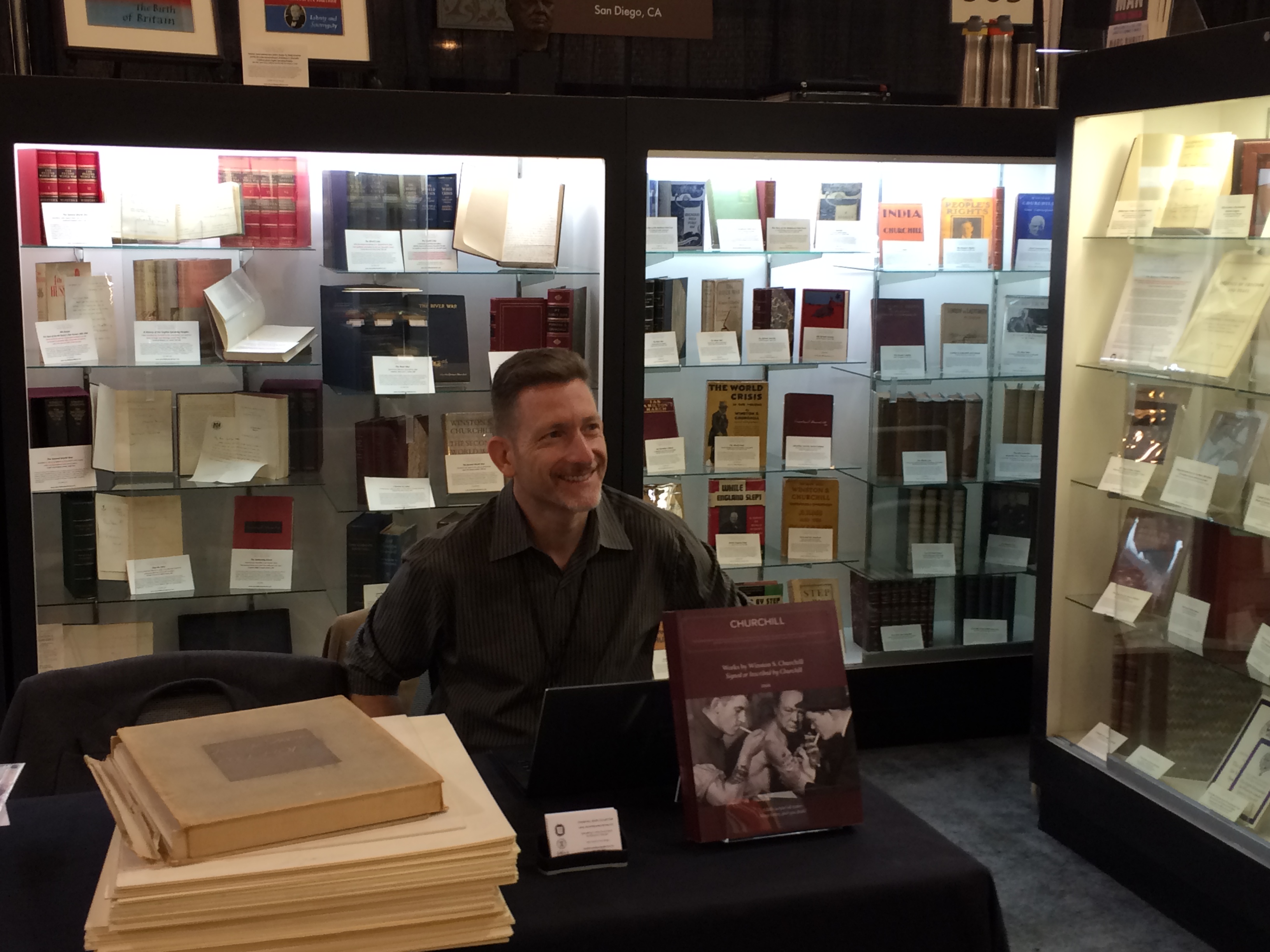
The Sacramento Antiquarian Book Fair was a great place for a beginner to become acquainted with the book fair circuit, because it’s one of the smaller, low-key venues, as book fairs go (or so I’m told). A blog post by a certain predecessor of mine had actually alerted me to the casual atmosphere ahead of time, but I was still wired going into it: I hardly slept the night before, and so was more than a bit punchy by the time we started setting up our booth on Friday. And by “we” I mean “I,” since Vic mostly left me to my own devices on that score while he browsed other dealers’ booths – much to the amused commiseration of Bill Bastick from Asian Steppes, situated across the aisle from us, who jokingly referred to me as “slave” for the remainder of the weekend. Nevertheless, I eventually managed to get things set up well enough for a first-timer, I think, and did so just in time for free pizza, courtesy of the show’s tireless coordinator, Jim Kay.

As for the fair itself on Saturday? Well . . . it was a little slow for us. Okay, more than a little: if you must know, it was woefully slow. In short, Tavistock Books had a bad fair.

The day started off promising enough: right out of the gate, a nice woman and her granddaughter purchased a hefty five-volume set of California history. Not only did these two ladies seem intent on reading their books from cover to cover together, but, equally delightful, the set’s departure created a spacious gap on the shelves, which I promptly scurried to fill. Then: nothing, sales-wise. Despite heading the next blank invoice “Sacto Fair” in accordance with Vic’s belief that it would lure the fickle gods of consumerism, despite endlessly cleaning the glass display cases and straightening description labels, Booth #37 remained lamentably quiet. Customers squinted at our shelves and even picked up a book from time to time, but almost always put it back, in some cases repeating this procedure with the same book multiple times throughout the course of the day. Passerby lingered over the rarities in the display cases just long enough to raise our hopes, then moseyed on with nary a backward glance while nonchalantly swinging their regulation white shopping bags, each of which was ostentatiously marked “Sold.” The boxes of Americana we’d hauled out for California ephemera enthusiasts were apparently too daunting, or perhaps too tall, for most. Some of the coolest items, the ones I’d imagined would draw hordes of admirers – like our archive of Gold Rush letters and photographs, or a Steamship Yankee Blade ticket – weren’t  graced with so much as an appreciative sigh, much less a truly interested customer.

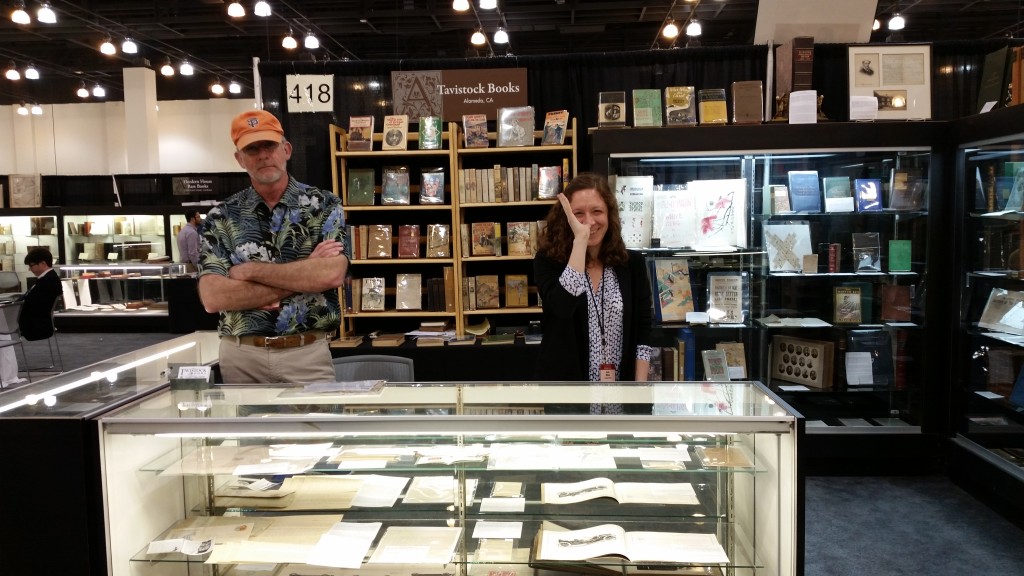
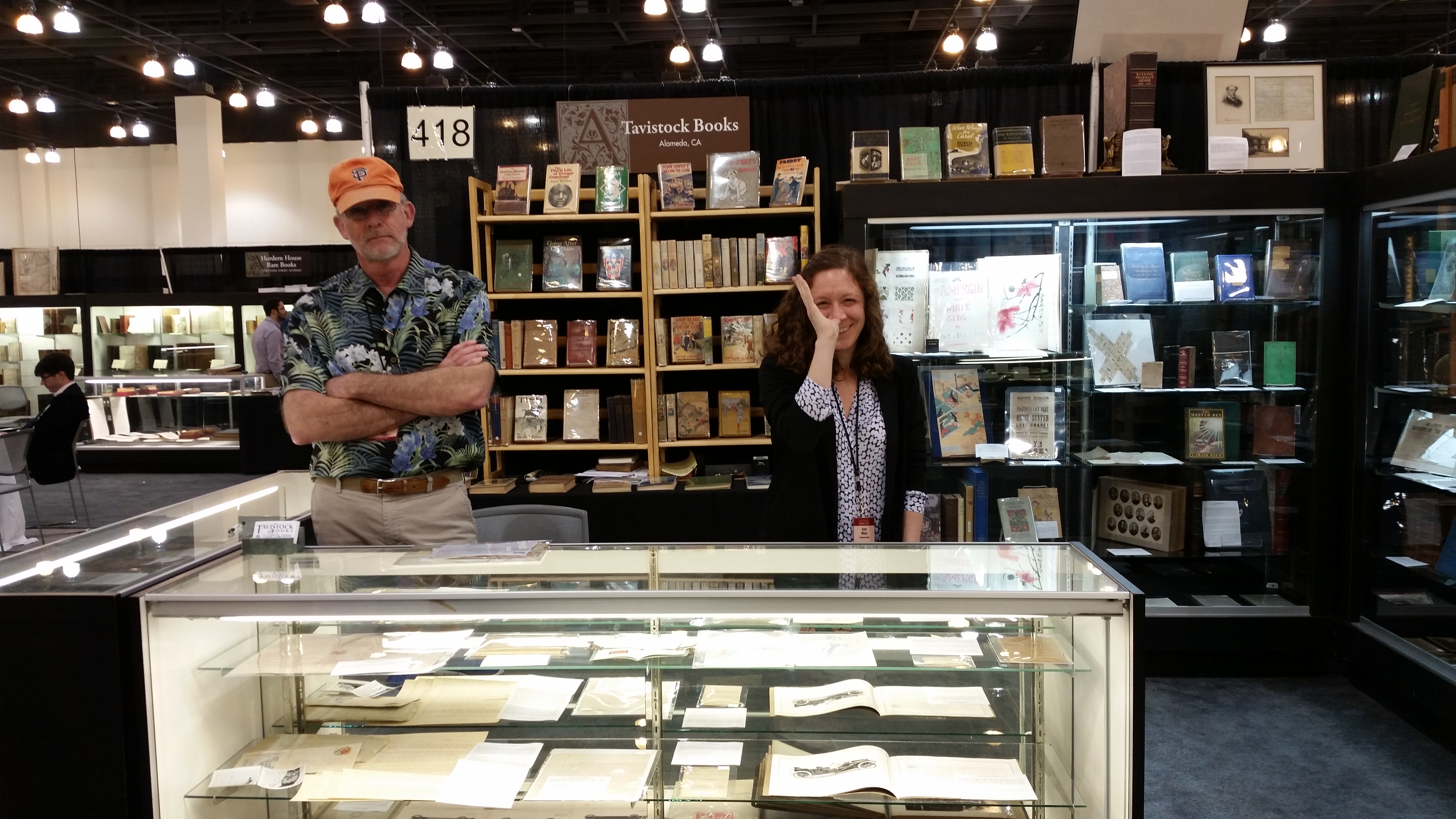
Let’s not forget the King of Tavistock Books… in a surprising choice of an orange Giants baseball cap! (Oh wait… did I say surprising?)

It was hard, I’ll admit, not to feel like the lone museum guard on duty in an empty exhibition hall, especially as many fellow dealers in the surrounding area seemed to be doing just fine. One dealer, in fact, who is a dear and deserving colleague and shall remain nameless, was even doing “just fine” with stock bought, not long ago, from us! We were, and are, sincerely glad for this colleague’s success, of course, but . . . oh, the agony, and the irony. Every now and then, a sale lifted us out of the doldrums and turned us into booksellers again, grateful for the chance to put good material into the hands of people who’d take pleasure in it; one regular at our shop stopped by, and was kind enough to give me props within earshot of Vic (thanks, Jim – don’t spend it all in one place!). But then, inexorably, we’d drift back to our becalmed waters, cursing our luck.

Hard at work!

Hard at work!

The one perk of all the deathly quietude was that Vic let me roam the fair, too. For a so-called small fair, there were enough vendors for the main area of the venue to feel almost too packed, and a decent-sized crowd milling about, as well. The best part, for me, was the sheer range of books on display: from Ken Karmiole’s (Kenneth Karmiole, Bookseller, Inc.) impeccable “old books” – his term, by the way, for the lovely array of pre-1800 material at his booth – to pulp fiction and modern firsts at Magus Books and several others, to Andrew Langer’s (Andrew Langer, Bookseller) collection of quirky ephemera and Elizabeth Svendsen’s (Walkabout Books) assortment of uncommon travel-related books, and so much more. Two of my fellow CABS grads this year, Morgan Brynnan (Uncommon Works) and Bill Wickoff (Ephemeriana), had booths, and I was glad to see them again; C-SPAN even showed up and interviewed (at least) Ken Sanders (Ken Sanders Rare Books) and Nick Aretakis (Nick Aretakis, Bookseller).

The unrecorded Armstrong found at the fair. Click for more info!

The unrecorded Armstrong found at the fair. Click for more info!

I wish I could say I scored something amazing, as some of the other dealers reportedly did, and as Vic discovered once back in the shop on Monday, in that he bought an apparently unrecorded Margaret Armstrong binding. But, I didn’t, at least not in that sense. Instead, I rediscovered something I’d already known: the incredible generosity of booksellers. Zhenya Dzhavgova (ZH Books) and Kim Herrick (The Book Lair), sharing the booth beside ours (and doing an enviously far brisker business), popped over from time to time to make sure my first fair was going okay and to provide extremely helpful tips (i.e., “Vic hates it when you stand in front of the display cases too long”). Stephanie Howlett-West (S. Howlett-West Books) explained the miraculous business card system of purchasing; David Smith (D.J. Smith Books) told me about other Sacramento fairs I might want to check out, and gave me a cookie, to boot. Andrew Langer even passed along buying tips – as I was in the process of buying from him. And there were more friendly gestures and kindnesses, too many, from too many people, to list them all. Simply listening to the abundance of trade talk – from Ken Karmiole and Vic discussing the possibility of partnering on a particular item, to Laurelle Swan (Swan’s Fine Books) musing about whether she should have brought more things – was an education in itself.

Some booksellers, smarter and savvier than I, can perhaps make it in this business on their own. For this bookseller, however, who needs all the help she can get, it’ll take a village. Or, maybe, a book fair (or a hundred book fairs).

And as for the persnickety little problem of having had a bad book fair? Vic is teaching me well: we’re acknowledging the hit, reassessing, and getting ready to come out swinging next time.

Seattle, here we come.

-Kate Mitas

The day's mascot itself!

         The day’s mascot itself!

Share

Playing Hooky? We Look at the Beginnings of the School System and Some of the Earliest Textbooks

By Margueritte Peterson

Ah, September. The smell of sharpened pencils and new Jansport backpacks (those are probably not still “in” though, are they? I’m getting old) combined with a boatload of traffic going 15 miles per hour on random streets throughout town say one thing: Summer is out… school is in! We thought, given that many of our followers work in the school system – curating, developing collections and managing libraries, among a myriad of other tasks – we would take a quick inside look at the development of the school system around the world and the earliest forms of “textbook” education (reading primers, ABCs… Alphabet Books, and Hornbooks)!

A mosaic from Pompeii of Plato's academy (source: wikipedia).

A mosaic from Pompeii of Plato’s academy (source: wikipedia).

Though originally the Greek word for school, σχολή, translated into “leisure” or “that in which leisure is employed” (listen closely kids, and this will surely impress your teacher when she asks you why you aren’t listening), eventually became known as a group to whom lectures were given. The concept of grouping those who need to or want to learn together has been known throughout classical history. Almost all ancient civilizations taught their students in bulk – Ancient Greece, Ancient Rome, Ancient China, Ancient India… lectures were given to all. Though in these civilizations lectures and schooling were usually only given to someday-to-be military personnel and academics, by the early 1700s obligatory attendance in elementary school became commonplace in many parts of Europe.

An example of an early Hornbook.

An example of an early Hornbook.

Around this time, printing had become more widely practiced, and was becoming available to the general populace of Europe and America. Literacy kept going up, given the new obligatory attendance in schools for the common man, and pamphlets and books were more readily available and distributed. Some of the tools used for schooling in early education are of interest to many collectors today. Reading Primers, Alphabet Books (or ABC Books) and Hornbooks are some of the most popular types that we will glance at today.

In all truthfulness, Hornbooks and Primers could both be considered a type of ABC book. Hornbooks, named quite appropriately, were often the alphabet and a woodcut illustration or prayer printed to a sheet of paper affixed to a wooden paddle. A thin, transparent sheet of horn was then placed over the paper to protect it (hence the name “hornbook”). These early “books” are quite collectible (in case you happen upon one in a dark corner of an antique store), as they are rare. Primarily used between the 16th to the 19th centuries, finding one intact is rare, no doubt due to the use, and abuse, of them by their petite owners! The next iteration in educational publications was the reading primer. The earliest primer known is a Latin text, translated into English as the Salisbury Prymer. It contains the alphabet and a series of Catholic Prayers, and was printed in the late 1400s. Early primers were often religious in theme, and more than somewhat didactic in nature. The earliest primer printed in the American Colonies was The New England Primer. Though originally published in Boston in 1687, it only began to be printed in greater numbers in the later 1700s, on the cusp of the American Revolution. Before this primer, most of what was used in the colonies for education were primers brought over from England with original settlers. The first US edition of The New England Primer contained a myriad of educational lessons – not only did it house the alphabet and religious lessons, but contained pages on vowels & consonants, double letters, woodcut illustrations and acronyms, among others. According to research, around 2 million copies of this title were printed and sold in the 18th century (though there are no surviving copies of those printed before the 18th century… or if you have one, please email vjz@tavbooks.com). Why place so much emphasis into a small book for young children?

Our holding of an early 19th century edition of the New England Primer. See it here>

Our holding of an early 19th century edition of the New England Primer. See it here>

Such a question brings us back to the developing school system in the Western World! Surprisingly, one room school houses were the norm until the 1920s, when students were finally split up by age and academic level into separate classrooms. Throughout these centuries, only the wealthy and predominant citizens were able to have private tutors and governesses to teach them. A primer allowed a child to learn a good amount on his own, and also allowed a teacher in a room with several different levels of students to assign a certain lesson to different groups. The primer, along with Hornbooks and other ABC books were useful educational tools for both students and tutors/teachers alike, and allowed for many youth to be educated in basic reading and writing skills.


Well, what are you waiting for? Back to the grind – open those notebooks, nibble on that pencil! School is back in session!

Share