Category Archives: Uncategorized

The Antiquarian Book World in 2016

Woohoo! It is almost 2016 and have you got a whirlwind year ahead of you! Interested in Book Fairs? Book events? Bibliophiles in general? The Antiquarian Book World has got you covered. Check out the most pressing book events (mainly CA or ABAA related) in early 2016 below!

seattlefair1

January:

Now until January 10th: If you haven’t caught it already, you have a few days left! The California Historical Society has hosted their current exhibition “City Rising: San Francisco and the 1915 World’s Fair” since January of 2015, and the closing day is January 10th of 2016! Get a viewing in while you still can… take it from someone who has seen the exhibition – it’s worth it!   http://www.californiahistoricalsociety.org/exhibitions/current_exhibitions/

January 9th & 10th: Greater Los Angeles Postcard & Paper Show – Glendale California. http://www.postcardshows.com/Glendale.php

January 25th (to April 25th): New exhibition at the Book Club of California in San Francisco! If you have never attended an exhibition at this prestigious club or thought of joining the ranks, you are missing out! The BCC hosts lovely and interesting functions and surely their new exhibition “Calligraphy and Poetry” is sure to impress!  http://www.bccbooks.org/

February:

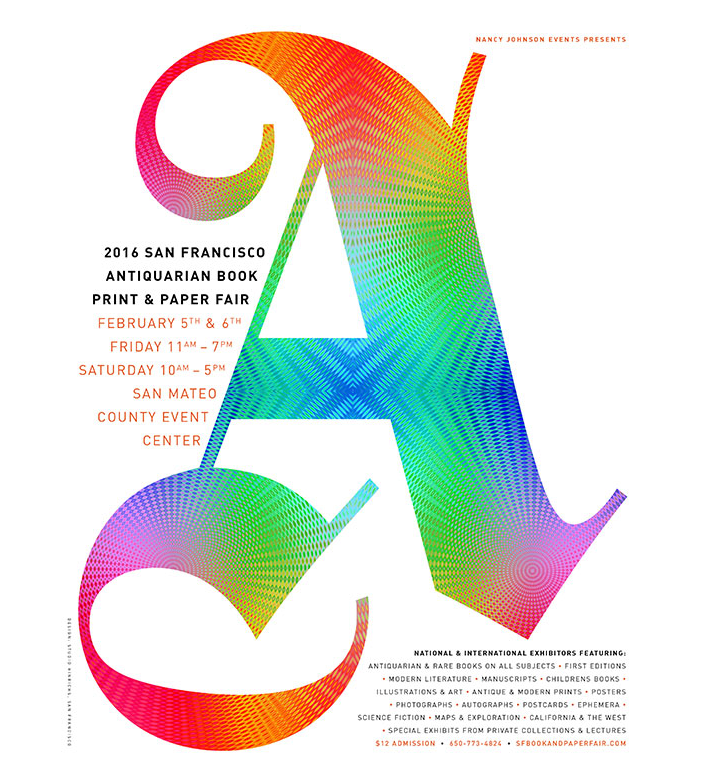
February 5th & 6th: San Francisco Book, Print & Paper Fair at the San Mateo County Event Center – San Mateo, California! This fair is close to our lovely shop… Just a ferry ride (or a long swim… just kidding you can also drive here) away! Please feel free to make an appointment and come see us when you’re around for the fair!   http://www.sfbookandpaperfair.com/

February 12th, 13th & 14th: The California International Antiquarian Book Fair (ABAA) – Pasadena, California. For those who don’t know, each year the ABAA oscillates between hosting the California ABAA Fair in Pasadena or the Bay Area. This year is Pasadena’s turn! Come down and show your support for the packed show of local, North American & International Booksellers! We’ll be there – even more a reason to come! http://cabookfair.com/index.php

March:

March 11th, 12th & 13th: Florida Antiquarian Book Fair – St. Petersburg, FL. I have to plug this one because not only has Vic exhibited at the Florida Antiquarian Book Fair before, but it is my home state! Don’t worry, alligators are more scared of you than you are of them…  http://floridabooksellers.com/

The Sacramento Antiquarian Book Fair

The Sacramento Antiquarian Book Fair

March 19th: Sacramento Antiquarian Book Fair. This one is a must! For those of you who have never been to a book fair, this is a great starting fair to attend. Lots of local booksellers, fun-loving bibliophiles and sunshine… what more could you ask for? Read our past blogs on this fair to hear what it’s all about, then come and visit us!  http://www.sacbookfair.com/
 

April (We like to call it… Bookselling in a New York Minute):

April 7th, 8th, 9th & 10th: The ABAA New York Antiquarian Book Fair – Park Avenue, NY. Always a beautiful venue to behold, this fair boasts booksellers and book-lovers from all over the world, and never fails to deliver a spectacular event! Don’t believe us? We wouldn’t lie to you! http://www.nyantiquarianbookfair.com/

April 9th: The Manhattan Vintage Book & Ephemera Fair / The Fine Press Book Fair – Lexington Ave, NY. One of the greatest things about the NY book fair are the numerous “shadow” fairs that go along with the ABAA’s shindig… check them out! You won’t be disappointed.  http://www.flamingoeventz.com/    http://www.fpba.com/fairs/newyork.html

April 9th: The New York City Book & Ephemera Fair. Again… how many fairs do you need to have happening before you agree to go to New York and have your fill of antiquarian books?! I believe “Shop till you Drop” is the phrase needed here!  http://www.antiqueandbookshows.com/


To find out more throughout the year, visit:

www.bookfairs.com or the ABAA list of events at www.abaa.org/events/  to find more to explore!


Share

Collecting Antiquarian Bibles (What Better Time to Discuss than at Christmas?)

By Margueritte Peterson

The Bible is the most common English-language book in the world, so it would hardly seem like an ideal focus for rare book collectors. But the history and variety of Bibles make collecting them a diverting and challenging occupation—especially because one can often start a lovely collection without spending too much money.

Image source: tntoday.com

                   Image source: tntoday.com

Finding Your Focus

The sheer number of editions of the Bible can make it difficult to choose a scope for your collection. Many amateur collectors start out with their own family Bibles and simply collect other Bibles that catch their fancy. As you get more serious about building your Bible collection, it’s important to decide on a specific direction because the array of Bibles and editions is dizzyingly diverse; in their oft-cited bibliography, Frederick Moule and Thomas Herbert identified over 239 different editions of the English Bible…and those were all printed before the King James Version was first published in 1611.

A few common ways to focus a Bible collection:

  • Version: The King James Version is undoubtedly the most famous, with multiple revisions over the centuries. Before it appeared, there were nine other major versions. And after the King James Version appeared, numerous other versions have been published. Many collectors choose to focus on one specific version.
  • Language: The Bible has been published in over 400 languages, and almost always in translation. After all, the original texts of the Bible were in Greek, Hebrew, and Aramaic, and historically very few people have been proficient in all three. A collector might look for different versions of the Bible in a single language, such as German, or try to collect Bibles in as many languages as possible.
  • Publication location: The Bible is a difficult book to print, due to both its length and its many textual features like numbered verses. It wasn’t uncommon for sections of the Bible to be printed in a given location, followed by the New Testament, and finally the entire Bible. The famous Bay Psalms book (1640), which included a novel translation of the Psalms, was the first volume published in the United States. The first complete American Bible didn’t appear until over fifty years later, in 1663, and it was John Eliot’s Algonquin translation.
  • Errors: It should come as no surprise that some Bible editions include scandalous or entertaining errors. The so-called Wicked Bible of 1631 says “Thou shalt commit adultery,” while King David exclaims in a 1702 edition, “Printers have persecuted me without a cause.” One could easily build an entire collection of these error copies!
  • Annotation: Bibles often served as repositories for family records, such as family trees and dates of birth, christening, marriage, and death. These annotations can be fascinating for those interested in genealogy or those who simply love that personal connection to the Bible’s original owners. Still other versions of the Bible include published maps and annotations, which can be fascinating in their own right.


With Bibles, “Old” Has a Whole New Meaning

Screen Shot 2015-12-22 at 9.12.49 AM

Our holding of a 1576 1st edition thus, New Testament. Someone had some thoughts on the writing!

In 1526, William Tyndale published the first complete translation of the New Testament. The book was deemed heretical, and almost all known copies were destroyed. The first English edition of the Old and New Testaments was published nine years later. Given that Bibles have been published for so many centuries, the word “old” takes on a whole new meaning. In the world of rare and antiquarian books, we usually think of a book that’s more than sixty years old as an antique. But a Bible isn’t really “old” until it’s been around for two full centuries.

Serious collectors generally consider Bibles published in Europe before 1700 the most collectible. And because Bibles were often used regularly, they’re not often in pristine (or even very good) condition. When you collect antiquarian Bibles, be prepared to embrace dog-eared copies filled with marginalia.That said, value isn’t always directly tied to age. Some 100-year-old Bibles are more valuable than others that are twice that age.


Bible Collecting Resources

Collecting rare books of any sort requires discernment and research. The same holds true for Bibles. The volumes below are exceptional resources for the collector of Bibles:

  • Frederick Moule and Thomas Herbert’s Historical Catalogue of the Printed Editions of Holy Scripture is the most commonly used and cited bibliography among Bible collectors. It has gone through muliple reprints and includes bibliographic details on Bibles in 600 languages.
  • Margaret Thorndike Hill’s The English Bible in America encompasses American Bibles published between 1777 and 1957. It’s the preferred bibliography for collectors of American Bibles.
  • P. Marion Simms’ The Bible in America delves into notable versions of the Bible in the histor of the United States.
  • See Christopher de Hamel’s The Book: A History of the Bible for an illustrated survey of Bibles, starting with the earliest manuscripts.
"Newly Translated out of Ye Original Tongues..." Are we sure about that? Check out our holding here!

“Newly Translated out of Ye Original Tongues…” Are we sure about that? Check out our holding here!

Some reference works may actually even find their way into your collection. For example, Thomas Wilson’s Christian Dictionary is useful to the scholarly collector…and a new somewhat scarce title.


Related Rare Books & Ephemera

Children in the Woods

Theodore Beza’s New Testament

Holy Bible Printed by His Majesty’s Special Command

Book of Isaiah, Translated into Navajo Dialect

Illustrated Scripture History for the Improvement of Youth

Share

A Warm Welcome (High-Five Included) to the Newly Nominated Vice President of the ABAA!

Our very own Vic Zoschak Jr. has been recently announced to be the new Vice President of the prestigious Antiquarian Booksellers Association of America (the ABAA). We pick his brains about the new role (and how he is to be bribed when in said position…) below!

Screen Shot 2015-12-12 at 12.42.25 PM

             Photo courtesy of the Florida Book Fair.

So we are looking at the new Vice President of the Antiquarian Bookseller’s Association of America! How does it feel? Are you nervous?

Well, not quite so fast Ms P… I’m nominated.  Which means that the membership has yet to vote me in as VEEP.  However, should they do me the honor of doing so, I confess, I’m a bit humbled by their expressed trust in me to act on their behalf, as well as pleased at the opportunity to continue to serve.  And yes, I also confess, I’m a bit nervous, for the VP job is a bit more direct responsibility for the health & welfare of the Association from that I’ve assumed in the past as a chapter representative to the national Board of Governors, or as a chapter officer.

Level with us, V… have you ever dreamed about the day you’d be Vice President and then President of the ABAA?

Ha! Only recently.  I threw my hat in the ring for the VP position, and it was “picked up”.  I can only say again, I’m honored by the selection.


What is the most important charge you would be tasked with in the new role?

Well, that somewhat depends on the incoming President, Mary Gilliam.  I am at her service for the 2 years of her term, and whatever she designates as “most important” will be it.

You are no stranger to a leadership role within the bookselling community… you are currently Vice Chair of the Northern California Chapter of the ABAA. What drew you to be Vice of the NCC and was that your first official role in the bookselling community?

As I recall, yes, my first ‘official’ ABAA position was Vice Chair of the Northern California Chapter of the ABAA.  The ABAA is a smallish organization, and much of its administration is accomplished by member volunteers.  Without those volunteers, it’s my opinion the Association would grind to a halt.  Anyway, having found my ‘peeps’, I wanted to give back what I could.  That belief hasn’t changed, and I volunteered for this coming VP position with the same thought… to give back to the ABAA, in a small fashion, for all it’s given me these last 20 some-odd years.

Screen Shot 2015-12-12 at 12.43.25 PM

Courtesy of ILAB.


That’s right, V, you’ve been a professional bookseller for… how long now? What’s your favorite part about it?

Actually, I’m coming up on 3 decades… started in 1989, so 2016 celebrates 27 years in the trade.  But that quibble aside, two aspects of the trade I find compelling & keeping me involved… one is the challenge.  It’s difficult to make a living in this business, but it can be done.  I enjoy that challenge… usually.  There have been anxious moments, I will admit!  lol…  and second, I came to the antiquarian book trade from a 27 year career in the US military, but here in the book world “I found my peeps”.  In other words, people that understood my fascination with books.  I’ve found that the trade acts like an extended family.  And who doesn’t want to be part of a family?


What are you currently planning on focusing your energies on during your “reign” (taking it a bit far? oh well!)?

The ABAA has had a slightly declining membership for the last few years, so I will recommend we, the Association, focus on reaching out to qualified booksellers, and convince them that membership in the ABAA would be mutually beneficially.  In my opinion, the ABAA’s continued viability rests on a vibrant membership, which means a constant, if not increasing, number to the member roles.


Let’s not forget the most important question of all… can you be bribed with a good bottle of Bourbon? 🙂

Ha!  …Pappy?

Share

Braving Rush Hour to Feed my Holiday Bibliophilia

20151209_194557

By Margueritte Peterson

Click, clack, click, clack… are these the sounds of the keys on my keyboard puncturing this blank document with letters as I write this? Maybe. Was it also the sound my heels made as they climbed the steps of the Berkeley City Club last night for the annual holiday dinner & raffle of the Northern California Chapter of the ABAA? Most definitely. That’s right, ladies and gents! Another year has passed us by and last night saw the usual cast of characters (minus a few) sharing cocktails, laughs and bottles of Single Malt Scotch Whiskey (for the raffle, of course… we aren’t alcoholics!) at a beautiful local venue.

Michael Hackenberg and his Raffle Surprise!

Michael Hackenberg and his Raffle Surprise!

The night started out promising enough, as Kate Mitas, Vic’s Aide-de-Camp, and I braved rush-hour East Bay traffic for over half an hour to get to Durant Avenue. We then parked in a lot I know well only to be accosted for $8 by what I originally assumed was a homeless person trying to make a buck (not a bad idea, when you think about it). A glass of red wine later and we were sitting at the back table, watching booksellers all around us enjoy an evening with friends, spouses and colleagues. Michael Hackenberg, Chair of the NCC, hustled all (rather well, I might add, as only Michael can do) for the purchase of raffle tickets, and then introduced the new board of the NCC. Himself returning as Chair and Steve Blackmer continuing on as Treasurer, we have the honor of welcoming two new members to the board! Scott Brown of Eureka Books joins as Vice Chair and Alexander Akin of Bolerium Books as Secretary.

After hearing from the current Chair and Steve as Treasurer, current Vice Chair Vic Zoschak gave some words on some recent goings-on in the ABAA. One of which was this – at the recent Boston ABAA fair, the ABAA partnered with RBS to offer an educational seminar. It was attended by 44 people in all, 9 of which were booksellers (3 from Northern California alone!). The session was opened by intrepid president of the ABAA Tom Goldwasser and President of RBS, Michael Suarez. The seminar was very successful and there are hopes that it will be repeated in the future!

Enjoying salmon and missing out on eggplant!

Missing out on eggplant!

After hearing from all parties, the meal continued! While a couple of us from Tavistock Books enjoyed a delicious roasted eggplant & polenta dinner (and another at Tavistock Books deemed it an alien life form and ate his usual salmon dinner), we exchanged pleasant dinner conversation with Rachel Eley, an associate at John Windle Antiquarian Bookseller (and an Associate Member of the ABAA herself) and her colleague Annika Green. As desert appeared on the tables I was suddenly thrust into the position of raffle item presenter (thanks a heap, Vic), and decided then and there that I should probably never apply for a position on a game show, no matter how low on cash I am! (I don’t think that game show hosts like it when the raffle presenter holds a bottle and when asked what it is retorts with “…it’s alcohol…”). In any event, the raffle each year is held to benefit the Elisabeth Woodburn Educational Fund which provides educational scholarships to booksellers (a great opportunity, of which a handful of booksellers in Northern California have been able to take advantage of to further their knowledge of the bookselling world!).

All in all, it was a pretty tame evening (compared to some other bookseller events I have been to over the last few years) but any night with books, wine and bibliophilia is a great night in our eyes! The holiday season has now officially begun!

Yours truly, Vic Zoschak & Kate Mitas of Tavistock Books!

Yours truly, Vic Zoschak & Kate Mitas of Tavistock Books!


Share

Booming Boston!

Our fearless leader, Vic Zoschak, took on the Boston Antiquarian Book Fair this past weekend (as a shopper and explorer). Known as a fantastic event hosted by the ABAA, this year was no different – packed to the brim with interesting items and perhaps even more interesting people! See V’s thoughts below, along with a couple fabulous items he took home with him!

The amazingly long entry line!

The amazingly long entry line!

Boston was Booming!  Well, perhaps I should qualify…  the Boston Book Fair was Booming.  Capital B.  As is my wont & practice, every fall we head back east to attend the ABAA’s Boston Book Fair, et al.  This year, the fair entry line STRETCHED all the way up to the mall entryway.  Unprecedented in my experience [which goes back, ahem, a ways].  From the prospective of this shopper, the entire week was a success.  Not only did I come home with lots of goodies [a presentation copy of OLD CURIOSITY SHOP, a lovely copy of NOTES ON NURSING, an 1847 gift book in jacket and other treasures to be named at a later date], the visit began Wednesday with fully subscribed all-day educational seminar jointly sponsored by the ABAA & Rare Book School.  

Looking for an amazing seafood dinner? Check out the 2016 Boston Antiquarian Book Fair and you'll be sure to get your fix!

Amazing seafood dinner!

Followed Thursday by a day of scouting & the ABAA Board meeting, followed by the Friday ABAA fair opening, followed Saturday by the shadow fair and more main event, with the week capped Saturday night by the Grolier reception & an excellent dinner at Oceanaire Seafood. I need a week to recover from my week.  Which is a good thing.  Put it on your calendar for 2016.

The 2015 Boston Antiquarian Book Fair saw 122 booksellers from 10 different countries take over the Veterans Memorial Convention Center from November 13 to the 15th. Want to be involved in the 2016 show? Keep checking the website for the fair, http://bostonbookfair.com/, to learn more about the 2016 fair! In the meantime, check out these FABULOUS items we brought back below!

dickensCheck out this Presentation Copy of The OLD CURIOSITY SHOP, inscribed by the author himself! “Mrs. McIan with the involuntary remembrances of Charles Dickens, New Year’s Night, 1842.” Bound in at the front flyleaf is an autograph note on coated paper by Dickens, also addressed to Mrs. McIan on New Years Night 1842. It reads: “The inclosed book belongs of right to you for you have beautifully perpetuated it. You who have done so much for the love of the fiction…” With the exception of some scuffing, the case and book VG to VG+. Come back soon to see our full catalogue description!

36960.2_2Do you collect Nursing items? Well then we’re the place for you! We are known (in certain circles, of course) for our lovely first editions of NOTES On NURSING – and here is no exception! Soon to be uploaded on our website – check back in shortly to get first shot at it!

Share

Robert Louis Stevenson’s Shocking Christmas Tale

We Interrupt your Weekend Activities to Bring You this Very Important Blog Honoring this Friday the 13th Birthday…

Scottish Writer

By Margueritte Peterson

On November 13, 1884, Robert Louis Stevenson received a request from the Pall Mall Gazette. The editors wanted a sensational story to publish in its special Christmas issue, and they offered Stevenson a generous £5 per 1,000 words. Woozy with morphine taken for a chronic cough, Stevenson complained that he wasn’t up to the task of writing something new. So he dusted off a piece he’d written back in 1881: The Body-Snatcher.

While the book fit into the long-standing tradition of telling scary stories at Christmas, it also went far beyond the spooks of Charles Dickens’ A Christmas Carol or The Haunted Man and the Ghost’s Bargain. The Pall Mall Gazette ran ever increasingly dramatic advertisements for the story, which finally appeared in its 1884 Christmas Special. In fact, some of the advertisements were so graphic, police actually stripped the signs from the sandwich-board men. Both grotesque and horrifying, Stevenson’s The Body-Snatcher  was not only shocking for its lurid content, but also because in its pages Stevenson accused a highly respected surgeon of committing murder.

A Novella Ripped from the Headlines

In The Body-Snatcher, the character of Wolfe Macfarlane is a wealthy, fashionable London surgeon who hails from Edinburgh. Early in his career, he had served as assistant for a Dr. K…, who purchased the bodies of murder victims killed specifically for the sale of their corpses. Macfarlane himself even commits one of these murders.

Stevenson draws the novella’s inspiration directly on the true story of the Burke and Hare murders, which implicate a real-life Dr. K…., along with his assistant, Sir William Fergusson, who rose to the rank of surgeon to Queen Victoria. The implication that Fergusson might have committed murder like his fictional counterpart scandalized Stevenson’s readers. By this time, Fergusson had passed away, protecting Stevenson from a libel suit—and ensuring that the truth remained buried.

The Real Dr. K…

Dr. Knox, circa 1830.

Dr. Knox, circa 1830.

During the 1820’s, Robert Knox ran the most successful anatomy school in Edinburg. At the height of his career, the school had over 500 students. Endlessly ambitious, Knox wasn’t satisfied. He also built a private anatomy museum and pursued his own research interests. All these activities left Knox with one significant challenge: he couldn’t get enough cadavers.

At that time, the only cadavers that could legally be used for dissection were those of prisoners who were condemned to death and dissection—which wasn’t very many. Many doctors and medical students resorted to purchasing bodies from so-called “resurrectionists,” who were really grave robbers. They would remove bodies from cemeteries during the night and sell them to anatomy schools. Numerous doctors and medical students were actually charged with misdemeanors for possession of these ill-begotten bodies.

Given the shortage of bodies, a fresh cadaver garnered a high price: sometimes as much as £10. When a boarder died at William Burke’s lodging house, he and his associate William Hare decided to try selling it. It was so easy and lucrative, the pair decided to, in Burke’s words, “try the murdering for subjects.” They would go on to kill three men, twelve women, and one child. Robert Knox purchased every single one of these bodies.

Knox was especially pleased with the corpse of Mary Paterson. Her body was so flawless, he preserved it in whisky for three months before dissecting it and invited artists to capture her likeness. But there was one problem: when Burke and Hare brought Paterson’s corpse, one of Knox’s assistants recognized it: Fergusson. In his confession, Burke said that Fergusson “was the only man who ever questioned me anything about the bodies” and noted that he’d particularly inquired about Paterson’s.

A Sensational Court Case

But it wasn’t Paterson’s murder that drew the police’s attention, even though anatomy students recognized her. Rather, it was Madgy Docherty, one of Burke’s boarders. When Docherty went missing, two other boarders went looking for her…and found her body stashed under a bed. They immediately went to the police.  Mary Paterson and James Wilson were also named as victims on the murder indictment against William Burke, Helen M’Dougal, William Hare, and Margaret Hare.

The press jumped to publish every bit of information available about the victims. Paterson was a resident at Magdalene Asylum, a home for at-risk girls similar to Charles Dickens’ Urania Cottage. James Wilson was a well-known street figure survived by his mother and sister. And Madgy Docherty was the only victim whose body was examined by the police. A thriving trade in hand-colored portraits of the victims quickly emerged, although only the ones of Wilson were actually drawn by someone who knew him.

burke1Before the trial, the Hares agreed to testify for the prosecution in exchange for immunity. Burke and M’Dougal were tried on December 24, 1868. M’Dougal was acquitted, but Burke was convicted. On January 28, 1829, he was executed. In a turn of rather poetic justice, Burke’s body was dissected and exhibited publicly.

Knox Falls from Grace

Meanwhile, Knox was vilified for having purchased Burke and Hare’s bodies. He denied all knowledge of the murders, though his detractors pointed out that someone so accomplished in anatomy should easily identify a body that has died through violence. Furthermore, it’s simple to notice when a body hasn’t been pulled from a grave. Many researchers argue that Knox probably had an extensive network of body snatchers, supplying him with corpses not only from Edinburgh but also from Glasgow, Dublin, and Manchester. However, Knox claimed that his assistants (including Fergusson) handled cadaver acquisition on his behalf, so they were the ones who had actually purchased the bodies.

The public was unconvinced. On February 12, 1829, an effigy of Knox was publicly hung and quickly torn to pieces in the street. Popular ballads and caricatures reviled the formerly respected figure. Though Knox was cleared of any knowledge of the crime, his career crumbled. Unable to establish a new anatomy school, Knox resorted to translating French anatomy textbooks and writing for medical journals.

His assistant Fergusson fared much better. Despite the fact that he had even questioned Burke about the bodies, Fergusson was not called to task for his probable role in the entire affair. On the contrary, he moved to London and eventually established himself as a preeminent surgeon. It was not until Stevenson published The Body-Snatcher in 1884 that the public reevaluated Fergusson’s potential role in the whole debacle.

Legislation Quells Practice, But Not Public Fascination

burke2The Burke and Hare murders, and others like them, paved the way for the Anatomy Act of 1832. As the cadaver shortage reached crisis in 1828, a Select Committee on Anatomy reported to Parliament. Chairman Henry Warburton drafted an Anatomy Bill that would allow schools access to unclaimed bodies of people who died in workhouses and hospitals. It failed in the House of Lords. But in 1832, John Bishop and Thomas Williams were also convicted of committing murder to get cadavers. Fearing an epidemic of similar murders, Parliament passed the Anatomy Act of 1832, expanding access to cadavers and establishing a system for documentation and inspection. The Anatomy Act did little to actually resolve the issues surrounding cadaver acquisition because many parts were intentionally vague. However, because a record of cadavers was created, it did eliminate the possibility of murder for cadaver sale.

By 1884, five decades had passed since the Anatomy Act went into effect. Yet the public still had an insatiable thirst for shocking episodes like the Burke and Hare murders, so it’s no surprise that The Body-Snatcher proved an overnight success. (And Stevenson probably regretted having refused the entire £40 payment for the work.) Stevenson would go on to explore the grotesque successfully in The Strange Case of Dr. Jekyll and Mr. Hyde, now perhaps his most famous work.

Related Books and Ephemera

College Papers No 1The Master of Ballantrae. A Winter’s Tale,  The Haunted Man and the Ghost’s Bargain
A Christmas Carol in Prose. Being a Ghost Story of Yule Tide.Silverado SquattersThe Sea Fogs
New Arabian Nights


Share

Fair Acquisitions at Tavistock Books! (Seattle items found here…)

It’s that time of year again… the time after our exhibiting fairs of Sacramento and Seattle… the time when we place our new items up on our website and tempt you to look at them with blog posts, that is! Check out this post for an in-depth view of some of our newest (and hottest) items!

Screen Shot 2015-10-22 at 9.23.04 AMDickens’s Works, Diamond Edition (1880). An original Dickens in original publisher’s binding in an original publisher’s box! Yes, that’s right ladies and gents… we nabbed a 1st edition thus of Chapman and Hall’s Diamond Edition of Dickens’s [sic] Works! This 16 volume set shows only modest wear, garnering it our VG+ rating! As we tell you, this economical edition in pocket format quite rare as it is offered here – a complete set with the original publisher’s box. You know what? I’m not doing it justice. See it here>


Screen Shot 2015-10-22 at 9.31.39 AMOur next item [regrets, this item now SOLD]: The Old Manor House (1822) in Two Volumes… Did you know that the founder of the famous Chiswick Press is often credited as one of the first printers to come up with the idea of printing cheaper, handy editions of standard authors for the common man? Even stated on the rear panel of a volume here is “[The publisher] means that his edition shall combine correctness, neatness, portability and cheapness…” This set a rare double-survivor, as the cheapness of the printing meant being issued in drab boards and on cheaper paper. Read more here>

Screen Shot 2015-10-22 at 9.38.12 AMNow, are you one of those collectors who like the more personal items? Are photograph albums and inscriptions your thing? Check out our Personal Guest Book of Ralph and Violette Lee. This guest book belonged to a California jeweler and art patron, and the founder of the Gensler-Lee Jewelry Company, one of the largest jewelry chains in the state of California around the beginning of the 20th century. This guest book is filled with personal signatures and inscriptions praising the patrons and their beautiful California home! See more on it here>

Screen Shot 2015-10-22 at 10.01.10 AMA 1st edition of David Copperfield from 1850? Sounds great! This 1st volume edition a VG+ copy in a later full blue calf binding (binding by Bayntun), spine only slightly sunned. Did you know that David Copperfield is a primarily autobiographical novel? In the preface to the 1867 edition, Dickens went so far as to state “like many fond parents, I have in my heart of hearts a favourite child. And his name is David Copperfield.” This eighth novel of Charles Dickens is beloved by many. Is it beloved by you? Look at it here>

Screen Shot 2015-10-22 at 9.49.16 AMAre you expecting? We don’t mean to be intrusive, but take a look at our Mother’s Book! This 1831 1st edition by Mrs. Lydia Maria Francis Child is a primer for the new mother! Our attention is held by Chapter VII: “Advice Concerning Books” followed by “List of Good Books for various ages” where Child gives 10 pages full of recommended titles for ages 4 to 16. This title has everything a lady would need to know in the early 19th century about the “joys” of motherhood! Read more here>

Share

The Dying Californian, or, Kate’s 1st Book Fair!

 Kate Mitas, Tavistock Books’ New Right-Hand (Wo)Man, has returned from the Sacramento Antiquarian Book Fair… her first fair (as a worker-bee, that is), and reports back. Beware, readers, as what follows may be a sweetly written, if perhaps slightly disheartening tale!

A lovely setup by Ms. Mitas! 1st Tavistock Books booth done - many more to follow!

A lovely setup by Ms. Mitas! 1st Tavistock Books booth done – many more to follow!

By Kate Mitas

The Sacramento Antiquarian Book Fair was a great place for a beginner to become acquainted with the book fair circuit, because it’s one of the smaller, low-key venues, as book fairs go (or so I’m told). A blog post by a certain predecessor of mine had actually alerted me to the casual atmosphere ahead of time, but I was still wired going into it: I hardly slept the night before, and so was more than a bit punchy by the time we started setting up our booth on Friday. And by “we” I mean “I,” since Vic mostly left me to my own devices on that score while he browsed other dealers’ booths – much to the amused commiseration of Bill Bastick from Asian Steppes, situated across the aisle from us, who jokingly referred to me as “slave” for the remainder of the weekend. Nevertheless, I eventually managed to get things set up well enough for a first-timer, I think, and did so just in time for free pizza, courtesy of the show’s tireless coordinator, Jim Kay.

As for the fair itself on Saturday? Well . . . it was a little slow for us. Okay, more than a little: if you must know, it was woefully slow. In short, Tavistock Books had a bad fair.

The day started off promising enough: right out of the gate, a nice woman and her granddaughter purchased a hefty five-volume set of California history. Not only did these two ladies seem intent on reading their books from cover to cover together, but, equally delightful, the set’s departure created a spacious gap on the shelves, which I promptly scurried to fill. Then: nothing, sales-wise. Despite heading the next blank invoice “Sacto Fair” in accordance with Vic’s belief that it would lure the fickle gods of consumerism, despite endlessly cleaning the glass display cases and straightening description labels, Booth #37 remained lamentably quiet. Customers squinted at our shelves and even picked up a book from time to time, but almost always put it back, in some cases repeating this procedure with the same book multiple times throughout the course of the day. Passerby lingered over the rarities in the display cases just long enough to raise our hopes, then moseyed on with nary a backward glance while nonchalantly swinging their regulation white shopping bags, each of which was ostentatiously marked “Sold.” The boxes of Americana we’d hauled out for California ephemera enthusiasts were apparently too daunting, or perhaps too tall, for most. Some of the coolest items, the ones I’d imagined would draw hordes of admirers – like our archive of Gold Rush letters and photographs, or a Steamship Yankee Blade ticket – weren’t  graced with so much as an appreciative sigh, much less a truly interested customer.

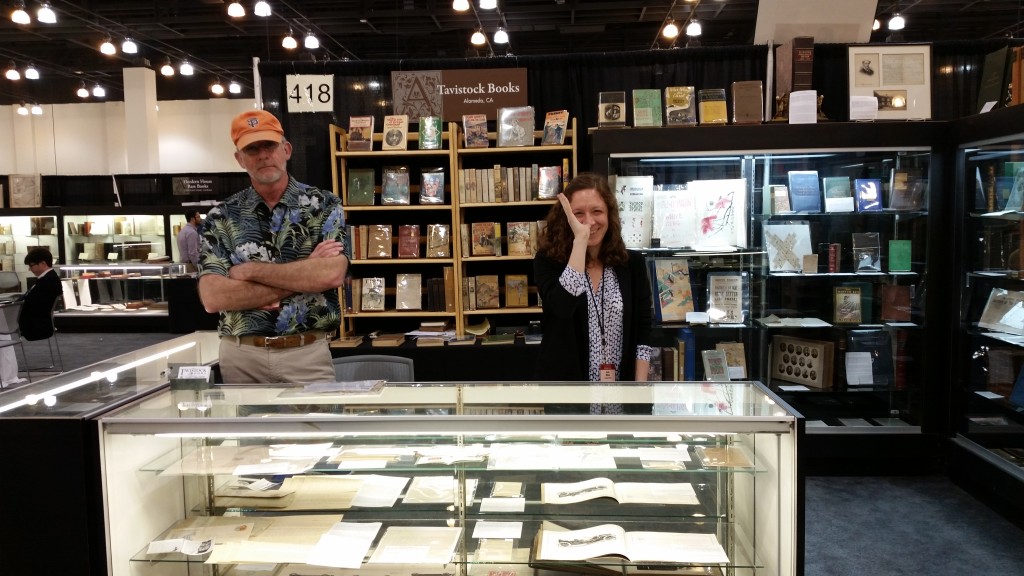
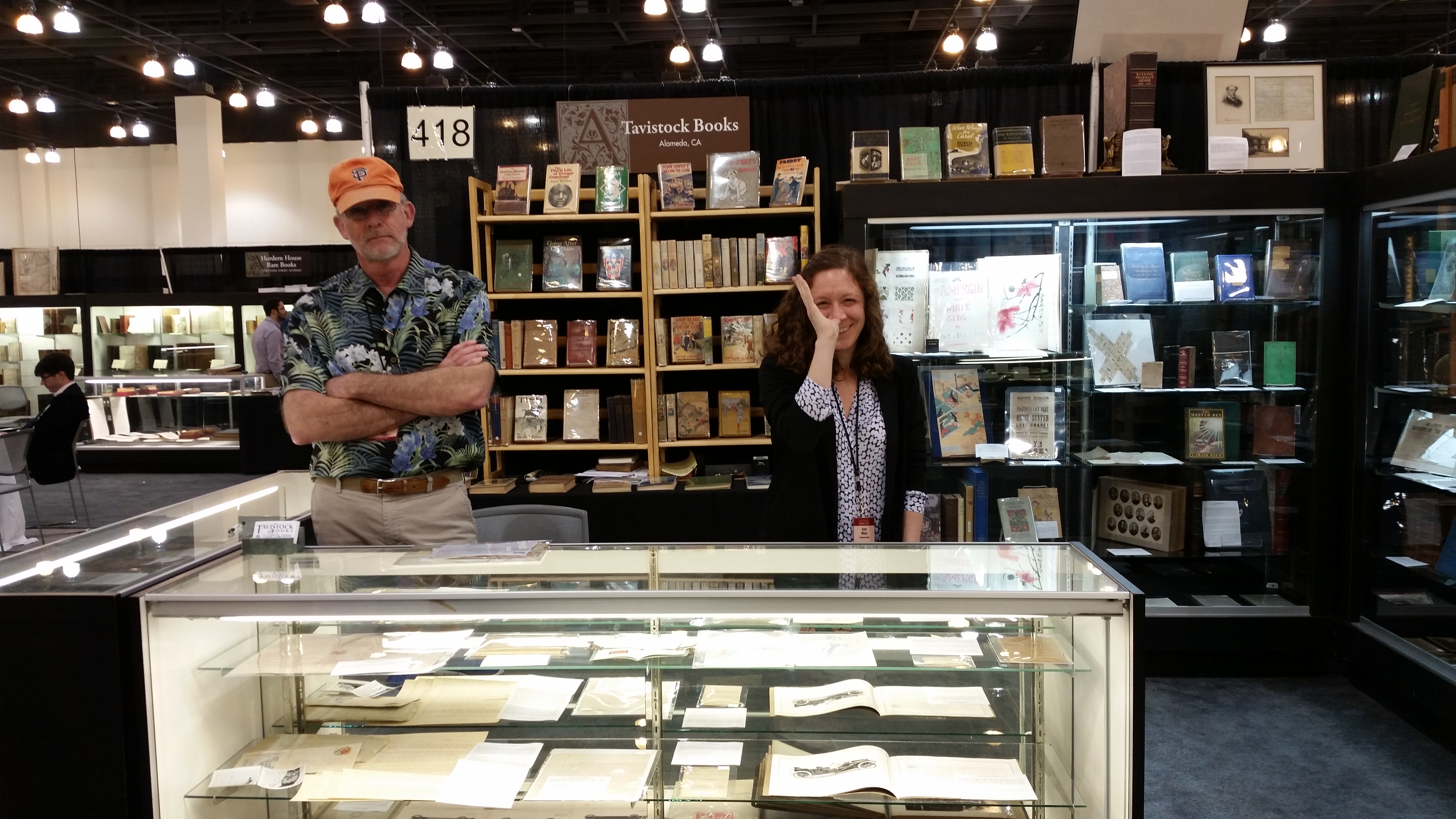
Let’s not forget the King of Tavistock Books… in a surprising choice of an orange Giants baseball cap! (Oh wait… did I say surprising?)

It was hard, I’ll admit, not to feel like the lone museum guard on duty in an empty exhibition hall, especially as many fellow dealers in the surrounding area seemed to be doing just fine. One dealer, in fact, who is a dear and deserving colleague and shall remain nameless, was even doing “just fine” with stock bought, not long ago, from us! We were, and are, sincerely glad for this colleague’s success, of course, but . . . oh, the agony, and the irony. Every now and then, a sale lifted us out of the doldrums and turned us into booksellers again, grateful for the chance to put good material into the hands of people who’d take pleasure in it; one regular at our shop stopped by, and was kind enough to give me props within earshot of Vic (thanks, Jim – don’t spend it all in one place!). But then, inexorably, we’d drift back to our becalmed waters, cursing our luck.

Hard at work!

Hard at work!

The one perk of all the deathly quietude was that Vic let me roam the fair, too. For a so-called small fair, there were enough vendors for the main area of the venue to feel almost too packed, and a decent-sized crowd milling about, as well. The best part, for me, was the sheer range of books on display: from Ken Karmiole’s (Kenneth Karmiole, Bookseller, Inc.) impeccable “old books” – his term, by the way, for the lovely array of pre-1800 material at his booth – to pulp fiction and modern firsts at Magus Books and several others, to Andrew Langer’s (Andrew Langer, Bookseller) collection of quirky ephemera and Elizabeth Svendsen’s (Walkabout Books) assortment of uncommon travel-related books, and so much more. Two of my fellow CABS grads this year, Morgan Brynnan (Uncommon Works) and Bill Wickoff (Ephemeriana), had booths, and I was glad to see them again; C-SPAN even showed up and interviewed (at least) Ken Sanders (Ken Sanders Rare Books) and Nick Aretakis (Nick Aretakis, Bookseller).

The unrecorded Armstrong found at the fair. Click for more info!

The unrecorded Armstrong found at the fair. Click for more info!

I wish I could say I scored something amazing, as some of the other dealers reportedly did, and as Vic discovered once back in the shop on Monday, in that he bought an apparently unrecorded Margaret Armstrong binding. But, I didn’t, at least not in that sense. Instead, I rediscovered something I’d already known: the incredible generosity of booksellers. Zhenya Dzhavgova (ZH Books) and Kim Herrick (The Book Lair), sharing the booth beside ours (and doing an enviously far brisker business), popped over from time to time to make sure my first fair was going okay and to provide extremely helpful tips (i.e., “Vic hates it when you stand in front of the display cases too long”). Stephanie Howlett-West (S. Howlett-West Books) explained the miraculous business card system of purchasing; David Smith (D.J. Smith Books) told me about other Sacramento fairs I might want to check out, and gave me a cookie, to boot. Andrew Langer even passed along buying tips – as I was in the process of buying from him. And there were more friendly gestures and kindnesses, too many, from too many people, to list them all. Simply listening to the abundance of trade talk – from Ken Karmiole and Vic discussing the possibility of partnering on a particular item, to Laurelle Swan (Swan’s Fine Books) musing about whether she should have brought more things – was an education in itself.

Some booksellers, smarter and savvier than I, can perhaps make it in this business on their own. For this bookseller, however, who needs all the help she can get, it’ll take a village. Or, maybe, a book fair (or a hundred book fairs).

And as for the persnickety little problem of having had a bad book fair? Vic is teaching me well: we’re acknowledging the hit, reassessing, and getting ready to come out swinging next time.

Seattle, here we come.

-Kate Mitas

The day's mascot itself!

         The day’s mascot itself!

Share

Playing Hooky? We Look at the Beginnings of the School System and Some of the Earliest Textbooks

By Margueritte Peterson

Ah, September. The smell of sharpened pencils and new Jansport backpacks (those are probably not still “in” though, are they? I’m getting old) combined with a boatload of traffic going 15 miles per hour on random streets throughout town say one thing: Summer is out… school is in! We thought, given that many of our followers work in the school system – curating, developing collections and managing libraries, among a myriad of other tasks – we would take a quick inside look at the development of the school system around the world and the earliest forms of “textbook” education (reading primers, ABCs… Alphabet Books, and Hornbooks)!

A mosaic from Pompeii of Plato's academy (source: wikipedia).

A mosaic from Pompeii of Plato’s academy (source: wikipedia).

Though originally the Greek word for school, σχολή, translated into “leisure” or “that in which leisure is employed” (listen closely kids, and this will surely impress your teacher when she asks you why you aren’t listening), eventually became known as a group to whom lectures were given. The concept of grouping those who need to or want to learn together has been known throughout classical history. Almost all ancient civilizations taught their students in bulk – Ancient Greece, Ancient Rome, Ancient China, Ancient India… lectures were given to all. Though in these civilizations lectures and schooling were usually only given to someday-to-be military personnel and academics, by the early 1700s obligatory attendance in elementary school became commonplace in many parts of Europe.

An example of an early Hornbook.

An example of an early Hornbook.

Around this time, printing had become more widely practiced, and was becoming available to the general populace of Europe and America. Literacy kept going up, given the new obligatory attendance in schools for the common man, and pamphlets and books were more readily available and distributed. Some of the tools used for schooling in early education are of interest to many collectors today. Reading Primers, Alphabet Books (or ABC Books) and Hornbooks are some of the most popular types that we will glance at today.

In all truthfulness, Hornbooks and Primers could both be considered a type of ABC book. Hornbooks, named quite appropriately, were often the alphabet and a woodcut illustration or prayer printed to a sheet of paper affixed to a wooden paddle. A thin, transparent sheet of horn was then placed over the paper to protect it (hence the name “hornbook”). These early “books” are quite collectible (in case you happen upon one in a dark corner of an antique store), as they are rare. Primarily used between the 16th to the 19th centuries, finding one intact is rare, no doubt due to the use, and abuse, of them by their petite owners! The next iteration in educational publications was the reading primer. The earliest primer known is a Latin text, translated into English as the Salisbury Prymer. It contains the alphabet and a series of Catholic Prayers, and was printed in the late 1400s. Early primers were often religious in theme, and more than somewhat didactic in nature. The earliest primer printed in the American Colonies was The New England Primer. Though originally published in Boston in 1687, it only began to be printed in greater numbers in the later 1700s, on the cusp of the American Revolution. Before this primer, most of what was used in the colonies for education were primers brought over from England with original settlers. The first US edition of The New England Primer contained a myriad of educational lessons – not only did it house the alphabet and religious lessons, but contained pages on vowels & consonants, double letters, woodcut illustrations and acronyms, among others. According to research, around 2 million copies of this title were printed and sold in the 18th century (though there are no surviving copies of those printed before the 18th century… or if you have one, please email vjz@tavbooks.com). Why place so much emphasis into a small book for young children?

Our holding of an early 19th century edition of the New England Primer. See it here>

Our holding of an early 19th century edition of the New England Primer. See it here>

Such a question brings us back to the developing school system in the Western World! Surprisingly, one room school houses were the norm until the 1920s, when students were finally split up by age and academic level into separate classrooms. Throughout these centuries, only the wealthy and predominant citizens were able to have private tutors and governesses to teach them. A primer allowed a child to learn a good amount on his own, and also allowed a teacher in a room with several different levels of students to assign a certain lesson to different groups. The primer, along with Hornbooks and other ABC books were useful educational tools for both students and tutors/teachers alike, and allowed for many youth to be educated in basic reading and writing skills.


Well, what are you waiting for? Back to the grind – open those notebooks, nibble on that pencil! School is back in session!

Share

New Acquisitions at Tavistock Books

Before the hectic Book Fair season begins, we thought we’d give a quick run-down of a few of our most interesting acquisitions in the recent past! Click on the pictures or follow the links to be directed to the item in question. Enjoy!

blog1Ambrotype of Mr. & Mrs. James M. Lilley of Virginia, circa 1860s: This VG set of Ambrotypes are of a prominent Virginian and his wife. Mr. Lilley, a surveyor by trade, served in the Civil War as a colonel of the 93rd Regiment of the Infantry of the Line (yes, that is a mouthful!). In 1857 Lilley was granted a patent for an “Improved Instrument for Surveying and Calculating Areas.” This “Compass” was intended to facilitate calculation of oblique-angled trigonometry and finding the area of triangles.” It seems Lilley was simply a mouthful all the time! $275. See it here>

Blog3


Songs Against Evil, Childrens Songster circa 1879: I don’t know about you, but I happen to love Children’s Songsters! Especially when they have amusing front covers. This 12-page songster published in New York by McLoughlin Brothers contains 5 chromolithographic images. Check out our homepage ‘Childrens’ section to see similar recently catalogued songsters! Our listings are automatically shown by the latest items to enter our inventory. Check out this one here>


Blog2James Lilley’s Arithmetic Book, circa 1812: Yes, this manuscript codex on arithmetic is written by Mr. James Lilley (mentioned above) as a child! This notebook begins with Lilley as a 10-year old boy in early 19th century Virginia, and covers all manner of mathematical topics, from Subtraction and Compound Division to Extracting the Roots of all Powers! The journal follows Lilley over a span of 7 years, and after the lessons contains ledgers of a neighboring schoolhouse and farm, as well as documentation on family births and deaths in that time. Also included are his geometry and land survey problems for the year of 1823 to 1824. A fascinating, unique primary source documenting this individual’s mathematical schooling (including current thought and practice) as well as local county history and family geneology. See it here>

Blog4


Bohemian Club Broadside, Olde Goats Night: This Bohemian Club broadside, printed recto only, was printed circa 1940. “Inspired by the season to a renewal of youth, a select company of ‘Old Goats’ will gambol, cavort and bleat for your amusement on Bohemia’s own green.” This broadside was illustrated, quite humorously, by Francis Todhunter, a California artist often noted for his landscape paintings and architecture sketchings. Check out this scarce WWII-era Bohemian Club item here>

This codex begins with James but 10 years old, as he begins arithmetic instruction under Mr Tilford. The volume continues with Lilley’s voluminous notes for the next seven years, covering a number of mathematical topics, from Subtraction, Dry Measure, Apothecaries Weight, Compound Division, Of Rebate or Discount, Inverse Proportion, A General Rule for Extracting the Roots of All Powers, Promiscuous Questions, etc. This is followed by a 2ll ledger for Lancaster Schoolhouse, then a 5ll ledger for Surry Farm, then a 10ll general ledger. Next are 4ll recording family births & deaths beginning with John Lilley [b. 1772] to James Campbell Lilley [d. 1901 (some later entries obviously recorded in a different hand)]. Next are Lilley’s 6 leaves of pen trials, with the repetition (21x, in this instance) of such phrases as “Contention and Strife make uneasy our life James Lilley 1820” The volume concludes with 43 ll of geometry & land survey problems, cases, etc, dated 1823 – 1824.A fascinating, unique primary source documenting this individual’s mathematical schooling [including current thought & practice], as well as local county history & family genealogy. – See more at: http://www.tavbooks.com/pages/books/41788/manuscript-codex-1802-1875-james-m-lilley/james-lilleys-arithmetic-book-taught-under-the-tuition-of-nicholas-tilford-teacher-of-the#sthash.MAGeqLXe.dpuf

In 1857, Lilley was granted a patent for an “Improved Instrument for Surveying and Calculating Areas.” The text of the patent refers to a new and improved “Compass” that is “intended to facilitate calculation of oblique-angled trigonometry and finding the area of triangles.” – See more at: http://www.tavbooks.com/pages/books/41790/james-m-lilley-mrs-j-m-1802-1875-lilley-mary-c/ambrotype-photograph-s-with-decorative-brass-surrounds-in-union-case#sthash.w69g77Mo.dpuf
Share