Category Archives: Uncategorized

In Honor of Emily

emily-dickinson-hires-cropped

“Hope is the thing with feathers” by Emily Dickinson is the first poem I remember reading and analyzing as part of a school assignment. 

The first time I read it, I definitely did not “get it”. I honest to goodness remember my initial reaction to my teachers’ analysis of the poem itself. It was the first time I asked myself the question… how do we know that that is what the author wanted us to read into it? How do we know for sure that she meant for the bird to signify the innocence of the emotion of hope? With some authors it is harder than others – as some authors left… well… less of a trail of breadcrumbs for us to follow. One of those authors was Emily Dickinson – the recluse who, to this day, inspires many with her words, whilst we know relatively little about her innermost thoughts during her most productive literary period. On today the anniversary of her death, we’d like to give a brief background on this interesting poet and focus not on exactly what her words mean to us, but rather on the lasting legacy she left behind. 

emily3Emily Dickinson was born in Amherst, Massachusetts, on December 10th, 1830. She was the second of three children, with one elder brother named Austin and a younger sister, Lavinia. Her father was not only a lawyer by trade, but a trustee of Amherst College, where his father had been one of the founders of the school. With their background in education, the Dickinson children were given a thorough education for the time, certainly when it came to the two girls. At the age of 10 Emily and her sister began their studies at Amherst Academy, which had begun to allow female students a scant two years before their studies began. Emily remained at the school for seven years, studying math, literature, latin, botany, history, and all manner of respected academia. Upon finishing her studies at the Academy in 1847, Dickinson enrolled in the Mount Holyoke Female Seminary (now Mount Holyoke College). Although the Seminary was only 10 miles from her home, Dickinson only remained at the school for 10 months before returning home – for reasons many have tried to unearth but none can be sure of. 

emily2Though throughout her late teens Dickinson seemed to enjoy life in Amherst socially, and was certainly already writing poetry (a family friend Benjamin Franklin Newton hinted in letters before his death in this time that he had hoped to live to see her reach the success he knew possible), by her twenties Emily was already feeling a melancholy pull, exacerbated by her emotions when it came to death, and the deaths of those around her. Her mother’s many chronic illnesses kept Emily often at home, and by the 1860s (Dickinson’s 30s) she had already largely pulled out of the public eye. By her 40s, Dickinson rarely left her room, and preferred to speak with visitors through her door rather than face-to-face. Unbeknownst to any, Dickinson worked tirelessly throughout this period on her poetry, and by the end of her life had amassed a collection of roughly 1,800 poems neatly written in hand sewn journals. That being said, less than one dozen of her poems would be published during her lifetime. The first book of her poetry, published four years after her death on May 15th, 1886 by her sister Lavinia, was a resounding success. In less than two years, eleven editions of the first book had been printed, and her words spread across nations. 

“Hope” is the thing with feathers –
That perches in the soul –
And sings the tune without the words –
And never stops – at all –
 
And sweetest – in the Gale – is heard –
And sore must be the storm –
That could abash the little Bird
That kept so many warm –
 
I’ve heard it in the chillest land –
And on the strangest Sea –
Yet – never – in Extremity,
It asked a crumb – of me.
emily5

It is only now, in researching her life and rereading a few of her best-loved poems that I can see the answer to my question of long ago. We don’t know what Emily Dickinson wanted each word to signify. We don’t need to know. It is the way her poetry made and makes the public feel that gave it the popularity it still holds to this day. “Hope”, indeed. 

Today we honor Emily Dickinson and her lasting impact on the world of poetry. 

Share

A New Adventure at the Chicago Antiquarian Book Fair

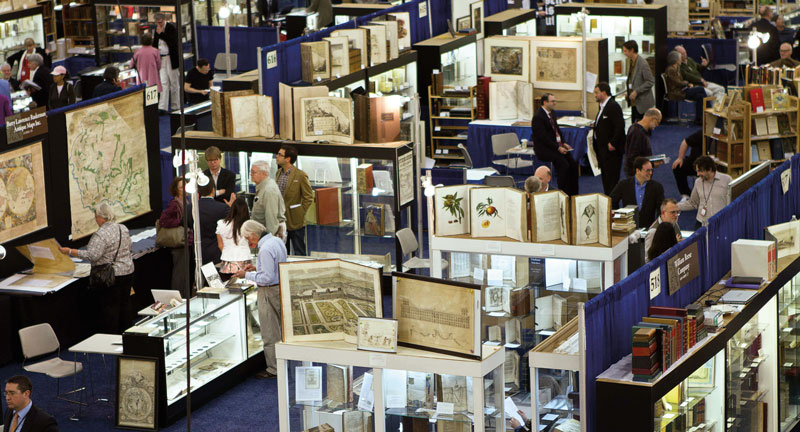
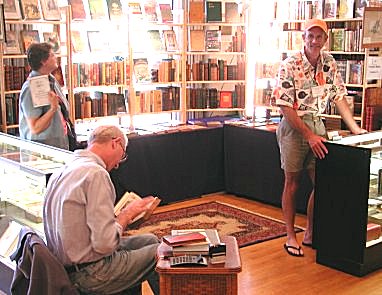
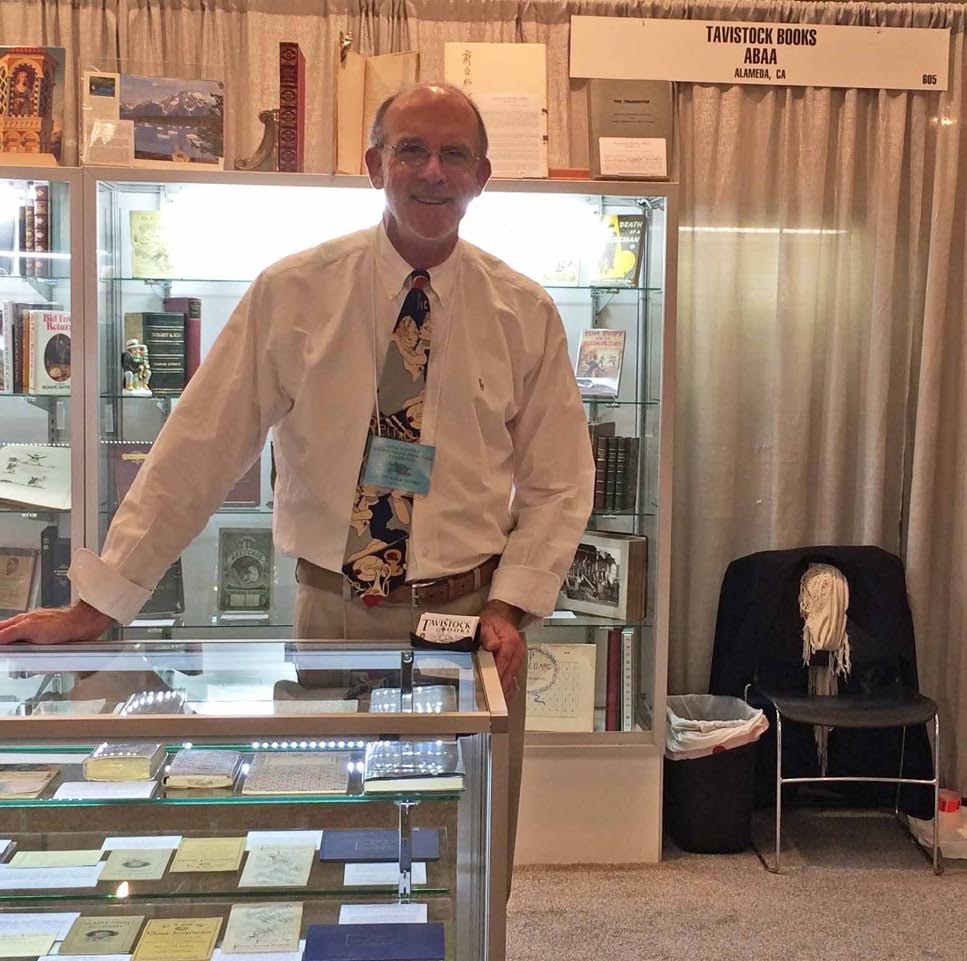
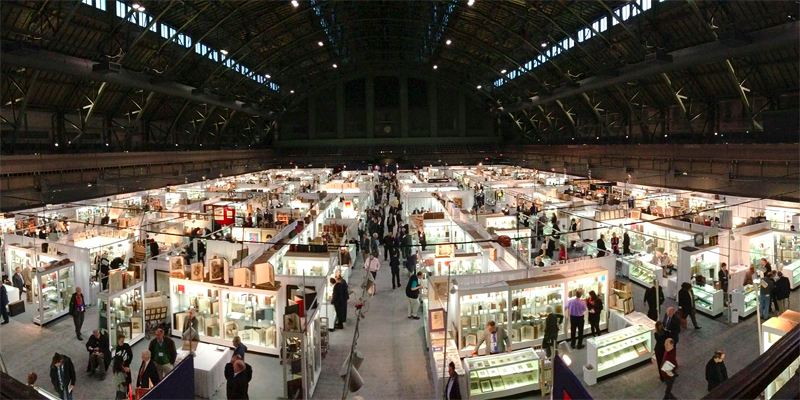
Recently, Team Tavistock flew out to Chicago to exhibit at the Chicago Antiquarian Book Fair. A first time exhibiting at this fair for Tavistock, we got the low-down on their experiences below! 

chicago7

So Vic, is this your first time exhibiting at the Chicago fair? And if so, what made you decide to try it out?

VZ: Indeed, this was my first time exhibiting in Chicago, and I did so because it was held at the prestigious Newberry Library.  A lovely venue.

Samm, have you spent any time in Chicago before this fair?

SF: Yes, I have spent quite a bit of time in Chicago before this trip. However, I was never in the area we were in – Lincoln Park is, I believe, the neighborhood that the Newberry is in. The park in front of the Newberry is absolutely gorgeous, and the Newberry Library was spectacular! Not to mention that we discovered a lovely breakfast diner called Tempo, and it was a delight. Every time I visit Chicago I seem to find great and beautiful places.

chicago1

Vic, how did you decide what was best to take with you, exhibit-wise?

VZ: We had contracted for two trophy cases, no tables. And to save on shipping costs, decided to carry everything with us on the airplane. So selections tended to have two aspects: a connection to Chicago, and being more of a pamphlet or otherwise ’smallish’ item. What inventory we brought with us was supplemented by the 85 Dickens titles I acquired at the 1 May Hindman auction. And no, we didn’t put out all 85! Just a half dozen or so.

Samm, what was load-in and set up like? How did it compare to the previous fairs you have worked on?  

SF: Overall, load-in was easy.  It is always a bit confusing when first arriving at a book fair – where to go and what doors lead to what rooms. But it is definitely the way when you have never even been to the venue before! Other fairs I have attended have had very detailed load-in and load-out policies and rules, but that did not seem to be the case at the Newberry. It is a HUGE venue and easy to get turned around if you are unfamiliar with it. 

chicago3

Vic, what was the best part of the fair, as one who has so much experience both exhibiting and shopping fairs around the country?

VZ: In this case, for me, the best part of the fair was the Friday night exhibitor dinner arranged by the fair promoter, Sammy Berk. Was a quite enjoyable evening, with good food, good drink, & good company.

Samm, what was your favorite thing about this fair?  

SF: To be honest, I think its one of my favorite things about every fair I have exhibite at so far. Meeting people I have only talked to on the phone or emailed with! It is always nice to put a face to voice or name. People’s responses to me are typically along the lines of “its nice to meet you in person, I have been seeing you on Instagram and the blog.” Haha!

chicago4

And last but not least… Vic, do you think you’ll be exhibiting at the Chicago Antiquarian Book Fair in the future? 

VZ: TBD! I say this, for despite the fantastic venue, sales were, shall we say, less than robust, and at the end of the day, one must have sales to remain a bookseller.

And there you have it, ladies and gents!

Looking forward to the next book fair report this fall, coming to you from Tavistock Books. 

chicago9

Share

Happy Anniversary… To Us!

Just yesterday, Tavistock Books celebrated its 30 year anniversary. 30 years in business. 30 years in this wonderful, insane business we call the antiquarian book trade. We are nothing short of proud, and grateful for all of your support over our many years!

MVIMG_20190417_150333

We were able to throw a little shindig at Tavistock Books’ main residence – 1503 Webster Street in Alameda, California (where we have been located for the last 22 years of our full 30). Samm and Vic made sure there were snacks and champagne galore! A big thank you to many of our bibliophile friends for their encouragement – and for the turn out! We had a steady stream of visitors all day and are so happy to not only call them our colleagues, but our friends as well.

vic samm

I don’t believe anyone could have put it better than Chris Lowenstein of Book Hunter’s Holiday (ABAA), “It is a pleasure to see someone be successful in this business for 30 years – especially someone who shares that success with others all around him through his mentorship and kindness. He has been mentoring me for the past 12 years and I wouldn’t still be in this business without him! Congratulations to Vic Zoschak and to Tavistock Books.”

Hear, hear!

MVIMG_20190417_142518 MVIMG_20190417_142505 MVIMG_20190417_142456

Share

The American Anniversary of the (American) English Language

Many men born in the states during and after the revolution were more die-hard Americans than any of the foam fingered MAGA supporters we see today. After all, they were the children of the revolution… either they or their fathers fought hard to ensure our country’s freedom, and they weren’t about to let us forget it. They used whatever skills they had – political? They wrote the Constitution. Physical? They fought in battles. Academic? They wrote Declaration of Independence, or essays on our rights… or a dictionary of the American English language. Today we’d like to discuss one such man – who wrote the first American dictionary. With its over 70,000 entries it was more conclusive than ever before, and included words specific to America.

We may be young… but we invented the word “hickory.” So there.

webster3

Noah Webster was born in 1758 in West Hartford, Connecticut. His father, though a farmer by trade, was at the same time a deacon of their local church, captain of the town’s small militia, and a founder of the local book society (which later because the local public library). Though his father did not have extensive educational knowledge, Webster (Sr.) did have a thirst for learning, comprehension, and understanding. His wife began teaching her son to read and write at a young age, and after attending small, dilapidated schools in the region and using a private tutor, and after his father mortgaged their family farm to pay the tuition fees, Noah Webster was able to enroll at Yale College when he was 16 years old… during the height of revolutionary unrest, and he continued studying during the Revolutionary War.

After graduating from Yale, Webster began teaching, then quit to study law, and finally passed the bar exam in 1781. One can imagine it was trying times to be finding a job and earning a living, what with the Revolutionary War still raging on. He began a small private school in Western Connecticut that he closed shortly thereafter, then he wrote essays for local papers praising the Revolution, and then he opened yet another school, but this time for the wealthy of New York. It was at this establishment that he began work on his first “speller” – a grammar and reader for use in elementary classes. The revenue from this first venture is what enabled Webster to spend the next years working on his infamous dictionary.

webster1Webster married Rebecca Greenleaf in 1789, and as she was of good breeding (man, I don’t get to use that phrase often enough) he was able to join higher levels of society in Connecticut than he had been. (They would later have 8 children, but that is neither here nor there.) Due to his beliefs in the revolution and conviction in America’s greatness, one Alexander Hamilton loaned him $1,500 in 1793 to move to New York and become the editor for the Federalist Papers.  For the next few decades, Webster spent much of his time being one of the most profuse authors of the time, especially when it came to political reports, but also in regard to textbooks and articles across the board.

Over these years, Webster focused on one specific way he personally could help his beloved new country. He wanted to promote an American approach to educating our children, and wanted to “rescue our native tongue from the ‘clamour of pedantry’ that surrounded English grammar and pronunciation.” He said that the English language had suffered the British aristocracy’s approach to spelling and pronunciation – an outdated and elite way of speaking and teaching. He eventually began work on his lifetime’s achievement… The Webster Dictionary.

webster4

In 1806 Webster published the first attempt – A Compendious Dictionary of the English Language – the first actual American dictionary of its kind, but knew immediately it was not enough. He continued working on his opus. He learned somewhere between 26-28 languages in evaluate their importances and meanings, and connected with people around the east coast of the new America in order to gather words and meanings from around the “country.” At the tender age of 70, Webster published his dictionary in 1828. Though at first it only sold 2,500 copies, and Webster ended up re-financing his home to pay for a second edition… we all know the eternal significance his dictionary would play on us all… as the Webster (now Webster-Merriam, after rights were granted to the publishing brothers in 1843) Dictionary is still used in schools and households across the United States today.

This week we celebrate its publication (as the copyright was registered by Webster on April 14th, 1828) and the lasting impact it has had on America… just as Noah Webster wished it to.

webster2 universityofwashingtoncredit

Credit: University of Washington libraries.

Share

A Sacramento Update in Honor of Samm’s One Year Anniversary!

This past weekend’s Sacramento Antiquarian Book Fair marks Samm Fricke’s one year anniversary with Tavistock Books. Some of you loyal blog followers might remember that Samm joined us in panic mode just two days before the fair last March, and we were just as lucky to have her then as we were to have her at this – her third Sacramento Book Fair! We sat down with her to pick her brain on her feelings now versus one year ago, so enjoy this little Q&A on Samm’s experiences at this fair!

sacfair1

Q: So Samm! This Sacramento Book Fair this past weekend marks your one year anniversary with Tavistock Books. How does it feel? 

SF: I must say it feels pretty good! All in all I think I am getting a handle on things. I am feeling more and more comfortable in my book skin each day, and also learning something new each day!

**

Q: What was your favorite thing about this Sacramento Book Fair, and how is it different from your favorite aspects one year ago?  

SF: Hmm, my favorite thing? Haha! Probably the simple fact that is was the Sacramento Book Fair!  The last two fairs we exhibited at (Pasadena and the Oakland ABAA fair) were huge and stressful, so it was quite nice to come back to a less chaotic fair and see some familiar faces.  Some of those faces I of course saw in Oakland and Pasadena, but without us all being so hyped up it was nice being able to relax with my colleagues and fellow bibliophiles! That being said, I also loved that I could actually say I had two Sac fairs under my belt!

sacfair2

Q: What do you think your most important lesson was this year and how did you go about learning it? Did Vic teach you? Did you make a mistake? (No joke, my first week I dropped a book that Vic had just spent hundreds of dollars having the binding redone on. Both boards snapped off and I had a mini heart-attack. Vic was at a Giants game. C’est la vie.) 

SF: (First of all, haha Margueritte! That is my worst fear!) There have been so many lessons, and still so many lessons I have to learn!  Vic teaches me everyday – “let me show you” and “have I mentioned this bibliography?” – are some of most common phrases I hear each day! I have, of course, made mistakes here and there, its a learning curve! Thankfully none of my mistakes have lead to him going bankrupt or losing items in his collection… yet! Kidding! Within my first week, I was taking photos and bumped the books behind me. One fell. My heart skipped about 3 beats while I saw Vic look over.  Thankfully, however, it was an inexpensive book and nothing was damaged (unlike you, Margueritte!). But I won’t lie – I thought I was going to die.

**

Q: What are you most excited about moving forward in the book trade? 

SF: Like I mentioned a year ago, I just want to continue learning new aspects of the book trade. There is always something new, even with the old! And yes, you can quote me on that one.

**

We are so happy to have you on board, Samm!

Here’s to the next Sacramento Antiquarian Book Fair!

Share

New Acquisitions for Your Viewing Pleasure

The recent fairs have given us a fair amount (pun intended) of new inventory! As we haven’t posted one in a while we thought it might be nice to give you an in-depth look at some of our latest and greatest… though there are many more ready to go home with their new owners! Check out our website’s categories for more info on these and other awesome titles.

Screen Shot 2019-03-05 at 7.11.21 PM

We would be remiss in sending our hometown book fairs love without beginning this blog with one of our favorite local finds! DeWitt’s Guide to San Francisco was published in 1900, and is illustrated by nearly 20 engravings! The city guidebook lists tourist sights, hotels, restaurants, banks, businesses, churches, clubs, schools, etc. Love San Francisco? Perhaps you should see what has changed in the last 118 years! See it here.

Screen Shot 2019-03-05 at 7.11.34 PM

This cabinet card photograph depicts three young girls, most likely of the Utes tribe, where they resided in the southern end of Colorado. The photograph itself is circa 1890s, when the town of Rouse, Colorado (now a ghost town) was home to, what was in 1888, the largest coal mine in the state. View this amazing piece of 19th century photographical history here.

Screen Shot 2019-03-05 at 7.12.38 PM

This 1890 edition of The Care of the Sick has a beautiful gilt illustrated binding – and is a solid Very Good copy of this handbook for Nurses, detailing care for the ill both at home and in the hospital. You love nursing material as much as we do? Check it out here!

Screen Shot 2019-03-05 at 7.11.46 PM

We also have a pretty spectacular collection of children’s series books – Nancy Drews, Tom Swifts… Hardy Boys? All can be found on our website and on our shelves! Some series books are not quite so well known as these, however… like this copy of The Bobcat of Jump Mountain. Part of the Boys’ Big Game Series, this title was published in 1920 and our copy still has its original dust jacket! Did we mention it is signed and inscribed by the author, the year of publication? See it here.

Screen Shot 2019-03-05 at 7.12.02 PM

Now this may look like nothing special, but in fact these two volumes make up a first US edition of Oliver Twist… and we would be remiss Dickens specialists indeed if we did not include one of his titles in this list! Now certainly Oliver Twist needs no description to provide its storyline or enforce its importance… so let’s just say that this rare set is not often offered in the trade. See it here.

Screen Shot 2019-03-05 at 7.12.26 PM

Kind of a strange leap from our classic main man, but here offered as well is a 1941 1st edition of rogue author Henry Miller’s The World of Sex. Bibliographers Shifreen & Jackson have speculated that the 3 states of the first [ours given priority] runs of this work may each have had a run of 250 copies. This first state binding is increasinly uncommon, especially in its original jacket – as ours is! Expand your horizons here.

Screen Shot 2019-03-05 at 7.13.11 PM

And while we’re on the subject, here is another fun find from the fairs! We almost feel like the mid 20th century Gilbert Vitalator requires no explanation except for their own marketing! With this vibrator attached to your fingers… “…you’re ready for the thrill of your life. Press your fingers against your body on the spot you wish to massage, and flip the switch. Things happen quickly here, but they can be explained slowly. The Vitalator sets up a vibration which travels to your finger tips and flows through them to your body. But it is not merely a vibration. If you had a pencil in your fingers, set to paper, it would be tracing tiny ovals with lightning rapidity. This rotary movement – this “Swedish massage” action – in the secret of Vitalators superior benefits.” Woohoo! Can be used by men and women, apparently. See this funny body massager here

Screen Shot 2019-03-05 at 8.32.18 PM

This poem, Dickens in Camp was written by Bret Harte shortly after Dickens’ death in the 1870s. Published in a fine press edition in 1923 by John Henry Nash in a run of only 250 copies… and it is signed by the famous publisher! Check out this wonderful tribute to our main man here.

Screen Shot 2019-03-05 at 7.12.52 PM

This Red Cross WWII campaign promotion poster advertises Toys for Kiddies – an initiative where patients in military hospitals designed and created handmade toys for children in homes and orphanages at Christmastime. With the materials provided by the Red Cross, apparently the men spent months making and competing to produce the most creative children’s toy of the season. See this 1940s broadside here.

Screen Shot 2019-03-05 at 8.32.29 PM

Last but not least, we offer as a tribute to the wonderful OZ themed California fair just a couple weeks ago this beautiful 1st edition, 1st printing of Frank L. Baum’s The Woggle – Bug Book, inscribed by the author to one Ruth Bailey Ingersoll in 1905 – the year of its publication. Said by bibliographer Bienvenue to be “remarkably difficult for collectors to find, particularly in good condition. … the large book is one of the most delicate and ephemeral of all Baum’s publications”, we are lucky enough to offer a very pleasing Very Good copy of this unusual early Baum title here at Tavistock Books! Check it out here.

enjoy

We hope you’ve enjoyed this brief list of some fun new items on our shelves! Stay tuned throughout the rest of book fair season to see more of them.


Share

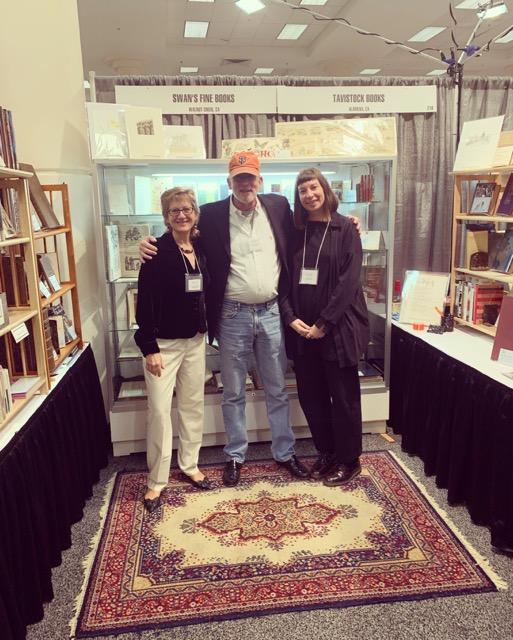
A Q&A with ABAA President Vic Zoschak and Tavistock Books’ Samm Fricke on the Recent California Fair

tav6

What were you most excited about for the Oakland ABAA fair? 

Samm: Having everyone in town on our “turf” to invite to the shop and seeing all the international dealers!

Vic: The ending…?  Seriously, it had been a long 10 days for us, what with the Pasadena fair the weekend prior, and boy, by the end of Sunday, my dogs were barkin’, let me tell you!

What was the theme of this year’s California ABAA fair and how did it present itself at the fair? 

Samm: The theme of this years fair was OZ. There was a large collection of rare Oz items in the room. A lot of dealers also brought some things from their Oz collections that were dispersed around peoples booths… there was a touch of Oz or Baum almost everywhere if you looked hard enough!

Vic: The OZ theme was very well presented, though we’re sorry to say the OZ things we brought, we also brought back to the shop! But nevertheless, it was an exciting theme, and I saw some wonderful material in the genre throughout the room.

tav4

Were there any special events you two attended that you’d like to make note of for us?

Samm: We did not make the poker benefit as we were exhausted.  I personally did not make the talk put on by the Womens Initiative as I was finally taking time to browse the booths.  I snuck in for a brief minute to see Vic’s talk and take some photos.  He had a large turn out and looked super comfortable up on stage.  Some people who attended his seminar even came and browsed the booth and told him that they very much enjoyed his talk.

Vic: One that perhaps deserved more press I’d like to mention here: the Northern California Chapter’s “Young Book Collector’s Prize.”  The award was won by a nice young man from La Jolla, Matthew Wills.  His collection, “Anti-Confucian Propaganda in Mao’s China”, was on display in the room.  This award, and the many young people who submitted entries, indicates to me that book collecting is alive & well  with the next generation.

Vic, did you speak at this year’s fair? 

Samm: He did!  “Whats a Book Worth?” and “Book Collecting 101” were his two seminars.

Vic: Samm’s right, I did, though it was my ’Swan’ song so to speak, as Laurelle Swan, Swan’s Fine Books, will take over for me come 2021.  Yes, pun intended!  🙂

tav2

How was the attendance at the Oakland fair? 

Samm: The turn out was the best on Saturday I think.  The rain was a bit lighter.  Friday was a dreary day, but people still came out.  Overall, a good turn out I thought, but I don’t have another ABAA fair to compare too!

Vic: Both were of modest proportions for us in Oakland, though I thought the promoter did well getting people through the door.  But we had few sales to the general public, so, for whatever reason, the material we brought failed to resonate with them.  You win some, you lose some.

Which fair was better overall for Tavistock Books – the Oakland fair or Pasadena fair – in terms of buying, selling and fun?  

Samm: In terms of buying I would say Pasadena. In terms of selling and fun I would say Oakland.  The fun and selling go hand in hand I think as we had our “Shin-dig” which was great and we sold some items at that too!

Vic: This a tough call…  our energy levels were higher in Pasadena, and I didn’t have ABAA responsibilities while in Pasadena [in Oakland, I had a Board of Governors meeting, as well as the Association’s Annual meeting].  That said, it’s always a pleasure to see colleagues, and perhaps share a meal.  While in Oakland, groups of us did get out to both Wood Tavern & Chez Panisse, two of the top East Bay restaurants.  And yes, Samm is correct, we bought way more in Pasadena [for details, watch our forthcoming Wednesday morning lists!].

tav1

Is the Oakland fair still as much of a draw as it has been since the year they moved it from San Francisco?  

Vic: Here in California, to be honest, our biggest attendance detriment is the proximity of the New York book fair [early March].  The ABAA leadership is acutely aware of this situation, and hopes, in future years, to introduce more of a calendar separation between the two events.

How did your pre-fair Tavistock Books shindig go?  

Vic: Given it’s last minute nature, we think it went well!  We did have a number of colleagues say they’d already had commitments, and therefore weren’t able to make it. Samm & I agreed to do it again in 2021, and ‘get the word out’ much earlier that year.

Samm: It was fun!  We had a good turn out – maybe 15 people or so filtering in and out! Sold some items! People drank our drinks and ate snacks and talked books!  What could be better?

What did you both learn at this year’s fair that you might not have known before it?  

Samm: I suppose I learned that you can never truly know what will sell. You don’t know what booksellers will want, which collectors will be there etc. It can be a guessing game. But having a website to shop and storefront helps. So you may not make a sale at the fair itself but you can offer those other options to make a sale at a later date!

Vic: I’ve done enough of these fairs over the last 30 years that the one thing I’ve learned is that no one fair is like any other!  It’s like rolling dice, you just hope a 7 comes up.

And last but not least… Vic, what is different about being president of the ABAA at an ABAA fair?  

Vic: Interesting question Ms P, for this is the first ABAA fair at which I’ve exhibited since becoming the Association’s President.  What I found is that knowing I’m the President, ABAA colleagues came over to chat about diver Association matters, which is a good thing.  To properly do my job as President, I need to know how members stand on different issues.  For those that took the time to do so, I thank you.

And that's a wrap, ladies and gentlemen!

And that’s a wrap, ladies and gentlemen!

Share

One Down… So Many to Go

download_20190207_083521new

Team Tavistock!

download_20190207_083533

Vic with Brad Johnson of Johnson Rare Books.

With the new year being the start of the new book fair season, we always love to indulge and give you a report on our local fairs. This past weekend, we attended and exhibited at the Pasadena Rare Books LA fair, set up by Brad and Jen Johnson of Johnson Rare Books in Covina, CA. We braved terrifyingly bad weather, accidents all along the drive, and the possibility of pouring rain on our books to support these bookselling and organizing forces of nature (they even had goodie bags for us at our booths when we arrived) – and we are so glad we did! 

download_20190207_083552

An ominous start to the weekend…

download_20190207_083546Now, we might be exaggerating just a teensy bit, as there really wasn’t any rain falling on our books, as we were able to unload in the garage, with plenty of help with dollys, unlike other local fairs we have attended! Luckily for us… it meant we didn’t really need to do much heavy lifting. The fair itself was a fun event, us getting to catch up with a lot of our fellow bibliophiles before the Oakland fair this upcoming weekend, and although the sales were a tad underwhelming for us (in all fairness, however, we were saving our big ticket items for the upcoming Oakland fair), it was definitely worth the trip in acquisitions – many of which you’ll be able to see on display at the Marriott this weekend! That all being said, many booksellers did have great sales… with one rumor that a seller sold out his entire booth!

download_20190207_083542

Vic doing what Vic does best… talking about books! (And maybe a hint of baseball.)

download_20190207_083527

Happy Pasadena Fair, Samm!

download_20190207_083524

Between the fun of the fair, the ability to put faces to names (for this was Samm’s first Pasadena Rare Books fair!) wonderful dinners, great conversation and magnificent buying… we’d say this fair was worth every minute of our time.

Now on to the next! Don’t forget – the ABAA California International Antiquarian Book Fair begins this Friday and continues through the weekend… you won’t want to miss it! And if you were curious to see our shop while you’re in the area, this next week – we are only a few short minutes drive from the fair! Let us know you’d like to stop by and say hi soon. 

download_20190207_083529

Samm relaxing after a full day of bookselling in the booksellers’ lounge!

Share

“Think only of the past as its remembrance gives you pleasure” : Name That Novel!

jane1

206 years ago this week a book was published that changed the course of literary history, respect for women authors, and the romantic ideals of young women around the world. Over 20 million copies have been sold internationally. Little did Ms. Jane Austen know, Pride and Prejudice, the novel she sold publisher Thomas Egerton for one lump sum of 110 GBP, would sell out its first run in a matter of weeks, the three hardcover volumes valued at 18 shillings. 

jane6Perhaps blogs on Jane Austen’s life are unoriginal, seeing how often she is touted as a great literary genius. We would like to add our own to the fold, since a) it is kind of shocking we have gotten away with not writing blogs on the lady for so long, and b) we love to love Jane Austen. Austen’s literary genius comes from her impeccable representations of English mannerisms, her wit, her clever dialogues, and her respected portrayals of young women in Regency England as she slowly but surely added to the transition of English Literature to 19th century realism.

And now let’s go over the story we all know… probably by heart, yes? (Not Pride and Prejudice… Jane Austen’s life. But… well… actually we know them both by heart.)

Jane Austen was born on December 16th, 1775 in Steventon, Hampshire. She was a welcome addition to a large family, and especially welcomed as the sole female sibling to be a companion to her sister Cassandra. This understanding ended up being amazingly true, as never before have we heard of sisters more devoted to each other than Jane and Cassandra Austen. Both were sent to boarding school in Reading in 1785, where they were taught the normal accomplishments of women of the day (needlework, dancing, spelling, etc.). However, their formal schooling lasted only a little under two years, before the school fees became too much for the Austen household to handle and the girls returned home. Never again would Jane or Cassandra live parted from the family unit.

The rest of the girls’ schooling would come from their father and brothers James and Henry (to whom Jane remained quite close). The family and their friends would stage private theatricals at the Steventon rectory, often comedic in nature (one doesn’t need to look far to see where her wit and satirical nature was developed). By the time Jane was 12, she had begun to try her hand at writing, working on short plays, poems, and other works of a satirical nature. Later on, these works would be compiled into a volume known as Juvenilia. At the age of 18, at the birth of her first niece Fanny, Jane sent the baby some humorous essays on the conduct of young women. Continuing to do such work for family and friends, which were cherished and often read aloud at gatherings.

jane3Between the ages of 18 to 20, Austen wrote a short epistolary novel known as Lady Susan (not published in her lifetime). The plot of Lady Susan deals with a manipulative and seductive protagonist who uses charm and flirtation to get what she wants out of men, and is significantly different from any of Austen’s future novels. Throughout her twenties, Austen had several flirtations (mainly Tom Lefroy and an almost terribly matched marriage to Harris Bigg-Wither), but no one stuck. The marriage to Bigg-Wither could have provided her family with financial ease and freedom, but Jane refused to marry for money rather than love (a theme seen in so much of her writing), so rescinded her acceptance of the proposal. (You go, girl.) During her twenties she began the novels SusanElinor and Marianne and First Impressions – novels which would eventually turn into Northanger Abbey, Sense and Sensibility and Pride and Prejudice.

jane4The early 1800s were a tumultuous time for the Austen family, as with her father’s sudden death in 1805 her sister, mother and her were left on the charity of their brothers and other extended family members. The ladies moved around the countryside often, until finally in 1809 being offered a cottage in Chawton by Austen’s elder brother, Edward. If is here that Austen perfected and wrote more novels, at a relatively quick pace. This was seemingly due to quiet country life, with fewer distractions and more time to focus on her skill. Sense and Sensibility was published in 1811, Pride and Prejudice in 1813, Mansfield Park in 1814, and Emma in 1815. These novels, though published anonymously “By a Lady” were favored and popular during their time. Though they brought her rather little fame or money, she was known and by the 1830s she would become a household name.

Unfortunately Jane would not live to see those days, as by 1816 she began feeling unwell, with what can today be attributed to Addison’s disease or Non-Hodgkins Lymphoma. By March of 1817 she was no longer strong enough to write, and passed away on July 18th, 1817, at the young age of 41. Much of her work was published posthumously, despite her personal life being somewhat of a mystery – after her death her sister Cassandra destroyed (possibly) thousands of her letters, leaving only 161 known letters to investigate – to protect her sister’s privacy. Who knows what kind of further work could have been achieved by this literary lioness had she not fallen ill… who knows what other heroines we might have been able to empathize and laugh with had she lived long enough to write.

jane5

The important fact is… Jane Austen existed, and due to her wit and cleverness we have Elizabeth Bennet and Mr. Darcy to show us how its done… right in time for Valentine’s Day!

Share

Character Copyrighting – a nod to the January 6th Licensing Agreement signed in 1930 by A.A. Milne for One of History’s Most Beloved Bears

Happy 2019! Hope our followers had a safe and happy New Years (and more importantly made use of our Pop Up New Years Eve Sale). And now without further ado, onto a whole new year of book loving, bookselling, and book worship!

copyright2

Copyright (literally meaning the right to copy) can be a slippery slope in terms of infringement. Where does one draw the line? Well, that is exactly what the last century has aimed at helping delineate. On realizing that characters, not just titles, can be taken and used for copies of original works, authors fought for characters, plots and fictional places to be copyrighted as well, to protect their interests. On January 6th, 1930, author of Winnie-the-Pooh A.A. Milne transferred exclusive merchandising and other rights of Pooh and the Thousand Acre Wood to Stephen Slesinger, who then in 1961 granted those same rights to Walt Disney Productions.

In the coming years, Slesinger would find faults with Disney and how they interpreted the somewhat vaguely worded contract, and would file lawsuits against the corporation. However, our blog is not meant to be a description of all the lawsuits between Stephen Slesinger and Walt Disney Productions. Rather, we would like to bring attention to what fiction copyright laws mean today and how infringement is decided.

In the United States, for a work to allow for copyright protection, it must meet certain regulations. It must be tangible (art, literature, etc.) and it must involve creativity – meaning that it must be an original work. The tangible aspect implies that facts and ideas are unable to be copyrighted – they must be put forth in a work of art or writing. Now, this is not quite as cut and dry as it seems. In fact, in the same year that A.A. Milne transferred rights to Mr. Slesinger, the United States held a court case deciding on the eligibility of fictional characters to be protected under copyright law – not merely as they are part of a larger work. In the case of Nichols v. Universal Pictures, two tests was developed to find whether characters were eligible for their own copyright. The first test was the well-delineated test – meaning that for a character to be copyrighted it needed to have a well-rounded personality and meaning in the story – for example, as characters James Bond and Tarzan pass this test, but an un-named poor factory worker (more of a stereotype) would not. The second test requires the character to be central to the storyline, and not merely a vessel for putting the plot forward. Sam Spade of the Maltese Falcon detective novels was found not to be copyrightable, as he was looked at as a vessel for storytelling, rather than as central to the plot. In terms of plot, for a copyright lawsuit to be made against an infringement a test must be made to prove the works as “substantially similar.” as the US Legal website states, “Though there is no ready-made yardstick as to what constitutes a “substantially similar” work, the basic test to determine whether a work is “substantially similar” to another is to see whether a person looking at the two works would believe the two works to be the same. This protects the author of a literary work from another person changing a few words here or there in a work and claiming it to be his own.” Amen to that – though unfortunately perhaps a bit vague.

copyrightIn the basest terms, these days it is behooves an author to copyright their work. It cuts down significantly on time and expenses should there ever be an infringement on their creativity, and also “U.S. copyright law gives persons who register their works the option of recovering statutory damages for infringements which occur after the registration of the work, and not just the actual damages the copyright owner can prove he has suffered. Statutory damages are damages which the court can award without regard to the amount of damages which the copyright holder has suffered, or could prove he has suffered. In addition to an award of damages, a successful copyright infringement plaintiff may also obtain an injunction against further infringement by the defendant and, in appropriate circumstances, obtain the destruction of infringing copies of the copyrighted work.” As you can see, should you be worried about your characters or plot, it does make sense to register the work with the US Copyright Office.

There are so many aspects to copyright law – and these are just a few in terms of fictional character and plot! If you would like to read more about the history of copyright law, etc., we suggest checking out Copyright.USlegal and this timeline of the history of copyright in the US. To read more on the legal battles between Slesinger and Walt Disney Productions, read this article here.

Share