Category Archives: Collecting

The Literature of Nobel Laureates

This week the winners of the 2013 Nobel Prizes are announced! Since the prizes were first awarded in 1901, they’ve recognized the best minds in science and literature. Nobel laureates are historically a prolific bunch, leaving us a rich chronicle of their contributions.

Argon, a New Constituent of the Atmosphere (1896)

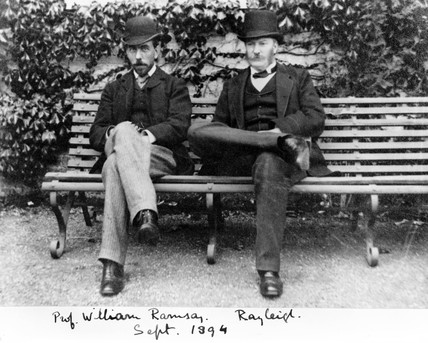
William-Ramsay-Lord-Rayleigh

Sir William Ramsay & Lord Rayleigh

John William Strutt, Lord Rayleigh, first embarked on mostly mathematical studies. But he soon turned to the broader field of physics. He and Sir William Ramsay independently came to the same conclusion: that there must be an undiscovered gas in our atmosphere. Though the two maintained separate laboratories, they worked together to identify the gas, communicating almost daily. They announced the discovery of argon at the 1894 meeting of the British Association.

The Smithsonian Institution produced an edition of Argon, a New Constituent of the Atmosphere in 1896, marking the first time it had appeared in a separate publication.

Come prima meglio di prima (1933)

Como prima meglio di prima-Luigi Pirandello

‘Como prima meglio di prima’

Luigi Pirandello was awarded the 1934 Nobel Prize in literature for his “bold and brilliant renovation of the drama and the stage.” He wrote multiple novels, hundreds of short stories, and over forty plays. Pirandello’s dramas are considered forerunners to the Theater of the Absurd.

Come prima, meglio di prima was written in 1919 and was performed in March of the following year at Venice’s Teatro Goldoni. Pirandello drew inspiration for the comedy from his novel Veglia and his collection In silenzio. This third edition is signed by the author in the half-title page.

The Transistor: Selected Reference Material on Characteristics and Applications (1951)

Transistor-William-Shockley

‘The Transistor’

The week of September 17, 1951, Bell Telephone Laboratories hosted a symposium on transistors. According to the foreward, The Transistor “covers the same ground and supplements the talks” given during the symposium. William Shockley, who would go on to win the Nobel Prize in Physics in 1956, contributed two articles and co-authored two more. Shockley was the co-inventor of the transistor, and his 1950 publication “Electrons and Holes in Semiconductors” was the first book on transistor electronics. That piece is previewed here, in “Holes and Electrons,” reprinted from Physics Today (vol 3, October 1950).

Shockley’s second major contribution to this manual is “The Theory of p-n Junctions in Semi-Conductors and p-n Junction Transistors.” This exploration would lay the groundwork for the development of virtually all semiconductor electronic devices, from integrated circuits to LED’s and solar cells.

Some Personal Notes on the Search for the Neutron (1962)

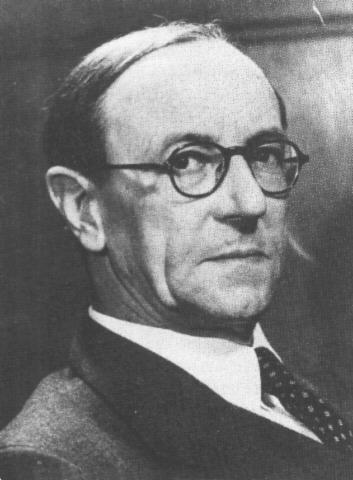
James-Chadwick-Nobel-Laureate

Sir James Chadwick

Sir James Chadwick was awarded the 1935 Nobel Prize in physics for his 1932 discovery of the neutron. He was also the head of the British scientists who worked on the Manhattan Project during World War II. Chadwick had intended to study mathematics, but the registrar at Victoria University of Manchester made a mistake and enrolled Chadwick as a physics major. He would soon become fascinated with the work of legendary scientist Ernest Rutherford and build on Rutherford’s discoveries.

Over the course of his career, Chadwick grew increasingly uncomfortable with the shift toward Big Science, and he retired in 1959. Some Personal Notes on the Search for the Neutron was published a few years after Chadwick’s retirement and is considered a fragmentary scientific autobiography.Our edition, an offprint from Ithaca, is the first to appear separately and includes pen emendations made by Chadwick.

Many collectors build their personal libraries around the extraordinary work of Nobel laureates. If you collect the work of Nobel laureates, we’d be happy to help you build your collection. Please contact us if you’re searching for specific items or laureates.

Share

Chapbooks: Short Books with Long History

Scholars debate over the etymology of the term “chapbook.” Some argue that “chap” is derived from “cheap,” surely an accurate description of chapbooks, since they were indeed cheap little publications. But the more widely accepted explanation is that “chap” comes from the Old English “céap,” meaning “barter” or “deal.” Peddlers came to be known as chaps, and they were the primary purveyors of chapbooks. Whatever the origin of their name, chapbooks became a vital tool for dissemination of information and promotion of literacy. As publishing and readers’ tastes evolved, chapbooks also provided an ideal means of addressing an increased demand for children’s literature.

Since the Middle Ages, traveling peddlers provided many necessary wares to rural communities–and that included the news. They would often regale their customers with the latest in politics, entertainment, and gossip. Then in 1693, England repealed the Act of 1662, which had limited the number of Master Printers allowed in the country. The number of printers exploded. Meanwhile, charity schools emerged, making education and literacy more accessible to the poor. The demand for cheaply printed reading materials drastically increased as a result, and all the new printers were happy to supply their needs.

By 1700, chapmen regularly carried small books–usually about the size of a waistcoat pocket–on virtually every topic imaginable. The books were generally coverless, and their illustrations were made of recycled (and irrelevant) woodcuts from other publications. In the absence of copyright laws, printers would steal illustrations or even large chunks of text from other chapbooks and reproduce them in their own editions. Early chapbooks weren’t even cut; the purchaser would cut apart the pages and either pin or stitch the book together to read.

Dr Watts-Divine SongsChapbooks grew into an incredibly powerful tool for disseminating new ideas. When Thomas Paine published The Rights of Man, he suggested that the second edition be made available in chapbook form. The book went on to sell over two million copies, an incredible feat in those days, when the average publishing run might be only a few hundred or thousand copies. Religious organizations used the form to publish religious tracts, nicknamed “godlinesses” or “Sunday schools.” There were even chapbooks for the chapmen themselves, containing information about different towns, dates for local fairs, and road maps.

The Industrial Revolution, however, brought a revolution in the printed word as well. People flocked to the cities, reducing chapbooks’ role in news delivery. Newspapers had also become cheaper to produce, so they were no longer relegated to the upper class. And chapbooks’ days seemed numbered when public solicitation was outlawed and peddlers could no longer distribute them. Meanwhile people’s tastes were changing. As the decades of the 1800’s passed, the novel was emerging as a new, preferred form, and in terms of “cheap” literature, chapbooks eventually gave way to “penny dreadfuls,” the dime novel, and other such low-brow forms.

But changing reading habits and higher literacy rates also meant an increased demand for children’s literature. From around 1780, most booksellers offered a variety of children’s chapbooks, which included ABC’s, jokes, riddles, stories, and religious materials like prayers and catechism. Thanks to improved printing techniques, this generation of chapbooks was printed with relevant illustrations and attached colored paper or card wrappers.

Juvenile-Pastimes-Baseball-Chapbook

Though we think of chapbooks as a distinctly British form, they emerged in various forms around the world. Harry B. Weiss writes in A Book about Chapbooks, “The contents of chapbooks, the world over, fall readily into certain classes and many were the borrowings, with of course, adaptations and changes to suit particular countries.” And despite their variant forms and culturally specific content, chapbooks consistently served as a democratizing force in the dissemination of ideas.

Collectors may build entire collections around chapbooks, or they may find that certain chapbooks fit in well with their collections. For example, the 1849 edition of Juvenile Pastimes includes a rare early pictorial depiction of baseball, making it an ideal addition to a collection of baseball books. Collectors of erotica may enjoy Dumb Dora: Rod Gets Taken Again, an adult chapbook with suggestive, but not pornographic, illustrations. The variety of chapbooks means there’s a little book for everyone!

This month’s select acquisitions are a short list of delightful chapbooks. Please peruse them and contact us if you have any inquiries. As cataloguing chapbooks is quite the endeavor, we’ve also put together an article about the resources used to catalogue the items on the list, which includes our bibliographic sources at the end.

Share

Chapbooks: A [Short] List for September

Chapbooks.

A meanly produced publishing phenomenon, Carter & Barker, in the 8th ABC, describe them thusly: “Small pamphlets of popular, sensational, juvenile, moral or educational character, originally distributed by chapmen or hawkers, not by booksellers.”

If one dips into Neuberg’s CHAPBOOK BIBLIOGRAPHY, we find this genre had “by 1700, [become] an important part of the [chapman’s] stock-in-trade … whose varied subject matter included devils, angels, scoundrels, heroes, love, hate, fairy tales, religion, fables, shipwreck, executions, prophecies and fortune telling. …  During the eighteenth century chapbooks formed the main reading matter for the poor.”  Though around for centuries, the chapbook, as a viable publishing genre, had mostly expired towards the end of the 19th C, except as Carter noted, “as a conscious archaism.”

Despite oft being an object of acquisition by collectors, one can still find these little volumes floating about, and offered at [comparatively] modest prices such that building a pleasing & extensive collection of these modest works is not beyond the means of the ‘average’ person [however such a term may be defined].

Here then is Tavistock Books’ list for September.  A small cache of 30 chapbooks, primarily for children, primarly American, primarily 19th Century.  Prices range from a modest $45 to a decidely robust $2000, for one that will be found in David Block’s ground breaking work, BASEBALL BEFORE WE KNEW IT.  Many titles offered are the only copy on the market; one or two not found on OCLC.

Should you have queries regarding any of this material, or other listings you may find on our site, please contact us.  We thank you for your attention, and we hope you find something of interest while browsing these offerings.

REFERENCES CITED

Cataloguing chapbooks is a task both challenging and engaging, as evidenced by the list of sources used to catalogue this month’s list of select acquisitions.

American Imprints AMERICAN BIBLIOGRAPHY. A Preliminary Checklist. 1801 – 1846.  NY [et al]: Scarecrow Pres, 1958-1997.

Arndt & Eck The FIRST CENTURY Of GERMAN LANGUAGE PRINTING In The UNITED STATES Of AMERICA.  Göttingen: 1989.

BAL.  Blanck, Jacob [et al].  BIBLIOGRAPHY Of AMERICAN LITERATURE.  New Haven: 1955 – 1991.

Block, David.  BASEBALL BEFORE WE KNEW IT.  A Search for the Roots of the Game.  Lincoln: (2005).

Cappon & Brown NEW MARKET, VIRGINIA, IMPRINTS 1806 – 1876.  A Check-list.  Charlottesville: 1942.

Church.  Cole, George Watson – Compiler.  A CATALOGUE Of BOOKS Relating to The Discovery and Early History of North and South America Forming a Part of the Library of E. D. Church.  NY: Peter Smith, 1951.

Cropper, Percy J.  The NOTTINGHAMSHIRE PRINTED CHAP-BOOKS, with Notices of Their Printers and Vendors. 1892. 

Davis, Roger.  KENDREW Of YORK and His Chapbooks for Children.  Elmete Press, 1988.

ESTC ENGLISH SHORT TITLE CATALOGUE.  http://estc.bl.uk

Gumuchian Les LIVRES De L’ENFANCE du XVe au XIXe Siècle.  London: Holland Press, 1985.

Hamilton, Sinclair.  EARLY AMERICAN BOOK ILLUSTRATORS And WOOD ENGRAVERS. 1670-1870.  Princeton: 1968.

Heartman, Charles F.  The NEW ENGLAND PRIMER Issued Prior to 1830.  1922.

[-].  AMERICAN PRIMERS. INDIAN PRIMERS. ROYAL PRIMERS.  And Thirty-Seven Other Types of non-New-England Primers Issued Prior to 1830.  Highland Park: 1935.

NCBEL The NEW CAMBRIDGE BIBLIOGRAPHY Of ENGLISH LITERATURE.  Cambridge: 1969 – 1977.

NUC NATIONAL UNION CATALOGUE.  Pre-1956 Imprints.

Opie, Iona & Peter.  The OXFORD DICTIONARY Of NURSERY RHYMES.  Oxford: (1951).

Osborne.  The OSBORNE COLLECTION Of EARLY CHILDREN’S BOOKS 1566-1910.  Toronto: TPL, 1975.

Rosenbach, A.S.W.  EARLY AMERICAN CHILDREN’S BOOKS.  NY: Dover, 1971.

Spencer A CATALOGUE Of The SPENCER COLLECTION Of EARLY CHILDREN’S BOOK And CHAPBOOKS.  Preston: 1967.

Weiss, Harry B.  SAMUEL WOOD & SONS. Early New York Publishers of Children’s Books.  NY: 1942.

Welch, d’Alté A.  A BIBLIOGRAPHY Of AMERICAN CHILDREN’S BOOKS Printed Prior to 1821.  Worcester: AAS, 1972.

Wust.  THREE HUNDRED YEARS Of GERMAN IMMIGRANTS In NORTH AMERICA 1683-1983  1983.


Share

Rare Books about Baseball Are a Home Run!

The first book devoted exclusively to the sport of baseball was The Base Ball Player’s Pocket Companion, published in Boston in 1859. Since then America’s love of baseball has continued to grow, establishing the sport as America’s pastime. Now baseball is also the most popular subject among collectors of rare books in sports. Because of the breadth of baseball literature, most collectors of rare baseball books narrow their focus to a specific aspect of the literature or sport.

Early History

The game of baseball has evolved considerably since its beginnings. Consider, for instance, that there were originally two sets of rules for baseball: one from Boston, and the other from New York. Thus books from baseball’s early history are often quite fascinating, detailing a sport that varies widely from the one we know today.

Beadle's Dime Base-Ball Player

Beadle’s Dime Base-Ball Player


Spalding's Base Ball Guide

Spalding’s Base Ball Guide

Hidden Histories

The All-American Girls Professional Baseball League began during World War II and operated from 1943 to 1954. The history of this league and its players don’t receive much attention today, but the league was quite popular at the time. Meanwhile, both the Negro Leagues and African-American players were frequently overlooked; few books exist about either before the 1970’s. One notable exception is Sol White’s Official Base Ball Guide (1907), sometimes called the “holy grail” of baseball book collecting because it’s so scarce. It’s both challenging and engaging to build a collection around these hidden histories in baseball.

“Get that Nigger off the Field!”

Voices from the Great Black Baseball Leagues

Voices from the Great Black Baseball Leagues

Regional Leagues

As baseball’s popularity spread, smaller leagues began popping up all around the country. Although these leagues may not have boasted star players, they offered one means of local entertainment. Teams were sometimes formed around occupation or work location, as illustrated by the photograph of the New Almaden Quicksilver Mine Baseball Team.

New Almaden Quicksilver Mine Baseball Team

New Almaden Quicksilver Mine Baseball Team

Official Baseball Program-Pacific Coast League, 1934 Season

Official Baseball Program-Pacific Coast League, 1934 Season

Middle Atlantic League 25th Anniversary Souvenir Book

Middle Atlantic League 25th Anniversary Souvenir Boo

Biographies and Autobiographies

In the early days, baseball players were frequently illiterate. Their autobiographies were therefore frequently ghostwritten. Both autobiographies and biographies were also “cleaned up”; they tended to be much more inaccurate than modern biographies, sanitizing the players’ lives to make them more acceptable to middle-class readers.

Mickey Mantle of the Yankees

Mickey Mantle of the Yankees

Baseball Fiction

Likely the first novel primarily devoted to baseball was Noel Brooks’ Our Base Ball Club (1884). The genre has grown considerably. It includes dime novels, comic books, and modern first editions. Some collectors focus on a particular series, while others explore the limits of baseball fiction and collect a wider variety of examples.

The Big League

The Big League


Double Curve Dan the Pitcher Detective

Double Curve Dan the Pitcher Detective

The Pick-Up Nine

The Pick-Up Nine

How-To Guides

With the establishment of official rules and leagues, the art of playing baseball became much more standardized. That certainly didn’t mean that opinions never differed on the right form and approach for skills like pitching, batting, and fielding.

Spalding's Baseball for Beginners

Spalding’s Baseball for Beginners


The Science of Baseball

The Science of Baseball

Individual Teams

If you love to “root for the home team,” it makes sense to build your baseball collection around them. You’ll likely find a wealth of programs, statistics, and score cards. Some items, such as the New York Giants’ Press Radio TV from 1956, include a list of players, schedules, and statistics. A collection built around a single baseball team also encompasses biographies and memoirs from team players.

Press Radio 1956-Giants

Press Radio 1956-Giants

New York Giants 1954 Training Season

New York Giants 1954 Training Season

Bibliographies

Regardless of your area of expertise, it’s important to learn all you can about the rare books of baseball, and about your specialization. And that means one thing: getting the right bibliography! A terrific place to start is David Block’s Baseball Before We Knew It: A Search for the Roots of the Game (1995). In addition to offering a great print history of the game, it also has a bibliography of pre-1850 books that treat baseball in some way. For baseball fiction, you’ll want Andy McCue’s Baseball by the Books (1991). And a more general bibliography is Myron Smith’s Baseball: A Comprehensive Bibliography (1986). Smith has since published supplements to include later material.


Share

A Brief History of True Crime Literature

True crime literature is unique because, in the words of Joyce Carol Oates, the genre has “always been enormously popular among readers…[and] appeals to the highly educated as well as the barely educated, to women and men equally.” The popularity of true crime literature extends to the rare book world.

Daniel Defoe

Daniel Defoe

The literature of true crime dates all the way back to the Elizabethan era, but the genre didn’t enter the mainstream until the late seventeenth and early eighteenth centuries. It its earliest form, true crime literature included biographies of prisoners before and after executions. In some cases, these accounts were factual, but they were just as often completely fictionalized–and almost always sensationalized. These gave rise to fictional criminal autobiographies, notably The Fortunes and Misfortunes of the Famous Moll Flanders (1721) by Daniel Defoe. Domestic dramas such as George Lillo’s The London Merchant; or, The History of George Barnard (1731).

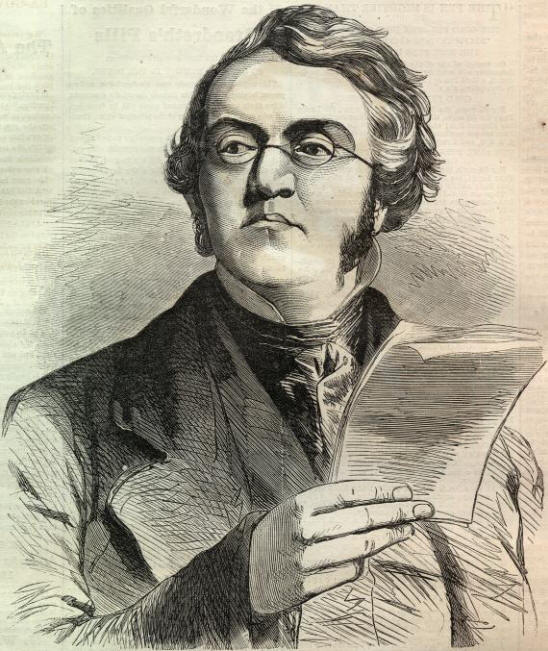
William Makepeace Thackeray

William Makepeace Thackeray

The second half of the eighteenth century saw a sharp decline in crime literature, but the genre reasserted itself in the nineteenth century. Factual reporting, in the style of Francis Kirkman’s The Counterfeit Lady Revealed (1673), again came into vogue. The Newgate Calendar published criminal biographies starting in 1773, and it was periodically published before finally being compiled in 1841. In the United States, the National Police Gazette was launched in 1845 and remains in publication today. Meanwhile leading literary figures also began to address issues of crime and punishment. Charles Dickens included studies of Newgate and the Old Bailey in his Sketches by Boz, and William Makepeace Thackeray wrote “Going to See a Man Hanged” (1840).

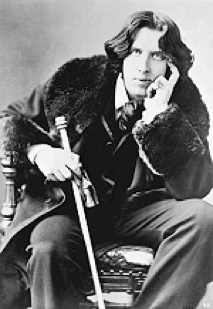
Perhaps the most influential was “On Murder Considered as One of the Fine Arts,” two essays Thomas de Quincey published in Blackwood’s Magazine (1827 and 1839). De Quincey explored the Radcliffe murders of 1811, which were presumably committed by mariner John Williams. He delved into the psychology of the murderer, victims, and witnesses in a way that no other author had attempted before. Oscar Wilde followed suit in “Pen, Pencil, and Poison” in 1889, when he argued that Thomas Griffith’s creativity improved when he began taking out life insurance policies on relatives, whom he then poisoned with strychnine. These seminal works paved the way for modern works like Truman Capote’s In Cold Blood (1966).

Crime in fiction had taken a turn for the low brow; starting in the 1820’s the so-called “Newgate novel” romanticized the lives of criminals, depicting highwaymen as heroes–even when their exploits ended at the gallows. Thackeray would parody Newgate novels in several of his works and publicly attach their authors, but the works still flourished. GWM Reynolds, for example, published Mysteries of London from 1845 to 1848, with sequels to 1856. The books, which sold for one cent, came to be known as “penny dreadfuls.”

Sherlock Holmes

The iconic Sherlock Holmes

The 1830’s saw the development of the modern police force–with detectives to investigate crime and constables to enforce order–in both England and the United States. For this we can thank, among others, author and magistrate Henry Fielding. Soon these men of the law popped up as characters in fiction: Inspector Bucket in Dickens’ Bleak House (1853) and Sergeant Cuff in Collins’ The Moonstone (1868), respectively based on real-life Scotland Yard detectives Charles Field and Jack Whicher. Poe invented a more complex detective in his C. Auguste Dupin character, and Sir Arthur Conan Doyle debuted Sherlock Holmes in 1887. Four years later the detective began making regular appearances in Doyle’s Strand Magazine.

In the last century there has been a markedly decreased overlap of true crime and literature. But the genre of true crime writing remains quite popular, and many rare book collectors build entire collections around the genre. There are plenty of interesting items for collectors of true crime literature and ephemera.

The Confessions of Jesse Strang

Originally from Putnam County, New York, Jesse Strang deserted his wife when he suspected that she’d been unfaithful. After a stint in Ohio, Strang made his way to western New York–where he faked his own death in the spring of 1826. Strang ended up in Albany, where he used the alias of “Joseph Orton.” He saw Elsie Whipple in an Albany bar and was immediately interested in the spirited young woman. Elsie was the daughter of a wealthy family in Albany, and Strang managed to get hired as a handyman at the family’s estate, Cherry Hill–where Elsie lived with her husband, John. But that didn’t stop Strang from pursuing Elsie, and the two were soon exchanging love letters with the assistance of other members of the household.

Cherry Hill-Jesse Strang

Cherry Hill as it looked at the time of the murder

Elsie, known for being moody and tempestuous, decided that the lovers should kill John and run away together. Strang was reluctant, but ultimately supplied Elsie with arsenic to poison John. But she didn’t administer enough poison, and John merely suffered an upset stomach. The lovers clearly needed a more foolproof plan, and Elsie urged Strang to shoot John. Eventually he acquiesced, climbing onto the roof and shooting John through a window into the couple’s quarters. Elsie had removed the curtain to give Strang a clear shot. Strang rushed to a local store to give himself an alibi, then returned and even helped the doctor remove the bullet from John’s body. But the police ruled that Strang had enough time to commit the murder and make it to the store, so he was arrested. He immediately confessed and implicated Elsie.

Strang desperately asked his lawyer to plant papers at Cherry Hill implicating Elsie as the mastermind of the plot, arguing that Elsie would receive a lighter sentence because she was a woman. His lawyer refused, but Strang was correct. While he was convicted of murder and sentenced to death by hanging, Elsie was found not guilty on all charges. Between 30,000 and 40,000 people came to watch Strang’s execution on August 24, 1827. Among the crowd were peddlers hawking pamphlets containing Strang’s confession. Strang himself promoted the pamphlet from the scaffold, saying, “This contains a confession of the great transaction for which I am about to die, and every single word that it contains, tot he best of my knowledge, is true; if there is a single word in i t that is not true, it has been inserted by mistake, not by design.” Strang’s hanging was botched, and his neck did not break. He hung for half an hour before suffocating. It was the last hanging in Albany.

Official Report of the Trial of Laura D Fair

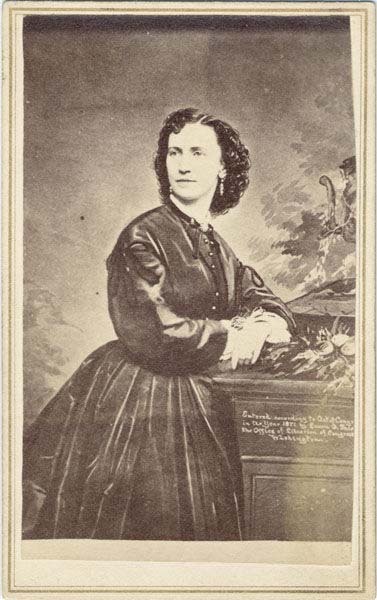
On November 3, 1870, Laura D Fair followed Alexander Parker Crittendon onto a ferry, where he was meeting his family. Fair shot Crittendon in the chest with a pepperbox pistol and fled to the ship’s saloon, where she immediately confessed to her crime. Fair believed that she was defending her own name; Crittendon had represented himself as single when he began courting Fair, and when she discovered that he was married, Crittendon promised to divorce his wife. When he failed to follow through, Fair decided to exact revenge.

Laura D Fair

Laura Fair

The ensuing trial was a national sensation. Fair’s defense argued that Fair had experienced delayed menstruation (in part because she assumed a masculine role by running her own business), which resulted in temporary insanity. Suffragists like Elizabeth Cady Stanton and Susan B Anthony took up the cause, noting that “female hysteria” had long been used to subjugate women to men. Prosecutors also focused on gender, portraying Fair as a man-hungry murderess whose temporary insanity could also have been caused by sexual excess. Fair was convicted of murder and sentenced to death, but the trial was overturned because evidence had been incorrectly admitted. After a second trial, Fair was acquitted.

The case remained in the headlines intermittently from June 1871 to January 1873. Mark Twain and his collaborator Charles Dudley Warner would incorporate the case into Twain’s first novel, The Gilded Age: A Tale of To-Day, published in December 1873: Laura Hawkins bears a striking similarity to Laura Fair. Twain also incorporated another famous trial; the Senate investigation of Senator Dilworthy for vote buying parallels the real trial of Kansas Senator Samuel C Pomeroy. Both critics and historians agree that these sensational elements greatly contributed to the novel’s success.

Ruth Snyder’s Own True Story

Ruth Snyder

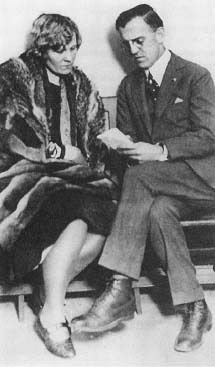
Snyder and Judd Gray conferring during a break in the trial

In 1925, housewife Ruth Brown Snyder began an affair with married corset salesman Henry Judd Gray. She soon began planning her husband, Albert’s murder, with only reluctant support from Judd Gray. Snyder reportedly made seven attempts to kill her husband. Finally, she and Judd Gray garrotted Albert, shoved chloroform soaked rags up his nose, and staged a burglary. Their ploy fell apart under only the slightest scrutiny, and they were both convicted of murder and sentenced to death. Ruth would be the first woman executed at Sing Sing since 1899, and the first ever to be executed by electrocution.

The murder trial was covered by a number of prominent journalists, but only one was granted an interview: Jack Lait, who would provide Ruth the typewriter she used to record her memoir. Ruth Snyder’s Own True Story (1927) proved a poignant and candid account of Ruth’s experience–and a useful bit of propaganda for Lait. In the preface, he writes that Ruth “bristles with courage, she has poise, assurance, no end of intelligence…she loves like fire and hates like TNT.” (With such a portrayal, it’s perhaps no wonder that Ruth received 107 marriage proposals before her execution!) At Ruth’s execution, Chicago Tribune photographer Tom Howard captured her final moment with a miniature camera strapped to his ankle. The image, now famous, was emblazoned on the front page of the New York Daily News the next day.

Our interest in rare books about true crime shows no evidence of fading, especially since the genre so frequently intersects with the worlds of history and literature. How has true crime crept into your book collection?

Share

Meet Dr. Erin Blake, Curator of Art & Special Collections at the Folger!

Erin-Blake-Folger-Shakespeare-Library

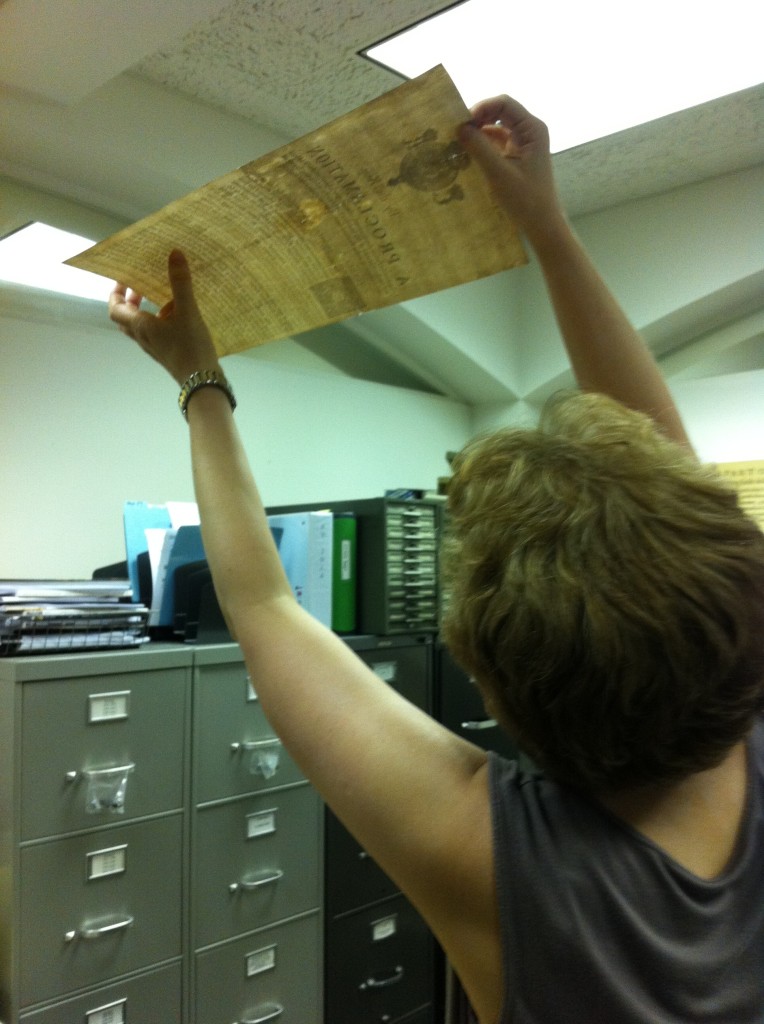
Dr. Blake examines the backside of a broadside, where we often find clues about the document that we can’t glean from the text. This item, which the Folger acquired from Tavistock Books, is the Edinburg edition of the “Regicides” broadside (1660), wherein Charles II commands those involved in the death of Charles I to present themselves, “being deeply guilty of that detestable and bloody Treason.”

This week we’re pleased to welcome our friend and colleague from Rare Book School, Dr. Erin Blake. Dr. Blake is the Curator of Art and Special Collections at the Folger Shakespeare Library in Washington, DC. She was kind enough to sit down with us to talk about her journey to the Folger and her evolving role as the curator of “anything that’s not a book or a manuscript.”

TavBooks: Tell us a bit about your career path. What drew you to art history? And what brought you to the Folger?
Dr. Blake: I started out as a history major and discovered that I really liked studying objects as part of history, as evidence. And art history is where you actually get to delve into that, so I did a double major in history in art history. When I got my PhD, I didn’t want to do that typical art history thing where you pick an artist no one else has “done” before. Instead I ended up studying topographical views designed for the zograscope, which was a viewing device that gained popularity around 1750 in England. You look through a lens and mirror arrangement to get a three-dimensional view of a scene.

Zograscope

This colored print, from the University of Exeter, shows a zograscope in use.

Although these images were often topographical, they weren’t really maps. Nor were they really art. But when the British Museum split into the British Museum and the British Library, the zograscope images went to the map library. The art people didn’t study them because they weren’t art, and the map people didn’t study them because they weren’t maps. So here I was, this art person looking at pictures in a map library!

It was only a matter of time before I began exploring the world of special collections libraries. I always knew that I’d wanted to work in a library, rather than a museum, and that I didn’t want to be an art history professor. When the Folger advertised for a curator, it seemed like the perfect opportunity.

TavBooks: Your original title was Curator of Art, and that has been expanded to include special collections. What are your responsibilities now? And how has your position evolved since you began?
Dr. Blake: My job here is to make the items in our collection available to scholars as primary sources and to acquire new items that complement the research needs of the collection. Our interests in that regard are unusual for art. Museums want rare, pristine, first state prints, but we’d rather have the more common ones. The version of an item most seen and used by people is of most use to researchers. When Mr. and Mrs. Folger were building their collection, they were also interested in things that had been written in, written on, things that had been used. When people come to study the history of readership, that record helps us determine what was important to people as they looked at books and prints.

When I started at the Folger, I was in charge of art. The objective definition of art is “anything that isn’t a book or manuscript.” And special collections is lots of stuff that isn’t really art by other people’s definition. Here, for instance, that includes ephemera like playbills, scrapbooks, and even strange objects.

TavBooks: What’s your favorite item in the collection? Have you discovered anything that inspired you to do more in-depth research for yourself?
Dr. Blake: It’s interesting to explore the degree to which there are fetish objects associated with Shakespeare. For example, there are items made out of Shakespeare’s mulberry tree. The tree grew in his garden, and he supposedly planted it. During the eighteenth century, people would make pilgrimages to Shakespeare’s home. They’d take slips of the tree and use them to grow their own at home.

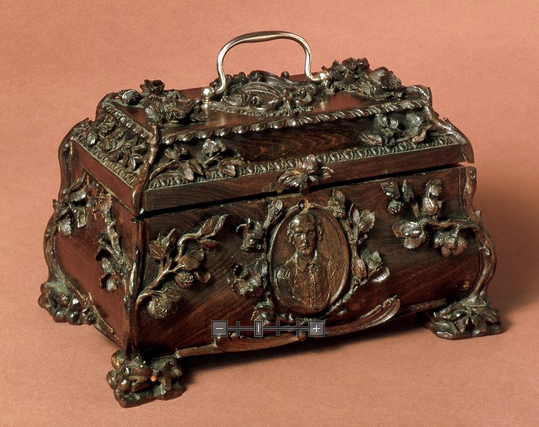
This tea caddy, wrongly attributed to Thomas Sharp, bears Shakespeare's bust and coat of arms.

A 1905 auction catalogue featured a photograph of this “tea-caddy made from the mulberry tree planted by Shakespeare” and called it “an undoubted genuine relic, having Sharp’s own stamp on it.” Thomas Sharp was the most recognized maker of mulberry souvenirs, stamping his products with “Shakespeare’s wood.” This box has no stamp, but rather a place where a stamp appears to have been scraped away.

Eventually the man who owned the property grew tired of the constant stream of visitors, so he cut down the tree and sold it for firewood. But the people who bought it didn’t use it for firewood. Instead, it was made into a wide variety of souvenirs and talismans, such as bookmarks and figurines. We obviously can’t definitively determine whether each of these items actually originated from the tree in Shakespeare’s yard–at least not without destroying the objects themselves–but what’s important is that the people believed these items were associated with Shakespeare.

But my favorite items are the unexpected ones. One is a book of caricatures by the artist Sem. Because of the way the Folger collection was unpacked in 1932, items were sorted into books and manuscripts, or prints and drawings. This volume is more like a scrapbook. The pages have really detailed watercolor caricatures of people from the theater scene, along with handwriting samples from each person, often letters written to the collector who created the book. There’s also a Shakespeare quote with each character. The book was marked “A.L.S.” — autograph letters, signed — and placed with the manuscripts because of the handwriting samples, so it ended up being catalogued as about 60 separate manuscripts. People never knew significant art was there, but this year a summer intern is making preliminary records for the drawings.

TavBooks: How has our perception of art changed since Shakespeare’s time?
Dr. Blake: The status of artists has changed quite a bit, a shift which really started around Shakespeare’s time. There was a movement to elevate artists to the status of intellectuals; art was not a craft, and not a trade. But for a long time art sat astride two worlds. The people who did theater scenery might also show at the Royal Academy.

For some time, book illustrators were excluded. Illustrations were not seen as fine art. But we find a whole lot of primary source information in book illustrations. But there’s been a shift in the past ten to fifteen years. Researchers used to come to the Folger and say, “I’ve written a book. Now I need illustrations to go with it.” Now it’s the other way around. They say, “I’m writing a book, and I need to examine the visual evidence.” We’ve learned that evidence can also be visual, not just verbal.

Watercolor-Shakespeare

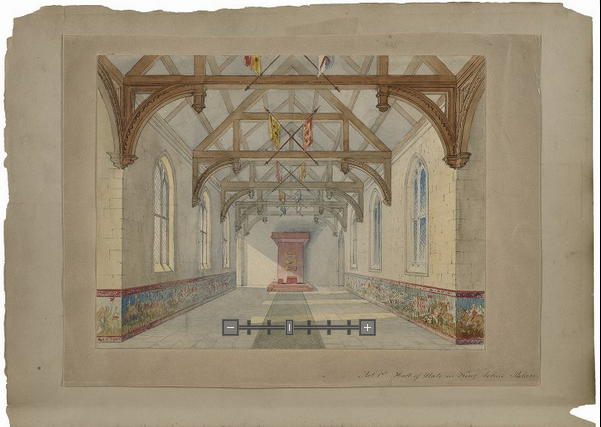
The collection includes many drawings and sketches of costumes and scenery, such as this one. Charles Hamilton Smith and his daughter, Emma drew these watercolor drawings and tracings of theatrical costumes, banners, shields, and arms especially for Charles Kean’s productions at the Princess and Haymarket theaters.

TavBooks: What do you love about working at the Folger Shakespeare Library?
Dr. Blake: One of the great things about working here is the flexibility for people to do things they particularly enjoy. I’ve become much more involved in descriptive cataloguing. I’ve been helping to develop a new edition of guidelines for libraries to catalogue pictures. The manual, Descriptive Cataloguing of Rare Materials (Graphics), will be published later this year.

TavBooks: Why are you particularly interested in descriptive cataloguing?
Dr. Blake: That goes back to why I was so interested in working in a library. When I was doing dissertation research in the 1990s, web-based online catalogues were brand new. I was doing research at Northwestern when they got their new online system, and I noticed that one of the tabs on the search results was “Staff View.” I wondered what that was, so I clicked on it. It was an encoded version of all the information displayed elsewhere in the record. All this information was hidden from scholars, but it meant much more sophisticated searching strategies for those who knew.

I’ve always been interested in systems, how they’re constructed, and how they work. What I enjoyed was building a database, seeing how things broke down, and figuring out how to make the data accessible to the people who needed to use it. The methodology of descriptive cataloguing certainly fits into that. And I wanted to help create a system for something that’s often perceived as subjective.

TavBooks: You’ve also done some interesting work in the field of preservation. Tell us a little bit about your discoveries.
Dr. Blake: We received an NEH grant for developing a sustainable preservation environment with the help of the Image Permanence Institute. The long-received wisdom was that the best way to maintain your library was a straight-line temperature and relative humidity: 70 degrees Fahrenheit and 50% RH. It turns out that this guideline, which had long been the convention, was actually a provisional guideline that wasn’t meant to be widely applied. In most cases cooler and dryer is actually better. But there’s also a greater range of acceptable conditions. As an analogy, think of flexing a piece of cardboard: it has quite a bit of give; it’s only if it’s bent past a certain point that it gets permanently creased.

For libraries, maintaining an absolute flat line at 70 degrees and 50% RH is expensive. It’s also damaging to the environment. So our goal was to define more flexible parameters and make preservation more sustainable. If we’re preserving a collection, but destroying the environment, then why bother? Ultimately we upgraded key air handlers to maintain a cooler, dryer environment while consuming less energy. We also now shut off air handlers for underground spaces at night; the conditions are relatively stable, and books don’t require constant air circulation. We did face a problem with humidity in the summer, but have figured out how to handle that.

TavBooks: You’re responsible for items that are made of basically everything except paper–and probably some paper, too. What preservation challenges do you face as a result?
Dr. Blake: The most difficult things are objects that aren’t entirely one material or another, but that are made of multiple materials. A painting on wood in a metal frame…these materials expand and contract at different rates, the frame could rust, etc.

TavBooks: As a curator, you’re responsible for deciding the direction and scope of an extensive collection. Individual book collectors are also curators, albeit on a smaller scale. What advice would you offer them?
Dr. Blake: Be sure to collect something that interests you. Don’t collect because you think it will be worth money in the future. And come up with a clear theme for your collection–and stick to it! You build a strong collection around a core idea. There’s a phrase in libraries, “build to strength.” We don’t want a few random things, but the best collection of X, whatever X may be. Consider your collection as something you’re building for the future, and that you’re telling a story with your collection. What you choose to collect illustrates what’s important to you and to someone of your era.

It’s also important to document your collection and why it’s particularly interesting to you. Record when and where you got each object, and why you chose to acquire it. Otherwise, that object dies because its story isn’t being told. Ask yourself, “What else can this object tell us about people in the 21st century?”

A terrific example of a large and meaningful collection is the Babette Craven Theatrical Memorabilia collection. Mrs. Craven collected objects across all media from late eighteenth-century to early nineteenth-century England. The way she collected reflected her intention that the collection would be a legacy. It included not only prints and playbills, but also figurines and other memorabilia. Most institutions wanted only one category of items, rather than the collection as a whole. But we saw the value in the whole body of work, and our enthusiasm for the collection has inspired others to build similar legacies.

Craven-Collection-Folger-Shakespeare-Library

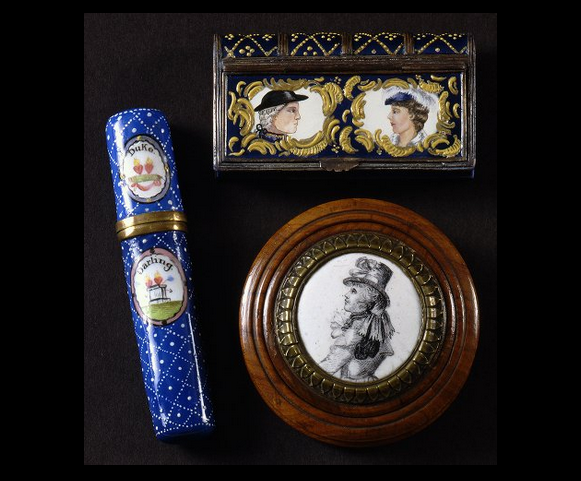
Three items from the Craven collection: Bilston enamel bodkin case of Dorothy Jordan and the Duke of Clarence (ca. 1795) (verso); enamel patch box of Dorothy Jordan and the Duke of Clarence( late 18th century); turned wooden box with a Bilston enamel portrait medallion of Dorothy Jordan(ca. 1790).

TavBooks: It seems like eventually the Folger would own a pretty comprehensive and complete collection. Has it become more difficult to find and acquire new, unique objects over time?
Dr. Blake: It seems that there’s always some private collection that’s been unexplored and no one’s paid attention to. So things are constantly coming to the market. We’re sometimes amazed that they haven’t been discovered before, but no one was looking for it!

We thank Dr. Blake for her time! If you’re in Washington,DC we also encourage you to stop by the Folger Shakespeare Library. Currently on exhibit is “A Book behind Bars: The Robben Island Shakespeare.” Nelson Mandela served eighteen years as a political prisoner at Robben Island. A fellow prisoner smuggled in a copy of the complete works of Shakespeare, and prisoners–including Mandela–signed and dated their favorite passages. The book is on display along with a series of sketches Mandela made reflecting his life in prison. 

Share

Are You Ready for the Pasadena Antiquarian Book Fair?

Pasadena-International-Book-Fair-Bustamante-ShowsPhoto: Bustamante Shows

On August 10 and 11, over 60 exhibitors will come together at the Pasadena Center for the 14th Annual Pasadena International Antiquarian Book, Print, Photo, and Paper Fair. Visitors will find a wide variety of antiquarian, rare and modern first edition books, prints, posters, vintage photographs, and a variety of unique ephemera. It’s an excellent opportunity to experience an incredible number of fine collections.

We’ll be among the exhibitors and would love to see you at Booth #208! The show, organized by Bustamante Shows, is always a terrific event. Sheila Bustamante, who oversees the Pasadena Fair, was kind enough to share her perspective on collecting and explain why this fair is exceptional.

TavBooks: How did you get involved in organizing these antiquarian book shows? Are you a collector yourself?
Bustamante: Throughout the years in producing the antique shows, we had a couple of participating book dealers. In their occasional conversations with Mr. Bustamante, they would always encourage him to produce a book fair, but the suggestion was never taken too seriously. Our schedule of shows was pretty full with over 39 shows per year in California, Nevada, and Arizona. It wasn’t until fifteen years ago that Walter Larsen approached Mr. Bustamante and urged him to produce a book fair in Pasadena. The time was right, and our schedule of annual shows had been reduced sufficiently to allow us to take on the endeavor.

And yes, I’m a collector of books, American brilliant cut glass, art, and many other antique items.

TavBooks:Many of the dealers who’ll attend the Pasadena fair are from California and neighboring states, but one dealer is coming all the way from New York. What’s unique about the rare book community in Pasadena? Why are dealers so interested in attending this fair?
Bustamante: Pasadena has a lot of wonderful history. It was a “sleepy” town for a long time. When we first started producing antique shows there, the town would close up at 9 o’clock at night. Our shows didn’t close until that time, and dealers would not have a place to grab a bite to eat or relax afterward, except back in their hotel rooms. The residents of Pasadena have always been serious about preserving their history. They have done a marvelous job of resurrecting their downtown, and making their city more inviting for the young as well as the older generation. Pasadena has become a marvelous place to visit, without the congestion.

TavBooks: Bustamante Shows has been organizing these book fairs for many years. How has the rare and antiquarian book industry changed since you got involved with the business?
Bustamante: Bustamante Enterprises, Inc has been organizing the book fairs for fourteen years. We’ve been producing antique shows since 1975. Since we have only been involved with the book fairs for a short period, we have nothing to compare with on the evolution of the trade. We do feel, however, that just like the regular antique business, it’s always important to generate new collectors and to get our young generation interested. These will be the future custodians of history. If we do not teach our younger allies how to appreciate and preserve, we will lose those objects that carry the very stories and souls of our ancestors.

TavBooks:What advice would you offer a novice collector who doesn’t have much experience navigating a book fair like this?
Bustamante: For any novice collector: ask questions, research, and purchase what tugs at your heart and desire.

TavBooks:Any exciting items that you know dealers are planning to bring?
Bustamante: We never get involved with our dealers’ inventory, unless they have placed on display something inappropriate for the show. After all, it is always the unknowing that brings those collectors to the doors early, that causes excitement when on the hunt for an item to add to a collection. So whether one is young or old, a novice or a seasoned collector, there is always something at our fairs for everyone.

Fair Details

The Pasadena International Antiquarian Book, Print, Photo, and Paper Fair is open from 10:00 am to 6:00 pm on Saturday, August 10 and 11:00 am to 4:00 pm on Sunday, August 11. General admission is $8, with discounts available for senior citizens (62+) and free admission for children under 12. Your ticket includes free return privileges. The Pasadena Center (300 East Green Street) has ample parking.

Have a question about the show? Call 626-793-2122 or reach the show promoter at 209-358-3134.

Share

Astronomy, Astrology, Potato, Po-tah-to?

New-Astrology

From ‘The New Astrology’ (1786)

Since the Neolithic age, humans have attempted to track lunar cycles and understand their relationship with natural phenomena like the changing tides. From these rudimentary attempts, the fields of astrology and astronomy were eventually born. The two disciplines evolved together, but our changing understanding of the universe has relegated astrology to the world of superstition and folklore. The world of rare books offers an interesting glimpse into these parallel studies.

An Ancient Science

Astrology evolved from our desire to better understand changing seasons, weather patterns, and other natural phenomena. It proved useful in agriculture, and astrological predictions were soon applied to other aspects of life. Eventually kings and emperors even had astrologers as The first evidence of astrology as a discipline comes to us from the Babylonians. The Venus tablet of Ammisaduqa, compiled in Babylon around 1200 BCE is one of the oldest known astrological references. For almost 2,000 years, astronomy and astrology were synonymous. Astrology was introduced to the ancient Greeks around 400 BCE. Respected thinkers like Plato and Aristotle incorporated astrology in their works, giving it credibility. The Romans eagerly adopted astrology, and the practice endured through the ages.

It’s from the Romans that we get our modern-day names for the signs of the Zodiac, which means “circle of animals” in Greek. Early astrologers knew that it took twelve lunar cycles (now known as months) for the sun to return to its original position in the sky. They then identified twelve constellations that were linked to the progression of the seasons and assigned these the names of animals or figures. For example, during the rainy season, the corresponding constellation was Aquarius, which means “water bearer.”

Horoscope charts relate the position of the sun, moon, planets and stars to a particular time, place. Astrologers don’t use horological time, but rather “sidereal time,” which is based on the sun’s position at the spring equinox. They consult an astrological ephemeris, a table listing the positions of the sun, moon, planets, and constellations at any given time. The information they gather helps them make predictions about finances, relationships, and other life events, along with inferences about personality traits.

The Advent of Heliocentrism

In many ways, astrology drove discoveries in astronomy, and the two were regarded as the same discipline for centuries. Then in the medieval period, when we knew more about the stars and solar system, astronomy was seen as a means for gaining a greater understanding of astrology. Some concepts from astrology also influenced the study of alchemy, meteorology, and even medicine. But a basic premise of astrology conflicted with emerging knowledge; scientists were beginning to realize that the Earth was not the center of the universe.

As scholars came to realize that the sun was the center of the universe (a theory known as heliocentrism), astrology naturally came under fire. Though the study persisted, it has since been relegated to the realm of superstition and novelty; to this day, people still read their daily horoscopes, though more for fun than anything else. Meanwhile, astronomy has proven itself as an academic discipline. For instance, scholars have applied principles of calculus to the function of the cosmos, lending validity to the science.

Rare Books about Astrology and Astronomy

A Briefe and Most Easie Introduction to the Astrological Judgement of the Starres (1598)
Noted French physician Claudius Dariot practiced in the tradition of Paracelsus, the Renaissance physician, botanist, and astrologer who founded the discipline of toxicology. Paracelsus and his followers divined their patients’ treatments from astrological readings. Dariot applied astrology in a new way, for horary astrology (using astrological readings to answer specific questions). His Introduction was a seminal work in the field of astrology and remains a principal authority in its field. This edition of the book contains two texts. The first is a revised and expanded translation of Dariot’s work by Fabian Wither, including a brief treatise on electoral astrology. The second is the first edition of an original text on medical applications, written by G.C., an unidentified Englishman who was also responsible for the revisions and expansions of Dariot’s original text.

The New Astrology; or, The Art of Predicting or Foretelling Future Events, by the Aspects, Positions, and Influences of the Heavenly Bodies…In Two Parts (1786)
The real Sir Christopher Heydon was a Member of Parliament, solider, and astrology writer. He died in 1623, and the author of The New Astrologerevidently used his name as a pseudonym. The author’s use of a false name indicates that the field of astrology wasn’t necessarily considered “respectable.” The work includes 17 tables and diagrams. OCLC shows three institutional holdings, none in the US; ESTC shows two copies in the US; and ABPC shows no copies at auction in the last thirty years.

A Collection of Examples of the Applications of the Calculus of Finite Differences and Examples of the Solutions of Functional Equations (1820)
John Herschel, William Frederick, and Charles Babbage were distinguished mathematicians who contributed to a mathematical revival in England. Hershel, a member of the Royal Society since 1813, had a brilliant career in astronomy, while Babbage (also elected to the Royal Society in 1816) would go on to pursue analytical and difference engines–the precursors to the modern computer. The close relationship between mathematics and astronomy, so eloquently explored by these scholars and others, would distance it from the formerly synonymous field of astrology.

The Unseen World: Communications with it, Real or Imaginary, Including Apparitions, Warnings, Haunted Places, Prophecies, Aerial Visions, Astrology, &c &c (1847)
Educated at Trinity College, John Mason Neale was an Anglican priest, scholar, and hymn writer. The author of famous holiday carols like “Good Christian Men, Rejoice” and “Good King Wenceslas” seems an unlikely author for a book on astrology. Indeed, Neale’s views were quite high church, but he also wrote a devotional and mystical commentary on the Psalms. The Unseen World (1847) illustrates the ways that mysticism (of which astrology can be considered a part) often commingled with religion–as it still does to this day.

Share

Planes, Trains, and Automobiles!


Summer is officially underway, and the season is synonymous with family vacation, road trips, and carefree adventures. Though the ways we travel have evolved over time, the thrill of the journey endures.

Planes

Since the beginning of time, humans have been obsessed with flight. At first, their attempts were based on the way birds flew. Next the hot air and hydrogen balloons gave us a means of navigating the skies. But it was two bicycle manufacturers from Dayton, Ohio who would introduce the airplane. The Wright brothers revolutionized travel, war, and commerce with their invention.

The Call of the Clouds

CAll-Clouds-GallaudetEdson Gallaudet formed the first aircraft engineering office in 1908. Two years later, Gallaudet Engineering Office had begun building planes under contract. The company was reorganized as the Gallaudet Aircraft Corporation in 1917 and offered its first product, the Curtis floatplane, the following year. This rare trade catalogue, The Call of the Clouds, presents the Gallaudet Chummy Flyabout Sport Model–which sold for the low price of $3,500. We’ve found no evidence that this plane was ever actually produced, making the catalogue a fascinating record of a machine that could have been.

Pilot’s Flight Operating Instructions

Pilots-Flight-ManualsOur collection includes three pilot’s’ flight operating instructions for Army planes, published in 1945. These flight manuals address both American and British planes used during the World War II era, such as the P-51 and B-29. They incorporate numerous charts and graphs for pilots, along with a few annotations from the original owner. For those interested in aviation or military history, this collection of documents are quite fascinating.

Aeroplanes

AeroplanesA rare early aviation trade catalogue, Aeroplanes presents models manufactured by Aug. C. Gomes & Cie, with specifications, illustrations, and performance records for Henry Farman, Sommer, Bleriot, Tellier, Voisin, Antoinette, Maurice Farman, REP, and Hanriot models. A powerplant section follows, and the catalogue concludes with a variety of other aircraft accessories and components. The company even offers hangar facilities for some airplane models. We’ve found no listing for this particular catalogue in either OCLC or KVK.

Trains

As early as 1550, roads with wooden rails were built in Germany to make it easier for horse-drawn carriages to move. These wagonways, as they were called, were the precursor to the modern railroad. Two centuries later, iron had replaced wood. But the railroad truly became an efficient means of transportation with the introduction of the steam locomotive. Today, trains evoke the romance and nostalgia of leisurely travel.

Baldwin Locomotive Works Photographs

This photo album apparently belonged to SM Vauclain, locomotive designer and eventual president of Baldwin Locomotive. It’s possibly unique, with 18 pasted-in albumen prints of various Baldwin locomotives. Identified models include “Nacional Mexicano,” “Northern Pacific,” “Companhia Paulista,” “EFOM,” “Ramal Dumont,” “WNY & PRR,” and “Estrada de Ferro Central do Brazil.” The photo quality is very good to fine.

Baldwin-Locomotive-Works

War of the Gauges

IWar-Gauges-Railroad-Erie-Pennsylvanian December, 1853, the city of Erie and its neighboring township Harborcreek waged an interesting battle against rail travel. They tore up tracks of the Erie and North-East Railroad, wherever the tracks intersected the public highway or city streets. While their actions were ostensibly promulgated by a debated over track width, it indicated an underlying struggle for economic advantage. For two months, rail travel between New York and the West was interrupted, but the inconveniences lasted a full two years. The War of the Gaugesis the first book publication documenting this exciting time in Erie history, complete with court testimony and individual statements.

The Union Pacific Railroad

Union-Pacific-Railroad-BrochureThis Union Pacific Railroad brochure served as both a progress report and a promotional brochure. Because the railroad fell under the auspices of the federal government, it issued regular updates for Congress. Issued in 1868, this one includes information through December, 1867. It outlines the progress of the railroad west of Omaha, Nebraska, which resulted in an unbroken line from the Atlantic to the Pacific. The report’s frontis features a “Map of the Union Pacific Rail Road and its connections.”

Automobiles

Though Henry Ford is widely credited with inventing the automobile, the machine’s history is actually much more complex. Back in the 15th century, Leonardo da Vinci created designs and models for vehicles that foreshadow the modern-day automotive. Many suggest that Karl Benz actually invented the first true automobile, and it was his wife, Bertha, who undertook the first road trip to demonstrate the road-worthiness of her husband’s invention.

Locomobile

LocomobileFounded in 1899, the Locomobile Company manufactured small, affordable steam cars for only four years before offering only internal combustion-powered luxury cars. This brochure, one of the first the company issued, notes the demand for “a self-propelling vehicle that will combine the qualities of lightness, speed, economy, and ease of operation.” It describes the advantages and attributes of the vehicle and includes images of several models. The last, Model 6, is billed as “the Fastest Racing Machine in the World.” OCLC records only three institutional holdings of this item, making it uncommon in the trade.

A Joy Ride of 1911

Joy-Ride-Chalmers_1911Generously illustrated with both photographs and postcards, “A Joy Ride of 1911” is a charming amateur account of one family’s Chalmers automobile trip through New Jersey up through New England. Their objective is to reach the White Mountains. Recorded by the anonymous wife/mother of the family, the vacation is engagingly chronicled.

1936 Report of Bonneville Salt Flats Speed Runs

JB Jenkins Robinson made a typewritten report to HC Bougey, Chief Chemist of General Motors, detailing the results of sponsored speed runs in 1936. Their aim: “To establish Worlds’ speed records with a view of utilizing results for advertising and sales promotion.” Over four testing periods, 19 speed records were set. Seven carbon copies of Robinson’s report exist; this one is bound in a manilla folder along with a facsimile log-sheet for Jenkins’ 24-hour run (Sept 21-23) and 16 captioned black-and-white snapshots.

Bonneville-Salt-Flats-Speed

 As we look back in time at the history of transportation, we wonder what the future holds. What mode of transportation will be next to captivate the world with its promise of adventure?

Share