Category Archives: History

Famous Figures in the History of Nursing (Part Two)

The history of nursing is filled with illustrious figures like Florence Nightingale and Clara Barton. But there are plenty of women whose contributions to this noble vocation are overlooked.

Elizabeth Fry

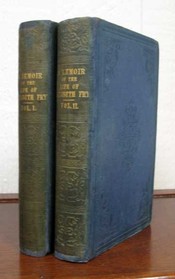
Memoirs_Life_Elizabeth_FryA Quaker and Christian philanthropist, Elizabeth Fry came to be known as the “angel of prisons.” At eighteen years old, Fry was moved by the sermons of American Quaker William Savey. She immediately took an interest in caring for the poor, sick, and incarcerated. Her efforts led her to Newgate Prison, where she was horrified to find the women’s prison crowded with both women and their children. She soon became an outspoken advocate for improving prison conditions, even spending the night in prisons occasionally herself and inviting members of nobility to do the same.

In 1840, Fry established a training school for nurses. Florence Nightingale later took a group of Fry’s nurses to assist wounded soldiers in the Crimean War, and her experience working with them inspired her to start a similar program. By this time, Fry was quite well known throughout England; even Queen Victoria was an admirer of her work. The monarch granted Fry a few audiences and donated to her causes.

Anna Morris Holstein

Anna_Ellis_Holstein

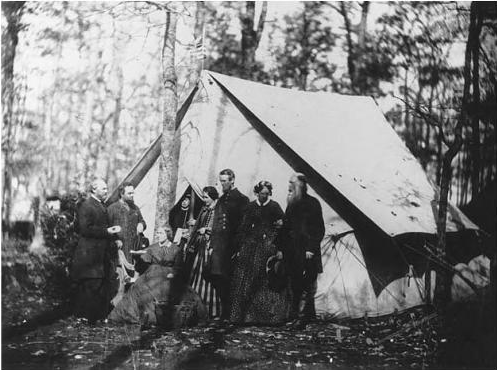
The Holsteins (center) on site at a field hospital

Anna Morris Holstein may have been the last person you’d expect to see traveling with soldiers. She and her husband, William H. Holstein, were quite wealthy. But they still had a strong sense of duty. William had served in the Pennsylvania militia during Lee’s 1862 invasion. And when the couple witnessed the carnage at Antietam, they felt called to serve. Anna noted, “we have no right to the comforts of our home, while so many of the noblest of our land renounce theirs.”

Three_Years_Field_Hospital_Army_PotomacThe couple enlisted with the US Sanitation Commission. Anna struggled with the grisly realities of war and later admitted that she was of little use till she could gain control of her composure and stop crying. Even after she was more experienced, Anna would succumb to emotion when she received “earnest thanks” from a soldier. After the war, publisher JB Lippincott capitalized on the hunger for war stories, first with Hospital Sketches, then less successfully with Notes of Hospital Life (1864). Anna’s Three Years in Field Hospitals of the Army of the Potomac fit the bill to continue the trend.

Alice Fisher

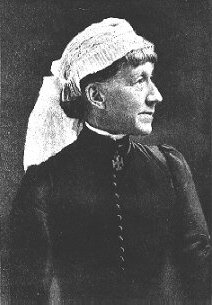
Alice_FisherAlice Fisher didn’t immediately embark on a career in nursing. She started out as an author. Fisher penned Too Bright to Last in 1873, and the three-volume His Queen in 1875. But her father, an astronomer and priest, took ill and soon passed away, leaving Fisher to make her own way. She decided to pursue nursing, and went to school at the Nightingale Training School and Home for Nurses, where her mentor was none other than the founder herself. The two corresponded, but no letters are extant.

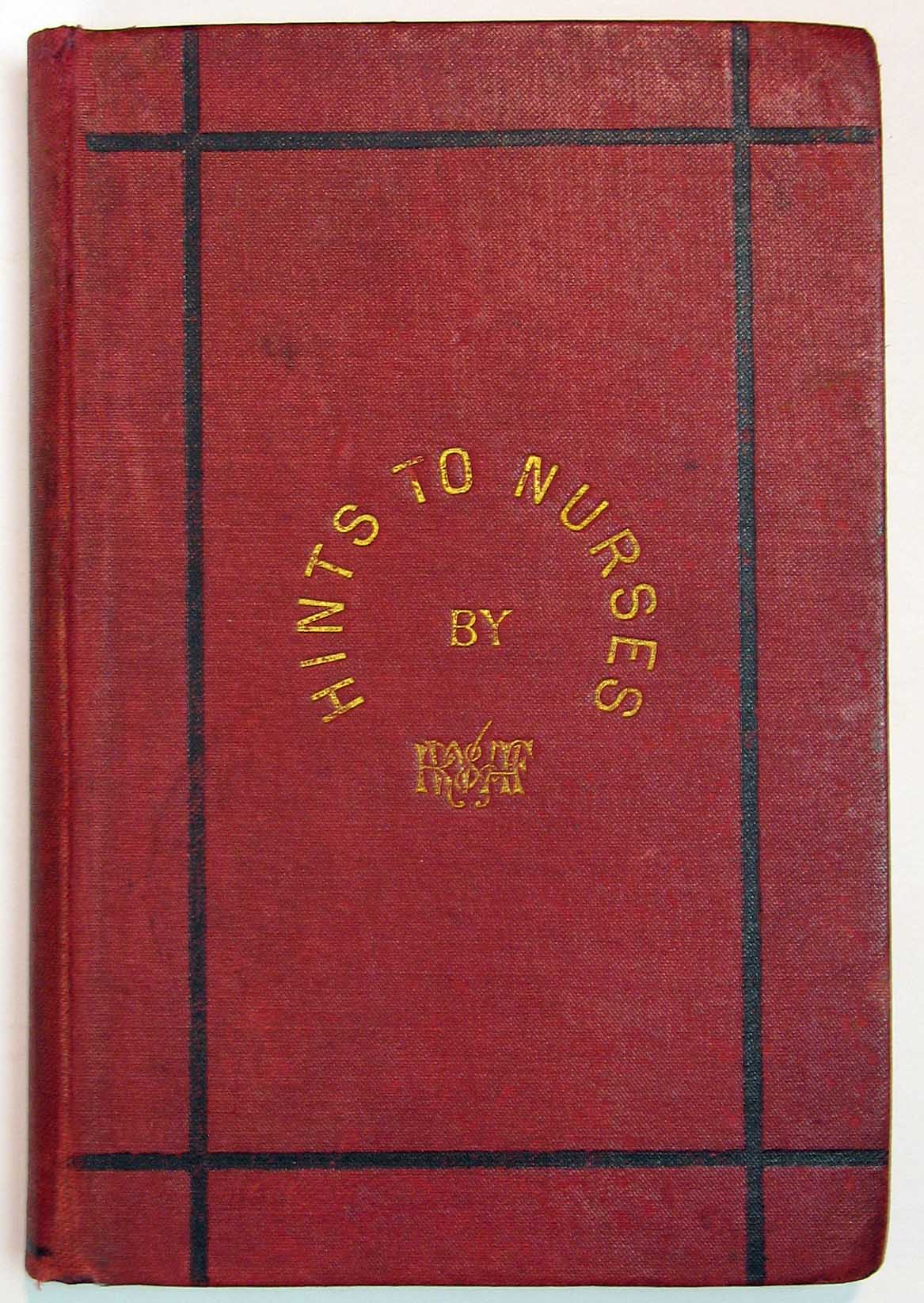
Hints_Nurses_Fisher_WilliamsFisher came to the US in 1884 as the superintendent of Philadelphia General Hospital (PGH), then more commonly known as Buckley Hospital. Fisher made sweeping changes to the hospital. Her approach was a sterling example of the benefits of standardized training for nurses. Along with fellow Nightingale nurse Rachel Williams, Fisher edited Hints for Hospital Nurses (1877).

Lavinia Dock

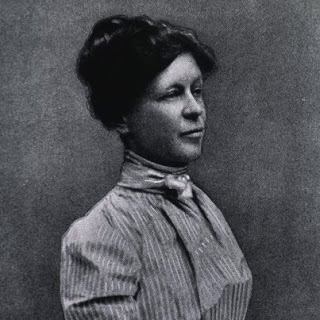
Lavinia_DockLavinia Dock graduated from the Bellevue Hospital School of Nursing in 1886. Two years later, she was in Florida during a yellow fever outbreak. Dock served alongside Jane Delano, who went on to found the American Red Cross Nursing Service. Dock was a contributing editor to American Journal of Nursing and authored a number of books on the subject, including a four-volume history of nursing and a nurse’s drug manual that was the standard reference for years. Dock served as the assistant superintendent of Johns Hopkins School of Nursing under Isabel Hampton Robb. Dock, Robb, and Mary Adelaide Nutting would go onto found to organization that evolved into the National League for Nursing.

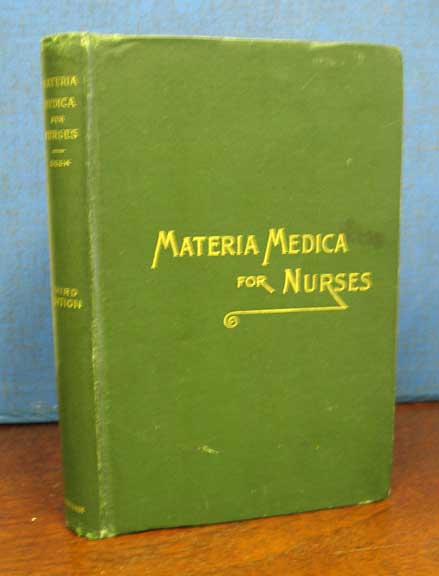
Materia_Medica_Nurses_Lavinia_DockAfter Dock retired from nursing, she turned her attention more fully to the issue of women’s rights. She became active in the National Woman’s Party, leading numerous protests–including a picket of the White House. Dock was actually arrested on three separate occasions for militant protesting. But her efforts paid off, and she was instrumental in the passage of the 19th Amendment. This wasn’t Dock’s only political concern; she also lobbied for legislation that would allow nurses to control their own profession, rather than being overseen by doctors.

This month we’re pleased to offer works by these four women, along with a number of other select acquisitions on nursing. We invite you to peruse the entire list. Should you have a question about an item, please don’t hesitate to contact us!


Related Posts:
Edith Cavell: Nurse, Historian, and Traitor? 
Famous Figures in the History of Nursing (Part One)
Clara Barton: Heroine of Civil War Nursing and Record Keeping

Thanks for reading! Love our blog? Subscribe via email (right sidebar) or sign up for our newsletter--you’ll never miss a post.

Share

AA Milne: Legendary Children’s Author and Ambivalent Pacifist

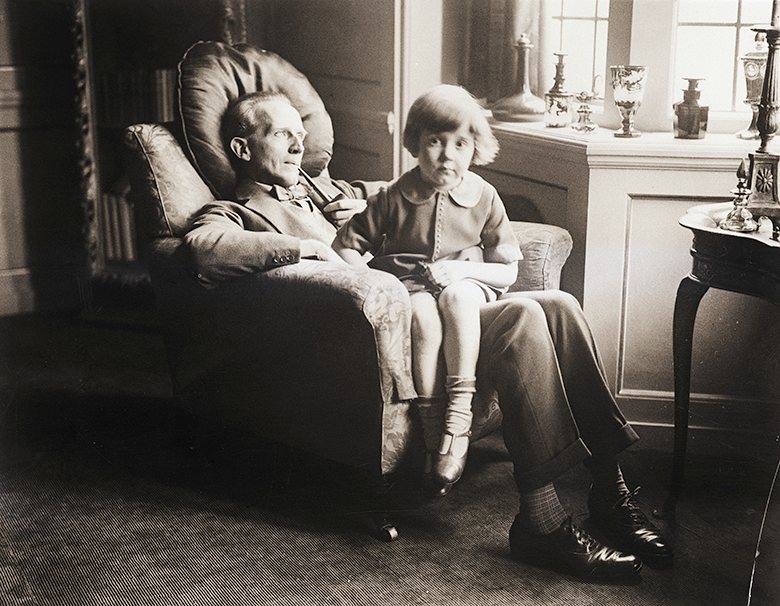
AA_Milne_Christopher_Robin

AA Milne with son, Christopher Robin (1925). Christopher later resented having been the inspiration for the eponymous character in Milne’s classic ‘Winnie-the-Pooh’ tales.

Alan Alexander Milne came to regret that his beloved Winnie-the-Pooh series overshadowed his other works. Yet some of his most interesting pieces were never even attributed to him. An outspoken pacifist during World War I, Milne secretly served in Britain’s M17b unit, writing pro-war propaganda. But by World War II, Milne’s views on war had changed, creating a rift between him and beloved author PG Wodehouse.

Born on January 18, 1882 in Scotland, Milne spent his childhood in London. His tutor, the young HG Wells, was, according to Milne “a great writer and a great friend.” Milne went on to Westminster School and Trinity College. He edited Granta for a year, and his preliminary literary efforts appeared in Punch magazine. Just after his 24th birthday, Milne became the assistant editor of Punch. He held the post until World War I began.

An Outspoken Pacifist

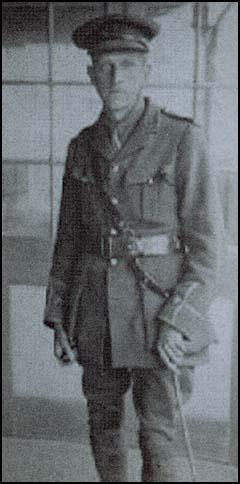
AA_Milne_Western_Front_1916

AA Milne on the Western Front, 1916

At the start of World War I, Milne enlisted in the Royal Warwickshire Regiment. He served as a signalling officer and did a brief stint in Paris before being discharged due to trench fever. Milne never even fired at an enemy; indeed, his most notable service remained a complete secret until recently. Thanks to a set of long-lost documents secretly saved from destruction, we now know that Milne was part of the classified M17b unit.

Established in 1916, the unit included twenty of Britain’s top writers of the time. Their mission: to produce propaganda that would sustain support for the war at a time when the number of casualties was rapidly rising and anti-war movements were sprouting all over Europe. The unit not only wrote accounts of Victoria’s Cross winners and other war heroes, but they also focused on the atrocities perpetrated by the Germans.

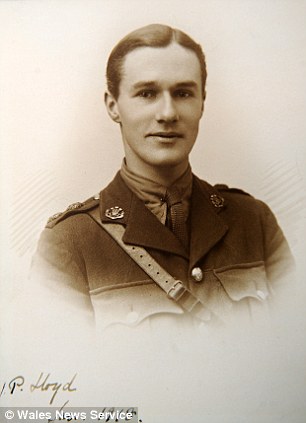
Captain_James_Lloyd

Captain James Lloyd

Alongside Milne were Cecil Street, the author of the Dr. Priestley novels; “the Navvy Poet” Patrick MacGill; Roger Pocock, the world-traveling author; JP Morton, who earned his fame with The Bystander; and Captain James Lloyd, who was recruited to join the unit after being wounded in combat. It was Captain Lloyd who defied orders and took about 150 of the unit’s classified documents home. They were discovered last year by his great nephew Jeremy Alder, who discovered them just before they were going to be thrown away.

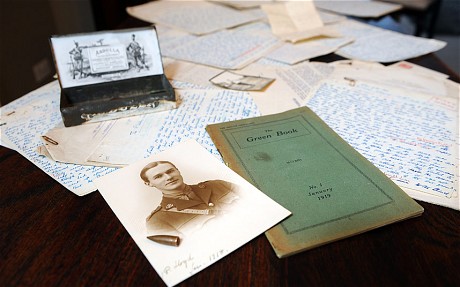
Among the documents recovered was The Green Book, which is marked “for private circulation.” There were likely no more than twenty copies ever published. The pamphlet included contributions from the unit’s authors and poked fun at the task of creating government propaganda. Milne’s own contributions illustrate how onerous he found the task. In “Captain William Shakespeare, of a Cyclist Battalion,” Milne writes:

In M17b
who loves to lie with me
About atrocities
And Hun corpse factories
Come hither, come hither, come hither,
Here shall we see
No enemy
But sit all day and blather

In “Some Early Propagandists,” also compiled in The Green Book, Milne writes about Paul von Hindenburg, the German Field Marshal. Hindenburg would go on to become Germany’s President and to appoint Adolf Hitler as Chancellor of Germany.

Milne_M17b_Documents

Captain Lloyd’s cache of M17b documents, which included ‘The Green Book’

After the war ended, Milne went on to great success, largely due to his Winnie-the-Pooh series. He also published Peace with Honour: an Enquiry Into the War Convention, which was an overtly pacifist work. Milne said that he wrote it because “I want everybody to think (as I do) that war is poison, and not (as so many think) an overstrong, extremely unpleasant medicine.”

World War II Brings a Change of Heart

But by World War II, Milne had changed his mind. In 1940, he even went so far as to publish War with Honour, in which he states, “War is something of a man’s own fostering; and if all mankind renounces it, then it is no longer there.” Soon Milne inflicted his newfound hawkishness on PG Wodehouse, an author with whom he’d previously enjoyed mutual admiration.

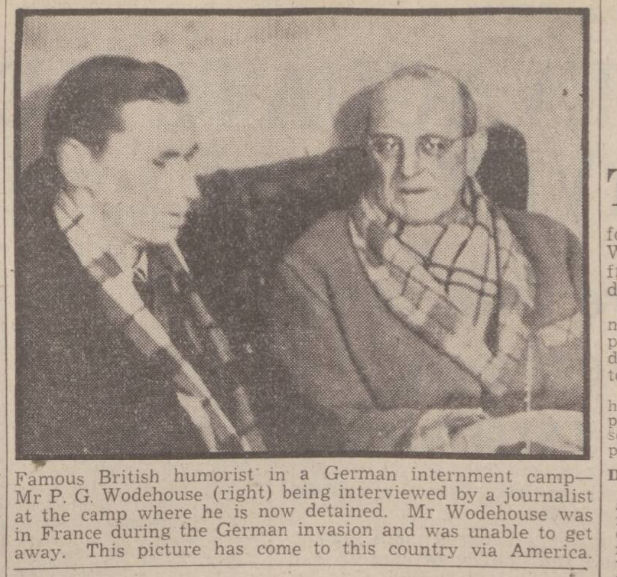
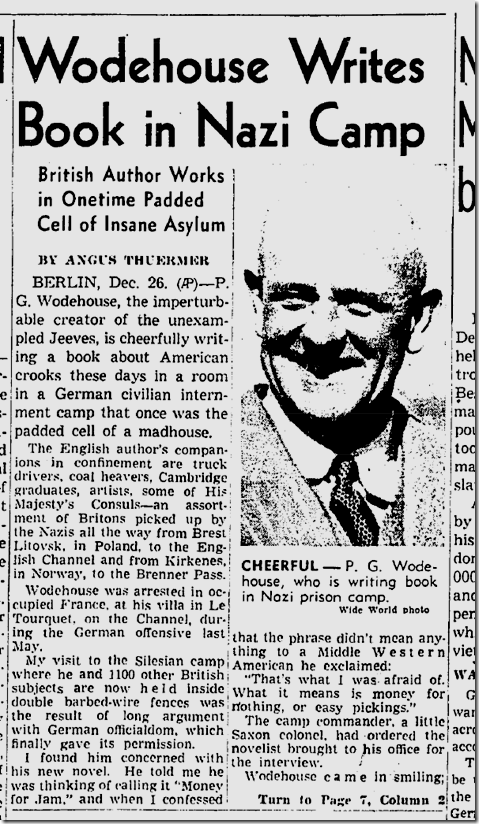
Milne had long enjoyed Wodehouse’s writing–he even read it to his own son, Christopher Robin, instead of his own stories. But as Wodehouse’s career took off in the 1930’s, Milne’s was burning less brightly. When Wodehouse began doing radio broadcasts for the Nazis, Milne was first in line to accuse the imprisoned author of treason, possibly out of jealousy. Wodehouse and his wife were in France when the Nazis invaded in 1940. They were taken to an internment camp. A few Nazis had known Wodehouse thanks to his Hollywood projects, and they asked Wodehouse to do radio broadcasts detailing his experiences at the camp.

PG_Wodehouse_Internment_Camp

The above appeared in a British newspaper while Wodehouse was still at the internment camp.

Wodehouse likely had little say in the matter; after all, did one really argue with the Nazis? Wodehouse complied, though his broadcasts were probably far from what the Nazis had in mind; with characteristic wit, Wodehouse made sport of the Nazis. After reading the transcripts, one British Air Marshal marveled that the Nazis had permitted Wodehouse to complete five broadcasts; “Why the Germans let him say all this I cannot think,” he observed, “They have either got more sense of humor than I credit them with,or it just slipped past the censor. Wodehouse has probably been shot by now.”

Wodehouse_Clip

The above was published in the ‘LA Times’ on December 27, 1940.

When Wodehouse’s countrymen found out about the broadcasts, they were furious. Even though they’d never head them, they were confident that Wodehouse had agreed to the task in exchange for favored treatment. People vociferously excoriated Wodehouse, and Milne was chief among his detractors. The furor soon grew into hysteria. Milne dismissed the possibility that Wodehouse had simply been naive, calling the author irresponsible. He said that Wodehouse “has encouraged in himself a natural lack of interest in ‘politics’–‘politics’ being all the things grown-ups talk about at dinner while one is hiding under the table. Things, for instance like the last war, which found and kept him in America, and post-war taxes, which chased him back and forth across the Atlantic.”

Wodehouse was released in 1941. He was cleared of any wrongdoing but was unable to overcome the stigma that had tarnished his reputation. Wodehouse would exact some revenge in “The Mating Season” and “Rodney Has a Relapse,” where he mocks the literary insignificance of Milne’s work and points out that Milne had exploited his own young son to attain literary fame. Wodehouse also once admitted, “Nobody could be more anxious than myself…that Alan Alexander Milne would trip over a loose bootlace and break his bloody neck.”

Milne and Wodehouse never spoke again, and all evidence suggests that Milne held on to the grudge till the end of his life. Wodehouse, on the other hand, was able to let go. When he learned that Milne was ailing, he expressed regret and noted that Milne was “about my favorite author.” Regardless of how they felt about each other, both AA Milne and PG Wodehouse remain beloved figures in modern British literature.

Related Posts:
Edith Cavell: Nurse, Historian, and Traitor? 
The Man Behind the Beloved ‘Freddy’ Series

Thanks for reading! Love our blog? Subscribe via email (right sidebar) or sign up for our newsletter--you’ll never miss a post.
Share

Fra Paolo Sarpi, Scholar, Priest, and Heretic

The Counter-Reformation began with the Council of Trent (1545-1563) and lasted a full century, until the close of the Thirty Years’ War (1648). The movement sparked conflict all over Europe, challenging the very foundations of people’s daily lives. As nationalism fermented, states like Venice began to assert their autonomy–and the Catholic Church often took drastic measures in response. In the case of cleric and statesman Fra Paolo Sarpi, they even hired a hitman. Though Sarpi consistently stood up to the Church in an official capacity, he also chose to publish his greatest work, The History of the Council of Trent, under a pseudonym.

A Complicated Relationship with the Church

Paolo Sarpi was born in Venice on August 14, 1552. He entered the Servite order in 1566 and was eventually assigned to Mantua, then Milan. He was reassigned to 1588 after a brief stint in Rome to address business related to reforming the Servite order. Sarpi proved an adept scholar and lawyer. In 1601, the Venetian Senate recommended him for the bishopric of Caorle, but the papal nuncio declined. He alleged that Sarpi had denied the immortality of the soul and controverted Aristotle’s authority. This would not be the last accusation of heretical behavior levied against Sarpi. The following year, Sarpi made another bid at the bishopric, but this time Pope Clement VIII himself took offense; Sarpi was known to correspond with heretics, which wasn’t fitting behavior for a church official.

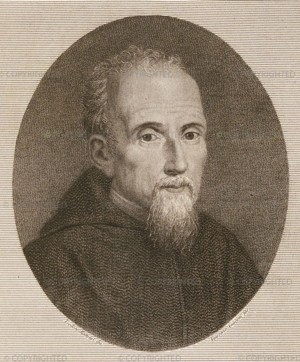
Paolo-SarpiFurthermore, Sarpi had already appeared before the Inquisition in both 1575 and 1594. He would be questioned again in 1607. Sarpi advocated Protestant worship in Venice, as well as the establishment of a Venetian free church autonomous of the Catholic Church. He even admitted that he disliked saying Mass and avoided it whenever he could. Sarpi lived by two maxims, “God does not regard externals so long as the mind and heart are right before Him” and “I never never lie, but I do not divulge every fact to everyone.” By the end of his life, Sarpi had come to favor the Calvinist Contra-Reformists and rejected religious dogma.

Embroiled in the Counter-Reformation

In March, 1605, Pope Clement VIII died. His successor, Pope Paul V, had a different attitude toward papal prerogative and exerted even more rigorous authority over the government. The Venetian government responded by attempting to restrict the Pope’s power. The conflict came to a head in January, 1606, when the papal nuncio delivered a brief that demanded the Venetians’ unconditional submission to papal authority. Rather than comply, the Venetian senate promised protection to all ecclesiastics who would defend the republic with their counsel. Sarpi stepped up, penning a memoir that outlined how the Venetians could respond to the censures. The document was so well received that Fra Sarpi was made canonist and theological counsellor to the republic.

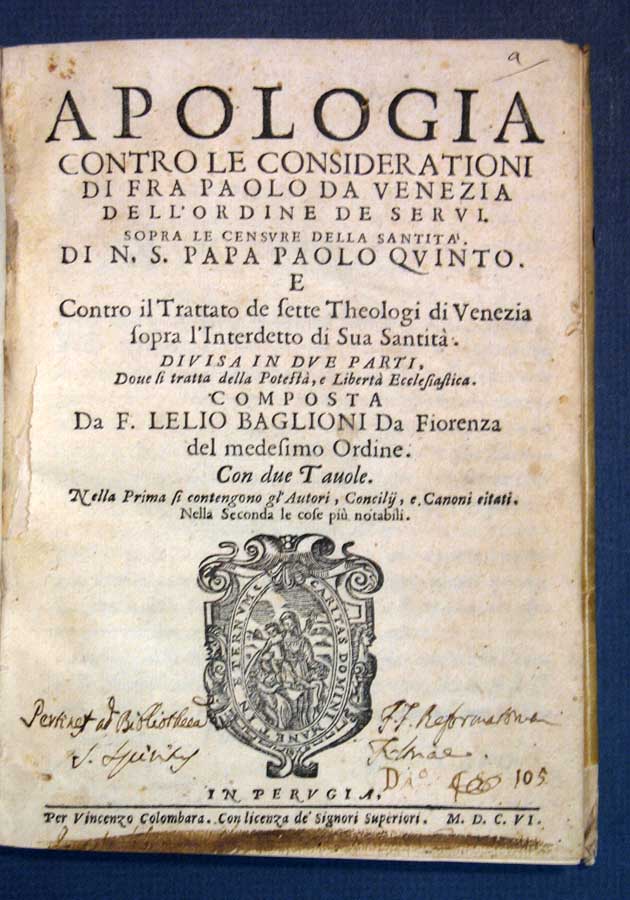
Apologia_Antonio_Possevino

Writing as Paolo Anafesto, papal diplomat Antonio Possevino defended Pope Paul V’s interpretation of ecclesiastical jurisdiction.

In April, the Pope summarily excommunicated all Venetians. Sarpi again entered the controversy, an unprecedented move for someone of his stature. He openly argued that the power of the clergy should be secondary to the power of the state. Sarpi first republished the anti-papal republican opinions of canonist Jean Gerson (1363-1429). He also anonymously published Risposta di un Dottore in Teologica, which was promptly added to the Church’s index of banned books. Cardinal Bellarmine roundly lambasted Gerson’s works, and Sarpi responded with an Apologia. By this time, Sarpi was censor of all materials written in defense of the Venetian republic, and multiple tracts either inspired or controlled by him were published in quick succession. Only the Jesuits, the Theatines, and the Capuchins really abided by the papal decrees and were expelled from Venetian territories; the rest of Venice simply continued business as usual, and

The Catholic powers in France and Spain had tried to avoid becoming embroiled in Italian affairs, but they finally had to step in. They arranged a weak compromise in 1607: the Church acknowledged that interdicts and excommunications had lost their force. This admission did little to mitigate the animosity between the Church and the state of Venice. Indeed, the Church actually commissioned an assassination attempt on Fra Sarpi. They hired Rotillo Orlandini, a brigand and unfrocked friar, along with his two brothers-in-law to kill Fra Sarpi for 8,000 crowns. But the plot was discovered, and the would-be assassins were taken into custody before they could follow through.

On October 5, 1607, however, Sarpi was stabbed fifteen times with a stiletto and left for dead. His attackers returned to papal territory in what was described as a “triumphant march.” The enthusiasm of papal authorities was quashed when Sarpi survived the attack, but the failed assassins eventually settled in Rome and received a pension from the Viceroy of Naples. Their leader, Poma, said that he’d committed the crime for religious reasons. Sarpi would continue to be the subject of assassination plots for the rest of his life, and he occasionally considered relocating to England.

Instead, he passed his years quietly at the monastery, preparing state papers and pursuing scientific studies. He corresponded with a number of prominent scholars, including Galileo Galilei, and his documents suggest that he first encountered a telescope in November, 1608–perhaps before Galileo. The following year, the Venetian government had a telescope on approval for military use. Sarpi advised them to decline it, anticipating Galileo’s superior model. Sarpi also claimed to have anticipated William Harvey’s discovery of the human circulatory system, but the only anatomical discovery that can definitively be attributed to Sarpi is the contractibility of the iris.

The History of the Council of Trent

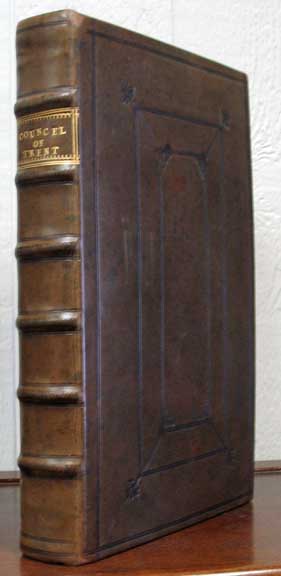
Sarpi_History_Council_TrentIn 1619, Sarpi anonymously published Istoria del Concilio Tridentiro. It was printed in London under the pseudonym Pietro Soave Polano (an anagram of “Paolo Sarpi, Veneto,” with an extra “o”). Sarpi never admitted authorship during his lifetime, even under pressure from Louis II of Bourbon, the Prince of Conde. Sarpi’s editor, Marco Antonio de Dominis, was soon accused of falsifying parts of the text, but a look at Sarpi’s own manuscripts show that Dominis’ changes were minor. Nathaniel Brent published a translation, The History of the Council of Trent, in 1629. It would also be translated into French and German. The book presents an unofficial history, one that’s clearly hostile toward the papacy. Sarpi addressed ecclesiastical history as a matter of politics, so his work was especially popular among Protestants. John Milton even called Sarpi “the great unmasker.”

Sarpi argued in The History of the Council of Trent that the settlement wasn’t intended to foster compromise, but rather to incite further conflict. Critics have never denied the literary merits of Sarpi’s masterpiece, but they do acknowledge the numerous liberties Sarpi took with history (as did Cardinal Pallavicini, who refuted Sarpi’s history on behalf of the Catholic Church). Historian Hubert Jedin was particularly critical of Sarpi’s scholarship, but it has since come to light that the cleric probably used sources that haven’t survived.

Related Posts:

Astrology, Astronomy, Potato, Po-tah-to? 

The Millerites and the Great Disappointment


Thanks for reading! Love our blog? Subscribe via email (right sidebar) or sign up for our newsletter--you’ll never miss a post.

Share