Author Archives: tavistock_books

The Disappearance of Antoine de Saint-Exupéry

prince4

“People where you live, the little prince said, grow five thousand roses in one garden… Yet they don’t find what they’re looking for… And yet what they’re looking for could be found in a single rose.”

prince1So said the Little Prince – an absolutely beloved character in the canon of Western Literature. Antoine de Saint-Exupéry wrote this story, a children’s story on the outside and a very adult study of human nature and morality on the inside. Saint-Exupéry, a French national, had fled Europe at the onset of World War II and wrote much of his tale during his 27 week stay in North America and Canada. Now normally we would do a blog on Saint-Exupéry’s life story and how he came to write such a popular and precious children’s tale, but today we are speaking of a specific day in this author’s life… the day he disappeared from the skies.

Saint-Exupéry was not only a writer, but an aviation enthusiast and a pilot. He began his career as a basic rank soldier in the French army when he was a mere 21 years old, but soon after accepting private flying lessons he was offered a place in the French Air Force. After taking a brief break from flying for an office job in the mid 1920s, Saint-Exupéry was back at it by 1926. Over the next many years, Saint-Exupéry worked as a pilot for Aéropostale, working as a mail courier, navigation specialist, and as the negotiating correspondent for downed fliers taken hostage by native Saharan tribes in the Spanish zone of South Morocco. In 1929 he was transferred to Argentina, where he spent his time surveying new piloting routes and also ran search missions for downed fliers… ironic, as eventually Saint-Exupéry would not only become a downed flier himself, but flying would ultimately lead to his disappearance.

prince2

By 1929 Saint-Exupéry had already been trying his hand at writing, having published a novella in a literary magazine in 1926, and his first book in 1929. His 1931 publication of Vol de nuit (or Night Flight) was the work that established him as a writer, however. An important event in Saint-Exupéry’s life happened during this time, as a matter of fact, and it would prove to be a great inspiration in his future authorship of The Little Prince. On December 30th, 1935, Saint-Exupéry and his mechanic/navigator crashed a small plane in the Libyan desert. They had very little sustenance with them – some grapes, two oranges, a madeleine cookie, a pint of coffee and a pint of white-wine (how very French!) was all they carried with them. Miraculous was the word of the day, however, as the two had somehow survived the crash and were once again able to survive on these meager rations for three full days (hallucinating, but still alive). Finally on the fourth day a local Bedouin on a camel happened to come across the pair and rehydrated them – saving their lives. This airplane crash – and brush with death – would be revisited in The Little Prince almost a decade later. 

prince3Unfortunately, less than that decade later Saint-Exupéry would be fleeing his homeland and arriving in New York City, winning writing prizes and rubbing shoulders with the literary crowd in New York, all the while simultaneously trying to convince the US government (through its higher-ups) to join in on the fight against fascism. Saint-Exupéry did not stay away from Europe for long through, as he returned to his homeland in 1943 (right around the publication of The Little Prince) to help with the war effort. On a fateful day in 1944 – July 31st, 1944, to be exact – Saint-Exupéry left on a reconnaissance mission from the island of Corsica. His plane, a Lockheed Lightning P-38, and Saint-Exupéry himself were never seen again. Many theories arose, that he had lost control of the plane, that he had committed suicide (French president Charles de Gaulle had implied publicly that Saint-Exupéry supported the German war effort and this caused the author to begin to drink more heavily than regularly and gave him bouts of depression), or that he had been shot down near Marseille and his plane lost at sea. Until 1998, no clues had arisen of his whereabouts and he had become the Amelia Earhart of the literary scene. In 1998 fishermen off of the coast of Marseille dragged up a silver bracelet with Saint-Exupéry’s name, publisher’s name and New York address on it – an ID bracelet. Shortly thereafter, divers picked up a wrecked plane, believed to be Saint-Exupéry’s, and even more theories arose. A German fighter pilot emerged who claimed to have felt shame for decades that he had been the one to shoot down one of his literary idols (after all, Saint-Exupéry wrote often of pilots and aviation before publishing The Little Prince). Perhaps we will never know the truth. But what we do know is infinitely more important… and was taught to us by Saint-Exupéry himself.

“You – you alone will have the stars as no one else has them…In one of the stars I shall be living. In one of them I shall be laughing. And so it will be as if all the stars were laughing, when you look at the sky at night…You – only you – will have stars that can laugh.” Well said, Little Prince. Here’s to Antoine de Saint-Exupéry… may he rest in peace.

prince5

Share

“All for one and one for all” – Happy Birthday to Alexandre Dumas!

dumas2

Alexandre Dumas – a bibliophile household name around the world, created some of the most memorable stories of love, adventure, history, revenge and politics in the 19th century. On this, what would be his 217th birthday, we would like to pay homage to this wonderful French author and the adventurous worlds he created for his audiences.

Alexandre Dumas was born on July 24th, 1802 the third child of Thomas-Alexandre Dumas, a French nobleman of mixed race (his mother having been a slave in Saint-Domingue, now Haiti) and an innkeeper’s daughter. Dumas (Sr., for all intents and purposes) brought his son to France. The young Dumas was given a thorough education and began writing at a young age and publishing articles for magazines and writing stage plays. 

dumas1

When he was 27 years old, Alexandre Dumas saw his first play produced, entitled Henry III and His Courts, which met with acclaim from the very start. A scant year later his second play, Christine, met with just as much success – and Dumas turned his head to writing full time. After enjoying the success of writing several hit plays, Dumas began to try his hand at writing novels. His first novel, published as a serial (as novels often were at the time) was based on one of his earlier, popular plays! Dumas didn’t stop with a work on his Le Capitaine Paul, however… oh, no. Dumas proved to be a very versatile writer indeed, as in the first years of his writing he wrote both an 8-volume compilation (with friends) on Celebrated Crime in European history and a book on a fencing master’s take on the Decemberist Revolt in Russia. It was almost as if Dumas was testing out the waters in his writing, trying different kinds on for size – except that this behavior lasted his entire writing career! Dumas wrote in a variety of styles and genres, most all of which met with success.

dumas3


Some of his best known and best loved works include The Count of Monte Cristo and The Three Muskateers… both of which happen to have been published in the same year. As if we needed more evidence of this accomplished authors’ capabilities, here are some fast facts about Dumas that you may not have known before:

  • Dumas is one of the most read of French authors in history.
  • Dumas actually at one point built a large chateau outside Paris, that he named the Chateau de Monte-Cristo, right upon its final serial publication in 1846. Unfortunately due to Dumas’ constant money troubles (he spent more than he made on women, entertainment and pleasure) he was made to sell the chateau a mere two years later.
  • He once shot down a racist with class, intelligence and total general badass-ery: “My father was a mulatto, my grandfather was a Negro, and my great-grandfather a monkey. You see, Sir, my family starts where yours ends.” Burn baby burn!
  • Dumas wrote over 100,000 pages in all, and more have been found and attributed to him even after his death.
  • As Napolean Bonaparte disapproved of the author, Dumas fled France for Belgium in 1851 to escape him (and his debts… a happy coincidence).
  • He is accounted for having over 40 mistresses, and fathered at least 4 children between them all. (We had to add in some gossipy news, and ask that we are forgiven for our interest in it all!)

dumas6

One thing is for sure – Dumas was a man dedicated to two things in life… his writing and pleasure. He lived for the pleasure of writing and the pleasures of life that his popular writing afforded him. On this July 24th, let us all strive to be more like Dumas! Enjoy your day, live to enjoy your day… and have a drink to celebrate this magnificent author’s birthday. Cheers!

dumas5

Share

A Report on Rare Book School from Our 21 Year Attendee, Vic Zoschak Jr.

by Vic Zoschak, Jr.
IMG_0482

Number 21 is now in the books for yours truly, that is Rare Book School course number 21.  In this instance, G-65, i.e., Nick Wilding’s Forgeries, Facsimiles & Sophisticated Copies.  Better known to the 13 of us in class as Fakes & Forgeries.  Nick Wilding, for those of you not familiar with the name, is the Professor of History at Georgia State University, though perhaps he is better known as the fellow who recently identified Massimo De Caro’s copy of Galileo’s Sidereus Nuncius as a forgery, which had, up until Nick got involved, fooled a goodly number of experts as being authentic.

IMG_0489

Nick with the first folio facsimilie

But I get ahead of myself, so back to the beginning of the week, which started out Saturday July 6th.  In brief, it wasn’t so brief, in fact, it was a [expletive deleted] long day: the flight out of SFO was delayed around 2 hours… the rental car place at Dulles did not [immediately] have a car available… all of which contributed to my late arrival, ~ 11:00 pm, in Charlottesville.  Given I had no dinner that day, thank God for Benny Deluca’s!  This a hole-in-the-wall pizza place a block away from my hotel, which is open till 3am on Saturday nights.  And that slice I had that night around 11:30, delicious!

IMG_0474For those new to RBS, things kick off Sunday afternoon, 5ish.  There’s a reception, a Michael Suarez welcome speech & restaurant night.  The latter an opportunity for ~ 10 students to share a meal at one of the local ‘Corner’ restaurants, in my case, Lemongrass Thai.  Wonderful food, wonderful company!

The weekdays start at 8 am, with a gathering in the RBS spaces for coffee, bagels & fruit.  And, of course, conversation with fellow RBS students, staff & faculty.  Classes begin, as Michael reminds all, promptly at 8:30.  But only after washing one’s hands!  RBS has one of the largest, if not THE largest, working collections extant.  Material is handled daily by LOTS of students, so ‘hand washing’ an understandable act of preservation.

IMG_0494

The Vandercook

Our week in G-65 covered, amongst other things, mechanics of printing [relief, intaglio & planographic], including actual printing from a Vandercook; paper attributes; divers means of repair & conservation; sophistications; pen facsimiles; the relevance of provenance, and [of course] visits to UVa’s Albert & Shirley Small Special Collections to look at numerous examples of that we were studying.

Of especial note during the week was the Wednesday night lecture, in this instance, given by my bookseller colleagues Heather O’Donnell & Rebecca Romney of Honey & Wax Booksellers.  They talked about their belief the trade needs to reach out to the next generation of collectors, and in doing so, should consider a paradigm shift from well established paths.  Quite thought provoking.  After, a group of us, including Heather & Rebecca, went to a local restaurant for dinner & conversation.  That evening, I learned Rebecca, in concert with Brian Cassidy, will soon be opening her own shop, Type Punch Matrix, in the Washington DC area.  We wish her every success!

RBS classes conclude on Friday, with the usual highlight of the day a class luncheon.  In our case, we trouped over to Michael’s Bistro & Tap House, a RBS favorite watering hole in the Corners.  I’m sure I speak for all my classmates when I say it was probably the most enjoyable lunch of the week.  The day concludes with a closing reception, where all friendships forged during the week are cemented.

IMG_0501

Vic’s Friday class luncheon!

And so another week at RBS had drawn to a close.  I can say with some surety this course was one of the best I have ever taken, and I’ve taken a few!  That said, I already look forward to number 22 next summer, whatever it may be.  Perhaps see you there?

Share

Start Off Summer 2019 Right… with an Antiquarian Twist!

Well, fellow bibliophiles… it’s that time of year again! The time of year when kids are out for summer holidays, the days are longer and the heat gives us ever more reasons to stay in the shade of the umbrella with a book! (Of course, we can really always find reasons to stick with a book… cold winter? Curl up with a book! Happy spring? Take a book on your picnic! You get the gist…) In honor of the recent start to summer 2019 we would like to share some of our favorites that you may or may not have read before! 

Start your summer off right… here are some of our preferred “beach reads”… with an antiquarian twist, of course!


gatsby


1. The Great Gatsby (1925): The ultimate party read – who wouldn’t want to find out what all is going on behind the greatest host in history’s eyes? Perhaps it is finally time to pick this classic up and find out for yourself!


Screen Shot 2019-07-02 at 10.06.06 PM

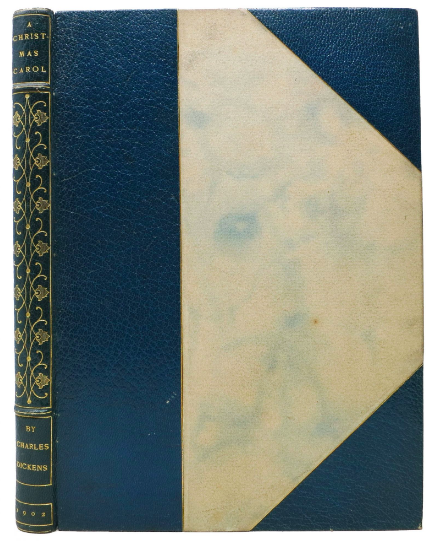
2. Great Expectations (1861): Of course we can’t recommend some antiquarian faves without putting in one of our main man’s most beloved novels. Great Expectations is popular for many reasons – and many of those reasons make it great company for a day at the beach! Murder, unconditional love, convicts… in a way Great Expectations is a very early kind of crime fiction! What could possibly make this less of a wonderful beach read? Try it, we know you’ll love it as much as we do. (And no, we do not recommend you bring our 1861 3rd edition to the beach with you… but isn’t it pretty??)


ripley

3. The Talented Mr. Ripley (1955): Another intense one (we are noticing a trend here) is this psychological thriller by the same complex and wonderful author, Patricia Highsmith, who wrote Strangers on a Train – her first novel which was later adapted for the silver screen by none other than Alfred Hitchcock. The Talented Mr. Ripley has just as much intrigue to entertain you… and the best part? There are five novels featuring this complicated villain – so don’t despair once you’ve finished the first installment!


war of the worlds

4. War of the Worlds (1897): For you science fiction buffs out there, we’ve included this novel as it is one of the most commented on and famous in the entire genre… not to mention that it is one of the first of its kind! War of the Worlds describes the conflict between mankind and an alien race – which is pretty darn notable for a work first serialized in 1897. Make sure to leave hours for this one, though – it isn’t a book easy to put down!


jaws

5. Jaws (1974): Beaches. Sharks. Death. Enough said? For those of you that love to wallow in paranoia and/or scare your friends and family – this one is for you! (Hint: Don’t become inspired by this read to yell “shark!” at a beach to freak out your loved ones. They usually don’t find it funny. Neither do the authorities.)


And one for good luck!


treasure island

6. Treasure Island (1883): We kind of feel like this one is also self-explanatory as a beach read, as what kind of story containing the open water, pirates and buried treasure wouldn’t find its home by the sea? But if you’ve only ever seen the movie version, we highly recommend this wonderful classic – fun for all ages!

Just please do us all a favor and keep your books safe from sand and water… you can take an antiquarian bookseller to the beach but you can’t keep us from worrying!

Enjoy your summers!

Share

Happy 90th Birthday to the Creator of The Very Hungry Caterpillar

eric carle1

eric carleEric Carle was born on June 25th, 1929 in Syracuse, New York, but his family originally being from Germany they moved back there and he was educated in art in Stuttgart. His father was drafted into the German army at the beginning of WWII, and eventually taken prisoner by Soviet Forces. Carle himself was also conscripted by the German government at the age of 15 to spend time with other boys his age building trenches on the Siegfried Line. Throughout all this time, Carle dreamed of returning to the United States, and finally, upon turning 23 he moved back to New York City with only $40 to his name. Carle was able to land a job as a graphic designer at The New York Times. Less than a year later, unfortunately, Carle was drafted once more into war, and America sent the recent civilian to the Korean War, where he was stationed back in Germany until discharged a year later at the end of the war. After returning to New York, Carle once more took up his job at The New York Times for a time, before becoming the art director for an advertising agency in the city. 

eric carleIt was at this agency that author Bill Martin Jr. spotted a lobster Carle had drawn for an advert illustration and Martin decided to ask Carle to collaborate with him on a book for children – the result of which is one of Carle’s best known works… Brown Bear, Brown Bear, What Do You See? was published in 1967. The book was an immediate success for Martin (who authored the story) and Carle, and in relatively short time it became a best-seller. This popularity jump-started Carle’s career in books, and within just two years he was both writing and illustrating his own.

Screen Shot 2019-06-22 at 2.05.58 PMOne reason behind the popularity of Carle’s work is that his illustrations are so very unique. He creates collages using hand-painted paper, which he then cuts to shape and layers to create the right colors and designs. A 30-minute video of Carle’s work, both in his design, and the way he carries out his ideas, and his work with his wife and children around the world can be seen here! This video, “The Art of Picture Books. Illustrating, story telling and making meaning with children” might be an older documentary, but we cannot recommend it enough to give our readers an overview of this famous artist and the beautiful, captivating and distinctive exceptional works that he has given to children throughout the years.

How famous is he, you might ask? Well, The Very Hungry Caterpillar has sold more than 46 million copies, having been translated into over 65 languages. According to some, that is roughly “equivalent to 1.8 copies being sold every minute” since its publication in 1969. Wow! So on this Eric Carle’s 90th Birthday, we’d like to give a warm thank you to him for his decades worth of entertainment and dedication to children around the world!

Digital archiving - Pivot Media413-584-5302Direct Digital Capture - Sinar HD43

Share

10 Facts About Welsh Author Ken Follett

Now, it isn’t often that we report on modern literature, but even we enjoy the occasional thriller and fun beach read (not that we are saying Ken Follett is a beach read). We can’t have our followers thinking that we spend all of our time flipping through Bleak House or other 1st editions of Charles Dickens now, can we? So in that vein and on this popular author’s birthday we would like to offer you ten facts about Follett that you may not have known previously!

Screen Shot 2019-06-05 at 9.38.09 AM

Also, we would like to take this time to introduce to you our latest catalogue – released just yesterday for Summer 2019, it is a wonderful representation of our inventory! With beautiful and interesting selections from each of our specialities (and some genres that perhaps you didn’t know we dabble in), it really is worth a good look. As Samm says – relax, sit back with a cup of coffee, and enjoy some of our latest and greatest catalogued items!

Now back to the blog…

10 Facts About Ken Follett

1. Ken Follett was born on June 5th, 1949 in Cardiff, Wales.

2. As a child, Follett was banned from watching television because his parents were part of a conservative, evangelical Christian movement known as Plymouth Brethren. That is how Follett developed an interest in reading at a young age!

3. Having moved to London at the age of 10, Follett applied and was admitted to University College London, where he studied philosophy and became interested in politics.

4. Upon his graduation in 1970, Follett took a 3 month post-grad course in journalism, and immediately took his new wife and son back to Cardiff to work as a trainee reporter on the South Wales Echo.

5. Though he first returned from Cardiff to work in London at the Evening News, Follett became bored of his profession and decided to try his hand at publishing, instead. After a short time in his new trade, Follett was made deputy managing director of Everest Books – a relatively small London publishing house.

follett

6. Follett has said that his reasoning for writing his first book, Eye of the Needle, was to hopefully make some money on the side in order to fix his car. If only we all had such inclinations that casually turned out to be best sellers!

7. Eye of the Needle is, to this date, one of Follett’s most popular works. Upon its publication in 1978 it became an international best seller and sold over 10 million copies. We are assuming Follett then had enough money to fix his car. Or buy a new car. Or maybe even a plane.

8. Many of Follett’s works have also been international best sellers, with a few even adapted for the big screen. Follett’s works have sold over 160 million copies worldwide.

9. Most of Follett’s works are placed in the historical thriller genre or thriller/mystery genres of literature. He has published over 44 books throughout his life.

10. Follett is an amateur musician, playing the guitar and the bass balalaika. Here is a video of him singing and playing the guitar to “Mustang Sally”. You are welcome.

Happy Birthday, Ken Follett!

Psst… and don’t forget to check out our new catalogue!

Share

The Prince of Paradox

chesterton2

Who WAS G. K. Chesterton?

According to many, he is one of the most prolific and best writers of the early 20th century – and yet he is not one often found on school curriculums or on the average household shelf. So the question is… who was G. K. Chesterton and how did he contribute to the literary world and become his nickname – “The Prince of Paradox”? Let’s find out.

chesterton3Gilbert Keith Chesterton was born on May 29th, 1874, in Kensington, London. His childhood is not elaborately researched, but we do know that he was born to a family of Unitarians, and as a young man was interested in the occult and regularly played (or practiced) with a Quija board with his younger brother (and only sibling) Cecil. He was educated at St. Paul’s School in London, but instead of continuing on to a university as you might have expected, Chesterton attended the Slade School of Art in London – in hopes of eventually becoming an illustrator. Though at Slade Chesterton took lessons in both art and literature, Chesterton left without a degree in either! 

RNS-CHESTERTON-SOCIETYWhen Chesterton was 27 years old, he married Frances Alice Blogg – an author herself, who would prove to be a major influence on Chesterton’s writing and religious life throughout the years. As www.chesterton.org mentions, Frances was in charge of all aspects of Chesterton’s life – kept his schedule for him, kept house, and kept him in check. According to the site, Chesterton often “had no idea where or when his next appointment was. He did much of his writing in train stations, since he usually missed the train he was supposed to catch. In one famous anecdote, he wired his wife, saying, ‘Am at Market Harborough. Where ought I to be?’” To which Mrs. Chesterton would almost inevitably respond with “Home.” The Chesterton’s were perhaps the epitome of the phrase “Behind every great man is an even greater woman.” 

chesterton4

Chesterton cut an amusing figure, indeed. He was 6 foot, 4 inches tall, and weighed almost 300 pounds. He could often be found laughing at himself, smoking a cigar, and scribbling away in the oddest of places. And what was he scribbling? Well – that is a question, isn’t it! Around the turn of the century, Chesterton worked as a freelance art and literary critic before 1902, when the Daily News gave him his own weekly opinion column. From then until the mid 1930s, Chesterton pushed out a steady stream of work – be they stories, poems, essays, articles, biographies or critiques – Chesterton wrote them all. Some of his most notable works included The Napoleon of Notting Hill (a book said to have influenced the setting of Orwell’s 1984), a critical study of Charles Dickens (which you know we love to hear), Orthodoxy (did we mention he was also a theologian?), the Father Brown short stories (has anyone read these? A Catholic priest who solves ghastly crimes and putters about resolving conflicts in his small town? I love them – think Miss Marple-esque), Eugenics and Other Evils (this guy really does get around in terms of subject matter), and The Everlasting Man (the book which reportedly turned C.S. Lewis’ face towards Christianity). Now that’s a resume, eh?! And of course – that is only a smattering of the work Chesterton produced. (The total of which includes roughly 80 books, hundreds of poems, 200 short stories, 4000 essays, and a few plays – jeez!)

chesterton1

So why the nickname? Well a paradox is defined as: “a seemingly absurd or self-contradictory statement or proposition that when investigated or explained may prove to be well founded or true.” Throughout his work, Chesterton consistently employs a long scope of humor and wit. This is true in both his fiction and non-fiction – and he often used paradoxes to make severe, if humorous (and not to mention true) statements on government, policies, religion, literature and humanity. For example – one of Chesterton’s political paradoxes could still occasionally be considered true today! He said “The whole modern world has divided itself into Conservatives and Progressives. The business of Progressives is to go on making mistakes. The business of the Conservatives is to prevent the mistakes from being corrected.” Ouch! As the Imaginative Conservative (online blog) puts it, “Chesterton show[ed] us that life is full of paradoxes. It is full of those apparent contradictions, those incongruous juxtapositions, that point to deeper truths. Take, for instance, the fact that it takes a big man to know how small he is, or the fact that pride is the sin of a small man who thinks he is big.” Indeed, even more of Chesterton’s paradoxes come into play in his studies of religion – where he considers Christ one of the greatest masters of the paradox. 

In all, G. K. Chesterton is not read as widely as he ought to be – considering the breadth of his work and the fact that, if you look hard enough, there is surely something of his for each and every one of us! My advice? Start with Father Brown… you won’t be disappointed!

Happy Birthday to this author, one of the most influential authors of the 20th century!

Share

In Honor of Emily

emily-dickinson-hires-cropped

“Hope is the thing with feathers” by Emily Dickinson is the first poem I remember reading and analyzing as part of a school assignment. 

The first time I read it, I definitely did not “get it”. I honest to goodness remember my initial reaction to my teachers’ analysis of the poem itself. It was the first time I asked myself the question… how do we know that that is what the author wanted us to read into it? How do we know for sure that she meant for the bird to signify the innocence of the emotion of hope? With some authors it is harder than others – as some authors left… well… less of a trail of breadcrumbs for us to follow. One of those authors was Emily Dickinson – the recluse who, to this day, inspires many with her words, whilst we know relatively little about her innermost thoughts during her most productive literary period. On today the anniversary of her death, we’d like to give a brief background on this interesting poet and focus not on exactly what her words mean to us, but rather on the lasting legacy she left behind. 

emily3Emily Dickinson was born in Amherst, Massachusetts, on December 10th, 1830. She was the second of three children, with one elder brother named Austin and a younger sister, Lavinia. Her father was not only a lawyer by trade, but a trustee of Amherst College, where his father had been one of the founders of the school. With their background in education, the Dickinson children were given a thorough education for the time, certainly when it came to the two girls. At the age of 10 Emily and her sister began their studies at Amherst Academy, which had begun to allow female students a scant two years before their studies began. Emily remained at the school for seven years, studying math, literature, latin, botany, history, and all manner of respected academia. Upon finishing her studies at the Academy in 1847, Dickinson enrolled in the Mount Holyoke Female Seminary (now Mount Holyoke College). Although the Seminary was only 10 miles from her home, Dickinson only remained at the school for 10 months before returning home – for reasons many have tried to unearth but none can be sure of. 

emily2Though throughout her late teens Dickinson seemed to enjoy life in Amherst socially, and was certainly already writing poetry (a family friend Benjamin Franklin Newton hinted in letters before his death in this time that he had hoped to live to see her reach the success he knew possible), by her twenties Emily was already feeling a melancholy pull, exacerbated by her emotions when it came to death, and the deaths of those around her. Her mother’s many chronic illnesses kept Emily often at home, and by the 1860s (Dickinson’s 30s) she had already largely pulled out of the public eye. By her 40s, Dickinson rarely left her room, and preferred to speak with visitors through her door rather than face-to-face. Unbeknownst to any, Dickinson worked tirelessly throughout this period on her poetry, and by the end of her life had amassed a collection of roughly 1,800 poems neatly written in hand sewn journals. That being said, less than one dozen of her poems would be published during her lifetime. The first book of her poetry, published four years after her death on May 15th, 1886 by her sister Lavinia, was a resounding success. In less than two years, eleven editions of the first book had been printed, and her words spread across nations. 

“Hope” is the thing with feathers –
That perches in the soul –
And sings the tune without the words –
And never stops – at all –
 
And sweetest – in the Gale – is heard –
And sore must be the storm –
That could abash the little Bird
That kept so many warm –
 
I’ve heard it in the chillest land –
And on the strangest Sea –
Yet – never – in Extremity,
It asked a crumb – of me.
emily5

It is only now, in researching her life and rereading a few of her best-loved poems that I can see the answer to my question of long ago. We don’t know what Emily Dickinson wanted each word to signify. We don’t need to know. It is the way her poetry made and makes the public feel that gave it the popularity it still holds to this day. “Hope”, indeed. 

Today we honor Emily Dickinson and her lasting impact on the world of poetry. 

Share

A New Adventure at the Chicago Antiquarian Book Fair

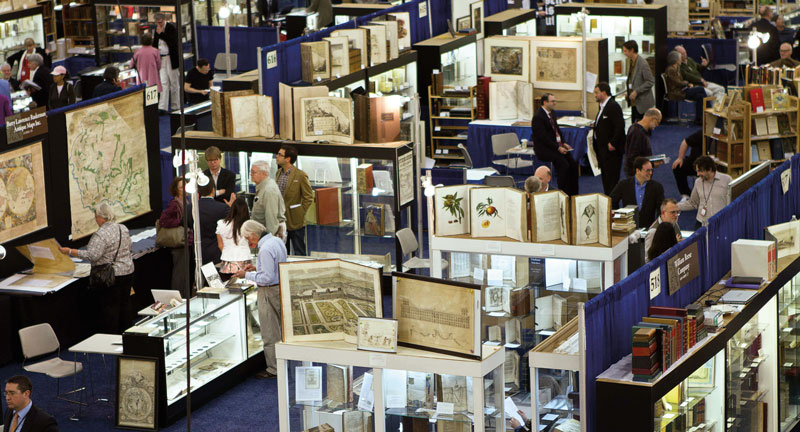
Recently, Team Tavistock flew out to Chicago to exhibit at the Chicago Antiquarian Book Fair. A first time exhibiting at this fair for Tavistock, we got the low-down on their experiences below! 

chicago7

So Vic, is this your first time exhibiting at the Chicago fair? And if so, what made you decide to try it out?

VZ: Indeed, this was my first time exhibiting in Chicago, and I did so because it was held at the prestigious Newberry Library.  A lovely venue.

Samm, have you spent any time in Chicago before this fair?

SF: Yes, I have spent quite a bit of time in Chicago before this trip. However, I was never in the area we were in – Lincoln Park is, I believe, the neighborhood that the Newberry is in. The park in front of the Newberry is absolutely gorgeous, and the Newberry Library was spectacular! Not to mention that we discovered a lovely breakfast diner called Tempo, and it was a delight. Every time I visit Chicago I seem to find great and beautiful places.

chicago1

Vic, how did you decide what was best to take with you, exhibit-wise?

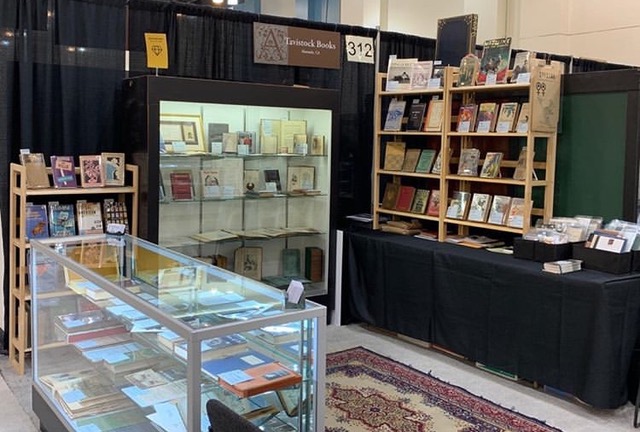
VZ: We had contracted for two trophy cases, no tables. And to save on shipping costs, decided to carry everything with us on the airplane. So selections tended to have two aspects: a connection to Chicago, and being more of a pamphlet or otherwise ’smallish’ item. What inventory we brought with us was supplemented by the 85 Dickens titles I acquired at the 1 May Hindman auction. And no, we didn’t put out all 85! Just a half dozen or so.

Samm, what was load-in and set up like? How did it compare to the previous fairs you have worked on?  

SF: Overall, load-in was easy.  It is always a bit confusing when first arriving at a book fair – where to go and what doors lead to what rooms. But it is definitely the way when you have never even been to the venue before! Other fairs I have attended have had very detailed load-in and load-out policies and rules, but that did not seem to be the case at the Newberry. It is a HUGE venue and easy to get turned around if you are unfamiliar with it. 

chicago3

Vic, what was the best part of the fair, as one who has so much experience both exhibiting and shopping fairs around the country?

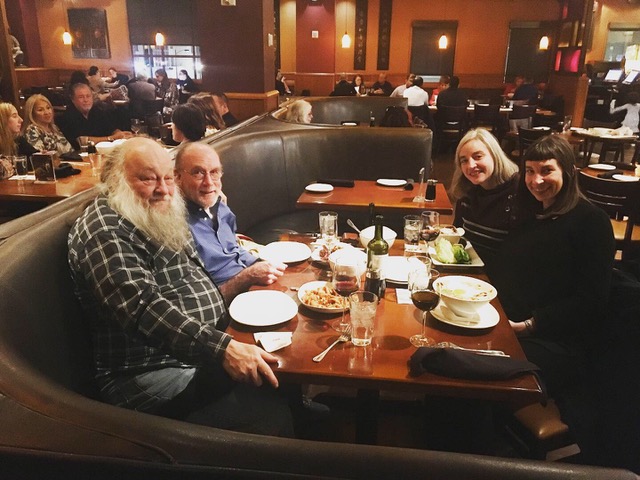
VZ: In this case, for me, the best part of the fair was the Friday night exhibitor dinner arranged by the fair promoter, Sammy Berk. Was a quite enjoyable evening, with good food, good drink, & good company.

Samm, what was your favorite thing about this fair?  

SF: To be honest, I think its one of my favorite things about every fair I have exhibite at so far. Meeting people I have only talked to on the phone or emailed with! It is always nice to put a face to voice or name. People’s responses to me are typically along the lines of “its nice to meet you in person, I have been seeing you on Instagram and the blog.” Haha!

chicago4

And last but not least… Vic, do you think you’ll be exhibiting at the Chicago Antiquarian Book Fair in the future? 

VZ: TBD! I say this, for despite the fantastic venue, sales were, shall we say, less than robust, and at the end of the day, one must have sales to remain a bookseller.

And there you have it, ladies and gents!

Looking forward to the next book fair report this fall, coming to you from Tavistock Books. 

chicago9

Share

Happy Anniversary… To Us!

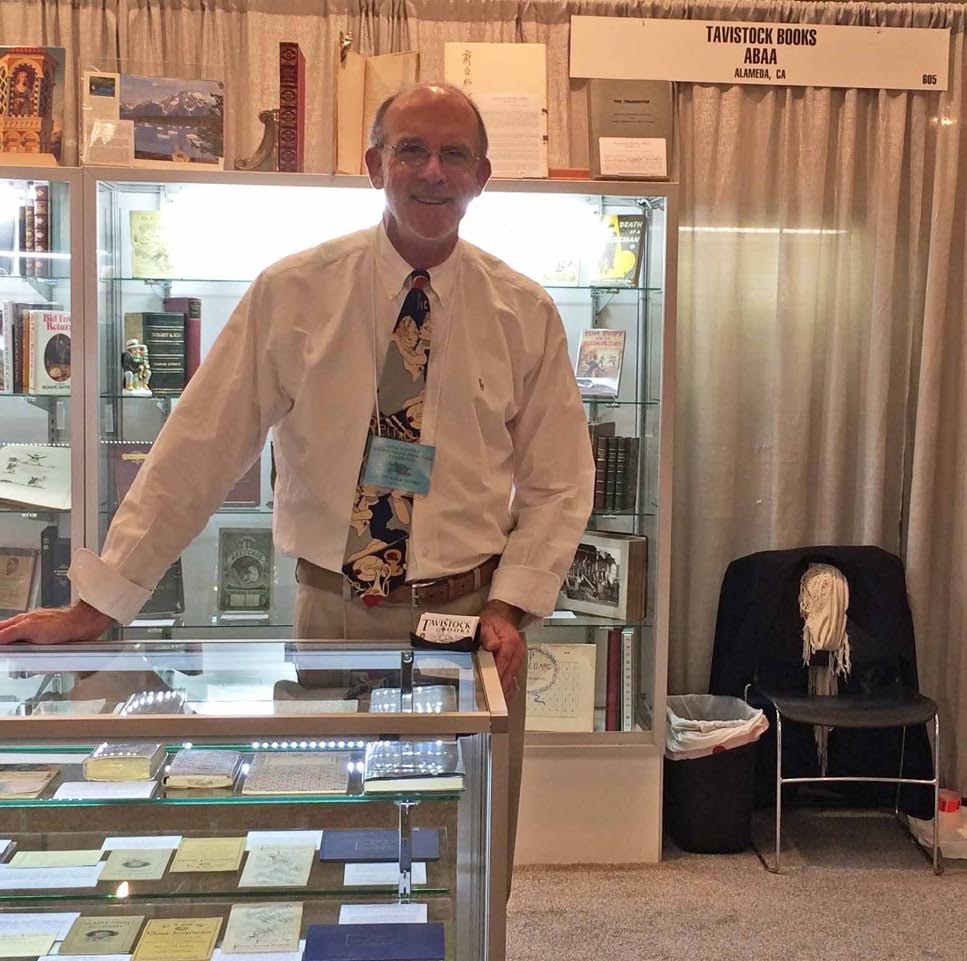
Just yesterday, Tavistock Books celebrated its 30 year anniversary. 30 years in business. 30 years in this wonderful, insane business we call the antiquarian book trade. We are nothing short of proud, and grateful for all of your support over our many years!

MVIMG_20190417_150333

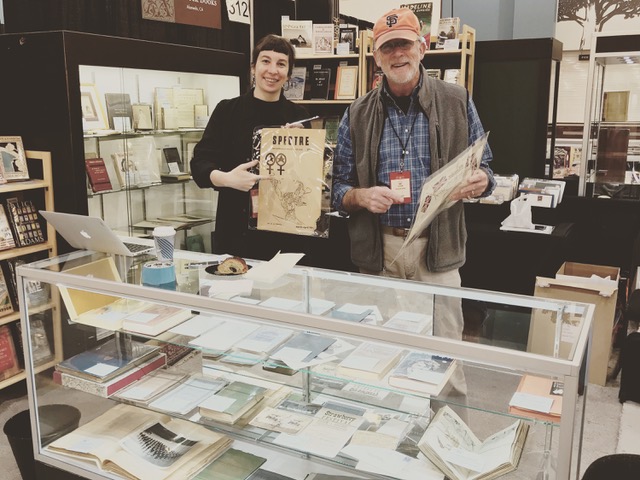
We were able to throw a little shindig at Tavistock Books’ main residence – 1503 Webster Street in Alameda, California (where we have been located for the last 22 years of our full 30). Samm and Vic made sure there were snacks and champagne galore! A big thank you to many of our bibliophile friends for their encouragement – and for the turn out! We had a steady stream of visitors all day and are so happy to not only call them our colleagues, but our friends as well.

vic samm

I don’t believe anyone could have put it better than Chris Lowenstein of Book Hunter’s Holiday (ABAA), “It is a pleasure to see someone be successful in this business for 30 years – especially someone who shares that success with others all around him through his mentorship and kindness. He has been mentoring me for the past 12 years and I wouldn’t still be in this business without him! Congratulations to Vic Zoschak and to Tavistock Books.”

Hear, hear!

MVIMG_20190417_142518 MVIMG_20190417_142505 MVIMG_20190417_142456

Share