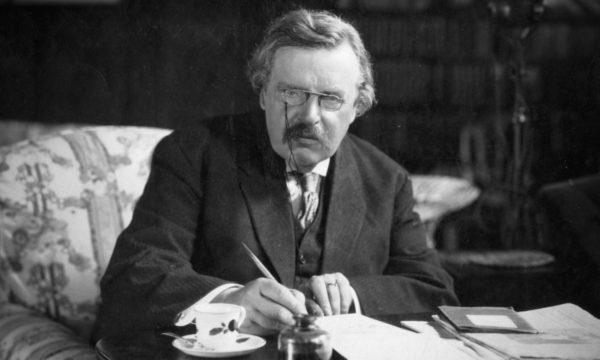
Who WAS G. K. Chesterton?
According to many, he is one of the most prolific and best writers of the early 20th century – and yet he is not one often found on school curriculums or on the average household shelf. So the question is… who was G. K. Chesterton and how did he contribute to the literary world and become his nickname – “The Prince of Paradox”? Let’s find out.
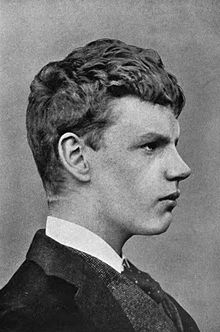 Gilbert Keith Chesterton was born on May 29th, 1874, in Kensington, London. His childhood is not elaborately researched, but we do know that he was born to a family of Unitarians, and as a young man was interested in the occult and regularly played (or practiced) with a Quija board with his younger brother (and only sibling) Cecil. He was educated at St. Paul’s School in London, but instead of continuing on to a university as you might have expected, Chesterton attended the Slade School of Art in London – in hopes of eventually becoming an illustrator. Though at Slade Chesterton took lessons in both art and literature, Chesterton left without a degree in either!
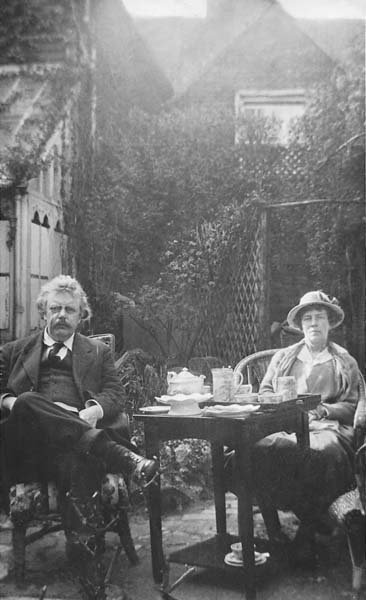 When Chesterton was 27 years old, he married Frances Alice Blogg – an author herself, who would prove to be a major influence on Chesterton’s writing and religious life throughout the years. As www.chesterton.org mentions, Frances was in charge of all aspects of Chesterton’s life – kept his schedule for him, kept house, and kept him in check. According to the site, Chesterton often “had no idea where or when his next appointment was. He did much of his writing in train stations, since he usually missed the train he was supposed to catch. In one famous anecdote, he wired his wife, saying, ‘Am at Market Harborough. Where ought I to be?’” To which Mrs. Chesterton would almost inevitably respond with “Home.” The Chesterton’s were perhaps the epitome of the phrase “Behind every great man is an even greater woman.”
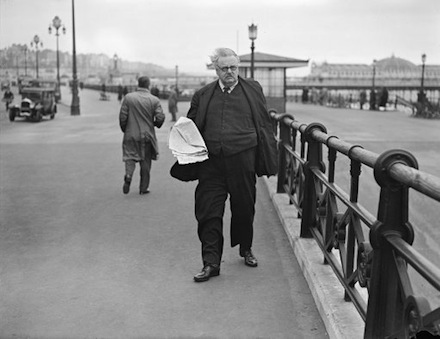
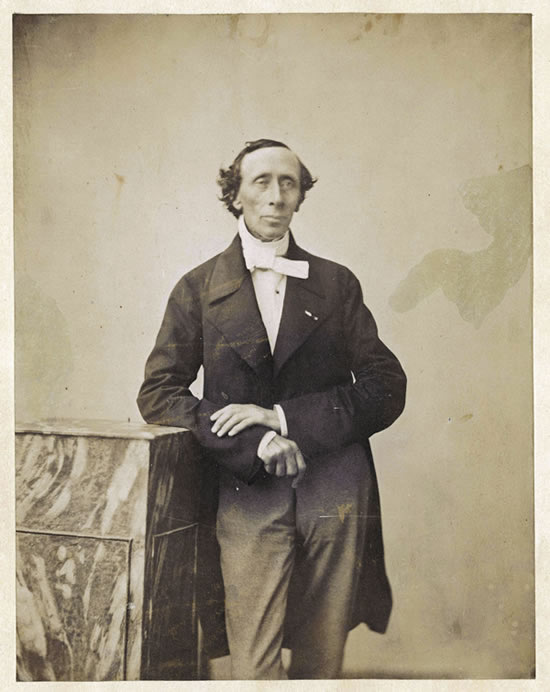
Chesterton cut an amusing figure, indeed. He was 6 foot, 4 inches tall, and weighed almost 300 pounds. He could often be found laughing at himself, smoking a cigar, and scribbling away in the oddest of places. And what was he scribbling? Well – that is a question, isn’t it! Around the turn of the century, Chesterton worked as a freelance art and literary critic before 1902, when the Daily News gave him his own weekly opinion column. From then until the mid 1930s, Chesterton pushed out a steady stream of work – be they stories, poems, essays, articles, biographies or critiques – Chesterton wrote them all. Some of his most notable works included The Napoleon of Notting Hill (a book said to have influenced the setting of Orwell’s 1984), a critical study of Charles Dickens (which you know we love to hear), Orthodoxy (did we mention he was also a theologian?), the Father Brown short stories (has anyone read these? A Catholic priest who solves ghastly crimes and putters about resolving conflicts in his small town? I love them – think Miss Marple-esque), Eugenics and Other Evils (this guy really does get around in terms of subject matter), and The Everlasting Man (the book which reportedly turned C.S. Lewis’ face towards Christianity). Now that’s a resume, eh?! And of course – that is only a smattering of the work Chesterton produced. (The total of which includes roughly 80 books, hundreds of poems, 200 short stories, 4000 essays, and a few plays – jeez!)
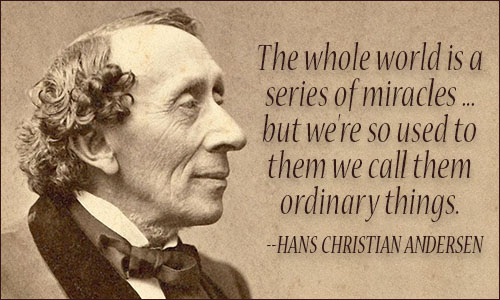
So why the nickname? Well a paradox is defined as: “a seemingly absurd or self-contradictory statement or proposition that when investigated or explained may prove to be well founded or true.” Throughout his work, Chesterton consistently employs a long scope of humor and wit. This is true in both his fiction and non-fiction – and he often used paradoxes to make severe, if humorous (and not to mention true) statements on government, policies, religion, literature and humanity. For example – one of Chesterton’s political paradoxes could still occasionally be considered true today! He said “The whole modern world has divided itself into Conservatives and Progressives. The business of Progressives is to go on making mistakes. The business of the Conservatives is to prevent the mistakes from being corrected.” Ouch! As the Imaginative Conservative (online blog) puts it, “Chesterton show[ed] us that life is full of paradoxes. It is full of those apparent contradictions, those incongruous juxtapositions, that point to deeper truths. Take, for instance, the fact that it takes a big man to know how small he is, or the fact that pride is the sin of a small man who thinks he is big.” Indeed, even more of Chesterton’s paradoxes come into play in his studies of religion – where he considers Christ one of the greatest masters of the paradox.
In all, G. K. Chesterton is not read as widely as he ought to be – considering the breadth of his work and the fact that, if you look hard enough, there is surely something of his for each and every one of us! My advice? Start with Father Brown… you won’t be disappointed!
Happy Birthday to this author, one of the most influential authors of the 20th century!

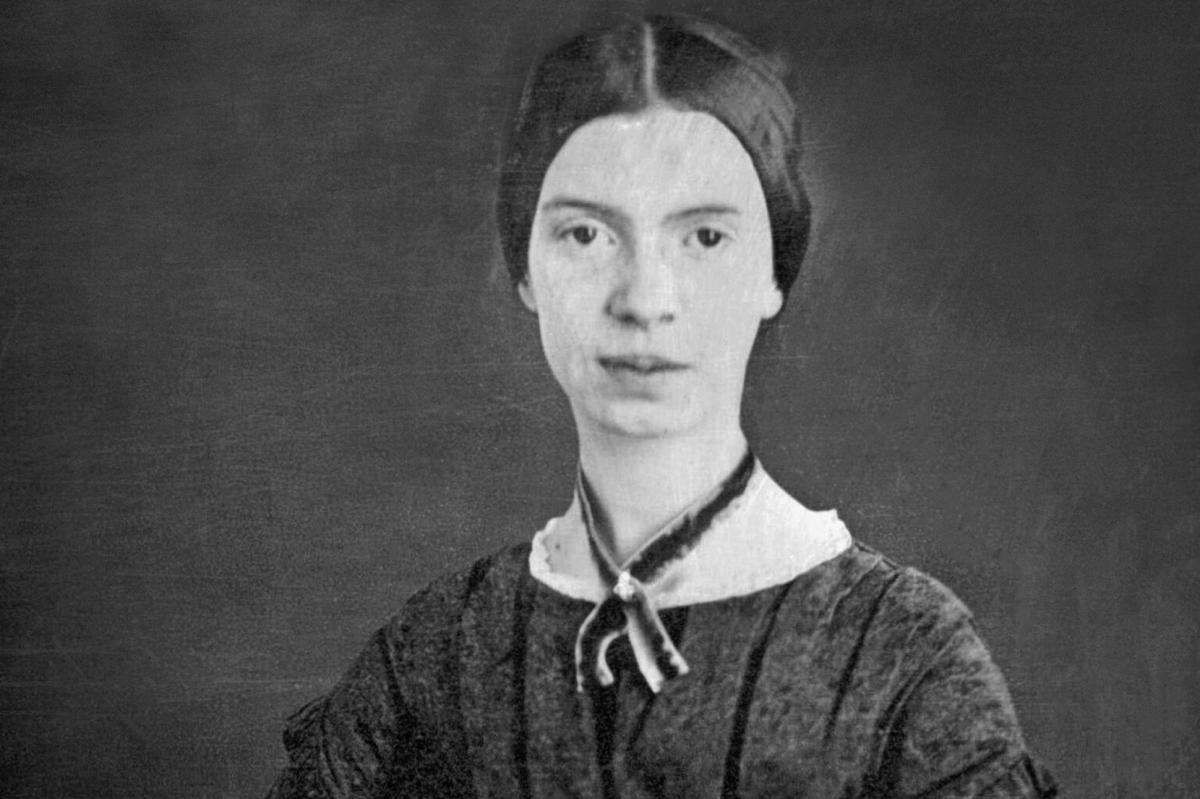
 Emily Dickinson was born in Amherst, Massachusetts, on December 10th, 1830. She was the second of three children, with one elder brother named Austin and a younger sister, Lavinia. Her father was not only a lawyer by trade, but a trustee of Amherst College, where his father had been one of the founders of the school. With their background in education, the Dickinson children were given a thorough education for the time, certainly when it came to the two girls. At the age of 10 Emily and her sister began their studies at Amherst Academy, which had begun to allow female students a scant two years before their studies began. Emily remained at the school for seven years, studying math, literature, latin, botany, history, and all manner of respected academia. Upon finishing her studies at the Academy in 1847, Dickinson enrolled in the Mount Holyoke Female Seminary (now Mount Holyoke College). Although the Seminary was only 10 miles from her home, Dickinson only remained at the school for 10 months before returning home – for reasons many have tried to unearth but none can be sure of.
 Though throughout her late teens Dickinson seemed to enjoy life in Amherst socially, and was certainly already writing poetry (a family friend Benjamin Franklin Newton hinted in letters before his death in this time that he had hoped to live to see her reach the success he knew possible), by her twenties Emily was already feeling a melancholy pull, exacerbated by her emotions when it came to death, and the deaths of those around her. Her mother’s many chronic illnesses kept Emily often at home, and by the 1860s (Dickinson’s 30s) she had already largely pulled out of the public eye. By her 40s, Dickinson rarely left her room, and preferred to speak with visitors through her door rather than face-to-face. Unbeknownst to any, Dickinson worked tirelessly throughout this period on her poetry, and by the end of her life had amassed a collection of roughly 1,800 poems neatly written in hand sewn journals. That being said, less than one dozen of her poems would be published during her lifetime. The first book of her poetry, published four years after her death on May 15th, 1886 by her sister Lavinia, was a resounding success. In less than two years, eleven editions of the first book had been printed, and her words spread across nations.
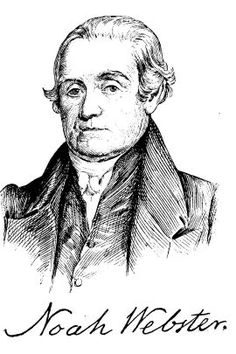
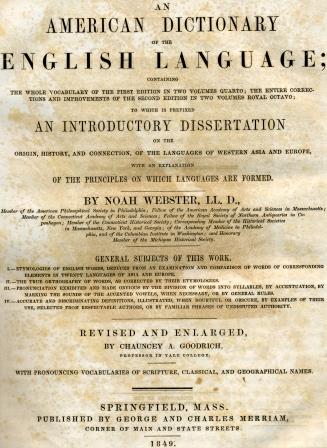
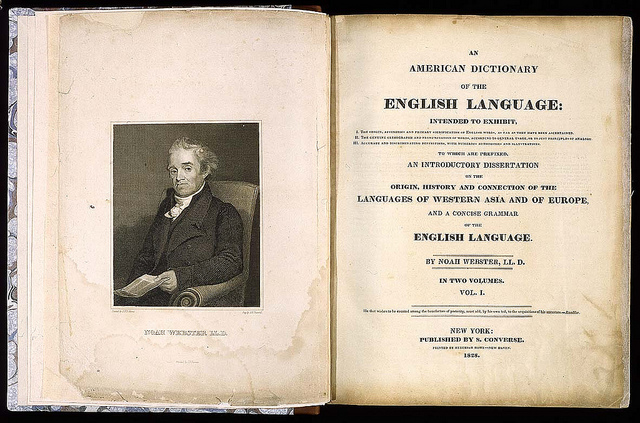
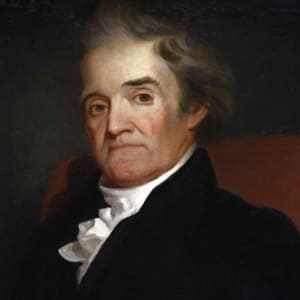 Webster married Rebecca Greenleaf in 1789, and as she was of good breeding (man, I don’t get to use that phrase often enough) he was able to join higher levels of society in Connecticut than he had been. (They would later have 8 children, but that is neither here nor there.) Due to his beliefs in the revolution and conviction in America’s greatness, one Alexander Hamilton loaned him $1,500 in 1793 to move to New York and become the editor for the Federalist Papers. For the next few decades, Webster spent much of his time being one of the most profuse authors of the time, especially when it came to political reports, but also in regard to textbooks and articles across the board.