Author Archives: tavistock_books

Congratulations to Travis Low, Winner of the Tavistock Books RBS Scholarship!

Travis-Low-Ken-Sanders-Rare-Books

Photo: Ashley Thalman, Fine Books & Collections

We’re extremely pleased to announce that Travis Low of Ken Sanders Rare Books has won this year’s Tavistock Books Scholarship to Rare Book School (RBS). Travis will take Joel Silver’s course, Reference Sources for Researching Rare Books, at RBS in Charlottesville, Virginia.

Rare Books through the Back Door

As many of us in this field do, Travis wears many hats at Ken Sanders Rare Books. He came in, almost literally, through the back door, starting out as a shipping clerk. Travis, who is also a documentary filmmaker, was shooting a documentary about writer and performance poet Alex Caldiero. Ken Sanders, a friend of Caldiero’s, appeared in the documentary, so Travis got to meet him. He’d been a customer of Ken Sanders Rare Books and asked if there were any employment opportunities.

He found the bookstore an incredibly collegial environment and has gotten involved in other aspects of the trade as opportunities arose. “Ken has been extremely supportive, and I’m gradually getting more involved in acquisition and description, so this RBS course seems like an excellent place to further my understanding,” says Travis.

As he delves further into the rare book world, research becomes increasingly important. “My favorite aspect of the book trade is when new books come into the store and we get to start digging through them. I find that pretty engaging and have a real affinity for the research required to learn something new about the publishers, the authors, and the books’ subject areas as well.”

The Start of an Ongoing Education

Last summer Travis attended the Colorado Antiquarian Books Seminar (CABS). The program gave him an excellent introduction to the world of rare books, and RBS will allow him to take a more specific, focused course in an area where he needs to grow. Travis noted that he’s been encouraged to further his education through RBS by many respected professionals: Ken Sanders, Melissa Sanders, and Terry Belanger had all stressed the value of the experience.

Travis says that he hopes this will be the first of many courses he takes at RBS. “I’ve spoken several times with Tavistock Books’ proprietor, Vic Zoschak, and he always talks about RBS as his way of continuing his education, and about how he feels an obligation to do that as a professional. That really resonated with me, and I feel compelled to constantly better myself.” After taking Reference Sources for Researching Rare Books, Travis would like to take the Introduction to the Principles of Bibliographical Description.

Travis Low grew up near Logan, UT. He studied Philosophy, Humanities, and Film at Utah Valley University. In January 2010, Travis began working at Ken Sanders Rare Books where he has found an encouraging and instructive working environment. In addition to being a full-time bookseller, he is also an active documentary filmmaker and a hibernating musician. He currently lives in Salt Lake City, UT.

Share

Kate Greenaway: Legendary Illustrator of Children’s Books

Kate-Greenaway

“May Day”

One of the few artists to gain true celebrity from illustrating children’s books, Kate Greenaway was one of the most influential illustrators of her age. Greenaway, along with Randolph Caldecott and Walter Crane, revolutionized illustration. Popular in both Europe and the United States, Greenaway has remained highly sought after, even among contemporary children’s book collectors.

Greenaway’s Early Rise to Fame

Born on March 17, 1846, Greenaway was an only child. Her father was a draughtsman, while her mother was a seamstress who owned a tailoring shop. Both parents encouraged their daughter’s artwork, and in 1867 Greenaway completed her first accompanying illustrations for Infant Amusements, or How to Make a Nursery Happy by William Kingston. The following year, Greenaway began exhibiting watercolors in London’s Dudley Gallery.

Kate-Greenaway-Christmas-Card

Christmas card by Greenaway

Over the next twelve years, Greenaway would illustrate over 30 children’s picture books. She also created Christmas cards and bookplates, which were both incredibly popular. Greenaway’s singular style differed considerably from other illustrators of the day; her pictures were simple and elegant, and they captured a quiet innocence. Greenaway always depicted happy, well loved children in natural scenes, which resonated with people of all ages.

A New Venture

Kate-Greenaway-Under-Window

“Beneath the Lilies” from ‘Under the Window’

Though Greenaway gained considerable notoriety doing illustrations for other authors’ works, she also longed to write her own book. In 1879, Greenaway made her debut as an author with Under the Window. Like her illustrations, Greenaway’s verses were simple, elegant, and charming. The book was an instant success, selling approximately 150,000 copies. Both French and German editions of the book were published. Subsequent titles were equally successful, and Greenaway received a tidy sum for her works. She also published yearly almanacs from 1888 to 1897 (excepting 1896).

Greenaway’s publisher, George Routledge & Co, had earned prominence for publishing yellowbacks, that is, colorful, eye-catching and less costly, glazed-paper volumes, which, to a very large degree, helped make literature more accessible to people of more modest income levels. Famous engraver Edmund Evans, known for his significant artistic contribution to the genesis of the yellowback phenomena, used chromoxylography to reproduce the images for Greenaway’s books.

Trendsetting in Illustration–and Fashion

Likely because her mother was a seamstress, Greenaway paid particular attention to the clothing of her characters. Rather than stick to the fashion of the time, she chose instead to depict characters in clothing from the early 19th century. Though unconventional, the choice proved instrumental in influencing Victorian fashion.

As Greenaway’s books gained international renown, they also attracted the attention not only of book lovers, but also the fashionable set in London. Parents began to dress their children in outfits that could have come straight out of Greenaway’s illustrations. Liberty of London, a well known department store in Britain, even adapted her “looks” for a line of children’s clothing.

A Sterling Reputation among Artists and Collectors

Kate-Greenaway-Painting

“The Rainstorm”

While Greenaway stayed quite busy illustrating and publishing children’s books, she still found time to contribute to the art world. In 1890, she was elected to the Royal Institute of Painters in Water-colour. Greenaway’s work captured the attention of legendary figures like John Ruskin and Arsne Alexandre, and she was compared with Stothard, Reynolds, and even Botticelli.

The variety and beauty of Kate Greenaway’s work have made her a perennial favorite among collectors of children’s books. Her books, greeting cards, book plates, and other art offer limitless potential for building an interesting and dynamic collection.


Share

George Steevens: Bibliophile, Scholar, and Prankster

George-Steevens

George Steevens (1800)

Perhaps best remembered for his exceptional contributions to the study of Shakespeare, George Steevens was also an incredible collector of books. His enthusiasm for Elizabethan literature led him to build an amazing collection, which also included a number of William Hogarth prints. After Steevens’ death in 1800, his library was sold. A significant portion went to the British Museum. But among his contemporaries, George was equally well known for his literary pranks–which did little to endear him to his colleagues.

Shakespeare Scholarship

Steevens’ first published works on Shakespeare were 49 notes to Samuel Johnson’s 1765 edition of Shakespeare’s works. He strongly believed in preserving the quarto editions of Shakespeare, and soon published Twenty of the plays of Shakespeare, being the whole number printed in quarto during his life-time, or before the restoration, collated where there were different copies, and published from the originals. Johnson was so impressed with Steevens’ work, he suggested that Steevens undertake the entirety of Shakespeare’s works.

Samuel-Johnson

Samuel Johnson

That edition, The plays of Will Shakespeare (1773), was ten volumes long and took six years to publish. Though Johnson had contributed to the book only minimally, Steevens lionized his involvement to bolster sales. The edition was received quite well, though later it was discovered that Steevens had borrowed generously from Edward Capelli’s 1768 edition. Steevens and Isaac Reed published an updated edition in 1778. Reed undertook a third edition in 1785, but Steevens, who considered himself a “dowager” editor by this time, had little to do with the project. He resumed involvement only because of his resentment for rival editor Edmond Malone.

Steevens’ Hoaxes and Exploits

For all Steevens’ scholarship, he earned the nickname “Puck of Commentators” for his mischievous pranks. This was certainly a gentle assessment; Steevens executed some exceptional pranks. For his first (mis)deed, Steevens forged a letter from George Peele, recounting his meeting with Shakespeare and other dramatists at the Globe Theatre. Everyone accepted the letter as genuine, and it even appeared in Dr. John Berkenhout’s Biographia litteraria (1777).

Later Steevens decided to exact revenge on Richard Gough, a well known antiquarian against whom Steevens held a grudge. Gough refused to trade his Hogarth plates for some of Steevens’ rare books. Steevens had a large marble block engraved with an Anglo-Saxon inscription and the name “Hardecanute.” The tombstone was displayed in a Southwark shop, and Steevens circulated the story that the headstone had been discovered in Kennington. The faux artifact gleaned a write-up in Gentlemen’s Magazine (1790), and it was Steevens himself who revealed the forgery.

Even accomplished biologist and botanist Erasmus Darwin was taken in by Steevens’ ploys. In the December 1783 issue of London Magazine, Steevens published a description of the invented upas tree of Java, which could kill all other life within 15 to 18 miles. He based his account on the reports of an invented Dutch traveler. Darwin accepted the account and included it in his 1789 Loves of the Plants.

The Other Side of the Coin

Though Steevens obviously loved a good prank, he also helped to expose some of the most notorious forgers of his era. When Samuel Ireland announced that his son William Ireland had discovered a treasure trove of Shakespeare manuscripts. Steevens was quick to criticize the “discovery” and declare the Ireland editions to be forgeries. He also played an important part in exposing the Chatterton-Rowley forgeries.

Meanwhile Steevens was also known for his generosity–sometimes helping the family members of his own rivals. He assisted the family of author Oliver Goldsmith and many others. Ultimately these acts mitigated Steevens’ peers’ evaluation of him. Now he’s remembered not for these hoaxes, but for his scholarship and bibliography.

Share

Happy Birthday, Washington Irving!

April 3 marks the birthday of Washington Irving, American author, historian, and diplomat. Though best known for his short stories “Legend of Sleepy Hollow” and “Rip Van Winkle,” Irving was a prolific writer who also penned several historical fiction books and biographies.

Washington-IrvingChildhood and Education

Irving was born the same week that Britain’s ceasefire ended the American Revolution, and his joyful parents decided to name their new son after George Washington. Young Irving got to meet his namesake when Washington was inaugurated president in 1789, an event that Irving would later commemorate with a watercolor painting. Irving was an unenthusiastic student; by age fourteen, he was already skipping evening classes to attend the theater. Luckily for him, his older brothers were successful merchants who would later support his budding career as a writer.

Irving began submitting pieces to the New York Morning Chronicle in 1802, when he was nineteen years old. Published under the pseudonym Jonathan Oldstyle, the articles focused on New York’s theater and social scenes. They were quite an impressive debut: Aaron Burr, then the magazine’s co-publisher, snipped several of the articles to send to his daughter Theodosia. And Charles Brockden Brown journeyed from Philadelphia to New York to convince Oldstyle to write for Brown’s literary magazine.

Shortly thereafter his brothers sent him to Europe–only to be disappointed that Irving skipped all the “high spots.” He concentrated instead on accumulating an impressive social circle. The charismatic young man soon earned a reputation for congeniality and was a much sought after dinner guest. Irving also forged a close friendship with Washington Allston, who almost convinced him to give up writing for a career as a painter.

Authorial Success

Irving returned to New York, where he founded “The Lads of Kilkenny,” a group of young literati from the city. In 1807, he founded the literary magazine Salmagundi with his brother William and fellow Lad James Kirke Paulding. Even though Irving again wrote under pseudonyms, the magazine helped spread his name outside of New York. And it was in the November 11, 1807 issue of Salmagundi that Irving referred to New York as “Gotham.” Anglo-Saxon for “Goat’s Town,” the nickname wasn’t intended to be flattering. But for some reason it stuck, and Gotham has been used to refer to New York ever since.

Two years later, Irving perpetrated what was one of the greatest literary hoaxes of his time. He placed a series of missing person advertisements in the local papers, asking for information about the whereabouts of historian Diedrich Knickerbocker. Irving also fabricated a notice from a hotel proprietor, threatening to publish the manuscript that Knickerbocker left behind in the hotel room, if the historian failed to surface and pay his bill. The ploy was so effective that New York officials actually considered offering a reward for Knickerbocker’s safe return.

Irving published A History of New-York from the Beginning of the World to the End of the Dutch Dynasty by Diedrich Knickerbocker on December 6, 1809. The book was an instant success. “It took with the public and gave me celebrity, as an original work was something remarkable uncommon in America,” Irving commented. Over time the name “Knickerbocker” became a name for New Yorkers in general; it has since been shortened to “Knicks,” for which the city’s basketball franchise is named.

Financial Struggles and International Copyright Battles

Despite Irving’s fame, he still struggled financially. For a time Irving was editor of Analectic Magazine, where he wrote biographies of naval war heroes. He was among the first to reprint Francis Scott Key’s “Defense of Fort McHenry,” now famous as “The Star-Spangled Banner.” Then the War of 1812 destroyed his family’s finances, and he went to England to keep the family trade business afloat. Irving would remain in Europe for the next seventeen years.

Irving declared bankruptcy and had trouble finding a job. In the meantime, he kept writing at a furious pace. In summer of 1817, he penned “Rip Van Winkle” during an overnight stay with his sister and her husband in Birmingham. By spring of 1819, Irving had sent a set of short stories to his brother Ebenezer. These would become the first installment of The Sketchbook of Geoffrey Crayon, Gent. It met with instant success, and Irving published seven more installments in New York. The stories were reprinted in two volumes in London.

Irving’s bi-continental reputation introduced a significant challenge: literary bootleggers, who would republish his works without permission, particularly in England. Like Charles Dickens, Irving spoke out about the need for international copyright law, but made little progress. Dickens and Irving corresponded on the topic, and Dickens would stay with Irving during his 1842 American tour. But they still grappled with international copyright issues on both sides of the pond. Irving’s stopgap solution: he hired London publisher John Murray to distribute his books in England and made sure to release all his works concurrently in both the US and Britain.

Travel to Spain

Thanks to an invitation from Alexander Hill Everett, the American Minister to Spain, Irving found himself in Spain in 1826. Many manuscripts regarding the Spanish conquests in America had recently gone public, and soon Irving was working on multiple books simultaneously. He wrote The Life and Voyages of Christopher Columbus (1828; his first work not published using a pseudonym); Chronicles of the Conquest of Granada (1829); and Voyages and Discoveries of the Companions of Columbus (1831). These books were historical fiction, rather than biography or history. Irving made one mistake; he helped to perpetuate the myth that scholars of the Middle Ages thought the world was flat. But he wasn’t alone; other authors who promoted this misconception were John William Draper and Andrew Dickson White.

Irving soon moved into the Alhambra, where he expected to finish several writing projects. Instead he was appointed to the American Legation in London. He returned to England to serve as an aide-de-campe to American Minister Louis McLane. Irving helped to negotiate a trade agreement between the US and the British West Indies. He resigned from the post in 1832, returning to the States to publish Tales of the Alhambra.

Western Exploration

That same year, Irving accompanied US Commissioners for Indian Affairs Henry Leavitt Ellsworth and Charles la Trobe, along with his friend Count Albert-Alexandre de Pourtales to survey Indian Territory. The expedition inspired A Tour of the Prairies. Irving also met fur magnate John Jacob Astor during the trip, and Astor convinced Irving to write his biography. Astoria was published in February 1836. Meanwhile Irving encountered Benjamin Bonneville and, fascinated with his tales, convinced Bonneville to sell his maps and notes for $1,000. Irving used these as the basis for The Adventures of Captain Bonneville (1837).

Irving undertook these works, often called his Western series, for a few reasons. First, he was broke. Second, he’d been criticized for becoming a more European writer. Both James Fenimore Cooper and Philip Freneau thought he’d turned his back on America. Fortunately for Irving, the books were received well in the States, though predictably less so in Britain.

After a stint as the American Minister to Spain, Irving returned to his Tarrytown, NY property, called Sunnyside, in 1846. He worked on the “Author’s Revised Edition” of his works for publisher George Palmer Putnam. Irving also turned his attention to biographies, writing about Oliver Goldsmith, the Islamic prophet Muhammed, and George Washington. His biography of Washington was released in five volumes, and Irving died within months of its completion.

Share

The Rare Books of Baseball

This weekend kicks of the beginning of the 2013 Major League Baseball season. While the precise origins of the game remain dubious, the sport has gained a sure place as the most popular sport of focus among rare book collectors.

A Legendary Rivalry

Henry Chadwick (1824-1908) was a British-born journalist. A true baseball enthusiast, Chadwick launched one of the first newspaper columns devoted to baseball. He was also among the first to record baseball statistics as a means to evaluate individual players’ performance. In 1903, Chadwick wrote an article suggesting that baseball was a form of an English game called rounders. The game had similar rules and equipment, so the guess seemed plausible enough.

Enter Albert Spalding (1850-1915). A great pitcher from the 1870’s, Spalding was one of baseball’s greatest advocates. He owned the Chicago White Stockings and the National League of Professional Ball Clubs. In 1911, Spalding launched a massive campaign to make baseball the national pastime. He believed that baseball was a quintessentially American game–and was invented by Americans. Thus he vociferously disagreed with Chadwick’s assertion that baseball had British origins.

To settle the disagreement, Spalding appointed a committee whose mission was to uncover the origins of baseball. He selected Abraham Mills as the chairman. Mills was the National League’s president from 1882 to 1884. The task force, nicknamed the “Mills Commission,” ruled on December 30, 1907 that Abner Doubleday had invented baseball. Immediately a myth was born.

The Doubleday Myth

The Mills Commission based their ruling almost entirely on the testimony of one man: 71-year-old Abner Graves, a mining engineer who lived in Denver, Colorado. Graves responded to a “call for people who had knowledge of the game,” placed in Akron, Ohio’s Beacon Journal by Spalding. Graves claimed that he’d seen Doubleday draw a diagram of a baseball field back in 1839, during a schoolboy’s game. Graves sent his account to the Beacon Journal, which printed it with the headline “Abner Doubleday Invented Baseball.”

Abner-Doubleday-Baseball

US Army general and Civil War hero Abner Doubleday was spuriously credited with creating baseball thanks to the Mills Commission.

Meanwhile Doubleday himself never claimed that he invented the sport. A US Army general and Civil War hero, Doubleday never once mentioned baseball in his extensive diaries. By the time the Mills Commission declared Doubleday the inventor of baseball, he’d already passed away. But that didn’t stop the myth from taking on a life of its own. Soon, Doubleday was even credited with introducing baseball to Mexico during the Mexican-American War.

Flaws in the Doubleday Myth

Unfortunately the Mills committee overlooked some critical information. First, Graves wasn’t the most reliable witness. He’d been only five years old in 1839 when he supposedly saw Doubleday diagram the baseball field. But the greatest flaw in Graves’ account was that Doubleday was not even in Cooperstown, New York in 1839.

Clearly Doubleday hadn’t invented baseball, but who had? America longed for an answer. In 1953, Congress named Andrew Cartwright the inventor of baseball, definitively debunking the Doubleday myth. Cartwright, a volunteer firefighter, had been a founding member of the New York Knickerbockers (est September 23, 1845). He’d been instrumental in making baseball more of a gentlemen’s sport. But modern scholars of baseball have also dismissed Cartwright as baseball’s inventor.

New-York-Knickerbockers-Baseball

The New York Knickerbockers were the first organized baseball team. In 1953, Congress declared founding member Andrew Cartwright the inventor of baseball.

Historian and antiquarian David Block is the leading scholar on the history of baseball. His 2005 book, Baseball before We Knew It: A Search for the Roots of the Game, outlines the earliest mentions and illustrations of baseball in literature. The first known appearance of “base-ball” in print occurred in the 1744 edition of A Little Pretty Pocket-Book. And the first-known rules of baseball were printed in Spiele zur Erholung (1796). The German book that summarizes the rules of a game called “Ball mit Freystaten (oder das englische Base-ball),” which translates as “ball with free station (or English base-ball). Block illustrates the similarities between baseball and trapper ball He also notes that the first written account of rounders in England was in The Boy’s Own Book (1828).

Thus, neither Chadwick nor Spalding (nor the 1953 American Congress) was correct about baseball’s origins. The game had already existed for nearly a century before Doubleday, Cartwright, or any of their relative contemporaries could have “invented” it.

Collecting Rare Baseball Books

Baseball is by far the most popular game among collectors who specialize in a sport. This is due, in large part, to the mysterious origins of the sport. But there are also plenty of niches for collectors to focus on, from baseball’s early history, to regional leagues or specific teams, to baseball fiction.

Spalding-Official-Baseball-Guide

Henry Chadwick, the sports writer who had questioned baseball’s origins, played a significant role in nationalizing the rules of baseball. He wrote Beadle’s Dime Base-Ball Player most years, from 1860 to 1881. The guide included not only rules for the game itself, but also guidelines for establishing baseball clubs and game statistics from the previous year. These guides were ubiquitous at the time, helping to spread interest in the game and normalize rules. But Chadwick’s guides have become exceptionally scarce, and they’re prized among collectors who specialize in baseball.

Juvenile-Pastimes-BaseballOne of the earlier references to “base-ball” as a children’s game comes from Juvenile Pastimes; Or Girls’ and Boys’ Book of Sports (1849). References to the sport at this time are particularly uncommon. One of the 17 woodcuts in this book depicts two boys playing “base-ball,” making it a relatively early pictorial depiction of the game.

Baseball fiction has long been favored among collectors. Earlier baseball fiction was often published in serial form, though novels soon gained steam. One especially collectible title is Freddy and the Baseball Team from Mars (1955) by Walter R Brooks. The Freddy series itself is beloved among many collectors of modern first editions, as well.

Freddy-Baseball-Team-Mars

Ephemera also remains attractive, especially to collectors who focus on individual teams. One particularly interesting piece of ephemera comes in the form of a poem by Barry Gifford. An avid Cubs fan, Gifford published “The Giants Are Going to Win the Pennant” on a Madrugada broadside. He compares the poet Jack Spicer to Ted Williams, one of the greatest baseball players of all time, whose “hits are in/the record books/waiting to be broken.”

Giants-Win-Pennant-Baseball-Ephemera

As Americans’ love of baseball remains strong and the game continues to evolve, collectors of rare baseball books will undoubtedly have plenty of opportunities to expand their collections.

Share

Don’t Miss the Sacramento Antiquarian Book Fair

Sacramento-Antiquarian-Book-Fair

This Saturday we’ll be taking Tavistock Books on the road for the Sacramento Antiquarian Book Fair. One of the best regional book fairs, the show features booths from 60 vendors. This Sacramento book fair has gained an excellent reputation in the community, and visitors will find an incredibly variety of items, including many that cannot be found anywhere online.

Sacramento Antiquarian Book Fair

March 23rd, 2013: 9:45 AM to 5 PM

September 14, 2013: 9:45 AM to 5 PM

Scottish Rite Temple, 651 H Street, Sacramento 95819

This fair is unique because it draws such a strong crowd year after year. Fair manager Jim Kay has worked hard to make the event accessible–and memorable–for visitors. For about 20 years now, the fair has been at the Scottish Rites Temple, an ideal location because it’s spacious and offers plenty of free parking. Meanwhile, visitors find a wide variety of unique items. “Our dealers bring items that are unique, and most of them bring items that you simply can’t find on the internet,” says Kay.

Visitors will also be able to get free appraisals on their own antiquarian books, which is always a popular service. Kay, who’s been a book dealer himself for many years, conducts the appraisals. If you’ve always wondered what your books are worth, now’s the time to find out!

The Sacramento Antiquarian Book Fair draws crowds from all backgrounds, from beginners to serious rare book collectors. “Fair offerings run the general gamut, from $5 to $20,000 books. You’ll find collectibles and relatively modern authors, but someone looking for a very rare John Steinbeck would also likely find it if it’s available. There are postcards, original art pieces, diaries of people from the Gold Rush, and more,” says Kay. He also noted that collectors would find plenty of graphic items and ephemera, such as movie posters from the 1920’s and even original paintings.

You’ll find us at the fair with a spectacular collection of items from our inventory. If you’d like to see a particular item, please let us know and we’ll do our best to bring it for you.

Share

Hit the Books with Us at RBS

Rare-Book-School-University-VirginiaWhen’s the last time you were in school? If you’re into antiquarian books, bibliography, or any other aspect of the printed word, it’s time to re-enroll. Rare Book School (RBS) offers an incredible array of courses taught by leading scholars in the field. This year, Tavistock Books is pleased to offer a scholarship to an RBS course for an excellent class taught by expert Dr. Joel Silver.

About Rare Book School

Founded in 1983, Rare Book School had its first home at Columbia University. The program moved to its current home, the University of Virginia, Charlottesville, in 1992. Each year RBS offers about 30 five-day courses related to old and rare books, special collections, and manuscripts. These courses, mostly offered in Charlottesville, are quite intensive; students attend all-day classes and often opt to participate in lectures and other bookish events in the evenings.

As RBS has grown, it has become much more than a collection of bookish classes; it’s now a mainstay of bibliographic education in the English-speaking world. Schools following the RBS model have been established globally. Meanwhile, in 2005 RBS expanded to offer courses at the Morgan Library & Museum and the Grolier Club, both in New York City. Some courses are now also offered in Washington, DC and Philadelphia.

Our RBS Scholarship

Tavistock Books is pleased to offer a full-tuition scholarship for Joel Silver’s course, “Reference Sources for Researching Rare Books” (L-25). The scholarship is available to all antiquarian booksellers interested in the course, and preference will be given to individuals who are early in their careers or who may not be able to attend RBS without the assistance of a scholarship.

The scholarship is offered every year that the course is taught at RBS, and the deadline for 2013 is rapidly approaching! To apply, you’ll need to submit your 2013 RBS summer application along with a cover letter that outlines your reasons for applying for the scholarship, your work in the antiquarian book trade, and any other relevant information.

About Joel Silver and His RBS Course

First offered in 2012, “Reference Resources for Researching Rare Books” (L-25) offers students a comprehensive overview of the myriad resources available for researching rare books. Emphasis is on early printed works; American and British literature; maps and atlases; science and medicine; historical Americana; voyages and travels; and the book arts. Students will systematically learn about approximately 350 printed and electronic reference sources, along with how each was compiled and the strengths and weaknesses of each resource.

Dr. Joel Silver is Associate Director and Curator of Books at Indiana University’s Lilly Library in Bloomington, where he’s been on the faculty since 1983. His articles have appeared in Fine Books & Collections Magazine and AB Bookman’s Weekly. Dr. Silver has taught many rare books-related courses at the Indiana University school of Library and Information Science, where he is the Director of Education for Special Collections.

If you have questions about RBS or the Tavistock Books Scholarship, please don’t hesitate to contact us!


Share

Clara Barton: Heroine of Civil War Nursing and Record Keeping

Clara-Barton-Photograph

“We have captured one fort—Gregg—and one charnel house—Wagner—and we have built one cemetery, Morris Island. The thousand little sandhills that in the pale moonlight are a thousand headstones, and the restless ocean waves that roll and breakup on the whitened beach sing an eternal requiem to all the toll-worn gallant dead who sleep beside.”

-Clara Barton, Morris Island

The Library of Congress commemorates the sesquicentennial of the Civil War with an incredible exhibition of about 200 artifacts from the period—many of which have never been seen before. Last week we were honored to attend the exhibit, and to sit in on a fascinating conversation between filmmaker Ric Burns and Harvard President Drew Gilpen Faust. The two recently collaborated on making a documentary from Dr. Faust’s book This Republic of Suffering: Death and the American Civil War. 

Faust’s book focuses on the ways that the Civil War significantly shaped the way we grapple with death—both personally and pragmatically. At least 2% of the population died during the war, making it the most fatal of all the wars in American history. Several significant figures emerged in this struggle. For example, Edmund Burke Whitman, an abolitionist who’d come from Kansas, took it upon himself to collect information about missing soldiers and the locations of unmarked graves. A quartermaster during the war, Whitman would go on to become the Superintendent of National Cemeteries after the war ended. 

Barton’s Role during the Civil War

But Whitman wasn’t the only one to feel a higher duty to identify the lost and fallen. Born in Massachusetts in 1821, Clara Barton grew up to be one of the most distinguished nurses in the United States. Perhaps best known for founding the American Red Cross, Barton also played a pivotal role during the Civil War—not only as a nurse, but also as a record keeper.

Barton first came to Washington, DC in 1854, where she took a position at the US Patent Office. She worked there for three years, until her abolitionist views made her to controversial and she returned to New England. But 1861 saw her back in the capitol, and when the Civil War broke out Barton was one of the first volunteers to arrive at the Washington Infirmary.

After Barton’s father died, she left the city hospital to care for soldiers in the field. What she found here reflected the scene in battlefields all over the country. There was a dizzying shortage of medical supplies, and Barton purchased supplies with donations and her own money. (Congress would later reimburse her for these expenses.)

Barton also quickly discovered what would turn into one of the greatest challenges in the nation’s recovery: there were no processes for documenting the wounded, the dead, the buried; no protocol for notifying families if a loved one had been wounded or killed. Barton immediately set about collecting as much information as possible. She would post lists of the missing and solicit input directly from the soldiers.

The Nation Faces a New Challenge

It became readily apparent that the isolated efforts of individuals like Whitman and Barton would not be enough. In March 1865, Abraham Lincoln appointed Barton General Correspondent for the Friends of Paroled Prisoners. Her mission was to respond to inquiries from family members who were searching for loved ones. To do this, Barton sifted through all the prison rolls, hospital records, and casualty lists she could get her hands on. These documents weren’t always accurate.

John-Shuman-Civil-War-Correspondence

Take, for instance, the case of John Shuman. He joined the Union Army in August 1862, but died of dysentery in August 1863. Shuman left behind an extensive correspondence with his family, which offers a fascinating glimpse into Civil War soldiers’ daily lives. Though the family name appears to be “Shuman” in the letters, the local census lists the family as “Shurman.” Furthermore the office responsible for removing John’s remains identified him as Shuman, but the grave marker and index at the cemetery list him as “Sherman.” The history of John’s infantry, published in 1895, calls him “John Shewman.”

Many soldiers in the war were not so lucky; they were not identified. Whitman and Barton again led the charge, independently insisting on the identification and marking of soldiers’ graves wherever they could be tracked down. Eventually it was thanks to their efforts that our national cemetery system was developed and implemented.

Barton would go on to distinguish herself as the founder of the American Red Cross and a true pioneer in the field of nursing. But her contributions during the Civil War were an equally significant accomplishment. What do you believe is Barton’s greatest achievement?


Share

Of Slavery, Psalms, and Sculpture

Zingo-Stevens-slavery-rare-books

We love rare books not only for the stories told on their pages, but for the stories of the volumes themselves. The previous ownership of a book, known as provenance, can often be even more interesting than the book itself. Such is the case with one copy of The Psalms of David; though this book was common enough, one particular volume was owned by Zingo Stevens, formerly Pompe Stevens. Sold into slavery, Stevens apprenticed as a stonemason, earned his freedom, and helped to start the nation’s first self-help group for African Americans.

Apprenticeship with John Stevens

From the moment the first slave ship, the Sea Flower, landed in Newport, Rhode Island in 1696, the town embraced the slave trade. At that time, the city produced some of the best rum in the New World. Citizens traded the rum for slaves–then traded the slaves for molasses to make more rum. As the town grew, it became less dependent on rum and soon grew into a bustling urban center.

Thus, unlike their counterparts in the South, slaves in Newport usually entered apprenticeships and learned a trade. When Pompe Stevens arrived in the city, presumably from West Africa, he was bought by John Stevens, whose Christian name Pompe took per the custom of the time. Stevens’ family owned a prominent stonemasonry. The shop had opened in 1705 and continues to operate today; indeed it’s one of the longest running businesses in the United States.

Zingo-Stevens-Newport-slavery

Zingo Stevens’ work shows up throughout the Newport Burial Ground, unusual because African Americans were usually not permitted to do such work for white clients. But this tombstone bears designs strikingly similar to the one that Zingo carved for his brother.

Eventually Pompe worked alongside John Bull and John Stevens at the stonemasonry, primarily making headstones for African and African American members of the community. Pompe’s responsibilities included writing inscriptions on headstones, which certainly contributed to his literacy–extremely rare among slaves.

Pompe’s work shows up in the Newport Common Burial Ground. Interestingly enough, though the cemetery is segregated and blacks were thought never to do work on for white customers, Pompe clearly completed work for clients of both races. He signed many of the tombstones, including that of his own brother and of his first wife, Phyllis. Pompe, therefore, was one of the first known African-American sculptors.

Newport’s Unusual Culture

Zingo-Stevens-Newport-Slavery-Phyllis-Lyndon

Zingo depicted his first wife, Phyllis, wearing traditional African dress and cradling their infant son, who also died.

Unlike most cities in the colonial United States, Newport offered uncharacteristic tolerance and even sometimes celebration of African and African-American culture. This is evident in the cemetery, where tombstones bear traditional African names and likenesses. For example, when Pompe’s first wife, Phyllis died in childbirth, Pompe engraved an image of her cradling their infant and wearing typical African dress.

This tolerance may have been a manifestation of several factors. First, Newport was home to Quakers and several other religious minorities who openly opposed slavery. Theologian Samuel Hopkins even established a church where slave owners could not be members, and blacks could be full members. Second, because Newport slaves tended to be craftsmen rather than field hands, they earned slightly more status and were better equipped to buy their own freedom through trade work. And finally, slave owners tended to share their homes with their slaves, fostering a different kind of relationship.

This is not to say that slaves in Newport didn’t face oppression and prejudice; but the culture created a different dynamic than was often found in the South. The ornate headstone that Pompe carved for Phyllis was actually paid for by her owner, a situation that would scarcely have happened on a rural plantation.

By 1784, Rhode Island had actually begun to abolish slavery. Already, freed slaves had earned prominence in the community. Pompe Brenton, a cook for the Brenton family, earned his freedom and established himself as caterer and public leader. And Duchess Quamino bought her own freedom, goin going on to earn the nickname “Pastry Queen of Rhode Island.” Pompe gained his freedom when his owner John Stevens died in 1786. Stevens stipulated in his will that Pompe and his third wife, Violet, be set free. Pompe officially changed his name to Zingo after his liberation, though he’d been using the traditional African name for quite some time.

The African Union Society

Even before earning his freedom, Zingo had worked to further the African-American community of Newport. In 1780, he and Newport Gardner founded the Africa Union Society (AUS). The organization was the first self-help organization for African-Americans in the United States. The AUS offered the typical benefits of a mutual-aid society, such as support and loans after an illness or death and loans for buying property.

Some members of the organization also felt an incredibly strong connection to Africa and wanted to emigrate back there. Members of the AUS wrote letters to the federal government, asking for funding and inquiring about their ability to own land in Africa. In 1825, Gardner finally managed to return with a small group of AUS members, but died shortly thereafter.

Newport-Gardner-AUS-diaspora

Newport Gardner arrived from East Africa seeking an education. He received that, as evidenced by this letter to his niece. Gardner would later return to Africa with several members of AUS.

Meanwhile, the organization began to incorporate more religious elements. By 1824, the organization had changed its name to the Colored Union Church and Society, making it the first separate black church in Newport. The AUS played a vital role in recording the births, deaths, baptisms, and weddings of the African-American community, and it also offered opportunities for group worship.

Zingo’s literacy probably proved useful, as he could read hymns and scriptures and share them with the congregation. Thus his copy of Psalms of David, Imitated in the Language of the New Testament would have been an incredibly important book for Newport’s African-American community. Books of such provenance–owned by a literate revolution-era slave who was also an important public figure–are incredibly scarce.

Though we know few details of his life, Zingo’s book offers us an opportunity to glimpse into his life and get a deeper understanding of a pivotal period in American history. His voice verily comes alive as you turn its pages. Which rare books in your library have a similarly significant provenance?

Share

Bonnie Prince Charlie Takes a Treasonous Stand

Prince-Charles-Wales-Jacobite-Rebellion

Bonnie Prince Charlie cuts quite the dashing figure, but was he really the romantic hero history makes him out to be?

The Jacobite uprisings, especially the last in 1745, have often been romanticized. We may even see Prince Charles of Wales as a romantic hero, personifying the age-old conflict between Scotland and England. Yet his character and the conflict were much more complex, and they fascinate historians to this day.

A Brief History of the Jacobites

The issue of religion had long been a divisive one in England. King Henry VIII first separated the English Church from Rome in 1534, primarily because he wanted to divorce Catherine of Aragon and marry Anne Boleyn. Pope Paul III excommunicated Henry, who then declared himself Supreme Head of the Church of England. Subsequent monarchs introduced further reforms, and England has had an uneasy relationship with the Catholic Church ever since.

Fast forward to 1689. That year King James VII of Scotland (II of Britain) fled Britain to escape the invading armies of William of Orange. The British government feared that James would re-instate Catholicism as the national religion, so Parliament invited James’ daughter Mary and her Protestant husband William to take the throne. James certainly didn’t go quietly, but he was utterly defeated in the Battle of the Boyne and left the British Isles altogether. But James still had plenty of supporters, called Jacobites, throughout Britain.

Generations in Exile

James’ son, James Frances Edward Stuart had been born only one year earlier, in 1688. He would have been James III of Britain but instead grew up in exile. But he took up his father’s fight, staging more unsuccessful uprisings and earning the nickname “the Old Pretender.” Though James was extremely brave and honorable, he also had atrocious luck. In 1718, he entered negotiation with King Charles XII of Sweden for 10,000 troops. But the king died before they reached an agreement. And in 1719, the Spanish Armada was promised to back James, but the fleet was thwarted by terrible weather.

Unfortunately James’ Catholicism proved an extraordinary obstacle in gaining new supporters. It didn’t help that he’d settled in Rome and received the support of the Pope. By this time James also had two sons, Charles and Henry, who grew up in Rome. Both received considerable support from the Catholic Church, especially in their later years. Henry would even go on to become a cardinal.

Charles, however, aspired to the British throne. He furthermore believed in the divine right of kings and planned to make himself the absolute ruler of Britain–which would have required dissolving Parliament. Whatever his intentions, Charles’ efforts often undermined the Jacobites’ efforts; a heavy drinker, he lost his temper when conditions grew unfavorable. The Prussians actually withdrew their support of the Jacobites because Charles publicly insulted them while intoxicated.

The Jacobites still enjoyed support in both Scotland and England. Jacobites wore a white rose on the Old Pretender’s birthday, and they sported white cockades on their hat to show their loyalty to the Jacobite cause. Wearing a tartan waistcoat also became a symbol of support, as traditional kilts were temporarily banned because of their affiliation with the rebel forces.

A Portrait of Misplaced Confidence

In 1745, Charles, who had by now earned the nickname “Bonnie Prince Charlie,” decided to stage another uprising. He landed on the small island of Eriskay and gathered a group of loyal Clan chiefs to fight alongside him. The troops easily too Edinburgh, thanks to a brilliant surprise attack in the marshes of Prestonpans.

Charles Prince of Wales-Jacobite Rebellion

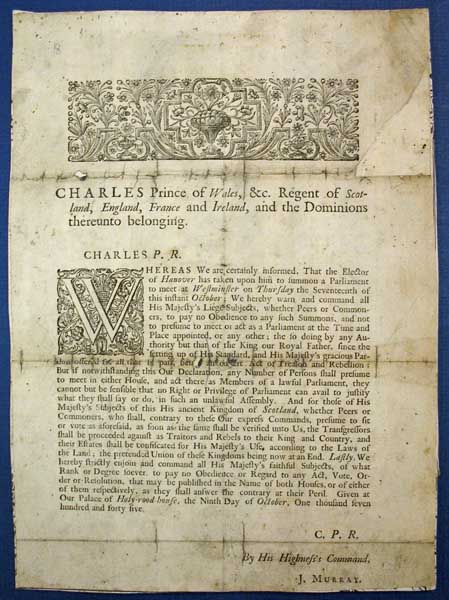
Prince Charles issued this inflammatory broadside at the height of the Jacobite rebellion. He denies the authority of Parliament and calls its members traitors.

That early victory lent Charles an early–and misguided–sense of confidence. At the apex of the rebellion, he issued a fascinating broadside. In it he proclaimed that the British Parliament lacked legitimacy and called those who attended it both traitors and rebels. Charles even goes so far as to declare the “pretended union of these Kingdoms now at an End.” Only six of these broadsides are known to survive.

Final Defeat

The Highlanders only wanted to take Scotland, but Charles had bigger ideas. He deceived his troops, promising that English Jacobites would meet them further south. In reality, the English Jacobites had decided not to participate in the uprising at all. Under these false pretenses the Highlanders advanced with Charles through Carlisle and Manchester.

But when they reached Derby, they faced three different armies. It was only then that the Highlanders realized Charles had lied. They hastily retreated. Charles reportedly drank and moaned all the way home. Then at Culloden the British troops cornered them. As they slaughtered the Highlander soldiers, Charles managed to escape. This defeat marked the final blow for the Jacobite cause.

Charles made his way out of Scotland despite a £30,000 reward offered for information leading to his capture. Countless Scots helped him on his journey, and he always managed to stay one step ahead of the British government. He eventually found passage aboard the French frigate L’Heureux and arrived in France in September 1745. He’d live the rest of his life in exile.

Last Attempts at Power

Charles returned to France, where he lived until 1748. That year he was expelled under the Treaty of Aix-la-Chapelle, which ended the war between France and Britain. He then lived for several years with his Scottish mistress Clementina Walkinshaw, whom he’d likely met during the 1745 rebellion. The couple had an illegitimate daughter, Charlotte. Later, many would suspect Charlotte of being a spy for the Hanoverian government of Great Britain.

Meanwhile Charles acknowledged that his Catholicism was a huge stumbling block and committed to becoming Protestant if that would help his cause. Thus in 1750 he entered England incognito and took Anglican communion. His conversion wasn’t widely advertised; indeed by the time he married in 1772, Charles seemed to have returned to the Roman Catholic Church.

Almost a decade later, in 1759, French foreign minister Duc De Choiseul summoned Charles to a meeting in Paris. De Choiseul planned a full-scale invasion of England and hoped to rally the remaining Jacobites behind his cause. The Seven Years War had reached its height, and De Choiseul saw this as a golden opportunity. Unfortunately he was none too impressed with Charles stubborn idealism and gave up on attaining Jacobite support. This French invasion marked Charles’ last real opportunity to retake the British throne, but the effort was thwarted by naval defeats at both Lagos and Quiberon Bay.

The final blow came in 1766, when Charles’ father James died. Pope Clement XIII had recognized James as king of England, Scotland, and Ireland, along with James III and James VIII. He didn’t grant Charles the same legitimacy. This very public snub undermined any last claim to the throne that Charles had had.

Charles died on January 31, 1788. He was interred first at the Cathedram of Frascati, where his brother Henry was a bishop. But when Henry died in 1807, Charles’ remains were relocated to St. Peter’s Basilica in the Vatican. Both brothers are interred there, along with their parents.

Share