Category Archives: History

The Art of Freeing the Mind (and Body) with Henry Miller

Screen Shot 2016-04-05 at 3.32.48 PM

By Margueritte Peterson

Normally our author blogs are based on a date in the life of said author – birthdays, publishing dates, even memorials to their deaths. I’d like to take this moment to say that this is not one of those types of dates. This blog is completely and utterly random… all because I recently dreamt about seeing a sunrise at Big Sur and decided to get to know one of the many authors who made the area their home… Mr. Henry Miller.

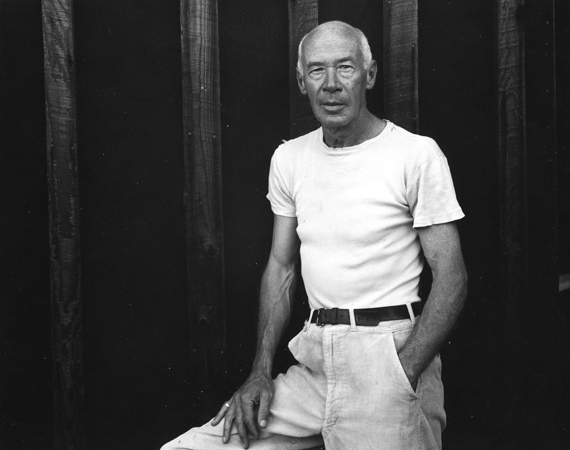
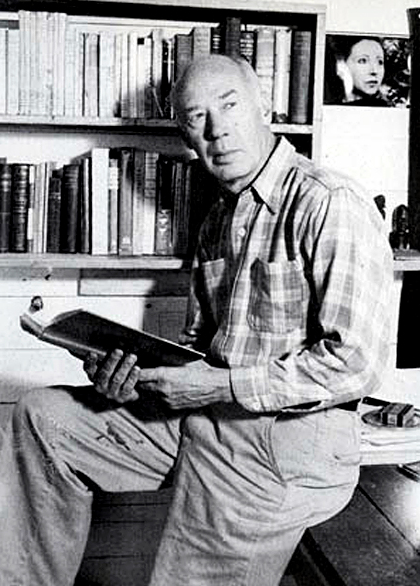
Screen Shot 2016-04-05 at 3.32.39 PMHenry Miller lived to the ripe old age of 88, and in less than a century managed to offend tens of thousands of people. His books were banned in not only states but entire countries. (The United States being one of them… yay for freedom of speech?) And why was this one man as taboo as sex before marriage was to Victorians? Because he dared. Well… dared in life and then proceeded to publish his daring activities. Miller was known for his free way of writing – a truly singular author in style, blending many different genres of literature (autobiography and philosophy, surrealism and social critique – to name a few) creating a truly unique voice. But one of the many aspects that set him apart from the crowd was the fact that his work was, at the least, semi-autobiographical in nature – and to describe the sexual exploits of a lonely man in Paris in the 30s was gutsy, to say the least. So what in Miller’s life was so audacious as to be banned in countries around the world? Well I’ll tell you…

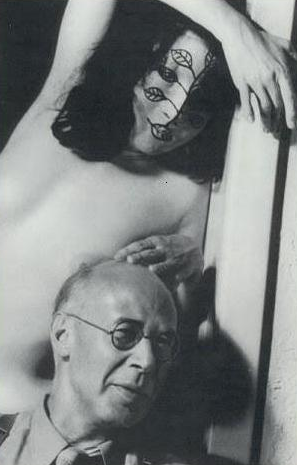
Miller was born the day after Christmas in 1891 and spent most of his childhood growing up in Brooklyn, New York. The author married his first wife (Beatrice Sylvas Wickens) young, and though the union produced his first child, daughter Barbara, in 1919, the marriage was not a happy one and the couple divorced in 1923. A short while after his divorce was finalized (so shortly, in fact, that it is quite likely Miller began the next relationship before the end of his first one) Miller married a dancer who went by the name June Mansfield. June would be much written about and discussed for both her beauty and her deceptive and slightly challenging nature. During his marriage to Mansfield, Miller would spend much time abroad, particularly in Paris (and continued to live there for 5 years after she divorced him by proxy in 1934). His time in Paris was very influential to his writing, as he became ingratiated with a literary community there – so far as to be financed by Anais Nin and her husband Ian Hugo for most of the 1930s while he wrote in (what would today be considered) poverty. Nin and Miller were lovers and their relationship would be common knowledge once Nin’s private diaries were published (with both’s permission) in 1969. The pair would remain friends for life.

Screen Shot 2016-04-05 at 3.32.55 PMThe Dust Jacket on his first published work, “Tropic of Cancer” (1934) came with a warning to readers that it was not to be distributed in the United States or in Great Britain. Miller’s work detailed varied sexual experiences that were considered extremely scandalous (perhaps because they were based in truth!) for the time and for a great number of years his work was banned in two of the most (supposedly) democratic countries in the world. Luckily for the author, however, the censorship and scandal surrounding his work grew him a fantastical reputation in underground literary society – and despite his books being banned he was world-famous and well-known. Though Miller eventually grew tired of being respected for writing what, to some, came across as smut or erotica, he did not fight his reputation (being married and divorced five times certainly didn’t help to quell the image of his excessive sexuality). He is known to have inspired an entire group of writers that later would become known as the Beat Generation (Jack Kerouac cited Miller as one of his literary idols). For that he is considered one of the forerunners of modern literature, and is to be revered for his help in freeing up the “mind” for future authors and audiences.

Share

Who cares that Gold was found near Sacramento? Check out these Gems we Mined at the Sacramento Antiquarian Book Fair…

Screen Shot 2016-03-28 at 6.27.56 PM


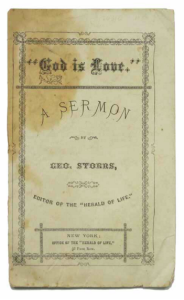
Circa 1869, this pamphlet titled “God is Love. A Sermon” was authored by George Storrs – one of the leaders of the Second Advent movement, affiliated with William Miller and Joshua V. Himes. After a fair amount of study, Storrs preached to some Adventists on the condition and prospects… for the dead. OCLC records no copies of this pamphlet, nor is it found in the NUC! See more on it here>


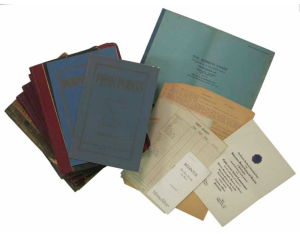
Screen Shot 2016-03-28 at 6.38.53 PMThis set of 5 Nursing Student journals were written between 1923 and 1926 by one Mildred Godwin, a class of ’26 nursing student at Crozer Hospital, Chester, Pennsylvania. Within these journals the young lady records diverse class notes beginning in September of 1923 from lectures by her professors – Dr. Crowther, Miss Burkhard, Dr. Gray, etc. The subject of her entries range widely across the medical spectrum, from items such as Social Service to “Why Cases are Referred.” A very interesting archive of post WWI nursing education! Check it out here>


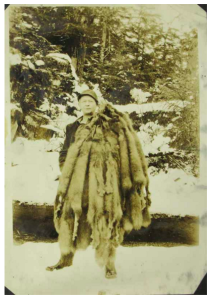
Screen Shot 2016-04-01 at 10.05.56 AMThis is no ordinary promotional photograph album or scrapbook… at least, not in terms of subject! The Alaska Blue Fox Company seem to have produced this interesting documentary album, providing an invaluable historical look at a very successful fox farming venture (yes, you read that correctly. No, there’s nothing I can do about it) on Bushy Island, in the Southeast Alaska Islands. After WWI there was a rise in fur prices, giving some eccentric entrepreneurs an opportunity to lease the island in the Tongass National Forest off the coast of Alaska and stock it with some 20 breeding pairs of foxes – all for your wearing pleasure. Be unnerved here>


Screen Shot 2016-04-01 at 10.06.36 AMThis 1929 Promotional Project Photograph Album details the Western Maryland Railway – a (primarily) coal & freight hauling operation – with images of the diverse aspects & views of the port facilities & docks, of the ‘up-to-date’ buildings & even some freight moving mechanisms (spiral chutes & cranes, etc). An outstanding, possibly unique album documenting local pre-depression Baltimore history, as well as the capital improvement efforts of one of Maryland’s major transportation firms! Love automotive and locomotive history? This is the album for you…

Share

It’s Always Sunny in Sacramento

Our main lady, the lovely Kate Mitas, reports on the recent Sacramento Antiquarian Book Fair. That’s not all… perhaps I should call it (for Tavistock Books, at least) the most recent and successful Sacramento Antiquarian Book Fair. Stay tuned!
IMG_2801 (1)

By Kate Mitas

Maybe I’m wrong, but I’m willing to bet that by now, if you’ve been following Tavistock’s less than stellar performance at the past three book fairs, you probably don’t really give a damn about the progress of this latest fair. All you really want to know is if we finally, finally managed to have a decent book fair, or if we’ve had to slink away with our tail between our legs yet again.

Now, if this were any other book fair, knowing that wouldn’t actually stop me from forcing you to sit through this entire blog, anyway, while I regaled you with comic misadventures and newbie impressions until, at the very last minute, revealing whether or not we’d succeeded. But just this once, I’ll spare you the suspense. 

Because this isn’t just any old book fair: at long last, and for the first time ever in my short antiquarian bookselling career, Tavistock Books actually had a good book fair.

Yeah, you read that right: we had a good book fair! We sold books! And we even made some money! Hurrah!

Well, that is to say, we mostly had a good book fair. And then again, we almost didn’t. Because, in fact, we nearly gave up before we began, and the good ship Tavistock, languishing in the doldrums for so long, seriously considered dropping out of the fair circuit altogether. 

See? There’s always a story to tell. 

So, for any who are still curious, procrastinating, or otherwise willing to fritter away a few more minutes of your time: here is your tale of book fair woe and triumph, as soberly and matter-of-factly told as I can manage right now.

Once upon a time, in a land rather a lot like this one, but slightly more drought-stricken, a wee lass of a bookseller-in-training traipsed off to Sacramento to work her first-ever booth at an antiquarian book fair. Let’s say, for the sake of this story, that it was a bright September afternoon in 2015, and that, although the hills and fields were brown and had been for some time, the sky was blue and cloudless and full of promise. This young bookseller and her not-so-young boss barreled up Interstate 80 in the shop’s trusty van, which was filled with what seemed like good candidates for a regional book fair: loads of Californiana and Western Americana, interesting ephemera, and, of course, helpings from some of the loveliest books in the shop’s specialties. The iron mesh door behind the front seats rattled quietly as they drove, and the side panels of the folded wooden bookcases in back occasionally let slip a muted clack whenever the van hit a bump. These sounds were oddly soothing to the young bookseller’s jangling nerves.

Our heroine was but five weeks into the antiquarian book trade, then, and ignorant of the sometimes cruel vagaries of the book fair circuit. She had high hopes for the shop’s success at the fair, though she kept them to herself, not wanting to jinx it. And yet, as perhaps a few of you may recall, those hopes were thoroughly quashed by the nearly unrelenting cacophony of crickets in the Tavistock booth that weekend. 

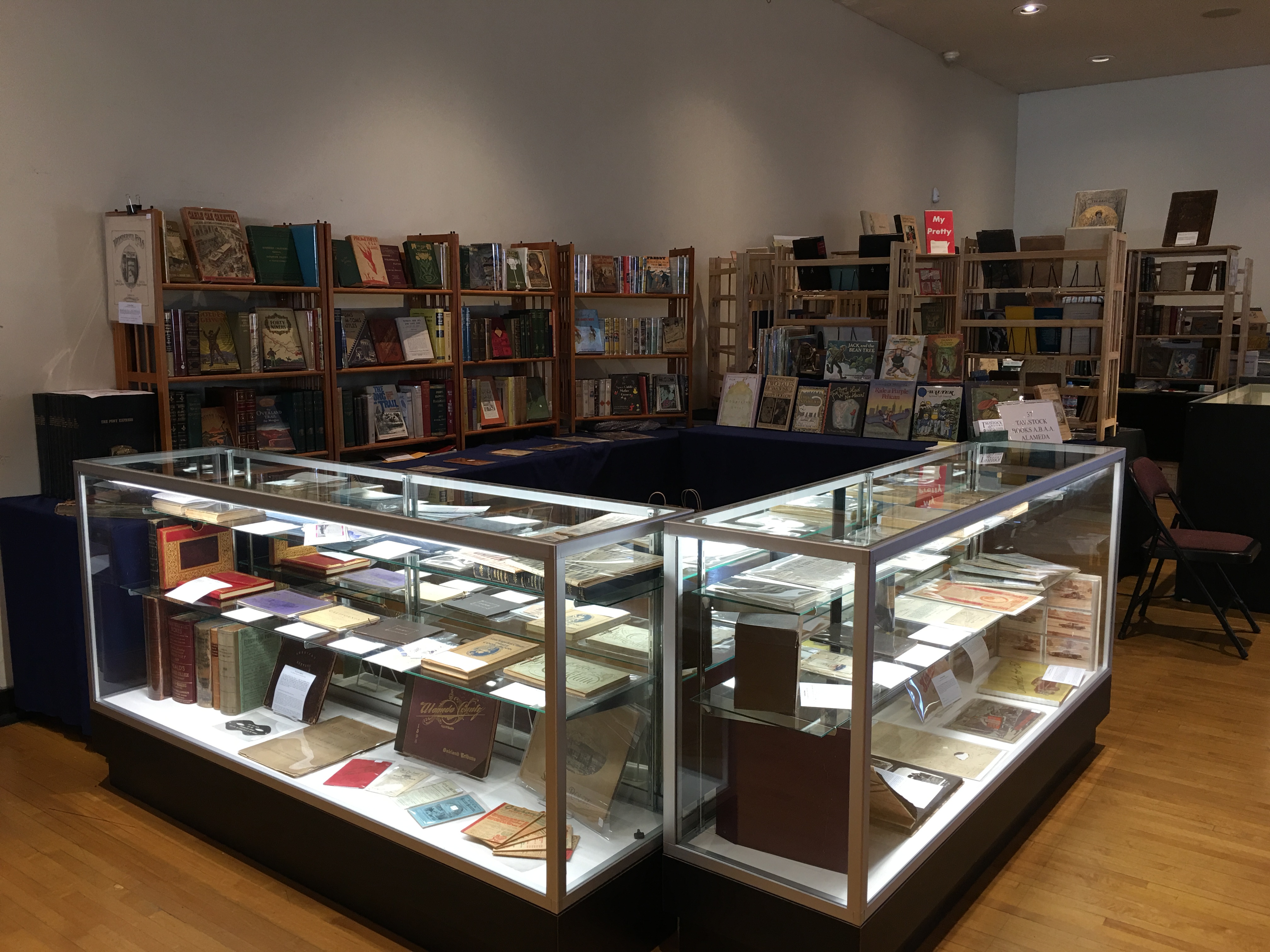
Three mournful, but plucky, blogs, two increasingly painful unsuccessful book fairs, and one wrecked van later, and the mood in the shop during the days leading up to this past weekend’s biannual Sacramento Antiquarian Book Fair was decidedly grim. A kind of preliminary dread set in. There was talk of abandoning the fair circuit. All of our books looked crummy. Never mind that a second look might at them might steal our hearts all over again — no customer would want them. It rained all week, adding to the gloomy atmosphere. In short, we had the pre-fair blues.

Nevertheless, despairing naps and weeping under one’s desk are generally frowned upon at work, so, naturally, we went through the motions of packing and preparing. And while we were doing so, it occurred to me that if we kept on this way, we were definitely going to have another bad book fair. And I wasn’t having any of it, not this time.

“Hey, Vic,” I announced, “you know this is going to be my first successful book fair, right?” (This is true — you can ask him.)
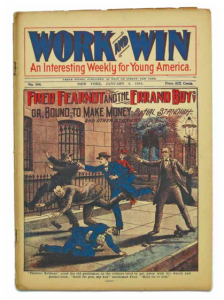
The lucky title that perhaps played a hand in Tavistock Books' successful Sacramento fair! See it here>

The lucky title that perhaps played a hand in Tavistock Books’ successful Sacramento fair! See it here>

He seemed doubtful. And who can blame him? But instead of packing “The Dying Californian,” the songster that had served as my first Sacto fair’s sorry mascot, I decided to bring along our copy of Fred Fearnot and the Errand Boy; or, Bound to Make Money. Sure, maybe it was silly, but maybe it’d bring us a bit of much-needed luck, too. Plus, if things worked out, it’d make for a good blog title. “Kate Fearnot” has a certain ring to it, after all . . . 

Okay, if I’m honest, I can’t really take credit for the success that followed. Clouds continued to loom as we left the city, but the sun broke through around Vacaville. Thanks to Jim Kay’s tireless efforts, booth setup went smoothly, for the most part, and any flagging spirits were topped-up by free pizza in the afternoon. The company of what has become the usual crowd on the book-fair circuit was splendid, as always, and even Ms. P. (aka Margueritte Peterson) made an appearance, and may yet have room in her busy schedule for new clients for her social media/ catalogue design business. The crowd trickled in early Saturday morning, then grew quickly and remained steady throughout the day, and although not all of the booksellers I spoke with were happy, few seemed to regret having made the trek. At the Tavistock booth, we sold a range of material to both customers and dealers, ranging from a $9 children’s book (haggled down from $10 out of what, I’m sure, was merely compulsive bargaining) to considerably more expensive items, and everyone seemed happy with their purchases. Even the buying was pretty good for us.
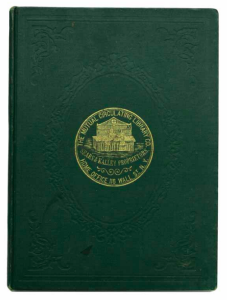
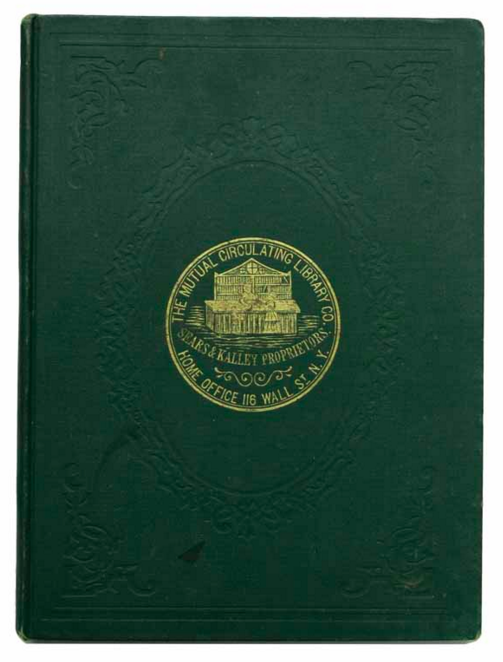
Kate hasn't seen Vic so excited a book since she’s been here! He says he’s never seen a dedicated lending library binding! More details coming soon...

Kate hasn’t seen Vic so excited a book since she’s been here! He says he’s never seen a dedicated lending library binding! More details coming soon…

I wish I could say that it was a huge success, of course, making up for the preceding lackluster showings and then some. Certainly not enough to merit a Kate Fearnot blog title. Are they worth it then, these fairs? All that effort and agony, all the expense and risk just to gather, however briefly, with colleagues and book lovers of all stripes? Are they bonanzas, migratory communities, or refuges of a book trade that keeps losing physical stores? And what would we do, how would we swap knowledge and ideas and, it goes without saying, books, if we didn’t do book fairs?

Frankly, I don’t know the answers to these questions. What I do know is that I have a catalogue to get ready for next week, and a stack of cool things to catalogue for it, and a pile of fair items to finish putting away, and a tally sheet on my desk pointing out our modest profit, in black ink, for the first time. It feels an awful lot like being a bookseller.

Share

“You’re wrong as the deuce, and you shouldn’t rejoice. If you’re calling him Seuss – he pronounces it Soice.” (But then changed it to Seuss, so…)

Screen Shot 2016-03-02 at 9.00.17 AM

By Margueritte Peterson

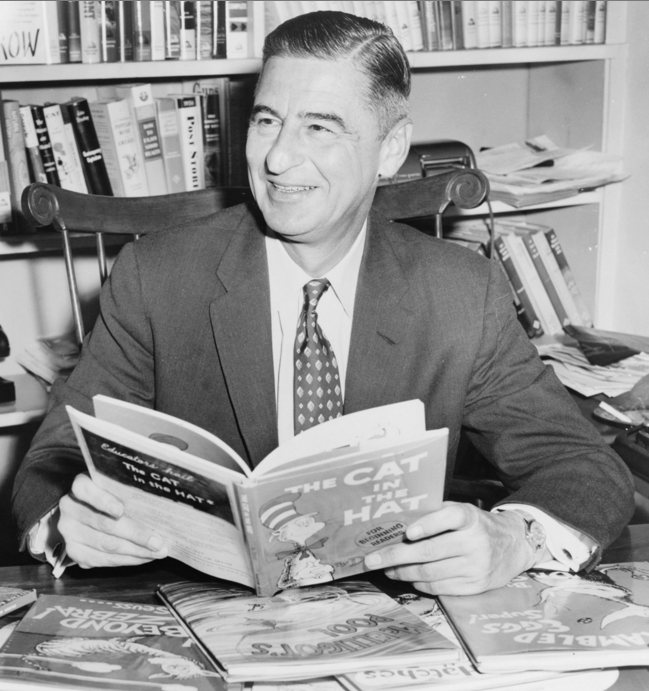
If someone says “Children’s Books” to you, what is the first thing that comes to your mind? Picture books? Perhaps here is the better question… what author first comes to mind? I would venture to bet that at least 90% of you come up with the same name. However, did you know that the name you come up with is not his true name? (Probably most of you do, since you are members of the book world or bibliophiles and would know something like that… but humor me!) 

Screen Shot 2016-03-02 at 8.59.38 AMTheodor Seuss Geisel was born on March 2nd, 1904 to a German family in Springfield, Massachusetts. His father ran a family-owned brewery in Massachusetts (well, until the Prohibition did away with that). Geisel went to school in Massachusetts until he went to Dartmouth College in New Hampshire, graduating in 1925. During his time at Dartmouth, Geisel first showed skill and interest in humorous literature as rose to the role of editor-in-chief of the literary magazine the Dartmouth Jack-O-Lantern before graduating. Unfortunately, one college incident threatened to end his early literary career – when Geisel was caught drinking gin (the Prohibition was in effect) in his dorm room with some of his friends. In punishment for this crime, Geisel was forced to resign from his position at the magazine. In order to continue publishing his work at the Jack-O-Lantern, Geisel began writing under the pen name “Seuss”, his middle name. The beginning of Dr. Seuss was underway. 

Once graduating from Dartmouth, Geisel began his PhD studies at Lincoln College, Oxford, to earn a degree in English Literature. Though he left Oxford without a degree in early 1927, Geisel was still able to begin his living publishing humorous cartoons. He accepted a job at the humor magazine Judge and 6 months after he began working at the magazine he first published work under his pen-name “Dr. Seuss.” Geisel’s cartoons gained popularity throughout the end of the 1920s and the entirety of the 1930s, largely due to his help with advertisements of popular brands like General Electric and Standard Oil – adverts that helped him and his wife maintain financial stability through the Great Depression. Due to help from a friend (despite his popularity), Geisel was able to begin publishing humorous poems with the Vanguard Press. In 1940, he published a poem under the title “Horton Hatches an Egg” – a poem that has, to this day, sparked further books, movies, animated films and even musical productions. 

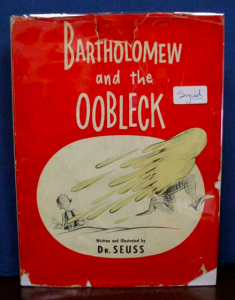
Our signed copy of Bartholomew and the Oobleck can be found here!

Our inscribed copy of Bartholomew and the Oobleck can be found here!

Throughout the 1940s and WWII, Geisel created hundreds of political cartoons criticizing Hitler and Mussolini and strongly supported the US war effort. Shortly after the war, Geisel and his wife Helen moved from New York to La Jolla, California and he returned to writing children’s books. Between 1950 and 1960 Geisel published many of the works he is most well-known for today, such as Bartholomew and the Ooblek (1949), If I Ran the Zoo (1950), Horton Hears a Who! (1955 – a more in-depth work on his original poem), If I Ran the Circus (1956), The Cat in the Hat (1957), How the Grinch Stole Christmas (1957) and Green Eggs and Ham (1960). In 1954, William Ellsworth Spaulding challenged Geisel to write a book with 250 words chosen by the education division of Houghton Mifflin of words that all 1st graders ought to know. The result contained 236 of the 250 words and was Geisel’s famed The Cat in the Hat

Though Geisel (surprisingly) never won a Newbery or Caldecott award, he was awarded an honorary doctorate from Dartmouth (1956), a Laura Ingalls Wilder Medal in 1980, and the Pulitzer Prize in 1984 (for his “substantial and lasting contributions to children’s literature”). Geisel also never had children of his own (perhaps he was too busy teaching and entertaining everyone else’s children!), but will forever be remembered as one of the fathers of Children’s Literature! 

Share

Adah Isaacs Menken’s Relationship with Charles Dickens: A Blog in Honor of his Upcoming 204th Birthday

By Margueritte Peterson

 “[Menken] is a sensitive poet who, unfortunately, cannot write.” -Charles Dickens

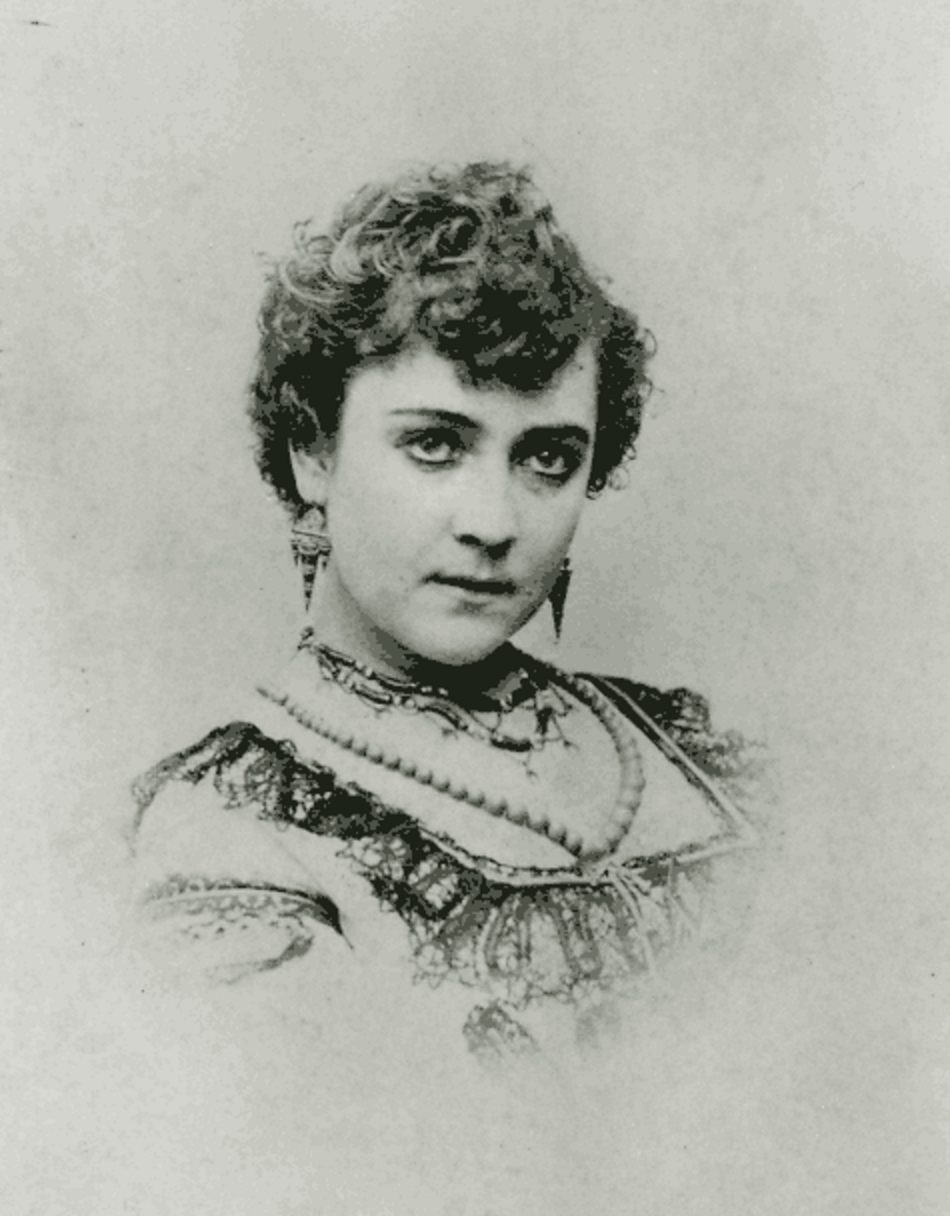
Screen Shot 2016-02-02 at 10.16.57 AMAdah Isaacs Menken died in Paris on August 10, 1868, only eight days before her collection of poems, Infelicia would be published. Dedicated to Charles Dickens, Infelicia highlights Menken’s complicated relationship with her literary contemporaries—and, perhaps, her unfailing talent for generating publicity. Details about Menken’s early life are difficult to corroborate because Menken herself told so many different versions of her story. Most experts agree that she was born on June 15, 1835 in Memphis, and that her given name was Adah Bertha Theodore. She moved to Lousiana as a young child, grew up there, and launched her acting career there. From Louisiana, Menken traveled throughout the South and West. Meanwhile, she launched her writing career with “Fugitive Pencillings,” which appeared in Texas’ Liberty Gazette and the Cincinatti Israelite.

The year 1856 brought the first of Menken’s multiple marriages, to Alexander Isaacs Menken. The two were (supposedly) divorced already when Menken entered her next marriage with prizefighter John Heenan in 1859. But Heenan and Menken separated shortly thereafter; Heenan was scandalized to find that his new wife was still legally married to her first husband. By this time, Menken had already begun traveling in bohemian and literary circles. A regular at Pfaff’s, Menken met Walt Whitman, who greatly influenced her work.

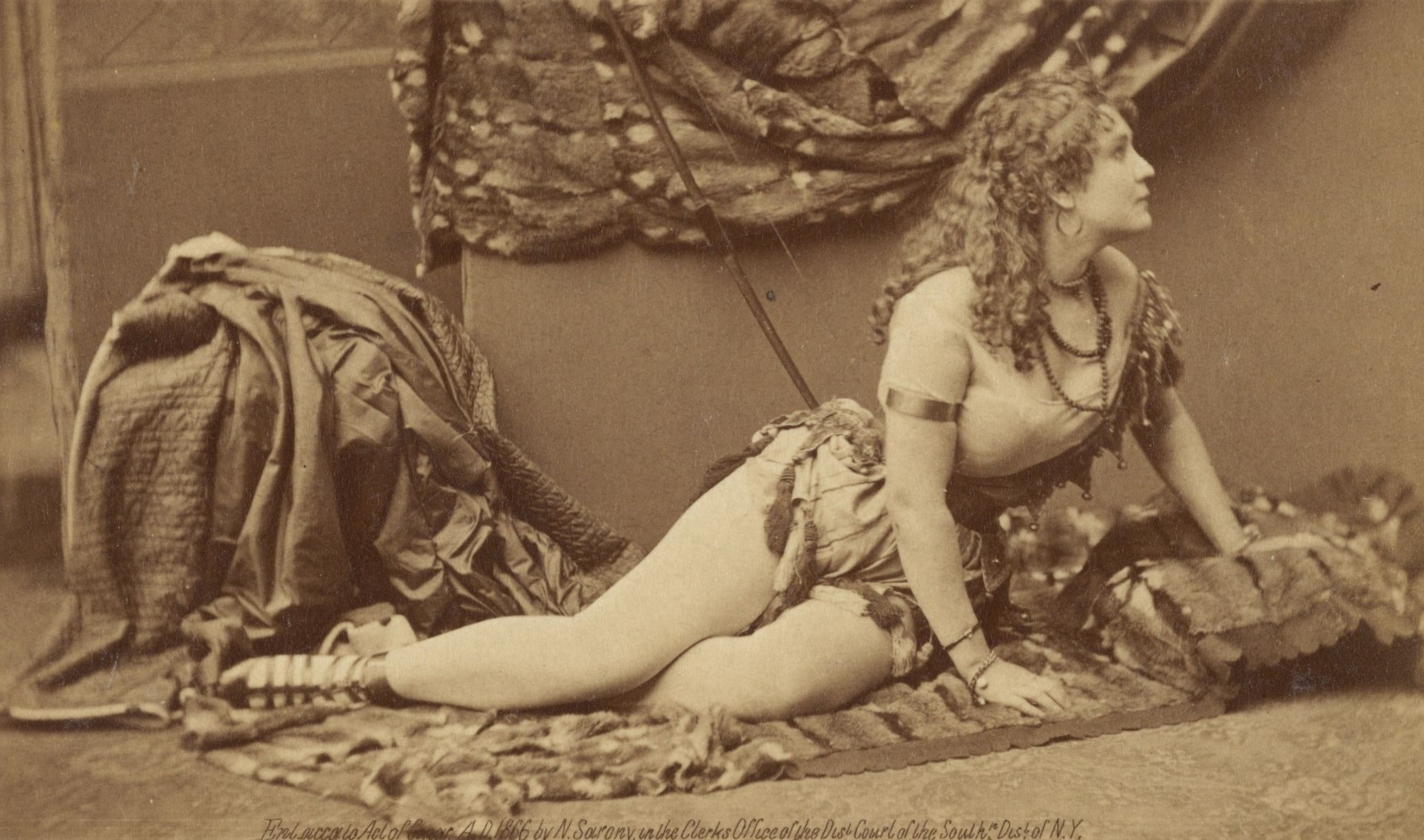
Menken in Mazeppa - where she caused quite a stir.

Menken in Mazeppa – where she caused quite a stir.

Soon Menken was “not known for her talent, but rather for her frenetic energy, her charismatic presence, and her willingness to expose herself.” Indeed, Menken’s primary claim to fame was her performance in Mazeppa. Menken played the role of a man, and in one scene she was lashed to the back of a running horse…wearing nothing but a flesh-colored body stocking.

The play debuted in Albany in June, 1861. Menken’s manager, Edwin James was a sports reporter for the New York Clipper (and a former lawyer who’d inspired the character of Striver in Tale of Two Cities.) James managed to get reporters from all six of New York’s daily papers to attend, along with reporters from three weeklies and two monthlies. Although the Civil War had already broken out, Menken’s performance grabbed headlines. Mark Twain saw Mazeppa at Tom Maguire’s Opera House in San Francisco. Though he had formerly dismissed Menken as a “shape actress,” her performance changed his mind. On September 13, 1863, he wrote a column called “The Menken—Written Especially for Gentlemen.” His assessment of Menken was less than sterling:

“Here every tongue sings the praises of her matchless grace, her supple gestures, her charming attitudes. Well, possibly, these tongues are right. In the first act, she rushes on the stage, and goes cavorting around after ‘Olinska’; she bends herself back like a bow; she pitches headforemost at the atmosphere like a battering ram; she works her arms, and her legs, and her whole body like a dancing-jack: her every movement is as quick as thought; in a word, without any apparent reason for it, she carries on like a lunatic from the beginning of the act to the end of it. At other times she ‘whallops’ herself down on the stage, and rolls over as does the sportive pack-mule after his burden is removed. If this be grace then the Menken is eminently graceful.”

At any rate, Menken continued to bring crowds to theatre after theatre. Always the shrewd self-promotor, she would arrive in a new city and immediately ensure that her photograph was hanging in every shop window. By now Menken had also gotten into the habit of inventing stories about herself. She also frequently exaggerated the extent of her relationship with famous figures, particularly those in the literary world.

Mazeppa opened in London on October 3, 1864. Charles Dickens attempted to attend an early performance, only to find that the show was already sold out. The ticket manager recognized Dickens and offered him a private box, but Dickens declined. It’s long been rumored that Menken used the incident as an excuse to meet Dickens, but it’s likely that Menken started that rumor herself. The two traveled in the same social circles, and Dickens may even have attended some of Menken’s “literary salons” at her rooms in the Westminster Hotel. But there’s little evidence to suggest a deeper relationship, and even the rumor of an association with Dickens would have bolstered Menken’s reputation.

Meanwhile, Menken’s connection to Dickens’ contemporary Algernon Charles Swinburne was anything but a rumor. Fearing that Swinburne had lost his interest in the opposite sex, his associates set him up with the sexy Menken. After Menken’s death, Swinburne would say of her, “She was most loveable as a friend, as was as as a mistress.”

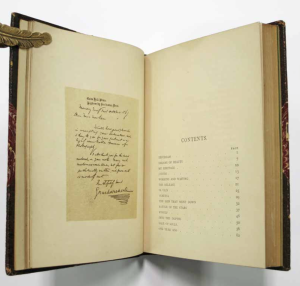
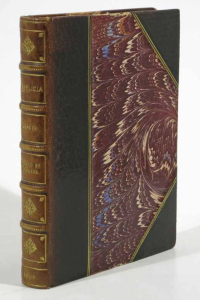
A shot of the inserted facsimile letter in our holding of Felicia.

A shot of the inserted facsimile letter in our holding of Felicia.

By 1868, Menken had published more than enough poems to publish a collection, which she titled Infelicia. Menken made another probably-calculated move: she dedicated the book to Charles Dickens, who by now enjoyed the Victorian equivalent of rockstar status in both England and America. The first edition included an engraved portrait of Menken on the frontispiece, along with a poem that Swinburne had written for her. It also included a facsimile of a letter that Dickens had supposedly written to Menken, thanking her for the dedication.

While Dickens did indeed thank Menken for the dedication, the facsimile was actually comprised of two different letters Dickens had sent to Menken. Thus this first edition was quickly suppressed, and subsequent editions don’t include the facsimile. This only added to the sensation that already surrounded the book. The dedication to Dickens left many speculating about the true nature of their relationship, and Menken’s untimely death had catapulted her back into the headlines.

Meanwhile, her relationship with Swinburne and the fact that the frontispiece bore a Swinburne poem led some to suggest that Swinburne or his assistant, John Thomson, had actually authored Infelicia. Critics soon pointed out, however, that the poems were riddled with flaws and simply weren’t that good. They eventually accepted the work as Menken’s, arguing that Swinburne was too talented to write it.

Infelicia went through a number of editions in England and America, mostly pirated. The book made its last appearance in 1902. It’s now quite rare to find a copy of Infelicia that bears that facsimile letter from Charles Dickens.

Screen Shot 2016-02-02 at 7.02.44 PM

Share

A Wonderland of Books, Indeed! Happy 184th Birthday, Mr. Dodgson!

By Margueritte Peterson

One of my most favorite Children’s writers of all time was born on the 27th of January, 1832. Scratch that – one of my most favorite writers, period, was born on the 27th of January, 1832. Many critics of great literature have commented on the fact that one of the most lasting kinds of literature is the kind that speaks to both children AND adults – writers whose works you can read when you are both 5 and 75 and learn something equally important at both of these starkly different ages. It is my super humble (though really awesome) opinion that the writer we honor today, on what would be his 184th birthday, is one of those writers. It is perhaps also appropriate that we honor his memory this week, as in less than a month there will be an ABAA Fair in Pasadena named after some of his most well-known work. The name of the fair? A Wonderland of Books. Can you guess who it is yet? 

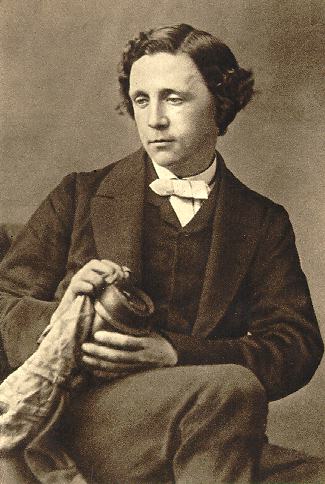
lewisCharles Lutwidge Dodgson (pen name Lewis Carroll – for those readers that are having one of those really slow days) was the fourth child of what would be a family of 12 (just children, that is). He and quite a few of his siblings would suffer from an unfortunate stammer for their lives, a condition often thought to be brought on when a naturally left-handed child is forced to become right-handed early in childhood (though there is no specific evidence that shows this to blame for Dodgson in particular). This stammer would cause the author no end of misery as he felt inferior throughout life and led to his later relationships with children (sparking great work and no end of controversy to this very day). A (somewhat vague) problematic time in Dodgson’s upbringing would arrive when the 13-year-old Dodgson was sent to Rugby School – an independent boarding school in Warwickshire. Years after leaving the school, Dodgson would write, “I cannot say … that any earthly considerations would induce me to go through my three years again … I can honestly say that if I could have been … secure from annoyance at night, the hardships of the daily life would have been comparative trifles to bear.” Though never expanded on, one can assume that Dodgson was either teased mercilessly or suffered even worse hardships at the hands of his fellow students. 

In 1850 Dodgson entered Christ Church College in Oxford, where he excelled academically, despite not always being the most faithful of students. He received first-class honors in Mathematics at the College, and continued teaching and studying the subject until 1855, when he won the Christ Church Mathematical Lectureship, a post he then held for the next 26 years. It was during this period that he began to be published nationally (having been writing poetry and satires, often humorous in nature, since young adulthood), in magazines like The Comic Times and The Train. It was during this period (1856, to be exact) that Dodgson first published a poem under the pseudonym “Lewis Carroll” – a work entitled “Solitude” published in the magazine mentioned above – The Train.

lewis2

The Liddell sisters – Alice, Lorina & Edith.

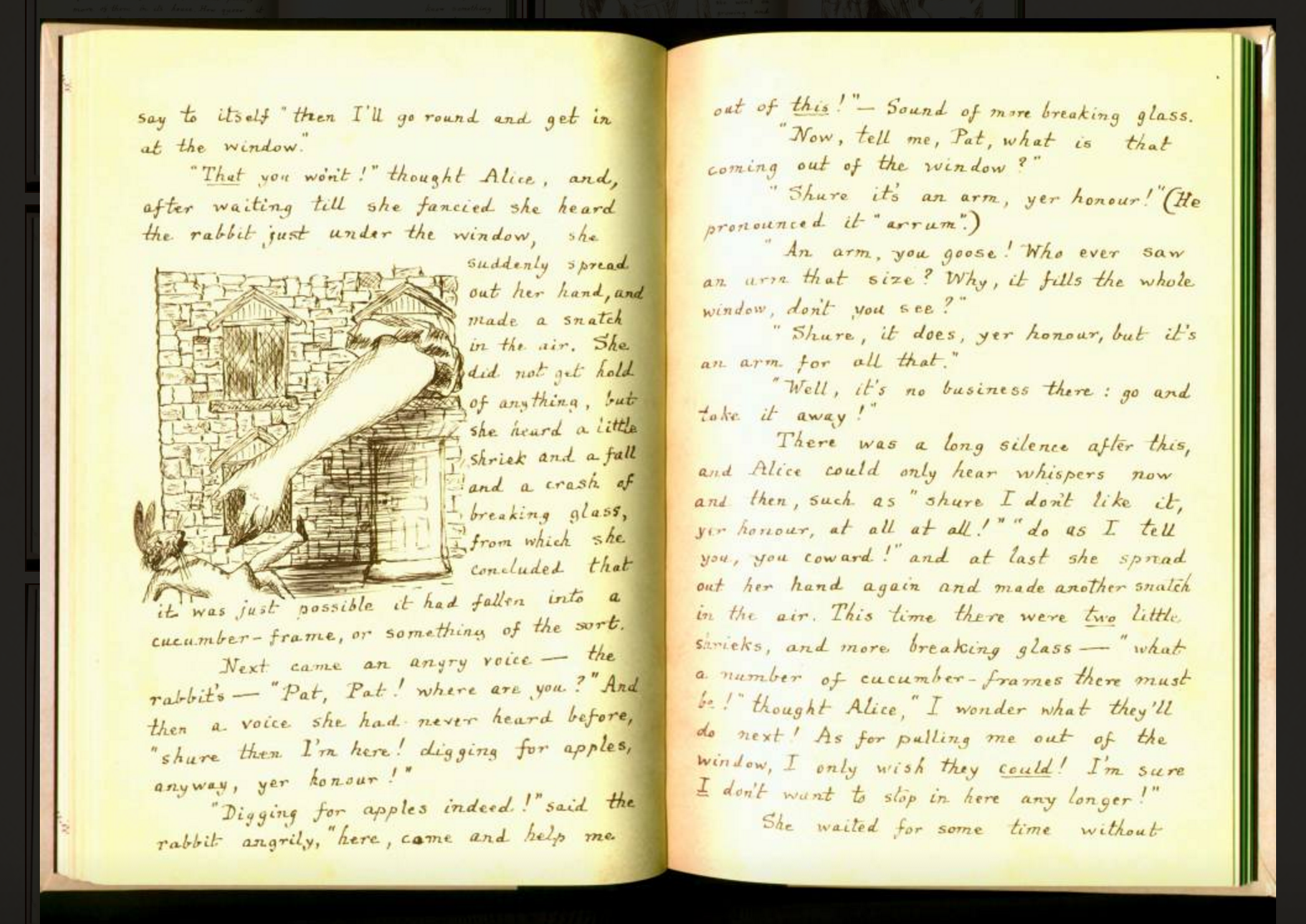
In the same year as the publication of “Solitude”, a new Dean arrived at Christ Church – Dean Henry Liddell. The Liddell family would feature heavily in Dodgson’s life for years to come, as he became an important influence and friend to the Liddell daughters – Lorina, Edith, and Alice. He would often take the Liddell children on short day-trips around Oxford – rowing or going for walks – and it was on one of these trips that he first began the story that would eventually turn into one of the most beloved children’s books of all time – Alice in Wonderland. His story of a precocious and questioning young girl was a story told to Alice Liddell, who in turn begged Dodgson to put it to paper for her. His personally illustrated manuscript entitled “Alice’s Adventures Under Ground” was completed in 1863. After Dodgson’s longtime friend (and fellow author) George MacDonald got ahold of the story, it was his persistence that led to its publication in 1865, with new illustrations by Sir John Tenniel. The book was an instant commercial success – with “Lewis Carroll” receiving attention from around the world. 

One of the most well-known Tenniel illustrations to the first Alice publication!

One of the most well-known Tenniel illustrations to the first Alice publication!

In 1871 Dodgson published a sequel to Alice, titled “Through the Looking-Glass and What Alice Found There”. Though it was popular as well, it’s somewhat darker mood and gloomier settings did not garner the same amount of success as the first novel. In 1876, “Carroll” published his next great work – a humorous and fantastical poem – “The Hunting of the Snark.” Another work came even later, in a two-volume set of a fairy story titled “Sylvie and Bruno” – though not as well known it has remained in print ever since.

A great love of Dodgson’s throughout his life was photography. The first photographs that are attributed to the author date back to 1856 – around the time that he began his association with the Liddell family. Often, even today, Dodgson comes under scrutiny when fans find out that over half of his photographic subjects include little girls – sometimes scantily clad in what one might consider strange positions or situations. Though no evidence has ever come into question of an inappropriate relationship between Dodgson and any of the girls he came into contact with (as most of his “friends” were children – Dodgson was notoriously shy around adults), many continue to wonder whether he ever considered a more intense relationship with the girls in the photographs. Nevertheless, they are interesting pieces of early photographic work – all done with full knowledge of the subject’s parents and often commissioned by the families themselves! 

Dodgson is well-remembered for Alice and for the children’s stories he came up with, but it should be noted that this Mathematician also produced works that are still remembered if not used today in Mathematical sciences. He published almost a dozen books under his real name (not the pseudonym) on the science, and himself developed new ideas in the subject of linear algebra. He taught Mathematics in his post at Christ Church until 1881, and then remained in residence there for the rest of his life. On January 14th, 1898, two weeks away from his 66th birthday, Dodgson passed away from pneumonia following a bout of influenza, and is buried in Guildford. One thing is for sure and certain, whether you wish to remember him as Charles Dodgson or Lewis Carroll – this author remains, to this day, one of the most well-known names in Children’s Literature (if not the most well-known), and deserves to be celebrated on this his 184th birthday!

One of Dodgson's original illustrations in the manuscript "Alice's Adventures Under Ground".

One of Dodgson’s original illustrations in the manuscript “Alice’s Adventures Under Ground”.

Share

“He was America”: Happy Birthday Carl Sandburg!

By Margueritte Peterson

Admitting this is probably one of those phenomenally bad ideas I continuously have despite how much older I get, but I am one of those wicked people who pretended to know, well…something about this American literary star for many years. People would mention his name and I would be all, “Oh yes, Carl Sandburg, wow… it went for how much? Woah!” While casually hoping the conversation would change because as far as I knew I could not remember reading anything by this author and continually neglected to read up on him when I got to a quiet corner away from prying eyes. Yes, ladies and gentlemen, I know it is a shocker but I am not omniscient (though I’m sure it seems that way most of the time. Eh-hem). So now, just in case any of you out there are like me and think you can continue fooling people into thinking you know about this magnificent man… think again!

sandburgCarl August Sandburg was born on January 6th, 1878 in Galesburg, Illinois. Though he left school at the age of 13 out of monetary necessity for his family and spent years as a laborer in some form or fashion (a milk wagon driver, a porter, a bricklayer, a farmhand, a hotel servant, a member of the American Army – 6th Illinois Infantry Regiment 1898, a coal-heaver… you name it, he did it). After leaving the army, Sandburg was encouraged by a fellow student to spend a few years at Lombard College where he attracted the attention of one of his Professors, Philip Green Wright, who so believed in Sandburg’s work that he paid for his first publication – a book of poetry entitled Reckless Ecstasy in 1904. Sandburg left Lombard in 1903 sans a degree (though he would later received honorary degrees for much of his schooling).

Around 1905 Sandburg moved to Milwaukee and joined Wisconsin’s Social Democratic Party, or in other words, the Socialist Party of America. A couple years later he met another young Socialist Party worker Lillian Steichen (sister of photographer Edward Steichen) and they were married. From 1910 to 1912 Sandburg would work as secretary to the Socialist Milwaukee mayor Emil Seidel. In the coming years Sandburg and Lillian (whom he called Paula) would celebrate the birth of three daughters. After moving around a bit (mainly in Illinois – where at one point Sandburg became a journalist for the Chicago Daily News), the couple and their family settled in Elmhurst, IL in 1919.

View our holding of Sandburg's Complete Poems (an Inscribed Presentation Copy, by the way) here!

View our holding of Sandburg’s Complete Poems (an Inscribed Presentation Copy, by the way) here!

Once settling down in Elmhurst, Sandburg became interested in writing for himself and his budding family. And write he did! The author began by writing Children’s books, followed by some fiction, a two volume biography on President Lincoln, anthologies of folk music, and poetry books! Some of his works for Children included Rootabaga Stories (1922), Rootabaga Pigeons (1923) and Potato Face (1930). Sandburg was quite interested in the idea of American children’s stories for American children – thinking that European stories of kings and palaces and knights were out of place in American education. In 1926 he published his two-volume series on Abraham Lincoln. Sandburg’s first big win came even earlier, right at the beginning of his real writing career, as he won the Pulitzer Prize in 1919 for his collection of poems titled Corn Huskers. Over a decade after its publication he won his second Pulitzer for Volume II of his Abraham Lincoln biography, and his third Pulitzer was awarded in 1951 for his collection of poetry titled Complete Poems. He is, perhaps, best remembered as a poet, but clearly his variety of work shows a talent in much of the literary arts, one could argue a talent almost unparalleled to this day.

On July 22nd, 1967, Sandburg died in his home of natural causes. After hearing of Sandburg’s death, President Lyndon B. Johnson is said to have stated “[he] was more than the voice of America, more than the poet of its strength and genius. He was America.” And now that I know a bit about him, I couldn’t agree more! Ladies and gentlemen, on this 6th of January we’d like to wish a very happy birthday to Carl Sandburg – an American writer and legend that was the voice of America in many different fashions!

Our inscribed presentation copy of "Remembrance Rock" can be found here!

Our inscribed presentation copy of “Remembrance Rock” can be found here!

Share

This Thanksgiving, Be Thankful You Aren’t… David Colbreth Broderick, Victim of America’s Last Notable Duel

On September 13, 1859, the “last notable American duel” took place in a ravine just outside San Francisco. Duels were illegal in California, but that didn’t stop David Colbreth Broderick and David Terry from squaring off to resolve their personal and political differences.

The Honorable David Culbreth [Colbreth] Broderick.

The Honorable David Colbreth Broderick.

In 1849, David Colbreth Broderick came to California from New York with the Gold Rush. By 1857, he’d established himself as a political don of San Francisco; in 1851, the “free-soil” Democrat was named Lieutenant Governor of California after his predecessor, John McDougal, was promoted to Governor when Peter Burnett resigned. Friends considered Broderick an honest man and pointed to his humble upbringing as the son of a stonecutter. But Broderick’s rivals saw him as a conniving saloonkeeper who picked up politics in Tammany Hall. David Terry, on the other hand, hailed from Kentucky and was a proud Southern Democrat. He came to California after the Mexican-American War. In 1855, he was appointed Justice of the California Supreme Court. By 1857, Terry was Chief Justice. Though Broderick and Terry disagreed over slavery, the two were friends.

That all changed in 1859, when Terry ran for reelection as chief justice and lost, presumably due to his pro-slavery stance. He blamed the opposing faction of the Democratic party—which was led by Broderick. Terry insisted on delivering a speech denouncing his abolitionist opponents, alleging that they were all “personal chattels of a single individual” and belonged “heart, soul, body, and breeches to David C Broderick.” When Broderick heard about Terry’s comments, he called Terry a “damned miserable wretch” and retorted, “I have said that I considered him the only honest man on the Supreme Court bench, but I now take it all back.” Terry immediately demanded a retraction, which Broderick refused to provide. Terry then immediately wrote a letter to “demand the satisfaction usual among gentlemen.”

The two men scheduled the duel for September 12, 1859. But news of the duel had spread, and the local sheriff showed up to intercede. He concluded that no law had been broken (yet) and went on his way. Broderick and Terry rescheduled the duel for the following morning. At the appointed time, a crowd gathered. Broderick and Terry took .58 caliber Belgian pistols and assumed their positions. Broderick fired first, but his shot landed in the grass short of Terry. Terry returned fire and struck Broderick. He initially thought he’d hit “too far out” to mortally wound Broderick.

The injured Broderick was taken to the home of Leonidas Haskell. Doctors confirmed that the bullet had penetrated Broderick’s lung. He died in the Haskell home three days later, on September 16, 1859, and to this day, the house is reportedly haunted by Broderick’s ghost. Over 30,000 people attended the senator’s funeral. Broderick’s death ultimately aided the Union cause by garnering popular support for the abolitionists. Historians consider the Broderick-Terry duel a critical factor in California’s remaining free of slavery.

Broderick had amassed quite the estate, mostly because he sold state positions of authority during his tenure as president of the state senate. His extensive real estate holdings—a total of 362 properties–were finally auctioned off on November 30, 1861. They included properties in prime locations like Larkin, Howard, and Mission Streets. If they were sold on today’s market, they’d undoubtedly fetch a nine- or ten-figure sum.

David Terry!

                 David Terry!

Terry was arrested and tried for participating in a duel, but was found innocent and released. He left California after the duel and later joined the Confederate Army during the Civil War, serving as a colonel in the Texas Calvary. Following the war, Terry returned to Stockton, California to practice law.

Terry is perhaps best remembered for representing Sarah Althea Hill Sharon in a lawsuit brought by her husband, Senator William Sharon. The senator sought to have the marriage canceled, and the California Supreme Court ruled in his favor after his death. Terry (who later married Sarah) blamed US Supreme Court Justice Stephen Fields for his loss. Then on August 14, 1889, Terry encountered Fields in the breakfast room of a railroad hotel. He slapped the justice across the face. Fields’ bodyguard, David Neagle, immediately shot and killed Terry. Neagle’s actions led to a jurisdiction dispute; state authorities claimed that the field marshal had committed murder, while federal authorities argued that he had killed Terry in the line of duty.


Related Rare Books and Ephemera

Documents in Relation to Charges Preferred by Stephen J FieldPublic Auction of the Beidman EstateRelacion de los debates de la Convencion de CaliforniaSan Francisco Semi-Annual Trades Guide & Pacific Coast DirectorySteamship Yankee BladeThoughts of Idle Hours

Share

Robert Louis Stevenson’s Shocking Christmas Tale

We Interrupt your Weekend Activities to Bring You this Very Important Blog Honoring this Friday the 13th Birthday…

Scottish Writer

By Margueritte Peterson

On November 13, 1884, Robert Louis Stevenson received a request from the Pall Mall Gazette. The editors wanted a sensational story to publish in its special Christmas issue, and they offered Stevenson a generous £5 per 1,000 words. Woozy with morphine taken for a chronic cough, Stevenson complained that he wasn’t up to the task of writing something new. So he dusted off a piece he’d written back in 1881: The Body-Snatcher.

While the book fit into the long-standing tradition of telling scary stories at Christmas, it also went far beyond the spooks of Charles Dickens’ A Christmas Carol or The Haunted Man and the Ghost’s Bargain. The Pall Mall Gazette ran ever increasingly dramatic advertisements for the story, which finally appeared in its 1884 Christmas Special. In fact, some of the advertisements were so graphic, police actually stripped the signs from the sandwich-board men. Both grotesque and horrifying, Stevenson’s The Body-Snatcher  was not only shocking for its lurid content, but also because in its pages Stevenson accused a highly respected surgeon of committing murder.

A Novella Ripped from the Headlines

In The Body-Snatcher, the character of Wolfe Macfarlane is a wealthy, fashionable London surgeon who hails from Edinburgh. Early in his career, he had served as assistant for a Dr. K…, who purchased the bodies of murder victims killed specifically for the sale of their corpses. Macfarlane himself even commits one of these murders.

Stevenson draws the novella’s inspiration directly on the true story of the Burke and Hare murders, which implicate a real-life Dr. K…., along with his assistant, Sir William Fergusson, who rose to the rank of surgeon to Queen Victoria. The implication that Fergusson might have committed murder like his fictional counterpart scandalized Stevenson’s readers. By this time, Fergusson had passed away, protecting Stevenson from a libel suit—and ensuring that the truth remained buried.

The Real Dr. K…

Dr. Knox, circa 1830.

Dr. Knox, circa 1830.

During the 1820’s, Robert Knox ran the most successful anatomy school in Edinburg. At the height of his career, the school had over 500 students. Endlessly ambitious, Knox wasn’t satisfied. He also built a private anatomy museum and pursued his own research interests. All these activities left Knox with one significant challenge: he couldn’t get enough cadavers.

At that time, the only cadavers that could legally be used for dissection were those of prisoners who were condemned to death and dissection—which wasn’t very many. Many doctors and medical students resorted to purchasing bodies from so-called “resurrectionists,” who were really grave robbers. They would remove bodies from cemeteries during the night and sell them to anatomy schools. Numerous doctors and medical students were actually charged with misdemeanors for possession of these ill-begotten bodies.

Given the shortage of bodies, a fresh cadaver garnered a high price: sometimes as much as £10. When a boarder died at William Burke’s lodging house, he and his associate William Hare decided to try selling it. It was so easy and lucrative, the pair decided to, in Burke’s words, “try the murdering for subjects.” They would go on to kill three men, twelve women, and one child. Robert Knox purchased every single one of these bodies.

Knox was especially pleased with the corpse of Mary Paterson. Her body was so flawless, he preserved it in whisky for three months before dissecting it and invited artists to capture her likeness. But there was one problem: when Burke and Hare brought Paterson’s corpse, one of Knox’s assistants recognized it: Fergusson. In his confession, Burke said that Fergusson “was the only man who ever questioned me anything about the bodies” and noted that he’d particularly inquired about Paterson’s.

A Sensational Court Case

But it wasn’t Paterson’s murder that drew the police’s attention, even though anatomy students recognized her. Rather, it was Madgy Docherty, one of Burke’s boarders. When Docherty went missing, two other boarders went looking for her…and found her body stashed under a bed. They immediately went to the police.  Mary Paterson and James Wilson were also named as victims on the murder indictment against William Burke, Helen M’Dougal, William Hare, and Margaret Hare.

The press jumped to publish every bit of information available about the victims. Paterson was a resident at Magdalene Asylum, a home for at-risk girls similar to Charles Dickens’ Urania Cottage. James Wilson was a well-known street figure survived by his mother and sister. And Madgy Docherty was the only victim whose body was examined by the police. A thriving trade in hand-colored portraits of the victims quickly emerged, although only the ones of Wilson were actually drawn by someone who knew him.

burke1Before the trial, the Hares agreed to testify for the prosecution in exchange for immunity. Burke and M’Dougal were tried on December 24, 1868. M’Dougal was acquitted, but Burke was convicted. On January 28, 1829, he was executed. In a turn of rather poetic justice, Burke’s body was dissected and exhibited publicly.

Knox Falls from Grace

Meanwhile, Knox was vilified for having purchased Burke and Hare’s bodies. He denied all knowledge of the murders, though his detractors pointed out that someone so accomplished in anatomy should easily identify a body that has died through violence. Furthermore, it’s simple to notice when a body hasn’t been pulled from a grave. Many researchers argue that Knox probably had an extensive network of body snatchers, supplying him with corpses not only from Edinburgh but also from Glasgow, Dublin, and Manchester. However, Knox claimed that his assistants (including Fergusson) handled cadaver acquisition on his behalf, so they were the ones who had actually purchased the bodies.

The public was unconvinced. On February 12, 1829, an effigy of Knox was publicly hung and quickly torn to pieces in the street. Popular ballads and caricatures reviled the formerly respected figure. Though Knox was cleared of any knowledge of the crime, his career crumbled. Unable to establish a new anatomy school, Knox resorted to translating French anatomy textbooks and writing for medical journals.

His assistant Fergusson fared much better. Despite the fact that he had even questioned Burke about the bodies, Fergusson was not called to task for his probable role in the entire affair. On the contrary, he moved to London and eventually established himself as a preeminent surgeon. It was not until Stevenson published The Body-Snatcher in 1884 that the public reevaluated Fergusson’s potential role in the whole debacle.

Legislation Quells Practice, But Not Public Fascination

burke2The Burke and Hare murders, and others like them, paved the way for the Anatomy Act of 1832. As the cadaver shortage reached crisis in 1828, a Select Committee on Anatomy reported to Parliament. Chairman Henry Warburton drafted an Anatomy Bill that would allow schools access to unclaimed bodies of people who died in workhouses and hospitals. It failed in the House of Lords. But in 1832, John Bishop and Thomas Williams were also convicted of committing murder to get cadavers. Fearing an epidemic of similar murders, Parliament passed the Anatomy Act of 1832, expanding access to cadavers and establishing a system for documentation and inspection. The Anatomy Act did little to actually resolve the issues surrounding cadaver acquisition because many parts were intentionally vague. However, because a record of cadavers was created, it did eliminate the possibility of murder for cadaver sale.

By 1884, five decades had passed since the Anatomy Act went into effect. Yet the public still had an insatiable thirst for shocking episodes like the Burke and Hare murders, so it’s no surprise that The Body-Snatcher proved an overnight success. (And Stevenson probably regretted having refused the entire £40 payment for the work.) Stevenson would go on to explore the grotesque successfully in The Strange Case of Dr. Jekyll and Mr. Hyde, now perhaps his most famous work.

Related Books and Ephemera

College Papers No 1The Master of Ballantrae. A Winter’s Tale,  The Haunted Man and the Ghost’s Bargain
A Christmas Carol in Prose. Being a Ghost Story of Yule Tide.Silverado SquattersThe Sea Fogs
New Arabian Nights


Share

Happy Birthday, Lady Lazarus

By Margueritte Peterson

“I am terrified by this dark thing/ That sleeps in me; / All day I feel its soft, feathery turnings, its malignity.” The author of this quote, and many similar to it, was a haunted being. She struggled with depression throughout her life and eventually succumbed to the constant pain she felt and ended her life. Many think of her and immediately think “that lady put her head in an oven” (don’t lie… you did, didn’t you?). Banish it from your mind for a moment! Today, we’d rather focus on her fascinating life and haunting poetry instead. Her being, of course, Sylvia Plath.  Though you may not think that writing a blog on Sylvia Plath at Halloween-time is very… original, we are going to do it – as today would have been her 83rd birthday. Plath was an extremely influential person – not just in words, but in her struggle to have her poems heard – despite seeming to have the world against her!

0115549_H

A young Sylvia Plath.

Sylvia Plath was born in October of 1932 and was raised in Massachusetts. Despite her father’s sudden death shortly following her 8th birthday, Plath did not begin to show signs of her mental illness until college. As an 8 year old child Plath survived and thrived through a tumultuous year – first with her father’s death, then her family’s relocation to Wellesley, MA, and also with her first published poem in the Boston Herald’s Children’s Section. Sylvia blossomed in academic environments and in 1950 when she began to attend Smith College in Northampton, Massachusetts, she discovered a whole new world, finding she loved being a part of an academic community. She became editor of The Smith Review and interned, as a guest editor, at Mademoiselle magazine during the summer after her junior year – a highly sought after position. Her mental illness finally seemed to surface during this time, when Plath was distraught after not meeting poet (and one of her idols) Dylan Thomas during one of his trips to New York. She quickly spiraled into depression, and at the end of the summer she made her first documented suicide attempt by taking sleeping pills and laying down in the crawl space beneath her mother’s house – where she was found 3 days later.

A happy Plath and Hughes after the birth of their daughter, Freida, in 1960.

A happy Plath and Hughes after the birth of their daughter, Freida, in 1960.

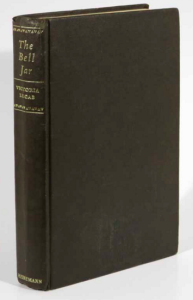
Now, I know I said that we would be focusing on her fascinating life and poetry rather than her suicide, but bear with me! The events in this particular summer were of great inspiration a decade later when Plath began and published her first and only novel, The Bell Jar. (There is a method to my madness, you can see.) But let us not get ahead of ourselves. Despite her intense summer and a stay at McLean Hospital receiving insulin and electric shock therapy in the fall, Plath recovered and graduated the following June with high honors. She received a Fulbright Scholarship to study at Newnham College, Cambridge, where she continued to study poetry and was constantly published in the university paper, Varsity. The following February, Plath’s life would be turned upside down by her passionate romance with a fellow poet, Ted Hughes. The pair were married after a short four-month courtship. Hughes was described by Plath as a singer, story-teller, lion and world-wanderer with “a voice like the thunder of God” (Oxford Dictionary of National Biography). Plath and Hughes moved to Massachusetts shortly after their wedding so that Plath could teach creative writing at her alma mater, Smith College. Hughes, during this time, taught at the University of Massachusetts in Amherst. After spending a couple years in America, the couple moved back to London, where their first child, Freida Hughes, was born in 1960.

plath3It was at this time that Sylvia’s first large book of poetry was published by William Heinemann, named The Colossus and Other Poems. It received mixed reviews (overall better in the UK than it was received in the US), but did not gain enough enthusiasm to raise Sylvia Plath to the point of literary fame. She finished her novel The Bell Jar in 1962 (though it would not be published for another year) and the couple moved to Devon, England, to a small house in the English countryside. Later on in 1962, Plath and Hughes separated after she became aware of his affair with Assia Wevill, the beautiful woman renting their old flat in London with her husband. After moving back to the city with the children, Plath rented a small flat in a house that was once lived in by William Butler Yeats. Plath, renting the flat on a five year lease, thought this a good omen. The poet experienced a final burst of creative energy in the winter of 1962, writing many of the poems that would eventually be contained in Ariel, her posthumously published book of poetry. The Bell Jar finally hit the shelves in January of 1963, published under a pseudonym, but, like The Colossus, was not the great success Plath’s ego needed. In February of 1963, Plath ended her life.

Her work continues to be immensely popular, but many fans of the author’s brutal poetry know very little of her previous works. By the time Plath entered Smith College, she had written over 50 short stories and had them published in local papers and school publications. Also part of her poetry works were her “landscape poetry” – much of which was centered around Northern England (Yorkshire) and is not given as much credit as her later works. Much of her writing is also contained in her private diaries, which were first published in 1982, though her mother published a book of her correspondence home, letters Plath wrote between 1950 and 1963. In 2000 a new book of Plath’s journals was published, when Hughes gave the rights to publish the journals still in his possession (as executor of Plath’s estate), of which over half was new material to the public eye. Though the last of Plath’s journals were destroyed by Hughes, an act condemned often by Plath’s fans – as he said he did not ever want his children with Plath to see her desperate and depressed last months of thought.

plath5Plath’s style has been difficult for scholars to describe, as her writings ran the gamut of emotion and subject. Death and resurrection was a consistent theme throughout her writings in The Colossus, where as in Ariel her more vengeful poems focus more on the rage and despair she felt as she coped with her mental illness. Her poems are almost autobiographical in nature, as she used herself as the subject for almost all of her work. Perhaps this is why she is so popular with readers – though Plath struggled using her personal self as fodder for her poems, she continued to do so. She unabashedly offered herself as a model for her poems – a difficult undertaking for any author. On this her 83rd birthday, we honor Plath and her contribution to the world of poetry – for giving other writers (as many have since given her credit in helping shape their own work) the strength to delve into their own psyche and use it in their compositions.

Share