Category Archives: Americana

Thomas Dorr’s Treasonous Stand for Voting Rights

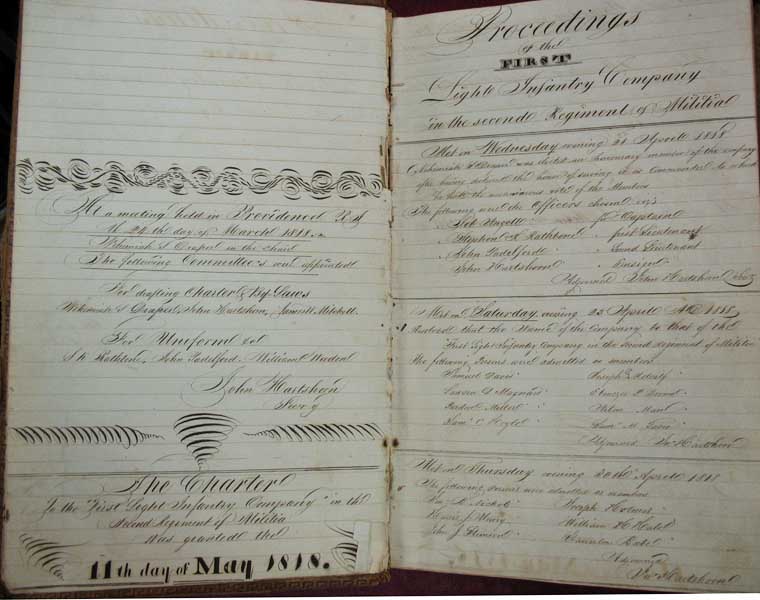
Rhode_Island_Light_Infantry

The Rhode Island First Light Infantry Company was formed in 1818 as a state militia company based in Providence. Affiliated with the Second Regiment of the Rhode Island militia, it saw no active duty. Indeed, for the majority of its history the company’s activities were more like those of a social club than of a militia–with a notable exception. The company helped to quell the Dorr Rebellion, even though some of its members actually fought alongside the rebels. Led by Thomas Wilson Dorr, the rebels sought to extend suffrage to the working class. Although Dorr was eventually convicted of treason, his ideas were influential enough that Rhode Island finally revised its archaic voting requirements.

A State Ripe for Revolution

In 1833, Rhode Island’s voting regulations were over 200 years old. Thus the only people who could vote were white, natural born males who owned land. But Rhode Island’s demographics had shifted; the population had grown, but the number of landowners had increased only by a small percentage. Self-educated carpenter Seth Luther was among the first to protest the old voting laws. His “Address on the Right of Free Suffrage” (1833) pointed out that 12,000 working people were at the mercy of Rhode Island’s 5,000 landowners, whom he called “mushroom lordlings, sprigs of nobility…[and] small potato aristocrats.” Luther urged his fellow citizens to stop cooperating with the government, to refuse to pay taxes and serve in the militia.

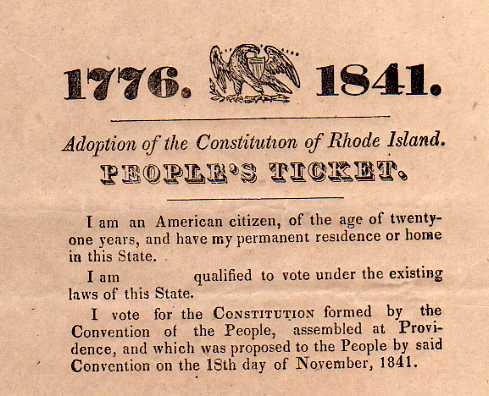
Peoples_Ticket_Dorr

The People’s ticket was designed to connect the Dorr Rebellion with the American Revolution.

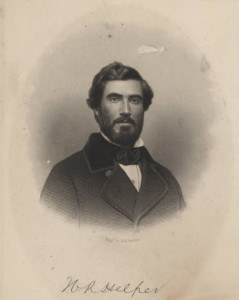
As support for voting reform grew, a somewhat unlikely champion for the cause emerged. Thomas Wilson Dorr was an attorney who hailed from a relatively wealthy family. Dorr served in the Rhode Island General Assembly, and in 1834 he attended a convention at Providence to discuss the issue of universal suffrage (then defined as “voting rights for all males.” But the legislature failed to pass any reforms. By 1841, Rhode Island one of only a few states that hadn’t adopted universal suffrage for white males. it was also the only state that had not adopted its own written constitution. That year the Rhode Island Suffrage Association was founded, and the organization sponsored a demonstration on the streets of Providence.

That year, both the Dorrites and the conservatives drew up their own constitutions. The conservative constitution maintained the same voting requirements as the 1663 charter. Meanwhile, at the “People’s Convention,” Dorr and his faction drew up a constitution that permitted all white males to vote. Dorr’s version got approval in referendum, but that was ruled illegal since it hadn’t been called by the government. The government’s constitution was defeated in a separate referendum. It seemed that Rhode Island had reached a stalemate. The Dorrites then decided to put their constitution to a vote. About 14,000 people voted for it, including 5,000 landowners; it won the majority even among only those who were currently allowed to vote. Although the vote was illegal, it did show the government that its citizens supported universal suffrage.

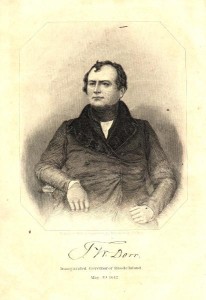
Thomas_Wilson_Dorr

Dorr’s gubernatorial portrait

In 1842, both factions went so far as to hold their own elections, and two separate governments emerged. The conservatives were based in Newport, and the Dorrites established themselves in Providence. Dorr ran for governor unopposed and, with 6,000 votes, was elected in April 1842. Obviously this election was also illegal, and Rhode Island’s rightful governor petitioned President Tyler to intercede. He invoked a clause in the US Constitution that permitted the federal government to provide troops to control local rebellions at the request of the state government.

Undone by Racism

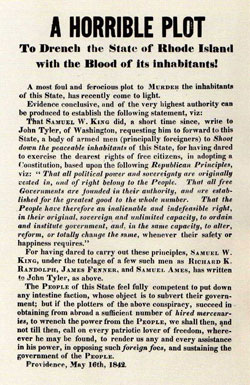
Broadside_Dorr_Rebellion

This broadside was published only one day before Dorr staged his rebellion.

Undeterred, the Dorittes held an inauguration ball for Dorr on May 3, 1843. The parade included not only local workers, but even members of the local militia! The parade marched through the streets of Providence. Shortly thereafter, the People’s legislature convened. Dorr’s next move was ill calculated. With the support of many local militia members, Dorr staged an attack on the state arsenal. But it ended quickly and disastrously when a cannon misfired. The government immediately ordered Dorr’s arrest on charges of treason, and Dorr was forced to flee Rhode Island.

And the People’s party had made another terrible move; despite the protests of Dorr and other members, their constitution extended voting rights only to white males. The Rhode Island government used this to its advantage, promising that any new voting legislation would allow blacks to vote. Soon black men were volunteering to join the Law and Order militia, which had been organized to quell the riot and defeat the faction that would deny them the right to vote.

When Dorr came back to Rhode Island, he found that although he had several hundred men ready to fight for his cause, they were far outnumbered by the Law and Order militia. Dorr went back into hiding to regroup. Martial law was declared in Rhode Island. At least 100 rebel soldiers were captured and taken to prison in Providence–after they were put on display, of course.

 Rebellion Leads to Reform

Though it appeared that the rebellion had been quashed, legislators now fully appreciated the support for amending suffrage requirements. They drafted a new constitution. The vote was extended to include not only property owners, but also those who paid a one-dollar poll tax. Naturalized citizens could vote if they held at least $134 in real estate. Then elections were held in 1843. The Law and Order group still met opposition from Dorrites, but used intimidation to get people to vote. The conservatives still lost in industrial areas, but got the votes in more rural zones. Ultimately the Law and Order group won the major offices.

That year Dorr returned to Rhode Island and was arrested on the street in Providence. He soon went to trial for treason, and the judge instructed the jury to put aside all political arguments and to ignore Dorr’s motives. They were to reach a decision only on specific, overt acts. Dorr had, of course, admitted to all his actions, so he was speedily convicted. The judge sentenced him to life in prison and hard labor. But Dorr would spend only twenty months in jail; the new Rhode Island governor thought it wise to pardon him, rather than let him languish in prison as a martyr.

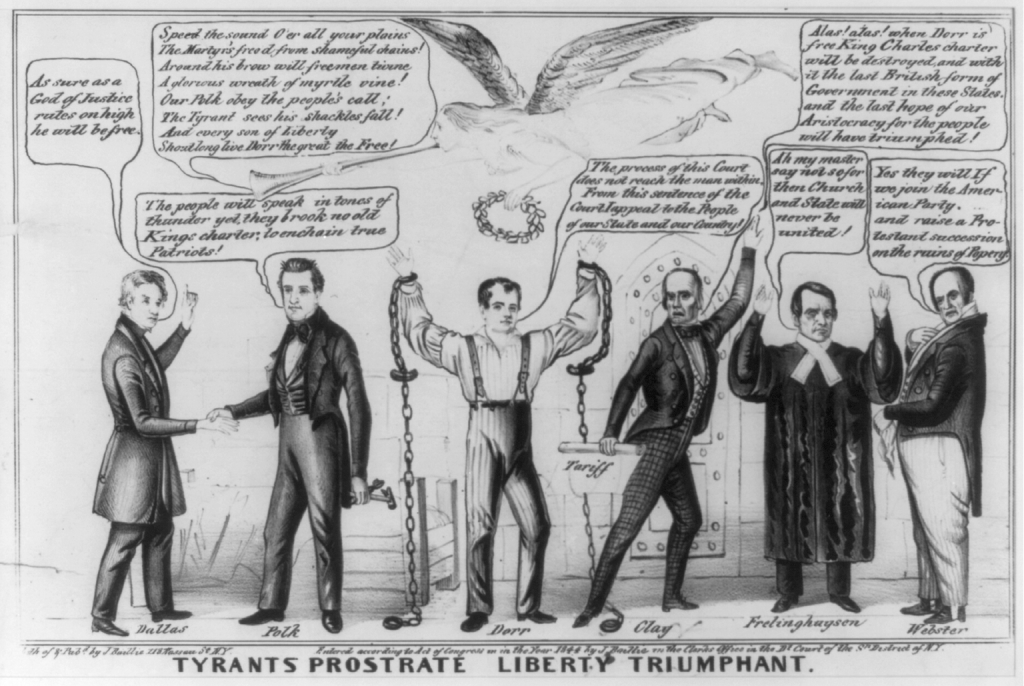
Polemic_Dorrite_cause_1844

The Dorrite cause still had support even after the rebellion had been quashed, as evidenced in this 1844 polemic.

A Last Stand at the Supreme Court

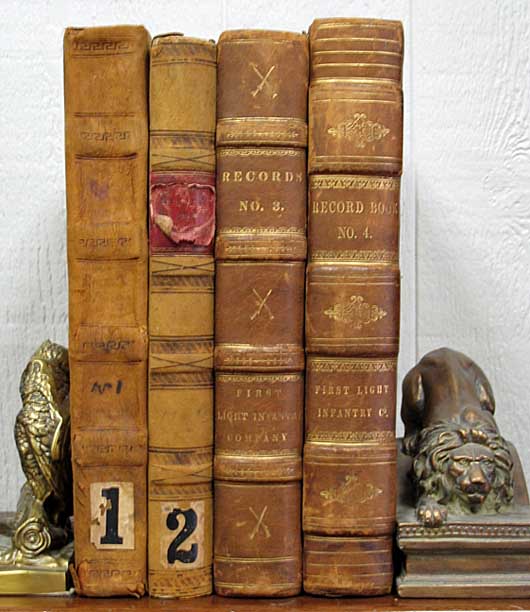
Rhode_Island_Light_Infantry_VolumesThough the Dorrites had been defeated, they remained in public consciousness for many more years, most notably through a landmark Supreme Court case. In Luther v Bordn (1849), Luther made a trespassing suit against the Law and Order militia. He alleged that the People’s government was truly a legitimate, elected government in 1842. Daniel Webster defended the militia, arguing that granting such legitimacy jeopardized the very existence of government and could lead to total anarchy. The Supreme Court ruled that it would defer to the President and Congress in matters of war and revolution, a conservative stance.

This period was certainly a dramatic one in Rhode Island history, particularly for members of the local militia. The company journals of the Rhode Island Infantry Company, which we’re proud to offer, capture these events as they were experienced by militia members at the time. Handwritten by a series of members, the four-volume set of records stretches from 1818 to 1873, providing exceptional context for quite a long era in American and local history.

Related Posts:
Rare Books in History: The Revolutionary War
Charles Dickens the Copyright Confederate
The Millerites and the Great Disappointment

Thanks for reading! Love our blog? Subscribe via email (right sidebar) or sign up for our newsletter--you’ll never miss a post.

Share

Charles Dickens the Copyright Confederate

In 1854, Sigmund H Goetzel arrived in Mobile, Alabama and immediately got to work setting up a bookstore. A German immigrant who’d been naturalized as a US citizen, Goetzel was intent to establish himself as a prominent member of the city and a vital member of the publishing community. During the Civil War, Goetzel’s publishing house would make waves regarding international copyright law–an issue near and dear to Charles Dickens’ heart. That copyright policy likely contributed to Dickens’ decision to support the South during the Civil War.

An Enterprising Publisher

Goetzel set up shop with silent partner Bernard L Tine, who owned a local clothing store. They called their outfit SH Goetzel & Company. Goetzel would drop the “& Company” once he repaid his debt to Tine in 1863, five years after their partnership had actually expired. Though he remained in the business only eight years, Goetzel proved quite industrious, publishing not only maps and broadsides, but also pamphlets and a number of books. Although many of the books were simply reprints of English or northern titles, a significant number were also original titles.

Mobile-Harpers_Weekly

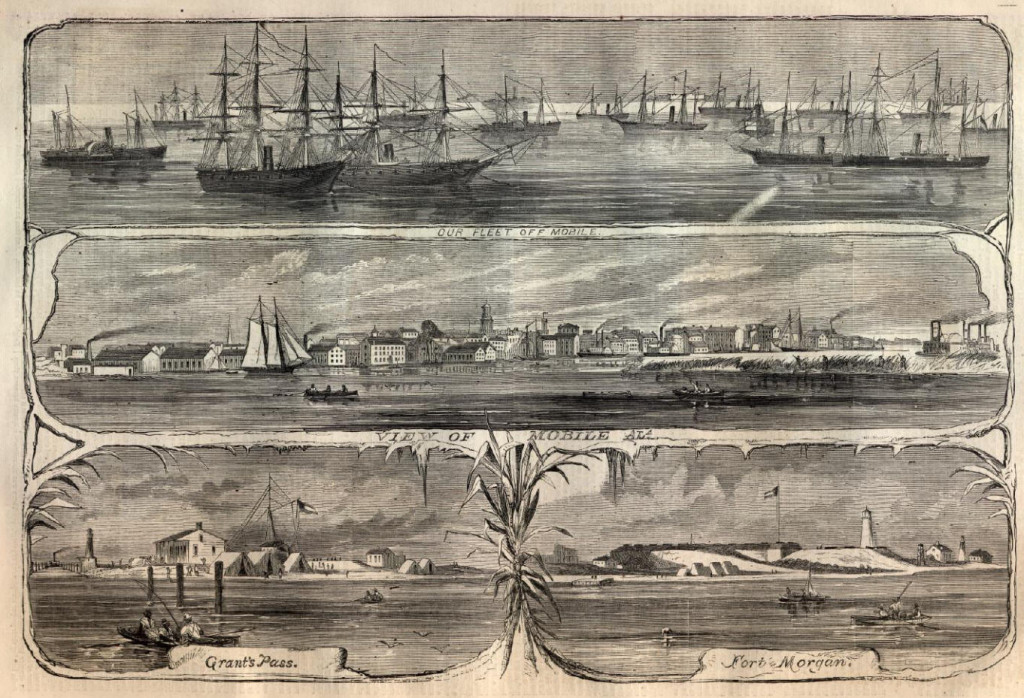
Confederate-era sketches of Mobile, Alabama, from Harpers Weekly

By 1860, the publishing industry in Mobile had grown by leaps and bounds, probably due to increased wealth and an influx of residents. The city was prosperous and cosmopolitan; approximately 50% of its white, male residents were foreign born. Meanwhile in the late 1850’s, Goetzel had consistently garnered praise for the high quality of his publications. SH Goetzel & Company was a thriving part of the Cotton City.

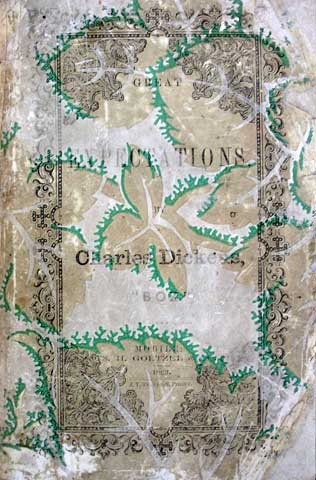
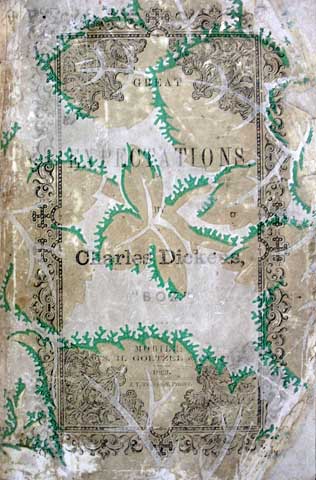
The onset of the Civil War in 1861, however, presented new challenges. Materials, particularly paper and ink, became increasingly difficult to procure from the North, and Union blockades prevented the import of materials from Europe. Goetzel’s main competitor, William Strickland & Company, was driven out of business due to accusations that the firm’s principles were “incendiaries,” that is, abolitionists. By the middle of the war, publishers and printers had either shuttered their shops, or stretched the limits of their ingenuity; thus, wallpaper became a common book covering material when paper and other materials ran out.

Copyright Controversy

Yet Goetzel persevered, anxious to prove to the world that the Southern publishing world would not be undone. His first endeavor was a new edition of William J Hardee’s Hardeen’s Revised and Improved Infantry and Rifle Tactics, which Hardee had revised at the request of Jefferson Davis. Goetzel soon found himself embroiled in a copyright lawsuit, as the work was immediately pirated both in the North and the South. He began printing “THE ONLY COPYRIGHTED EDITION” directly over the title.

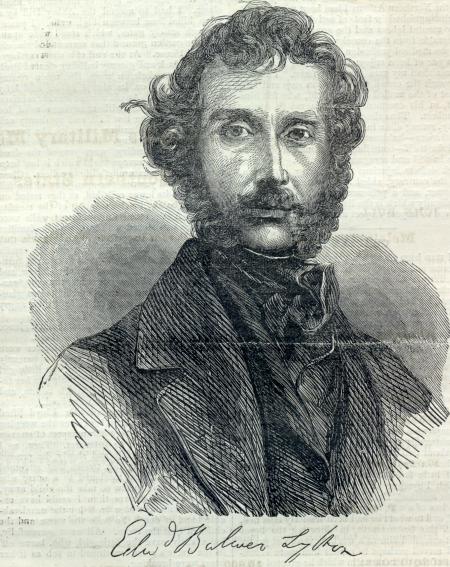
Edward_Bulwer_LyttonThe following year, Goetzel announced that the firm would issue an edition of Sir Edward Bulwer-Lytton’s A Strange Story. Scheduled to start in time for Christmas and New Years, it was issued in numbers. Goetzel published the numbers with such astonishing rapidity, that editors at the Mobile Advertiser and Register noted that the printer’s resources “exceeded expectations.”

By this time, the Confederate States of America had already established a strong stance on international copyright. On May 21, 1861, the CSA Copyright Act was ratified, granting reciprocal copyright and royalties to foreign-born authors. The legislation was a calculated move, designed to appeal particularly to the British, French, and Germans. And it did garner goodwill tin Europe, particularly in England, where Charles Dickens and other authors had been proponents of copyright law reform for decades.

Dickens_Great_Expectations_Confederate_EditionThus Goetzel had indeed written to Bulwer-Lytton to obtain permission to print A Strange Story and offer him a payment of $1,000. But thanks to the blockade, the letter never arrived. Bulwer-Lytton announced that the only royalties he’d received had come from his New York City Publisher, Harper & Company. Goetzel wrote a letter of self-defense to the editor of the Mobile Advertiser and Register, arguing that he’d sent Bulwer-Lytton payment and had only recently received confirmation of its arrival.

These issues did little to slow Goetzel’s prodigious output. In 1863–the height of the war–Goetzel published five new book-length titles, along with a map, three pamphlets, and a handful of reprints of earlier titles. One of these was an edition of Charles Dickens’ Great Expectations, which was bound in wallpaper. It’s now an incredibly scarce volume. The following year, Goetzel executed six new titles, each about 320 pages.

Dickens’ Sympathies Shift to the Confederates

Dickens_American_NotesThe Civil War had aroused vehement debate in England. Charles Dickens, then the editor of the popular periodical All the Year Round, simply couldn’t remain neutral. Furthermore, Dickens had already taken a decidedly anti-American stance following the debacle of his first visit there. Though American Notes only cast aspersions on the American institution of slavery and the press, Dickens was much more aggressive in Martin Chuzzlewit. The works only served to alienate him further from his American audience.

Dickens personally published on the war in All the Year Round only once, on March 1, 1862. He simply republished a number of controversial passages from American Notes with the following note: “The foregoing was written in the year eighteen hundred forty-two. It rests with the reader to decide whether it has received any confirmation, or assumed any color of truth, in or about the year eighteen hundred sixty-two.” The comment implies disdain for both the North and the South. But it also served to vindicate Dickens’ original (and somewhat unpopular) stance in American Notes.

But All the Year Round saw at least 25 pieces about the Civil War. Ever the attentive editor, Dickens carefully supervised every aspect of his publications. That extended to the publication’s political stances which we know thanks to his public announcement following the mid-war printing of Charles Reade’s serialized novel Very Hard Cash, which attacked the Commissioners on Lunacy (which included Dickens’ dear friend John Forster). Dickens said that he took responsibility for the political stances presented in All the Year Round–with the exception only of noted authors’ serial novels that appeared in the periodical.

Appealing to His Readership

Dickens relied on All the Year Round for a substantial portion of his income and had to consider his readers’ interests to ensure sales. Therefore he leaned toward narratives and “true accounts” of the Civil War, rather than news and political commentary. On December 29, 1860, a summary review of Frederick L Olmstead’s A Journey into the Back Country appeared. The book chronicled the most horrifying aspects of slavery in the Lower Mississippi Valley, the least cultured area of the South. The review descried the South’s purported intention to reopen the slave trade.

An article published on July 13, 1861 denounced the South for commissioning privateers to harass British ships delivering goods to the North. Such interference with foreign trade was simply a barbarous tactic. Then on October 26, 1861, a story about an English doctor who treats a runaway slave appeared. It includes all the usual elements: bloodhounds, sketchy Southerners, and a doctor who notes how “wonderfully” the Southerners’ minds have been warped by slavery. A West Virginian character in the story opines, “I only wish we could have a hand on them philanthropists (abolitionists)…A load of brushwood and a lucifer-match will be about their mark, I calculate.”

Spence the English Confederate

By the end of the year, however, the editorial bent of All the Year Round had become decidedly pro-Southern. What happened to change Dickens’ mind? First, he read James Spence’s The American Union, Its Effects on National Character and Policy with an Inquiry into Secession as a Constitutional Right and the Causes of Disruption. Dickens’ copy is inscribed by Spence himself, and the work would deeply impact Dickens’ view of the war.

Historian of the South Frank Lawrence called Spence’s book “the most effective propaganda of all by either native or Confederate agent.” Spence also became active in agitating for the South among England’s working class. He would organize meetings and rallies to counter those held by the Foster-Bright abolitionist groups. So Dickens wasn’t the only British citizen swayed by Spence; he was simply one of multitudes–but perhaps the only one with such a public platform for endorsing Spence’s views.

Dickens was so anxious to review Spence’s book in All the Year Round, he mentioned it more than once in his letters to his assistant editor. After it finally appeared (in not one, but two issues), he was dissatisfied with it. Written by Henry Morley, the review harshly criticizes the Northern cause and contends that the United States is too large to govern honestly and effectively.

A Change of Heart

Dickens was so taken with Spence’s arguments that he espoused them almost unquestioningly. In a letter to his Swiss friend WF de Cerjat on March 16, 1862, Dickens outlines his own views on the war…which are almost entirely borrowed from Spence. He argued that abolition was merely a pretext for other economic aims and “in reality [had] nothing on earth to do” with the Northern war effort. He went on to say, “Any reasonable creature may know, if willing, that the North hates the Negro, and that until it was convenient to make a pretense that sympathy for him was the cause of the war, it hated the abolitionists and derided them up hill and down dale.”

Spence grounds his arguments in the tariff debated that had gripped America even before the South had seceded from the Union. The Morrill tariff, passed on March 2, 1861, replaced the Tariff of 1857, which strongly favored Southerners. The Morill tariff, in contrast, gave preference to industrial workers and placed the South at a considerable disadvantage (hardly a surprise, given that by the time of its ratification, the Southern representatives had left Congress). It also impeded trade with Europe. Two subsequent tariffs during the Civil War helped raise necessary funds for the war.

While Dickens openly adopted Spence’s views, there’s another reason he may have shifted his allegiance: international copyright law. After all, his perspective shifted after the CSA’s Copyright Act had been ratified. And Dickens had long advocated stronger international copyright law; indeed, his first visit to the United States was spoiled because he refused to dismount his copyright law hobby horse and act graciously toward his American hosts and interlocutors. Instead, Dickens pushed his agenda at every opportunity, even using a dinner in his honor as a platform to galvanize fellow authors to his cause.

This issue would have been an emotional one for Dickens, but not one that would garner him much empathy from readers. Better, then, to repeat other, more popular arguments. Thus, it’s quite possible that Dickens privately sympathized with the South because the South seemed to sympathize with his own cause. Whatever his motives, the Confederate imprint of Great Expectations remains a work that will undoubtedly continue to evoke questions and enrapture collectors.

Related Posts:
A Collection of Confederate Literature
How the “Dickens Controversy” Changed American Publishing
Charles Dickens Does Boston
The Two Endings of Charles Dickens’ ‘Great Expectations’

Thanks for reading! Love our blog? Subscribe via email (right sidebar) or sign up for our newsletter--you’ll never miss a post.
Share

A Collection of Confederate Literature

On March 11, 1861, delegates from Alabama, Florida, Georgia, Louisiana, South Carolina, and Texas gathered in Montgomery, Alabama. Their purpose: to ratify the Constitution of the Confederate States of America. The document was–not unsurprisingly–similar to the US Constitution, even using some of the same language.

But the Confederate Constitution gave the states much more autonomy and power than the central government. For example, while a presidential item veto existed, states had to consent to the use of any funds or resources by the federal government. The Confederate Constitution also set six-year terms for the president and the vice presidents, and precluded the president from serving two consecutive terms. And slavery was “recognized and protected” in all slave states and territories, while foreign slave trade remained illegal.

Both France and Great Britain considered entering the fray on the side of the Confederates. But they never acknowledged the Confederate States of America as its own independent, autonomous entity, and the Confederate States crumbled in April 1865.

A Selection of Confederate Literature

For collectors of Americana, the Civil War is a perennially popular area of focus. Within that specialization, the depth and breadth of material available makes it possible to further specialize in a sub-section of Civil War literature. The works and records of the Confederacy offer a fascinating, enlightening, and sobering look into one of the bloodiest periods in American history. Even this sub-specialty has incredible scope, stretching to include works written both before and long after the war itself.

The Italian Bride

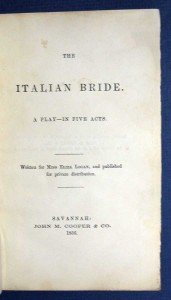
Levy-Italian_brideSamuel Yates Levy wrote this play in honor of Eliza Logan and had it printed for private distribution in 1856. Logan was a popular actress in the mid-nineteenth century, and her father, Cornelius Logan, acted as her manager until his death in 1853. Though Logan was born in Philadelphia, she made her name in the antebellum South, with many lucrative engagements in cities like Savannah. Meanwhile, Levy would go on to become a Confederate officer during the Civil War, slightly unusual because he was Jewish. Research indicates that this volume’s recipient was a fellow officer from Georgia. Details>> 

Great Expectations

Dickens_Great_Expectations_Confederate_EditionDickens’ first visit to America ended less than well. The legendary author returned to Britain and published two American Notes, which criticized the United States, most notably for permitting the institution of slavery. (He further alienated American readers with Martin Chuzzlewit.) Dickens’ strong opposition to slavery and his keen sensitivity to social injustice made him an unlikely ally of the Confederacy. But after a close reading of James Spence, who was not only a writer for the London Times, but also a pro-South merchant, Dickens revised his opinion. In All the Year Round, he spoke out in defense of the South on the subject of the Morrill Tariff, noting that the ariff had “severed the last threads that bound the North and South together.” This first Confederate edition of Great Expectations is exceedingly rare in the trade, with no copies having come to auction in the past thirty years. Details>>

Carrie Bell

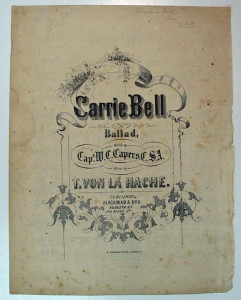
Carrie_BellCaptain MC Capers wrote the lyrics to the Confederate tune “Carrie Bell,” while T. Von La Hache composed the musical accompaniment. Capers was formerly of the “Macon Volunteers” and had also participated in the Indian Wars in Florida (1836). During the Civil War, Capers was in command of Company G, 1st LA Heavy Artillery Regiment of the CSA. In July 1863, he was promoted to major, seeing service at Vicksburg and elsewhere in the South. Details>>

A Legal View of the Seizure of Messrs Mason and Slidell

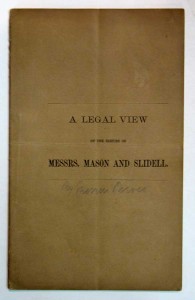
Legal_View_Seizure_Mason_SlidellThough this pamphlet was published under the pseudonym “Pro Lege,” it’s thought to be the work of Virginia statesman Francis Rives. He delves into the issues regarding seizure at sea during the US Civil War. The matter came the the forefront when Captain Wilkes, acting on his own cognizance, boarded the British vessel Trent and took two individuals, Mason and Slidell, captive. The two were acting as Confederate diplomats. Wilkes’ bold move was locally applauded, but the British were indignant and on the verge of entering the war against the Union forces. Seward released the two gentlemen and told the British that Wilkes had erred and acted without proper authority. Published in 1861, this pamphlet looks at the diverse international maritime legal issues and the ramifications of Wilkes’ act. Details>>

General Orders No 30

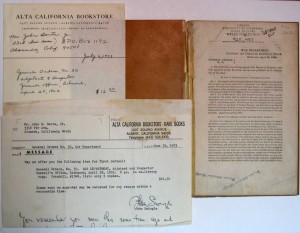
General_Orders_No_30Containing “An Act to Organize Bands of Partizan (sic) Raiders” and “An Act to Further Provide for the Public Defence,” this document was published in April 1862 by the Confederate War Department. It authorized the president “to call out and place in the military serve of the Confederate States, for three years, unless the war shall have been sooner ended, all white men who are residents of the Confederate State, between the ages of 18 and 35 years old.” Details>>

Life of General Stand Watie

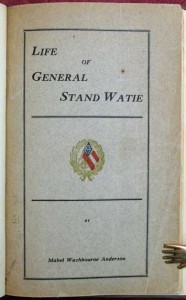
Life_General_Stand_WatieThe only Indian brigadier in the Confederate Army and the last Confederate general to surrender, Stand Watie was no stranger to conflict. Long before the war, Watie and his brother, Elias Boudinot, had published the Cherokee Phoenix. Watie also acted as a signatory to the 1835 Treaty of New Echota, which called for the removal of the Cherokee people from Georgia to “Indian Territory” (which eventually became Oklahoma). During the Civil War, Watie consistently distinguished himself in battle, refusing to surrender until June 23, 1865. His grandniece wrote the biography Life of General Stand Watie. The first edition is rare in the trade; only one other copy has come to market in the last fifteen years. Details>>

The Princess of the Moon: A Confederate Fairy Story

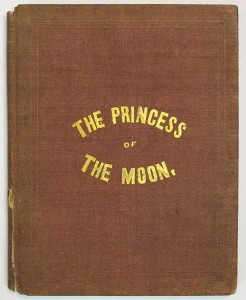
Princess_Moon“‘I am the Fairy of the Moon,’ said she, ‘and having witnessed your grief I desire to serve you. What would you have?'”

The Princess of the Moon is a relatively scarce juvenile with strong fantasy elements. The bias of the author, Cora Semmes Ives, is obvious, and she clearly wanted the Civil War to end differently. Published in 1869, this volume illustrates that Confederate sympathies certainly didn’t dissolve with the Confederacy. OCLC records three institutional holdings, though we found a few additional ones. Details>>

John Brown and Wm. Mahone

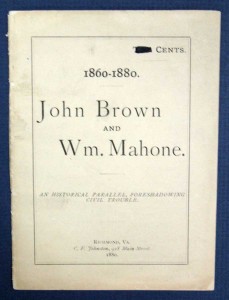
John_Brown_William_MahoneWritten by George W Bagby in 1880, this pamphlet’s half-title is “An Historical Parallel, Foreshadowing Civil Trouble.” The political tract, anti-Grant and anti-Malone, was issued during Malone’s 1880 run for US Senator for Virginia. Bagby proposes an odd connection among Grant, Mahone, and Confederate guerilla John S Mosby. He also predicts a civil war worse than that of the early 1860’s. “Miserable South!…despised by all the world, and for no crime but that you Christianized a race of savages thrust upon you by mercantile greed–how sad is your fate!” Details>>

The James Boys in Arkansas; or, After Confederate Gold

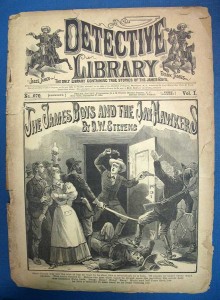
James_Boys_JayHawkers_Confederate_GoldThe concept of Confederate plunder was a popular one that survived the end of the Civil War. It inspired this 1895 dime novel, which plays on the notion that Confederate rebels had hoarded ill-gotten wealth. According to Bragin’s Dime Novels Bibliography, author Frank Tousey “practically revolutionized the dime novel field…[and here in the Detective Library was] the finest James Boys stories. The second title proves but a teaser, comprising only three pages of text and informing readers that the entire tale can be found in Issue No. 671. This is considered a scarce title of outlaw fiction; OCLC records only one institutional holding. Details>>

Share

L Frank Baum’s Forgotten Foray into Theatre

Baum_Fairylogue_Radio_Plays

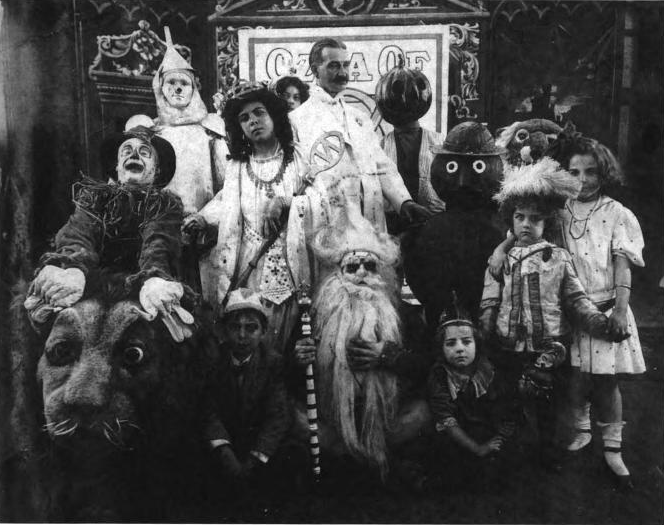
Baum with the cast of ‘Fairylogue and Radio-Plays’ (1908)

Though L Frank Baum is best known as the author of The Wonderful Wizard of Oz, the famed author had a rich and varied career. His accomplishments include trade magazines and newspapers, along with an oft-forgotten play based on his sequels to Wizard of Oz.

Early Literary Aptitude

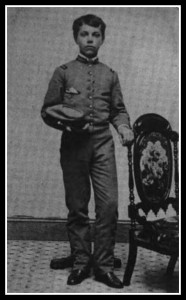
L_Frank_Baum_CadetBorn on May 15, 1856, Lyman Frank Baum was a sickly child. Particularly fond of fairy tales and British authors like Charles Dickens, Baum spent much of his time reading. But Baum found fault with fairy tales because they were so often frightening and gruesome. He would later note, “One thing I never liked then…was the introduction of witches and goblins into the story. I didn’t like the little dwarfs in the woods bobbing up with their horrors.” Thus, from an early age, Baum resolved to write a different kind of fairy tale.

But his first literary exertions weren’t fairy tales: Baum started his own newspaper, The Rose Lawn Home Journal with a printing press purchased by his father. Baum took the publication quite seriously, writing news pieces and editorials, along with poetry, word games, and fiction. The young man’s paper did quite well, and a number of local businesses purchased advertising space in its pages. In 1873, Baum launched two more papers, The Empire and The Stamp Collector.

Meanwhile it had become quite fashionable to breed chickens and other fowl. Baum took up breeding Hamburgs and won several awards with his birds. He also launched The Poultry Record, a magazine devoted to breeding and raising poultry. The publication was rather successful. Then in 1886, Baum published his first book, The Book of the Hamburgs: A Brief Treatise upon the Mating, Rearing, and Management of the Different Varieties of Hamburgs.

A Love for Theatre

Baum_Holcomb_Maid_Arran

Baum as Hugh Holcomb in ‘The Maid of Arran’

Baum also found time to nurture his interest in theatre. He frequently memorized passages of Shakespeare and even founded a Shakespearean troupe with his father’s financial backing. The elder Baum had made a fortune in the family business and purchased a number of opera houses in Pennsylvania and New York. He entrusted their management to his son in 1880. Baum proved quite adept, even delving into writing his own plays. The Maid of Arran, considered Baum’s first major literary work, met with immediate success.

But with the decline of the Baum’s father’s health and two unlucky episodes with swindling employees, Baum was left virtually penniless. His wife, Maud, suggested that the family move West. They settled in Dakota territory, where Baum opened a general store called Baum’s Bazaar. Soon Baum had made a reputation for two things: storytelling and extending credit. Thanks to Baum’s generous spirit and a drought that left most of his customers destitute, the bank foreclosed on Baum’s Bazaar in 1890, only two years after it opened. Baum established The Aberdeen Saturday Pioneer, acting as reporter, printer, and salesman all in one. But that, too, failed in 1891.

Return to Authorship

That year, Baum decided to move his family to Chicago. The World Columbian Exposition was there, so employment opportunities were plentiful. First Baum worked as a reporter for the Evening Post, but the paltry pay was hardly enough to support a family. Next he went into sales for the china company Pitkin & Brooks. He was often on the road. His mother-in-law, noted feminist Matilda Gage, moved in to help with the Baum children. It was she who encouraged Baum to write down the fairy tales he spun for his children and their young friends.

Baum frequented the Chicago Press Club when he wasn’t traveling. It’s been conjectured that Baum met illustrator Maxfield Parrish, resulting in Mother Goose in Prose (1897). But so far as we know, the two never actually met; Chauncey Williams of Way and Williams negotiated for Parrish’s illustrations in the children’s book. Williams also served as publisher of The Show Window when the journal was launched in 1897. The magazine gave Baum an opportunity to make a living without traveling as a salesman.

A Serendipitous Acquaintance

L Frank Baum

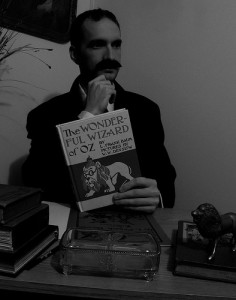
This photograph considered a fake, merely an actor holding a facsimile version of the 1st edition.

Soon Baum made the acquaintance of William W Denslow. Though the two had disparate personalities, they decided to collaborate on a companion to Mother Goose in Prose. Together they published Father Goose, His Book in 1899. The beloved book spurred Songs of Father Goose. The pair worked on a few more project, most notably The Wonderful Wizard of Oz. Baum had originally submitted the story with the title The Emerald City, which publishers Hill and Company rejected. They finally agreed on a new title, and the first edition appeared in May, 1900.

Two years later, Baum collaborated with Paul Tietjens and Julian P Mitchell on an adult musical adaptation of Wizard of Oz. A major success, the production toured all over America. The country was absolutely infatuated with the land of Oz and its whimsical characters. Baum published a total of thirteen Oz books and six short Oz stories and came to be known as the “Royal Historian of Oz.” The Ozmapolitan, a promotional piece, was issued in 1904 to help Reilly & Britton advertise The Marvelous Land of Oz, which was the new firm’s first publication. Occasional later versions of The Ozmapolitan were also issued.

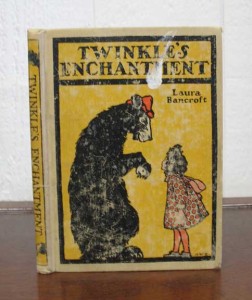
Baum_Bancroft_Twinkles_EnchantmentThough he indulged his audience with all these tales of Oz, he longed to delve into other projects. Baum often used pseudonyms for these endeavors, so that he didn’t have to worry about their critical reception. One notable project was Aunt Jane’s Nieces, a series for teenage girls Baum published under the pen name Edith Van Dyne. He also wrote under the names Laura Bancroft, Floyd Akres, Captain Hugh Fitzgerald, Suzanne Metcalf, and John Estes Cooke.

Baum also launched a traveling show called “Fairylogue and Radio Plays.” The show featured live actors costumed as characters from several of Baum’s fantasy books, a live orchestra, motion-picture clips, and colored lantern slides. Baum traveled with the show as master of ceremonies. The endeavor proved a commercial failure.

Return to the Stage

In 1913, The Tik-Tok Man of Oz made its debut on the stage. Producer Oliver Morosco inserted three songs he wrote (with music composed by Victor Schertzinger). Billed as “a companion play to The Wizard of Oz, The Tik-Tok Man of Oz met with great success in Los Angeles, but didn’t resonate with other audiences. Chicago critics were particularly unimpressed. Though the show made money, Morosco decided not to keep producing it.

Only an early manuscript of the musical is extant, and the play probably would have faded into obscurity were it not for the published music and advertisements. Promotional materials for the production have proven exceedingly rare; a survey of auction records and other online sources indicate only two extant playbills. One, from December 2, 1913 at the Babcock Theatre in Billings, Montana, comes from the collection of Fred M Meyer and can be viewed at the International Wizard of Oz Club website. The other, from the play’s opening night in San Francisco on April 21, 1913, is pictured here. We’re proud to offer this item as one of this month’s select acquisitions, which features a diverse collection of broadsides.

We invite you to peruse the entire list! Should you have a question about any item, please feel free to contact us.

Many thanks to our esteemed friend Peter E Hanff for his contributions to this article. The Deputy Director of the Bancroft Library at the University of California, Berkeley, Hanff is a great scholar of L Frank Baum. He collaborated with Douglas G Greene on Bibliographia Oziana, the main bibliographic record and resource on Oz literature. 

Share

Collecting Antiquarian Diaries, Journals, and Correspondence

In this age of electronic communication, the practice of keeping a journal or diary has largely fallen by the wayside, as has the art of letter writing. But in past centuries, keeping a diary was the only means of creating a written record of one’s life, the only way to look back at one’s personal past. In bygone days, farmers may have recorded observations about crops, livestock, and weather in a journal. Soldiers recorded strife,while ordinary men and women simply recorded the simple details of their daily lives. And written correspondence was the primary method for maintaining long-distance relationships.

Looking back at these documents can give us tremendous insight into the aspects of life that history books often omit. They may reveal facts about the diet, customs, or etiquette of the time period. They sometimes shed light on genealogy and local history. Journals and correspondence may even reveal the real motivations behind historic events or explain the nuanced relationships among important individuals.

Tips for Collecting Diaries, Journals, and Correspondence

For many collectors, diaries and journals are appealing because each volume is an absolutely unique manuscript. Such a document is quite a treasure, indeed. Collectors should keep a few tips and hints in mind.

  • Look for complete sets, rather than individual volumes of journals and diaries. Faithful diarists will often have produced a number of volumes over the course of their lifetimes. Stay away from individual volumes that have most likely been removed from a set.
  • Decide whether you’ll digitize your collection. This will require the assistance of a skilled archivist or conservator. Digitizing these items is an investment, but it will enhance your ability to enjoy the content of your collection–and to share it with scholars if the content proves significant.
  • Be gentle! Old paper can be quite brittle, while covers may be fragile. Handle them with care, and consider professional conservation or preservation to extend the life of your collection.
  • Don’t overlook ephemera. Journals frequently contain extra items, which can range from dried flowers to vacation souvenirs. These items damage the pages on either side. A conservator may recommend carefully documenting each item’s location and storing it separately in an archival envelope.
  • If correspondence is still contained in the original envelopes, consult a conservator about the best means to preserve both the envelopes and the letters inside. Chemical interactions between materials–even between two sheets of the same or similar papers–can hasten breakdown.

A Selection of Diaries and Journals

Journal Across the Atlantic

Journal_Across_AtlanticOriginal mss journals such as this are quite rare in commerce. An unidentified male passenger recorded the details of his 1785 transatlantic journey from London to Philadelphia. He records the names and nationalities of the crew and passengers, along with the daily minutiae of life aboard the ship. Events include the sighting of a “grampus whale,” an encounter with a Spanish ship, and a lively debate over how moths and butterflies came to be aboard the ship. Details>>

Notes from Lectures of Professor Alonzo Clarke for 1848-1849

Almon Mitchell Orcutt attended the College of Physicians and Surgeons in New York. The first 136 pages of his journal consist of notes he took during the lectures of Alonzo Clarke, a noted physician and professor at the college. Clarke was often quoted in medical journals and association reports. He famously said, “All of our curative agents are poisons; and, as a consequence, every dose diminishes the vitality.” He was correct, indeed, given the “medicines” and treatments commonly used at the time. John Harvey Kellogg quotes Clarke in his Home Hand-Book of Domestic Hygiene (volume 2, 1880) in a discussion of the smallpox vaccination. Orcutt’s notes include the semester’s lectures, while the last 68 pages contain financial records. Details>>

Department of the Interior, US Geological Survey

US_Geological_Survey_Notes_JournalThis workbook started out as a record of levels and other data, kept by Allen T Paine, the survey crew levelman. But Paine also used the book as a photo journal. Many of the photographs are captioned. While many show family, friends, and colleagues, a good number also document the buildings of Concord, New Hampshire, along with the survey crew’s work and environs. Details>>

Family Trip Photo Diary/Journal

This period photo journal of a visit to the 1915 Panama Pacific Exposition in San Francisco begins in Albuquerque, New Mexico. It includes 45 images, eight of which clearly depict portions of the journey to San Francisco. One image, for example, shows part of the Salt Lake; another, the Grand Canyon. Fourteen of the images have handwritten captions. Details>>

 Archive of Shuman Family Letter Correspondence, August 1862-September 1866

Shuman_Family_Correspondence_Civil_WarJohn Shuman was in his early twenties when he volunteered for service in the 88th Regiment of the Indiana Volunteers to fight for the Union in the American Civil War. His letters illustrate his confidence in the decision and that he believed the war would be short-lived. It lasted longer than Shuman expected, and he lost his life in battle, not due to wounds, but due to dysentery. The Shumans’ correspondence offers a unique snapshot of a soldier’s life during the war. Details>>

Eleven Manuscript Diaries

Manuscript_DiariesThe author of these diaries, William Antrim Flowers, was born on March 21, 1832 in Champaign County, Ohio. He begins his memoir with his birth and then goes back to the birth of his father in 1804. The memoir is a rich storehouse of family genealogy and history, following his family and relatives as they moved abou tthe Midwest in the early nineteenth century. Flowers also documents his own life, during which he worked variously as a teamster, a wagon driver, a teacher, and a dairy farmer. He saw the first McCormick reaper in 1855 and enlisted to serve in the Civil War. Flowers records descriptions of his own experiences in the war, along with a description of the 114th Colored Regiment Infantry and the 44th Colored Regiment; and the death of Abraham Lincoln. Details>>

Related Posts:
Flights of Fancy: Collecting Vintage Airline Posters
Of Sammelbands and Sheet Music
A Brief History of Broadsides


Thanks for reading! Love our blog? Subscribe via email (right sidebar) or sign up for our newsletter--you’ll never miss a post.
Share

Irwin and Erastus Beadle, Innovators in Publishing Popular Literature

Toward the middle of the nineteenth century, the story papers started giving way to a new publication format: the dime novel. Though a number of American publishers capitalized on the trend, Irwin and Erastus Beadle were likely the most successful. The fruits of their publishing company include numerous series, constituting a unique category of collecting.

Erastus Flavel Beadle was born on September 9, 1821 in Oswego County, New York. Five years later, his brother, Irwin Pedro Beadle, was born. After various apprenticeships, the brothers eventually set up their own stereotype foundry in 1850. The following year, Erastus teamed up with engraver Benjamin Vanduzee to publish the youth magazine The Youth’s Casket. Though Vanduzee would leave the project a few years later, publication continued until 1856. Meanwhile, in 1855, Erastus started his next project: The Home: A Fireside Companion and Guide for the Wife, the Mother, the Sister, and the Daughter.

New City, New Venture

Beadles_Metta_Victoria_Fuller_VictorThe following year, however, Erastus decided to head west. He hoped to take advantage of the land boom in Kansas and Nebraska. It’s likely that his former apprentice Robert Adams took over publication until his return in 1857. Then in 1858, both Beadle brothers and Adams relocated to New York City. Erastus continued publishing The Home from there, and he brought on Metta Victoria Fuller Victor as the new editor in December, 1858. Victor would become a notable author of several Beadle’s dime novels, including The Dead Letter and Maum Guinea. Her husband would also become an editor for the publishing house for several years.
The late 1850’s also saw a new interest in sheet music and popular songs. Irwin capitalized with the Dime Song Book (1859), a paper-bound set of ballads that had previously been published separately. The book sold quite well, so Irwin undertook a series of dime booklets on a wide variety of subjects, from cookery to baseball. At the end of that year, Irwin and Adams formed Irwin P Beadle & Co. Though Irwin would come up with the innovation of publishing dime novels serially, it would be Erastus who got most of the credit–and the profit.
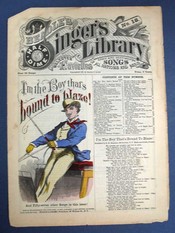
Beadle's Singer's Library-I'm the Boy That's Bound to Blaze1860 saw the inception of the first Beadle novel series. It kicked off with Ann Stephens’ Maleaska, the Indian Wife of the White Hunter, which had first appeared in Ladies’ Companion magazine (February-April 1839). The story was advertised as “a dollar book for a dime.” In dime novel form, Stephens’ work sold more than 65,000 copies in the first few months. Erastus would later estimate that the eighth novel, Edward Sylvester Ellis’ Seth Jones, sold over twice that, though some experts believe he exaggerated. At any rate, the dime novels, with their orange paper wrappers and patriotic stories, were popular sellers.
The Civil War temporarily slowed sales of Beadle’s Dime Novels, but the Union troops were soon reading them as voraciously as ever. Nevertheless, in 1861, Beadle’s American Library was launched in London. It mostly included reprints from the American editions and lasted for five years. In 1862, Erastus and Adams actually bought out Irwin. They didn’t rename the firm Beadle & Adams until 1870, four years after Adams had died and his two brothers, David and William Adams, had assumed his ownership. In the meantime, publications would be issued under several subsidiary names: Frank Starr & Co; Adams, Victor, & Co; and Adams & Co.

Irwin tried his hand at publishing dime novels on his own, but he couldn’t match the efforts of his brother. He gave up the endeavor in 1868. But 31 more novel series would be published, many of these reprints of earlier publications.

Beadle’s New York Dime Library

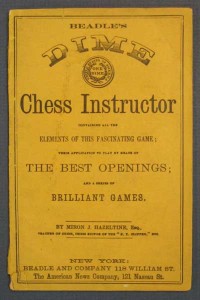
Beadles_Dime_Chess_InstructorThe longest running of these was Beadle’s New York Dime Library. The series actually began as Frank Starr’s New York Library, and Numbers 1 through 26 were were originally published under this title. Then Number 27 appeared on February 18, 1878 with the title Beadle’s New York Dime Library. When Numbers 1 through 26 ran out, they were reprinted with the new name. Now, it’s almost impossible to find printings with the original name, though occasionally a copy will surface with the new title pasted over the old one. In advertisements, the “New York” was often omitted from the name, likely because it was considered rather insignificant.

Stories in Beadle’s Dime Library generally hadn’t been published anywhere else first, except for a few serials from story papers. The content was largely the same: stories of adventure, of pioneers and cowboys, of criminals and war heroes. An occasional tale of the sea would be included (notably the pirate stories of the two Ingrahams), but for the most part this genre was considered past its prime. In the late 1870’s and 1880’s, stories of street boys who made their way in the world became increasingly popular. Horatio Alger, Jr was a frequent contributor of these.

Beadle’s Half-Dime Novels

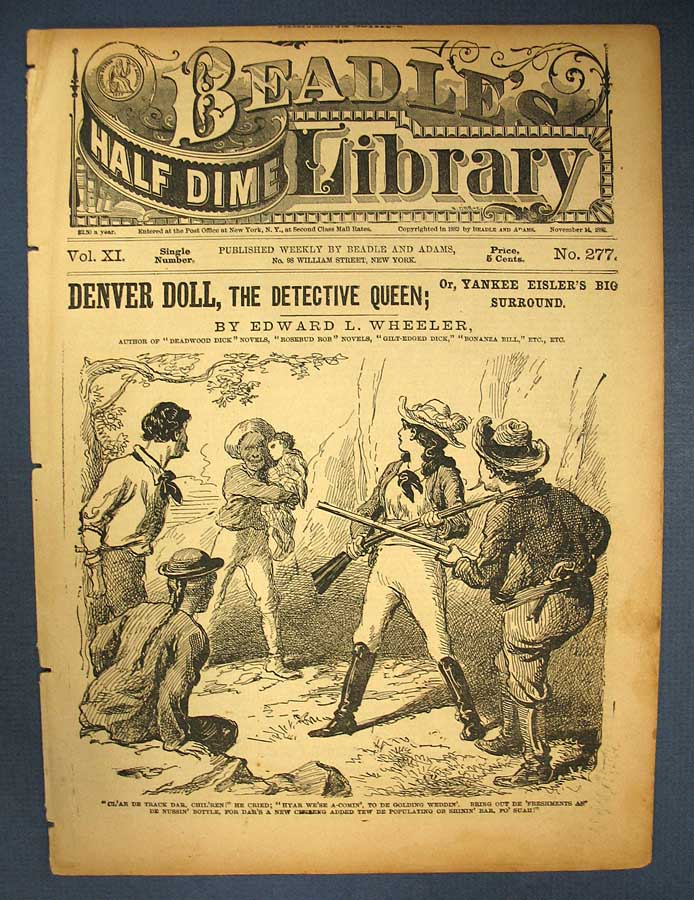
Just five months after Beadle’s Dime Library was launched, Beadle & Adams started the Beadle’s Half-Dime Library. It was geared toward children, who couldn’t always get a dime, but could often scrape together five cents. Experts believe that the first Number most likely appeared on Monday, October 15, 1877, which is actually the same day that the advertisement stating that the series was “coming soon” appeared in Beadle’s Dime Library.

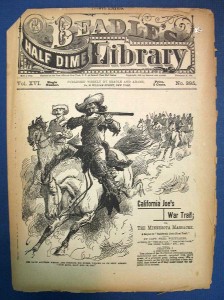
Beadles_California_Joes_War_TrialBeadle’s Half-Dime Library was published twice a week until the end of 1877. Starting in 1878, the publication appeared once a week, on Tuesdays, so long as Beadle remained publisher. Some early Numbers have multiple illustrations. For the most part, however, they are illustrated with a single woodcut on the front page. Beadle also squeezed quite a bit of text on each page–often twelve lines of type per inch.

Earlier Half-Dime stories were of adventurers, backwoodsmen, trappers, and hunters. The majority of the stories ran as series. These included Broadway Billy and Joe Phoenix. Deadwood Dick was probably the most successful of these, continuing for over 100 Numbers.

The End of an Era

In 1891, two other similar libraries emerged: Nick Carter Library and Gem Library. Then 1893 saw the establishment of the Bob Brooks Library. And the Tip Top Library and the Diamond Dick Library both started in 1896. But these would be short lived in comparison to Beadle’s Dime Library, which continued a few more years, until 1905. By the end of the 1930’s the dime novel had mostly given way to the pulp magazine.

A Selection of Beadle’s Dime and Half-Dime Publications

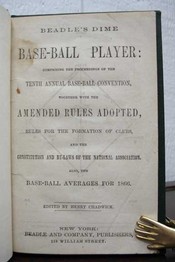
Beadles_Dime_Baseball_PlayerBeadle’s Dime Base-Ball Player (1867)

Beadle’s Dime Base-Ball Player was published as a continuous series from 1860 to 1881 (none were issued in 1861 or 1863). This is the sixth example. Author Henry Chadwick, is generally regarded as the first sports writer in the US. According to DAB, “the rules of baseball are largely his work.” The series gave rise to the many iterations and laborious study that baseball fans still love today. All of these guides are quite scarce; OCLC shows only one listing of the seventh issue for the nine editions through 1870, and none have come to auction in the last three decades. Details>>

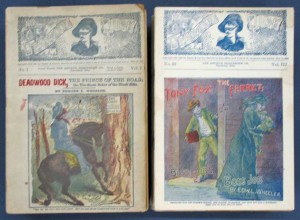
Deadwood_Dick The Deadwood Dick Library

Published in 64 issues, the Deadwood Dick series was penned by Edward Lytton Wheeler. The eponymous protagonist, whose real name is Edward Harris, is considered the quintessential dime-novel hero. Written from 1877 to 1895, the series began publication in Beadle’s Half-Dime Library and was later republished multiple times. This Westwood set is quite rare because it’s complete. Details>>

Beadles_Denver_DollDenver Doll, the Detective Queen

Our research indicates that the “Denver Doll” was one of the earliest female detective characters in American fiction. Wheeler (also responsible for the Deadwood Dick series, above) describes her as “a splendid specimen of young womanhood.” Despite the protagonist’s charm, the series failed to capture the attention of Beadle’s Half-Dime Library readers. The fourth, and last, part of the series was published in March 1883. The series’ short life-span has undoubtedly contributed to its current scarcity. Indeed, even avid mystery collectors are unaware of the Denver Doll and believe that Katherine Green’s Amelia Butterworth (The Affair Next Door, 1897) is the first female detective in US literature. This is the first of the Denver Doll series and can be said to be quite rare. Details>>


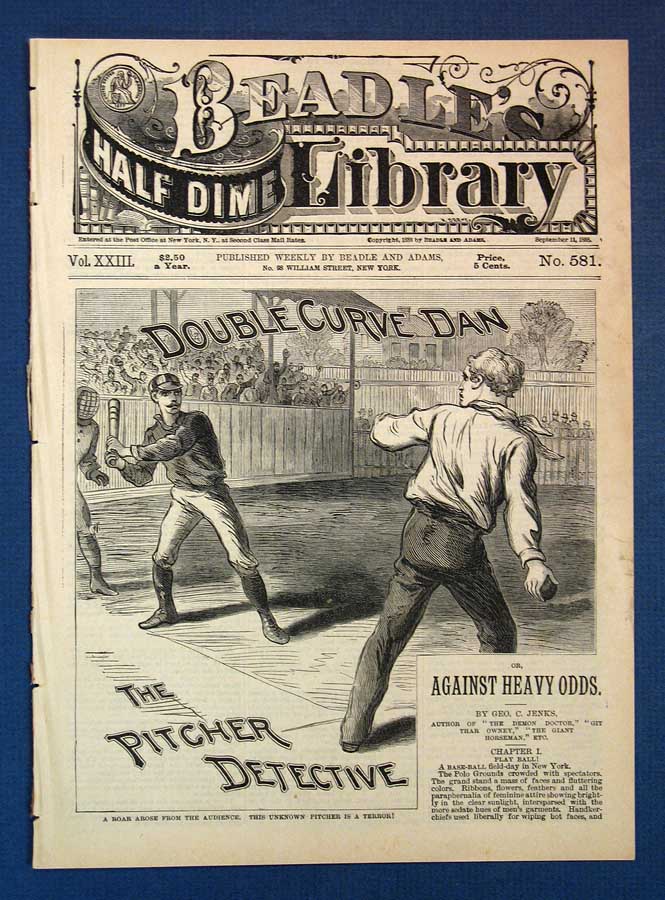
Beadles_Double_Curve_Dan_Pitcher_DetectiveDouble Curve Dan, the Pitcher Detective

George Jenks penned three stories for the Double Curve Dan series. This is the first in the series. OCLC shows only three institutional holdings, and no copies have been at auction in the past thirty years. This copy shows evidence of previous binding, but is otherwise a very good copy of a quite fragile item. Details>>


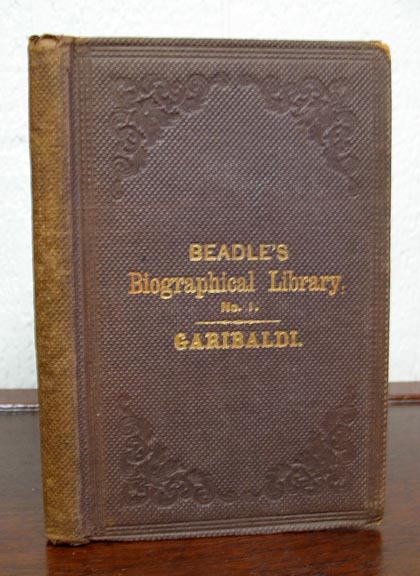
Beadles_Biographical_GaribaldiThe Life of Joseph Garibaldi, the Liberator of Italy

In addition to the popular dime novel series, Beadle & Co launched another series in 1860. Beadle’s Dime Biographical Library presented biographies of famous figures from all over the world. This first edition of The Life of Joseph Garibaldi (1860) has proven a quite rare Beadle publication, especially in this cloth binding (which is not mentioned in Johannsen). It includes an engraving of Garibaldi on the frontis. Details>>

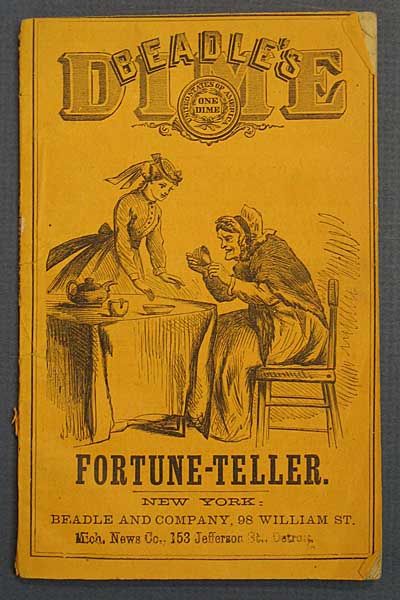
Beadles_Dime_Fortune_TellerBeadle’s Dime Fortune-Teller

The woodcut on the front of this pamphlet depicts an old crone telling the fortune of a young maid. The book promises to demystify dreams and instruct the reader to discern his fortune in everything from tea leaves to egg whites. First published in October 1868, this is an early reprint, circa December 1868. OCLC records just one institutional holding, at NIU. Details>>

Share

Three Pioneering Authors Who Used Pseudonyms

In Shakespeare’s Romeo and Juliet, Juliet says, “A rose by any other name would smell as sweet.” In Numerous authors have taken that sentiment to heart, choosing to publish under pseudonyms for a host of reasons. Charles Dickens famously wrote as “Boz,” and Samuel Clemens is better known as Mark Twain. Here’s a look at three more overlooked authors who also took pen names.

James Mason Hutchings, AKA “Forty Nine”

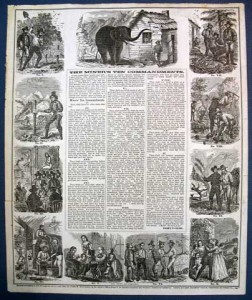
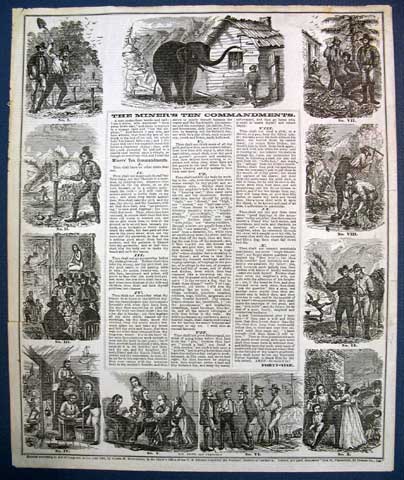
Born in England, James Mason Hutchings immigrated to the United States in 1848. He headed to California to find his fortune during the Gold Rush. In 1853, he published “The Miner’s Ten Commandments” under the pseudonym “Forty Nine.” Though he indeed struck it rich, Hutchings lost everything in a bank failure. He would later rebuild with a career in publishing. However he’s known not for his contributions to publishing, but for his promotion of Yosemite. Hutchings came to the region after reading Lafayette Bunnell’s evocative description of waterfalls in the region.

Hutchings_Miners_Ten_Commandments

The Miner’s Ten Commandments

On July 5, 1855, Hutchings set out on one of the most historic trips to the area: he led the second tourist expedition into Yosemite (the first, led by Robert C Lamon, occurred in 1854, but there’s no known written record). Hutchings had been one of the earliest settlers in the area, and his Hutching’s Illustrated California Magazine did much to publicize the natural wonders of Yosemite. And in 1869, Hutchings hired John Muir–at the time an itinerant sheepherder–to build a sawmill on park land. Muir would become Yosemite’s greatest champion.

When Yosemite was dedicated as a state park in 1864, Hutchings refused to leave his land. Essentially a squatter, he alleged that preemption laws meant he was entitled to 160 acres of land in the valley. The case dragged on for years and went all the way to the US Supreme Court, which was unswayed by Hutchings’ argument. He would not get his land, though he did get a generous payment from the state. That satisfied him only temporarily. Hutchings continued to push legal limits, constantly challenging the prohibition of constriction of buildings on public lands. By 1875, Hutchings’ demands and arguments had worn thin; he was banished from Yosemite Valley altogether.

Metta Victoria Fuller Victor, AKA “Seeley Regester”

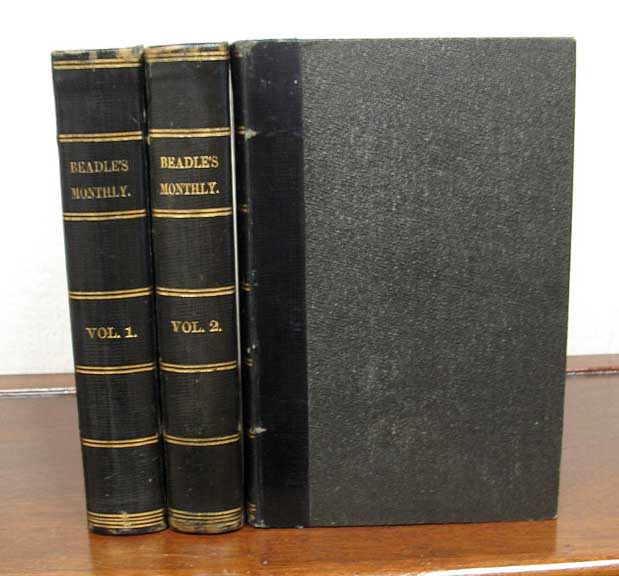
Dead_Letter_Victor_Beadles

‘The Dead Letter’ as serialized in ‘Beadles Monthly’

Metta Victoria Fuller Victor, the wife of publishing pioneer Orville James Victor, broke new ground herself with the publication of The Dead Letter (1864). The novel, which Victor published as Seeley Regester, is considered the first detective novel in the United States. Prior to that, Victor had penned Alice Wilde (1860), an early dime novel. And her abolitionist novel Maum Guinea, and Her Plantation “Children” was read and enjoyed by Abraham Lincoln himself. Victor frequently used pseudonyms, including Corrine Cushman, Eleanor Lee Edwards, Walter T Gray, and Rose Kennedy.

Victor proved an extremely prolific author, writing poetry, fiction, short stories, social issue novels, and even cookbooks. She’s notable for her adaptability; while other writers would fall out of fashion, Victor would adapt her style or genre to remain relevant. Thus, her earlier works are more sentimental, but she happily made her stories more sensational as public demand shifted. Her inventiveness drew attention from The New York Weekly, which offered Victor a $25,000 contract for the exclusive rights to her stories for five years. Such an income was quite impressive for the time period–consider, for instance that Henry Wadsworth Longfellow, a rockstar of his time, earned about $3,000 in eighteen months (between roughly July 1835 and January 1837).

When Victor’s contract with The New York Weekly expired, she worked mostly for Beadle & Adams, still using pen names. Eventually her husband would also work at Beadle & Adams as an editor. He became one of the most respected editors in the dime novel business, making the Victors a true literary power couple of the era. Despite Victor’s multitude of contributions to fiction and literature, she remains relatively unknown today.

William Taylor Adams, AKA “Oliver Optic”

While the majority of authors who adopt pseudonyms prefer to hide their true identities, William Taylor Adams never denied responsibility for his books and stories. On the contrary, Adams frequently used his real name on the title page or at the end of the preface. Though his favorite nom de plume was Oliver Optic, Adams also used Warren T Ashton, Gayle Wintertown, Brooks McCormick, Irving Brown, and Clingham Hunter, MD. By the end of his career, he’d published 126 novels and over 1,000 stories.

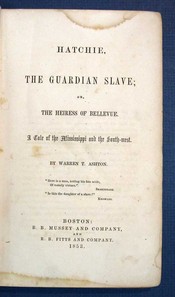
Hatchie-Guardian_Slave_Adams

Hatchie the Guardian Slave

When Adams published his first work, Hatchie, the Guardian Slave, in 1853, he’d been teaching in Boston Public Schools for over a decade. The book met with only moderate success, but Adams persevered. His effort paid off two years later with The Boat Club. The book was so successful, Adams decided to expand it into a series of six volumes. From then on, Adams would often write multi-volume series. Adams also acted as editor of Oliver Optic’s Magazine, Our Boys and Girls starting in 1867. It grew to be the most popular juvenile magazine in the United States.

Adams’ works were, for the most part, enthusiastically received by children and critics alike. Both action packed and lively, they still imparted moral lessons. Only Louisa May Alcott openly disapproved, possibly out of jealousy. In her “Eight Cousins,” the character Mrs. Jessie criticizes her son’s reading material for its use of slang and focus on lowlifes like bootblacks and newsboys. She says, “I have read about them…I am not satisfied with those optical delusions, as I call them now.” Adams responded line by line, and the two authors never put aside their animosity for one another.

Unfortunately Adams would later draw ire from the American Library Association. At the annual conventions of 1876 and 1879, the ALA debated the value of “sensational” fiction like that of Adams, and for some time Adams’ works were not allowed in some public libraries. Modern critics and scholars view Adams as a true pioneer in juvenile fiction. When he began writing for children, the usually available stories were the moralistic tales of the Sunday School library, books by Jacob Abbot, and others of that ilk. These tales were hardly appealing to little boys; they lacked relevance and vigor. Adams changed all that, writing stories that were full of action and adventure.

Regardless of what names they affixed to their publications, James Mason Hutchings, Metta Victoria Fuller Victor, and William Taylor Adams all made incredible contributions to the history of American literature.

Related Reading:

The Inimitable Boz and the Delightful Phiz


Thanks for reading! Love our blog? Subscribe via email (right sidebar) or sign up for our newsletter--you’ll never miss a post!.

Share

Of Sammelbands and Sheet Music

Confederate_Sheet_Music_See_Feet_Suppliant_One

“See at Your Feet a Suppliant One” As Sung By Miss Ella Wren, In Balfe’s Grand Opera of the Bohemian Girl. An example of Confederate sheet music

Music has always played a powerful role in cultures around the world. Now sheet music provides a glimpse at people’s daily lives and illustrates changes in fashion, dress, and even behavioral expectations. Collecting sheet music isn’t just for music lovers; it’s an engaging pursuit that frequently intersects with history and literature.

The first music to appear in a printed volume was in the Codex spalmorum (1457). But the work didn’t include the actual notes; instead the text was printed with blank space to manually add the music to each manuscript! It wasn’t until 1473, with the publication of the Constance gradual in Germany, that music appeared fully printed. Three years later, Ulrich Hahn published Missale secundum consuetudinem curie romane, which included music printed with woodcuts. He claimed to be the first to print music, but most experts agree the Constance gradual was the true first. Soon after, missals, graduals, and other religious texts began popping up all over Europe, and many contained printed music.

The difficulty with printing music is that it generally requires multiple print runs: one to print the staff lines, and another to print the actual notes and notations. Hahn and his successors got around this issue by using woodcuts. Eventually, however, new printing technologies–namely moveable type and lithography–were adopted for music as well. (Famous revolutionary and publisher Isaiah Thomas was the first to use moveable type to print music in the United States. More on him later this month!)

Climbin-Those-Stairs_Bohemian_Club

Illustrations and themes of antiquarian sheet music can be an uncomfortable reminder of the past. This item, from the Bohemian Club, is quite rare with none listed in OCLC.

By the 1820’s, however, the most common method for printing music was engraved plates. This has produced numerous bibliographic obstacles for collectors and scholars today. First, not all sheet music bore copyright information in the first place. Next, publishers would often store the plates for long periods of time and simply use them, unaltered, for later reprints whenever they needed to replenish their stock. And sometimes they sold these plates to other publishers, who didn’t bother emending copyright information when it did exist. Sometimes the plate numbers can be used to determine an approximate date, but that’s largely based on how much is known about the particular engraver or publisher. Collectors of nineteenth-century sheet music, then, must put their detective skills to the test on a regular basis–and be comfortable with some uncertainty about publication information.

While many antiquarian book collectors would shy away from works that are not definitive first editions, this factor is less important with sheet music. These items were printed with the intention of being ephemera, and of being used. They often bear the marks of use, such as tears, smudges, wear, and mending with tape or sewing thread. Music printed in the early nineteenth century and earlier tends to be more durable than later sheet music because it was printed on paper made of rag rather than wood pulp. Meanwhile, during the heyday of American sheet music, it was common to print sheet music as newspaper supplements. These items, printed on thin, cheap paper, are often quite fragile if they survived at all. Collectors must be quite mindful of preservation issues to extend the longevity of their sheet music.

Highlights from Our Sheet Music Collection

A Complete Dictionary of Music

Complete_Dictionary_Music_Thomas_BusbyThomas Busby, author of A Complete Dictionary of Music, began his musical career at a young age. After being rejected as too old to be a chorister by Westminster Abbey organist Benjamin Cooke, he went on to study under Samuel Champness, Charles Knyvett, and Jonathan Battishill. Busby’s first musical venture was music to accompany William Kenrick’s play The Man the Master. This remained incomplete during his lifetime. His next pursuit, an oratorio for Alexander Pope’s Messiah, occupied Busby intermittently for several years. He published a musical dictionary with Samuel Arnold in 1786, along with a serial called The Divine Harmonist. Busby also published the first music periodical in England, The Monthly Musical Journal. His A Complete Dictionary of Music went through several editions during his lifetime.

A Sheet Music Sammelband

Sheet_Music_SammelbandOccasionally also called a nonce-volume, a sammelband is a collection of works that were originally published separately and have since been bound together. A musician or music enthusiast might assemble a sammelband of favorite pieces, while music teachers might put them together to teach students specific skills in a set progression. This particular sammelband contains 43 pieces, ranging from waltzes and quadrilles to country dances, sonatas, and operas. It includes a handwritten “Contents” at the front. Much of the music was composed for the piano forte, so the original owner likely played this delightful instrument.

“Carrie Bell”

Carrie_Bell_Confederate_Sheet_MusicCaptain WC Capers, who wrote the words to “Carrie Bell,” was formerly of the “Macon Volunteers” and had served in the Florida Indian Wars (1836). During the Civil War, he commanded Company G, 1st LA Heavy Artillery Regiment of the CSA. In July 1863, Capers was promoted to Major. He saw service at Vicksburg and elsewhere in the South. Confederate sheet music such as “Carrie Bell” was much more frequently published via lithography instead of engraved plates because metal was such an important commodity during the war–it simply wasn’t available for making engraved plates.

“The Ivy Green”

Ivy-Green-Charles-DickensThough “The Ivy Green” makes its first appearance in Chapter Six of The Pickwick Papers, Kitton informs us that the piece wasn’t written expressly for the novel. The favorite setting for the piece was by veteran Henry Russell, who said he received the whopping sum of ten shillings for the composition. Dickens frequently incorporated popular music into his works. He also occasionally wrote his own pieces, such as the satirical ballad “The Fine Old English Gentlemen,” which he penned for The Examiner and said should be sung at all conservative dinners. Meanwhile, Dickens’ extraordinary popularity meant that his novels often took on lives of their own, and people also composed their own musical pieces based on Dickens’ works.

Share

Irving and Dickens: The Authors Who Saved Christmas

Dickens-Irving

When Clement Clarke Moore published “A Visit from Saint Nicholas” anonymously on December 23, 1823 in the Troy Sentinel, he couldn’t have known that it would become an international phenomenon. But the poem not only gave names to Santa’s eight reindeer. The illustrations of the poem’s reprints significantly impacted our perception of Santa Claus. Caricaturist Thomas Nast would later illustrate jolly old Saint Nick, cementing our concept of him as a jolly. bearded man. And Coca-Cola would eventually be the first to bring us Santa in a red coat. We can thank Washington Irving and Charles Dickens, however, for resurrecting Christmas as a holiday for joyful family celebration.

A Brief History of Christmas

Before Christianity took hold, pagan rituals were routinely honored on the winter solstice. On this day, people would celebrate the triumph of light over darkness. Early church officials, eager to supplant these rites with their own, wisely chose to make Christmas celebrations correspond to these pagan rituals. The strategy had one caveat: the Church couldn’t dictate how people would celebrate Christmas. Thus, Christmas had mostly replaced pagan holidays by the Middle Ages, but holiday observances were usually far from pious. Believers might go to church, but afterward citizens would gather for rowdy festivals similar to Mardi Gras. Each year a student or beggar would be named “Lord of Misrule,” and festival attendants would play the role of his subjects. Meanwhile the poor would go to the homes of the rich to demand food and drink. Non-compliant homeowners risked mischief.

Oliver-Cromwell

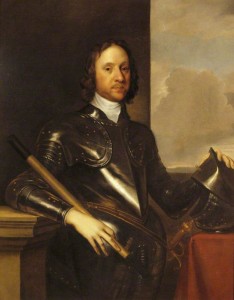
Oliver Cromwell was the original Grinch, canceling Christmas when he took over England in 1645.

But Oliver Cromwell proved to be the original Grinch. A staunch Puritan, Cromwell believed that Christmas was a decadent and unchristian holiday. When he took over in 1645, he vowed to rid England of such indulgences and cancelled Christmas. In 1660 Charles II was restored to the throne by popular demand and reinstated the holiday. But the holiday wouldn’t immediately take hold. By Dickens’ time, the Industrial Revolution had all but destroyed the holiday in Great Britain–for most people, Christmas was still a work day.

Meanwhile the Puritans had left England to settle in the New World. For the most part, Christmas went uncelebrated in the colonies. In Boston the observation of Christmas even bore a five-shilling fine from 1659 to 1681. (Jamestown was a notable exception: Captain John Smith–the first person ever to consume eggnog–reported in 1607 that the settlement happily enjoyed the holiday.) The American Revolution proved a death knell for traditions of British origin, so Christmas again fell out of favor. It would not be declared a national holiday in the United States until June 26, 1870.

Washington Irving, the Real Father Christmas?

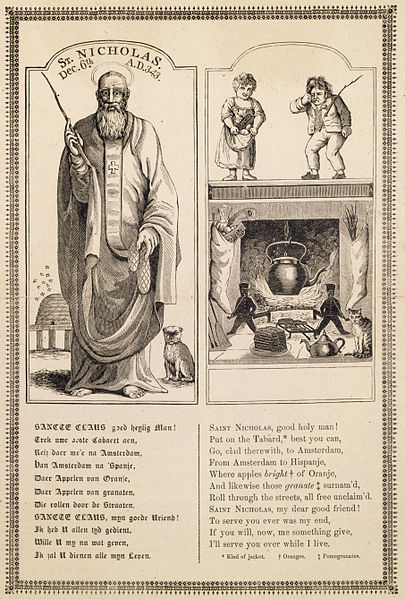
When Washington Irving published Knickerbocker’s History of New York (1809) under the pseudonym Dietrich Knickerbocker, New Year’s Eve was New York’s only real winter holiday. The book parodied American life, and Irving satirized the traditions of New York’s Dutch settlers. He poked fun at their patron saint, Nicholas, whom they called “Sanct Claus.” In Irving’s account of Oloffe the dreamer, Oloffe, a prophet and land speculator, dreams of a night where “the good Saint Nicholas came riding over the tops of the trees, in that self-same wagon wherein he brings his yearly presents for children.” Irving’s St. Nicholas not only delivers presents to children in a sleigh; he also smokes a pipe and places the presents in stockings hung by the chimney.

John-Pintard-St-Nicholas

John Pintard’s St. Nicholas isn’t quite the jolly figure we imagine today!

Irving had some unsolicited assistance in St. Nick’s makeover. New York Historical Society founder John Pintard publicized an engraved picture of St. Nicholas–admittedly looking less than merry–as a symbol of New York City. But Americans remained ambivalent about the holiday. Members of different religious denominations had different concepts of what the holiday should be; some saw Christmas as sacred, while others still believed it blasphemous. Observation was spotty at best, though enterprising Boston merchants advertised ritual Christmas gift exchange as early as 1808.

Dickens-Irving-Grolier-Club

A stray leaf from the correspondence of Washington Irving and Charles Dickens

Irving moved abroad in 1815, and it was not until several years later that he would write another bestseller. The Sketch Book of Geoffrey Crayon was published in several installments from 1819 to 1820. Sandwiched in between American classics like “Rip Van Winkle” (first installment) and “The Legend of Sleepy Hollow” (sixth installment), Irving published five Christmas stories in The Sketch Book’s fifth installment on January 20, 1820. He’d spent time at Astor Hall, recently leased from Adam Bracebridge by James Watt and passed the Christmas holiday with the Watt family. Irving was charmed by their Christmas traditions, reinventing Watt as the benevolent “Squire Bracebridge” in “Bracebridge Hall.” In “Christmas,” Irving writes, “But in the depth of winter, when nature lies despoiled of every charm and wrapped in her shroud of shielded snow, we turn for our gratifications to moral sources.” He would later explain the tradition of hanging mistletoe to American readers with a footnote in “Christmas Eve.” Irving believed that America could use a dose of English Christmas tradition, particularly the part where the poor are welcomed into the homes of the wealthy for a meal.

Historians mostly agree that Irving idealized the English country Christmas in The Sketch Book, but the veracity of his accounts wasn’t important to Americans. They embraced Irving’s stories. Then in 1828, the New York City Council had to create its first police force in response to a Christmas riot. The upper class decided it was time to reinvent the holiday, and Irving’s accounts fit the bill. By 1835, New Yorkers had all but abandoned Christmas revelry in favor of more idyllic celebrations at home. Christmas was revived in America.

Charles Dickens Follows Irving’s Footsteps

Charles-Dickens-Boston-Washington-Irving

Report of the Dinner Given to Charles Dickens in Boston (Feb 1, 1842)

Charles Dickens visited the United States in 1842, and Washington Irving hosted a dinner in his honor on February 1 of that year. Numerous luminaries attended, and the event made headlines. When Dickens addressed the audience and thanked his host, he admitted his own devotion to Irving: “I say, gentlemen, I do not go to bed two nights out of seven without taking Washington Irving under my arm upstairs to bed with me.” In The Pickwick Papers, Dickens evokes Irving’s Squire Bracebridge in the character of Mr. Wardle, who merrily reminds his guests that it’s customary to while away the hours of Christmas Eve with games and ghost stories. Dickens again adapts Irving’s presentation of Christmas in A Christmas Carol, placing them in Mr. Fezziwig’s hall and in the home of Scrooge’s nephew, Fred. Thus he takes Christmas out of the country manor and brings it to working class London. Dickens’ Christmas is also centered on family and children, rather than church or community, another paradigm shift that Victorians readily embraced.

Charles-Dickens-Pirate-Christmas-Carol

Dickens brought suit against five defendants for selling a piratical edition of ‘A Christmas Carol.’ Only one fought the charges, and the account makes for interesting reading!

Dickens wrote A Christmas Carol in only six weeks during the autumn of 1843. It was published on December 19, and all 6,000 copies sold out that day. Dickens had chosen to illustrate the book with colored plates, but the expense associated with that method cut into his profits. It would be the first and only book he published with such plates. The illustrations, however, helped to bring Dickens’ Christmas to life and have since inspired a number of talented illustrators–not to mention printers and book binders who have also been taken with the work. A Christmas Carol has never gone out of print, and so many editions exist that the book is the perfect subject for a single-title collection. Dickens would write other Christmas tales, but none of these would have such an influence on the way the holiday was celebrated. Dickens’ exhausting schedule of reading tours–the first of which was for A Christmas Carol– doubtless helped promulgate his vision of Christmas, as well.

Washington Irving and Charles Dickens helped to pave the way for a rich tradition of Christmas literature, ranging from community cookbooks to children’s books. But these contributions are merely one facet of the authors’ incredible legacies.

Related Posts:

Why Did Charles Dickens Write Ghost Stories for Christmas? 
Charles Dickens Does Boston
Charles Dickens’ Debt to Henry Fielding
Happy Birthday, Washington Irving! 

Share

The Rare Books of Boston

November 15, 2013 kicks off the 36th Annual Boston International Antiquarian Book Fair! The city has played a vital role in America’s history, and in the history of the book. Here’s a look at some items in our collection that tie in with Boston’s rich past.

Red Sox Memorabilia

Red-SoxFew sports fans are more loyal than Red Sox fans. The Boston team was founded in 1901 as one of the American League’s eight charter franchises. For seven seasons, the team actually had no official name. They were referred to simply as “Boston,” “Bostonians,” or “Boston Americans,” while newspapers gave them more creative nicknames like “the Beaneaters” or “Plymouth Rocks.” In 1908, team owner John I Taylor chose the name “Red Sox,” a nod to the red socks that would become symbols of the team. Chicago journalists had started using “sox” as a headline-friendly shorthand for “stockings” already, and Taylor liked the name. But the team initially didn’t even wear red socks, but dark blue ones! And a Cincinnati team was actually the first to call iRed-Sox-Deweytself the Red Stockings. The team were members of the pioneering National Association of Base Ball Players and hired their first fully professional team in 1869, but the club folded after the 1870 season.

Boston Red Sox memorabilia is part of America’s rich and exciting tradition of baseball. We’re pleased to offer Boston Official Programs and Score Cards from 1957 and 1958. Another interesting item is AG Dewey Company’s Genuine Dodge Davis Flannel sample book (1971). The company got its start in 1936 in Quechee, New Hampshire. Throughout the 1930’s AG Dewey Company made the uniforms for the Boston Red Sox, New York Yankees, and other teams.

Boston Training School for Nurses

The Boston Training School for Nurses was only the second of its kind in the country, preceded by the Bellevue school in New York. At the time, nursing was still not viewed as a vocation that required much training; women would often take up the career simply due to financial need, and in many cases nurses had no special qualifications to recommend them. In New York, this resulted in patients’ immense suffering at the hands of inept nurses. No such condition emerged in Boston, however; nurses there were considered some of the best in the nation. Thus the push to start a training school met with some resistance; why would good nurses need further training?

Eventually, however, nurses and doctors saw the potential advantages of such a program. The Boston Training School for Nurses was established in 1873. It was affiliated with Massachusetts General Hospital and eventually evolved into the Massachusetts General Hospital School of Nursing. The organization published annual reports, which are quite enlightening regarding nursing history. This copy of the report from 1892, in very good condition, shows us how the organization and nursing have evolved in only a few decades.

Dinners for Dickens

Charles-Dickens-Boston-1842Charles Dickens made two visits to the United States, first in 1842 and again in 1867. Boston proved an important city during both tours. In 1842, Dickens arrived to find himself already quite the celebrity, and his presence was in great demand. The “Young Men of Boston” had already extended an invitation to Dickens before he’d even left England. The dinner in his honor, documented by Thomas Gill and William English of the Morning Post, was held on February 1, 1842. Dickens made an almost fatal move during the course of the evening: he introduced the concept of an international copyright law. Dickens failed to gain the support of fellow authors as he’d anticipated. Instead he sparked a battle with the American press, who accused Dickens of creating a “huge dissonance” by broaching the subject of international copyright at such an inappropriate occasion. Dickens would further disenchant his American audience when he published American Notes and Martin Chuzzlewitt, both of which painted America in a less than favorable light.

Charles-Dickens-Boston-1867But Dickens’ genius soon won over his American audience once again. Swayed by the promise of £10,000 from a group of Boston intellectuals, Dickens headed back to America in 1867. Prior to his departure, a public banquet was held in the author’s honor at London’s Freemason’s Hall, on November 2, 1867. A record of the meeting was made, which includes speeches by Dickens, Lytton, Trollope, and other luminaries. Dickens’ second visit to the US proved a dizzying tour, jam packed with readings and public appearances. During one of his early appearances, he noted that both he and America were much changed since his first visit and vowed to issue appendices to American Notes and Martin Chuzzlewitt to temper his critical tone towards the US.

News from a Moving Train

In May, 1870, the Boston Board of Trade journeyed over 3,000 miles to San Francisco to meet with the San Francisco Chamber of Commerce. During the trip, twelve issues of the Trans-Continental were published on a Gordon press located in the baggage car. The paper reported the normal business of the train and its passengers, along with other news. The first issue, for instance, reports that the Athletics of Philadelphia beat Harvard Base Ball Club 20-8. The newspaper’s office was located in the train’s second car. The train was also equipped with “two well-stocked libraries, replete with choice works of fiction, history, poetry, etc.” Each issue recorded a different locale on the masthead. The newspaper is generally regarded as the first newspaper to be printed on a moving train.

A Political Discourse on Abolition

Lydia-Childs_AbolitionBoston was a hotbed for abolitionism. One Bostonian’s abolitionist work, though denounced at the time of publication, is now recognized as a groundbreaking tour de force in American abolitionist literature. Lydia Maria Francis Child published An Appeal in Favor of That Class of Americans Called Africans in 1833 and immediately shocked even fellow abolitionists. Unlike her colleagues, Child eschewed religious or scriptural justifications for ending slavery. She also ignored traditional, emotional arguments about the cruelties of slavery. This was because Child had a larger and more ambitious objective; she sought to end discrimination against free African Americans. Such a stance was hardly popular, which Child had predicted in her preface, saying, “Though I expect ridicule and censure, I cannot fear them.” Child’s tone and style of argument at the time were seen as more masculine than feminine, which didn’t ameliorate reception of her work. Her book sales plummeted, and the Boston Athenaeum even rescinded her free library privileges.

But Child’s work would prove incredibly influential in the movement, making it a desirable addition to a collection on abolition, African American history, and the history of ideas. The book is relatively scarce in the trade; only three copies have appeared at auction in the last thirty years. The last copy, sold in 2000, was imperfect. This edition of An Appeal in Favor of That Class of Americans Called Africans is bound in the original publisher’s cloth and has the errata slip tipped in. All in all, it’s a very good copy of a hard-to-find work.

Boston’s place in history intersects with the world of rare books in so many ways! What’s the most interesting item of Bostoniana in your collection?

Share