Famous Figures in the History of Nursing (Part One)

We all know Florence Nightingale and Clara Barton are major figures in the history of nursing, but they were certainly not the only women in the history of nursing who made an important mark. During the Civil War, a number of important historical figures turned their attention to nursing. Today we’ll look at Louisa May Alcott, Annie Wittenmyer, and Dorothea Dix.

Louisa May Alcott
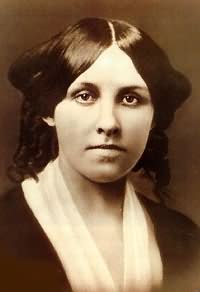
Louisa-May-AlcottBest known for Little Women, Louisa May Alcott penned dozens of popular works and was an early supporter of the women’s suffrage movement. Her family were also passionate abolitionists; one of her earliest childhood memories was of a “Contraband” slave hiding in her family’s home, which was part of the Underground Railroad. When the Civil War broke out, Alcott was eager to support the cause. In December 1862, at thirty years old, Alcott began nursing at Union Hospital in Georgetown. She fell ill with typhoid pneumonia after only six weeks and returned home. Though she survived the illness, the mercury-based drugs used to treat it had lasting side effects; Alcott would never be fully healthy again.

Alcott-Hospital-Sketches

Hospital Sketches (1869)

Alcott published Hospital Sketches in 1863. She noted that “the Sketches never made much money, but showed me ‘my style,’ and taking the hint I went where glory awaited me.” Alcott credited Hospital Sketches with showing her that her writing would be successful if she drew from her own experiences. Five years later, in 1868, Little Women would prove extremely popular for exactly that reason. Though Alcott’s stint as a nurse didn’t last long, it planted the seeds of some of America’s most beloved literature.

Annie Wittenmyer
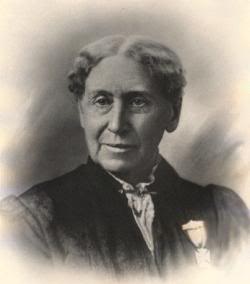
Annie-WittenmyerSarah “Annie” Turner Wittenmyer began her career campaigning for orphans in Iowa. But during the Civil War, Wittenmyer joined the Keokuk Ladies’ Soldiers’ Aid Society and turned her attention to caring for wounded soldiers. As Wittenmyer visited different military hospitals, she observed the deplorable conditions–and wasn’t shy about reporting them. Her advocacy resulted in new local support for funding and reform. In 1862, Wittenmyer was named Sanitary Agent for Iowa State Sanitary Commission. She was the first woman to hold that post.

Wittenmyer_Under_Guns

Under the Guns (1895)

In 1864, however, Wittenmyer resigned the post to develop a dietary system for hospitals. By this time the practice of offering specialized food for convalescents was widely practiced. But she observed that these special diets were often poorly prepared–the people preparing the food often had little experience in food preparation, and the proper ingredients were often in short supply. Wittenmyer devised a plan to address at least the first of these challenges: she came up with a system of special kitchens that were overseen by female superintendents. Wittenmyer got support from the United States Christian Commission and established these kitchens at multiple large hospitals. The program was so successful that it was instituted at approximately 100 hospitals by the end of the Civil War. Wittenmyer even published a cookbook as a guide for the women running these kitchens.

Dorothea Dix

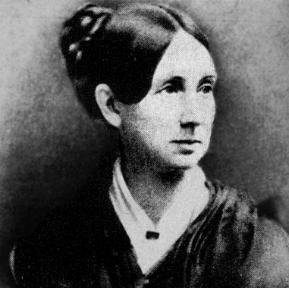
Dorothea Lynde Dix first became involved with the mentally ill at a prison in Massachusetts. She was shocked at the horrible conditions and lack of care that prisoners who clearly had mental illnesses Dorothea-Dixreceived, and she immediately began campaigning to improve their situation. But her focus changed on April 19, 1861, when a Massachusetts regiment on the way to Baltimore was waylaid by secessionists. Dix immediately boarded a train to Baltimore, intending to volunteer as a nurse. But when she arrived in Baltimore, Dix discovered that provisional hospitals had already been established and were relatively well staffed. Thus, she continued on to Washington, DC, where she offered her services as a nurse for the War Department.
Dix-Sequel-Marion-Wilder

Sequel to Marion Wilder (1828)

Despite her lack of medical training, Dix was made Superintendent of United States Army Nurses only months later. She immediately turned her attention to acquiring supplies and training staff. Dix insisted that her nurses all be over age 30 and plain looking. She also required them to wear drab uniforms. Her stringency paid off; Dix not only established order, but she also raised the standards of care.

Dix consistently demonstrated a selfless dedication to her cause. She once went to visit Joseph Fielding, first Secretary of the Smithsonian Institution. Fielding noted Dix’s exhaustion and asked why Dix had not taken a carriage. Dix noted that she hadn’t the money to hire a carriage because she’d spent all her money on medical supplies, and she staunchly refused to use the carriage Fielding requisitioned for her. Dix served as superintendent through the end of the Civil War, and then went back to advocating for the mentally ill.

Check back soon for Part Two, where we’ll introduce more overlooked figures in the history of nursing!

Share

Charles Dickens Does Boston

Dickens-Public-Reading-1867

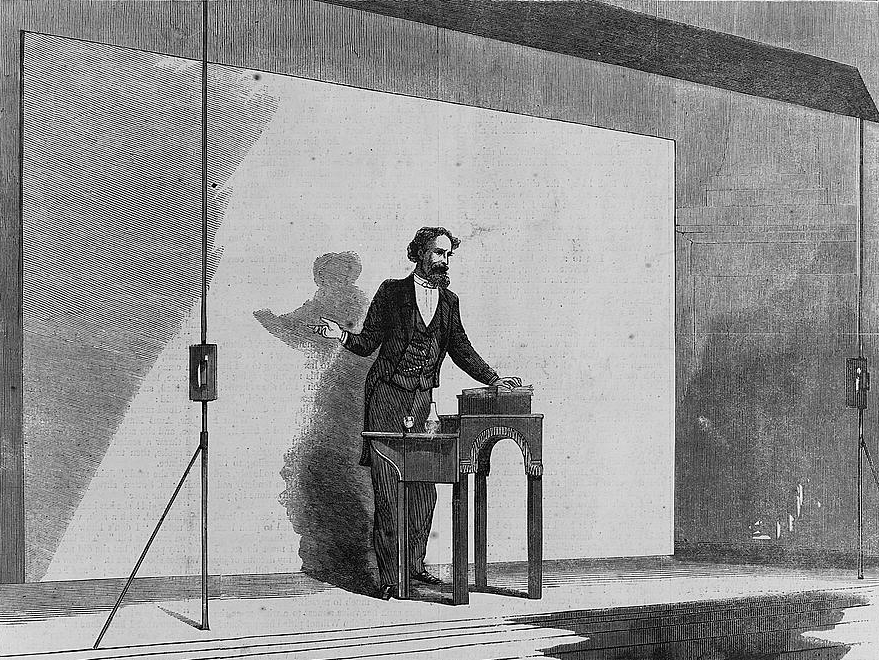
Charles Dickens at a public reading in 1867

We’re ready for a cross-country voyage to Boston for the 36th Annual Boston International Antiquarian Book Fair this weekend! Boston is a city steeped in literary tradition, and it was the first city in the New World to emerge as an enclave of authors and publishers. It’s no wonder that Charles Dickens chose it as an important destination when he came to America in 1842 and again in 1867. The confluence of advancements in steam and rail travel, along with new photography technology, contributed to elevating Dickens to celebrity status. The Inimitable was indeed the one of the first in the nineteenth century to achieve such a vaunted position.

Dickens’ First Visit and American Notes

Proclaimed the “first American edition” of Dickens’ ‘American Notes,’ this Brother Jonathan edition actually missed that distinction by mere hours.

On January 3, 1842, Charles Dickens boarded the steamship Britannia and started his first voyage to America. Though he wasn’t yet even thirty years old, Dickens had already attained incredible popularity on both sides of the Atlantic. He planned to take a year off from writing and explore the United States. Dickens, his wife, Kate, and maid Anne Brown faced unusually rough seas on their journey but arrived in Boston relatively unscathed on January 22, 1842.

He’d arrived in Boston only to be mobbed by adoring fans. Noted painter Frances Alexander rescued Dickens and his wife from the melee. Dickens was received in Boston by a number of prominent Bostonians, including Harvard professor Cornelius Felton, abolitionist and Anglophile Richard Henry Dana (himself the bestselling author of 1840 Ten Years Before the Mast), Daniel Webster, Oliver Wendell Holmes, and barrister Charles Sumner. Dickens soon found himself praised in the press as “Boz, the gay personification of youthful genius on a glorious holiday.”

Dickens stayed in Boston a whole month and fell in love with the city. “Boston,” he said, “is what I would like the whole United States to be.” Dickens had a relatively ambitious travel agenda; he planned to start in Boston, then head west and explore the country. He also had another ambitious goal: to introduce the idea of an international copyright law. Dickens’ works were regularly pirated in America, costing Dickens untold sums each year. He reasoned that American authors–whose works were frequently pirated in Europe–would also benefit from international copyright law and would support the idea.

Dickens-Boston-1842

Despite Dickens’ gaffe of introducing the unpopular topic of international copyright law that evening, Dickens enjoyed his dinner with the “Young Men of Boston,” writing to John Forster that “It was a most superb affair and the speaking admirable.”

But such would not be the case. Dickens broached the subject at a “Young Men of Boston” dinner on February 1, 1842. He met resistance from both his fellow authors and the popular press. It would be another fifty years until an international copyright law was implemented. Dickens would, however, eventually manage to forge a relationship with American publisher James T Fields, who held absolute volume rights to Dickens’ novels in America. Not that this mattered to some US publishers, but nevertheless, this provision offered Dickens some modest remuneration for his popularity in the States.

Meanwhile, thanks to tireless introductions from Sumner and Dickens’ own international celebrity, Dickens enjoyed quite the full and varied itinerary. Dickens sat in on sessions of Congress and met President Tyler. He also indulged his fascination with the odd, touring prisons, asylums, reform schools, and schools for deaf and blind children. Dickens also wished to witness slavery firsthand He had planned a trip to Charleston, South Carolina, but due to complications found himself in Richmond, Virginia instead. Dickens was rightfully horrified by the institution of slavery. He would write to William Macready, “This is not the republic I came to see; this is not the republic of my imagination.”

Dickens’ impressions would be published in American Notes, which Dickens completed in only four months. The work painted an unflattering picture of America: Dickens attacks slavery and descries Americans’ general lack of social awareness. He blamed the latter on the press. Dickens further explored the shortcomings of the new republic in Martin Chuzzlewit, when young Martin goes to America. Dickens’ scathing representation of the country temporarily crushed his popularity, but he soon recovered.

An Amended View of America

Dickens-Departure_Boston

A banquet with “upwards of one hundred celebrities” was held in Dickens’ honor before he departed London in 1867. This pamphlet records speeches made by Dickens, Lytton, Russell, Trollope, and others.

In 1867, Dickens finally succumbed to the temptation of another lucrative book tour (and who can blame him, what with so many mouths to feed at home?). By this time, the Civil War had resulted in the abolition of slavery, and Dickens found America much changed. On April 18, 1868 at a dinner in his honor, Dickens alluded to his previous negative impressions of the country and admitted that both he and the United States had evolved. He promised to make appendices to both Martin Chuzzlewitt and American Notes to mitigate his prior views.

That dinner was one of seemingly countless appearances and events that Dickens attended during his second trip to America. He’d considered bringing his mistress, Ellen Ternan, with him for the tour. But tour manager George Dolby, who’d arrived in Boston early, learned that bringing Ternan would be a serious faux pas. Dickens would travel, then, only with his staff. By this time his health was failing; he’d spent many previous weeks unable to walk without assistance. But he’d been guaranteed £10,000 from a consortium of Boston dignitaries, with his publisher Fields leading the initiative.

Boston had little else to occupy itself during Dickens’ visit; the lack of crisis or election left them plenty of time to indulge in Dickens mania. Dickens did his best to avoid the throngs of adoring fans, passing his down time in his rooms at the Parker House. He still managed to meet members of Boston’s intelligentsia, such as illustrators Sol Entinge, Jr and Thomas Nast, scholar Charles Eliot Norton, and science writer Louis Aggasiz.

Christmas Carol-Charles Dickens

This first US edition of ‘A Christmas Carol’ is, in our experience, offered much less frequently than the first UK edition.

Dickens pushed himself through a grueling schedule of readings and other events during this visit. He found that ticket scalpers had become terribly aggressive; for example, when Dickens read at Harvard on December 2, 1867, not a single student was able to obtain a ticket. That day, Dickens read from A Christmas Carol, much to the pleasure of his adoring audience.

On November 30, 1868, the Saturday Club met at the Parker House to hear Dickens read. The author was noted for his elaborate dress and stage set-up, and this event was no exception. In front of a massive maroon backdrop, and atop a maroon carpet, sat a custom designed reading desk. The desk held a variety of gas pipes designed to provide proper lighting for different moments in the reading. Dickens delivered a 2.5-hour program with only a ten-minute intermission.

Dickens was himself a member of the Saturday Club, which also included colleagues like Oliver Wendell Holmes and Henry Wadsworth Longfellow. Though Dickens generally dined with Fields at the Parker House, he joined Longfellow for a traditional Thanksgiving meal. The meal was surely a sober affair. Longfellow had recently been made a widower. His second wife, Frances Appleton, had been immolated in an accidental fire. Longfellow wore a beard to cover the disfiguring scars he’d incurred trying to save her. Then in New York from December 25, 1867 to January 4, 1868, Dickens enjoyed a traditional Christmas holiday with Fields.

Afterward he continued to push himself past his own limits–both professionally and personally. On February 29, 1868, Dickens participated in what he jokingly called the “Great International Walking Match,” a competition more suitable for a man used to walking up to twelve miles a day, rather than a man of Dickens’ careworn constitution. The weather that day was terrible, but Dickens and his friendly competitors persisted. In a letter to his daughter, Dickens called himself the “Gads Hill Gasper” and said, “As the subtitle of the famous broadside said, ‘the origin of this highly exciting and important event cannot be better state than in the articles of agreement subscribed by the parties.” Following this athletic exertion, Dickens required a full rubdown before he could attend dinner–and he fell into his own bathtub, fully clothed, later that same evening.

Dickens would depart from Boston on April 10, 1868. He quietly traveled to Westminster, New York, where he stayed until sailing back to England on April 22, 1868. Thanks to the adulation of Dickens’ American readers, the author became one of the first modern celebrities.

Share

The Rare Books of Boston

November 15, 2013 kicks off the 36th Annual Boston International Antiquarian Book Fair! The city has played a vital role in America’s history, and in the history of the book. Here’s a look at some items in our collection that tie in with Boston’s rich past.

Red Sox Memorabilia

Red-SoxFew sports fans are more loyal than Red Sox fans. The Boston team was founded in 1901 as one of the American League’s eight charter franchises. For seven seasons, the team actually had no official name. They were referred to simply as “Boston,” “Bostonians,” or “Boston Americans,” while newspapers gave them more creative nicknames like “the Beaneaters” or “Plymouth Rocks.” In 1908, team owner John I Taylor chose the name “Red Sox,” a nod to the red socks that would become symbols of the team. Chicago journalists had started using “sox” as a headline-friendly shorthand for “stockings” already, and Taylor liked the name. But the team initially didn’t even wear red socks, but dark blue ones! And a Cincinnati team was actually the first to call iRed-Sox-Deweytself the Red Stockings. The team were members of the pioneering National Association of Base Ball Players and hired their first fully professional team in 1869, but the club folded after the 1870 season.

Boston Red Sox memorabilia is part of America’s rich and exciting tradition of baseball. We’re pleased to offer Boston Official Programs and Score Cards from 1957 and 1958. Another interesting item is AG Dewey Company’s Genuine Dodge Davis Flannel sample book (1971). The company got its start in 1936 in Quechee, New Hampshire. Throughout the 1930’s AG Dewey Company made the uniforms for the Boston Red Sox, New York Yankees, and other teams.

Boston Training School for Nurses

The Boston Training School for Nurses was only the second of its kind in the country, preceded by the Bellevue school in New York. At the time, nursing was still not viewed as a vocation that required much training; women would often take up the career simply due to financial need, and in many cases nurses had no special qualifications to recommend them. In New York, this resulted in patients’ immense suffering at the hands of inept nurses. No such condition emerged in Boston, however; nurses there were considered some of the best in the nation. Thus the push to start a training school met with some resistance; why would good nurses need further training?

Eventually, however, nurses and doctors saw the potential advantages of such a program. The Boston Training School for Nurses was established in 1873. It was affiliated with Massachusetts General Hospital and eventually evolved into the Massachusetts General Hospital School of Nursing. The organization published annual reports, which are quite enlightening regarding nursing history. This copy of the report from 1892, in very good condition, shows us how the organization and nursing have evolved in only a few decades.

Dinners for Dickens

Charles-Dickens-Boston-1842Charles Dickens made two visits to the United States, first in 1842 and again in 1867. Boston proved an important city during both tours. In 1842, Dickens arrived to find himself already quite the celebrity, and his presence was in great demand. The “Young Men of Boston” had already extended an invitation to Dickens before he’d even left England. The dinner in his honor, documented by Thomas Gill and William English of the Morning Post, was held on February 1, 1842. Dickens made an almost fatal move during the course of the evening: he introduced the concept of an international copyright law. Dickens failed to gain the support of fellow authors as he’d anticipated. Instead he sparked a battle with the American press, who accused Dickens of creating a “huge dissonance” by broaching the subject of international copyright at such an inappropriate occasion. Dickens would further disenchant his American audience when he published American Notes and Martin Chuzzlewitt, both of which painted America in a less than favorable light.

Charles-Dickens-Boston-1867But Dickens’ genius soon won over his American audience once again. Swayed by the promise of £10,000 from a group of Boston intellectuals, Dickens headed back to America in 1867. Prior to his departure, a public banquet was held in the author’s honor at London’s Freemason’s Hall, on November 2, 1867. A record of the meeting was made, which includes speeches by Dickens, Lytton, Trollope, and other luminaries. Dickens’ second visit to the US proved a dizzying tour, jam packed with readings and public appearances. During one of his early appearances, he noted that both he and America were much changed since his first visit and vowed to issue appendices to American Notes and Martin Chuzzlewitt to temper his critical tone towards the US.

News from a Moving Train

In May, 1870, the Boston Board of Trade journeyed over 3,000 miles to San Francisco to meet with the San Francisco Chamber of Commerce. During the trip, twelve issues of the Trans-Continental were published on a Gordon press located in the baggage car. The paper reported the normal business of the train and its passengers, along with other news. The first issue, for instance, reports that the Athletics of Philadelphia beat Harvard Base Ball Club 20-8. The newspaper’s office was located in the train’s second car. The train was also equipped with “two well-stocked libraries, replete with choice works of fiction, history, poetry, etc.” Each issue recorded a different locale on the masthead. The newspaper is generally regarded as the first newspaper to be printed on a moving train.

A Political Discourse on Abolition

Lydia-Childs_AbolitionBoston was a hotbed for abolitionism. One Bostonian’s abolitionist work, though denounced at the time of publication, is now recognized as a groundbreaking tour de force in American abolitionist literature. Lydia Maria Francis Child published An Appeal in Favor of That Class of Americans Called Africans in 1833 and immediately shocked even fellow abolitionists. Unlike her colleagues, Child eschewed religious or scriptural justifications for ending slavery. She also ignored traditional, emotional arguments about the cruelties of slavery. This was because Child had a larger and more ambitious objective; she sought to end discrimination against free African Americans. Such a stance was hardly popular, which Child had predicted in her preface, saying, “Though I expect ridicule and censure, I cannot fear them.” Child’s tone and style of argument at the time were seen as more masculine than feminine, which didn’t ameliorate reception of her work. Her book sales plummeted, and the Boston Athenaeum even rescinded her free library privileges.

But Child’s work would prove incredibly influential in the movement, making it a desirable addition to a collection on abolition, African American history, and the history of ideas. The book is relatively scarce in the trade; only three copies have appeared at auction in the last thirty years. The last copy, sold in 2000, was imperfect. This edition of An Appeal in Favor of That Class of Americans Called Africans is bound in the original publisher’s cloth and has the errata slip tipped in. All in all, it’s a very good copy of a hard-to-find work.

Boston’s place in history intersects with the world of rare books in so many ways! What’s the most interesting item of Bostoniana in your collection?

Share

Edgar Allan Poe: Creator of Enduring Terror and Literary Masterpieces

Edgar-Allan-Poe

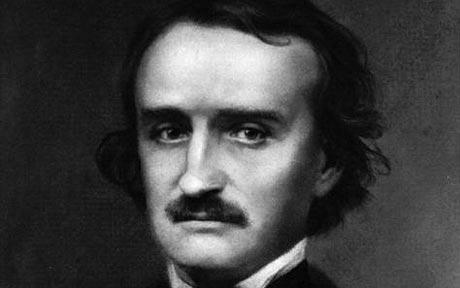
Edgar Allan Poe was the first American writer to earn a living completely by his pen–though that living wasn’t always enough to live on. The legendary author redefined the genre of horror and is rightly called the father of the modern detective novel. But these legacies are the result of a more visceral one: Poe’s ability to evoke an all-encompassing terror that springs not from without, but from within.

Poe’s Incredible Influence

It’s well known that Sir Arthur Conan Doyle used Poe’s C. Auguste Dupin as a model for his own detective, Sherlock Holmes, and that Doyle’s short stories (“Hound of the Baskervilles” in particular) owe a tremendous debt to Poe. Indeed, Doyle once rhetorically asked, “Where was the detective story until Poe breathed life into it?” But Poe’s influence reached beyond the worlds of horror and mystery. He has long been a beloved figure in literature, one whose power has not waned with the passage of many generations.

Poe and Washington Irving exchanged admiration for one another via correspondence. Irving noted that “the graphic effect [of “Fall of the House of Usher”] is powerful.” Poe responded by sending Irving a copy of “William Wilson,” which he considered his best work. Poe admitted that the story had been inspired by Irving himself, particularly Irving’s “An Unwritten Drama of Lord Byron.”

Robert Louis Stevenson said of Poe, “He who could write ‘King Pest’ has ceased to be a human being.” Stevenson found Poe’s stories absolutely gripping, and was undoubtedly flattered when critic Andrew Lang said that Stevenson was “like Poe with the addition of moral sense.”

Meanwhile Oscar Wilde ranked Poe’s poetry as more important than that of Walt Whitman, Ralph Waldo Emerson, and Henry Wadsworth Longfellow. Wilde emulated elements of Poe’s style in The Picture of Dorian Gray–which wasn’t lost on Walter Pater, who ardently praised Wilde’s efforts to evoke Poe’s style in the novel. Wilde’s colleague and defender George Bernard Shaw, often an unforgiving critic, was downright effusive about Poe, saying that the American author “constantly and inevitably produced magic where his greatest contemporaries produced only beauty. [His tales are] a world record for the English language: perhaps for all languages.”

Allen Ginsberg argued that “everything leads to Poe….Burroughs, Baudelaire, Genet, Dylan,” and Jorge Luis Borges contended that “contemporary literature would not be what it is” without Whitman and Poe. TS Eliot, however, was not initially convinced of Poe’s genius. He excluded Poe from both American and European literary traditions, calling Poe a “displaced European.” Eliot later acknowledged that he’d underestimated Poe’s talent.

Vladimir Nabokov included multiple allusions to “Annabel Lee” in his masterpiece, Lolita. It appears that Nabokov was indeed deeply interested in Poe; he meticulously mapped the area around Poe’s home and sketched the manifestations of soul in The Strange Case of Dr. Jekyll and Mr. Hyde (which he taught within the context of Poe). Both documents are currently on view at the Morgan Library’s excellent exhibit, Edgar Allan Poe: Terror of the Soul.

Later on, novelist and screenwriter Terry Southern, author of Dr. Strangelove, was deeply influenced by Poe, especially The Narrative of A Gordon Pym. Southern wrote an appreciation of Poe, called “King Weirdo,” which was published posthumously. And Stephen King has frequently borrowed archetypal themes from Poe’s works for his own horror novels. The Shining reminds us of both “Masque of the Red Death” and “Fall of the House of Usher.”

Collecting Edgar Allan Poe

Edgar Allan Poe makes a fascinating focus for a single-author collection and also fits wonderfully into nineteenth-century American literature and horror literature libraries. Poe’s works weren’t actually that popular during his lifetime, so they were issued in relatively small print runs. The first edition of Tamerlane and Other Poems (1827) is famously scarce; only twelve copies are known to exist. (Three are currently on display together at the Morgan Library!)

Even if Tamerlane is out of reach, there are countless other desirable editions and volumes. For example the Poetical Works of Edgar Allan Poe, published by George Robertson in 1868, was the first edition of Poe’s works to appear in Australia. It differs significantly from the British and American editions.

No illustrated editions of Poe’s works were published during his lifetime. The first, Tales of Mystery, Imagination and Humor; and Poems (1852) was illustrated by artists unknown, as they were not given credit for their work. Famous illustrators Edouard Manet, Aubrey Beardsley, Harry Clarke, Edmund Dulac, and Arthur Rackham; first editions of Poe’s works illustrated by these artists are highly desirable.

Poe’s works often showed up in serially issued collections. One of these is The Gift, A Christmas and New Year’s Present for 1842. This compilation includes Poe’s “Eleonora,” along with items from Howard Huntley, Catherine Beecher, and Park Benjamin. The volume also includes an uncollected piece by Lydia Sigourney, “The Village Church.”

Irving-Offering-Lizzie-Leigh-Gaskell

The Irving Offering for 1851

When Elizabeth Gaskell first published “Lizzie Leigh,” the story was initially ascribed to Charles Dickens–whose byline meant big bucks for publishers. “Lizzie Leigh” appears under Dickens’ name in The Irving Offering: A Token of Affection for 1851, which also include’s Poe’s “A Descent into the Maelstrom.” The edition is fairly scarce: OCLC records none west of the Mississippi.

Though Edgar Allan Poe enjoys special attention around Halloween, collectors of rare books appreciate his works year round. If you’re looking for a specific item for your Poe collection, please don’t hesitate to contact us! We’re happy to help.


Share

Flights of Fancy: Collecting Vintage Airline Posters

Salvador-Bahia_Brasil-Varig

Summer is long gone, and with it have gone the days of leisurely summer vacations. But collectors can recapture these moments and explore the history of aviation with vintage airline travel posters.

The earliest aviation posters, which date to the mid nineteenth century, did not advertise air travel, but the exploits of hot air balloonists. With the introduction of planes in the early twentieth century, posters were an effective means of advertising exhibitions and air shows. During World War I, aviation posters offered a subtle form of propaganda: the novelty and excitement of air travel attracted new recruits, and the military’s large-scale use of airplanes was an imposing sight unto itself. Commercial airlines began using posters to advertise in the 1920’s, but it wasn’t until the 1950’s and 1960’s that the airlines started producing posters that advertised both the excitement and comfort of air travel.

Collecting Vintage Airline Posters

For collectors, these collectible posters recapture the excitement and romance of air travel. They are also an interesting way to trace the history of aviation. Collectors often build collections around a specific airline, artist, destination, or time period.

Northwest_Orient_747FThe posters from now defunct airlines tend to be more sought after than those from companies that still exist. Pan American World Airways (PanAm) posters, for example, are particularly beloved. The airline started in 1927 with a single route from Key West to Havana, but soon became the leading international airline in the world, a distinction it held till iGolf-Worldwide_Pan_Americants collapse in 1991. Unlike other airlines, PanAm created posters for both its commercial and cargo planes. Smaller regional airlines also hold their own allure. Posters from the relatively obscure Jersey Airways in Britain and from Western Airlines and Northwest Orient Airlines in the US all offer charming travel posters. These airlines often have a relatively short history, so their posters can be more scarce.

Hawaii-United_Airlines

Some collectors focus on existing airlines. Swissair, founded in 1931 after the merger of two Swiss airlines, has long printed beautiful posters. The airline is a favorite among aviation enthusiasts because it consistently stays at the forefront of technology. Swissair was among the first to use DC-2’s, and it claims to be the first airline to employ stewardesses (1935). And United Airlines has also published a plethora of marvelous airline posters. In the early to mid 1970’s the airline produced a well-known series that evokes American history and freedom.

Meanwhile, a love of a specific destination motivates many collectors to create destination-themed galleries. Tropical locales like Hawaii or Tahiti are perennial favorites, as are more exotic destinations like the Philippines, Bahia, and Korea. Similarly, collectors may focus on an individual aircraft. United Airlines advertised its adoption of the 747 with three-dimensional foam boards.

United-Airlines-747

Caring for Vintage and Rare Posters

Collectors often wonder about the best ways to store and protect their rare and vintage posters. It’s actually perfectly fine to display your posters, so long as you take a few precautions. Use UV resistant Singapore_Japan_Airlinesglass or Plexiglass to protect your travel posters from damage from both sunlight and fluorescent lighting. If you decide to matte or back the poster, be sure to use only acid-free, archival quality materials. If you frame the poster without a matte, place a spacer between the poster and the frame, so that the poster and the glass are not touching. Otherwise, humidity can get trapped between the poster and the glass, and the poster will get stuck to the glass. Some posters are linen backed for preservation or restoration purposes. Well-executed linen backing can increase a vintage poster’s value, but it’s best done by professionals.

When your collection exceeds your wall space, you’ll need to store your posters safely. Ideally, posters are stored flat in acid-free sleeves, which will protect them from dust, moisture, and decomposition. It’s best to store each poster in its own sleeve; posters can leach chemicals onto one another, causing discoloration and decay. If flat storage isn’t an option, you can roll posters in acid-free tubes. Over time your posters may begin to curl, so you may have to flatten them if you decide to frame, photograph, or sell them later.

This month we’re pleased to offer a list of airline promotional and travel posters. We invite you to peruse the list! Please contact us if you have inquiries about any item.


Share

Oscar Wilde, Dickens Detractor and “Inventor” of Aubrey Beardsley

“I’ll be a poet, a writer, a dramatist. Somehow or other I’l be famous, and if not famous, I’ll be infamous.” –Oscar Wilde

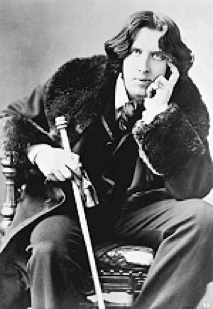
Oscar-WildeBorn on October 16, 1854 in Dublin, Ireland, Oscar Wilde is perhaps remembered more for his sparkling wit, larger-than-life personality, and historic trial than for his literary achievements. But the author made his mark on the literary world not only through his prolific career as a journalist, novelist, and dramatist, but also through his sometimes bizarre relationships with other literary figures. These interactions make collecting Wilde an even more engaging pursuit.

Love Lost between Wilde and Bram Stoker

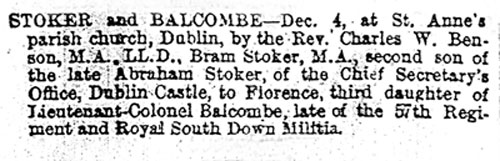
Wilde’s mother, Lady Jane, was a formidable author in her own right. She often kept literary company, and her circle of friends soon came to include Bram Stoker. Stoker soon met Florence Balcombe, a legendary beauty who had previously been involved with Wilde. Accounts of Balcombe’s relationship with Wilde vary; he claimed the two had been engaged. At any rate, Wilde was less than pleased when he learned that Stoker had proposed to Balcombe. He wrote to Balcombe, stating that he would never return to Ireland again. Wilde mostly kept to his word, returning to Ireland only for brief visits.

Bram-Stoker-Wedding-Announcement

But Stoker and Wilde’s relationship stretched beyond this inopportune love triangle. The two had gone to school together; Stoker even recommended Wilde for membership into the university’s Philosophical Society. And after Stoker and Balcombe had been married and Wilde had had sufficient time to lick his wounds, Stoker reinitiated the relationship. After Wilde was convicted of sodomy, Stoker even visited him. Yet Stoker also fastidiously removed all mention of Wilde from his published and unpublished texts, and it’s only recently that critics have begun to see Wilde’s influence in Stoker’s great novel Dracula.

Wilde Rejects Dickens’ Legacy…Or Does He?

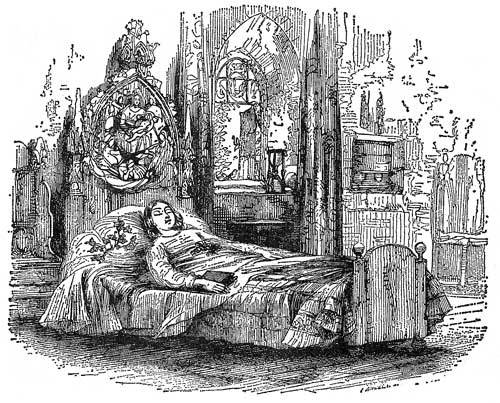
Old Curiosity Shop-Little NellWilde heaped praise upon Matthew Arnold, Robert Browning, and Elizabeth Barrett Browning. He even called Aurora Leigh “the greatest work in our literature.” But he was less than complimentary when it came to the great Charles Dickens; Wilde is famous for saying of Charles Dickens The Old Curiosity Shop, “One would have to have a heart of stone to read the death of Little Nell and not to dissolve into tears…of laughter.” Wilde found Dickens overly sentimental and wished to separate himself from this aspect of Dickens’ Victorian England. Yet he never fully succeeded in escaping Dickens’ shadow (indeed, few authors of the century did).

Critics have pointed to similarities in the ways that Wilde and Dickens portray London, and Wilde even makes allusions to Dickens’ works–most notably Little Dorritt. Little Dorritt’s Mrs. General repeats the phrase “Papa, potatoes, poultry, prunes, and prism” to her young charges, and the phrase “prunes and prism” soon became closely associated with her character. Is it any coincidence, then, that Wilde chooses the name “Ms. Prism” for the proper governess in The Importance of Being Earnest? Even though Wilde didn’t subscribe to Dickens’ sentimental style, it’s likely that he had great respect for Dickens, as Wilde himself aspired to the same international acclaim that the Inimitable One had achieved.

An Outlandish Claim Spurred by Public Rivalry

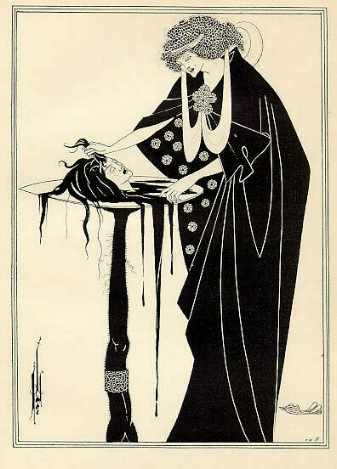
Beardsley-Salome-WildeIn April 1893, an up and coming artist was moved by the French publication of Oscar Wilde’s Salome. He drew Salome with St. John’s head, and the illustration became one of several that would accompany Joseph Pennell’s article on him in the first number of The Savoy. The artist, Aubrey Beardsley, contacted Wilde about illustrating the translation of Salome. Wilde responded in kindness, sending Beardsley an inscribed edition that read “For Aubrey: for the only artist who knows what the dance of seven veils is, and can see that invisible dance. Oscar” It wasn’t outright rejection, but it wasn’t an enthusiastic invitation, either.

Then Beardsley was contracted to illustrate Lord Alfred Douglas‘ English translation of Salome. Wilde initially called Beardsley’s illustrations for the work “too Japanese,” pointing out that the work was more Byzantine. Wilde then took his criticism a step further, saying that Beardsley’s art resembled “naughty scribbles a precocious boy makes on the margins of his copybook.” The rivalry exploded; Beardsley published caricatures of Wilde, and Wilde made the preposterous claim that he had “invented Aubrey Beardsley.” In reality, Wilde had simply worried all along that Beardsley’s brilliance would overshadow his own.

Mutual Admiration from a Distance

In November 1879, George Bernard Shaw met Oscar Wilde at Lady Jane’s London home. The two had trouble interacting, though Wilde clearly had good intentions toward Shaw. A few years later, on July 6, 1888, Wilde attended a meeting of the Fabian Society, likely at Shaw’s invitation. Artist Walter Crane spoke on “The Prospects of Art under Socialism,” which soon moved Wilde to write The Soul of Man under Socialism. Meanwhile over the years Shaw and Wilde maintained a pleasant relationship, albeit from a distance. They frequently exchanged books and letters and openly complimented each other’s works.

Shaw frequently defended Wilde against his critics, and he again rallied to Wilde’s defense when he was arrested for sodomy. Shaw was adamant that “never was there a man less an outlaw” than Wilde. Shaw and other writers put together a petition for Wilde’s early release, but it found surprisingly little support and was eventually dropped. As public opinion turned against Wilde and eventually forgot him entirely, Shaw still insisted on reminding people of Wilde’s greatness. He regularly mentioned him in drama reviews and remained fascinated with Wilde’s work for the rest of his life. When Frank Harris undertook his (somewhat controversial) biography of Wilde, Shaw edited it with the assistance of Lord Douglas.

Collecting Oscar Wilde

For collectors, Oscar Wilde is the ideal case study in how a single-author collection can–and should–come to include materials by a variety of other authors. A comprehensive Oscar Wilde collection would encompass the works of Wilde, not only his major literary pieces, but also the articles he penned as a journalist and critic. And a truly comprehensive collection would have a second layer: other authors’ reactions to and interactions with Wilde. For example, Shaw’s reviews mentioning Wilde are scarce because they were printed in periodicals on cheap paper, making them a challenging item for collectors to acquire. And Aubrey Beardsley’s caricatures of Wilde are sought after by both Beardsley and Wilde collectors alike, making them a desirable addition to an Oscar Wilde collection.

Oscar Wilde certainly left his mark on the world as an author and public figure. He will undoubtedly remain a popular figure among rare book collectors for generations to come.

Share

Maurice Boutet de Monvel and His Ingenius ‘Jeanne d’Arc’

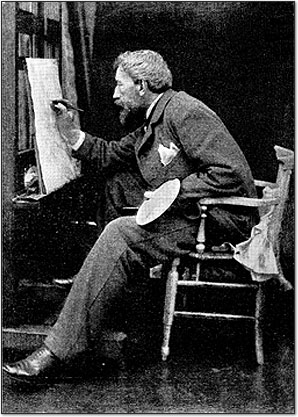
Maurice-Boutet-Monvel

Boutet at work in his studio

Born into a “family of gilt-edged artists,” it’s no wonder that Maurice Boutet de Monvel eventually established himself as a premier portrait painter and watercolorist. When the artist turned his attention to illustrating children’s books to support his family, his illustrations were magnificent enough that he’s considered one of the great figures of the Golden Age of children’s literature, alongside Kate Greenaway and Randolph Caldecott.

Boutet spent the majority of his childhood in Paris. In early 1870, he began studies at the École de Beaux Arts, but his studies were interrupted by the Franco-Prussian War. He joined the French Army, and though he returned from the war relatively unscathed, he would forever after be particularly vulnerable to respiratory illness.

Next Boutet continued his art studies at the Julian Academy under the tutelage of Gustave Boulanger and Jules Lefèbvre. In 1873, he displayed his first canvas at Le Salon and earned two medals over the next few years. Boutet greatly admired the works of José de Ribea and emulated Ribea’s dark style, using only chiarscuro. But he also recognized the need to lighten that heavy palette, which led him to work under Carolus Duran, whose light watercolors were considered revolutionary at the time.

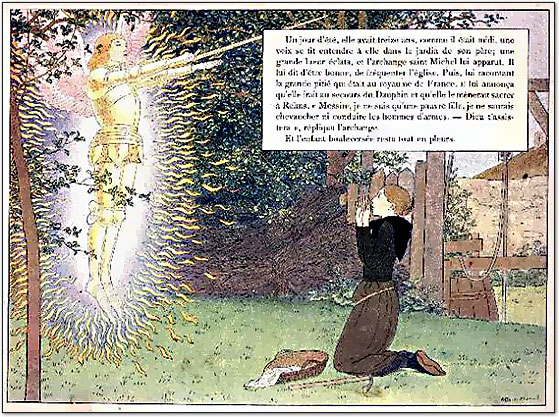
Jeanne-dArc-Boutet

From ‘Jeanne d’Arc’

Then in 1876, Boutet went to visit his brother in Algiers. The light of the foreign landscape was a complete surprise to Boutet, and the artist drastically altered his style thereafter. He adopted a primary palette of oranges and blues, using the latter mostly to create shadows. Boutet made two subsequent trips to Algiers, in 1878 and 1880.

Boutet’s life would change again in 1879 with the birth of his first child. He’d been married in 1876, but a child resulted in extra pressure to generate income and support his family. That was the impetus to venture into illustration. He began in 1881 with Les pourquois de Mademoiselle Suzanne (Miss Suzanne’s questions) by Emile Desbeaux and the reading book La France en Zig-Zag (Zigzagging across France) by Eudoxie Dupuis. Both were published by Charles Delagrave.

Delagrave was so pleased with Boutet’s work, he invited the artist to illustrate Saint Nicolas: Journal illustré pour garçons et filles (Saint Nicolas: A comic book for boys and girls). That endeavor was incredibly successful, so Boutet undertook Vieilles chansons et danses pour les petits enfants (Old songs and dances for young children) in 1883 and Chansons de France pour les petits Français (Songs of France for French Children) the following year.

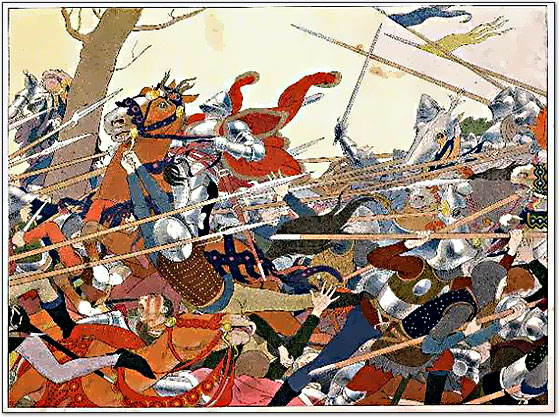
Boutet-Jeanne-dArc

From ‘Jeanne d’Arc’

Yet Boutet was reluctant to give up his career as a “serious” artist. In 1885, he submitted an obviously royalist canvas for exhibition. “L’apothéose de la canaille, ou le triomphe de Robert Macaire” (“The apotheosis, or the triumph of Robert Macaire”) was so controversial, the Deputy Secretary of State for Fine Art pulled it just before the exhibition opened. Now publicly disgraced, Boutet resigned himself to a life outside the art world.

Luckily his friend Edouard Detaille had just founded the Society of French Watercolorists and invited Boutet to exhibit there. He submitted a portrait of a girl dressed in Renaissance clothing, and the work was so well received that Boutet found himself quite occupied as a portrait artist. Yet he to illustrate children’s books and serials, contributing to Saint Nicolas until 1890.

Boutet also created illustrations for Quand j’étais petit (When I was young) by Lucian Briart in 1886, and La farce de Maître Pathelin (The farce of Master Pathelin; 1887), a comedy from the Middle Ages adapted for modern verse by Georges Gassies de Brulies. He would go on to design and illustrate La civilité puerile et honnête raconté pour l’Oncle Eugene (Puerile, honest civility recounted by Uncle Eugene), a manners book for children. In 1890, Boutet illustrated Ferdinand Fabre’s novel Xavière. The illustrations were reproduced using a new photoengraving technique that produced incredibly high-quality images.

Boutet-Jeanne-Arc

It’s quite rare to find Boutet’s ‘Jeanne d’Arc’ in its dust jacket.

Six years later, Boutet would complete the work that brought him lasting fame as a legendary children’s book illustrator. Published by Plon, Nourrir, et Cie, Jeanne d’Arc was masterfully illustrated in watercolors. Zincotype, a technique that blends etching with colored inks, was used to reproduce Boutet’s breathtaking images.

Following the 1896 publication of Jeanne d’Arc, Boutet enjoyed international acclaim. He heavily influenced the young school in Vienna and was invited to tour the United States. He was commissioned for numerous portraits and projects while he was in America. but was unable to complete the most ambitious: a series of large panels based on the illustrations of Jeanne d’Arc.

Boutet later said of the book’s muted palette, “It’s not color, really, it is the impression, the suggestion of color.” He was clearly influenced by the light and shadow modeling of Fra Angelico and the battle scenes of Paolo Uccello. Children’s literature critic Selma G. Lanes

Japanese-Fairy-Tales

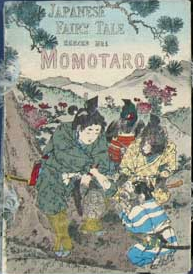
The Japanese style of illustration was popular in Boutet’s day.

noted that the “illustrations have a nobility and grandeur akin to the great church frescoes of the Renaissance. Their pleasingly flat renderings, combined with a sophisticated use of design elements….owe a great deal to the Japanese prints so popular in the artist’s day.”

It’s obvious from the beauty and subtlety of Jeanne d’Arc that Boutet was truly inspired by his chosen subject matter. Boutet had been born in Orléans, a town that Joan of Arc had liberated from the British in 1429. But more importantly, France was still reeling from its loss in the Franco-Prussian War. Boutet wished to remind children of France’s past glory. Thus he opens the book with an admonishment to children to “open this book with reverence…in honor of the humble peasant girl who is [the books’ subject].”

The works of Boutet represent an ideal intersection of art and literature for discerning collectors. The multitude of serial and individual publications to which he contributed are fruitful ground for building a fascinating collection.

Share

The Literature of Nobel Laureates

This week the winners of the 2013 Nobel Prizes are announced! Since the prizes were first awarded in 1901, they’ve recognized the best minds in science and literature. Nobel laureates are historically a prolific bunch, leaving us a rich chronicle of their contributions.

Argon, a New Constituent of the Atmosphere (1896)

William-Ramsay-Lord-Rayleigh

Sir William Ramsay & Lord Rayleigh

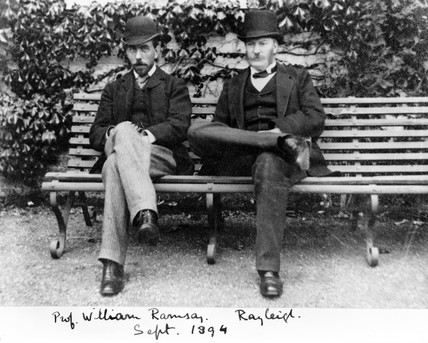
John William Strutt, Lord Rayleigh, first embarked on mostly mathematical studies. But he soon turned to the broader field of physics. He and Sir William Ramsay independently came to the same conclusion: that there must be an undiscovered gas in our atmosphere. Though the two maintained separate laboratories, they worked together to identify the gas, communicating almost daily. They announced the discovery of argon at the 1894 meeting of the British Association.

The Smithsonian Institution produced an edition of Argon, a New Constituent of the Atmosphere in 1896, marking the first time it had appeared in a separate publication.

Come prima meglio di prima (1933)

Como prima meglio di prima-Luigi Pirandello

‘Como prima meglio di prima’

Luigi Pirandello was awarded the 1934 Nobel Prize in literature for his “bold and brilliant renovation of the drama and the stage.” He wrote multiple novels, hundreds of short stories, and over forty plays. Pirandello’s dramas are considered forerunners to the Theater of the Absurd.

Come prima, meglio di prima was written in 1919 and was performed in March of the following year at Venice’s Teatro Goldoni. Pirandello drew inspiration for the comedy from his novel Veglia and his collection In silenzio. This third edition is signed by the author in the half-title page.

The Transistor: Selected Reference Material on Characteristics and Applications (1951)

Transistor-William-Shockley

‘The Transistor’

The week of September 17, 1951, Bell Telephone Laboratories hosted a symposium on transistors. According to the foreward, The Transistor “covers the same ground and supplements the talks” given during the symposium. William Shockley, who would go on to win the Nobel Prize in Physics in 1956, contributed two articles and co-authored two more. Shockley was the co-inventor of the transistor, and his 1950 publication “Electrons and Holes in Semiconductors” was the first book on transistor electronics. That piece is previewed here, in “Holes and Electrons,” reprinted from Physics Today (vol 3, October 1950).

Shockley’s second major contribution to this manual is “The Theory of p-n Junctions in Semi-Conductors and p-n Junction Transistors.” This exploration would lay the groundwork for the development of virtually all semiconductor electronic devices, from integrated circuits to LED’s and solar cells.

Some Personal Notes on the Search for the Neutron (1962)

James-Chadwick-Nobel-Laureate

Sir James Chadwick

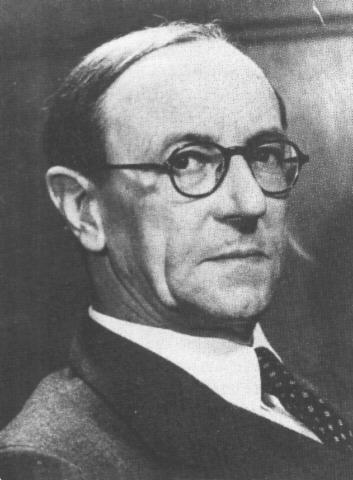
Sir James Chadwick was awarded the 1935 Nobel Prize in physics for his 1932 discovery of the neutron. He was also the head of the British scientists who worked on the Manhattan Project during World War II. Chadwick had intended to study mathematics, but the registrar at Victoria University of Manchester made a mistake and enrolled Chadwick as a physics major. He would soon become fascinated with the work of legendary scientist Ernest Rutherford and build on Rutherford’s discoveries.

Over the course of his career, Chadwick grew increasingly uncomfortable with the shift toward Big Science, and he retired in 1959. Some Personal Notes on the Search for the Neutron was published a few years after Chadwick’s retirement and is considered a fragmentary scientific autobiography.Our edition, an offprint from Ithaca, is the first to appear separately and includes pen emendations made by Chadwick.

Many collectors build their personal libraries around the extraordinary work of Nobel laureates. If you collect the work of Nobel laureates, we’d be happy to help you build your collection. Please contact us if you’re searching for specific items or laureates.

Share

Chapbooks: Short Books with Long History

Scholars debate over the etymology of the term “chapbook.” Some argue that “chap” is derived from “cheap,” surely an accurate description of chapbooks, since they were indeed cheap little publications. But the more widely accepted explanation is that “chap” comes from the Old English “céap,” meaning “barter” or “deal.” Peddlers came to be known as chaps, and they were the primary purveyors of chapbooks. Whatever the origin of their name, chapbooks became a vital tool for dissemination of information and promotion of literacy. As publishing and readers’ tastes evolved, chapbooks also provided an ideal means of addressing an increased demand for children’s literature.

Since the Middle Ages, traveling peddlers provided many necessary wares to rural communities–and that included the news. They would often regale their customers with the latest in politics, entertainment, and gossip. Then in 1693, England repealed the Act of 1662, which had limited the number of Master Printers allowed in the country. The number of printers exploded. Meanwhile, charity schools emerged, making education and literacy more accessible to the poor. The demand for cheaply printed reading materials drastically increased as a result, and all the new printers were happy to supply their needs.

By 1700, chapmen regularly carried small books–usually about the size of a waistcoat pocket–on virtually every topic imaginable. The books were generally coverless, and their illustrations were made of recycled (and irrelevant) woodcuts from other publications. In the absence of copyright laws, printers would steal illustrations or even large chunks of text from other chapbooks and reproduce them in their own editions. Early chapbooks weren’t even cut; the purchaser would cut apart the pages and either pin or stitch the book together to read.

Dr Watts-Divine SongsChapbooks grew into an incredibly powerful tool for disseminating new ideas. When Thomas Paine published The Rights of Man, he suggested that the second edition be made available in chapbook form. The book went on to sell over two million copies, an incredible feat in those days, when the average publishing run might be only a few hundred or thousand copies. Religious organizations used the form to publish religious tracts, nicknamed “godlinesses” or “Sunday schools.” There were even chapbooks for the chapmen themselves, containing information about different towns, dates for local fairs, and road maps.

The Industrial Revolution, however, brought a revolution in the printed word as well. People flocked to the cities, reducing chapbooks’ role in news delivery. Newspapers had also become cheaper to produce, so they were no longer relegated to the upper class. And chapbooks’ days seemed numbered when public solicitation was outlawed and peddlers could no longer distribute them. Meanwhile people’s tastes were changing. As the decades of the 1800’s passed, the novel was emerging as a new, preferred form, and in terms of “cheap” literature, chapbooks eventually gave way to “penny dreadfuls,” the dime novel, and other such low-brow forms.

But changing reading habits and higher literacy rates also meant an increased demand for children’s literature. From around 1780, most booksellers offered a variety of children’s chapbooks, which included ABC’s, jokes, riddles, stories, and religious materials like prayers and catechism. Thanks to improved printing techniques, this generation of chapbooks was printed with relevant illustrations and attached colored paper or card wrappers.

Juvenile-Pastimes-Baseball-Chapbook

Though we think of chapbooks as a distinctly British form, they emerged in various forms around the world. Harry B. Weiss writes in A Book about Chapbooks, “The contents of chapbooks, the world over, fall readily into certain classes and many were the borrowings, with of course, adaptations and changes to suit particular countries.” And despite their variant forms and culturally specific content, chapbooks consistently served as a democratizing force in the dissemination of ideas.

Collectors may build entire collections around chapbooks, or they may find that certain chapbooks fit in well with their collections. For example, the 1849 edition of Juvenile Pastimes includes a rare early pictorial depiction of baseball, making it an ideal addition to a collection of baseball books. Collectors of erotica may enjoy Dumb Dora: Rod Gets Taken Again, an adult chapbook with suggestive, but not pornographic, illustrations. The variety of chapbooks means there’s a little book for everyone!

This month’s select acquisitions are a short list of delightful chapbooks. Please peruse them and contact us if you have any inquiries. As cataloguing chapbooks is quite the endeavor, we’ve also put together an article about the resources used to catalogue the items on the list, which includes our bibliographic sources at the end.

Share

Chapbooks: A [Short] List for September

Chapbooks.

A meanly produced publishing phenomenon, Carter & Barker, in the 8th ABC, describe them thusly: “Small pamphlets of popular, sensational, juvenile, moral or educational character, originally distributed by chapmen or hawkers, not by booksellers.”

If one dips into Neuberg’s CHAPBOOK BIBLIOGRAPHY, we find this genre had “by 1700, [become] an important part of the [chapman’s] stock-in-trade … whose varied subject matter included devils, angels, scoundrels, heroes, love, hate, fairy tales, religion, fables, shipwreck, executions, prophecies and fortune telling. …  During the eighteenth century chapbooks formed the main reading matter for the poor.”  Though around for centuries, the chapbook, as a viable publishing genre, had mostly expired towards the end of the 19th C, except as Carter noted, “as a conscious archaism.”

Despite oft being an object of acquisition by collectors, one can still find these little volumes floating about, and offered at [comparatively] modest prices such that building a pleasing & extensive collection of these modest works is not beyond the means of the ‘average’ person [however such a term may be defined].

Here then is Tavistock Books’ list for September.  A small cache of 30 chapbooks, primarily for children, primarly American, primarily 19th Century.  Prices range from a modest $45 to a decidely robust $2000, for one that will be found in David Block’s ground breaking work, BASEBALL BEFORE WE KNEW IT.  Many titles offered are the only copy on the market; one or two not found on OCLC.

Should you have queries regarding any of this material, or other listings you may find on our site, please contact us.  We thank you for your attention, and we hope you find something of interest while browsing these offerings.

REFERENCES CITED

Cataloguing chapbooks is a task both challenging and engaging, as evidenced by the list of sources used to catalogue this month’s list of select acquisitions.

American Imprints.  AMERICAN BIBLIOGRAPHY. A Preliminary Checklist. 1801 – 1846.  NY [et al]: Scarecrow Pres, 1958-1997.

Arndt & Eck.  The FIRST CENTURY Of GERMAN LANGUAGE PRINTING In The UNITED STATES Of AMERICA.  Göttingen: 1989.

BAL.  Blanck, Jacob [et al].  BIBLIOGRAPHY Of AMERICAN LITERATURE.  New Haven: 1955 – 1991.

Block, David.  BASEBALL BEFORE WE KNEW IT.  A Search for the Roots of the Game.  Lincoln: (2005).

Cappon & Brown.  NEW MARKET, VIRGINIA, IMPRINTS 1806 – 1876.  A Check-list.  Charlottesville: 1942.

Church.  Cole, George Watson – Compiler.  A CATALOGUE Of BOOKS Relating to The Discovery and Early History of North and South America Forming a Part of the Library of E. D. Church.  NY: Peter Smith, 1951.

Cropper, Percy J.  The NOTTINGHAMSHIRE PRINTED CHAP-BOOKS, with Notices of Their Printers and Vendors. 1892. 

Davis, Roger.  KENDREW Of YORK and His Chapbooks for Children.  Elmete Press, 1988.

ESTC.  ENGLISH SHORT TITLE CATALOGUE.  http://estc.bl.uk

Gumuchian.  Les LIVRES De L’ENFANCE du XVe au XIXe Siècle.  London: Holland Press, 1985.

Hamilton, Sinclair.  EARLY AMERICAN BOOK ILLUSTRATORS And WOOD ENGRAVERS. 1670-1870.  Princeton: 1968.

Heartman, Charles F.  The NEW ENGLAND PRIMER Issued Prior to 1830.  1922.

[-].  AMERICAN PRIMERS. INDIAN PRIMERS. ROYAL PRIMERS.  And Thirty-Seven Other Types of non-New-England Primers Issued Prior to 1830.  Highland Park: 1935.

NCBEL.  The NEW CAMBRIDGE BIBLIOGRAPHY Of ENGLISH LITERATURE.  Cambridge: 1969 – 1977.

NUC.  NATIONAL UNION CATALOGUE.  Pre-1956 Imprints.

Opie, Iona & Peter.  The OXFORD DICTIONARY Of NURSERY RHYMES.  Oxford: (1951).

Osborne.  The OSBORNE COLLECTION Of EARLY CHILDREN’S BOOKS 1566-1910.  Toronto: TPL, 1975.

Rosenbach, A.S.W.  EARLY AMERICAN CHILDREN’S BOOKS.  NY: Dover, 1971.

Spencer.  A CATALOGUE Of The SPENCER COLLECTION Of EARLY CHILDREN’S BOOK And CHAPBOOKS.  Preston: 1967.

Weiss, Harry B.  SAMUEL WOOD & SONS. Early New York Publishers of Children’s Books.  NY: 1942.

Welch, d’Alté A.  A BIBLIOGRAPHY Of AMERICAN CHILDREN’S BOOKS Printed Prior to 1821.  Worcester: AAS, 1972.

Wust.  THREE HUNDRED YEARS Of GERMAN IMMIGRANTS In NORTH AMERICA 1683-1983.   1983.


Share