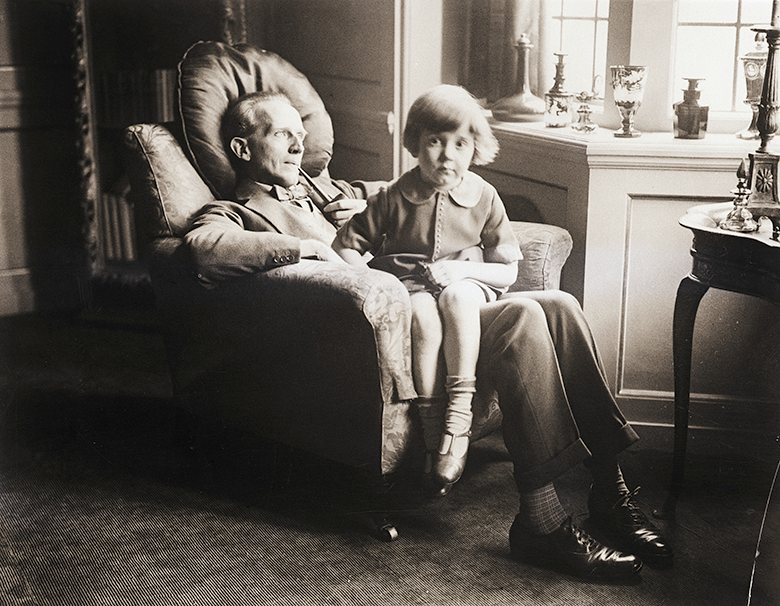
AA Milne: Legendary Children’s Author and Ambivalent Pacifist

AA_Milne_Christopher_Robin

AA Milne with son, Christopher Robin (1925). Christopher later resented having been the inspiration for the eponymous character in Milne’s classic ‘Winnie-the-Pooh’ tales.

Alan Alexander Milne came to regret that his beloved Winnie-the-Pooh series overshadowed his other works. Yet some of his most interesting pieces were never even attributed to him. An outspoken pacifist during World War I, Milne secretly served in Britain’s M17b unit, writing pro-war propaganda. But by World War II, Milne’s views on war had changed, creating a rift between him and beloved author PG Wodehouse.

Born on January 18, 1882 in Scotland, Milne spent his childhood in London. His tutor, the young HG Wells, was, according to Milne “a great writer and a great friend.” Milne went on to Westminster School and Trinity College. He edited Granta for a year, and his preliminary literary efforts appeared in Punch magazine. Just after his 24th birthday, Milne became the assistant editor of Punch. He held the post until World War I began.

An Outspoken Pacifist
AA_Milne_Western_Front_1916

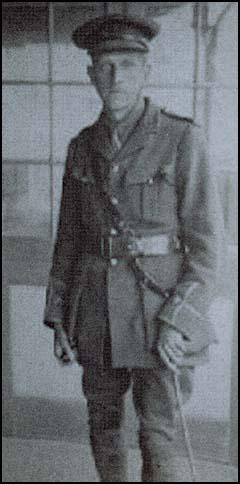
AA Milne on the Western Front, 1916

At the start of World War I, Milne enlisted in the Royal Warwickshire Regiment. He served as a signalling officer and did a brief stint in Paris before being discharged due to trench fever. Milne never even fired at an enemy; indeed, his most notable service remained a complete secret until recently. Thanks to a set of long-lost documents secretly saved from destruction, we now know that Milne was part of the classified M17b unit.

Established in 1916, the unit included twenty of Britain’s top writers of the time. Their mission: to produce propaganda that would sustain support for the war at a time when the number of casualties was rapidly rising and anti-war movements were sprouting all over Europe. The unit not only wrote accounts of Victoria’s Cross winners and other war heroes, but they also focused on the atrocities perpetrated by the Germans.
Captain_James_Lloyd

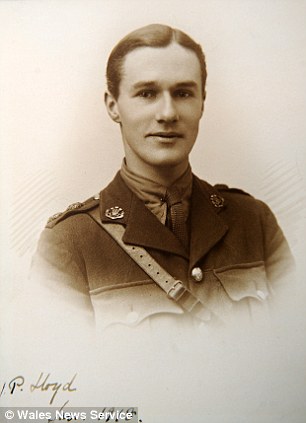
Captain James Lloyd

Alongside Milne were Cecil Street, the author of the Dr. Priestley novels; “the Navvy Poet” Patrick MacGill; Roger Pocock, the world-traveling author; JP Morton, who earned his fame with The Bystander; and Captain James Lloyd, who was recruited to join the unit after being wounded in combat. It was Captain Lloyd who defied orders and took about 150 of the unit’s classified documents home. They were discovered last year by his great nephew Jeremy Alder, who discovered them just before they were going to be thrown away.

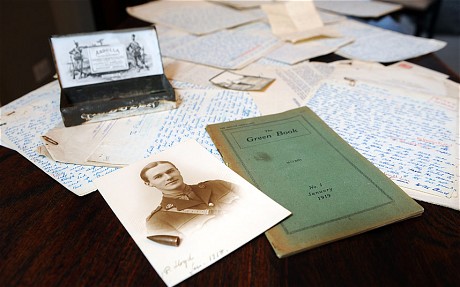
Among the documents recovered was The Green Book, which is marked “for private circulation.” There were likely no more than twenty copies ever published. The pamphlet included contributions from the unit’s authors and poked fun at the task of creating government propaganda. Milne’s own contributions illustrate how onerous he found the task. In “Captain William Shakespeare, of a Cyclist Battalion,” Milne writes:

In M17b
who loves to lie with me
About atrocities
And Hun corpse factories
Come hither, come hither, come hither,
Here shall we see
No enemy
But sit all day and blather

In “Some Early Propagandists,” also compiled in The Green Book, Milne writes about Paul von Hindenburg, the German Field Marshal. Hindenburg would go on to become Germany’s President and to appoint Adolf Hitler as Chancellor of Germany.
Milne_M17b_Documents

Captain Lloyd’s cache of M17b documents, which included ‘The Green Book’

After the war ended, Milne went on to great success, largely due to his Winnie-the-Pooh series. He also published Peace with Honour: an Enquiry Into the War Convention, which was an overtly pacifist work. Milne said that he wrote it because “I want everybody to think (as I do) that war is poison, and not (as so many think) an overstrong, extremely unpleasant medicine.”

World War II Brings a Change of Heart

But by World War II, Milne had changed his mind. In 1940, he even went so far as to publish War with Honour, in which he states, “War is something of a man’s own fostering; and if all mankind renounces it, then it is no longer there.” Soon Milne inflicted his newfound hawkishness on PG Wodehouse, an author with whom he’d previously enjoyed mutual admiration.

Milne had long enjoyed Wodehouse’s writing–he even read it to his own son, Christopher Robin, instead of his own stories. But as Wodehouse’s career took off in the 1930’s, Milne’s was burning less brightly. When Wodehouse began doing radio broadcasts for the Nazis, Milne was first in line to accuse the imprisoned author of treason, possibly out of jealousy. Wodehouse and his wife were in France when the Nazis invaded in 1940. They were taken to an internment camp. A few Nazis had known Wodehouse thanks to his Hollywood projects, and they asked Wodehouse to do radio broadcasts detailing his experiences at the camp.
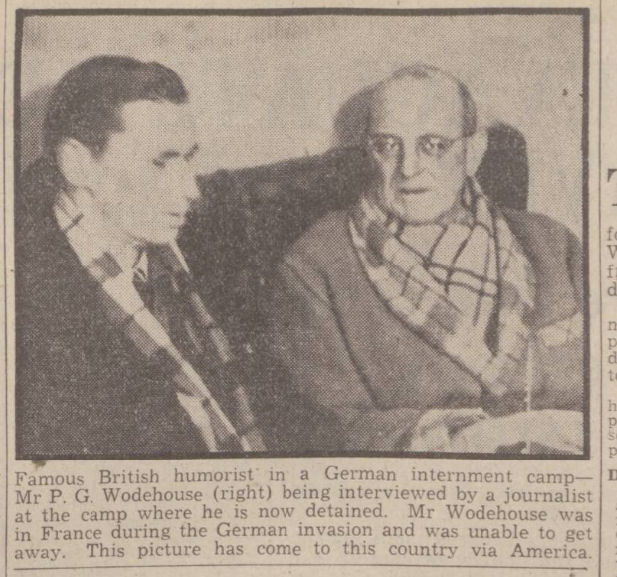
PG_Wodehouse_Internment_Camp

The above appeared in a British newspaper while Wodehouse was still at the internment camp.

Wodehouse likely had little say in the matter; after all, did one really argue with the Nazis? Wodehouse complied, though his broadcasts were probably far from what the Nazis had in mind; with characteristic wit, Wodehouse made sport of the Nazis. After reading the transcripts, one British Air Marshal marveled that the Nazis had permitted Wodehouse to complete five broadcasts; “Why the Germans let him say all this I cannot think,” he observed, “They have either got more sense of humor than I credit them with,or it just slipped past the censor. Wodehouse has probably been shot by now.”
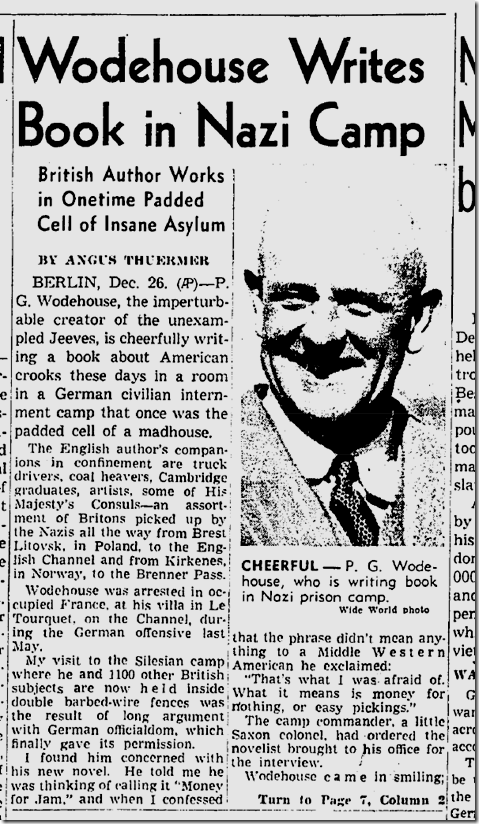
Wodehouse_Clip

The above was published in the ‘LA Times’ on December 27, 1940.

When Wodehouse’s countrymen found out about the broadcasts, they were furious. Even though they’d never head them, they were confident that Wodehouse had agreed to the task in exchange for favored treatment. People vociferously excoriated Wodehouse, and Milne was chief among his detractors. The furor soon grew into hysteria. Milne dismissed the possibility that Wodehouse had simply been naive, calling the author irresponsible. He said that Wodehouse “has encouraged in himself a natural lack of interest in ‘politics’–‘politics’ being all the things grown-ups talk about at dinner while one is hiding under the table. Things, for instance like the last war, which found and kept him in America, and post-war taxes, which chased him back and forth across the Atlantic.”

Wodehouse was released in 1941. He was cleared of any wrongdoing but was unable to overcome the stigma that had tarnished his reputation. Wodehouse would exact some revenge in “The Mating Season” and “Rodney Has a Relapse,” where he mocks the literary insignificance of Milne’s work and points out that Milne had exploited his own young son to attain literary fame. Wodehouse also once admitted, “Nobody could be more anxious than myself…that Alan Alexander Milne would trip over a loose bootlace and break his bloody neck.”

Milne and Wodehouse never spoke again, and all evidence suggests that Milne held on to the grudge till the end of his life. Wodehouse, on the other hand, was able to let go. When he learned that Milne was ailing, he expressed regret and noted that Milne was “about my favorite author.” Regardless of how they felt about each other, both AA Milne and PG Wodehouse remain beloved figures in modern British literature.

Related Posts:
Edith Cavell: Nurse, Historian, and Traitor? 
The Man Behind the Beloved ‘Freddy’ Series

Thanks for reading! Love our blog? Subscribe via email (right sidebar) or sign up for our newsletter--you’ll never miss a post.

Share

Irwin and Erastus Beadle, Innovators in Publishing Popular Literature

Toward the middle of the nineteenth century, the story papers started giving way to a new publication format: the dime novel. Though a number of American publishers capitalized on the trend, Irwin and Erastus Beadle were likely the most successful. The fruits of their publishing company include numerous series, constituting a unique category of collecting.

Erastus Flavel Beadle was born on September 9, 1821 in Oswego County, New York. Five years later, his brother, Irwin Pedro Beadle, was born. After various apprenticeships, the brothers eventually set up their own stereotype foundry in 1850. The following year, Erastus teamed up with engraver Benjamin Vanduzee to publish the youth magazine The Youth’s Casket. Though Vanduzee would leave the project a few years later, publication continued until 1856. Meanwhile, in 1855, Erastus started his next project: The Home: A Fireside Companion and Guide for the Wife, the Mother, the Sister, and the Daughter.

New City, New Venture

Beadles_Metta_Victoria_Fuller_VictorThe following year, however, Erastus decided to head west. He hoped to take advantage of the land boom in Kansas and Nebraska. It’s likely that his former apprentice Robert Adams took over publication until his return in 1857. Then in 1858, both Beadle brothers and Adams relocated to New York City. Erastus continued publishing The Home from there, and he brought on Metta Victoria Fuller Victor as the new editor in December, 1858. Victor would become a notable author of several Beadle’s dime novels, including The Dead Letter and Maum Guinea. Her husband would also become an editor for the publishing house for several years.

The late 1850’s also saw a new interest in sheet music and popular songs. Irwin capitalized with the Dime Song Book (1859), a paper-bound set of ballads that had previously been published separately. The book sold quite well, so Irwin undertook a series of dime booklets on a wide variety of subjects, from cookery to baseball. At the end of that year, Irwin and Adams formed Irwin P Beadle & Co. Though Irwin would come up with the innovation of publishing dime novels serially, it would be Erastus who got most of the credit–and the profit.

Beadle's Singer's Library-I'm the Boy That's Bound to Blaze1860 saw the inception of the first Beadle novel series. It kicked off with Ann Stephens’ Maleaska, the Indian Wife of the White Hunter, which had first appeared in Ladies’ Companion magazine (February-April 1839). The story was advertised as “a dollar book for a dime.” In dime novel form, Stephens’ work sold more than 65,000 copies in the first few months. Erastus would later estimate that the eighth novel, Edward Sylvester Ellis’ Seth Jones, sold over twice that, though some experts believe he exaggerated. At any rate, the dime novels, with their orange paper wrappers and patriotic stories, were popular sellers.

The Civil War temporarily slowed sales of Beadle’s Dime Novels, but the Union troops were soon reading them as voraciously as ever. Nevertheless, in 1861, Beadle’s American Library was launched in London. It mostly included reprints from the American editions and lasted for five years. In 1862, Erastus and Adams actually bought out Irwin. They didn’t rename the firm Beadle & Adams until 1870, four years after Adams had died and his two brothers, David and William Adams, had assumed his ownership. In the meantime, publications would be issued under several subsidiary names: Frank Starr & Co; Adams, Victor, & Co; and Adams & Co.

Irwin tried his hand at publishing dime novels on his own, but he couldn’t match the efforts of his brother. He gave up the endeavor in 1868. But 31 more novel series would be published, many of these reprints of earlier publications.

Beadle’s New York Dime Library

Beadles_Dime_Chess_InstructorThe longest running of these was Beadle’s New York Dime Library. The series actually began as Frank Starr’s New York Library, and Numbers 1 through 26 were were originally published under this title. Then Number 27 appeared on February 18, 1878 with the title Beadle’s New York Dime Library. When Numbers 1 through 26 ran out, they were reprinted with the new name. Now, it’s almost impossible to find printings with the original name, though occasionally a copy will surface with the new title pasted over the old one. In advertisements, the “New York” was often omitted from the name, likely because it was considered rather insignificant.

Stories in Beadle’s Dime Library generally hadn’t been published anywhere else first, except for a few serials from story papers. The content was largely the same: stories of adventure, of pioneers and cowboys, of criminals and war heroes. An occasional tale of the sea would be included (notably the pirate stories of the two Ingrahams), but for the most part this genre was considered past its prime. In the late 1870’s and 1880’s, stories of street boys who made their way in the world became increasingly popular. Horatio Alger, Jr was a frequent contributor of these.

Beadle’s Half-Dime Novels

Just five months after Beadle’s Dime Library was launched, Beadle & Adams started the Beadle’s Half-Dime Library. It was geared toward children, who couldn’t always get a dime, but could often scrape together five cents. Experts believe that the first Number most likely appeared on Monday, October 15, 1877, which is actually the same day that the advertisement stating that the series was “coming soon” appeared in Beadle’s Dime Library.

Beadles_California_Joes_War_TrialBeadle’s Half-Dime Library was published twice a week until the end of 1877. Starting in 1878, the publication appeared once a week, on Tuesdays, so long as Beadle remained publisher. Some early Numbers have multiple illustrations. For the most part, however, they are illustrated with a single woodcut on the front page. Beadle also squeezed quite a bit of text on each page–often twelve lines of type per inch.

Earlier Half-Dime stories were of adventurers, backwoodsmen, trappers, and hunters. The majority of the stories ran as series. These included Broadway Billy and Joe Phoenix. Deadwood Dick was probably the most successful of these, continuing for over 100 Numbers.

The End of an Era

In 1891, two other similar libraries emerged: Nick Carter Library and Gem Library. Then 1893 saw the establishment of the Bob Brooks Library. And the Tip Top Library and the Diamond Dick Library both started in 1896. But these would be short lived in comparison to Beadle’s Dime Library, which continued a few more years, until 1905. By the end of the 1930’s the dime novel had mostly given way to the pulp magazine.

A Selection of Beadle’s Dime and Half-Dime Publications

Beadles_Dime_Baseball_PlayerBeadle’s Dime Base-Ball Player (1867)

Beadle’s Dime Base-Ball Player was published as a continuous series from 1860 to 1881 (none were issued in 1861 or 1863). This is the sixth example. Author Henry Chadwick, is generally regarded as the first sports writer in the US. According to DAB, “the rules of baseball are largely his work.” The series gave rise to the many iterations and laborious study that baseball fans still love today. All of these guides are quite scarce; OCLC shows only one listing of the seventh issue for the nine editions through 1870, and none have come to auction in the last three decades. Details>>

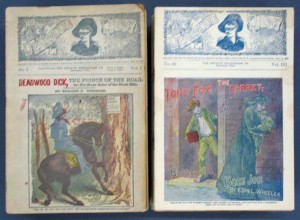
Deadwood_Dick The Deadwood Dick Library

Published in 64 issues, the Deadwood Dick series was penned by Edward Lytton Wheeler. The eponymous protagonist, whose real name is Edward Harris, is considered the quintessential dime-novel hero. Written from 1877 to 1895, the series began publication in Beadle’s Half-Dime Library and was later republished multiple times. This Westwood set is quite rare because it’s complete. Details>>

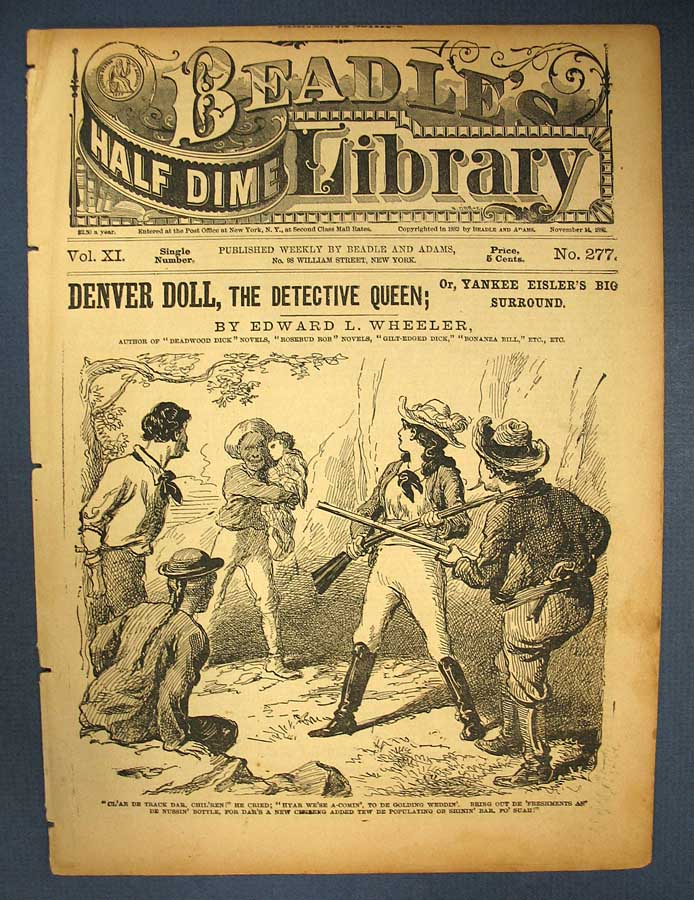
Beadles_Denver_DollDenver Doll, the Detective Queen

Our research indicates that the “Denver Doll” was one of the earliest female detective characters in American fiction. Wheeler (also responsible for the Deadwood Dick series, above) describes her as “a splendid specimen of young womanhood.” Despite the protagonist’s charm, the series failed to capture the attention of Beadle’s Half-Dime Library readers. The fourth, and last, part of the series was published in March 1883. The series’ short life-span has undoubtedly contributed to its current scarcity. Indeed, even avid mystery collectors are unaware of the Denver Doll and believe that Katherine Green’s Amelia Butterworth (The Affair Next Door, 1897) is the first female detective in US literature. This is the first of the Denver Doll series and can be said to be quite rare. Details>>


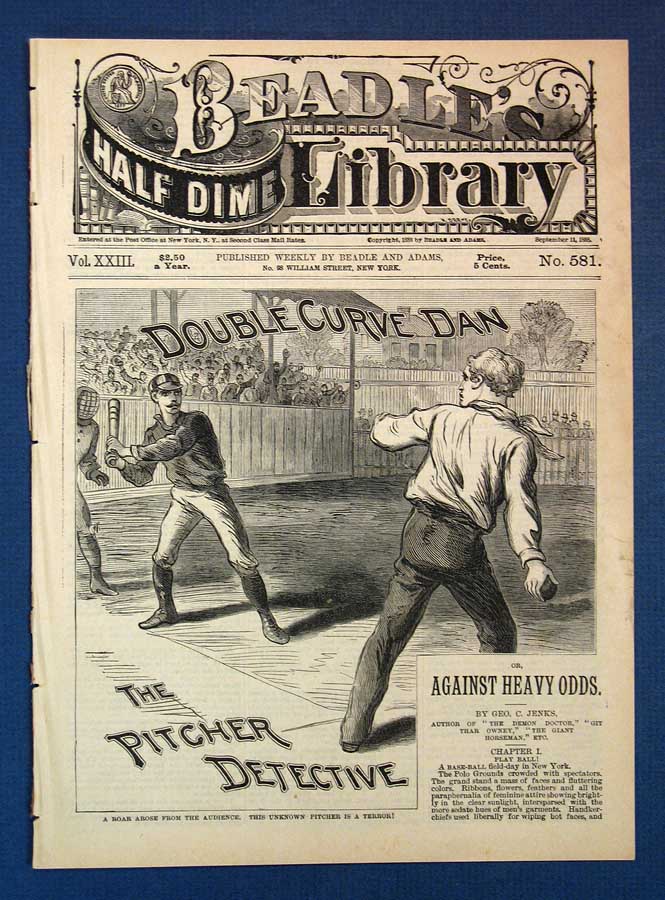
Beadles_Double_Curve_Dan_Pitcher_DetectiveDouble Curve Dan, the Pitcher Detective

George Jenks penned three stories for the Double Curve Dan series. This is the first in the series. OCLC shows only three institutional holdings, and no copies have been at auction in the past thirty years. This copy shows evidence of previous binding, but is otherwise a very good copy of a quite fragile item. Details>>


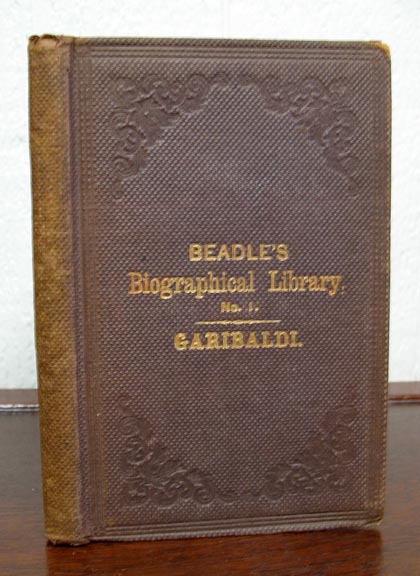
Beadles_Biographical_GaribaldiThe Life of Joseph Garibaldi, the Liberator of Italy

In addition to the popular dime novel series, Beadle & Co launched another series in 1860. Beadle’s Dime Biographical Library presented biographies of famous figures from all over the world. This first edition of The Life of Joseph Garibaldi (1860) has proven a quite rare Beadle publication, especially in this cloth binding (which is not mentioned in Johannsen). It includes an engraving of Garibaldi on the frontis. Details>>

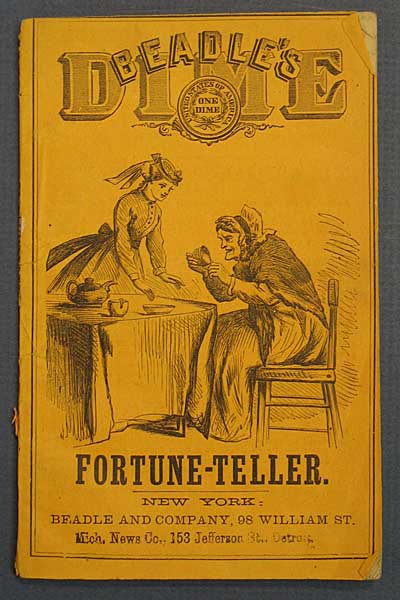
Beadles_Dime_Fortune_TellerBeadle’s Dime Fortune-Teller

The woodcut on the front of this pamphlet depicts an old crone telling the fortune of a young maid. The book promises to demystify dreams and instruct the reader to discern his fortune in everything from tea leaves to egg whites. First published in October 1868, this is an early reprint, circa December 1868. OCLC records just one institutional holding, at NIU. Details>>

Share

Fra Paolo Sarpi, Scholar, Priest, and Heretic

The Counter-Reformation began with the Council of Trent (1545-1563) and lasted a full century, until the close of the Thirty Years’ War (1648). The movement sparked conflict all over Europe, challenging the very foundations of people’s daily lives. As nationalism fermented, states like Venice began to assert their autonomy–and the Catholic Church often took drastic measures in response. In the case of cleric and statesman Fra Paolo Sarpi, they even hired a hitman. Though Sarpi consistently stood up to the Church in an official capacity, he also chose to publish his greatest work, The History of the Council of Trent, under a pseudonym.

A Complicated Relationship with the Church

Paolo Sarpi was born in Venice on August 14, 1552. He entered the Servite order in 1566 and was eventually assigned to Mantua, then Milan. He was reassigned to 1588 after a brief stint in Rome to address business related to reforming the Servite order. Sarpi proved an adept scholar and lawyer. In 1601, the Venetian Senate recommended him for the bishopric of Caorle, but the papal nuncio declined. He alleged that Sarpi had denied the immortality of the soul and controverted Aristotle’s authority. This would not be the last accusation of heretical behavior levied against Sarpi. The following year, Sarpi made another bid at the bishopric, but this time Pope Clement VIII himself took offense; Sarpi was known to correspond with heretics, which wasn’t fitting behavior for a church official.

Paolo-SarpiFurthermore, Sarpi had already appeared before the Inquisition in both 1575 and 1594. He would be questioned again in 1607. Sarpi advocated Protestant worship in Venice, as well as the establishment of a Venetian free church autonomous of the Catholic Church. He even admitted that he disliked saying Mass and avoided it whenever he could. Sarpi lived by two maxims, “God does not regard externals so long as the mind and heart are right before Him” and “I never never lie, but I do not divulge every fact to everyone.” By the end of his life, Sarpi had come to favor the Calvinist Contra-Reformists and rejected religious dogma.

Embroiled in the Counter-Reformation

In March, 1605, Pope Clement VIII died. His successor, Pope Paul V, had a different attitude toward papal prerogative and exerted even more rigorous authority over the government. The Venetian government responded by attempting to restrict the Pope’s power. The conflict came to a head in January, 1606, when the papal nuncio delivered a brief that demanded the Venetians’ unconditional submission to papal authority. Rather than comply, the Venetian senate promised protection to all ecclesiastics who would defend the republic with their counsel. Sarpi stepped up, penning a memoir that outlined how the Venetians could respond to the censures. The document was so well received that Fra Sarpi was made canonist and theological counsellor to the republic.

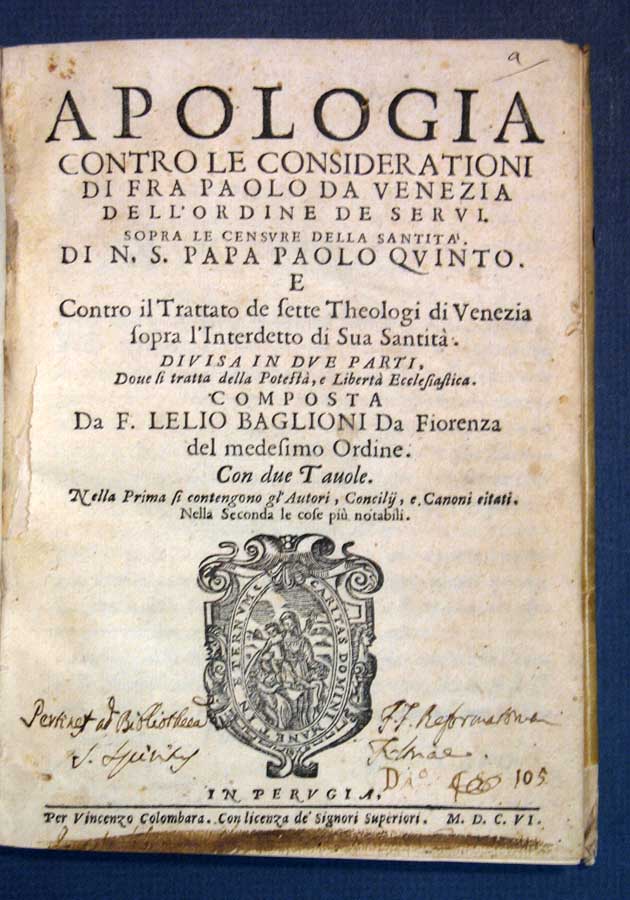
Apologia_Antonio_Possevino

Writing as Paolo Anafesto, papal diplomat Antonio Possevino defended Pope Paul V’s interpretation of ecclesiastical jurisdiction.

In April, the Pope summarily excommunicated all Venetians. Sarpi again entered the controversy, an unprecedented move for someone of his stature. He openly argued that the power of the clergy should be secondary to the power of the state. Sarpi first republished the anti-papal republican opinions of canonist Jean Gerson (1363-1429). He also anonymously published Risposta di un Dottore in Teologica, which was promptly added to the Church’s index of banned books. Cardinal Bellarmine roundly lambasted Gerson’s works, and Sarpi responded with an Apologia. By this time, Sarpi was censor of all materials written in defense of the Venetian republic, and multiple tracts either inspired or controlled by him were published in quick succession. Only the Jesuits, the Theatines, and the Capuchins really abided by the papal decrees and were expelled from Venetian territories; the rest of Venice simply continued business as usual, and

The Catholic powers in France and Spain had tried to avoid becoming embroiled in Italian affairs, but they finally had to step in. They arranged a weak compromise in 1607: the Church acknowledged that interdicts and excommunications had lost their force. This admission did little to mitigate the animosity between the Church and the state of Venice. Indeed, the Church actually commissioned an assassination attempt on Fra Sarpi. They hired Rotillo Orlandini, a brigand and unfrocked friar, along with his two brothers-in-law to kill Fra Sarpi for 8,000 crowns. But the plot was discovered, and the would-be assassins were taken into custody before they could follow through.

On October 5, 1607, however, Sarpi was stabbed fifteen times with a stiletto and left for dead. His attackers returned to papal territory in what was described as a “triumphant march.” The enthusiasm of papal authorities was quashed when Sarpi survived the attack, but the failed assassins eventually settled in Rome and received a pension from the Viceroy of Naples. Their leader, Poma, said that he’d committed the crime for religious reasons. Sarpi would continue to be the subject of assassination plots for the rest of his life, and he occasionally considered relocating to England.

Instead, he passed his years quietly at the monastery, preparing state papers and pursuing scientific studies. He corresponded with a number of prominent scholars, including Galileo Galilei, and his documents suggest that he first encountered a telescope in November, 1608–perhaps before Galileo. The following year, the Venetian government had a telescope on approval for military use. Sarpi advised them to decline it, anticipating Galileo’s superior model. Sarpi also claimed to have anticipated William Harvey’s discovery of the human circulatory system, but the only anatomical discovery that can definitively be attributed to Sarpi is the contractibility of the iris.

The History of the Council of Trent

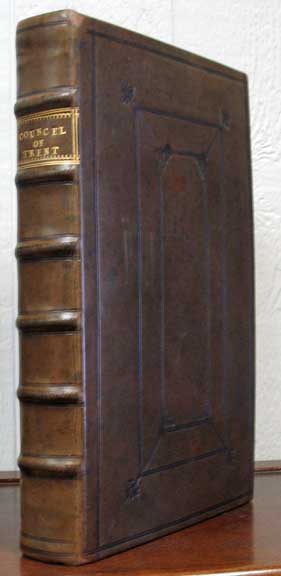
Sarpi_History_Council_TrentIn 1619, Sarpi anonymously published Istoria del Concilio Tridentiro. It was printed in London under the pseudonym Pietro Soave Polano (an anagram of “Paolo Sarpi, Veneto,” with an extra “o”). Sarpi never admitted authorship during his lifetime, even under pressure from Louis II of Bourbon, the Prince of Conde. Sarpi’s editor, Marco Antonio de Dominis, was soon accused of falsifying parts of the text, but a look at Sarpi’s own manuscripts show that Dominis’ changes were minor. Nathaniel Brent published a translation, The History of the Council of Trent, in 1629. It would also be translated into French and German. The book presents an unofficial history, one that’s clearly hostile toward the papacy. Sarpi addressed ecclesiastical history as a matter of politics, so his work was especially popular among Protestants. John Milton even called Sarpi “the great unmasker.”

Sarpi argued in The History of the Council of Trent that the settlement wasn’t intended to foster compromise, but rather to incite further conflict. Critics have never denied the literary merits of Sarpi’s masterpiece, but they do acknowledge the numerous liberties Sarpi took with history (as did Cardinal Pallavicini, who refuted Sarpi’s history on behalf of the Catholic Church). Historian Hubert Jedin was particularly critical of Sarpi’s scholarship, but it has since come to light that the cleric probably used sources that haven’t survived.

Related Posts:

Astrology, Astronomy, Potato, Po-tah-to? 

The Millerites and the Great Disappointment


Thanks for reading! Love our blog? Subscribe via email (right sidebar) or sign up for our newsletter--you’ll never miss a post.
Share

Three Pioneering Authors Who Used Pseudonyms

In Shakespeare’s Romeo and Juliet, Juliet says, “A rose by any other name would smell as sweet.” In Numerous authors have taken that sentiment to heart, choosing to publish under pseudonyms for a host of reasons. Charles Dickens famously wrote as “Boz,” and Samuel Clemens is better known as Mark Twain. Here’s a look at three more overlooked authors who also took pen names.

James Mason Hutchings, AKA “Forty Nine”

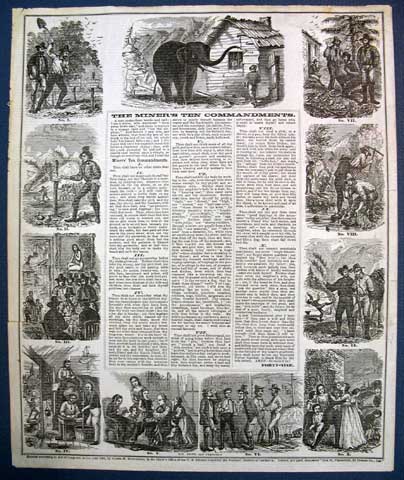
Born in England, James Mason Hutchings immigrated to the United States in 1848. He headed to California to find his fortune during the Gold Rush. In 1853, he published “The Miner’s Ten Commandments” under the pseudonym “Forty Nine.” Though he indeed struck it rich, Hutchings lost everything in a bank failure. He would later rebuild with a career in publishing. However he’s known not for his contributions to publishing, but for his promotion of Yosemite. Hutchings came to the region after reading Lafayette Bunnell’s evocative description of waterfalls in the region.

Hutchings_Miners_Ten_Commandments

The Miner’s Ten Commandments

On July 5, 1855, Hutchings set out on one of the most historic trips to the area: he led the second tourist expedition into Yosemite (the first, led by Robert C Lamon, occurred in 1854, but there’s no known written record). Hutchings had been one of the earliest settlers in the area, and his Hutching’s Illustrated California Magazine did much to publicize the natural wonders of Yosemite. And in 1869, Hutchings hired John Muir–at the time an itinerant sheepherder–to build a sawmill on park land. Muir would become Yosemite’s greatest champion.

When Yosemite was dedicated as a state park in 1864, Hutchings refused to leave his land. Essentially a squatter, he alleged that preemption laws meant he was entitled to 160 acres of land in the valley. The case dragged on for years and went all the way to the US Supreme Court, which was unswayed by Hutchings’ argument. He would not get his land, though he did get a generous payment from the state. That satisfied him only temporarily. Hutchings continued to push legal limits, constantly challenging the prohibition of constriction of buildings on public lands. By 1875, Hutchings’ demands and arguments had worn thin; he was banished from Yosemite Valley altogether.

Metta Victoria Fuller Victor, AKA “Seeley Regester”

Dead_Letter_Victor_Beadles

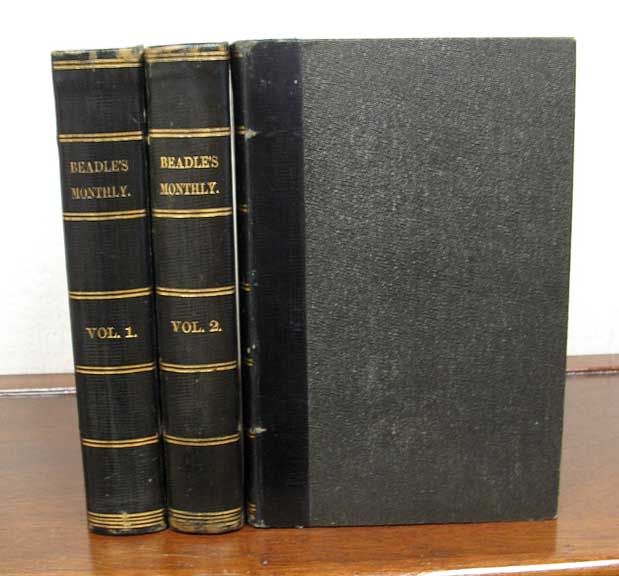
‘The Dead Letter’ as serialized in ‘Beadles Monthly’

Metta Victoria Fuller Victor, the wife of publishing pioneer Orville James Victor, broke new ground herself with the publication of The Dead Letter (1864). The novel, which Victor published as Seeley Regester, is considered the first detective novel in the United States. Prior to that, Victor had penned Alice Wilde (1860), an early dime novel. And her abolitionist novel Maum Guinea, and Her Plantation “Children” was read and enjoyed by Abraham Lincoln himself. Victor frequently used pseudonyms, including Corrine Cushman, Eleanor Lee Edwards, Walter T Gray, and Rose Kennedy.

Victor proved an extremely prolific author, writing poetry, fiction, short stories, social issue novels, and even cookbooks. She’s notable for her adaptability; while other writers would fall out of fashion, Victor would adapt her style or genre to remain relevant. Thus, her earlier works are more sentimental, but she happily made her stories more sensational as public demand shifted. Her inventiveness drew attention from The New York Weekly, which offered Victor a $25,000 contract for the exclusive rights to her stories for five years. Such an income was quite impressive for the time period–consider, for instance that Henry Wadsworth Longfellow, a rockstar of his time, earned about $3,000 in eighteen months (between roughly July 1835 and January 1837).

When Victor’s contract with The New York Weekly expired, she worked mostly for Beadle & Adams, still using pen names. Eventually her husband would also work at Beadle & Adams as an editor. He became one of the most respected editors in the dime novel business, making the Victors a true literary power couple of the era. Despite Victor’s multitude of contributions to fiction and literature, she remains relatively unknown today.

William Taylor Adams, AKA “Oliver Optic”

While the majority of authors who adopt pseudonyms prefer to hide their true identities, William Taylor Adams never denied responsibility for his books and stories. On the contrary, Adams frequently used his real name on the title page or at the end of the preface. Though his favorite nom de plume was Oliver Optic, Adams also used Warren T Ashton, Gayle Wintertown, Brooks McCormick, Irving Brown, and Clingham Hunter, MD. By the end of his career, he’d published 126 novels and over 1,000 stories.

Hatchie-Guardian_Slave_Adams

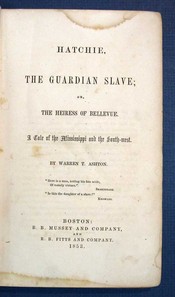
Hatchie the Guardian Slave

When Adams published his first work, Hatchie, the Guardian Slave, in 1853, he’d been teaching in Boston Public Schools for over a decade. The book met with only moderate success, but Adams persevered. His effort paid off two years later with The Boat Club. The book was so successful, Adams decided to expand it into a series of six volumes. From then on, Adams would often write multi-volume series. Adams also acted as editor of Oliver Optic’s Magazine, Our Boys and Girls starting in 1867. It grew to be the most popular juvenile magazine in the United States.

Adams’ works were, for the most part, enthusiastically received by children and critics alike. Both action packed and lively, they still imparted moral lessons. Only Louisa May Alcott openly disapproved, possibly out of jealousy. In her “Eight Cousins,” the character Mrs. Jessie criticizes her son’s reading material for its use of slang and focus on lowlifes like bootblacks and newsboys. She says, “I have read about them…I am not satisfied with those optical delusions, as I call them now.” Adams responded line by line, and the two authors never put aside their animosity for one another.

Unfortunately Adams would later draw ire from the American Library Association. At the annual conventions of 1876 and 1879, the ALA debated the value of “sensational” fiction like that of Adams, and for some time Adams’ works were not allowed in some public libraries. Modern critics and scholars view Adams as a true pioneer in juvenile fiction. When he began writing for children, the usually available stories were the moralistic tales of the Sunday School library, books by Jacob Abbot, and others of that ilk. These tales were hardly appealing to little boys; they lacked relevance and vigor. Adams changed all that, writing stories that were full of action and adventure.

Regardless of what names they affixed to their publications, James Mason Hutchings, Metta Victoria Fuller Victor, and William Taylor Adams all made incredible contributions to the history of American literature.

Related Reading:

The Inimitable Boz and the Delightful Phiz


Thanks for reading! Love our blog? Subscribe via email (right sidebar) or sign up for our newsletter--you’ll never miss a post!.

Share

Of Sammelbands and Sheet Music

Confederate_Sheet_Music_See_Feet_Suppliant_One

“See at Your Feet a Suppliant One” As Sung By Miss Ella Wren, In Balfe’s Grand Opera of the Bohemian Girl. An example of Confederate sheet music

Music has always played a powerful role in cultures around the world. Now sheet music provides a glimpse at people’s daily lives and illustrates changes in fashion, dress, and even behavioral expectations. Collecting sheet music isn’t just for music lovers; it’s an engaging pursuit that frequently intersects with history and literature.

The first music to appear in a printed volume was in the Codex spalmorum (1457). But the work didn’t include the actual notes; instead the text was printed with blank space to manually add the music to each manuscript! It wasn’t until 1473, with the publication of the Constance gradual in Germany, that music appeared fully printed. Three years later, Ulrich Hahn published Missale secundum consuetudinem curie romane, which included music printed with woodcuts. He claimed to be the first to print music, but most experts agree the Constance gradual was the true first. Soon after, missals, graduals, and other religious texts began popping up all over Europe, and many contained printed music.

The difficulty with printing music is that it generally requires multiple print runs: one to print the staff lines, and another to print the actual notes and notations. Hahn and his successors got around this issue by using woodcuts. Eventually, however, new printing technologies–namely moveable type and lithography–were adopted for music as well. (Famous revolutionary and publisher Isaiah Thomas was the first to use moveable type to print music in the United States. More on him later this month!)

Climbin-Those-Stairs_Bohemian_Club

Illustrations and themes of antiquarian sheet music can be an uncomfortable reminder of the past. This item, from the Bohemian Club, is quite rare with none listed in OCLC.

By the 1820’s, however, the most common method for printing music was engraved plates. This has produced numerous bibliographic obstacles for collectors and scholars today. First, not all sheet music bore copyright information in the first place. Next, publishers would often store the plates for long periods of time and simply use them, unaltered, for later reprints whenever they needed to replenish their stock. And sometimes they sold these plates to other publishers, who didn’t bother emending copyright information when it did exist. Sometimes the plate numbers can be used to determine an approximate date, but that’s largely based on how much is known about the particular engraver or publisher. Collectors of nineteenth-century sheet music, then, must put their detective skills to the test on a regular basis–and be comfortable with some uncertainty about publication information.

While many antiquarian book collectors would shy away from works that are not definitive first editions, this factor is less important with sheet music. These items were printed with the intention of being ephemera, and of being used. They often bear the marks of use, such as tears, smudges, wear, and mending with tape or sewing thread. Music printed in the early nineteenth century and earlier tends to be more durable than later sheet music because it was printed on paper made of rag rather than wood pulp. Meanwhile, during the heyday of American sheet music, it was common to print sheet music as newspaper supplements. These items, printed on thin, cheap paper, are often quite fragile if they survived at all. Collectors must be quite mindful of preservation issues to extend the longevity of their sheet music.

Highlights from Our Sheet Music Collection

A Complete Dictionary of Music

Complete_Dictionary_Music_Thomas_BusbyThomas Busby, author of A Complete Dictionary of Music, began his musical career at a young age. After being rejected as too old to be a chorister by Westminster Abbey organist Benjamin Cooke, he went on to study under Samuel Champness, Charles Knyvett, and Jonathan Battishill. Busby’s first musical venture was music to accompany William Kenrick’s play The Man the Master. This remained incomplete during his lifetime. His next pursuit, an oratorio for Alexander Pope’s Messiah, occupied Busby intermittently for several years. He published a musical dictionary with Samuel Arnold in 1786, along with a serial called The Divine Harmonist. Busby also published the first music periodical in England, The Monthly Musical Journal. His A Complete Dictionary of Music went through several editions during his lifetime.

A Sheet Music Sammelband

Sheet_Music_SammelbandOccasionally also called a nonce-volume, a sammelband is a collection of works that were originally published separately and have since been bound together. A musician or music enthusiast might assemble a sammelband of favorite pieces, while music teachers might put them together to teach students specific skills in a set progression. This particular sammelband contains 43 pieces, ranging from waltzes and quadrilles to country dances, sonatas, and operas. It includes a handwritten “Contents” at the front. Much of the music was composed for the piano forte, so the original owner likely played this delightful instrument.

“Carrie Bell”

Carrie_Bell_Confederate_Sheet_MusicCaptain WC Capers, who wrote the words to “Carrie Bell,” was formerly of the “Macon Volunteers” and had served in the Florida Indian Wars (1836). During the Civil War, he commanded Company G, 1st LA Heavy Artillery Regiment of the CSA. In July 1863, Capers was promoted to Major. He saw service at Vicksburg and elsewhere in the South. Confederate sheet music such as “Carrie Bell” was much more frequently published via lithography instead of engraved plates because metal was such an important commodity during the war–it simply wasn’t available for making engraved plates.

“The Ivy Green”

Ivy-Green-Charles-DickensThough “The Ivy Green” makes its first appearance in Chapter Six of The Pickwick Papers, Kitton informs us that the piece wasn’t written expressly for the novel. The favorite setting for the piece was by veteran Henry Russell, who said he received the whopping sum of ten shillings for the composition. Dickens frequently incorporated popular music into his works. He also occasionally wrote his own pieces, such as the satirical ballad “The Fine Old English Gentlemen,” which he penned for The Examiner and said should be sung at all conservative dinners. Meanwhile, Dickens’ extraordinary popularity meant that his novels often took on lives of their own, and people also composed their own musical pieces based on Dickens’ works.

Share

Looking Back at 2013, and Looking Forward to 2014!

Happy_New_Year

This year has been a terrific one here at Tavistock Books, and we have you to thank for that! We appreciate your being a part of our community, and we look forward to building that community with you in the coming year. To that end, here’s a look back at the ten most popular blog articles of 2013. It came as no surprise that Charles Dickens was a favorite, as were William Shakespeare and articles about collecting rare books:

  1. Why Did Dickens Write Ghost Stories for Christmas?
  2. Happy Birthday, William Shakespeare!
  3. The Two Endings of Charles Dickens’ Great Expectations
  4. Meet Dr. Erin Blake, Curator of Art and Special Collections at the Folger Library!
  5. Alexander Pope’s Legacy of Satire and Scholarship
  6. Edgar Allan Poe: Creator of Enduring Terror and Literary Masterpieces
  7. A Brief History of True Crime Literature
  8. A Brief History of Broadsides
  9. Charles Dickens Does Boston
  10. The Benefits of Bibliography

Other favorites were recaps of events in the antiquarian world, such as intrepid assistant and Tavistock Books’ scholarship recipient Travis Low’s recap of Rare Book School. We’ll be sure to keep the updates coming, starting with with the two California book fairs: San Francisco (February 1-2) and Pasadena (February 7-9). Watch our website and blog for more information.

What’s Ahead for 2014

Many of you have graciously and thoughtfully offered blog article suggestions and other feedback. Therefore you’ll soon be seeing articles about a wide variety of bookish topics, from early American bindings to the history of nursing, from tips on collecting sheet music to a look back at Mark Twain’s Adventures of Huckleberry Finn.

Have an idea for a blog post or a question about rare books? We can’t wait to hear it! You’re invited to share it in the “Comments” section of any blog or to contact us via phone or email. You’ll also find us on Facebook and Twitter.

Share

Irving and Dickens: The Authors Who Saved Christmas

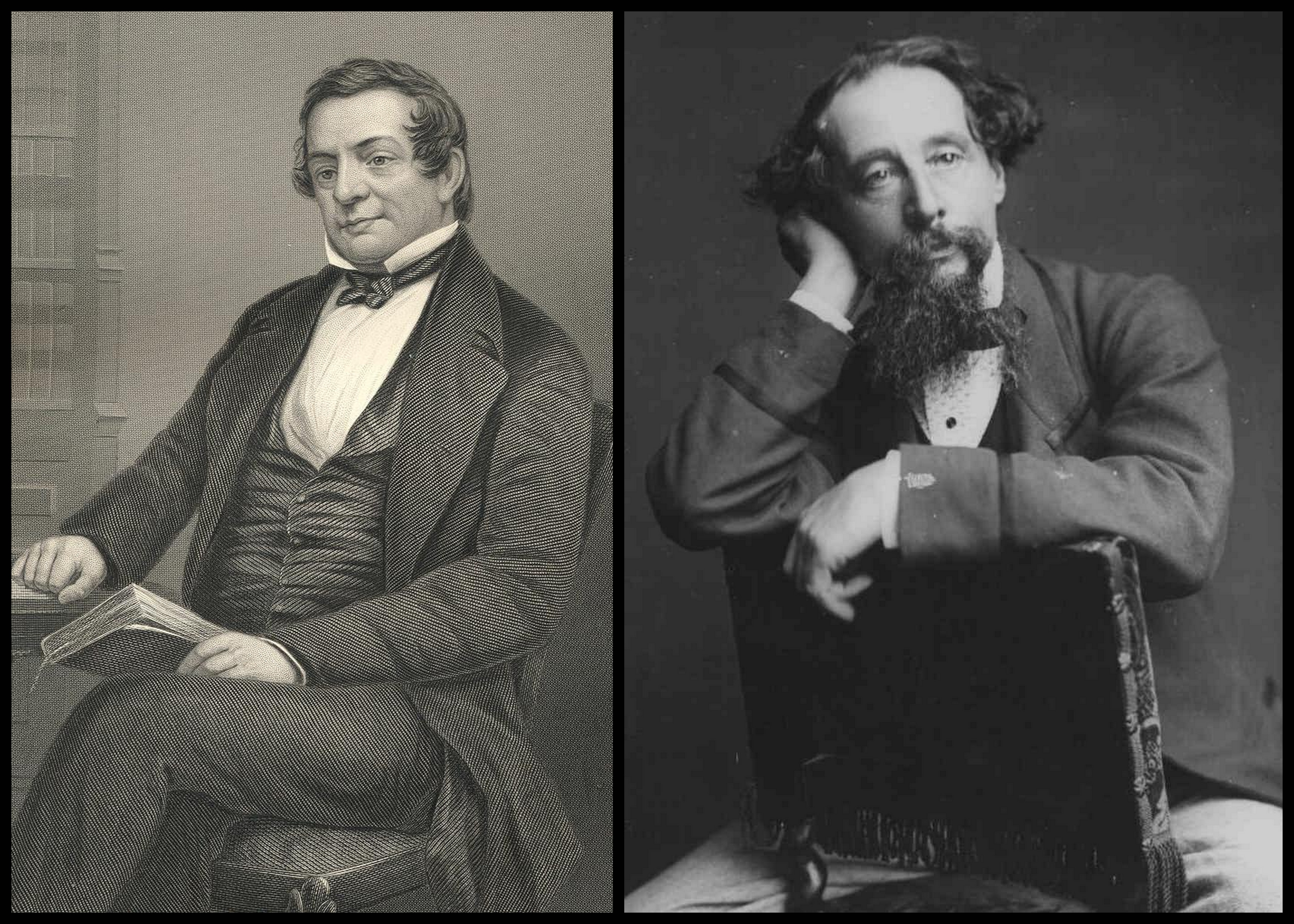
Dickens-Irving

When Clement Clarke Moore published “A Visit from Saint Nicholas” anonymously on December 23, 1823 in the Troy Sentinel, he couldn’t have known that it would become an international phenomenon. But the poem not only gave names to Santa’s eight reindeer. The illustrations of the poem’s reprints significantly impacted our perception of Santa Claus. Caricaturist Thomas Nast would later illustrate jolly old Saint Nick, cementing our concept of him as a jolly. bearded man. And Coca-Cola would eventually be the first to bring us Santa in a red coat. We can thank Washington Irving and Charles Dickens, however, for resurrecting Christmas as a holiday for joyful family celebration.

A Brief History of Christmas

Before Christianity took hold, pagan rituals were routinely honored on the winter solstice. On this day, people would celebrate the triumph of light over darkness. Early church officials, eager to supplant these rites with their own, wisely chose to make Christmas celebrations correspond to these pagan rituals. The strategy had one caveat: the Church couldn’t dictate how people would celebrate Christmas. Thus, Christmas had mostly replaced pagan holidays by the Middle Ages, but holiday observances were usually far from pious. Believers might go to church, but afterward citizens would gather for rowdy festivals similar to Mardi Gras. Each year a student or beggar would be named “Lord of Misrule,” and festival attendants would play the role of his subjects. Meanwhile the poor would go to the homes of the rich to demand food and drink. Non-compliant homeowners risked mischief.

Oliver-Cromwell

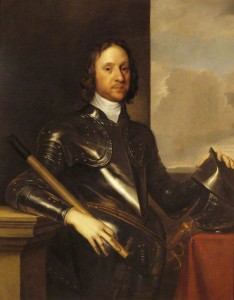
Oliver Cromwell was the original Grinch, canceling Christmas when he took over England in 1645.

But Oliver Cromwell proved to be the original Grinch. A staunch Puritan, Cromwell believed that Christmas was a decadent and unchristian holiday. When he took over in 1645, he vowed to rid England of such indulgences and cancelled Christmas. In 1660 Charles II was restored to the throne by popular demand and reinstated the holiday. But the holiday wouldn’t immediately take hold. By Dickens’ time, the Industrial Revolution had all but destroyed the holiday in Great Britain–for most people, Christmas was still a work day.

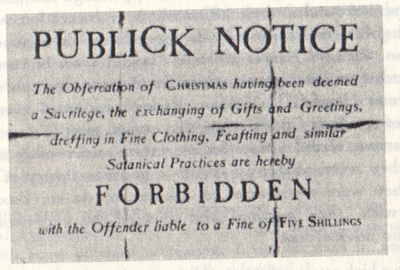
Meanwhile the Puritans had left England to settle in the New World. For the most part, Christmas went uncelebrated in the colonies. In Boston the observation of Christmas even bore a five-shilling fine from 1659 to 1681. (Jamestown was a notable exception: Captain John Smith–the first person ever to consume eggnog–reported in 1607 that the settlement happily enjoyed the holiday.) The American Revolution proved a death knell for traditions of British origin, so Christmas again fell out of favor. It would not be declared a national holiday in the United States until June 26, 1870.

Washington Irving, the Real Father Christmas?

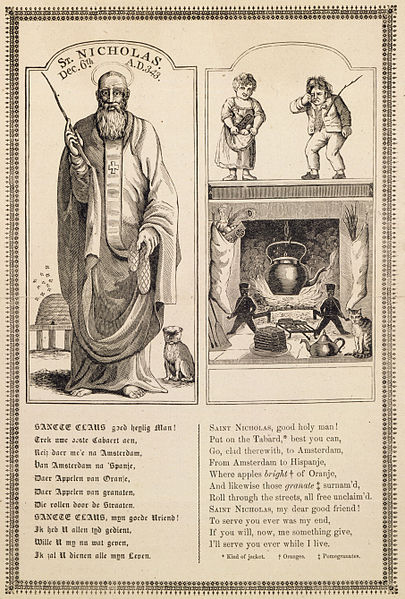
When Washington Irving published Knickerbocker’s History of New York (1809) under the pseudonym Dietrich Knickerbocker, New Year’s Eve was New York’s only real winter holiday. The book parodied American life, and Irving satirized the traditions of New York’s Dutch settlers. He poked fun at their patron saint, Nicholas, whom they called “Sanct Claus.” In Irving’s account of Oloffe the dreamer, Oloffe, a prophet and land speculator, dreams of a night where “the good Saint Nicholas came riding over the tops of the trees, in that self-same wagon wherein he brings his yearly presents for children.” Irving’s St. Nicholas not only delivers presents to children in a sleigh; he also smokes a pipe and places the presents in stockings hung by the chimney.

John-Pintard-St-Nicholas

John Pintard’s St. Nicholas isn’t quite the jolly figure we imagine today!

Irving had some unsolicited assistance in St. Nick’s makeover. New York Historical Society founder John Pintard publicized an engraved picture of St. Nicholas–admittedly looking less than merry–as a symbol of New York City. But Americans remained ambivalent about the holiday. Members of different religious denominations had different concepts of what the holiday should be; some saw Christmas as sacred, while others still believed it blasphemous. Observation was spotty at best, though enterprising Boston merchants advertised ritual Christmas gift exchange as early as 1808.

Dickens-Irving-Grolier-Club

A stray leaf from the correspondence of Washington Irving and Charles Dickens

Irving moved abroad in 1815, and it was not until several years later that he would write another bestseller. The Sketch Book of Geoffrey Crayon was published in several installments from 1819 to 1820. Sandwiched in between American classics like “Rip Van Winkle” (first installment) and “The Legend of Sleepy Hollow” (sixth installment), Irving published five Christmas stories in The Sketch Book’s fifth installment on January 20, 1820. He’d spent time at Astor Hall, recently leased from Adam Bracebridge by James Watt and passed the Christmas holiday with the Watt family. Irving was charmed by their Christmas traditions, reinventing Watt as the benevolent “Squire Bracebridge” in “Bracebridge Hall.” In “Christmas,” Irving writes, “But in the depth of winter, when nature lies despoiled of every charm and wrapped in her shroud of shielded snow, we turn for our gratifications to moral sources.” He would later explain the tradition of hanging mistletoe to American readers with a footnote in “Christmas Eve.” Irving believed that America could use a dose of English Christmas tradition, particularly the part where the poor are welcomed into the homes of the wealthy for a meal.

Historians mostly agree that Irving idealized the English country Christmas in The Sketch Book, but the veracity of his accounts wasn’t important to Americans. They embraced Irving’s stories. Then in 1828, the New York City Council had to create its first police force in response to a Christmas riot. The upper class decided it was time to reinvent the holiday, and Irving’s accounts fit the bill. By 1835, New Yorkers had all but abandoned Christmas revelry in favor of more idyllic celebrations at home. Christmas was revived in America.

Charles Dickens Follows Irving’s Footsteps

Charles-Dickens-Boston-Washington-Irving

Report of the Dinner Given to Charles Dickens in Boston (Feb 1, 1842)

Charles Dickens visited the United States in 1842, and Washington Irving hosted a dinner in his honor on February 1 of that year. Numerous luminaries attended, and the event made headlines. When Dickens addressed the audience and thanked his host, he admitted his own devotion to Irving: “I say, gentlemen, I do not go to bed two nights out of seven without taking Washington Irving under my arm upstairs to bed with me.” In The Pickwick Papers, Dickens evokes Irving’s Squire Bracebridge in the character of Mr. Wardle, who merrily reminds his guests that it’s customary to while away the hours of Christmas Eve with games and ghost stories. Dickens again adapts Irving’s presentation of Christmas in A Christmas Carol, placing them in Mr. Fezziwig’s hall and in the home of Scrooge’s nephew, Fred. Thus he takes Christmas out of the country manor and brings it to working class London. Dickens’ Christmas is also centered on family and children, rather than church or community, another paradigm shift that Victorians readily embraced.

Charles-Dickens-Pirate-Christmas-Carol

Dickens brought suit against five defendants for selling a piratical edition of ‘A Christmas Carol.’ Only one fought the charges, and the account makes for interesting reading!

Dickens wrote A Christmas Carol in only six weeks during the autumn of 1843. It was published on December 19, and all 6,000 copies sold out that day. Dickens had chosen to illustrate the book with colored plates, but the expense associated with that method cut into his profits. It would be the first and only book he published with such plates. The illustrations, however, helped to bring Dickens’ Christmas to life and have since inspired a number of talented illustrators–not to mention printers and book binders who have also been taken with the work. A Christmas Carol has never gone out of print, and so many editions exist that the book is the perfect subject for a single-title collection. Dickens would write other Christmas tales, but none of these would have such an influence on the way the holiday was celebrated. Dickens’ exhausting schedule of reading tours–the first of which was for A Christmas Carol– doubtless helped promulgate his vision of Christmas, as well.

Washington Irving and Charles Dickens helped to pave the way for a rich tradition of Christmas literature, ranging from community cookbooks to children’s books. But these contributions are merely one facet of the authors’ incredible legacies.

Related Posts:

Why Did Charles Dickens Write Ghost Stories for Christmas? 
Charles Dickens Does Boston
Charles Dickens’ Debt to Henry Fielding
Happy Birthday, Washington Irving! 

Share

Announcing 100 for $100 (or Less!)

Fifty Romance Lyric Poems

The holidays are just around the corner. Santa is filling his bag, polishing his sleigh, and ensuring the reindeer are getting plenty of cardio in advance of the big night, December 24th. And perhaps that ‘big gift’ for your loved one(s) is already secreted away in the closet or a drawer, but stocking stuffers, accompaniments and remembrances for friends have yet to be secured.

Why not a book?

And in that vein, Tavistock Books offers our Holiday list, “A 100 for a $100 (or Beyond the Borderless!).” The one hundred books that comprise this list have been individually selected for their interesting & diverse nature, gift quality appearance, and modest price. You’ll find the entire list of select acquisitions online, and we invite you to peruse it. The list may be sorted by various means; just select your preferred option from the upper right.

Should you have queries regarding any of this material, or other listings you The Perfect Present-Haguemay find on our site, please contact us! We thank you for your attention, and we hope you find something of interest while browsing these offerings.

Happy Holidays to All!

Kind Regards,

13 Words-Lemony SnicketVic Zoschak
Principal

Margueritte Peterson
Aide-de-Camp

Share

Edith Cavell, Nurse, Humanitarian, and Traitor?

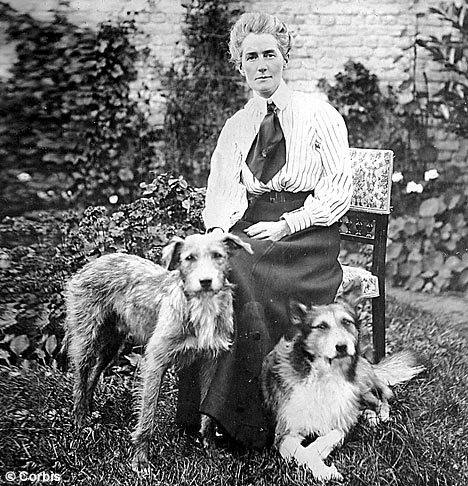
Edith_Cavell

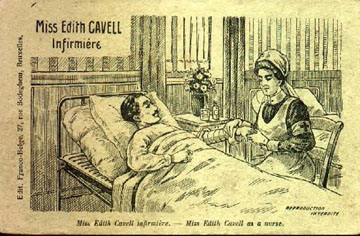
It’s not unheard of for nurses to serve in extraordinary ways, but Edith Cavell went far beyond her nursing duties during World War I. The British nurse and patriot was executed for treason during World War I. Both the British and American governments would propagandize her death to bolster support for the Allied cause.

Cavell was born on December 4, 1865. She trained at the London Hospital under Matron Eva Luckes and earned a reputation as a wonderfully capable nurse. In 1907, she was recruited by Dr. Antoine Depage to be matron of the newly established L’Ecole Belge d’Infirmieres Diplomees in Brussels. Cavell flourished there, and by 1910 she “felt that the profession of nursing [had] gained sufficient foothold in Belgium” to warrant a scholarly journal for the discipline. She launched L’infirmiere that same year.

An Accomplished Nurse with a Humanitarian Mission

By 1911, Cavell was the training nurse for three hospitals, 24 schools, and 13 kindergartens in Belgium. When World War I broke out, the Red Cross assumed control of Cavell’s hospitals. Cavell, famous for saying “Patriotism is not enough,” threw herself into her work, saving the lives of countless soldiers on both sides of the war.

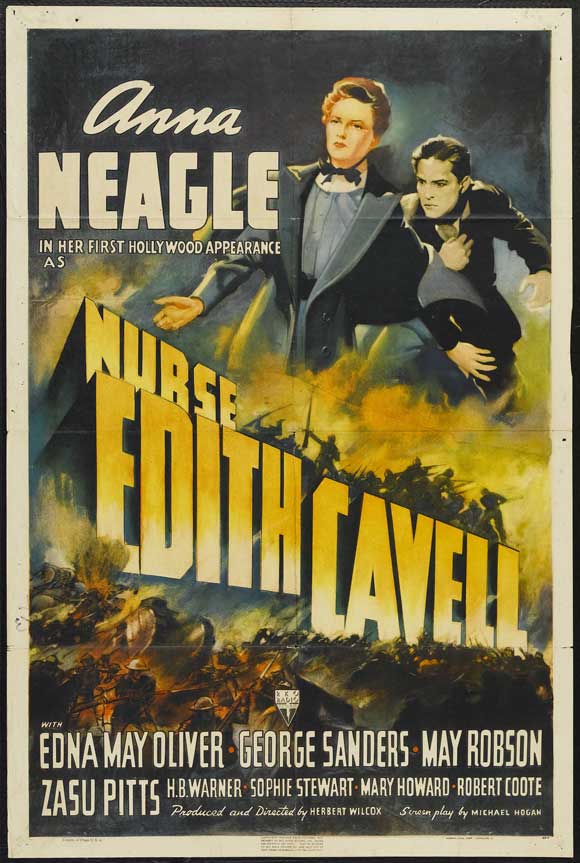
Edith-Cavell-Movie-Poster

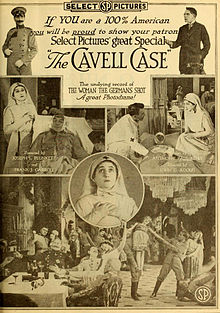
The-Cavell-Case

Cavell’s story was adapted for the silver screen, first as propaganda in 1919, and again in 1939 when it revived anti-German sentiments. 

Cavell was one of many nurses recruited by the British Secret Intelligence Service (SIS) to gather intelligence on the Germans. But in November 1914, she put these duties aside to begin funneling British and French soldiers out of Belgium and into neutral Holland. Cavell tirelessly dedicated herself to these efforts, eventually raising suspicion. On August 3, 1915, Cavell was arrested by the Germans.

Although Cavell had indeed committed espionage, the Germans chose to try her for treason. Cavell was incredibly outspoken after her arrest, making no attempt to defend herself. She openly admitted her actions in three separate written statements and multiple verbal interrogations. Unfortunately for Cavell, under the auspices of the first Geneva Convention, the death penalty was a permissible punishment for treason.

Edith-Cavell-NursingThe British claimed that their hands were tied in the matter. The US government did put some pressure on Germany, reminding German officials that the country’s public reputation was already quite tarnished. Only one German intervened on Cavell’s behalf: Baron von der Lancken argued that Cavell should be treated with moderation because she had saved so many German lives. But General von Saubozweig insisted that Cavell be executed swiftly. Of the five people arrested in the case, only Cavell and one other were actually executed; the rest were later released.

Fuel for Allied Propaganda

There are numerous accounts of nursing from World War I, such as Grace MacDougal’s Nursing Adventures: A FANY in France (1917) and Violetta Thurston’s Field Hospital and Flying Column: Being the Journal of an English Nursing Sister in Belgium and Russia (1915). But Edith Cavell would leave a different kind of legacy.

Edith-Cavell-Propaganda

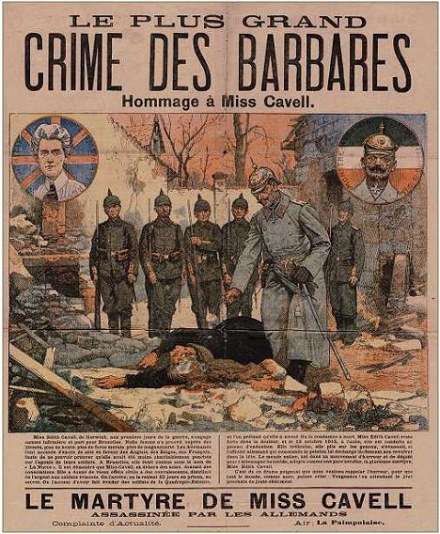
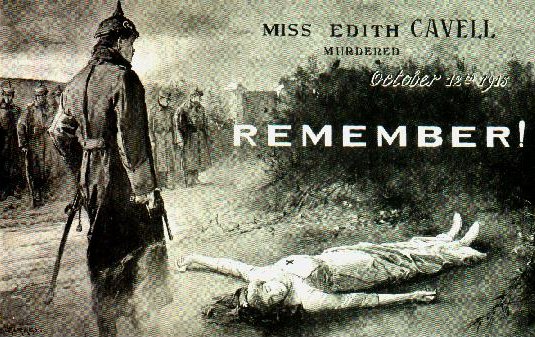
 Rather than leaving an account of her own experiences, Cavell would unwittingly leave her mark on British and American propaganda during World War I. She became the most famous British female Edith_Cavell_Crime_Des_Barbarescasualty of the war. The British government used her story to bolster military recruitment, while the US adopted Cavell to garner favorable sentiment toward the Allied effort–and to demonize the Germans.

Cavell-Propaganda-StampSoon after her death, news reports of questionable veracity emerged. Even the American Journal of Nursing printed a spurious account of Cavell’s execution, in which Cavell had refused to wear a blindfold, fainted in the face of the firing squad, and been shot point blank by a German commanding officer. Eyewitnesses later indicated that this version was false.

Cavell is one of many figures in the history of nursing who have left an indelible mark on the world. She not only made strides as a figure in modern nursing, but also set herself apart as a remarkable humanitarian.

Share

Why Did Charles Dickens Write Ghost Stories for Christmas?

scrooge


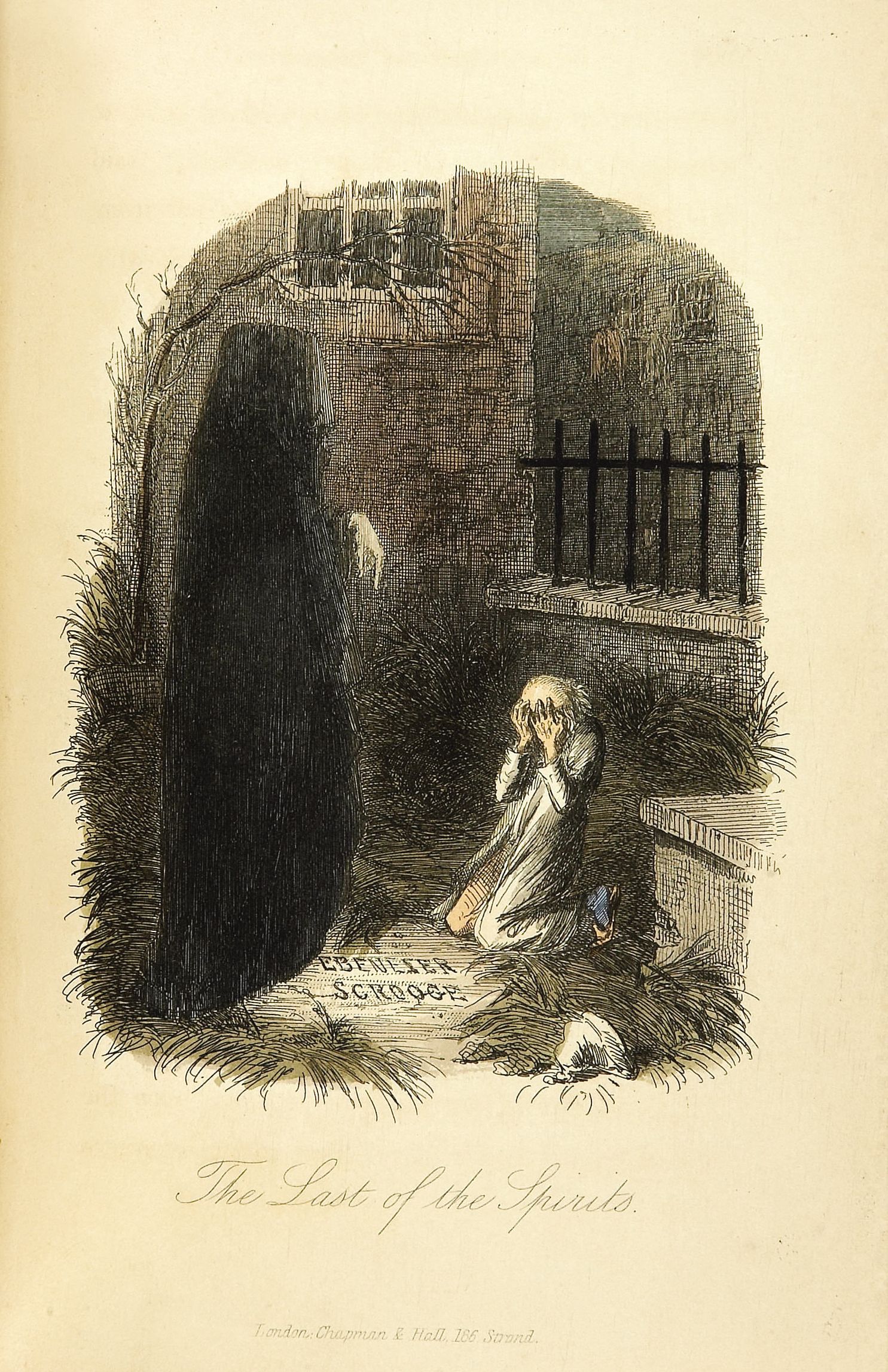
Charles Dickens’ A Christmas Carol has become a beloved part of the literary canon–and for many an indispensable part of the holiday season. The story embodies the goodwill associated with the Christmas season–and it has the Victorians’ favorite elements of a good Christmas story: ghosts. Dickens wrote other Christmas tales that also incorporated phantoms and ghosts, as did his Victorian cohorts. But why this obsession with ghosts at Christmastime?

An All But Dead Holiday–With Pagan Roots

By Dickens’ time, Christmas was not much of a holiday. In fact, for most people it was still a work day. The Industrial Revolution meant fewer days off for everyone, and Christmas was considered so unimportant that no one complained. This was thanks to none other than Oliver Cromwell, the Lord and Protector of England in mid seventeenth-century England. Cromwell had toiled to eradicate Christmas altogether because the holiday had no scriptural basis; the Bible mentions no “holy day” other than the Sabbath and certainly doesn’t exhort Christians to celebrate Jesus’ birth on December 25.

Christmas_Forbidden_Cromwell

Furthermore, Cromwell knew that the date of December 25 was shrewdly chosen by early Christian officials who wanted to replace pagan rituals with Christian ones. The day was selected because of its association with two pagan holidays, Yule and Sol Invictus (the birthday of the Unconquered Sun). Both were celebrated in conjunction with the winter solstice, the longest night of the year. On this night, the boundaries between the physical and spiritual worlds were considered particularly permeable. It was believed that spirits would return to Earth to finish unsettled business–exactly what Jacob Marley does in A Christmas Carol.

Spinning a Winter’s Tale

While there’s scant proof that the Christmas ghost tale existed as a consciously undertaken tradition before the Victorian era, there is etymological evidence that the tradition stretches back at least to Shakespeare’s time. In “A Christmas Tree” (1859), Dickens writes, “There is probably a smell of roasted chestnuts and other good comfortable things over time, for we are telling Winter Stories–Ghost Stories, or more shame for us–round the Christmas fire.” That phrase “winter stories” and its variant “winter’s tale” had mostly fallen into disuse by Dickens’ day, but it refers to a fantastical yarn that one would weave to entertain interlocutors around a wintertime fire.

An even more specific connotation for “winter story” or its relative “winter’s tale” notably shows up in Christopher Marlowe’s The Jews of Malta (1589) with a very specific definition: a “winter’s tale” is a ghost story.

Now I remember those old women’s words

Who in my wealth would tell me winter’s tales

And speak of spirits and ghosts that glide by night

Shortly thereafter Shakespeare would play on this meaning with A Winter’s Tale (1623), in which Prince Maximillius says, “A sad tale’s best for winter; I have one/Of sprites and goblins.” Later in Saducismus Triumphatis, Joseph Glanville’s treatise on witchcraft published posthumously in 1681, Glanville admonishes individuals who dismiss the existence of witchcraft as “meer Winter Tales or Old Wives fables.”

Robert Louis Stevenson would later evoke the winter’s tale with The Master of Ballantrae: A Winter’s Tale (1889). Though the story contains no ghosts of the usual sort, the Master cheats death multiple times. He essentially haunts his brother, Henry, who eventually exclaims, “nothing can kill that man. He is not mortal. He is bound upon my back to all eternity–to all eternity!” Later, after the Master’s body has been buried, Henry still does not believe the Master has perished. Henry is incredulous: “He’s not of this world, neither him nor that black de’il that serves him.”

A Victorian Predisposition for the Ghostly

The Victorian Age was one in which spiritual beliefs were constantly being upended by scientific discoveries. It’s no wonder that Victorians turned to spiritualism and other superstitions to distract from that state of uncertainty, or that seances, table rapping, and other fads took hold. Another of these was telling ghost stories, and Dickens was far from the only author to participate. Sir Arthur Conan Doyle was noted for his rather eccentric spiritualism. Edith Nesbitt, Elizabeth Gaskell, and Rudyard Kipling all wrote ghost stories that often get overshadowed by their more famous works. And Henry James uses Christmas ghost storytelling as a frame for Turn of the Screw. Most importantly, Washington Irving had actually presaged Dickens’ A Christmas Carol and The Pickwick Papers’ Gabriel Grub character (a character visited by goblins in Mr. Warble’s Christmas tale) with his own depictions of the Christmas holiday, a relationship that we’ll explore in an upcoming post.

The tradition of telling ghost stories at Christmas stuck. Slightly later, Eton Provost and author Montague Rhodes James would entertain his students with ghostly tales around the Christmas fire. HP Lovecraft’s “The Festival” was written for Christmas. And twentieth-century Canadian author Robertson Davies would spin ghost tales for Massey College students every Christmas season. Though not widely practiced, the winter’s tale lives on as a Christmas tradition.
This month, in anticipation of the Christmas season, we offer select acquisitions of Dickensian Christmas literature. We invite you to peruse the list, which includes 60 items. Should you have a question about any item, please don’t hesitate to contact us!

Share