Author Archives: tavistock_books

Unique? A List for June
Unique.

A compelling word, and one that certainly can, and should, stand on its own, though frequently we find unnecessary modifiers employed to make the unique even more so, if such is at all possible…  more unique, highly unique, uniquely unique….  you get the drift.

So with this in mind then, and without modifying hyperbole, we issue this list for June, wherein each of the 60 items displays an aspect of uniqueness… whether by definition, inscription or perhaps being the only copy on the market.  As is our practice, the list is eclectic in nature-  from air to water, original art to original mss, from Nevada to Massachusetts.  Temporally, the items reach back to the 1770s, and continue on until the mid-20th C.  Prices range from $75 to $7500.

Winning Independence: An Illustrated Address Describing the “Parlor Profession”

Bryant_Winning_ProfessionNiles Bryant, the President & Founder of the Niles Bryant School of Piano Tuning, and enjoys some recognition in the music world for his 1906 publication, Tuning, Care and Repair of Reed and Pipe Organs, which was reissued in 1968 by Vestal Press. “Through the profession of piano tuning, I offer you indestructible resources, good fortune and permanent independence.” So Bryant opens this publication, which is a promotional piece for the profession of piano tuning, and even more specifically, the advantages of attending his school to learn the profession, as well as to puff his invention, “The Tune-a-Phone”. This publication is tot located on OCLC, nor found in the NUC. Details>>

Mr. Thackeray, Mr. Yates, and the Garrick Club Affair

Yates_Thackeray_Garrick_Club_AffairThe notorious quarrel between two of England’s most popular authors began with Yates’ critical review, in Town Talk, of Thackeray’s English Humourists of the Eighteenth Century. Thackeray, as might be expected, was a bit affronted at what he viewed as a slanderous insult by this fellow member of the Garrick Club; believing much of Yates’ information came from club meetings, he took his grievance to the club committee. The committee sided with Thackeray and instructed Yates to apologize. Yates refused and was forcibly barred from club premises, subsequently bringing charges against the club Secretary.

Charles Dickens, absent from London as this brouhaha was brewing, returned to find all in full force. He offered to mediate, though primarily siding with Yates, which Thackeray viewed as treachery. The ill feelings between the two did not abate for years, until shortly before Thackeray’s death in 1863. (More about the Garrick Club Affair>>)

Herein Yates recounts the history and evidence of the disagreement, with, not unexpectedly, a bias to his own case. This copy was presented to Edward Bradley, presumed to be the Victorian novelist, who wrote under the pen name Cuthbert M. Bede. Known in Wise facsimiles (cf Todd 425c), the first edition, as here, has been just twice at auction in the last 30+ years, the last being 1977. It’s a rare piece of Dickensiana; this is the first time we’ve ever been able to offer the item. Details>>

Willow Park Water Cure, and Hygienic Institute

On March 1, 1853, John Henry Hero established the Willow Park Water Cure, with himself as proprietor and attending physician, for the treatment of chronic diseases through the “water cure.” Treatments of Swedish movements, light gymnastics, Turkish baths, and inhalations were also employed, to considerable success–though this success did not come without a personal price; as Hero writes in this circular “Friends, it is no small matter, to be thirteen years, day and night, surrounded by sick, nervous, irritable people, demanding our care and sympathies.” Hero seeks a change, and it is to this latter Hero addresses himself in this circular’s holograph letter: “I intend to convert / my Institution into a School / for young Ladies.” Later in the year, Dr. Hero did found the Willow Park Seminary for young women “where the Physical as well as the Intellectual facilities [were] faithfully and equally attended to.” OCLC does not record this particular broadside, though two others are found, each in one copy only. Details>>

Hero_Willow_Park_Water_Cure

BF Keith’s Grand Educational Demonstration

BF_Keith_Grand_Educational_DemonstrationClaude Grahame-White was the Glamour Boy of early aviation, somewhat of a playboy, with no engineering background whatsoever, Grahame-White became enamored of flying when, in 1908, he saw the Wright’s demonstrate their invention to the French crowds at Camp d’Auvours. Within a relatively short time, self-taught, Grahame-White soloed without a formal lesson. He quickly made a name for himself as a dashing aviator. In 1910, JV Martin of the Harvard Aeronautical Society, invited him to compete in the first Boston-Harvard Meet. With the promise of a $50,000 retainer & expenses, Grahame-White accepted. Grahame-White won that one, and others, as he thrilled spectators with his races & aerial exhibitions such as that announced in this “One-man Show” program.

This rare survivor lists the diverse aerial stunts to be performed by Grahame-White during the day… “With the Bleriot Monoplane” includes a dive from 4000 feet “with engine stopped.” “With the Farman Biplane,” the twelve planned events include “Aerial switchback flying”; “The corkscrew glide [spin?] from a high altitude”; and  “Knocking down ninepins placed on the ground, without alighting.” With this sort of exhibition, and his dashing and flamboyant personality, the handsome Grahame-White gave the new aviation field, previously dominated by engineers, something that had been lacking to date: a ‘sexy’ nature. Details>>

Salesman’s Album with Sixty Photographic Images of Indian Motorcycles

This a presumed company-issued production, no doubt targeted for those who already owned an Indian Motorcycle franchise, or generated for traveling company reps, allowing prospective buyers, such as police departments, to view the entire product line. We find no bibliographical record of another such album being offered, and believe the album to have been produced in limited numbers. 

Salesmans_Album_Indian_Motorcycles

 In 1940, Indian sold nearly as many motorcycles as its major rival, Harley-Davidson. At the time, Indian represented the only true American-made heavyweight cruiser alternative to Harley-Davidson. Indian’s most popular models were the Scout, made from 1920 to 1946, and the Chief, made from 1922 to 1953. Unfortunately, the company went bankrupt in 1953. Today, the vintage cycle enjoys much popularity amongst enthusiasts, with models from the era displayed herein being offered for five-figure sums. A fascinating and well-preserved original photograph album, which visually documents the late ’30s and early ’40s Indian Motorcycle company, and its impressive product line, as existed during the company’s heyday. Details>>

Correspondence, Including LaGuardia’s Wedding Invitation

Correspondence_Fiorello_LaGuardiaFiorello LaGuardia, or “Little Flower,” is widely regarded as one of the best mayors in New York City history, whose tenure redefined the office. He was the 99th mayor of the “Big Apple”, serving his populace from 1934 to 1945. For those twelve years, the 5’2″, sometimes belligerent, chief executive dominated life in New York City as if he was 7″2′. Unlike many politicians today, he fulfilled many of his pledges, especially the ferreting out of corruption in the city’s government. Such earned him a reputation for placing the city’s interests ahead of political considerations, and in the same vein, although technically a Republican, he worked closely with the New Deal administration of President Franklin Roosevelt to secure funding for large public works projects. These federal subsidies enabled New York City to create a transportation network the envy of the world, and to build parks, low-income housing, bridges, schools, & hospitals. Furthermore, he achieved the unification of the city’s rapid transit system, a goal that had long eluded his predecessors, and he reformed the structure of city government by pushing for a new City Charter. LaGuardia presided over construction of New York City’s first municipal airport on Flushing Bay, later to become his namesake. As a result of all his efforts, LaGuardia’s psychological effect on New York City was nothing short of profound, restoring faith in city government by demanding excellence from civil servants. Details>>

The Life of The Right Honourable Arimanes, Typhon, Thammuz, Beelzebub, Ashmodaus, Sammael, Daemon, Lucifer the Great, of the Dark Infernal Empire Count of Sheol and Gehenna, Baron of Hades &c., &c., &c

Life-Right_Honourable_Beezlebub_LuciferThis eighteenth-century codex is an entirely holograph history of Lucifer, wherein the anonymous author tells us in his Preface, “Lucifer … is a spiritual being. That is true; but far from being considered here in that light, he is represented plainly terrestrial. He is not the Lucifer as Vondel, Milton and Klopstock described him, but exactly as he is shown in magick lanthorns for the amusement of the spectators. … My Lucifer is of Ethereal breed and Ether is and remains material. …. mine is of a persian and chaldean race.”

Though the volume bears no date, it bears the Pro Patria “Maid of Dort” watermark, circa 1760’s. Affixed under the holograph title is an extracted woodcut image [ca 1550, cf. Sebastian MŸnster’s “Cosmographia” (1544)] of the ‘God Deumo (Demus or Deumus) of Calicut.’ The volume has a full vellum binding and yapp edges. Details>>


Thanks for reading! Love our blog? Subscribe via email (right sidebar) or sign up for our newsletter--you’ll never miss a post.

Share

Why California Isn’t Called “Nova Albion”

On June 17, 1579, Francis Drake claimed California for England. He anchored his ship, the Golden Hind, just north of present-day San Francisco and named the new territory “Nova Albion.” But despite Drake’s claim in the name of Queen Elizabeth I, he was not the first European to explore California.

Drake Lays Claim to California

Drake set out from England on December 13, 1577 with five ships. His mission was to raid Spanish holdings along the Pacific coast in the New World. Drake was forced to abandon two ships during the Atlantic crossing. Then the expedition encountered a series of storms in the Strait of Magellan. One ship was destroyed, and the other returned to England. Only the Golden Hind reached the Pacific. Drake raided Spanish settlements and captured a heavy-laden Spanish treasure ship.

Drake continued up the West Coast of North America in search of the fabled Northwest passage. He got as far north as present-day Washington, stopping near the San Francisco Bay in June 1579. In July, Drake’s expedition set off across the Pacific, eventually rounding the Cape of Good Hope and returning to England. Drake returned to Plymouth, England on September 26, 1580. Queen Elizabeth I knighted him the following year on a visit to his ship.

A Portuguese Explorer for the Spanish Crown

California gets its name from a mythical island populated by Amazon women who use golden tools and weapons. It appeared in a popular romance novel called Las Sergas de Esplandian by Garci Rodriguez de Montalvo. The book went through several editions, though the earliest extant copy dates from 1510. When Spanish settlers explored what’s now Baja California, they believed that they’d discovered the mythical island.

It was Portuguese adventurer Joao Rodruigues Cabrilho, better known as Jose Rodriguez Cabrillo, who disabused the Spaniards of the notion that California was an island. Little is known of Cabrillo’s life before 1519, when his name first appears in the ranks of those serving conquistador Hernan Cortes. Cabrillo participated in the conquests of both Mexico and Guatemala. He was also involved in military expeditions to southern Mexico, Guatemala, and San Salvador.

Cabrillo eventually settled in Guatemala and by 1530 had established himself as a leader of Santiago, Guatemala. He returned to Spain briefly to find a wife, marrying Beatriz Sanchez de Ortega. The couple would have two sons. Then in 1540, a major earthquake destroyed Santiago. Cabrillo’s report to Spain on the devastation is considered the first piece of secular journalism published in the New World.

Soon Spain was looking to expand northward. Francisco de Ulloa had recently explored the Gulf of California and proven that California was not an island after all (though the misconception persisted back in Spain). Now, Guatemala governor Pedro de Alvarado commissioned Cabrillo to lead a mission up the coast. He believed that Cabrillo and his men would find the fabled wealthy cities of Cibola, which were thought to be somewhere along the Pacific coast north of New Spain. The explorers also held out hope of discovering the “Straits of Arain,” rumored to connect the North Pacific and the North Atlantic.

Cabrillo Travels up the California Coast

On June 24, 1542, Cabrillo sailed out of the port of Navidad (modern-day Manzanillo). He took with him a crew of soldiers and sailors, along with merchants, a priest, slaves, livestock, and enough provisions to last two years. By September 28, 1542, Cabrillo had reached a “very good enclosed port,” now known as San Diego Bay. He and his crew stayed there for several days before heading up the coast. They visited a number of islands before turning around due to adverse weather conditions.

Taylor_First_Voyage_California_CabrilloCabrillo died of complications from a broken leg on January 3, 1543. His exploration helped to dispel geographical misconceptions and to expand the Spanish empire. Over three centuries later, Alex S Taylor, a resident of Monterey, California, wrote the history of Cabrillo’s expedition. First published separately in 1853, The First Voyage to the Coasts of California is considered an important work, indeed; it was the first work of California history actually published within California.

Other Works of Californiana

The Pony Express Courier 
Pony_Express_CourierIn 1860, countless men responded to advertisements for riders in the new Pony Express. At any one time, only about eighty men would actually be riders, though another 400 employees supported the operation. The Pony Express was a truly ambitious project, connecting the East coast with California. Mark Twain was lucky enough to witness the Pony Express in action, observing that the rider was “usually a little bit of a man.” The Pony Express Courier, published in Placerville, first appeared in 1934. It’s a wonderful resource for students of Western America, full of interviews, reminiscences, and more. This set includes 16 of 18 total issues, bound in eight books. They are custom bound in blue “marbled” cloth with gilt stamped lettering to the spine and front board. Details>>

Wi-Ne-Ma (The Woman Chief) and Her People
Meacham_Wi_Ne_Ma_PeopleAlso known as the Lava Beds War, the Modoc War began in 1872, making it the last of the Indian Wars to occur in California and Oregon. Wi-Ne-Man acted as interpreted for the peace commission during the conflict. Her efforts saved the life of Alfred Benjamin Meachum, Indian Superintendent of Oregon, Meachum would go on to write an account of the chieftainess called Wi-Ne-Man (The Woman Chief) and Her People. The first edition was published in 1876. APBC shows this title at auction last in 1997, with only one prior occurrence in 1991. Details>>

Documents in Relation to Charges Preferred by Stephen J Field and Others…
Field_Turner_Documents_Charges_PreferredThe Field-Turner feud is renowned in the annals of California history. Judge William R Turner had Field, an attorney, disbarred; Field ultimately got his revenge by, on election to the California Assembly, arranging Turner’s banishment, via judicial reorganization, to a remote “region in the northern part of the state.” [DAB]. This second edition includes testimonial and affidavits in Judge Turner’s defense from a host of local officials as well as a few national notables, including Andrew Jackson & Henry Clay. Furthermore, this copy contains rare associated ephemera: a handbill reprinting a contemporaneous review of the book entitled, “Judge Turner’s Book,” as published in the San Francisco Herald of Dec. 30, 1856; as well as a legal circular containing a statement by Judge Turner relating to his candidacy for re-election to the office of District Judge for the 8th District, dated Arcata, July 14, 1863. Additionally, contained within the circular are reprinted two letters with respect to Turner’s case before the Supreme Court, the latter advising Judge Turner “of the favorable and final decision of the Supreme Court in your case.” Details>>

All About California and the Inducements to Settle There
All_About_CaliforniaAttributed to JS Hittel, All About California includes the drop title “For Gratuitous Circulation.” The propaganda piece was designed to encourage settlement in California, and it’s full of pertinent data and factoids of the era. This, the second edition, was issued in 1870 just like the first. It includes a folding map of the railroad route for the “Chicago, Rock Island, and Pacific RR Line,” along with a two-page map of California, a full-page wood engraving of the Grand Hotel, and a two-page map of “JT Little’s San Joaquin Valley.” This copy bears the stamp of the California Immigrant Union in the upper right corner of the front wrapper. There’s a small bit of bio-predation on the top pages of the last eight pages, but no text is affected. Details>>

An Historical Sketch of Los Angeles County, California
Historical_Sketch_Los_Angeles_CountyThis account of California history stretches from the Spanish Occupancy, by the founding of the Mission San Gabriel Archangel, September 8, 1771, to July 4, 1876. This copy is a first edition, second issue, published in 1876. The volume is in its original printed paper wrappers. The wrapper edges chipped, with the upper corner lacking from front wrapper. A Japanese paper repair has been made to the spine. There’s occasional pencil marginalia. Overall, this is an about very good copy. Details>>


Related Posts:
The California Gold Rush, Slavery, and the Civil War
L Frank Baum’s Forgotten Foray into Theatre
Elias Samuel Cooper: Renowned and Controversial Surgeon

Thanks for reading! Love our blog? Subscribe via email (right sidebar) or sign up for our newsletter--you’ll never miss a post.

Share

Charles Dickens’ Fraught Relationship with Harriet Beecher Stowe

Harriet_Beecher_Stowe

One hundred years after Harriet Beecher Stowe’s Uncle Tom’s Cabin was published, Langston Hughes called the novel “the most cussed and discussed book of its time.” Hughes’ failure to comment on the literary merits of Uncle Tom’s Cabin hints at the persistent disagreement among writers, critics, and the reading public about the novel’s actual quality. Stowe’s contemporaries who found the book overly sentimental, extreme, or otherwise objectionable could not avoid discussing the book–on either side of the Atlantic. That included Charles Dickens, who initially endorsed Uncle Tom’s Cabin but came to resent the less than complimentary comparisons made between his own views and works and Stowe’s.

A Fortuitously Timed Publication

It seemed that Stowe had chosen precisely the right moment to publish an anti-slavery novel. The Fugitive Slave Act had passed in 1850, and the divisive legislation directly affected the Stowe household. Stowe had thought that one of her servants was a freed slave, but the girl had actually run away from a Kentucky plantation. When Stowe learned that the girl’s former owner was looking for her, Stowe immediately set out to find a safe hiding place for the girl. The episode would be one of many that inspired Stowe to undertake an abolitionist novel (though she would later claim that God himself was guiding her pen).

Stowe_Uncle_Toms_CabinSuch events happened all over the country, and the nation was ripe for just such a work as Uncle Tom’s Cabin. On May 8, 1851, the first installment of appeared in Washington DC’s National Era, which was owned by abolitionist Gamaliel Bailey. The piece was immediately popular; sales and readership of the National Era jumped from 17,000 to 28,000 while the story ran. Before the last installment had even appeared, Stowe already had an offer from John J Jewett & Co. to publish Uncle Tom’s Cabin in a single volume.

That edition was published on March 20, 1852. Over 100,000 copies had sold by the end of the summer, and over 300,000 copies had sold by March 1853. Dramatic versions of the novel appeared within months, and George L Aiken’s stage production remained among the most popular plays in England and America for the next 75 years.

Not everyone was quite so enthusiastic. Southerner William Gilmore Simms considered the novel both libelous and poorly researched. Reverend Joel Parker threatened to sue Stowe for her “dastardly attack” on his character. And Uncle Tom’s Cabin has been banned in the South at numerous points in history. The negative publicity induced Stowe to write The Key to Uncle Tom’s Cabin (1853) to defend herself. Either way, all the attention only served to increase Stowe’s fame.

An American Novel Goes Abroad

To expand her readership, Stowe sent presentation copies to a number of illustrious personages, from Prince Albert to the Reverend Charles Kingsley. Among the recipients was Charles Dickens, who received a little lavender-bound volume with a letter from Stowe. The American novelist evoked their shared mission, stating that “The Author of the following sketches offers them to your notice as the first writer in our day who turned the attention of the high to the joys and sorrows of the lowly.”

Dickens responded with guarded praise, complimenting Stowe’s noble cause. He was less restrained in expressing his opinion of the book later that year. Dickens reportedly told Sara Jane Clarke, a young American visiting Tavistock House, “Mrs. Stowe hardly gives the Anglo-Saxon fair play. I liked what I saw of the colored people in the States. I found them singularly polite and amiable, and in some instances decidedly clever; but then I have no prejudice against white people.” Clarke wrote, “Uncle Tom evidently struck him as an impossible piece of ebony perfection…and other African characters in the book as too highly seasoned with the virtues.” She noted that Dickens argued Uncle Tom’s Cabin was “scarcely a work of art.”

Stowe Proves Impossible to Ignore

Collier_Elizas_Flight_Sheet_Music

This piece of music published the same year as the novel – most likely due to the intense popularity Stowe’s work enjoyed right from the beginning. OCLC records nine institutional holdings.

By mid-1852, Uncle Tom’s Cabin was selling quickly in both America and England. Dickens simply couldn’t avoid talking and writing about the novel because it was simply what everyone wanted to discuss and read about. Thus he and Henry Morley wrote an article for the September 18, 1852 issue of Household Words called “North American Slavery.” The article opened with a critique of Uncle Tom’s Cabin. Dickens called the novel a “noble work,” before pointing out its “overstraining conclusions and violent extremes.” But then Dickens turned his pen to the author: “Harriet Beecher Stowe is an honor to the time that has produced her, and will take her place among the best writers of fiction.”

Before the article ran, however, Dickens was dragged into a most unpleasant controversy. On September 13, 1852, Lord Denmon, the former Lord Chief Justice of England and a friend of Dickens, launched a rather vicious attack against Dickens. He published an article in the London Standard critiquing both Uncle Tom’s Cabin and the first seven numbers of Bleak House. A staunch abolitionist, Denmon castigated Dickens for obstructing the abolitionist cause. He brought up the character of Mrs. Jellyby, “a disgusting picture of a woman who pretends zeal for the happiness of Africa…if it means to represent a class, we believe that no representation was ever more false.”

Denmon went on to publish five more columns in the Standard, which were subsequently republished for circulation in pamphlet form. In the third, Denmon satirized Dickens’ initial praise of Stowe, saying “Mrs. Stowe might have learned a more judicious mode of treating a subject from the pictures of Mrs. Dombey and Carker, of Lady Dedlock and Joe [sic]. Uncle Tom ought not to have come to his death by flogging. A railway collision, such as disposed conveniently of Mr. Carker, would have been much more artistic.” By the fifth piece, Denmon finally abandons Dickens to heap praises on Stowe’s “graphic skill and pathetic power in which she has so far surpassed all living writers.”

Dickens Tries to Quash the Controversy

Dickens didn’t publicly respond to Denmon right away. He probably would have preferred to avoid all discourse on Stowe and Uncle Tom’s Cabin altogether, but that was impossible. Indeed, he gets drawn into talking about the novel in his correspondence on more than one occasion, most notably with the Duke of Devonshire (October 29, 1852) and three weeks later with Mrs. Watson.

Soran_Aunt_Harriet_Becha_Stowe_Nightingale

“Aunt Harriet Becha (sic) Stowe” was written for Kunkel’s Nightingale Opera Troupe. OCLC records five institutional holdings.

Mrs. Cropper, Denmon’s daughter, wrote Dickens a letter of apology toward the end of 1852. She said that her father had suffered a severe paralytic stroke on December 2, 1852 and was not himself. Indeed, he had been forced to resign his post as Lord Chief Justice because of similar strokes. Dickens’ response indicates his growing resentment toward Stowe, who was now receiving praise at Dickens’ expense from a host of critics. Dickens argued that the best means to further the cause of abolition was not exaggerated emotional appeals and painting slave owners in the worst possible light, but rather reason and rational argument.

Dickens also felt that Stowe’s novel was being used as an “angry weapon” against him. He observed that the “exactly four words of objection to Uncle Tom’s Cabin (amidst the most ardent praise of it)” had resulted in unjust attacks on him. Cropper had her brother George draft a response to Dickens, but Dickens replied on January 21, 1853 with an aim of ending the matter completely. He sent back Cropper’s letter unopened.

An Unexpected Encounter

Unfortunately for Dickens, he couldn’t end his exposure to Stowe quite so easily. Now famous on both continents, Stowe embarked on a tour of the United Kingdom, and Dickens was to meet her. Her travel schedule proved unpredictable, so Dickens had virtually no time to prepare. Stowe and her husband arrived in London on May 2, 1853, which happened to be the day that the Lord Mayor was hosting a large banquet. Eager to show Stowe the proper hospitality, the Mayor immediately extended an invitation. He seated the Stowes directly across from Dickens and his wife, Catherine.

Unaware that Dickens harbored a grudge, Stowe was thrilled to be in Dickens’ company. She was impressed with him and his wife, noting later that they were “people that one couldn’t know a little of without desiring to know more.” Once the crowd had had several rounds of alcohol, Thomas Noon Talfourd proposed a toast to the literature of England and America. He noted how both Dickens and Stowe “employed fiction as a means of awakening the attention of their respective countries to the condition of the oppressed and suffering classes.” Then Talfourd made a toast to Dickens. Dickens stood and offered kind words to Stowe. Thus the evening appeared to go pleasantly enough. A few days later, Dickens took Catherine to call on Stowe and her husband at Walworth. Stowe returned the visit, only to find that Dickens was ill and Catherine was busy ministering to him.

In 1854, Stowe published Sunny Memories of Foreign Lands, recounting her visit to England. She specifically mentioned her meeting with Catherine Dickens, calling her a “good specimen of a truly English woman: tall, large, and well-developed, with fine, healthy color, and an air of frankness, cheerfulness, and reliability.” Perhaps Stowe was already predisposed to like Catherine. After all, she had championed an anti-slavery appeal, helping to collect about 500,000 signatures. The document, titled “An Affectionate and Christian Address from Many Thousands of Women of Great Britain and Ireland to Their Sisters, the Women of the United States of America.” The document was bound in 26 huge volumes and sent to Stowe.

By this time, however, Dickens had a very different view of his wife’s character. Thus Stowe’s lavish praise rankled him. He was sure to mention to others that Stowe had called Catherine “large.” Dickens also found Sunny Memories quite trite and dubbed the book “Moony Memories.” He wrote to a friend, “the Moony Memories are very silly I am afraid. Some of the people remembered most moonily are terrible humbugs–mortal, deadly incarnations of Cant and Quackery.”

Stowe Returns for a British Copyright

Stowe made a second visit to England in 1856, but she would not again encounter Dickens. This time, she met Robert Browning and Elizabeth Barrett Browning, along with Lord Byron and his wife Anne Isabella Milbanke, Lady Byron. The visit came on the heels of Dred: A Tale of the Great Dismal Swamp, another anti-slavery novel that was successful but not wildly popular like Uncle Tom’s Cabin.

During this second trip to England, Stowe and Dickens may have found common ground: Stowe’s primary purpose was to get a British copyright on her new book. She hadn’t held one for Uncle Tom’s Cabin, losing untold profit on all the copies sold abroad. Dickens, a long-time proponent of international copyright law, might have empathized with Stowe, given that he’d lost major sums thanks to pirated editions of his books in America.

A New Offense

For the next several years, there’s no evidence that Dickens discussed Stowe or Uncle Tom’s Cabin either in print or in correspondence. That changed in September 1869. That year, James T Fields, Dickens’ friend and American publisher, decided to run Stowe’s The True Story of Lady Byron’s Life in Atlantic Monthly. The piece delved into the Byrons’ private lives, unabashedly addressing the incestuous relationship between Lord Byron and his half-sister Augusta Leigh. Stowe intended to vindicate Lady Byron by exposing her husband’s depravity.

Dickens found such a work unconscionable. He’d always been vehemently opposed to prying into the lives of private figures; Dickens even called James Boswell an “unconscious coxcomb” for having written his biography of Samuel Johnson. Dickens was even sensitive once his own marriage fell apart and he started an affair with Ellen Ternan. Indeed, a simple indiscreet comment from William Makepeace Thackeray was among the first in a series of events that destroyed Thackeray and Dickens’ friendship. To protect his own privacy, Dickens even went to far as to make a bonfire at Gads Hill in September 1860, with the sole purpose of burning his own papers and correspondence.

Thus it should come as no surprise that on October 6, 1869 Dickens wrote to Fields, “Wish you had nothing to do with that Byron matter. Wish Mrs. Stowe was in the pillory.” And on October 18, 1869, he wrote to the actor Macready, “May you be as disgusted with Mrs. Stowe as I am.” He argued, “It seems to me that to knock Mrs. Beecher Stowe on the head, and confiscate everything about [the Byron affair] in a great international bonfire to be simultaneously lighted over the whole civilized earth, would be the only pleasant way of putting an end to the business.”

Yet Stowe’s brief foray into celebrity scandal would hardly remain a memorable part of her career. As she got older, she increasingly turned to more domestic subjects. None of her subsequent works would come close to reaching the popularity of Uncle Tom’s Cabin. Regardless of the book’s literary merits (or lack thereof), Uncle Tom’s Cabin has proven an incredibly powerful piece of literature. That’s evident in President Abraham Lincoln’s apocryphal greeting to Stowe, “So you’re the little woman who wrote the book that started the Great War!” Whether that’s true or not, the fact that it could be true aptly demonstrates the incredible impact of Uncle Tom’s Cabin.

Related Posts:
Charles Dickens the Copyright Confederate
How the “Dickens Controversy” Changed American Publishing
The California Gold Rush, Slavery, and the Civil War
Thanks for reading! Love our blog? Subscribe via email (right sidebar) or sign up for our newsletter--you’ll never miss a post.


Share

William Lambarde, Queen Elizabeth, and the Essex Rebellion

“I am Richard II. Know ye not that?”

So spoke Queen Elizabeth I to William Lambarde in August 1601–or so the story goes. The queen’s allusion to Shakespeare’s Richard II has long served as an illustration of the intense connection between arts and politics in Elizabethan England.

A Trusted Record Keeper

Lambarde_Perambulation_KentBorn in London, William Lambarde was a noted antiquarian, barrister, and politician who likely served in Parliament. Lord Chancellor Sir Thomas Egerton appointed Lambarde Keeper of the Rolls in 1597, and Queen Elizabeth appointed him Keeper of the Records of the Tower in 1601. By this time, Lambarde was already quite well known for his Perambulation of Kent. This volume, known as the first county history, was circulated in manuscript before it was printed in 1576. It was popular enough to go through several editions. Indeed, the last edition was published in 1656, some eighty years after its first appearance.

So how did the author of such a charming and innocuous work come to be at the center of political intrigue? Lambarde’s role as the Keeper of the Records of the Tower gave him unique access to records that spanned Elizabeth’s entire reign–and before. Early in August 1601, Lambarde presented Elizabeth with a book of “pandects,” the broad name for a compendium on virtually any subject. This book of pandects was a special compilation of records that Lambarde had prepared especially for Elizabeth.

Questions of Provenance and Authenticity

The ensuing dialogue between Lambarde and Queen Elizabeth I was recounted in a document titled “That which passed from the Excellent Majestie of Queen ELIZABETH, in her Privie Chamber at East Greenwich, 4 August, 1601, 43 reg. sui, towards William LAMBARDE.” Elizabeth supposedly told Lambarde, “I am Richard II. Know ye not that?” as she perused–and praised–Lambarde’s gift. The comment shows that Elizabeth knew that she, like Richard II, sat in a precarious position, in danger of losing her power at any moment.

At least, that was the conventional interpretation. But in recent years, scholars have questioned both the veracity of the document and the real implications of the statement. The document itself is first extant in 1780, where it’s included as an appendix to John Nichol’s biographical sketch of Lambarde in Bibliotheca Topographica Britannica. It was reprinted in 1788 in Progresses and Public Processions of Queen Elizabeth. Nichols added a note in a later edition that it was “communicated from the original, by Thomas Lambarde of Sevenoak, Esq.”

But the original author of the statement has been difficult to determine. The account drops to first person at the end, indicating that Lambarde may have written the account himself. He remained a competent and enthusiastic writer to the end of his life, and the manuscript could plausibly have passed down through multiple generations. Meanwhile, Queen Elizabeth was indeed on Greenwich on the date in question. Lambarde’s post as record keeper and independent interest in antiquities lend further support to the document’s authenticity. Thus it seems likely that the conversation happened as reported, even if we cannot readily identify the reporter.

Uncertain Succession

Elizabeth’s comment was certainly a pregnant one. She knew that her hold on the throne was loosening against her will. For years, there had been whispers about who would succeed her since she had no direct descendents. Many favored the succession of James VI of Scotland. Alternatives were Isabella of Spain, the sister of Spanish king Phillip III; and Arabella Stuart, the granddaughter of Margaret Tudor.

The majority of Elizabeth’s subjects were religiously moderate and would accept a monarch of either Catholic or Protestant persuasion, so long as tolerance was extended to observers of the other denomination. Elizabeth herself refused to discuss the matter and was careful not to show favor to any single heir. The entire situation invited intrigue upon intrigue, as various factions sought to assure the succession of their preferred candidates.

Essex Proves a Royal Disappointment

Robert_Devereux,_2nd_Earl_of_Essex_by_Marcus_Gheeraerts_the_Younger

Robert Devereux, 2nd Earl of Essex

One such schemer was Robert Devereux, Earl of Essex. Elizabeth thoroughly enjoyed Essex at court but never deigned to admit him to her confidence; she knew that Essex was not to be trusted. In 1598, the English sent a large force to Ireland to oppose Hugh O’Neill, Earl of Tyrone. Essex was put in charge of the effort and granted sweeping administrative power in Ireland.

However, Essex failed miserably, refusing to engage O’Neill and his men even under direct orders from the queen. When pushed harder, Essex struck an accord with O’Neill. Although the exact details of their agreement are unknown, scholars generally agree that they probably pledged their mutual support of James VI of Scotland.

The queen, none too pleased with this arrangement, reproached Essex–who responded by deserting his post, sailing for England, riding to Greenwich, and bursting in on the queen to beg her mercy. Queen Elizabeth was unconvinced. She banished Essex from her presence, and he was arrested later that day. Essex served a year of house arrest and emerged to discover that support for his cause had evaporated. All the while, his rival Robert Cecil had continued his own efforts to ingratiate himself to the queen.

A Failed Rebellion

Essex was sure that he’d still be able to garner support. His first move was to sponsor a performance of Shakespeare’s Richard II. He believed that the parallels would be quite clear: like Richard II, Queen Elizabeth had availed herself of malevolent advisors (ie, Cecil) and would invariably and imminently lose the throne. Such a move might seem ridiculously subtle by today’s standards, but the comparison would not have been lost on Essex’s contemporaries.

Essex then gathered about 300 followers and tried to persuade his replacement in Ireland, Lord Mountjoy, to bring his troops back to support Essex. Cecil already knew what Essex was planning, and Queen Elizabeth sent four advisors to Essex’s home. Essex locked them in his library and took to the streets, presuming that he’d be able to raise a supportive mob. He also hoped that the Sheriff of London, Sir Thomas Smyth, would support his cause.

Yet Smythe blew him off, and the mob failed to materialize. The Earl of Nottingham led a force of men to Essex house and forced Essex to surrender. He was tried and found guilty of treason alongside the Earl of Southampton (a patron of Shakespeare and the dedicatee of Venus and Adonis and The Rape of Lucrece). While Southampton was thrown into the Tower of London, Essex was sentenced to death. He hoped that Queen Elizabeth would intercede. She did not, and Essex was executed on February 25, 1601.

Seditious Shakespeare

The performance of Richard II was considered so treacherous that the Chamberlain’s Men also came under suspicion of sedition. On February 8, 1601, spokesman Augustine Philips testified, eager to distance the players from the performance. He emphasized that none of the players had wanted to perform such an outdated play, but that Essex had paid them 40 shillings above the usual fee. The players were exonerated and even performed for Elizabeth at Whitehall on the eve of Essex’s execution.

Some experts argue that the speed with which the investigate against the players was dropped shows how politically insignificant Shakespeare’s play really was. Others believe the play a sort of anthem for the Essex camp; it addresses issues of chivalry, pragmatism, and the divine right of monarchs. And it’s also possible that Essex didn’t intend treason at all, but that he was merely desperate to alert the queen of Cecil’s intentions. At any rate, the fact that Shakespeare’s imagined rebellion was implicated in a real one exemplifies the interplay between arts and literature in Elizabethan England.

Though William Lambarde was a trusted advisor to Queen Elizabeth I, his influence would not extend to the end of her reign. Lambarde passed away only a few months after his apocryphal exchange with Elizabeth. The episode elucidates Lambarde’s unique place in Elizabethan history, as much more than an author of a quaint county history.

Related Posts:
Happy Birthday, William Shakespeare! 
Meet Dr. Erin Blake, Curator of Art and Special Collections at the Folger! 

Thanks for reading! Love our blog? Subscribe via email (right sidebar) or sign up for our newsletter--you’ll never miss a post.

Share

Lydia Francis Child, Tenacious Abolitionist Author

Lydia_Maria_Child

Lydia Maria Francis Child established herself as a respected novelist before her rational approach to abolitionism cost her career. An influential thinker, Child managed to rebuild her reputation and became one of the most respected abolitionists of the time.

Child was born on February 11, 1802 in Medford, Massachusetts. Her father, David Convers Francis, was a successful businessman and sent her older brother, Convers, to Harvard. The same educational opportunity was not available to Child, but Convers supervised her education. When Child’s mother died in 1814, she was sent to live with her sister Mary Francis Preston in Norridgewock, Maine Territory. Child would stay there until 1820 and study at the local academy, which Convers supplemented with the works of Milton, Homer, and other classics.

In 1821, Child moved back to Massachusetts to live with Convers, who was by now a minister at the Unitarian church in Watertown. Just outside of Boston, Watertown was a veritable hotbed for progressive thought, and it was there that Child met such illustrious figures as John Greenleaf Whittier, Theodore Parker, and Ralph Waldo Emerson. Child also befriended Margaret Fuller.

By this time, Child had opened up her own girls’ school, but she still found time to write her first novel. Hobonok, a Tale of the Times (1824) was published when Child was only 22 years old. It recounted the story of Mary Conant, who is forbidden to marry her Episcopalian lover. Instead, she marries Hobonok, a member of the Pequod tribe and bears his child. While the literary community found the book scandalous, the novel became quite popular. Encouraged, Child published The Rebels; or, Boston Before the Revolution (1825), a novel about the events leading up to the Boston Tea Party. This book was popular among critics and readers alike.

In 1826, Child started Juvenile Miscellany, the first periodical in the United States that was solely devoted to children. She filled the journal with her own poems and stories, along with plenty of educational material. The venture proved more profitable than Child had anticipated, and it provided her a nice living for the next eight years.

Child met David Lee Child in 1828. He was a Harvard educated lawyer who practiced in Boston and had served in the state legislature. He also edited the Massachusetts Whig Journal. The couple soon married, and David introduced his wife to a new side of issues like Indian rights and abolition, including the radical ideas of William Lloyd Garrison.

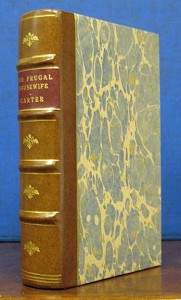
Despite David’s education and credentials, he proved a poor breadwinner. Child supported them both with her writing. In 1829, she published The Frugal Housewife. The manual included tips on saving money, preparing home remedies, and educating girls. The book proved a success, and Child followed up with The Mother’s Book and The Little Girl’s Own Book in 1831. These volumes earned Child international renown.

Child_Appeal_Favor_Class_AfricansIn 1833, Child made a decidedly bold move. She published An Appeal in Favor of That Class of Americans Called Africans. The abolitionist book represented a significant departure from abolitionist literature of the era: rather than making religious or scriptural arguments, Child appeals to reason and makes a political case for abolition. Child also went a step further than most abolitionists, presenting a case not just for eliminating slavery, but also for ending discrimination against freed African Americans. Child advocated immediate emancipation–without compensating slave owners for their “lost property” and spoke out against the colonization of Africa. The book is considered a tour-de-force in abolitionist literature, and it influenced leaders like Wendell Phillips, William Ellery Channing, and Charles Sumner.

Child faced immediate repercussions for her Appeal. The Boston Athenaeum revoked her free reading privileges. Book sales plummeted. People rushed to cancel their subscriptions to Juvenile Miscellany, and Child was forced to shut it down. Meanwhile her husband had opted to raise sugar beets instead of slave-produced sugar cane, which was a complete failure. Their savings slowly dwindled.

In 1841, Child accepted editorship of the National Anti-Slavery Standard, the New York newspaper of the American Anti-Slavery Society. But she couldn’t agree with the use of violence and other extreme measures to further the cause and left the publication in 1843. Her departure caused a significant rift in the abolition movement. Her husband stepped up as editor after her, but was equally unable to stomach the society’s agenda.

That year, Child separated her finances from her husband’s, and the couple would remain estranged for a decade. Child turned to journalism to support herself, writing prolifically for newspapers and other periodicals. With Letters from New York (1843-1845), she managed to reestablish her reputation as an author. Child also took up the cause of gender equality, but she was reluctant to officially align herself with either suffrage or abolitionist movements after her break with the American Anti-Slavery Society.

Child and her husband reconciled in 1852 and moved to Weyland, Massachusetts. Though they were no longer at the center of public affairs, they nevertheless stayed engaged. The couple sheltered runaway slaves in their home and closely followed the affair of their good friend Charles Sumner. Senator Preston Brooks had caned Sumner senseless for his “Crime Against Kansas” speech, and Sumner retaliated with a poem called “The Kansas Emigrants.”

When John Brown staged his rebellion at Harper’s Ferry in 1859, Child was compelled to action. Though she didn’t agree with Brown’s violent approach, she admired his courage. When Child learned that Brown had been injured, she immediately wrote to Virginia Governor Henry Wise to offer her nursing services at Brown’s bedside.

Brown declined the offer, but it nevertheless rankled the pro-slavery camp. Mrs. James Mason, the wife of the author of the Fugitive Slave Act, stepped in. She, too, wrote to Governor Wise, denouncing Child for offering her services to a murderer. Mason made an ill-advised appeal, noting that Southern women aided slave women during child birth. Child immediately responded, pointing out that Northern women, too, assisted in the childbirth of African Americans, but “after we have helped the mothers, we don’t sell the babies.” The Child-Wise-Mason correspondence was packaged as a pamphlet by abolitionist leaders and distributed all over the North. At one point, 30,000 copies were circulating.

Thus ironically it was the same outspoken abolitionism that had cost Child her reputation that would again make her a celebrated figure. Child continued to speak for equal treatment of African Americans. In 1861, she gladly accepted an invitation to edit former slave Harriet Jacob’s novel Incidents in the Life of a Slave Girl. She followed in 1865 with The Freedman’s Book, a collection of sketches, poetry, and essays designed to be inspirational to newly freed blacks. Child’s last publication would be an anthologies of her works, Aspirations of the World: A Chain of Opals (1878).

Child passed away on October 20, 1880. A central figure in the abolitionist movement, her works are considered highly collectible by both historians and literature lovers alike.

Share

Horatio Alger, Jr: Failed Minister Turned Juvenile Fiction Author

Today we remember Horatio Alger, Jr for his numerous children’s novels–and often little else. The prolific author’s life was shrouded in mystery and fabrication for decades, making him an even more fascinating figure for collectors of rare and antiquarian books.

A Childhood of Privation

Born on January 13, 1832 in Chelsea, Massachusetts, Alger was the son of Reverend Horatio Alger and Oliv (Fenno) Alger. His mother was the daughter of a wealthy local merchant, but the Alger family always struggled financially. Reverend Alger was an able minister, but the post didn’t pay much. After all, as the saying goes, “A doornail is as dead as Chelsea.”

To supplement his pastoral income, the elder Alger served as the town’s postmaster, tended a small farm, and even occasionally taught grammar school. These various pursuits left little time for educating his son; Alger supposedly did not learn his alphabet until he was six years old or receive any formal education until age ten. his education was also skewed toward algebra and Latin.

Alger's work first appeared in print when he was only seventeen years old, in 'Chivalry & Voices of the Past' in Pictorial National Library.

Alger’s work first appeared in print when he was only seventeen years old, in ‘Chivalry & Voices of the Past’ in Pictorial National Library.

Ultimately Reverend Alger’s efforts were insufficient, and he had to surrender the family’s land to creditors in 1844. The family moved to Marlborough, about halfway between Boston and Worchester. Alger attended Gates Academy there for three years, from 1845 to 1847, graduating at age fifteen.

The following year, Alger attended Harvard University. He paid for tuition by acting as the “President’s freshman,” that is, the student who runs errands for the president. Alger’s uncle Cyril Alger, a wealthy industrialist, also contributed to his tuition. Alger distinguished himself as a student, winning numerous academic awards and prizes for his essays. After Alger graduated in 1852, he reflected, “no period in my life has been one of such unmixed happiness as the four years which have been spent within college walls.”

An Uncertain Future

In September 1853, Alger entered Harvard Divinity School–but soon withdrew to take a position as assistant editor of the Boston Daily Advertiser. He soon left that position as well, taking a series of jobs as teacher, principal, and private tutor. During this period, Alger published two hardcover books: a collection of previously published works, Bertha’s Christmas Vision (1856); and the satirical poem Nothing to Do (1857). Even with both teaching and writing, Alger couldn’t earn a decent living. He reentered Harvard Divinity School in July 1857 and graduated on July 17, 1860.

Horatio_Alger_JrAlger’s first assignment was a congregation in Chicopee, Massachusetts. He took the post and immediately started planning a grand tour of Europe. To fund the trip, Alger agreed to write travel columns for the New York Sun. He set off in September 1860 and would remain in Europe for ten months. Alger returned to an embattled country at the dawn of the Civil War.

Though he was drafted, Alger’s poor health and diminutive stature kept him on the home front. Meanwhile, Alger was increasingly frustrated with his inability to make a living as a writer. At this point, the majority of his works had been comedic sketches for adults. Many of them were published under pseudonyms because Alger himself thought them second-rate.

Noting that books for children weren’t exactly in great supply, Alger decided to shift his focus to writing children’s dime novels. He contacted AK Loring with an outline for Frank’s Campaign, a story about a boy who assembles a junior army while his father is fighting in the Civil War. The book was published in 1864. In November of that year, Alger accepted a new ministerial position in Brewster, Massachusetts. While still fulfilling all his pastoral responsibilities, Alger wrote Paul Prescott’s Charge (1865), which received favorable reviews.

In January 1866, two boys in Alger’s congregation accused the minister of having molested them. Alger admitted that his behavior had been “imprudent” and immediately submitted his resignation. Though the congregation wanted to charge Alger publicly, the American Unitarian Association convinced them to keep the matter quiet and be satisfied with Alger’s resignation and the assurance that he would never be a minister again. The congregation acquiesced, and after a brief stint at his parents’ home, Alger moved to New York City.

New Start in the Big Apple

That year Alger published three books: Timothy Crump’s Ward, Charlie Codman’s Cruise, and Helen Ford. The first two were merely revisions of earlier serial strories. The books were well received, but they didn’t generate particularly strong sales. In 1867, Alger submitted Ragged Dick, or Street Life in New York to Student and Schoolmate magazine. Ragged Dick recounted the tale of a young bootblack living on the streets of New York.

The story built on Alger’s fascination with boys who lived on the city’s streets, then known as “street Arabs.” Alger visited the places these boys frequented, including the Newsboys’ Lodging House, where the boys could get a meal and a bed for whatever they could afford to pay. Alger often championed their cause and also took boys in himself. These boys often served as the inspiration for his stories.

Ragged Dick was so popular that Student and Schoolmate invited Alger to be a regular contributor, and Loring published an expanded version later that year. Alger signed on with Loring to write five more books in the Ragged Dick series: Fame and Fortune (1868); Mark the Match Boy (1869); Rough and Ready (1869); Ben the Luggage Boy (1870); and Rufus and Rose (1870). None of these were anywhere near as popular as Ragged Dick. But Alger, determined to make his living as an author, wrote at an incredible pace. He submitted articles to a number of magazines, from Ballou’s and Harper’s, to New York Weekly and Young Israel.

Alger_Brave_Bold_Stanford

Photo Credit: Stanford University

He also agreed to write more series for Loring. These included the “Luck and Pluck Series,” the “Brave and Bold Series,” and the “Tattered Tim Series.” Many of these remained in print for quite a while. It’s evident, too, from the cover of the Boy’s Home Weekly (pictured at right), that Alger’s name sold magazines; that’s why it appears not once, but twice on the magazine’s cover.

Meanwhile Alger still aspired to write for adults–a dream he’d never fully realize. Though a few pieces were published, children’s dime novels financially sustained him. He published a poetry collection, Grand’ther Baldwin’s Thanksgiving in 1875 and a novel called The New Schoolma’am; or, A Summer in North Sparta in 1877.

Alger also wrote a novel called Mabel Parker but decided to wait to publish it because of a slump in the book trade. It would be published posthumously by Edward Stratemeyer with revisions and under the title Jerry, the Backwoods Boy (1904). Gary Scharnhorst published the original version in 1986 under the Archon Books imprint.

Time for Reinvention as an Author

In 1873, Alger took a second tour of Europe, this time returning in time for the stock market crash of 1874. Soon after, he departed on a tour of the western United States. Alger found himself running out of ideas, so he shifted his books’ settings, placing them in new locales rather than big cities. These works sold well, but by this time Alger was publishing to a saturated market. Dime novels for children had proliferated, and Alger’s sales began to drop.

Deadwood_Dick_Denver_DollsTo keep up with the market, Alger began making his stories more lurid. He incorporated violence and criminal activity, similar to what one would find in Edward S Ellis’ Deadwood Dick stories. This proved an ill-advised move. Newspapers, schools, and other organizations had begun protesting violent literature for children.

The Boston Herald editors specifically called out Alger, noting that “boys who are raw at reading [and want] fighting, killing, and thrilling adventures…go for ‘Oliver Optic’ and Horatio Alger’s books.” Clearly this strategy was not the answer Alger had been looking for.

When President James Garfield died in 1881, Alger’s friend John R Anderson suggested that Alger write a biography of the president for children. By this time, sales were flagging, and Alger needed a new source of income. He reasoned that critics could hardly say something terrible about a presidential biography without seeming unpatriotic, so he gave it a try. Alger put together the manuscript in only fourteen days, using other biographies and news clippings. From Canal Boy to President got good reviews, so Alger wrote two more biographies. From Boy to Senator (about Daniel Webster) was published in 1882, and Abraham Lincoln, the Backwoods Boy came out in 1883.

Alger increasingly spent time out of the city to protect his lungs from smoke and soot. When his health began failing in 1898, he permanently relocated to his sister’s farm. Alger desperately wanted to keep writing, but he simply couldn’t. He decided to hire a ghostwriter to complete the manuscript of Out for Business, settling on editor Edward Stratemeyer. Stratemeyer was ill as well, and was not able to begin work on the manuscript until after Alger had died on July 18th, 1899. By the time Stratemeyer finished the book (both parts – Out for Business and Falling in with Fortune) in 1900, the book would be published posthumously in Alger’s name.

Collecting Books by and about Horatio Alger, Jr

When Alger passed away, his sister respected his wishes that his diaries and personal correspondence be destroyed. That left a momentous task for any would-be biographers. In 1927, Herbert Mayes was commissioned to write Alger’s biography but quickly grew frustrated with the task; there was little extant record of Alger’s life, and his contemporaries were reluctant to share information.

Mayes gave up. He decided to write a parody of Alger instead, opting for the scandalous tell-all format so popular in that era. “All I had to do was come up with a fairy tale…the going was easy, particularly when I decided to write copiously from Alger’s diary. If Alger kept a diary, I knew nothing about it,” Mayes admitted in an introduction to a reissue of his Alger: A Biography Without a Hero.

Mayes did not admit the book was a fake until the 1970’s. By then, plenty of revisions–equally fallacious–had been written. A true biography would not emerge until 1985, with Gary Scharnhorst and Jack Bales’ The Lost Life of Horatio Alger, Jr. For collectors of the author, this plenitude of biographies makes for a fascinating collection in its own right, and the biographies certainly complement a collection of Alger’s literature.

Meanwhile Alger was an incredibly prolific author; by the time of his death, Alger’s name was on 537 novels and short stories (including variant titles); 94 poems; and 27 articles. He also wrote under a number of pseudonyms (the ones we know: Carl Cantab, Harry Hampton, Caroline F Preston, Charles F Preston, Arthur Lee Putnam, and Julian Starr).

It’s likely that Alger used other pseudonyms we don’t know about, so some of his works may be lost forever. It’s also possible that a savvy collector or scholar could eventually identify other works that should be attributed to Alger. Collectors rely on bibliographies by Bob Bennett and Ralph D Gardner, but sometimes these experts even disagree on bibliographic points. Bennett’s bibliography, A Collector’s Guide to the Published Works of Horatio Alger, Jr 1832-1899 is considered the definitive bibliography.

Because of the sheer number of various Alger editions, a bibliography is indispensable to Alger collectors. It’s important to identify the right points of issue, which may be as obvious as a different title or minute as a tiny artistic detail on the book’s dust jacket. Some books may not be true first editions, but really “first editions thus,” that is, they represent the first time a book was published in a particular format. In some cases, for instance, the paperback edition was published before the hardback, so the hardback book is not the true first edition, but it could still be the first edition thus, meaning it was the first hardback edition. The Horatio Alger Society offers a terrific online guide to identifying first editions, which is a wonderful supplement to a full bibliography.

Ultimately, however, collecting Horatio Alger books will indeed require a bibliography because he so frequently published serially in magazines and other periodicals. These items can be tough to track down because they were not meant to last a long time and were generally printed on very cheap paper. This scarcity is yet another reason why so many find collecting Alger a challenging and engaging pursuit.

Have a question about collecting Alger? Interested in building a personal library of juvenile fiction? We’re happy to help! Please feel free to contact us with inquiries.

Related Posts:
The In’s and Out’s of Collecting Serial Fiction for Children
A Panoply of Primers
Irwin and Erastus Beadle: Innovators in Publishing Popular Literature
Three Pioneering Authors Who Used Pseudonyms

Thanks for reading! Love our blog? Subscribe via email (right sidebar) or sign up for our newsletter--you’ll never miss a post.


Share

Celebrating Tavistock Books’ 25-Year Anniversary

We recently celebrated our 25th anniversary with a delightful reception! Thanks to all our friends, family, and colleagues who came to join us. It was a wonderful evening–the perfect way to commemorate the occasion and kick off the next 25 years.

party3 Tavistock_Party_1 Tavistock_Party_3 Tavistock_Party_4 Tavistock_Party_6 Tavistock_Party_7 Tavistock_Party_8 Tavistock_Party_9

Share

Thackeray, Dickens, and the Garrick Club Affair

“I am become a sort of great man in my way–all but at the top of the tree; indeed there if truth be known and having a great fight up there with Dickens.”

-William Makepeace Thackeray, in a letter to his mother

Contemporary authors Charles Dickens and William Makepeace Thackeray are remembered as preeminent writers of Victorian England. The two traveled in the same social circles and were at first great admirers of each other’s work. Their daughters even grew to be close friends. But a series of literary disputes drove the authors apart. Their feud culminated in the Garrick Club affair, which resulted in a rift that would not be bridged until just before Thackeray’s death.

Thackeray_Loving_Ballad_Lord_BatemanThe young Charles Dickens became the darling of both critics and public with Pickwick Papers (1836-1837). Meanwhile, Thackeray slaved away as a hack writer for another decade. Despite their unequal reputations, the two authors enjoyed each other’s work. They even presumably collaborated on The Loving Ballad of Lord Bateman, which was initially attributed to Dickens. Now it’s believed that Thackeray wrote the body of the book, while Dickens wrote the preface and notes.

Finally, the publication of Vanity Fair (1847-1848) gained Thackeray the critical attention he sought and freed him from financial struggle. The novel got off to a slow start–multiple publishers rejected the first few chapters–but the novel eventually sold about 7,000 numbers per week. It made Thackeray the talk of London, though still not to the same extent as Dickens.

Caricature_Two_Great_Victorians_Dickens_Thackeray

“Caricature of Two Great Victorians, Christmas Greetings for 1916” was published by Oak Knoll Press. It later used as the frontis for Newton’s popular 1918 work, ‘The Amenities of Book Collecting and Kindred Affections.’

Thackeray’s next novel, Pendennis (1849-1850) was published concurrently with Dickens’ David Copperfield, and Thackeray finally earned comparison to the Inimitable, first in North British Review and later in other critical journals. Thackeray knew that he would never equal Dickens in the eyes of the reading public, but he was happy to be equally respected and admired among critics. Dickens, however, was less enthusiastic about sharing the limelight: Dr. John Brown, a friend of both authors, noted that Dickens “could not abide the brother so near the throne.” Thackeray and Dickens would subsequently engage in a number of literary quarrels, notably the “Dignity of Literature” debate.

In 1858, the situation finally reached a head. Dickens had recently separated from his wife, and he was sensitive to public and private opinion about his choice. It especially rankled Dickens when he heard that Thackeray had repeated information about Dickens’ affair with Ellen Ternan. Thus it should come as no surprise that Dickens allowed Edmund Yates to publish an anonymous, slanderous attack on Thackeray in Household Words. Yates was a young journalist whom Dickens had taken under his wing. He was also a member of the Garrick Club, along with Dickens and Thackeray.

When Thackeray learned that Yates had written the Household Words piece, he wrote a letter demanding an apology. Upset that Yates had shared confidential conversations from the Garrick Club, Thackeray took the issue before the Garrick Club. Though Dickens had been overseas when the dispute broke, he quickly jumped to Yates’ aid, writing letters to both Thackeray and to the Garrick Club committee. But Dickens intervention did little to mitigate the situation; the committee decided to cancel Yates’ membership, and he was forbidden to set foot on Club property.

Yates_Thackeray_Garrick_ClubYates did not consider the matter closed. He continued writing journal articles and pamphlets, fanning the flames of scandal. He even penned Mr. Thackeray, Mr. Yates, and the Garrick Club: The Correspondence and Facts (1859), which was predictably biased in his favor an which he had privately printed by Taylor and Greening. Finally Dickens realized that his support of Yates might damage his own reputation, and he convinced Yates to put the matter to rest.

The feud certainly weighed on Thackeray. He admitted to Charles Kingsley, “What pains me most is that Dickens should have been his adviser, and next that I should have had to lay a heavy hand on a young man who, I take it, has been cruelly punished by the issue of the affair and I believe is hardly aware of the nature of his own offense and doesn’t even understand that a gentleman should resent the monstrous insult which he volunteered.”

But Thackeray hardly felt compelled to extend an olive branch to either Dickens or Yates. Still close friends, Thackeray and Dickens’ daughters struggled to facilitate a reconciliation between their fathers. Though they got their fathers to relax their opinions, they didn’t manage to effect a meeting between the two men. That happened accidentally, when the two authors bumped into each other on the steps of another London club. The men shook hands and parted ways. Only months later, Thackeray passed away.

Though these literary titans may have bitterly quarreled, they both left behind a rich authorial legacy. Thackeray and Dickens are both central figures in the canon of Victorian literature.

Share

Top Ten Blog Posts of All Time

This month has been a big one here at Tavistock Books! We celebrate our 25th anniversary, along with the one-year anniversary of fearless Aide-de-Camp Margueritte Peterson. We’re also proud that this month we hit the 10,000-visitor mark for our blog. To recognize this occasion, we humbly present the top ten blog articles of all time. Hope you enjoy reading!

Dickens_Great_Expectations_Confederate_Edition1. The Two Endings of Charles Dickens’ Great Expectations

When Charles Dickens finished Great Expectations and sent it off to his publishers, he was quite pleased with himself. Then he showed a copy to friend and fellow author Edward Bulwer-Lytton, who, according to Dickens, “was so very anxious that I should alter the end…and stated his reasons so well, that I have resumed the wheel, and taken another turn at it.” The book’s dual endings present complications for critics and collectors alike. Read More>>

2. Why Did Charles Dickens Write Ghost Stories for Christmas? 

For the Victorians, Christmas wasn’t complete without a great ghost story! Charles Dickens certainly catered to this preference with his beloved Christmas Carol and a number of other Christmas tales. But why ghost stories? The holiday–once forbidden by Oliver Cromwell–has its roots in pagan rituals, which included telling “winter’s tales,” that is, ghost stories. Read More>>

Edith_Cavell_Crime_Des_Barbares3. Edith Cavell: Nurse, Humanitarian, and…Traitor?

Edith Cavell quickly earned a reputation as an excellent nurse, and during World War I she found herself with another set of duties. Along with other nurses, Cavell was recruited by the British Secret Intelligence Service to collect information about the Germans. She eventually put that mission aside, preferring to funnel British and French soldiers to neutral Holland. Cavell raised suspicion, and the Germans arrested her for treason. Cavell was convicted and executed, a move that provided plenty of fodder for British and American propaganda machines. Read More>>

4. Alexander Pope’s Legacy of Satire and Scholarship

History has not always been kind to Alexander Pope, and neither were his contemporary critics. The poet published his earliest extant work at only twelve years old and went on to found the Scriblerus Club alongside celebrated authors John Gay and Jonathan Swift. Thanks to the guidance and support of Swift, Pope was able to do what few authors of the era managed to accomplish: he made a comfortable living with the pen, mostly due to his ingenious translation of Homer’s Iliad. Read More>>

5. A Brief History of Propaganda

Propaganda has existed for ages; the Behistun Inscription, written around 515 BCE details King Darius I’s glorious victory. But the Catholic Church gave us the word itself and formalized the use of propaganda, most notably when Pope Urban II needed to bolster support for the Crusades. The literacy boom of the nineteenth century actually drove the production of more propaganda, as politicians had to sway the opinions of a more informed public. World War I saw the first large-scale propaganda production. Britain even enlisted its best authors, like AA Milne, to create pro-war propaganda. Read More>>

6. Charles Dickens Does Boston

Charles Dickens’ first trip to America began promisingly enough; he was immediately mobbed by adoring fans. Dickens fell in love with Boston, declaring the city “what I would like the whole United States to be.” But the trip turned sour when the young author insisted on addressing the issue of international copyright law at every turn. He was also appalled by the way slavery was practiced in the South and by Americans’ lack of social graces. Dickens documented his impressions of the United States in American Notes, which immediately alienated his Continental readers. Read More>>

Beardsley-Salome-Wilde7. Oscar Wilde, Dickens Detractor and “Inventor” of Aubrey Beardsley 

We remember Oscar Wilde just as much for his oversize personality as we do for his authorial excellence. Wilde’s ego often led to strange relationships with fellow authors, most notably Bram Stoker, Charles Dickens, and Aubrey Beardsley. Wilde lost a love to Stoker, railed against Dickens’ sentimentality, and claimed that Beardsley had Wilde to thank for his career. For rare book collectors, Oscar Wilde epitomizes the way that single-author collections can (and should) include works by other authors. Read More>>

8. The Six Hoaxes of Edgar Allan Poe

Edgar Allan Poe called his time “the epoch of the hoax,” and the horror writer couldn’t have been happier about it. Poe was a great lover of hoaxes, even attempting several himself. He forged a note from a supposed lunar inhabitant and penned a fake journal from an explorer. Poe even undertook one hoax to dissuade people from going West during the Gold Rush. But Poe’s efforts only proved that he should have stuck to poetry and fiction; he hardly convinced anyone that his hoaxes were real. Read More>>

George-Isaac-Robert-Cruikshank

From ‘The Cruikshankian Momus’ by Isaac, Robert, and George Cruikshank

9. George Cruikshank: “Modern Hogarth,” Teetotaler, and Philanderer

George Cruikshank followed in his father’s footsteps, building a reputation as a preeminent illustrator of his time. Political from the beginning of his career, Cruikshank was openly racist and patriotic. He adopted an incredibly moralistic tone about drinking. That uncompromising campaign for temperance ultimately became a wedge between Cruikshank and Charles Dickens. After Cruikshank’s death, however, his wife discovered that he’d been leading a secret life–and had fathered eleven children with the family’s former servant. Read More>>

10. The Millerites an the Great Disappointment

The Seventh-Day Adventist Church arose from a great failure. The nineteenth century saw a revival in millinarianism, the belief that a drastic event or movement would suddenly change the course of society as outlined in the book of Revelation. William Miller stepped forward as a sort of prophet, arguing that Jesus would certainly return in 1843 or 1844. His followers, called the Millerites, embraced his predictions–until the days passed and nothing happened. They broke into a number of different sects, one of which developed into the Seventh-Day Adventist Church. Read More>>


Share

Charles Dickens, Sir Arthur Conan Doyle, and Victorian Spiritualism

On April 1, 1848, modern Spiritualism was born in Hydesville, New York. That day, teenage sisters Margaret and Kate Fox announced that they had communicated with the spirit of a man who had been murdered in their house years before. A report of the incident first appeared in the New York Tribune, and it was reprinted soon after in both American and European newspapers.

Spiritualism Takes Hold in England

Fox_Sisters

The Fox Sisters

The roots of Spiritualism stretch back to the eighteenth-century works of Emmanuel Swedenborg. But the incident with the Fox sisters ignited unprecedented interest in the phenomenon of communicating with the dead. Spiritualism would enrapture leading thinkers of the day, along with celebrated authors like Elizabeth Barrett Browning and Sir Arthur Conan Doyle. Meanwhile, Charles Dickens came out as a staunch opponent–despite his own interest in the also-questionable practice of mesmerism.

Spiritualism in its modern form emerged in Britain in 1852. That year, Maria Hayden traveled to London and offered her services as a medium. She conducted seances, complete with table rappings and automatic writing. But Spiritualism was far from new in England; Queen Victoria herself had subscribed to the belief as early as 1846. By the 1860’s Spiritualism had exploded into a full-fledged counterculture; it had its own newspapers, societies, treatises, and pamphlets. Seances–complete with table tapping, table tipping, automatic writing and levitation–were conducted in even the most genteel social circles.

Victorian England was ripe for just such a movement. Though it was an era of great scientific discovery, it was also an era of turning away from organized religion and confronting uncertainty. To fill the void, many Victorians turned to the supernatural, mesmerism, electro-biology, Spiritualism, and other relatively new pursuits. These new practices thoroughly blurred the lines between religion and science, and even proponents of Spiritualism were divided about how to characterize it.

From Fiction Writer to Leading Spiritualist

Doyle_McCabePublic_Debate_SpiritualismElizabeth Barrett Browning famously subscribed to Spiritualism, much to the chagrin of her skeptical husband, Robert Browning, who was dragged to seances with her on multiple occasions. But the Brownings were far from the only authors at the seance tables; Christina Rosetti, John Ruskin, William Makepeace Thackeray, and Rudyard Kipling participated in seances. But it was Sir Arthur Conan Doyle who would delve so deeply into Spiritualism, he would turn away from fiction almost altogether.

Conan Doyle encountered Spiritualism as early as 1866, thanks to a book by US High Courts Judge John Worth Edmonds. The judge, who claimed he’d communicated with his wife after she died, was one of the most influential Spiritualists in America. Conan Doyle was by now already famous as the creator of Sherlock Holmes. But he hoped to be remembered for something entirely different, so he turned away from his famous protagonist to study Spiritualism. Conan Doyle presented his first public lecture on Spiritualism in 1917, and he would eventually travel throughout Great Britain, Europe, and America educating audiences about the practice. He even trekked to Australia, New Zealand, and South Africa in the name of Spiritualism.

Fairy_PicturesWhile Conan Doyle was respected in Spiritualist circles, his blind devotion led him headlong into ridicule on more than one occasion. He was taken in by Frances Griffith and Elsie Wright’s forged photographs of fairies. Conan Doyle, accepting the photographs as authentic, wrote a few pamphlets and The Coming of Fairies (1922), which made him a bit of a laughingstock. Later, Conan Doyle invited his friend Harry Houdini to attend a seance,with his wife Jean, acting as medium. Jean claimed to have contacted Houdini’s mother and “automatically” wrote a long letter in English. Unfortunately Houdini’s mother had known little English. Consequently the famous magician publicly declared Conan Doyle a fraud.

Perhaps unsurprisingly, Conan Doyle persisted, remaining an avid Spiritualist until his death. Once he passed away, claims surfaced that he and his wife had arranged for communication from beyond the grave. On July 7, 1930, five days after Conan Doyle’s death, a seance was held at Royal Albert Hall. The presiding medium, Estelle Roberts, claimed that she’d relayed a message from Conan Doyle to his wife…but was drowned out by the overzealous organ player.

Dickens Ridicules Spiritualists

Although Conan Doyle was devoted to Spiritualism, he was careful not to sully Sherlock Holmes with such a controversial ideology. Thus whenever Holmes encounters potentially supernatural phenomena, he remains nonplussed and seeks a rational explanation. After all, as the famed detective says in “The Adventure of the Sussex Vampire,” “This agency stands flat-footed upon the ground, and there it must remain. The world is big enough for us. No ghosts need apply.” Charles Dickens would surely have agreed.

Dickens grew up reading penny weeklies like The Terrific Register, which he said “frightened the very wits out of [his] head.” The register’s pages brimmed with tales of ghosts, murder, incest, and cannibalism. Meanwhile, the English tradition of telling ghost stories at Christmas–coupled with Dickens’ own (lucrative) habit of publishing new stories at Christmas resulted in Dickens’ publishing plenty of ghost stories of his own.


Dickens_Mesmerism

Dickens called Eliotson “one of my most intimate and valuable friends” in this letter to ‘The Boston Morning Post.’

That didn’t stop the Inimitable from openly dismissing Spiritualism as unmitigated quackery. He frequently attacked Spiritualists in both Household Words and All the Year Round. In “Well Authenticated Rappings,” (Household Words, 1858), Dickens questions why spirits would return to communicate with the living, only to make idiots of themselves by tapping out banal messages rife with orthographical mistakes.

Yet even Dickens got pulled into a movement of highly questionable validity: mesmerism. Named for its creator, Anton Mesmer, mesmerism was the belief that the universe was full of an invisible magnetic fluid, which influenced all life and could be manipulated more easily with magnets. Prominent doctor John Eliotson was one of the leading proponents of mesmerism (also known as magnetism and animal magnetism). Eliotson was eventually shunned from the medical establishment as a result.

Dickens actually became a practicing mesmeric doctor, successfully putting both his wife and sister-in-law into a trance. During his family’s trip to Italy in 1844, Dickens also mesmerized the alluring Augusta de la Rue, who suffered from, as she called it, a “burning and raging” in her head. The attention he lavished on M. de la Rue was sufficient to evoke jealousy from Dickens’ wife, Catherine. Meanwhile, Dickens was less successful in his attempt to mesmerize his friend Charles Macready.

Dickens_Edwin_DroodDickens and his fellow mesmerists believed, as Eliotson did, that the practice represented a genuine improvement in the field of medicine–unlike Spiritualism, which served no such therapeutic function. Thus he felt perfectly justified in lambasting Spiritualism while simultaneously espousing a practice that, as modern readers, we might find laughable. 

Ironically enough, Dickens was a frequent target of mediums. His final, unfinished novel, The Mystery of Edwin Drood has inspired many an author to attempt its end. But in 1873, printer Thomas James penned an ending for the book. He claimed that Dickens had dictated the ending from beyond the grave, calling the book The Mystery of Edwin Drood (Complete). Part second of The Mystery of Edwin Drood. By the spirit-pen of Charles Dickens, through a medium.

Ultimately both Sir Arthur Conan Doyle and Charles Dickens illustrate the Victorian predilection for the supernatural and strange. 

Related Posts:
Why Did Charles Dickens Write Ghost Stories for Christmas?
The Six Hoaxes of Edgar Allan Poe
All Posts-Charles Dickens


Thanks for reading! Love our blog? Subscribe via email (right sidebar) or sign up for our newsletter--you’ll never miss a post.

Share