We recently celebrated our 25th anniversary with a delightful reception! Thanks to all our friends, family, and colleagues who came to join us. It was a wonderful evening–the perfect way to commemorate the occasion and kick off the next 25 years.









We recently celebrated our 25th anniversary with a delightful reception! Thanks to all our friends, family, and colleagues who came to join us. It was a wonderful evening–the perfect way to commemorate the occasion and kick off the next 25 years.
“I am become a sort of great man in my way–all but at the top of the tree; indeed there if truth be known and having a great fight up there with Dickens.”
-William Makepeace Thackeray, in a letter to his mother
Contemporary authors Charles Dickens and William Makepeace Thackeray are remembered as preeminent writers of Victorian England. The two traveled in the same social circles and were at first great admirers of each other’s work. Their daughters even grew to be close friends. But a series of literary disputes drove the authors apart. Their feud culminated in the Garrick Club affair, which resulted in a rift that would not be bridged until just before Thackeray’s death.
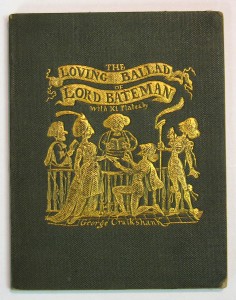 The young Charles Dickens became the darling of both critics and public with Pickwick Papers (1836-1837). Meanwhile, Thackeray slaved away as a hack writer for another decade. Despite their unequal reputations, the two authors enjoyed each other’s work. They even presumably collaborated on The Loving Ballad of Lord Bateman, which was initially attributed to Dickens. Now it’s believed that Thackeray wrote the body of the book, while Dickens wrote the preface and notes.
Finally, the publication of Vanity Fair (1847-1848) gained Thackeray the critical attention he sought and freed him from financial struggle. The novel got off to a slow start–multiple publishers rejected the first few chapters–but the novel eventually sold about 7,000 numbers per week. It made Thackeray the talk of London, though still not to the same extent as Dickens.
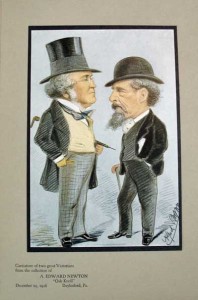
“Caricature of Two Great Victorians, Christmas Greetings for 1916” was published by Oak Knoll Press. It later used as the frontis for Newton’s popular 1918 work, ‘The Amenities of Book Collecting and Kindred Affections.’
Thackeray’s next novel, Pendennis (1849-1850) was published concurrently with Dickens’ David Copperfield, and Thackeray finally earned comparison to the Inimitable, first in North British Review and later in other critical journals. Thackeray knew that he would never equal Dickens in the eyes of the reading public, but he was happy to be equally respected and admired among critics. Dickens, however, was less enthusiastic about sharing the limelight: Dr. John Brown, a friend of both authors, noted that Dickens “could not abide the brother so near the throne.” Thackeray and Dickens would subsequently engage in a number of literary quarrels, notably the “Dignity of Literature” debate.
In 1858, the situation finally reached a head. Dickens had recently separated from his wife, and he was sensitive to public and private opinion about his choice. It especially rankled Dickens when he heard that Thackeray had repeated information about Dickens’ affair with Ellen Ternan. Thus it should come as no surprise that Dickens allowed Edmund Yates to publish an anonymous, slanderous attack on Thackeray in Household Words. Yates was a young journalist whom Dickens had taken under his wing. He was also a member of the Garrick Club, along with Dickens and Thackeray.
When Thackeray learned that Yates had written the Household Words piece, he wrote a letter demanding an apology. Upset that Yates had shared confidential conversations from the Garrick Club, Thackeray took the issue before the Garrick Club. Though Dickens had been overseas when the dispute broke, he quickly jumped to Yates’ aid, writing letters to both Thackeray and to the Garrick Club committee. But Dickens intervention did little to mitigate the situation; the committee decided to cancel Yates’ membership, and he was forbidden to set foot on Club property.
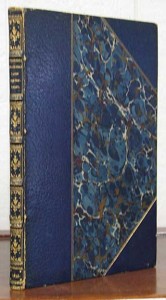 Yates did not consider the matter closed. He continued writing journal articles and pamphlets, fanning the flames of scandal. He even penned Mr. Thackeray, Mr. Yates, and the Garrick Club: The Correspondence and Facts (1859), which was predictably biased in his favor an which he had privately printed by Taylor and Greening. Finally Dickens realized that his support of Yates might damage his own reputation, and he convinced Yates to put the matter to rest.
The feud certainly weighed on Thackeray. He admitted to Charles Kingsley, “What pains me most is that Dickens should have been his adviser, and next that I should have had to lay a heavy hand on a young man who, I take it, has been cruelly punished by the issue of the affair and I believe is hardly aware of the nature of his own offense and doesn’t even understand that a gentleman should resent the monstrous insult which he volunteered.”
But Thackeray hardly felt compelled to extend an olive branch to either Dickens or Yates. Still close friends, Thackeray and Dickens’ daughters struggled to facilitate a reconciliation between their fathers. Though they got their fathers to relax their opinions, they didn’t manage to effect a meeting between the two men. That happened accidentally, when the two authors bumped into each other on the steps of another London club. The men shook hands and parted ways. Only months later, Thackeray passed away.
Though these literary titans may have bitterly quarreled, they both left behind a rich authorial legacy. Thackeray and Dickens are both central figures in the canon of Victorian literature.
This month has been a big one here at Tavistock Books! We celebrate our 25th anniversary, along with the one-year anniversary of fearless Aide-de-Camp Margueritte Peterson. We’re also proud that this month we hit the 10,000-visitor mark for our blog. To recognize this occasion, we humbly present the top ten blog articles of all time. Hope you enjoy reading!
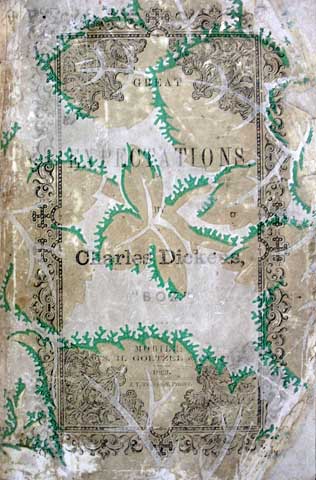 1. The Two Endings of Charles Dickens’ Great Expectations
When Charles Dickens finished Great Expectations and sent it off to his publishers, he was quite pleased with himself. Then he showed a copy to friend and fellow author Edward Bulwer-Lytton, who, according to Dickens, “was so very anxious that I should alter the end…and stated his reasons so well, that I have resumed the wheel, and taken another turn at it.” The book’s dual endings present complications for critics and collectors alike. Read More>>
2. Why Did Charles Dickens Write Ghost Stories for Christmas?
For the Victorians, Christmas wasn’t complete without a great ghost story! Charles Dickens certainly catered to this preference with his beloved Christmas Carol and a number of other Christmas tales. But why ghost stories? The holiday–once forbidden by Oliver Cromwell–has its roots in pagan rituals, which included telling “winter’s tales,” that is, ghost stories. Read More>>
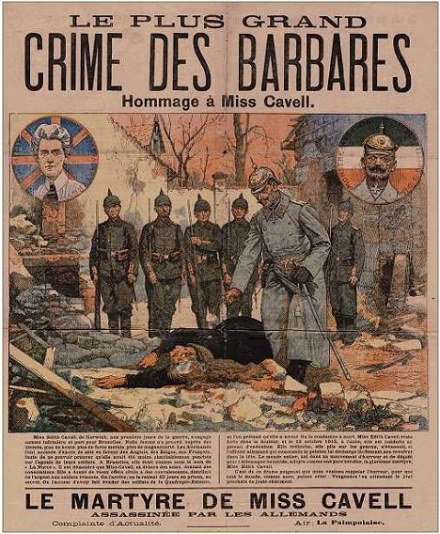 3. Edith Cavell: Nurse, Humanitarian, and…Traitor?
Edith Cavell quickly earned a reputation as an excellent nurse, and during World War I she found herself with another set of duties. Along with other nurses, Cavell was recruited by the British Secret Intelligence Service to collect information about the Germans. She eventually put that mission aside, preferring to funnel British and French soldiers to neutral Holland. Cavell raised suspicion, and the Germans arrested her for treason. Cavell was convicted and executed, a move that provided plenty of fodder for British and American propaganda machines. Read More>>
4. Alexander Pope’s Legacy of Satire and Scholarship
History has not always been kind to Alexander Pope, and neither were his contemporary critics. The poet published his earliest extant work at only twelve years old and went on to found the Scriblerus Club alongside celebrated authors John Gay and Jonathan Swift. Thanks to the guidance and support of Swift, Pope was able to do what few authors of the era managed to accomplish: he made a comfortable living with the pen, mostly due to his ingenious translation of Homer’s Iliad. Read More>>
5. A Brief History of Propaganda
Propaganda has existed for ages; the Behistun Inscription, written around 515 BCE details King Darius I’s glorious victory. But the Catholic Church gave us the word itself and formalized the use of propaganda, most notably when Pope Urban II needed to bolster support for the Crusades. The literacy boom of the nineteenth century actually drove the production of more propaganda, as politicians had to sway the opinions of a more informed public. World War I saw the first large-scale propaganda production. Britain even enlisted its best authors, like AA Milne, to create pro-war propaganda. Read More>>
6. Charles Dickens Does Boston
Charles Dickens’ first trip to America began promisingly enough; he was immediately mobbed by adoring fans. Dickens fell in love with Boston, declaring the city “what I would like the whole United States to be.” But the trip turned sour when the young author insisted on addressing the issue of international copyright law at every turn. He was also appalled by the way slavery was practiced in the South and by Americans’ lack of social graces. Dickens documented his impressions of the United States in American Notes, which immediately alienated his Continental readers. Read More>>
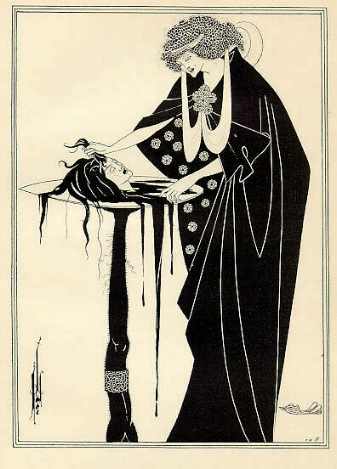 7. Oscar Wilde, Dickens Detractor and “Inventor” of Aubrey Beardsley
We remember Oscar Wilde just as much for his oversize personality as we do for his authorial excellence. Wilde’s ego often led to strange relationships with fellow authors, most notably Bram Stoker, Charles Dickens, and Aubrey Beardsley. Wilde lost a love to Stoker, railed against Dickens’ sentimentality, and claimed that Beardsley had Wilde to thank for his career. For rare book collectors, Oscar Wilde epitomizes the way that single-author collections can (and should) include works by other authors. Read More>>
8. The Six Hoaxes of Edgar Allan Poe
Edgar Allan Poe called his time “the epoch of the hoax,” and the horror writer couldn’t have been happier about it. Poe was a great lover of hoaxes, even attempting several himself. He forged a note from a supposed lunar inhabitant and penned a fake journal from an explorer. Poe even undertook one hoax to dissuade people from going West during the Gold Rush. But Poe’s efforts only proved that he should have stuck to poetry and fiction; he hardly convinced anyone that his hoaxes were real. Read More>>
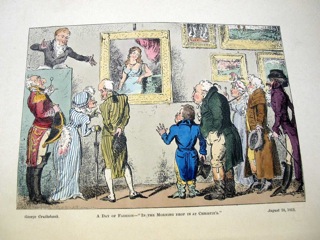
From ‘The Cruikshankian Momus’ by Isaac, Robert, and George Cruikshank
9. George Cruikshank: “Modern Hogarth,” Teetotaler, and Philanderer
George Cruikshank followed in his father’s footsteps, building a reputation as a preeminent illustrator of his time. Political from the beginning of his career, Cruikshank was openly racist and patriotic. He adopted an incredibly moralistic tone about drinking. That uncompromising campaign for temperance ultimately became a wedge between Cruikshank and Charles Dickens. After Cruikshank’s death, however, his wife discovered that he’d been leading a secret life–and had fathered eleven children with the family’s former servant. Read More>>
10. The Millerites an the Great Disappointment
The Seventh-Day Adventist Church arose from a great failure. The nineteenth century saw a revival in millinarianism, the belief that a drastic event or movement would suddenly change the course of society as outlined in the book of Revelation. William Miller stepped forward as a sort of prophet, arguing that Jesus would certainly return in 1843 or 1844. His followers, called the Millerites, embraced his predictions–until the days passed and nothing happened. They broke into a number of different sects, one of which developed into the Seventh-Day Adventist Church. Read More>>
On April 1, 1848, modern Spiritualism was born in Hydesville, New York. That day, teenage sisters Margaret and Kate Fox announced that they had communicated with the spirit of a man who had been murdered in their house years before. A report of the incident first appeared in the New York Tribune, and it was reprinted soon after in both American and European newspapers.
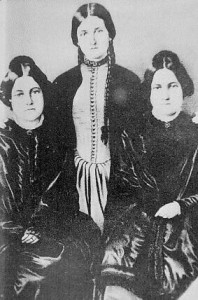
The Fox Sisters
The roots of Spiritualism stretch back to the eighteenth-century works of Emmanuel Swedenborg. But the incident with the Fox sisters ignited unprecedented interest in the phenomenon of communicating with the dead. Spiritualism would enrapture leading thinkers of the day, along with celebrated authors like Elizabeth Barrett Browning and Sir Arthur Conan Doyle. Meanwhile, Charles Dickens came out as a staunch opponent–despite his own interest in the also-questionable practice of mesmerism.
Spiritualism in its modern form emerged in Britain in 1852. That year, Maria Hayden traveled to London and offered her services as a medium. She conducted seances, complete with table rappings and automatic writing. But Spiritualism was far from new in England; Queen Victoria herself had subscribed to the belief as early as 1846. By the 1860’s Spiritualism had exploded into a full-fledged counterculture; it had its own newspapers, societies, treatises, and pamphlets. Seances–complete with table tapping, table tipping, automatic writing and levitation–were conducted in even the most genteel social circles.
Victorian England was ripe for just such a movement. Though it was an era of great scientific discovery, it was also an era of turning away from organized religion and confronting uncertainty. To fill the void, many Victorians turned to the supernatural, mesmerism, electro-biology, Spiritualism, and other relatively new pursuits. These new practices thoroughly blurred the lines between religion and science, and even proponents of Spiritualism were divided about how to characterize it.
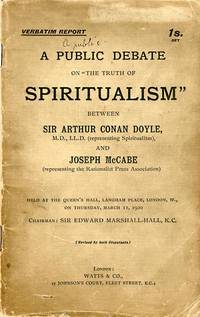 Elizabeth Barrett Browning famously subscribed to Spiritualism, much to the chagrin of her skeptical husband, Robert Browning, who was dragged to seances with her on multiple occasions. But the Brownings were far from the only authors at the seance tables; Christina Rosetti, John Ruskin, William Makepeace Thackeray, and Rudyard Kipling participated in seances. But it was Sir Arthur Conan Doyle who would delve so deeply into Spiritualism, he would turn away from fiction almost altogether.
Conan Doyle encountered Spiritualism as early as 1866, thanks to a book by US High Courts Judge John Worth Edmonds. The judge, who claimed he’d communicated with his wife after she died, was one of the most influential Spiritualists in America. Conan Doyle was by now already famous as the creator of Sherlock Holmes. But he hoped to be remembered for something entirely different, so he turned away from his famous protagonist to study Spiritualism. Conan Doyle presented his first public lecture on Spiritualism in 1917, and he would eventually travel throughout Great Britain, Europe, and America educating audiences about the practice. He even trekked to Australia, New Zealand, and South Africa in the name of Spiritualism.
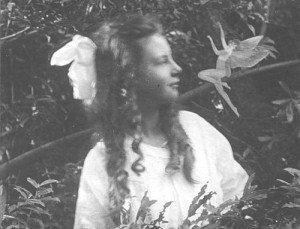 While Conan Doyle was respected in Spiritualist circles, his blind devotion led him headlong into ridicule on more than one occasion. He was taken in by Frances Griffith and Elsie Wright’s forged photographs of fairies. Conan Doyle, accepting the photographs as authentic, wrote a few pamphlets and The Coming of Fairies (1922), which made him a bit of a laughingstock. Later, Conan Doyle invited his friend Harry Houdini to attend a seance,with his wife Jean, acting as medium. Jean claimed to have contacted Houdini’s mother and “automatically” wrote a long letter in English. Unfortunately Houdini’s mother had known little English. Consequently the famous magician publicly declared Conan Doyle a fraud.
Perhaps unsurprisingly, Conan Doyle persisted, remaining an avid Spiritualist until his death. Once he passed away, claims surfaced that he and his wife had arranged for communication from beyond the grave. On July 7, 1930, five days after Conan Doyle’s death, a seance was held at Royal Albert Hall. The presiding medium, Estelle Roberts, claimed that she’d relayed a message from Conan Doyle to his wife…but was drowned out by the overzealous organ player.
Although Conan Doyle was devoted to Spiritualism, he was careful not to sully Sherlock Holmes with such a controversial ideology. Thus whenever Holmes encounters potentially supernatural phenomena, he remains nonplussed and seeks a rational explanation. After all, as the famed detective says in “The Adventure of the Sussex Vampire,” “This agency stands flat-footed upon the ground, and there it must remain. The world is big enough for us. No ghosts need apply.” Charles Dickens would surely have agreed.
Dickens grew up reading penny weeklies like The Terrific Register, which he said “frightened the very wits out of [his] head.” The register’s pages brimmed with tales of ghosts, murder, incest, and cannibalism. Meanwhile, the English tradition of telling ghost stories at Christmas–coupled with Dickens’ own (lucrative) habit of publishing new stories at Christmas resulted in Dickens’ publishing plenty of ghost stories of his own.
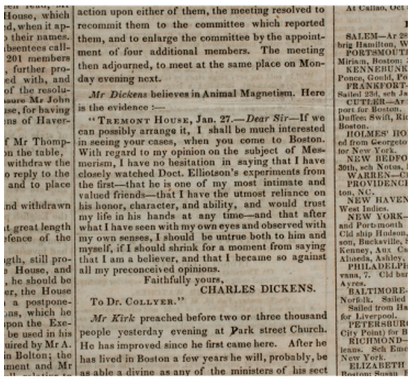
Dickens called Eliotson “one of my most intimate and valuable friends” in this letter to ‘The Boston Morning Post.’
That didn’t stop the Inimitable from openly dismissing Spiritualism as unmitigated quackery. He frequently attacked Spiritualists in both Household Words and All the Year Round. In “Well Authenticated Rappings,” (Household Words, 1858), Dickens questions why spirits would return to communicate with the living, only to make idiots of themselves by tapping out banal messages rife with orthographical mistakes.
Yet even Dickens got pulled into a movement of highly questionable validity: mesmerism. Named for its creator, Anton Mesmer, mesmerism was the belief that the universe was full of an invisible magnetic fluid, which influenced all life and could be manipulated more easily with magnets. Prominent doctor John Eliotson was one of the leading proponents of mesmerism (also known as magnetism and animal magnetism). Eliotson was eventually shunned from the medical establishment as a result.
Dickens actually became a practicing mesmeric doctor, successfully putting both his wife and sister-in-law into a trance. During his family’s trip to Italy in 1844, Dickens also mesmerized the alluring Augusta de la Rue, who suffered from, as she called it, a “burning and raging” in her head. The attention he lavished on M. de la Rue was sufficient to evoke jealousy from Dickens’ wife, Catherine. Meanwhile, Dickens was less successful in his attempt to mesmerize his friend Charles Macready.
 Dickens and his fellow mesmerists believed, as Eliotson did, that the practice represented a genuine improvement in the field of medicine–unlike Spiritualism, which served no such therapeutic function. Thus he felt perfectly justified in lambasting Spiritualism while simultaneously espousing a practice that, as modern readers, we might find laughable.
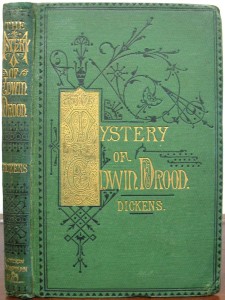
Ironically enough, Dickens was a frequent target of mediums. His final, unfinished novel, The Mystery of Edwin Drood has inspired many an author to attempt its end. But in 1873, printer Thomas James penned an ending for the book. He claimed that Dickens had dictated the ending from beyond the grave, calling the book The Mystery of Edwin Drood (Complete). Part second of The Mystery of Edwin Drood. By the spirit-pen of Charles Dickens, through a medium.
Ultimately both Sir Arthur Conan Doyle and Charles Dickens illustrate the Victorian predilection for the supernatural and strange.
Related Posts:
Why Did Charles Dickens Write Ghost Stories for Christmas?
The Six Hoaxes of Edgar Allan Poe
All Posts-Charles Dickens
Thanks for reading! Love our blog? Subscribe via email (right sidebar) or sign up for our newsletter--you’ll never miss a post.
25 years ago this month, in May 1989, Tavistock Books came into being- without capital, without business plan, without significant inventory. A rather inauspicious debut… and to be honest, one I never really expected to survive 25 months, much less 25 years. But here we are, in May of 2014, a surviving, if not actually thriving, antiquarian book shop, on Webster Street in Alameda, with a [sometimes] open door, and a decidely lazy shop dog one must step over to browse the shelves.
Also one year ago this month, the firm hired Margueritte Peterson, its first full-time employee, who, by accepting our modest job offer, fulfilled a personal desire to join our quaint trade, and so journeyed from Florida to California to take-on the not-inconsiderable tasks as my Aide-de-Camp.
With these thoughts in mind then, we issue our first full-color pdf catalogue, comprised of 25 items, selected from stock, which represent the firm’s subject specialities, as well as the overall eclectic & diverse nature of the Tavistock Books inventory.
Should you have queries regarding any of these 25, or other items you may find on our site, please don’t hesitate to contact us. We thank you for your attention, and we hope you enjoy browsing our catalogue, and/or the other listings found here on the website.
The early English Quaker movement emerged in the wake of King Charles I’s regicide, between the English Civil Wars and the Restoration. Multiple sects emerged between 1640 and 1660, and the word “Quaker” had yet to have a definitive meaning; in the media, the word was applied to people with quite divergent beliefs. Even among people who called themselves Quakers, views greatly varied. For instance, George Fox believed in the “Dwelling Spirit.” Meanwhile, a militant wing of the group advocated the use of violence to achieve its goals for the Second Coming and even attempted to assassinate Oliver Cromwell.
Following Venner’s Uprising in 1660, King Charles II and his government kept a close eye on the Quakers; the group had demonstrated its volatility, and some members were even suspected of murdering King Charles I. The king urged moderate Quakers to subdue its more radical members. The result: the group turned more of its attention to addressing England’s social problems, returning to its English Seeker roots. Meanwhile, the group increasingly turned to the pen, rather than the sword. Thus the history of the Quakers is one that we can trace through a rich body of literature, written by some of the sect’s most prominent (and sometimes controversial) figures.
Born in Westmoreland, George Whitehead discovered the Quaker philosophy at age fourteen. He began preaching in a limited capacity only two years later. Shortly thereafter, Whitehead joined the Valiant Sixty, a group of itinerant preachers that started in northern England and gradually traveled south. He was one of the group’s youngest members: only he, James Parnell (age 16) and Edward Burrough (age 18) joined the group before they were “of age.” The seventeenth century was a time of religious intolerance in England, and the Quakers often had brushes with the law. Whitehead was thrown in jail on multiple occasions and was once publicly whipped. He spoke out against the Act of Uniformity in 1660 and was influential in the Bill of Rights of 1689 and the Royal Declaration of Indulgence.
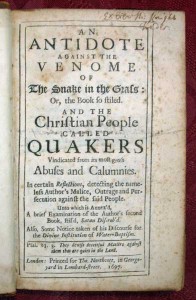 Whitehead published his journal, The Christian Progress of George Whitehead. He also wrote An Antidote Against the Venome of the Snake in the Grass, a rebuttal directed at Irish clergyman Charles Leslie the author of The Snake in the Grass, Satan Disrob’d, and A Discourse Proving the Divine Institution of Water Baptism. Most notably, Whitehead defended women’s ability to preach if they were so inspired, saying “we do not institute Women’s Preaching as [Leslie] saith, but leave them free to the Gift and Call of God.” The volume also includes an early mention of Quakers in America, including William Penn’s Pennsylvania colony. Whitehead’s views ultimately proved too liberal; by the 1800’s, his philosophy and works had passed out of favor in the Quaker community.
Born in Hempstead, New York in 1748, Elias Hicks was a carpenter who became a Quaker in his early twenties. In 1778, Hicks helped to construct the Friends Meeting House in Jericho, New York, where he’d settled with his wife. By this time, Hicks was already preaching extensively. That same years, Walt Whitman heard Hicks preach at Morrison’s Hotel in Brooklyn. The famed poet, then still quite young, would later recall the preacher’s “resonant, grave, melodious voice.”
In 1799, Hicks and his neighbor Phebe Dodge manumitted their slaves. They were the first Quakers to do so in their community, and soon after all the families of Westbury meeting had followed suit. Hicks also campaigned for a boycott of all goods produced by slaves, which mostly included cotton and products that contained sugar. In 1811, he wrote Observations on the Slavery of Africans and Their Descendants, which outlines the economic reasons for continuing slavery and points to war as a primary cause of slavery. The book gave the free produce movement a firm foundation. Although the movement wasn’t meant to be religious in nature, the majority of its proponents were indeed Quakers. The first person to open a free produce store was Benjamin Lundy, a Quaker who opened up a free produce mercantile in 1826. Lundy advocated helping freed slaves emigrate to Haiti and raising mone to buy slaves and settle them as free citizens in the territories out West. Hicks was a key figure in abolishing slavery in New York.
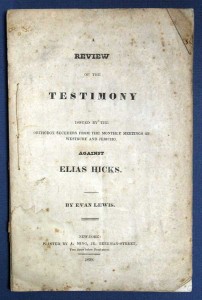 While Hicks’ abolitionism certainly fit with Quaker tenets, the same was not so with his theological stance. Hicks believed that following the “Inner Light” was the most important aspect of worship. He also denied Jesus’ complete divinity and the virgin birth. Furthermore, Hicks argued that the Devil was not at the root of human failings and sin, but that urges were simply part of human nature–and created by God. Thanks to the Great Awakening and other factors, the Quaker community was ripe for a schism, and Hicks’ controversial philosophy provided the reason. Hicks engaged with fellow Quaker Anne Braithewaite in a debate that produced a flurry of publications. Eventually, in 1828, after Hicks actually stood a sort of trial, the Quakers decided a separation was necessary. Those who followed Hicks were mostly rural poor and came to be called Hicksites. His critics called themselves the Orthodox Friends. Each group considered itself to be the rightful bearers of the legacy begun by Friends founder George Fox. The two groups would not be the only factions to develop among the American Quaker community.
Born in 1788, Joseph John Gurney was a banker in Norwich, England. Raised in the Quaker faith, he joined the sect and became an evangelical minister in the Religious Society of Friends. Because he was a member of a non-conformist religious group, Gurney was ineligible to study at English universities, so he was educated by a private tutor at Oxford. Gurney’s sister Elizabeth Fry was a social reformer, and in 1817 the siblings partnered to protest the death penalty and to improve conditions in prisons. They had little success, but Gurney would remain committed to the cause.
 Finally Home Secretary Robert Peel introduced the Gaols Act of 1823, which required that wardens be paid salaries–rather than being supported by the prisoners themselves. The Act also placed female wardens in charge of female prisoners and outlawed the use of manacles and irons. Meanwhile, Gurney and Fry visited prisons all over Great Britain. They published their findings in Prisons in Scotland and the North of England.
In 1837, Gurney began a journey to America and the West Indies, where he promoted abolitionism. He also preached at local Meeting houses in America and grew concerned about the prevalence of the “Inner Light” philosophy. Gurney felt that the American Quakers did not give sufficient weight to the Bible and the New Testament in their theology. This created a yet another splinter, between those who followed Gurney and those who followed his opponent, John Wilbur. Their respective disciples, predictably enough, were called Gurneyites and Wilburites, respectively.
The literature of the Quakers offers considerable insight into colonial history, and it is full of fascinating personalities who shaped approaches to social issues in the Western World.
Related Posts:
Charles Dickens and Capital Punishment
The California Gold Rush, Slavery, and the Civil War
Thanks for reading! Love our blog? Subscribe via email (right sidebar) or sign up for our newsletter--you’ll never miss a post.
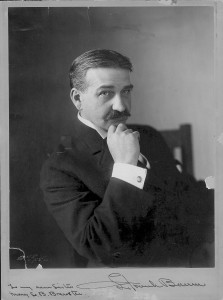 L Frank Baum is best remembered as the author of The Wonderful Wizard of Oz (1900), but writing was certainly not his first occupation. Baum was, like many men of his generation, a jack of all trades and a master of none; he’d pursued a number of careers–all with little success. He went to Aberdeen, South Dakota looking for a fresh start…only to find himself running a new baseball club, the Hub City Nine.
When Baum arrived in Aberdeen in 1888, the town was rapidly growing, and it wasn’t much like the stereotypical frontier town. Founded in 1881, Aberdeen was populated not with farmers and cowboys, but with college educated citizens who’d come West for cheap land. They arrived by train and immediately set about reestablishing life as they’d known it back East. Aberdeen’s citizens went to local events in full dinner dress. They enjoyed champagne and other delicacies. By 1885, assessment reports show that there were 135 pianos for a town of 2,500 people. Electric lights were available the following year.
Baum and his family moved to Aberdeen because Baum’s wife, Maud desperately missed her family. Her brother, TC Gage, had already settled in Aberdeen, and her sisters lived relatively close by. Baum had read reports of the town’s burgeoning prosperity in the June 2, 1888 edition of the Aberdeen Daily News. Overly impressed, he wrote to his brother-in-law, “In your country, there is an opportunity to be somebody, to take a good position, and opportunities are constantly arising where an intelligent man may profit.” He confided that he planned to open a novelty store, “not a 5¢ store, but a Bazaar on the same style as the ‘Fair’ in Chicago…and keeping a line of goods especially saleable in that locality.”
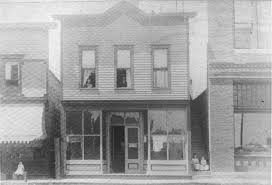
Baum’s Bazaar
Baum opened up Baum’s Bazaar on October 1, 1888. Over 1,000 people attended the grand opening. He’d stocked up on all kinds of luxury goods, from amateur photography equipment to sporting goods. There was no shortage of interest in his wares: the Christmas crowd numbered over 1,200. On December 3, 1888, the Aberdeen Daily News reported, “Baum’s Bazaar is an [Aladdin’s] chamber of wonders and beauty.”
As far as Baum was concerned, Aberdeen lacked only one important thing: a baseball team. Though Baum had never been a great athlete, he’d undoubtedly played the sport casually and watched local club teams play in upstate New York. However he encountered the game, Baum was an enthusiastic “crank,” as baseball fans were then called. As soon as he settled into Aberdeen, he went about rallying support to start a club team.
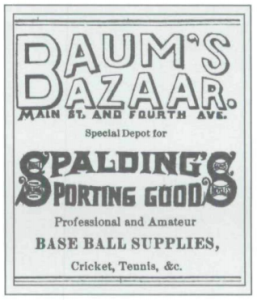
From the June 14, 1889 edition of ‘Aberdeen Daily News’
Baum reasoned that the sport would be great for the community and for his business; he hoped to sell plenty of Spalding sporting equipment during the baseball season. Meanwhile, larger cities like Omaha, St. Paul, Minneapolis, Des Moines, and Sioux City already had baseball teams. Getting a baseball club could put Aberdeen on the map in a new way. The Aberdeen Daily News spoke positively, saying “Nothing creates enthusiasm like base ball, and nothing will draw a crowd so continuously as the national game closely contested and honorably played.”
Baum convinced a group of Aberdeen businessmen that the city needed a baseball club. Baum so impressed the men with his enthusiasm, they named him secretary of the club and appointed him to the constitution and by-laws committee. They named the club the Hub City Nine, a reference to Aberdeen’s nickname as the Hub City because seven rail lines converged there. The first 210 shares sold at at $10 each in three days, and the remaining 90 sold shortly thereafter. Baum also spearheaded an effort to sell advertising space on the baseball field’s back fence.
The group was so industrious and successful in their fundraising, it drew the attention of nearby communities. In the Fargo Daily Argus, baseball club manager Con. Walker complained, “The citizens of Aberdeen contributed $3,000 to their base ball team this season. The Fargo people have done nothing for the club in the last two years.” Walker entreated the town to support the home team if they wanted the club to continue and flourish.
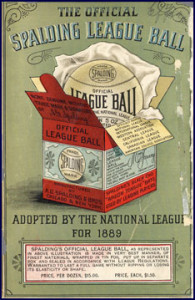
Even an “official” baseball size was new in 1889!
Baum and the other board members believed that organizing a league was critical to their success, so Baum headed up efforts to organize the South Dakota League. When the league was formalized on June 7, 1889, all the participating teams contributed $100. The Hub City Nine also strove to legitimize itself further by adopting the National League Rules. At the time, the rules of baseball had yet to be normalized, and the National League, Western Association, and American Association all had different rules. The National League, founded in 1876, was the oldest and most powerful of these organizations.
When it came time to recruit players, the Hub City Nine offered $50 per month, plus room and board. To sweeten the pot, club president Jewett offered a box of cigars to the first man to hit a ball over the center field fence. Baum threw in another box for the player who hit the first home run. And local grocers Thompson and Kearney promised $25 to anyone who hit a ball into the “Hit Me for $25” box on the fence where they advertised.
The National League forbade gambling or selling liquor on the premises, along with holding games on Sundays. The Hub City Nine took these rules a step further because they wanted the games to be family- and (more importantly) female-friendly. Profanity was prohibited. Both players and spectators were to treat the opposing team with the utmost respect, and “no unseemly or ungentlemanly conduct [was] allowed on the ball grounds.”
On May 29, 1889, the Hub City Nine players gathered for their first practice. The event was free to attend, and a healthy number of spectators showed up to observe the proceedings. The first game, a warm-up against Redfield, sold over 1,000 tickets. There was not enough room in the stands to hold them all! Baum later managed to get the St. Paul Indians to come to town for a game. The club raised admission to 50 cents, from 25, and though people grumbled, they still purchased tickets for the game. The Milwaukee railroad ran three extra trains to bring the fans into town. The game brought sorely needed funds back to the club.
Indeed, the Hub City Nine games were so popular, “half as many people perched on the fence and on buildings and elevations surrounding as there were in the enclosure,” according to the Aberdeen Daily News. The paper called this a “detestable practice.” Lester J. Ives, in particular, drew the ire of the paper’s editors. Ives’ house was directly across the street from the baseball field, and he would sell rooftop seats for a dime each. Ives was vilified in the local paper: “The antics of this individual…have thoroughly disgusted the people without exception. He is evidently a baseball crank–but of the hog species–without shame or self-respect.”
These interloping spectators robbed the club of vital revenue. So the club installed latticework on top of the fence. Ives responded by outfitting his roof with higher chairs. Infuriated, team manager Henry Marple threatened to turn the stream of a railroad hose on the unauthorized spectators. Finally, the club had to hang canvas over the latticework.Yet Baum came to Ives’ defense. In an article for the newspaper, he argued that “Mr. Ives is not so black as he has been painted” and said that he didn’t deserve insult. Thanks to Baum’s conciliatory efforts, the conflict was resolved by July 25, 1889: Ives agreed to give the club jurisdiction over his property during baseball games.
That inaugural season, the Hub City Nine were the unofficial champions of the Dakotas; they defeated every team in North Dakota and South Dakota. Unfortunately the players still struggled to work as a team, and fans failed to show up in sufficient numbers. Although some of the Ives fans came and bought full-price tickets, the Hub City Nine games didn’t draw enough fans to keep their coffers full. The first season, the club lost about $1,000. Baum was perhaps most disappointed with the season’s outcome; he’d been convinced that Aberdeen could easily support a baseball club. Dejected, he said, “If we are to have a baseball team next year, I am of the opinion that someone else will have to do the work.”
Baum’s Bazaar suffered the same fate. After scarcely a year in business, Baum suffered the “temporary embarrassment” of handing his business over to his creditors. He purchased a newspaper and renamed it the Saturday Pioneer. While the citizens of Aberdeen enjoyed Baum’s writing, the newspaper also folded after only a year. Baum could not handle the stress of being a business owner, and his health suffered. He took a job in Chicago working for a newspaper. The move would set in motion a series of events that resulted in one of the most iconic and beloved stories of the twentieth century, The Wonderful Wizard of Oz.
Related Posts:
L Frank Baum’s Forgotten Foray into Theatre
Rare Books about Baseball Are a Home Run!
The Rare Books of Baseball
Irwin and Erastus Beadle, Innovators in Publishing Popular Literature
Thanks for reading! Love our blog? Subscribe via email (right sidebar) or sign up for our newsletter--you’ll never miss a post.
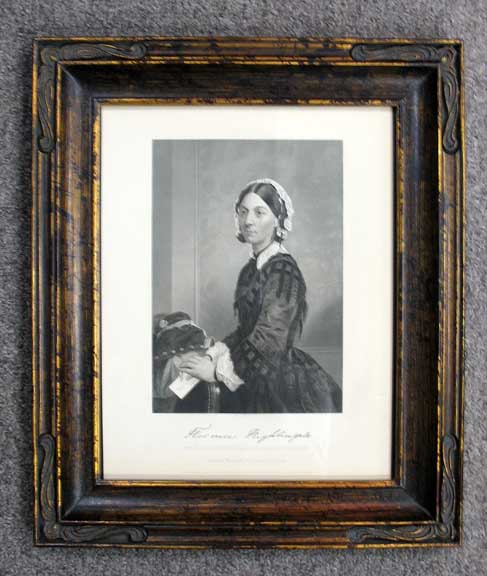
Florence Nightingale devoted her life to administering exceptional medical care and to furthering the profession of nursing. So it seems counterintuitive that the luminary would have opposed the formation of an organization like the British Nursing Association; after all, the organization’s aim was to bring some standardization to nursing. But Nightingale vehemently opposed the BNA, doing everything in her power to stymie its progress.
Nightingale entered nursing at a time when women had few respectable employment options. The few women of the upper class who chose the occupation did it out of duty or a sense of service, rather than the desire for a paycheck. Nurses often came from the working class and had little formal education outside their nursing training, which was more hands-on training during a probationary period than book- or lecture-based instruction. It’s also important to note that the wealthy still mostly received their medical care at home, resorting to hospital care only in dire emergencies. Hospitals were used for administering care to the poor and, during wartime, to soldiers.
Thus nursing fell short of being considered a true profession; some even thought of nursing as being only slightly better than prostitution! Behavior like stealing food from patients or demanding bribes for administering care was not uncommon; nor was inappropriate fraternization between female nurses and male patients. One of Nightingale’s first priorities was to establish standards for nursing as an “art” or “calling.” Nightingale placed considerable emphasis on nurses’ morality, noting that the best nurses were kind, moral, and decent. She strongly believed that lack of formal education did not preclude a woman from making an excellent nurse, so long as she possessed these other qualities.
Nightingale spoke positively about making nursing a profession early in her career. She also took substantial steps to remove opportunities for amoral behavior on her wards. For example, during the Crimean War, Nightingale did not allow any other female nurses to stay in the ward past 8:00 pm; during the night, male patients received care from male orderlies. This practice is what earned Nightingale the nickname “Lady of the Lamp.” She would pace the ward by lamplight virtually all night long, resting only briefly, intent on ensuring that her patients got exceptional care around the clock.
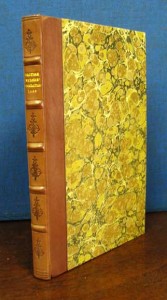
The First Annual Report of the BNA
The British Nurses’ Association (BNA) was founded in 1887 through the efforts of Ethel Bedford-Fenwick, Catherine J Wood, Isla Stewart, and a number of prominent male physicians. Princess Christian, Queen Victoria’s daughter was the BNA’s royal patron. The organization changed its name to the Royal British Nursing Association in 1891 and received its royal charter two years later. Its primary aim from the beginning was to establish a national registry of nurses. To be included in the registry, nurses would have to complete their training and pass a written examination.
With the written examination, the founders’ tacit goal was to exclude working-class women from nursing–thereby raising the social status of the profession. Nightingale didn’t deny that higher social status had its merits for administrators in nursing, but she argued that working-class nurses could provide equally excellent care despite their lack of formal education. She also pointed out that nurses weren’t “dictionaries,” and that passing a written exam did not necessarily indicate that someone would make a good nurse: “Some of our best could not pass an examination with credit, while some of our worst could gain the most credible place.” Nightingale’s fundamental opposition to the BNA stemmed from their efforts toward exclusion. She advocated improving the overall quality of nursing care through better training instead.
The BNA wanted to create a registry listing all the nurses who had completed training and passed a written exam. Hospital administrators could then use the registry as a resource to ensure that they were hiring qualified nurses. Nightingale objected to the registry for multiple reasons. First, the registry would be out of date almost from the moment of publication, as new nurses constantly entered the profession; some nurses would not even be included for years after they completed training, when a new registry was finally printed.
But the registry had an even greater flaw, in Nightingale’s eyes: no mechanism existed for removing the names of nurses who were subsequently found to be unfit for the profession. Nightingale said that it often proved difficult to fire nurses even in extreme cases, such as drunkenness on the job or egregious amoral behavior. If a fired nurse had her name printed in the registry, that would give her undue legitimacy when she sought new employment in the profession. Nightingale asked the BNA how a nurse’s name would be removed from the registry, outside of death or criminal conviction, but she never received a satisfactory answer.
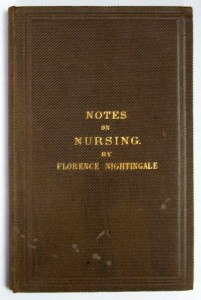 Furthermore, as it was conceived by the BNA, the registry would not indicate where or when a nurse had received her training. Nor would it list any additional advanced training she may have completed. Nightingale saw this lumping together of all nurses, regardless of training qualifications, as a fatal flaw. Training programs varied widely in technique, quality, and duration. And a nurse trained during wartime, or under a leading physician, for instance, were often better equipped to handle the demands of specific nursing positions. Nightingale argued that omitting such information from the registry made the document virtually useless.
Some opponents of the BNA proposed an alternative: issuing nurses certificates when they completed training. The certificate would indicate the date the nurse completed training and the training institution. Each nurse would bear responsibility for her own certificate, and the certificate could be confiscated if she were fired for negligence or misconduct. But the prospects of forgery and the onus of replacing lost certificates made this system less appealing to Nightingale and other leaders in the field.
Nightingale sought to make nursing an autonomous endeavor, not under the jurisdiction of physicians. She believed in creating a separate hierarchy within nursing, so that doctors did not have the power to hire, fire, or discipline nurses. Nurses would still take medical orders from doctors, but only because doctors had more knowledge and expertise in determining the best treatment for patients.
Yet the BNA intended to give one half of its seats to doctors. Nightingale saw this as directly undermining its stated mission to make nursing into a true profession. This point of contention proved one that Nightingale had to handle delicately, as she had important alliances with plenty of prominent physicians.
Nightingale was not fundamentally opposed to the idea of a registry. Indeed, she saw merit in the small, organization-based registries that hospitals like St. Thomas already kept. Regularly updated with dismissal information, nurse obituaries, and notices of criminal conviction, these registries escaped some of the problems presented by a national registry. (Contemporary researchers also point out that they contained a healthy amount of gossip.)
But Nightingale did object to the view that nursing was strictly a profession. She was very attached to the morality of nursing, and later in her career actually used the term “profession” pejoratively in regard to nursing. In an 1888 address to probationers, Nightingale referred to the “low sense” of the nursing profession as the “book-and-examination business.”
Nightingale went to considerably lengths to prohibit the BNA’s progress. She and her supporters launched numerous campaigns to draw attention to the organization’s shortcomings. They also pointed out that the BNA claimed to have more support than it actually did; in some cases, the BNA alleged that prominent doctors and nurses supported the organization–when they had already publicly expressed the opposite stance.
The registration issue emerged in 1887 and gathered momentum the following year. In 1889, the founder of the Hospitals’ Association and editor of The Hospital, Henry Burdett proposed the National Pension Fund as an alternative. Nightingale saw the competitiveness between the two plans as highly distasteful and opposed them both. In 1889, she helped to organize a “memorial” opposing the BNA’s receipt of a royal charter.
The House of Lords committee did not meet on the matter until 1891. William Rathbone spoke against the BNA using information supplied by Nightingale. His presentation was so thorough and so convincing that the BNA was forced to drastically revise its proposal. When the organization finally received its royal charter in 1893, the BNA had much less power than its founders had hoped.
Though Nightingale’s staunch opposition to the BNA may seem strange today, her reservations were grounded in a genuine love for nursing and desire for improvement in the field. Today we remember Nightingale as a visionary of nursing whose contributions ranged from improving quality of care, to shaping the laws that governed the profession.
Related Posts:
Louisa May Alcott: Abolitionist, Suffragette, Mercenary
Edith Cavell, Nurse, Humanitarian, and Traitor?
Famous Figures in the History of Nursing (Part One)
Famous Figures in the History of Nursing (Part Two)
Thanks for reading! Love our blog? Subscribe via email (right sidebar) or sign up for our newsletter--you’ll never miss a post.
 The late nineteenth century was truly a golden age in children’s literature. As the concept of childhood evolved, didacticism fell out of style and children’s authors focused more on stimulating their readers’ imaginations with exciting, engaging tales. George Alfred Henty was one of the most popular figures of the era. His historical adventure stories appealed to both children and young adults, but Henty was a controversial figure even in his own time.
Henty was born on December 8, 1832 in Trumpington, outside Cambridge. A sickly child, he entertained himself by diving into books and remained an avid reader all his life. Henty attended Westminster School, and then Gonville and Caius College, Cambridge, where he distinguished himself as a sportsman. But Henty left school before earning a degree; he and his brother decided to volunteer for the Army when the Crimean War began. Henty was assigned to the Army Hospital Commissariat. Conditions at the front were horrible, and Henty sent his father detailed letters about the appalling state of affairs. His father submitted the letters to the Morning Advertiser, which published them enthusiastically.
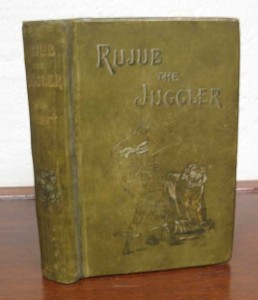 Seeing little promise of promotion, Henty resigned from the Army in 1859. He married Elizabeth Finucane shortly thereafter, but the union would be a short one; Elizabeth died in 1865 after a long illness. Left with children and unsure of his career path, Henty decided to begin writing for the Standard newspaper. By 1866, he was working as a special correspondent. During his career, Henty would cover the Franco-Prussian War; the Carlist Rebellion in Spain; the Turco-Serbian War; the opening of the Suez Canal; and the Dreyfus Trial.
Meanwhile Henty loved to regale his children with adventure stories at dinnertime. He decided to put the tales on paper and wrote his first children’s novel, Out of the Pampas, in 1868, naming the main characters after his children. Griffith & Farran published the book in 1870 (though the title page lists the year as 1871). Henty went on to write over 100 books, not only children’s fiction, but also adult novels and non-fiction. However, his children’s fiction was most popular, even inspiring other authors to emulate him. Captain Frederick Sadlier, Percy F. Westerman, and Herbert Strang (the pseudonym for George Herbert Ely and Charles James L’Estrange) all tried their hand at juvenile adventure tales in the “Henty style.”
To research his books, Henty would check out numerous books from his local library. His protagonists were usually intelligent, plucky, and modest young men–and occasionally women who were living through historically difficult times. The books were full of action and drama, appealing to young readers. But they also raised ire among many of Henty’s Victorian contemporaries–after all, Henty was hardly an unbiased author.
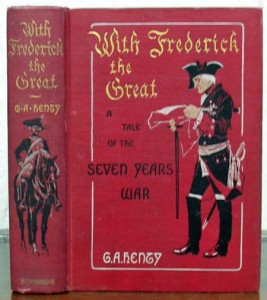 During his own lifetime Henty was frequently accused of being xenophobic and racist. An enthusiastic imperialist, Henty also drew criticism for glorifying British imperialism. His In the Reign of Terror (1888) and No Surrender! A Tale of the Rising in La Vendee (1900) were decidedly hostile toward the patriots of the French Revolution, and in True to the Old Flag (1885), Henty took a Loyalist stance regarding the American Revolutionary War. With Lee in Virginia (1890) also raised eyebrows for supporting the “aristocratic” Confederacy of the Civil War.
In the 1990’s, Henty’s books were taken up by conservative Christians and home-schoolers because of their wholesome protagonists. But these stories are also frequently criticized for being jingoist and promoting racism. A Roving Commission,or Through the Black Insurrection at Hayti (1900) is overtly racist, making it an inappropriate text from which to teach that period of history.
Henty has remained a popular figure among book collectors because his stories are so captivating and his works were so prodigious; in total, Henty penned 144 books, myriad short stories, and numerous pieces for several periodicals. Collectors usually rely on the second edition of Peter Newbolt’s GA Henty, 1832-1902 for bibliographic guidance. George Manville Fenn published a biography of Henty in 1907, but the work is generally considered too dispassionate. Thus the Henty Society is publishing a new biography, due out this year.
Henty’s books often have intricately designed bindings, often appealing to collectors in their own right. It’s quite rare to find these books in their original dust jackets, so most collectors settle for jacket-less copies in the best condition possible.
Though George Alfred Henty never became a household name in children’s literature, he nevertheless left an indelible mark on the genre. Henty’s books will continue to delight readers and collectors alike for ages to come.
Karl Marx deeply admired his contemporary Charles Dickens, which should surprise no one familiar with the works of the Inimitable. Dickens used his novels to address the social ills of Victorian society, from the poor conditions in factories to the deplorable treatment of orphans. Some of Dickens’ incredible popularity can certainly be attributed to his overt empathy for the common man, but that same popularity also gave him an unprecedented platform for promoting reform. Dickens took up social causes early in his career and, after the success of Oliver Twist, resolved to use the novel as a vehicle for social commentary.
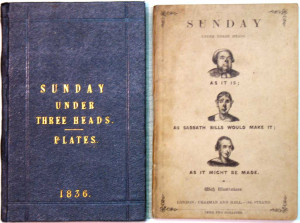 By 1836, England’s social classes were not only divided by economics; they also observed religion differently. For the middle and upper classes, the Sabbath remained a sacred day, free from feasting, visiting, and indulgences. But for members of the lower class, Sunday was usually the only day off and therefore the only day available to make merry. Thus the streets of London were often full of drunkards and revelers on Sundays. Sir Andrew Agnew despised the lower classes to such a degree that he went out of his way to end Sunday festivities with a Sabbath Observances bill. The bill would have put an end to the usual freedoms and entertainments that the lower class usually enjoyed on Sundays. Dickens found the bill draconian and discriminatory. In 1836, he published “Sunday Under Three Heads” under the pseudonym Timothy Sparks. The cartoon illustrates the fact that there could–and should–be some middle ground between reckless revelry and puritanical observance. Dickens would go on to criticize not only Agnew’s bill (which failed to pass in four different permutations, leading Agnew to resign from Parliament), but also his character.
Completed in 1839, 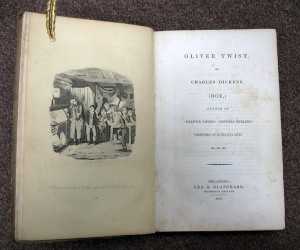 Oliver Twist vaunted Dickens to celebrity status in England. The novel was Dickens’ first to carry over social commentary, and its success galvanized his resolve to use his fiction to address social injustice. Two years prior, in 1837, six members of Parliament and six working men had banded together to publish the People’s Charter (1838). Their aim was to empower working-class men with voting rights and the ability to be elected to the House of Commons. While these demands weren’t new, they were made at just the right time, and the People’s Charter is often regarded as the most famous political manifesto of the nineteenth century. The Chartist movement rapidly emerged, drawing attention to the plight of the working class. Thus Oliver Twist likely could not have been published to a more sympathetic audience. Dickens’ criticism of the Poor Law of 1834 and the horrible conditions of orphanages fell on eager ears.
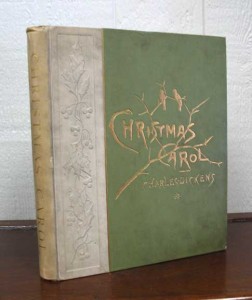 Robert Malthus published An Essay on the Principle of Population pseudonymously in 1798. He argued that overpopulation would necessarily right itself through famine, disease, war or other means. The work was highly influential and immediately raised concerns about the population of Great Britain. In 1800, the Census Act was passed, enabling a census count every ten years. In ensuing decades, the population of cities, and of London in particular, grew astronomically. Malthus’ theory became an excuse to ignore the spread of contagious disease and the lack of proper care for orphans. Dickens personified Malthus in Ebenezer Scrooge, who says, “If they would rather die…they had better do it, and decrease the surplus population.” By this time, another concept dovetailed conveniently with Malthusianism: the “deserving poor.” Victorians commonly believed that people were poor because they deserved to be. In A Christmas Carol, Dickens refutes both ideas wholeheartedly.
Critic Terry Eagleton notes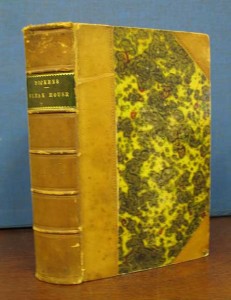 that by 1852, Dickens saw Victorian England as “rotting, unravelling, so freighted with meaningless matter that it [was] sinking back into primeval slime.” Bleak House, which Dickens completed in 1853, is widely regarded as England’s first contribution to the tradition of the modern detective novel. But the book still usually gets short shrift among readers and critics. Nevertheless, Bleak House is one of Dickens’ best–and one of his most ambitious in terms of social commentary. Dickens takes on issues of electoral corruption, class division, slum housing, overcrowded urban cemeteries, and the neglect of contagious diseases. More importantly, he draws attention to England’s faulty legal system, as exemplified in the Chancery Court. Prior to his career as an author, Dickens had been a court reporter. The post gave him an inside look at the inconsistencies, inefficiencies, and iniquities of the British court system, and he drew on this experience in Bleak House.
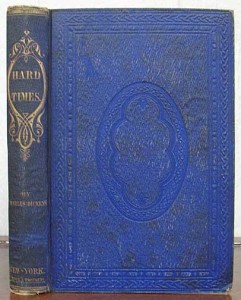 The Anti-Corn Law League was founded in 1836 with the sole purpose of abolishing the Corn Laws, which levied taxes on imported wheat and inflated the price of food at a time when factory owners were attempting to cut wages. After a decade, the movement was successful, and the league disbanded. The movement (known as Manchester capitalism or Manchester liberalism) was based on the principles of laissez-faire capitalism as promoted by Adam Smith, and its members believed that free trade would ultimately lead to a more equitable society. Although Dickens would likely have agreed with the school on other issues like slavery, he vehemently disagreed with laissez-faire capitalism. In Hard Times, we encounter characters whose personal relationships have been tainted by economics and face the cruel living conditions of the urban working class. Dickens also paints a picture of the greedy excesses enabled by unregulated capitalism. Meanwhile, he also addresses contemporary reforms to divorce law, the lack of education for the poor, and the working class’ right to amusement.
Dickens is often criticized for failing to offer any solutions to Victorian England’s social issues. Criticism also sways with political trends; in the 1960’s and 1970’s, for instance, Dickens was simply “not Marxist enough.” But ultimately Dickens renders an important service by bringing attention to such a wide range of social concerns, and one must ask whether we should really expect solutions to social problems in our literature.
Related Posts:
Charles Dickens and Capital Punishment
Andersen’s Visit with Dickens Less than a Fairy Tale
Charles Dickens the Copyright Confederate
Why Did Charles Dickens Write Ghost Stories for Christmas?
Jane Bigelow, the First Celebrity Stalker?
Thanks for reading! Love our blog? Subscribe via email (right sidebar) or sign up for our newsletter--you’ll never miss a post.