Author Archives: tavistock_books

A Collection of Confederate Literature

On March 11, 1861, delegates from Alabama, Florida, Georgia, Louisiana, South Carolina, and Texas gathered in Montgomery, Alabama. Their purpose: to ratify the Constitution of the Confederate States of America. The document was–not unsurprisingly–similar to the US Constitution, even using some of the same language.

But the Confederate Constitution gave the states much more autonomy and power than the central government. For example, while a presidential item veto existed, states had to consent to the use of any funds or resources by the federal government. The Confederate Constitution also set six-year terms for the president and the vice presidents, and precluded the president from serving two consecutive terms. And slavery was “recognized and protected” in all slave states and territories, while foreign slave trade remained illegal.

Both France and Great Britain considered entering the fray on the side of the Confederates. But they never acknowledged the Confederate States of America as its own independent, autonomous entity, and the Confederate States crumbled in April 1865.

A Selection of Confederate Literature

For collectors of Americana, the Civil War is a perennially popular area of focus. Within that specialization, the depth and breadth of material available makes it possible to further specialize in a sub-section of Civil War literature. The works and records of the Confederacy offer a fascinating, enlightening, and sobering look into one of the bloodiest periods in American history. Even this sub-specialty has incredible scope, stretching to include works written both before and long after the war itself.

The Italian Bride

Levy-Italian_brideSamuel Yates Levy wrote this play in honor of Eliza Logan and had it printed for private distribution in 1856. Logan was a popular actress in the mid-nineteenth century, and her father, Cornelius Logan, acted as her manager until his death in 1853. Though Logan was born in Philadelphia, she made her name in the antebellum South, with many lucrative engagements in cities like Savannah. Meanwhile, Levy would go on to become a Confederate officer during the Civil War, slightly unusual because he was Jewish. Research indicates that this volume’s recipient was a fellow officer from Georgia. Details>> 

Great Expectations

Dickens_Great_Expectations_Confederate_EditionDickens’ first visit to America ended less than well. The legendary author returned to Britain and published two American Notes, which criticized the United States, most notably for permitting the institution of slavery. (He further alienated American readers with Martin Chuzzlewit.) Dickens’ strong opposition to slavery and his keen sensitivity to social injustice made him an unlikely ally of the Confederacy. But after a close reading of James Spence, who was not only a writer for the London Times, but also a pro-South merchant, Dickens revised his opinion. In All the Year Round, he spoke out in defense of the South on the subject of the Morrill Tariff, noting that the ariff had “severed the last threads that bound the North and South together.” This first Confederate edition of Great Expectations is exceedingly rare in the trade, with no copies having come to auction in the past thirty years. Details>>

Carrie Bell

Carrie_BellCaptain MC Capers wrote the lyrics to the Confederate tune “Carrie Bell,” while T. Von La Hache composed the musical accompaniment. Capers was formerly of the “Macon Volunteers” and had also participated in the Indian Wars in Florida (1836). During the Civil War, Capers was in command of Company G, 1st LA Heavy Artillery Regiment of the CSA. In July 1863, he was promoted to major, seeing service at Vicksburg and elsewhere in the South. Details>>

A Legal View of the Seizure of Messrs Mason and Slidell

Legal_View_Seizure_Mason_SlidellThough this pamphlet was published under the pseudonym “Pro Lege,” it’s thought to be the work of Virginia statesman Francis Rives. He delves into the issues regarding seizure at sea during the US Civil War. The matter came the the forefront when Captain Wilkes, acting on his own cognizance, boarded the British vessel Trent and took two individuals, Mason and Slidell, captive. The two were acting as Confederate diplomats. Wilkes’ bold move was locally applauded, but the British were indignant and on the verge of entering the war against the Union forces. Seward released the two gentlemen and told the British that Wilkes had erred and acted without proper authority. Published in 1861, this pamphlet looks at the diverse international maritime legal issues and the ramifications of Wilkes’ act. Details>>

General Orders No 30

General_Orders_No_30Containing “An Act to Organize Bands of Partizan (sic) Raiders” and “An Act to Further Provide for the Public Defence,” this document was published in April 1862 by the Confederate War Department. It authorized the president “to call out and place in the military serve of the Confederate States, for three years, unless the war shall have been sooner ended, all white men who are residents of the Confederate State, between the ages of 18 and 35 years old.” Details>>

Life of General Stand Watie

Life_General_Stand_WatieThe only Indian brigadier in the Confederate Army and the last Confederate general to surrender, Stand Watie was no stranger to conflict. Long before the war, Watie and his brother, Elias Boudinot, had published the Cherokee Phoenix. Watie also acted as a signatory to the 1835 Treaty of New Echota, which called for the removal of the Cherokee people from Georgia to “Indian Territory” (which eventually became Oklahoma). During the Civil War, Watie consistently distinguished himself in battle, refusing to surrender until June 23, 1865. His grandniece wrote the biography Life of General Stand Watie. The first edition is rare in the trade; only one other copy has come to market in the last fifteen years. Details>>

The Princess of the Moon: A Confederate Fairy Story

Princess_Moon“‘I am the Fairy of the Moon,’ said she, ‘and having witnessed your grief I desire to serve you. What would you have?'”

The Princess of the Moon is a relatively scarce juvenile with strong fantasy elements. The bias of the author, Cora Semmes Ives, is obvious, and she clearly wanted the Civil War to end differently. Published in 1869, this volume illustrates that Confederate sympathies certainly didn’t dissolve with the Confederacy. OCLC records three institutional holdings, though we found a few additional ones. Details>>

John Brown and Wm. Mahone

John_Brown_William_MahoneWritten by George W Bagby in 1880, this pamphlet’s half-title is “An Historical Parallel, Foreshadowing Civil Trouble.” The political tract, anti-Grant and anti-Malone, was issued during Malone’s 1880 run for US Senator for Virginia. Bagby proposes an odd connection among Grant, Mahone, and Confederate guerilla John S Mosby. He also predicts a civil war worse than that of the early 1860’s. “Miserable South!…despised by all the world, and for no crime but that you Christianized a race of savages thrust upon you by mercantile greed–how sad is your fate!” Details>>

The James Boys in Arkansas; or, After Confederate Gold

James_Boys_JayHawkers_Confederate_GoldThe concept of Confederate plunder was a popular one that survived the end of the Civil War. It inspired this 1895 dime novel, which plays on the notion that Confederate rebels had hoarded ill-gotten wealth. According to Bragin’s Dime Novels Bibliography, author Frank Tousey “practically revolutionized the dime novel field…[and here in the Detective Library was] the finest James Boys stories. The second title proves but a teaser, comprising only three pages of text and informing readers that the entire tale can be found in Issue No. 671. This is considered a scarce title of outlaw fiction; OCLC records only one institutional holding. Details>>

Share

Preserving Antiquarian Photographs and Photo Albums

College_New_Jersey_Photo_Album

Collectors of rare and antiquarian books are well aware that they must take specific measures to preserve and protect their collections. Condition directly impacts value, but perhaps more importantly, condition dictates how intimately you can experience the items in your collection; items that have deteriorated cannot be handled and studied with the same freedom as items that have been better protected.

Death_Valley_Floyd_EvansCommon enemies of antiquarian books include direct sunlight, humidity, and vermin, along with substances like adhesives–and even other paper. The same holds true for antiquarian photographs and photo albums. But due to their more complex composition, these items often require even more specialized care.

First and foremost, it’s important to store photographs and photo albums only in archival quality containers. These are made from chemically stable materials, so they won’t contaminate your collection. The picture frames available at most retail shops generally contain high-acid wood pulp, along with polyvinyl chloride. Both of these trigger deterioration, so it’s best to stick with metal frames when possible.

Individual Photographs

If you’re not planning to display your loose photographs, you can store them in polypropylene or polyester sleeves (the most common brand is Mylar), which are considered stable enough for long-term use. For smaller photographs such as cartes de visite, stereo views, or cabinet cards, it’s relatively easy to find the right size sleeves. The photographs should then be placed in an archival quality box.

Detroit_Aircraft_Development_Corporation_Trade_CatalogueLarger photographs can be placed into individual polyethylene bags. If you’d prefer to display them, the best approach is to attach each photograph (and the original mounting board, if present) to 100% rag acid-free mat board with a window-mat of the same material hinged to fold over it. You can use acid-free linen tape to hinge the two mats together. This way, the photograph won’t come in contact with the frame’s glass, and you’ll hide the imperfections of the original mat.

Some collectors prefer to place their antique photographs into period photo albums. While this will protect the photos from dust and fingerprints, it won’t protect them from deterioration. Furthermore, most such albums are relatively fragile in their own right, so they won’t stand up to frequent handling.

Gathering_Photographs_Orr_IslandAlbumen prints are a special case. They tend to curl when removed from deteriorating albums. To combat curling, you have a few different options. A number of institutions embrace the practice of hinging albumen prints on all four corners, and this is a perfectly viable option. But the American Photographic Museum uses a different approach: they slip each print into its own clear polyester envelope and attach the envelope to a mat board with a hinged over-mat. Treated this way, the photos can then be framed if desired. This technique can be used with virtually any fragile item, not only photographs but also prints, maps, and ephemera.

Daguerrotypes, ambrotypes, and tin types also necessitate special consideration. These kinds of photos were usually sold originally in folding cases, with glass to protect the delicate surface of the image. But even a seemingly impervious material like glass can succumb to age; it may crack, get dirty, or become cloudy. If you’re tempted to replace the glass, consult a professional! This process requires extreme care; one stray touch can permanently ruin the image. You may also want to think about the impact of replacing the glass on the photograph’s value; many collectors prefer that daguerrotypes have their original seal intact, so replacing the glass could decrease your photograph’s value to potential buyers.

Caring for Antique Photo Albums

While caring for individual photographs is relatively straightforward, preserving antique photo albums can be a bit more complicated. This is because the various materials used to assemble the album can interact and trigger deterioration. Often antique photo albums will already show signs of damage, but it isn’t always due to these chemical interactions. In fact, damage is more often than not caused by other factors, such as humidity, improper handling, or poor processing.

Therefore, removing individual photographs from an album for preservation should be your absolute last resort, as dismantling the album often means losing the inscriptions, order, and presentation of the album. And you may damage the photographs in your attempt to remove them from the album. Conservators often recommend interleaving photo albums, that is, placing leaves of acid-free paper or plastic sheets between the album’s pages to protect them from each other. The pitfall of interleaving, however, is that it can strain the album’s binding.

Personal_Photograph_Album_Kurdistan

If an expert recommends that you go ahead and disassemble an album to protect the photographs, you can take color photocopies of individual pages to record the album’s order, layout, inscriptions, and captions. In most cases, an experienced conservator should perform the task of removing the photos. With old self-stick albums or those with plastic cover sheets, the adhesive dries up over time, so photographs may fall out on their own.

As with any attempt at conservation or preservation, it’s best to consult an expert before attempting anything on your own. Although the field of photograph conservation is relatively new, there are numerous consummate professionals who will be happy to consult you on the best approach for an item in your collection.

Share

Portrait of a Bluestocking: Hannah More

Hannah_MoreProlific author Hannah More made her way to the most prestigious literary circles of eighteenth-century England, establishing herself as a true Bluestocking. But she’s better known for her moralist writings.

Hannah More was born on February 2, 1745. Her father, who’d been raised Presbyterian, had turned to the Church of England. He’d aspired to a career in the church and raised all his daughters with a particularly strong religious foundation, even for the time. More and her sisters were educated at home. Her father taught mathematics and Latin. Later, her elder sisters would teach her French.

In 1758, her father established a girls’ boarding school. More eventually began teaching there. Her first literary endeavors were pastoral plays that would be appropriate for her students to perform. When she published In Search After Happiness (1762), the work proved a success. Within about twenty years, it had sold over 10,000 copies.

More gave up her position at the school in 1767 because she got engaged to William Turner. But six years later, the two still hadn’t gotten married–and Turner exhibited no sense of urgency. In 1773, the engagement ended. More suffered a nervous breakdown, and Turner agreed to pay £200 a year to More as compensation. That sum was enough that More could live modestly while she pursued a literary career.

Garrick-Poetical_WorksThat same year, More made a pilgrimage to London with two of her sisters, a trip she would repeat annually. Thanks to the lyrics she’d written about David Garrick’s version of King Lear, the legendary actor and playwright took notice of More. The acquaintance proved a fortuitous one for More: not only did Garrick help her gain entry into London’s literary circles, but he also collaborated with her on the tragedy Percy (1777), writing both the prologue and epilogue. The association ensured that when the play was performed at Convent Garden that December, it was a smashing success.

But when More followed up with The Fatal Falsehood in 1779, she was on her own. Garrick had passed away. The new play foundered, and More decided to turn away from theatre and pursue other genres. By this time, she’d become thoroughly ensconced with London’s literati. More befriended luminaries like Joshua Reynolds, Samuel Johnson, and Edmund Burke. In 1781, More met Horace Walpole, and the two occasionally corresponded thereafter.

More also frequented Lady Elizabeth Montagu’s salon and came to be closely affiliated with the Bluestockings, befriending Hester Capone, Elizabeth Carter, Frances Boscawen, and Elizabeth Vesey. In 1782, More wrote a witty poem in tribute to her friends called The Bas-Bleu, but it wouldn’t be published until two years later. That year also marked a turning point in More’s career. With Sacred Dramas (1782), she began turning toward more serious subjects. She followed up with works like An Estimate of the Religion of the Fashionable World (1788) and Strictures on the Modern System of Female Education (1809).

More also began to engage in the abolitionist movement. She had become close with Beilby Porteus, the Bishop of London, along with evangelical leaders like Zachary Macaulay and William Wilberforce. More also found herself drawn into a circle of prominent anti-slavery activists like James Ramsay and Charles Middleton.

While back in Bristol, More discovered the poetry of Ann Yearsley. She took the young poetess under her wing, even organizing a benefit to raise money when Yearsley faced dire financial straits. Yearsley, who was known as Lactilia, published Poems, on Several Occasions and earned £600. Wishing to protect Yearsley’s earnings from her greedy husband, More and Montagu put the money in trust. Yearsley demanded the capital, but her mentors refused. Finally, Yearsley publicly insinuated that More had stolen the money. They were left with no choice but to turn over the money to Yearsley. Meanwhile, her reputation destroyed, More was forced to slink away from the London social scene.

Though More left London, she didn’t stop writing. She retired to the country with her sister Martha in 1785 and devoted her time to writing religious books and tracts. More’s long friendship with Porteus would come to significantly shape this period of More’s authorial career. At Porteus’ urging, More undertook a number of lively rhymes and prose stories–all didactic, naturally. They started in 1792 with Village Politics, by Will Chip, with the intent to refute the doctrines of Thomas Paine and undermine the influence of the French Revolution.Village Politics was a publishing phenomenon.

More_Carpenter_Dangers_Evil_Company

“The Carpenter,” a broadside from the Cheap Repository series

Encouraged, More and Porteus embarked on a more ambitious endeavor. They began the Cheap Repository Series, which ran from 1795 until 1797. Already a prolific author, More managed to write three pieces for the series each month. The most famous of these, The Shepherd of Salisbury Plain, was even translated into multiple languages. The tracts promoted Christian virtues like sobriety, frugality, and industry. But they also encouraged respect for the British Constitution and a trust in the benevolence of the gentry. Two million copies circulated in one year.

Meanwhile, More and her sister Martha had been busy setting up a dozen schools where children could learn to read and get lessons on the Bible and the catechism. Their noble cause had met with considerable resistance from local farmers, who feared that education would prove the downfall of agriculture. More also had some unlikely detractors: local church leaders, who considered More’s approach and doctrine too Methodist.

More remained quite active and productive until the last years of her life. She’s remembered today for her tireless work for education, and for her religious writing. Because her doctrine has fallen out of fashion, More’s works aren’t often taught, and she’s fallen from our collective conscience. But her works encapsulate the zeitgeist of late eighteenth- and early nineteenth-century Britain.

Share

L Frank Baum’s Forgotten Foray into Theatre

Baum_Fairylogue_Radio_Plays

Baum with the cast of ‘Fairylogue and Radio-Plays’ (1908)

Though L Frank Baum is best known as the author of The Wonderful Wizard of Oz, the famed author had a rich and varied career. His accomplishments include trade magazines and newspapers, along with an oft-forgotten play based on his sequels to Wizard of Oz.

Early Literary Aptitude

L_Frank_Baum_CadetBorn on May 15, 1856, Lyman Frank Baum was a sickly child. Particularly fond of fairy tales and British authors like Charles Dickens, Baum spent much of his time reading. But Baum found fault with fairy tales because they were so often frightening and gruesome. He would later note, “One thing I never liked then…was the introduction of witches and goblins into the story. I didn’t like the little dwarfs in the woods bobbing up with their horrors.” Thus, from an early age, Baum resolved to write a different kind of fairy tale.

But his first literary exertions weren’t fairy tales: Baum started his own newspaper, The Rose Lawn Home Journal with a printing press purchased by his father. Baum took the publication quite seriously, writing news pieces and editorials, along with poetry, word games, and fiction. The young man’s paper did quite well, and a number of local businesses purchased advertising space in its pages. In 1873, Baum launched two more papers, The Empire and The Stamp Collector.

Meanwhile it had become quite fashionable to breed chickens and other fowl. Baum took up breeding Hamburgs and won several awards with his birds. He also launched The Poultry Record, a magazine devoted to breeding and raising poultry. The publication was rather successful. Then in 1886, Baum published his first book, The Book of the Hamburgs: A Brief Treatise upon the Mating, Rearing, and Management of the Different Varieties of Hamburgs.

A Love for Theatre

Baum_Holcomb_Maid_Arran

Baum as Hugh Holcomb in ‘The Maid of Arran’

Baum also found time to nurture his interest in theatre. He frequently memorized passages of Shakespeare and even founded a Shakespearean troupe with his father’s financial backing. The elder Baum had made a fortune in the family business and purchased a number of opera houses in Pennsylvania and New York. He entrusted their management to his son in 1880. Baum proved quite adept, even delving into writing his own plays. The Maid of Arran, considered Baum’s first major literary work, met with immediate success.

But with the decline of the Baum’s father’s health and two unlucky episodes with swindling employees, Baum was left virtually penniless. His wife, Maud, suggested that the family move West. They settled in Dakota territory, where Baum opened a general store called Baum’s Bazaar. Soon Baum had made a reputation for two things: storytelling and extending credit. Thanks to Baum’s generous spirit and a drought that left most of his customers destitute, the bank foreclosed on Baum’s Bazaar in 1890, only two years after it opened. Baum established The Aberdeen Saturday Pioneer, acting as reporter, printer, and salesman all in one. But that, too, failed in 1891.

Return to Authorship

That year, Baum decided to move his family to Chicago. The World Columbian Exposition was there, so employment opportunities were plentiful. First Baum worked as a reporter for the Evening Post, but the paltry pay was hardly enough to support a family. Next he went into sales for the china company Pitkin & Brooks. He was often on the road. His mother-in-law, noted feminist Matilda Gage, moved in to help with the Baum children. It was she who encouraged Baum to write down the fairy tales he spun for his children and their young friends.

Baum frequented the Chicago Press Club when he wasn’t traveling. It’s been conjectured that Baum met illustrator Maxfield Parrish, resulting in Mother Goose in Prose (1897). But so far as we know, the two never actually met; Chauncey Williams of Way and Williams negotiated for Parrish’s illustrations in the children’s book. Williams also served as publisher of The Show Window when the journal was launched in 1897. The magazine gave Baum an opportunity to make a living without traveling as a salesman.

A Serendipitous Acquaintance

L Frank Baum

This photograph considered a fake, merely an actor holding a facsimile version of the 1st edition.

Soon Baum made the acquaintance of William W Denslow. Though the two had disparate personalities, they decided to collaborate on a companion to Mother Goose in Prose. Together they published Father Goose, His Book in 1899. The beloved book spurred Songs of Father Goose. The pair worked on a few more project, most notably The Wonderful Wizard of Oz. Baum had originally submitted the story with the title The Emerald City, which publishers Hill and Company rejected. They finally agreed on a new title, and the first edition appeared in May, 1900.

Two years later, Baum collaborated with Paul Tietjens and Julian P Mitchell on an adult musical adaptation of Wizard of Oz. A major success, the production toured all over America. The country was absolutely infatuated with the land of Oz and its whimsical characters. Baum published a total of thirteen Oz books and six short Oz stories and came to be known as the “Royal Historian of Oz.” The Ozmapolitan, a promotional piece, was issued in 1904 to help Reilly & Britton advertise The Marvelous Land of Oz, which was the new firm’s first publication. Occasional later versions of The Ozmapolitan were also issued.

Baum_Bancroft_Twinkles_EnchantmentThough he indulged his audience with all these tales of Oz, he longed to delve into other projects. Baum often used pseudonyms for these endeavors, so that he didn’t have to worry about their critical reception. One notable project was Aunt Jane’s Nieces, a series for teenage girls Baum published under the pen name Edith Van Dyne. He also wrote under the names Laura Bancroft, Floyd Akres, Captain Hugh Fitzgerald, Suzanne Metcalf, and John Estes Cooke.

Baum also launched a traveling show called “Fairylogue and Radio Plays.” The show featured live actors costumed as characters from several of Baum’s fantasy books, a live orchestra, motion-picture clips, and colored lantern slides. Baum traveled with the show as master of ceremonies. The endeavor proved a commercial failure.

Return to the Stage

In 1913, The Tik-Tok Man of Oz made its debut on the stage. Producer Oliver Morosco inserted three songs he wrote (with music composed by Victor Schertzinger). Billed as “a companion play to The Wizard of Oz, The Tik-Tok Man of Oz met with great success in Los Angeles, but didn’t resonate with other audiences. Chicago critics were particularly unimpressed. Though the show made money, Morosco decided not to keep producing it.

Only an early manuscript of the musical is extant, and the play probably would have faded into obscurity were it not for the published music and advertisements. Promotional materials for the production have proven exceedingly rare; a survey of auction records and other online sources indicate only two extant playbills. One, from December 2, 1913 at the Babcock Theatre in Billings, Montana, comes from the collection of Fred M Meyer and can be viewed at the International Wizard of Oz Club website. The other, from the play’s opening night in San Francisco on April 21, 1913, is pictured here. We’re proud to offer this item as one of this month’s select acquisitions, which features a diverse collection of broadsides.

We invite you to peruse the entire list! Should you have a question about any item, please feel free to contact us.

Many thanks to our esteemed friend Peter E Hanff for his contributions to this article. The Deputy Director of the Bancroft Library at the University of California, Berkeley, Hanff is a great scholar of L Frank Baum. He collaborated with Douglas G Greene on Bibliographia Oziana, the main bibliographic record and resource on Oz literature. 

Share

The Ins and Outs of Collecting Serial Fiction for Children

By the 1890’s, dime novels were all the rage. They sold millions of copies each year. Teens and young adults were hardly immune to the allure of the often sensational stories. An ambitious author, Edward Stratemeyer saw an opportunity in publishing inexpensive novels especially for children and young adults. Stratemeyer had been around the publishing industry for years as both an author and an editor. He’d printed his first story at only fourteen years old, and was devoted to the industry from that moment on.

Judy_Bolton_Ghost_ParadeIn 1898, Stratemeyer got his big break: famous author Horatio Alger, Jr was ailing. Alger had already penned more than one hundred novels for boys, but he had a number of unfinished manuscripts. He invited Stratemeyer to complete one of the novels. Stratemeyer went a step further, negotiating for the copyright to four unpublished manuscripts, which he published under Alger’s name.

Stratemeyer published The Rover Boys at School in 1899 under the pseudonym Arthur Winfield. The book was so successful, it became the first of a thirty-book series that sold millions of copies. Stratemeyer founded the Stratemeyer Syndicate expressly to produce new series like The Rover Boys. He would pay writers fixed fees to write books based on his outlines. By the end of the twentieth century, Stratemeyer’s books had sold billions of copies and spawned multiple imitators.

Keene_Nancy_Drew_Tapping_HeelsThe Bobbsey Twins debuted in 1904. Written under the pseudonym Laura Lee Hope, the series was a runaway hit. Stratemeyer followed up with Tom Swift (1910), written under the pen name Victor Appleton. By the time The Hardy Boys series began in 1926 (written under the name Franklin Dixon), about 98% of children named a Stratemeyer Syndicate series book as their favorite. Stratemeyer had truly established a publishing empire. Nancy Drew debuted four years later–and originally outsold The Hardy Boys.

Many of Stratemeyer’s series remain popular among children even today. They’re also favorites among collectors of children’s books because they evoke such nostalgia. Because the books were so popular, they were frequently reissued, but without changes to the copyright or edition information. Some were even updated to keep up with technological advances–again, often without any updated edition information. It’s difficult, then, to identify true first editions. While there are detailed bibliographies for Hardy Boys, Nancy Drew, and Judy Bolton, little information is available on most other series. Collectors should only purchase books from these kinds of series if the seller cites the appropriate bibliography in the description.

Appleton_Tom_Swift_Sky_TrainIf you’re interested in collecting a particular series, don’t let the lack of bibliographic information dissuade you! Enthusiasts find collecting serial fiction particularly satisfying because the ideal contents of the collection are already well defined; the pursuit especially appeals to completists, who are often interested in building a collection whose value as a whole is more than merely the sum of its parts. A common approach is to assemble an entire set without regard to edition. Then you can work toward replacing less desirable editions as you become more confident and knowledgeable.

Share

A Brief History of Propaganda

The term “propaganda” has come to have a negative connotation in much of the English-speaking world. But in some places, the word is neutral or even positive. Why this difference? The reasons can be traced through the word’s etymology and the way that this strategy of communication has evolved over the centuries.

Roots in the Catholic Church

The use of propaganda began much earlier than most people would imagine. The Behistun Inscription, from around 515 BCE, details Darius I’s ascent to the Persian throne and is considered an early example of propaganda. And ancient Greek commander Themistocles used propaganda to delay the action of–and defeat–his enemy, Xerxes, in 480 BCE. Meanwhile, Alexander put his image on coins, monuments, and statues as a form of propaganda. Roman emperor Julius Caesar was considered quite adept at propaganda, as were many prominent Roman writers like Livy.

But it was the Catholic Church that both formalized the use of propaganda and gave us the word itself. Pope Urban II used propaganda to generate support for the Crusades. Later, propaganda would become a powerful tool for both Catholics and Protestants during the Reformation. Thanks to the printing press, propaganda could be disseminated to a much wider audience.

Centenario_Propaganda_Fide

The 300th anniversary of the Congregatio de Propaganda Fide was commemorated on Italian currency.

In 1622, Pope Gregory XV established the Congregatio de Propaganda Fide (Congregation for Propagating the Faith) for the purpose of promoting the faith in non-Catholic countries. The group’s name was often informally shortened to “propaganda,” and the name stuck. As literacy rates grew in subsequent centuries, propaganda became a more and more useful tool around the world. Thomas Jefferson and Benjamin Franklin were both considered adept propagandists during the American Revolution.

Literacy Propagates…Propaganda

All_About_California_1870

“All About California” is a propaganda piece designed to encourage settlement in the state.

By the nineteenth century, propaganda had finally emerged in the form we think of it today. Because most people were literate and had more than passing interest in government affairs, politicians found it necessary to sway public opinion. They turned to (sometimes unscrupulous) propaganda to get the job done.

A notorious propaganda campaign of the 1800’s was that of the Indian Rebellion in 1851. Indian sepoys rebelled against the British East India Company’s rule. The British grossly exaggerated–and sometimes completely fabricated–tales of Indian men raping English women and girls. The stories were intended to illustrate the savagery of the Indian people and reinforce the notion of “the white man’s burden” to rule, induce order, and instill culture in less civilized peoples who could not be trusted to rule themselves.

Abolitionists in both the US and Britain also aggressively used propaganda to support their cause. Certainly the conditions of slavery were heinous, but they often exaggerated or eroticized transgressions, making them more lurid. These efforts were complemented by freed slaves who traveled to speak at public events. The speakers generally made arguments against slavery based on moral, economic, and political grounds. The combination of emotional and rational arguments proved an excellent combination for winning supporters to the abolitionist cause.

Meanwhile another powerful form of communication was emerging in the nineteenth century: the political cartoon. Though illustrated propaganda had been used in the past, the form of the political cartoon was significantly refined during the second half of the century. Thomas Nast is considered one of the forerunners of this format.

Global Conflict Gives Propaganda New Power

Real_Issue_Shantung_Case

This 1919 propaganda publication assails the Shantung settlement incorporated in the Treaty of Versailles.

World War I saw the first large-scale, formalized propaganda production. Emperor Wilhelm of Germany immediately established an unofficial propaganda machine with the creation of the Central Office for Foreign Services. One of the office’s primary duties was to distribute propaganda to neutral countries.

After the war broke out, however, Britain immediately severed the undersea cables that connected Germany to the rest of the world; Germany was limited to using a powerful wireless transmitter to broadcast pro-German news to other nations. The country also set up mobile cinemas, which would be sent to the troops at the front lines. The films emphasized the power, history, and inevitable victory of the German Volk.

Meanwhile, the British propaganda machine was regarded as an “impressive exercise in improvisation.” It was rapidly brought under government control as the War Propaganda Bureau. Journalist Charles Masterson led the organization. On September 2, 1914, Masterson invited Britain’s leading writers to a meeting to discuss potential messaging. Attendees included Sir Arthur Conan Doyle, GK Chesterton, Ford Madox Ford, Thomas Hardy, Rudyard Kipling, and HG Wells. Winnie-the-Pooh author AA Milne would later be recruited to covertly write propaganda.

The propaganda of World War I was frequently based on complete exaggeration or misinformation. For example, nurse Edith Cavell was executed for treason after using her position as a nurse to help soldiers escape from behind German lines. The episode was used to exaggerate German atrocities, and it was even made into a movie. (Read more here.) Indeed, by the end of the war, people had begun to tire of propaganda.

Yet the British propaganda machine was quite effective. It is frequently credited with persuading the United States to enter the war in the first place. Adolf Hitler actually studied British propaganda after the war, declaring it both brilliant and effective. He would later enlist Joseph Goebbels to help with propaganda during World War II, and the two proved an indomitable team. They masterminded multiple campaigns to justify eugenics programs, extermination of target populations, and other atrocities. The Allies countered with propaganda that vilified the Germans.

South_Vietnam_GVN_Propaganda

This collection of South Vietnamese GVN propaganda were probably air drop leaflets. Though usually dropped in mass quantities, few survive.

When the true horrors of Nazi Germany came to light, the extreme power of propaganda was terribly apparent. The word “propaganda” soon developed a negative connotation, one that it still carries to this day in the English-speaking world. Airdrop leaflet campaigns during unpopular engagements like the Korean War and Vietnam War often brought the communication even lower.

Now it’s common for a government authority to regulate propaganda, and it may be used for more innocuous purposes like public health and safety campaigns. But in non-democratic countries, propaganda continues to flourish as a means for indoctrinating citizens, and this practice is unlikely to cease in the future.

Related Posts:
Edith Cavell: Nurse, Humanitarian, and Traitor? 
AA Milne: Legendary Author and Ambivalent Pacifist

Thanks for reading! Love our blog? Subscribe via email (right sidebar) or sign up for our newsletter--you’ll never miss a post.

Share

The Magic Ring: A Forgotten Inspiration for JRR Tolkien

When The Magic Ring was published in 1813, it met with instant success. Its author, Friedrich Heinrich Karl Freiherr de la Motte Fouqué, has largely faded from popular awareness, remembered occasionally for Undine (1811). But JRR Tolkien owes an extraordinary debt to Fouqué for his portrayal of the One Ring and his pioneering work in fantastic fiction.

A Soldier Author

friedrich_baron_de_la_motte_fouquetBorn on February 12, 1777, Fouqué was a descendent of French Huguenots. His grandfather was a general for Frederick the Great, and his father was a Prussian officer. Fouqué himself didn’t intend to have a military career. Instead, he went to Halles. But in 1794, he left school to join the army and participate in the Rhine campaign. Fouqué would again see battle in 1813, during the uprising against Napoleon. By this time, nationalism had taken deep root in Germany, and these sentiments came to influence Fouqué’s writing.

Following that first stint of military service, Fouqué decided to pursue his literary interests, which were split between medieval romance and northern mythology. In 1806 he versified a sixteenth-century medieval romance. Fouqué was also the first to dramatize the Nibelung legend, combining both Icelandic sources (such as the Volsunga Saga) with Middle High German legend. This play and its sequels were published as a single volume in 1811 and immediately brought Fouqué public attention.

The following year, Fouqué published Undine. The novel includes elements not only of fantasy, but also of religious allegory, Gothic horror, and historical romance, so it appealed to a wide audience. The book has also received praise from critics in all corners. In “The Fantastic Imagination,” George MacDonald says, “Were I asked, what is a fairytale? I should reply, Read Undine: that is a fairytale….of all the fairytales I know, I think Undine the most beautiful.” MacDonald’s love of Fouqué was clear in both his fiction and non-fiction, which would later inspire both CS Lewis and Tolkien.

From 1810 to 1815, Fouqué managed to churn out plays, novels, and epics at an incredible pace. But by 1820, his reputation had faltered; unable to adapt to changing times and tastes, Fouqué still clung to Romanticism. His rivals dubbed him the “Don Quixote of Romanticism.” Fortunately Frederick William IV of Prussia granted Fouqué a pension, so he passed his last years in relative comfort.

Fouqué’s Invisible Influence

Fouqué influenced multiple authors, from Robert Louis Stevenson and Louisa May Alcott, to Edgar Allan Poe and HP Lovecraft. But the most important of these were undoubtedly William Morris and JRR Tolkien. Morris, widely regarded as the father of modern fantasy, opened the door for Tolkien later on.

Motte_Fouque_Magic_RingTolkien scholar Amy H Sturgis notes that The Magic Ring (1813) is a sort of “missing link in the story of Tolkien’s One Ring.” The legend began several centuries ago with the Siegfried story of Norse legend. It also appears in the Nordic Sagas and Eddas, along with the Middle High German Nibelundenlied. Over time the legend evolved, but Fouqué’s adaptation proved incredibly influential. It was taken up by Richard Wagner in his Ring Cycle and by JRR Tolkien in the Lord of the Ring series.

So why has Fouqué fallen by the wayside? His work was tossed aside during his own lifetime as preferences changed. That alone is often enough to relegate an author to the sidelines of history. But as Tolkien has again gained more attention. readers and collectors are rediscovering figures like Fouqué. Which authors have you been most excited to (re)discover?


Thanks for reading! Love our blog? Subscribe via email (right sidebar) or sign up for our newsletter--you’ll never miss a post.
Share

A Look Back at Long-Lost Manuscripts

MarkTwainOn February 13, 1991, Sotheby’s made an incredible announcement: the auction house had Mark Twain’s long-lost manuscript of The Adventures of Huckleberry Finn. The manuscript bore edits in Twain’s own hand and had scenes not included in the published novel. The discovery and subsequent authentication sparked an argument over who had rights to the manuscript.

The recovered manuscript was unearthed in a set of trunks sent to a Los Angeles librarian after her aunt, a resident of upstate New York where Twain once lived, passed away. It constitutes the first half of the Huckleberry Finn manuscript. The second half had been in the possession of the librarian’s grandfather James Gluck. Gluck had solicited the manuscript directly from Twain for the Buffalo and Erie Library. At the time, Twain had been unable to find the first half of the manuscript, and it was presumed lost.

A “custody battle” ensued among the librarian and her sister; the library; and the Mark Twain Papers Project in Berkeley, California. They finally agreed that the library would take the papers, but that all three would share publication rights. The manuscript was published by Random House in 1995.

The discovery of such a document generates excitement among scholars and rare book collectors alike. The Huckleberry Finn manuscript was but one of many such documents to turn up unexpectedly.

Corroborating Robert Hooke’s Claim to an Invention

Robert_HookeRevered scientist Robert Hooke was one of the original fellows of the Royal Society and the curator of the group’s experiments. He was also responsible for recording the organization’s minutes from 1661 to 1682. The minutes make for fascinating reading, not least because of Hooke’s own asides and commentary. They recount many seminal moments in science, including the earliest work with a microscope and the first sightings of sperm and micro-organisms. This fascinating 500-page document didn’t show up until 2006, when it was discovered in a dusty cabinet.

The minutes from December 1679 detail correspondence between Hooke and Sir Isaac Newton regarding the design of an experiment to confirm the rotation of the earth. Hooke recorded a suggestion from Sir Christopher Wren, which required shooting bullets into the air at precise angles to see if they fell in a circle. But perhaps even more interesting is that the document finally elucidates a feud between Hooke and Dutch physicist Chistiaan Huygens.

Huygens announced that he’d invented a watch that would keep its own time for several days and would make it possible to measure longitude, which infuriated Hooke. He claimed that he’d showed the Royal Society the same invention five years earlier, and that someone must have leaked the design. Hooke embarked on a mission to prove he’d invented the watch first. He painstakingly combed through years of Royal Society minutes, looking for proof of his own invention. Ironically, he’d ripped out the notes about the invention itself and taken them home for safekeeping–only to misplace them. In this newly discovered document, Hooke exonerates himself: he records a quote from his predecessor, Henry Oldenberg, about Hooke’s presentation of the invention–five years earlier than Huygens, just as Hooke had alleged.

A First Look at Yellowstone

Diamond_City_1870

Diamond City ca 1870

By 1869, prospectors’ accounts of their finds at the Diamond City gold camp were both outlandish and persistent. Incredulous, thirty-year-old mining engineer David E Folsom decided to investigate for himself. In September of 1869, he undertook a treacherous expedition with friends Charles Cook and William Peterson. The group’s military envoy had canceled, and other would-be adventurers backed out, unwilling to venture into hostile territory unescorted.

During the four-week expedition, the group witnessed and documented the natural wonders of the area. They also took numerous measurements of the land, even using a rock on a string to measure the height of waterfalls. Folsom recorded their experiences and tried to sell his account to a number of prominent national magazines. They all turned him down because the tales seemed too fantastic to be real. Finally a small Chicago paper called Western Monthly ran the story. Folsom’s account contributed to the deployment of both the Washburn-Doane-Langford expedition (1870) and the Hayden expedition (1871)–which subsequently led Congress to make Yellowstone the first national park.

Folsom’s great-grandson David A Folsom found the original manuscript, written in pencil on lined paper. Two other manuscript copies had been destroyed in two separate fires, and had previously been the only extant copies. The younger Folsom gave the manuscript to Montana State University’s Renne Library Special Collections, where it still resides today.

Truman Capote, Kathryn Graham, and a Little Hashish

Ever the journalist, Truman Capote wasn’t known for glossing over his acquaintances’ secrets (or character flaws). Many a New York socialite fell victim to his pen–with one notable exception. Kathryn Graham never seemed to appear in Capote’s work. That all changed with the discovery of an unpublished story, “Yachts and Things” among Capote’s papers at the New York Public Library.

Capote_Graham

In the story, the narrator (presumably Capote) recounts a cruise along the Turkish coast with a “distinguished” and “intellectual” woman called Mrs. Williams. Their hosts have been called away due to a death in the family, and another guest has just passed away. One evening, the two invite some Turks aboard and smoke hashish for the first time. Though the hosts aren’t named, the deceased companion is named Adlai Stevenson.The researchers who discovered the story conjectured that the woman in the story was actually Graham because of her well-documented relationship with Stevenson, and they didn’t do much further research.

But a look at Graham’s own autobiography, Personal History, yields a more definitive answer. Graham, Capote, and Stevenson were invited on the trip by Gianna and Marcella Agnelli, who were unable to join their guests because of a death in the family. Graham and Capote stopped in London, and Graham coyly tells how Stevenson stayed with her (and forgot his tie and glasses in the morning). Stevenson died of a heart attack the next day. Graham and Capote decided to go on the cruise anyway, and Graham says they passed the time discussing Capote’s soon-to-be-published In Cold Blood.

Manuscripts like these will always be beloved because they seem to offer us a greater intimacy with the author. They illustrate the author’s own writing process, essentially illuminating the process of creating great history and literature.

Related Posts:
Three Pioneering Authors Who Used Pseudonyms

Thanks for reading! Love our blog? Subscribe via email (right sidebar) or sign up for our newsletter--you’ll never miss a post.
Share

The Rare Books of Valentine’s Day

Valentine’s Day is upon us. If this day of hearts, candy, and warm fuzzies isn’t exactly your cup of tea, you’re not alone! Here’s a look at our three best less-than-romantic rare books for the holiday.

Mark Twain’s (Burlesque) Autobiography and First Romance

Twain_Autobiography_First_RomanceThe title of this work is quite misleading; the events have no relevance to Twain’s life. The book, published by Sheldon & Co in 1871, contains two separate stories: “A Burlesque Autobiography,” which first appeared in Twain’s Memoranda contributions to The Galaxy; and “First Romance,” which was originally published in The Express in 1870. They were not Twain’s favorites; indeed, two years after the book was published, he bought the printing plates and destroyed them.

The short stories do feature characters who are supposedly related to Twain. Twain ends the story abruptly, saying only “The truth is, I have got my hero (or heroine) into such a particularly close place, that I do not see how I am ever going to get him (or her) out of it again—and therefore I will wash my hands of the whole business, and leave that person to get out the best way that offers—or else stay there. I thought it was going to be easy enough to straighten out that little difficulty, but it looks different now.”

Just as the story has no real connection to Twain’s life, the illustrations also have no connection to the text. They use illustrations of the children’s poem The House that Jack Built to criticize the Erie Railroad Ring and its participants.

Revi-Lona: A Romance of Love in a Marvelous Land

Cowan_Revi_LonaWhere romance and science fiction intersect, you’ll find Revi-Lona: A Romance of Love in a Marvelous Land by Frank Cowan. The novel is set in Antarctica and includes all the expected elements, such as prehistoric creatures and super science. Though Bleiler dates the novel’s publication to 1879, other sources simply place the novel “circa 1880’s.”

Though Cowan published a number of works, he’s probably better known for being Andrew Jackson’s personal secretary for managing land patents. Cowan was appointed to the position in 1867 and remained in the post until Jackson was succeeded by Ulysses S Grant. That same year, Cowan perpetrated a major literary hoax with his friend Thomas Birch Florence, who owned a failing Georgetown newspaper.

In an effort to bolster sales, Cowan and Florence came up with a fantastic story; they reported that the body of an Icelandic Christian woman who’d supposedly died in 1051 had been found under the Great Falls of the Potomac River. The body proved that other settlers had reached America a full five centuries before Christopher Columbus. Though the story did bolster sales, Cowan and Florence were eventually found out.

Fact and Fiction! Disappointed Love! A Story

Disappointed_Love_Cochran_CottonThe drop title of this work is “Drawn from the lives of Miss Clara C Cochran and Miss Catherine B Cotton, Who Committed Suicide, By Drowning, in the Canal at Manchester, N. H., August 14, 1853.” The two young women worked and roomed together at the Manchester Corporation and had “frequently expressed a purpose to drown themselves.” But their housemates thought little of it and paid the girls no heed.

Then on August 14, 1853, Cochran and Cotton “proceeded hand-in-hand, with great apparent cheerfulness, to the bridge crossing the upper canal…and together leapt into the water.” A few people witnessed the event. The women had obviously premeditated their demise, as both left letters to loved ones and put their affairs in order. Cochran, only nineteen years old at the time of her suicide, stood to inherit a large sum on her 21st birthday, which made her motives even more inscrutable to her contemporaries.

What are your favorite obscure or eccentric tales of love? And what rare book would you most like to receive for Valentine’s Day yourself?

Related Posts:
A Look Back at Long-Lost Manuscripts
Courtship, Romance, and Love…Antiquarian Style

Thanks for reading! Love our blog? Subscribe via email (right sidebar) or sign up for our newsletter--you’ll never miss a post.
Share

Jane Bigelow, the First Celebrity Stalker?

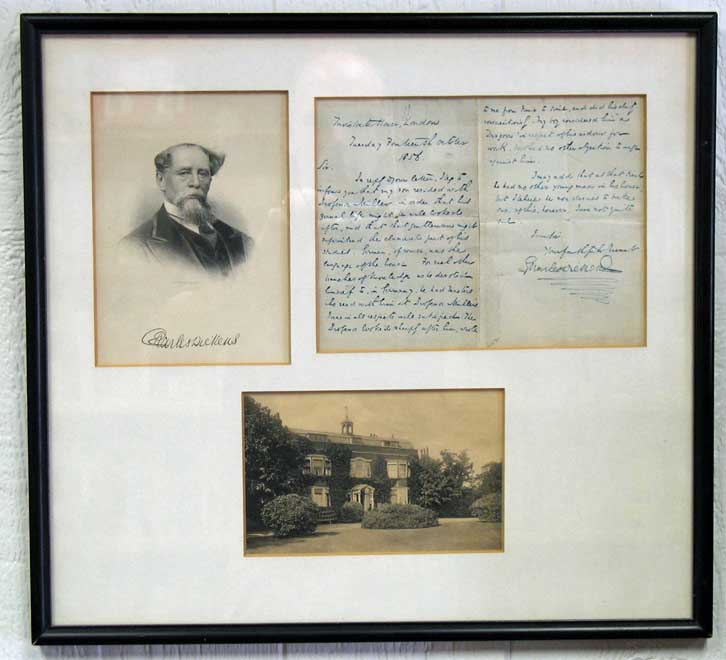
Charles_Dickens

Can we really blame Bigelow for being obsessed with this guy? We are!

When Charles Dickens arrived in Boston for the first time, he was greeted with incredible fanfare. He would fall in love with the city and be lured back there in 1867. By this time, Dickens had established himself as a preeminent author of the age, and he undertook a whirlwind reading tour. His fans’ adulation had not abated in the past decades, and Dickens found himself once again the center of attention.

One woman gave Dickens a bit too much attention–Jane Bigelow. Jane was a descendent of the Poultney family of England, a lineage that included a three-time mayor of London and an Earl of Bath. When she married John Bigelow on June 11, 1850, she was 21 years old and he was 33. The couple would have nine children together. John Bigelow was already managing editor and co-owner of the New York Evening Post, and he had a promising political career ahead of him. He would eventually serve as President Lincoln’s consul general and later as the minister to France.

Although John took well to political life, his wife was not quite so suited for it. She managed to offend the Prince of Wales by slapping him on the back, and she sent her servants to sit in the imperial opera box in Germany. It’s rumored that John was denied further diplomatic posts because of his wife’s crass behavior, to which Charles Dickens would unfortunately find himself privy.

A Chance Acquaintance at the Parker House

November, 1867 found both the Bigelows and Dickens at the Parker House. Dickens had made the hotel his home base during this second American tour, and he often dined there with publisher James T. Fields. The Bigelows dined with Fields, Dickens, and his manager George Dolby. The group played parlor games together, as was common for genteel hotel guests at the time. Jane Bigelow soon proved herself a rather tiresome companion; she frequently showed herself to have little grasp for polite manners or common courtesies.

Dickens’ own wife had proven unequal to the task of running a household–let alone keeping up with Dickens’ tireless publicity and authorial efforts, and Dickens could empathize with John Bigelow’s plight. Fields’ wife, Anne observed in her journal that Dickens had “deepest sympathy for men who were unfitly married and has really taken an especial fancy I think to John Bigelow…because his wife is such an incubus.” Jane Bigelow figured in Anne’s journal frequently enough that Anne took to calling her “Mrs. Bigs.” When the Bigelows finally returned to New York, Dickens was likely grateful to escape Jane’s irksome company.

An Unexpected Encounter Turns Violent

But then he traveled to New York himself and encountered Jane under more peculiar circumstances. Dickens was doing a reading at the Westminster Hotel, and the hotel manager asked him to meet with “a little widow” named Mrs. Hertz. She was a great admirer of Dickens and was thrilled to meet him privately. But when Mrs. Hertz left Dickens’ rooms, she found herself face to face with none other than Jane Bigelow! Jane attacked Mrs. Hertz and berated her for being “daring” enough to enter Dickens’ rooms alone. For the rest of the tour. Dolby had to place guards outside Dickens’ quarters to prevent interlocutors, most notably Jane, who tried to see Dickens on several subsequent occasions.

Dickens took the whole incident in stride, but he was struck with the oddity of the situation. He wrote to a friend, “How queer it is that I should be perpetually having things happen to me with regard to people that nobody else in the world can be made to believe.” Though a few other literary figures like Oliver Wendell Holmes had achieved celebrity status as authorial rock starts, such status was still relatively uncommon. It was certainly unusual for an adoring, possibly crazy fan to attack an old widow outside one’s hotel room!

Though Dickens’ encounter with Jane Bigelow was out of the ordinary, it illustrates the magnitude of his fame. Beloved in his time, Charles Dickens remains a major figure in world literature and a favorite among rare book collectors.

Related Posts:
How the “Dickens Controversy” Changed American Publishing
Charles Dickens Does Boston
Irving and Dickens: The Authors Who Saved Christmas
Why Did Charles Dickens Write Ghost Stories for Christmas?
The Two Endings of Charles Dickens’ ‘Great Expectations
Oscar Wilde: Dickens Detractor and “Inventor” of Aubrey Beardsley

Thanks for reading! Love our blog? Subscribe via email (right sidebar) or sign up for our newsletter--you’ll never miss a post.
Share