Author Archives: tavistock_books

Irving and Dickens: The Authors Who Saved Christmas

Dickens-Irving

When Clement Clarke Moore published “A Visit from Saint Nicholas” anonymously on December 23, 1823 in the Troy Sentinel, he couldn’t have known that it would become an international phenomenon. But the poem not only gave names to Santa’s eight reindeer. The illustrations of the poem’s reprints significantly impacted our perception of Santa Claus. Caricaturist Thomas Nast would later illustrate jolly old Saint Nick, cementing our concept of him as a jolly. bearded man. And Coca-Cola would eventually be the first to bring us Santa in a red coat. We can thank Washington Irving and Charles Dickens, however, for resurrecting Christmas as a holiday for joyful family celebration.

A Brief History of Christmas

Before Christianity took hold, pagan rituals were routinely honored on the winter solstice. On this day, people would celebrate the triumph of light over darkness. Early church officials, eager to supplant these rites with their own, wisely chose to make Christmas celebrations correspond to these pagan rituals. The strategy had one caveat: the Church couldn’t dictate how people would celebrate Christmas. Thus, Christmas had mostly replaced pagan holidays by the Middle Ages, but holiday observances were usually far from pious. Believers might go to church, but afterward citizens would gather for rowdy festivals similar to Mardi Gras. Each year a student or beggar would be named “Lord of Misrule,” and festival attendants would play the role of his subjects. Meanwhile the poor would go to the homes of the rich to demand food and drink. Non-compliant homeowners risked mischief.

Oliver-Cromwell

Oliver Cromwell was the original Grinch, canceling Christmas when he took over England in 1645.

But Oliver Cromwell proved to be the original Grinch. A staunch Puritan, Cromwell believed that Christmas was a decadent and unchristian holiday. When he took over in 1645, he vowed to rid England of such indulgences and cancelled Christmas. In 1660 Charles II was restored to the throne by popular demand and reinstated the holiday. But the holiday wouldn’t immediately take hold. By Dickens’ time, the Industrial Revolution had all but destroyed the holiday in Great Britain–for most people, Christmas was still a work day.

Meanwhile the Puritans had left England to settle in the New World. For the most part, Christmas went uncelebrated in the colonies. In Boston the observation of Christmas even bore a five-shilling fine from 1659 to 1681. (Jamestown was a notable exception: Captain John Smith–the first person ever to consume eggnog–reported in 1607 that the settlement happily enjoyed the holiday.) The American Revolution proved a death knell for traditions of British origin, so Christmas again fell out of favor. It would not be declared a national holiday in the United States until June 26, 1870.

Washington Irving, the Real Father Christmas?

When Washington Irving published Knickerbocker’s History of New York (1809) under the pseudonym Dietrich Knickerbocker, New Year’s Eve was New York’s only real winter holiday. The book parodied American life, and Irving satirized the traditions of New York’s Dutch settlers. He poked fun at their patron saint, Nicholas, whom they called “Sanct Claus.” In Irving’s account of Oloffe the dreamer, Oloffe, a prophet and land speculator, dreams of a night where “the good Saint Nicholas came riding over the tops of the trees, in that self-same wagon wherein he brings his yearly presents for children.” Irving’s St. Nicholas not only delivers presents to children in a sleigh; he also smokes a pipe and places the presents in stockings hung by the chimney.

John-Pintard-St-Nicholas

John Pintard’s St. Nicholas isn’t quite the jolly figure we imagine today!

Irving had some unsolicited assistance in St. Nick’s makeover. New York Historical Society founder John Pintard publicized an engraved picture of St. Nicholas–admittedly looking less than merry–as a symbol of New York City. But Americans remained ambivalent about the holiday. Members of different religious denominations had different concepts of what the holiday should be; some saw Christmas as sacred, while others still believed it blasphemous. Observation was spotty at best, though enterprising Boston merchants advertised ritual Christmas gift exchange as early as 1808.

Dickens-Irving-Grolier-Club

A stray leaf from the correspondence of Washington Irving and Charles Dickens

Irving moved abroad in 1815, and it was not until several years later that he would write another bestseller. The Sketch Book of Geoffrey Crayon was published in several installments from 1819 to 1820. Sandwiched in between American classics like “Rip Van Winkle” (first installment) and “The Legend of Sleepy Hollow” (sixth installment), Irving published five Christmas stories in The Sketch Book’s fifth installment on January 20, 1820. He’d spent time at Astor Hall, recently leased from Adam Bracebridge by James Watt and passed the Christmas holiday with the Watt family. Irving was charmed by their Christmas traditions, reinventing Watt as the benevolent “Squire Bracebridge” in “Bracebridge Hall.” In “Christmas,” Irving writes, “But in the depth of winter, when nature lies despoiled of every charm and wrapped in her shroud of shielded snow, we turn for our gratifications to moral sources.” He would later explain the tradition of hanging mistletoe to American readers with a footnote in “Christmas Eve.” Irving believed that America could use a dose of English Christmas tradition, particularly the part where the poor are welcomed into the homes of the wealthy for a meal.

Historians mostly agree that Irving idealized the English country Christmas in The Sketch Book, but the veracity of his accounts wasn’t important to Americans. They embraced Irving’s stories. Then in 1828, the New York City Council had to create its first police force in response to a Christmas riot. The upper class decided it was time to reinvent the holiday, and Irving’s accounts fit the bill. By 1835, New Yorkers had all but abandoned Christmas revelry in favor of more idyllic celebrations at home. Christmas was revived in America.

Charles Dickens Follows Irving’s Footsteps

Charles-Dickens-Boston-Washington-Irving

Report of the Dinner Given to Charles Dickens in Boston (Feb 1, 1842)

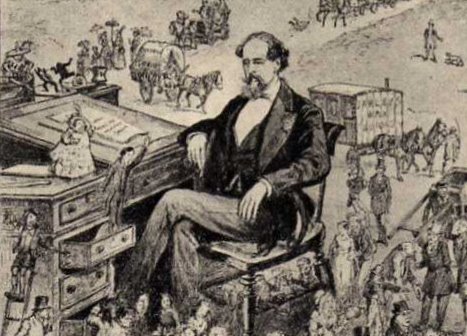
Charles Dickens visited the United States in 1842, and Washington Irving hosted a dinner in his honor on February 1 of that year. Numerous luminaries attended, and the event made headlines. When Dickens addressed the audience and thanked his host, he admitted his own devotion to Irving: “I say, gentlemen, I do not go to bed two nights out of seven without taking Washington Irving under my arm upstairs to bed with me.” In The Pickwick Papers, Dickens evokes Irving’s Squire Bracebridge in the character of Mr. Wardle, who merrily reminds his guests that it’s customary to while away the hours of Christmas Eve with games and ghost stories. Dickens again adapts Irving’s presentation of Christmas in A Christmas Carol, placing them in Mr. Fezziwig’s hall and in the home of Scrooge’s nephew, Fred. Thus he takes Christmas out of the country manor and brings it to working class London. Dickens’ Christmas is also centered on family and children, rather than church or community, another paradigm shift that Victorians readily embraced.

Charles-Dickens-Pirate-Christmas-Carol

Dickens brought suit against five defendants for selling a piratical edition of ‘A Christmas Carol.’ Only one fought the charges, and the account makes for interesting reading!

Dickens wrote A Christmas Carol in only six weeks during the autumn of 1843. It was published on December 19, and all 6,000 copies sold out that day. Dickens had chosen to illustrate the book with colored plates, but the expense associated with that method cut into his profits. It would be the first and only book he published with such plates. The illustrations, however, helped to bring Dickens’ Christmas to life and have since inspired a number of talented illustrators–not to mention printers and book binders who have also been taken with the work. A Christmas Carol has never gone out of print, and so many editions exist that the book is the perfect subject for a single-title collection. Dickens would write other Christmas tales, but none of these would have such an influence on the way the holiday was celebrated. Dickens’ exhausting schedule of reading tours–the first of which was for A Christmas Carol– doubtless helped promulgate his vision of Christmas, as well.

Washington Irving and Charles Dickens helped to pave the way for a rich tradition of Christmas literature, ranging from community cookbooks to children’s books. But these contributions are merely one facet of the authors’ incredible legacies.

Related Posts:

Why Did Charles Dickens Write Ghost Stories for Christmas? 
Charles Dickens Does Boston
Charles Dickens’ Debt to Henry Fielding
Happy Birthday, Washington Irving! 

Share

Announcing 100 for $100 (or Less!)

Fifty Romance Lyric Poems

The holidays are just around the corner. Santa is filling his bag, polishing his sleigh, and ensuring the reindeer are getting plenty of cardio in advance of the big night, December 24th. And perhaps that ‘big gift’ for your loved one(s) is already secreted away in the closet or a drawer, but stocking stuffers, accompaniments and remembrances for friends have yet to be secured.

Why not a book?

And in that vein, Tavistock Books offers our Holiday list, “A 100 for a $100 (or Beyond the Borderless!).” The one hundred books that comprise this list have been individually selected for their interesting & diverse nature, gift quality appearance, and modest price. You’ll find the entire list of select acquisitions online, and we invite you to peruse it. The list may be sorted by various means; just select your preferred option from the upper right.

Should you have queries regarding any of this material, or other listings you The Perfect Present-Haguemay find on our site, please contact usWe thank you for your attention, and we hope you find something of interest while browsing these offerings.

Happy Holidays to All!

Kind Regards,

13 Words-Lemony SnicketVic Zoschak
Principal

Margueritte Peterson
Aide-de-Camp

Share

Edith Cavell, Nurse, Humanitarian, and Traitor?

Edith_Cavell

It’s not unheard of for nurses to serve in extraordinary ways, but Edith Cavell went far beyond her nursing duties during World War I. The British nurse and patriot was executed for treason during World War I. Both the British and American governments would propagandize her death to bolster support for the Allied cause.

Cavell was born on December 4, 1865. She trained at the London Hospital under Matron Eva Luckes and earned a reputation as a wonderfully capable nurse. In 1907, she was recruited by Dr. Antoine Depage to be matron of the newly established L’Ecole Belge d’Infirmieres Diplomees in Brussels. Cavell flourished there, and by 1910 she “felt that the profession of nursing [had] gained sufficient foothold in Belgium” to warrant a scholarly journal for the discipline. She launched L’infirmiere that same year.

An Accomplished Nurse with a Humanitarian Mission

By 1911, Cavell was the training nurse for three hospitals, 24 schools, and 13 kindergartens in Belgium. When World War I broke out, the Red Cross assumed control of Cavell’s hospitals. Cavell, famous for saying “Patriotism is not enough,” threw herself into her work, saving the lives of countless soldiers on both sides of the war.

Edith-Cavell-Movie-Poster

The-Cavell-Case

Cavell’s story was adapted for the silver screen, first as propaganda in 1919, and again in 1939 when it revived anti-German sentiments. 

Cavell was one of many nurses recruited by the British Secret Intelligence Service (SIS) to gather intelligence on the Germans. But in November 1914, she put these duties aside to begin funneling British and French soldiers out of Belgium and into neutral Holland. Cavell tirelessly dedicated herself to these efforts, eventually raising suspicion. On August 3, 1915, Cavell was arrested by the Germans.

Although Cavell had indeed committed espionage, the Germans chose to try her for treason. Cavell was incredibly outspoken after her arrest, making no attempt to defend herself. She openly admitted her actions in three separate written statements and multiple verbal interrogations. Unfortunately for Cavell, under the auspices of the first Geneva Convention, the death penalty was a permissible punishment for treason.

Edith-Cavell-NursingThe British claimed that their hands were tied in the matter. The US government did put some pressure on Germany, reminding German officials that the country’s public reputation was already quite tarnished. Only one German intervened on Cavell’s behalf: Baron von der Lancken argued that Cavell should be treated with moderation because she had saved so many German lives. But General von Saubozweig insisted that Cavell be executed swiftly. Of the five people arrested in the case, only Cavell and one other were actually executed; the rest were later released.

Fuel for Allied Propaganda

There are numerous accounts of nursing from World War I, such as Grace MacDougal’s Nursing Adventures: A FANY in France (1917) and Violetta Thurston’s Field Hospital and Flying Column: Being the Journal of an English Nursing Sister in Belgium and Russia (1915). But Edith Cavell would leave a different kind of legacy.

Edith-Cavell-Propaganda

 Rather than leaving an account of her own experiences, Cavell would unwittingly leave her mark on British and American propaganda during World War I. She became the most famous British female Edith_Cavell_Crime_Des_Barbarescasualty of the war. The British government used her story to bolster military recruitment, while the US adopted Cavell to garner favorable sentiment toward the Allied effort–and to demonize the Germans.

Cavell-Propaganda-StampSoon after her death, news reports of questionable veracity emerged. Even the American Journal of Nursing printed a spurious account of Cavell’s execution, in which Cavell had refused to wear a blindfold, fainted in the face of the firing squad, and been shot point blank by a German commanding officer. Eyewitnesses later indicated that this version was false.

Cavell is one of many figures in the history of nursing who have left an indelible mark on the world. She not only made strides as a figure in modern nursing, but also set herself apart as a remarkable humanitarian.

Share

Why Did Charles Dickens Write Ghost Stories for Christmas?

scrooge


Charles Dickens’ A Christmas Carol has become a beloved part of the literary canon–and for many an indispensable part of the holiday season. The story embodies the goodwill associated with the Christmas season–and it has the Victorians’ favorite elements of a good Christmas story: ghosts. Dickens wrote other Christmas tales that also incorporated phantoms and ghosts, as did his Victorian cohorts. But why this obsession with ghosts at Christmastime?

An All But Dead Holiday–With Pagan Roots

By Dickens’ time, Christmas was not much of a holiday. In fact, for most people it was still a work day. The Industrial Revolution meant fewer days off for everyone, and Christmas was considered so unimportant that no one complained. This was thanks to none other than Oliver Cromwell, the Lord and Protector of England in mid seventeenth-century England. Cromwell had toiled to eradicate Christmas altogether because the holiday had no scriptural basis; the Bible mentions no “holy day” other than the Sabbath and certainly doesn’t exhort Christians to celebrate Jesus’ birth on December 25.

Christmas_Forbidden_Cromwell

Furthermore, Cromwell knew that the date of December 25 was shrewdly chosen by early Christian officials who wanted to replace pagan rituals with Christian ones. The day was selected because of its association with two pagan holidays, Yule and Sol Invictus (the birthday of the Unconquered Sun). Both were celebrated in conjunction with the winter solstice, the longest night of the year. On this night, the boundaries between the physical and spiritual worlds were considered particularly permeable. It was believed that spirits would return to Earth to finish unsettled business–exactly what Jacob Marley does in A Christmas Carol.

Spinning a Winter’s Tale

While there’s scant proof that the Christmas ghost tale existed as a consciously undertaken tradition before the Victorian era, there is etymological evidence that the tradition stretches back at least to Shakespeare’s time. In “A Christmas Tree” (1859), Dickens writes, “There is probably a smell of roasted chestnuts and other good comfortable things over time, for we are telling Winter Stories–Ghost Stories, or more shame for us–round the Christmas fire.” That phrase “winter stories” and its variant “winter’s tale” had mostly fallen into disuse by Dickens’ day, but it refers to a fantastical yarn that one would weave to entertain interlocutors around a wintertime fire.

An even more specific connotation for “winter story” or its relative “winter’s tale” notably shows up in Christopher Marlowe’s The Jews of Malta (1589) with a very specific definition: a “winter’s tale” is a ghost story.

Now I remember those old women’s words

Who in my wealth would tell me winter’s tales

And speak of spirits and ghosts that glide by night

Shortly thereafter Shakespeare would play on this meaning with A Winter’s Tale (1623), in which Prince Maximillius says, “A sad tale’s best for winter; I have one/Of sprites and goblins.” Later in Saducismus Triumphatis, Joseph Glanville’s treatise on witchcraft published posthumously in 1681, Glanville admonishes individuals who dismiss the existence of witchcraft as “meer Winter Tales or Old Wives fables.”

Robert Louis Stevenson would later evoke the winter’s tale with The Master of Ballantrae: A Winter’s Tale (1889). Though the story contains no ghosts of the usual sort, the Master cheats death multiple times. He essentially haunts his brother, Henry, who eventually exclaims, “nothing can kill that man. He is not mortal. He is bound upon my back to all eternity–to all eternity!” Later, after the Master’s body has been buried, Henry still does not believe the Master has perished. Henry is incredulous: “He’s not of this world, neither him nor that black de’il that serves him.”

A Victorian Predisposition for the Ghostly

The Victorian Age was one in which spiritual beliefs were constantly being upended by scientific discoveries. It’s no wonder that Victorians turned to spiritualism and other superstitions to distract from that state of uncertainty, or that seances, table rapping, and other fads took hold. Another of these was telling ghost stories, and Dickens was far from the only author to participate. Sir Arthur Conan Doyle was noted for his rather eccentric spiritualism. Edith Nesbitt, Elizabeth Gaskell, and Rudyard Kipling all wrote ghost stories that often get overshadowed by their more famous works. And Henry James uses Christmas ghost storytelling as a frame for Turn of the Screw. Most importantly, Washington Irving had actually presaged Dickens’ A Christmas Carol and The Pickwick Papers’ Gabriel Grub character (a character visited by goblins in Mr. Warble’s Christmas tale) with his own depictions of the Christmas holiday, a relationship that we’ll explore in an upcoming post.

The tradition of telling ghost stories at Christmas stuck. Slightly later, Eton Provost and author Montague Rhodes James would entertain his students with ghostly tales around the Christmas fire. HP Lovecraft’s “The Festival” was written for Christmas. And twentieth-century Canadian author Robertson Davies would spin ghost tales for Massey College students every Christmas season. Though not widely practiced, the winter’s tale lives on as a Christmas tradition.

This month, in anticipation of the Christmas season, we offer select acquisitions of Dickensian Christmas literature. We invite you to peruse the list, which includes 60 items. Should you have a question about any item, please don’t hesitate to contact us!

Share

Famous Figures in the History of Nursing (Part One)

We all know Florence Nightingale and Clara Barton are major figures in the history of nursing, but they were certainly not the only women in the history of nursing who made an important mark. During the Civil War, a number of important historical figures turned their attention to nursing. Today we’ll look at Louisa May Alcott, Annie Wittenmyer, and Dorothea Dix.

Louisa May Alcott

Louisa-May-AlcottBest known for Little Women, Louisa May Alcott penned dozens of popular works and was an early supporter of the women’s suffrage movement. Her family were also passionate abolitionists; one of her earliest childhood memories was of a “Contraband” slave hiding in her family’s home, which was part of the Underground Railroad. When the Civil War broke out, Alcott was eager to support the cause. In December 1862, at thirty years old, Alcott began nursing at Union Hospital in Georgetown. She fell ill with typhoid pneumonia after only six weeks and returned home. Though she survived the illness, the mercury-based drugs used to treat it had lasting side effects; Alcott would never be fully healthy again.

Alcott-Hospital-Sketches

Hospital Sketches (1869)

Alcott published Hospital Sketches in 1863. She noted that “the Sketches never made much money, but showed me ‘my style,’ and taking the hint I went where glory awaited me.” Alcott credited Hospital Sketches with showing her that her writing would be successful if she drew from her own experiences. Five years later, in 1868, Little Women would prove extremely popular for exactly that reason. Though Alcott’s stint as a nurse didn’t last long, it planted the seeds of some of America’s most beloved literature.

Annie Wittenmyer

Annie-WittenmyerSarah “Annie” Turner Wittenmyer began her career campaigning for orphans in Iowa. But during the Civil War, Wittenmyer joined the Keokuk Ladies’ Soldiers’ Aid Society and turned her attention to caring for wounded soldiers. As Wittenmyer visited different military hospitals, she observed the deplorable conditions–and wasn’t shy about reporting them. Her advocacy resulted in new local support for funding and reform. In 1862, Wittenmyer was named Sanitary Agent for Iowa State Sanitary Commission. She was the first woman to hold that post.

Wittenmyer_Under_Guns

Under the Guns (1895)

In 1864, however, Wittenmyer resigned the post to develop a dietary system for hospitals. By this time the practice of offering specialized food for convalescents was widely practiced. But she observed that these special diets were often poorly prepared–the people preparing the food often had little experience in food preparation, and the proper ingredients were often in short supply. Wittenmyer devised a plan to address at least the first of these challenges: she came up with a system of special kitchens that were overseen by female superintendents. Wittenmyer got support from the United States Christian Commission and established these kitchens at multiple large hospitals. The program was so successful that it was instituted at approximately 100 hospitals by the end of the Civil War. Wittenmyer even published a cookbook as a guide for the women running these kitchens.

Dorothea Dix

Dorothea Lynde Dix first became involved with the mentally ill at a prison in Massachusetts. She was shocked at the horrible conditions and lack of care that prisoners who clearly had mental illnesses Dorothea-Dixreceived, and she immediately began campaigning to improve their situation. But her focus changed on April 19, 1861, when a Massachusetts regiment on the way to Baltimore was waylaid by secessionists. Dix immediately boarded a train to Baltimore, intending to volunteer as a nurse. But when she arrived in Baltimore, Dix discovered that provisional hospitals had already been established and were relatively well staffed. Thus, she continued on to Washington, DC, where she offered her services as a nurse for the War Department.

Dix-Sequel-Marion-Wilder

Sequel to Marion Wilder (1828)

Despite her lack of medical training, Dix was made Superintendent of United States Army Nurses only months later. She immediately turned her attention to acquiring supplies and training staff. Dix insisted that her nurses all be over age 30 and plain looking. She also required them to wear drab uniforms. Her stringency paid off; Dix not only established order, but she also raised the standards of care.

Dix consistently demonstrated a selfless dedication to her cause. She once went to visit Joseph Fielding, first Secretary of the Smithsonian Institution. Fielding noted Dix’s exhaustion and asked why Dix had not taken a carriage. Dix noted that she hadn’t the money to hire a carriage because she’d spent all her money on medical supplies, and she staunchly refused to use the carriage Fielding requisitioned for her. Dix served as superintendent through the end of the Civil War, and then went back to advocating for the mentally ill.

Check back soon for Part Two, where we’ll introduce more overlooked figures in the history of nursing!

Share

Charles Dickens Does Boston

Dickens-Public-Reading-1867

Charles Dickens at a public reading in 1867

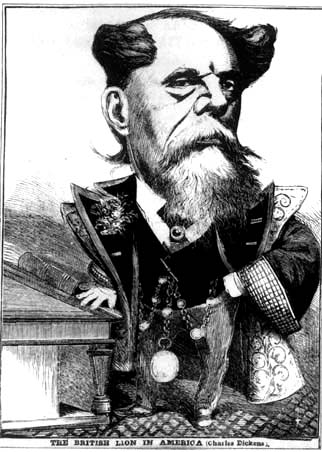
We’re ready for a cross-country voyage to Boston for the 36th Annual Boston International Antiquarian Book Fair this weekend! Boston is a city steeped in literary tradition, and it was the first city in the New World to emerge as an enclave of authors and publishers. It’s no wonder that Charles Dickens chose it as an important destination when he came to America in 1842 and again in 1867. The confluence of advancements in steam and rail travel, along with new photography technology, contributed to elevating Dickens to celebrity status. The Inimitable was indeed the one of the first in the nineteenth century to achieve such a vaunted position.

Dickens’ First Visit and American Notes

Proclaimed the “first American edition” of Dickens’ ‘American Notes,’ this Brother Jonathan edition actually missed that distinction by mere hours.

On January 3, 1842, Charles Dickens boarded the steamship Britannia and started his first voyage to America. Though he wasn’t yet even thirty years old, Dickens had already attained incredible popularity on both sides of the Atlantic. He planned to take a year off from writing and explore the United States. Dickens, his wife, Kate, and maid Anne Brown faced unusually rough seas on their journey but arrived in Boston relatively unscathed on January 22, 1842.

He’d arrived in Boston only to be mobbed by adoring fans. Noted painter Frances Alexander rescued Dickens and his wife from the melee. Dickens was received in Boston by a number of prominent Bostonians, including Harvard professor Cornelius Felton, abolitionist and Anglophile Richard Henry Dana (himself the bestselling author of 1840 Ten Years Before the Mast), Daniel Webster, Oliver Wendell Holmes, and barrister Charles Sumner. Dickens soon found himself praised in the press as “Boz, the gay personification of youthful genius on a glorious holiday.”

Dickens stayed in Boston a whole month and fell in love with the city. “Boston,” he said, “is what I would like the whole United States to be.” Dickens had a relatively ambitious travel agenda; he planned to start in Boston, then head west and explore the country. He also had another ambitious goal: to introduce the idea of an international copyright law. Dickens’ works were regularly pirated in America, costing Dickens untold sums each year. He reasoned that American authors–whose works were frequently pirated in Europe–would also benefit from international copyright law and would support the idea.

Dickens-Boston-1842

Despite Dickens’ gaffe of introducing the unpopular topic of international copyright law that evening, Dickens enjoyed his dinner with the “Young Men of Boston,” writing to John Forster that “It was a most superb affair and the speaking admirable.”

But such would not be the case. Dickens broached the subject at a “Young Men of Boston” dinner on February 1, 1842. He met resistance from both his fellow authors and the popular press. It would be another fifty years until an international copyright law was implemented. Dickens would, however, eventually manage to forge a relationship with American publisher James T Fields, who held absolute volume rights to Dickens’ novels in America. Not that this mattered to some US publishers, but nevertheless, this provision offered Dickens some modest remuneration for his popularity in the States.

Meanwhile, thanks to tireless introductions from Sumner and Dickens’ own international celebrity, Dickens enjoyed quite the full and varied itinerary. Dickens sat in on sessions of Congress and met President Tyler. He also indulged his fascination with the odd, touring prisons, asylums, reform schools, and schools for deaf and blind children. Dickens also wished to witness slavery firsthand He had planned a trip to Charleston, South Carolina, but due to complications found himself in Richmond, Virginia instead. Dickens was rightfully horrified by the institution of slavery. He would write to William Macready, “This is not the republic I came to see; this is not the republic of my imagination.”

Dickens’ impressions would be published in American Notes, which Dickens completed in only four months. The work painted an unflattering picture of America: Dickens attacks slavery and descries Americans’ general lack of social awareness. He blamed the latter on the press. Dickens further explored the shortcomings of the new republic in Martin Chuzzlewit, when young Martin goes to America. Dickens’ scathing representation of the country temporarily crushed his popularity, but he soon recovered.

An Amended View of America

Dickens-Departure_Boston

A banquet with “upwards of one hundred celebrities” was held in Dickens’ honor before he departed London in 1867. This pamphlet records speeches made by Dickens, Lytton, Russell, Trollope, and others.

In 1867, Dickens finally succumbed to the temptation of another lucrative book tour (and who can blame him, what with so many mouths to feed at home?). By this time, the Civil War had resulted in the abolition of slavery, and Dickens found America much changed. On April 18, 1868 at a dinner in his honor, Dickens alluded to his previous negative impressions of the country and admitted that both he and the United States had evolved. He promised to make appendices to both Martin Chuzzlewitt and American Notes to mitigate his prior views.

That dinner was one of seemingly countless appearances and events that Dickens attended during his second trip to America. He’d considered bringing his mistress, Ellen Ternan, with him for the tour. But tour manager George Dolby, who’d arrived in Boston early, learned that bringing Ternan would be a serious faux pas. Dickens would travel, then, only with his staff. By this time his health was failing; he’d spent many previous weeks unable to walk without assistance. But he’d been guaranteed £10,000 from a consortium of Boston dignitaries, with his publisher Fields leading the initiative.

Boston had little else to occupy itself during Dickens’ visit; the lack of crisis or election left them plenty of time to indulge in Dickens mania. Dickens did his best to avoid the throngs of adoring fans, passing his down time in his rooms at the Parker House. He still managed to meet members of Boston’s intelligentsia, such as illustrators Sol Entinge, Jr and Thomas Nast, scholar Charles Eliot Norton, and science writer Louis Aggasiz.

Christmas Carol-Charles Dickens

This first US edition of ‘A Christmas Carol’ is, in our experience, offered much less frequently than the first UK edition.

Dickens pushed himself through a grueling schedule of readings and other events during this visit. He found that ticket scalpers had become terribly aggressive; for example, when Dickens read at Harvard on December 2, 1867, not a single student was able to obtain a ticket. That day, Dickens read from A Christmas Carol, much to the pleasure of his adoring audience.

On November 30, 1868, the Saturday Club met at the Parker House to hear Dickens read. The author was noted for his elaborate dress and stage set-up, and this event was no exception. In front of a massive maroon backdrop, and atop a maroon carpet, sat a custom designed reading desk. The desk held a variety of gas pipes designed to provide proper lighting for different moments in the reading. Dickens delivered a 2.5-hour program with only a ten-minute intermission.

Dickens was himself a member of the Saturday Club, which also included colleagues like Oliver Wendell Holmes and Henry Wadsworth Longfellow. Though Dickens generally dined with Fields at the Parker House, he joined Longfellow for a traditional Thanksgiving meal. The meal was surely a sober affair. Longfellow had recently been made a widower. His second wife, Frances Appleton, had been immolated in an accidental fire. Longfellow wore a beard to cover the disfiguring scars he’d incurred trying to save her. Then in New York from December 25, 1867 to January 4, 1868, Dickens enjoyed a traditional Christmas holiday with Fields.

Afterward he continued to push himself past his own limits–both professionally and personally. On February 29, 1868, Dickens participated in what he jokingly called the “Great International Walking Match,” a competition more suitable for a man used to walking up to twelve miles a day, rather than a man of Dickens’ careworn constitution. The weather that day was terrible, but Dickens and his friendly competitors persisted. In a letter to his daughter, Dickens called himself the “Gads Hill Gasper” and said, “As the subtitle of the famous broadside said, ‘the origin of this highly exciting and important event cannot be better state than in the articles of agreement subscribed by the parties.” Following this athletic exertion, Dickens required a full rubdown before he could attend dinner–and he fell into his own bathtub, fully clothed, later that same evening.

Dickens would depart from Boston on April 10, 1868. He quietly traveled to Westminster, New York, where he stayed until sailing back to England on April 22, 1868. Thanks to the adulation of Dickens’ American readers, the author became one of the first modern celebrities.

Share

The Rare Books of Boston

November 15, 2013 kicks off the 36th Annual Boston International Antiquarian Book Fair! The city has played a vital role in America’s history, and in the history of the book. Here’s a look at some items in our collection that tie in with Boston’s rich past.

Red Sox Memorabilia

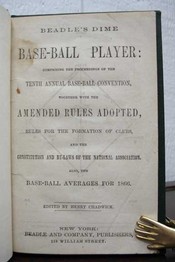
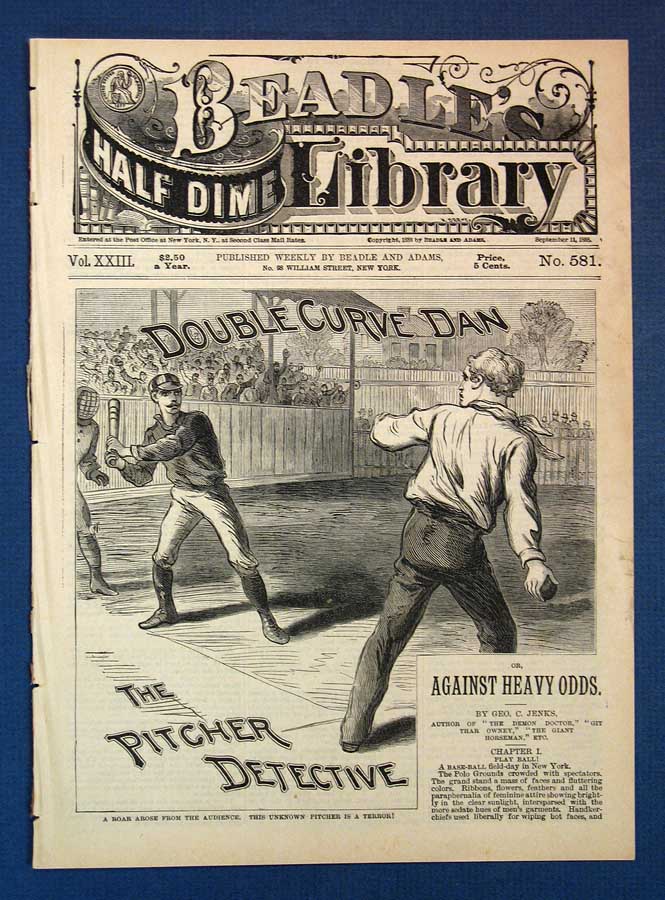
Red-SoxFew sports fans are more loyal than Red Sox fans. The Boston team was founded in 1901 as one of the American League’s eight charter franchises. For seven seasons, the team actually had no official name. They were referred to simply as “Boston,” “Bostonians,” or “Boston Americans,” while newspapers gave them more creative nicknames like “the Beaneaters” or “Plymouth Rocks.” In 1908, team owner John I Taylor chose the name “Red Sox,” a nod to the red socks that would become symbols of the team. Chicago journalists had started using “sox” as a headline-friendly shorthand for “stockings” already, and Taylor liked the name. But the team initially didn’t even wear red socks, but dark blue ones! And a Cincinnati team was actually the first to call iRed-Sox-Deweytself the Red Stockings. The team were members of the pioneering National Association of Base Ball Players and hired their first fully professional team in 1869, but the club folded after the 1870 season.

Boston Red Sox memorabilia is part of America’s rich and exciting tradition of baseball. We’re pleased to offer Boston Official Programs and Score Cards from 1957 and 1958. Another interesting item is AG Dewey Company’s Genuine Dodge Davis Flannel sample book (1971). The company got its start in 1936 in Quechee, New Hampshire. Throughout the 1930’s AG Dewey Company made the uniforms for the Boston Red Sox, New York Yankees, and other teams.

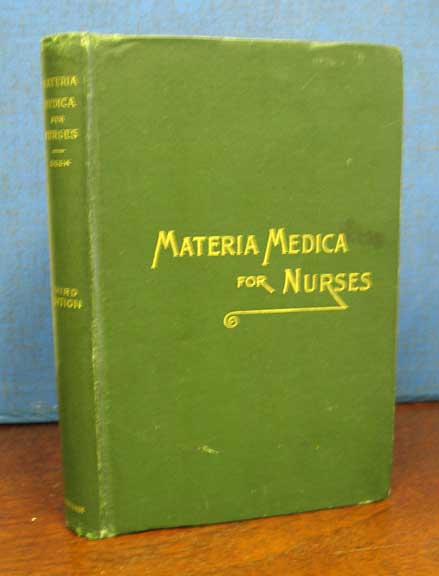
Boston Training School for Nurses

The Boston Training School for Nurses was only the second of its kind in the country, preceded by the Bellevue school in New York. At the time, nursing was still not viewed as a vocation that required much training; women would often take up the career simply due to financial need, and in many cases nurses had no special qualifications to recommend them. In New York, this resulted in patients’ immense suffering at the hands of inept nurses. No such condition emerged in Boston, however; nurses there were considered some of the best in the nation. Thus the push to start a training school met with some resistance; why would good nurses need further training?

Eventually, however, nurses and doctors saw the potential advantages of such a program. The Boston Training School for Nurses was established in 1873. It was affiliated with Massachusetts General Hospital and eventually evolved into the Massachusetts General Hospital School of Nursing. The organization published annual reports, which are quite enlightening regarding nursing history. This copy of the report from 1892, in very good condition, shows us how the organization and nursing have evolved in only a few decades.

Dinners for Dickens

Charles-Dickens-Boston-1842Charles Dickens made two visits to the United States, first in 1842 and again in 1867. Boston proved an important city during both tours. In 1842, Dickens arrived to find himself already quite the celebrity, and his presence was in great demand. The “Young Men of Boston” had already extended an invitation to Dickens before he’d even left England. The dinner in his honor, documented by Thomas Gill and William English of the Morning Post, was held on February 1, 1842. Dickens made an almost fatal move during the course of the evening: he introduced the concept of an international copyright law. Dickens failed to gain the support of fellow authors as he’d anticipated. Instead he sparked a battle with the American press, who accused Dickens of creating a “huge dissonance” by broaching the subject of international copyright at such an inappropriate occasion. Dickens would further disenchant his American audience when he published American Notes and Martin Chuzzlewitt, both of which painted America in a less than favorable light.

Charles-Dickens-Boston-1867But Dickens’ genius soon won over his American audience once again. Swayed by the promise of £10,000 from a group of Boston intellectuals, Dickens headed back to America in 1867. Prior to his departure, a public banquet was held in the author’s honor at London’s Freemason’s Hall, on November 2, 1867. A record of the meeting was made, which includes speeches by Dickens, Lytton, Trollope, and other luminaries. Dickens’ second visit to the US proved a dizzying tour, jam packed with readings and public appearances. During one of his early appearances, he noted that both he and America were much changed since his first visit and vowed to issue appendices to American Notes and Martin Chuzzlewitt to temper his critical tone towards the US.

News from a Moving Train

In May, 1870, the Boston Board of Trade journeyed over 3,000 miles to San Francisco to meet with the San Francisco Chamber of Commerce. During the trip, twelve issues of the Trans-Continental were published on a Gordon press located in the baggage car. The paper reported the normal business of the train and its passengers, along with other news. The first issue, for instance, reports that the Athletics of Philadelphia beat Harvard Base Ball Club 20-8. The newspaper’s office was located in the train’s second car. The train was also equipped with “two well-stocked libraries, replete with choice works of fiction, history, poetry, etc.” Each issue recorded a different locale on the masthead. The newspaper is generally regarded as the first newspaper to be printed on a moving train.

A Political Discourse on Abolition

Lydia-Childs_AbolitionBoston was a hotbed for abolitionism. One Bostonian’s abolitionist work, though denounced at the time of publication, is now recognized as a groundbreaking tour de force in American abolitionist literature. Lydia Maria Francis Child published An Appeal in Favor of That Class of Americans Called Africans in 1833 and immediately shocked even fellow abolitionists. Unlike her colleagues, Child eschewed religious or scriptural justifications for ending slavery. She also ignored traditional, emotional arguments about the cruelties of slavery. This was because Child had a larger and more ambitious objective; she sought to end discrimination against free African Americans. Such a stance was hardly popular, which Child had predicted in her preface, saying, “Though I expect ridicule and censure, I cannot fear them.” Child’s tone and style of argument at the time were seen as more masculine than feminine, which didn’t ameliorate reception of her work. Her book sales plummeted, and the Boston Athenaeum even rescinded her free library privileges.

But Child’s work would prove incredibly influential in the movement, making it a desirable addition to a collection on abolition, African American history, and the history of ideas. The book is relatively scarce in the trade; only three copies have appeared at auction in the last thirty years. The last copy, sold in 2000, was imperfect. This edition of An Appeal in Favor of That Class of Americans Called Africans is bound in the original publisher’s cloth and has the errata slip tipped in. All in all, it’s a very good copy of a hard-to-find work.

Boston’s place in history intersects with the world of rare books in so many ways! What’s the most interesting item of Bostoniana in your collection?

Share

Edgar Allan Poe: Creator of Enduring Terror and Literary Masterpieces

Edgar-Allan-Poe

Edgar Allan Poe was the first American writer to earn a living completely by his pen–though that living wasn’t always enough to live on. The legendary author redefined the genre of horror and is rightly called the father of the modern detective novel. But these legacies are the result of a more visceral one: Poe’s ability to evoke an all-encompassing terror that springs not from without, but from within.

Poe’s Incredible Influence

It’s well known that Sir Arthur Conan Doyle used Poe’s C. Auguste Dupin as a model for his own detective, Sherlock Holmes, and that Doyle’s short stories (“Hound of the Baskervilles” in particular) owe a tremendous debt to Poe. Indeed, Doyle once rhetorically asked, “Where was the detective story until Poe breathed life into it?” But Poe’s influence reached beyond the worlds of horror and mystery. He has long been a beloved figure in literature, one whose power has not waned with the passage of many generations.

Poe and Washington Irving exchanged admiration for one another via correspondence. Irving noted that “the graphic effect [of “Fall of the House of Usher”] is powerful.” Poe responded by sending Irving a copy of “William Wilson,” which he considered his best work. Poe admitted that the story had been inspired by Irving himself, particularly Irving’s “An Unwritten Drama of Lord Byron.”

Robert Louis Stevenson said of Poe, “He who could write ‘King Pest’ has ceased to be a human being.” Stevenson found Poe’s stories absolutely gripping, and was undoubtedly flattered when critic Andrew Lang said that Stevenson was “like Poe with the addition of moral sense.”

Meanwhile Oscar Wilde ranked Poe’s poetry as more important than that of Walt Whitman, Ralph Waldo Emerson, and Henry Wadsworth Longfellow. Wilde emulated elements of Poe’s style in The Picture of Dorian Gray–which wasn’t lost on Walter Pater, who ardently praised Wilde’s efforts to evoke Poe’s style in the novel. Wilde’s colleague and defender George Bernard Shaw, often an unforgiving critic, was downright effusive about Poe, saying that the American author “constantly and inevitably produced magic where his greatest contemporaries produced only beauty. [His tales are] a world record for the English language: perhaps for all languages.”

Allen Ginsberg argued that “everything leads to Poe….Burroughs, Baudelaire, Genet, Dylan,” and Jorge Luis Borges contended that “contemporary literature would not be what it is” without Whitman and Poe. TS Eliot, however, was not initially convinced of Poe’s genius. He excluded Poe from both American and European literary traditions, calling Poe a “displaced European.” Eliot later acknowledged that he’d underestimated Poe’s talent.

Vladimir Nabokov included multiple allusions to “Annabel Lee” in his masterpiece, Lolita. It appears that Nabokov was indeed deeply interested in Poe; he meticulously mapped the area around Poe’s home and sketched the manifestations of soul in The Strange Case of Dr. Jekyll and Mr. Hyde (which he taught within the context of Poe). Both documents are currently on view at the Morgan Library’s excellent exhibit, Edgar Allan Poe: Terror of the Soul.

Later on, novelist and screenwriter Terry Southern, author of Dr. Strangelove, was deeply influenced by Poe, especially The Narrative of A Gordon Pym. Southern wrote an appreciation of Poe, called “King Weirdo,” which was published posthumously. And Stephen King has frequently borrowed archetypal themes from Poe’s works for his own horror novels. The Shining reminds us of both “Masque of the Red Death” and “Fall of the House of Usher.”

Collecting Edgar Allan Poe

Edgar Allan Poe makes a fascinating focus for a single-author collection and also fits wonderfully into nineteenth-century American literature and horror literature libraries. Poe’s works weren’t actually that popular during his lifetime, so they were issued in relatively small print runs. The first edition of Tamerlane and Other Poems (1827) is famously scarce; only twelve copies are known to exist. (Three are currently on display together at the Morgan Library!)

Even if Tamerlane is out of reach, there are countless other desirable editions and volumes. For example the Poetical Works of Edgar Allan Poe, published by George Robertson in 1868, was the first edition of Poe’s works to appear in Australia. It differs significantly from the British and American editions.

No illustrated editions of Poe’s works were published during his lifetime. The first, Tales of Mystery, Imagination and Humor; and Poems (1852) was illustrated by artists unknown, as they were not given credit for their work. Famous illustrators Edouard Manet, Aubrey Beardsley, Harry Clarke, Edmund Dulac, and Arthur Rackham; first editions of Poe’s works illustrated by these artists are highly desirable.

Poe’s works often showed up in serially issued collections. One of these is The Gift, A Christmas and New Year’s Present for 1842. This compilation includes Poe’s “Eleonora,” along with items from Howard Huntley, Catherine Beecher, and Park Benjamin. The volume also includes an uncollected piece by Lydia Sigourney, “The Village Church.”

Irving-Offering-Lizzie-Leigh-Gaskell

The Irving Offering for 1851

When Elizabeth Gaskell first published “Lizzie Leigh,” the story was initially ascribed to Charles Dickens–whose byline meant big bucks for publishers. “Lizzie Leigh” appears under Dickens’ name in The Irving Offering: A Token of Affection for 1851, which also include’s Poe’s “A Descent into the Maelstrom.” The edition is fairly scarce: OCLC records none west of the Mississippi.

Though Edgar Allan Poe enjoys special attention around Halloween, collectors of rare books appreciate his works year round. If you’re looking for a specific item for your Poe collection, please don’t hesitate to contact us! We’re happy to help.


Share

Flights of Fancy: Collecting Vintage Airline Posters

Salvador-Bahia_Brasil-Varig

Summer is long gone, and with it have gone the days of leisurely summer vacations. But collectors can recapture these moments and explore the history of aviation with vintage airline travel posters.

The earliest aviation posters, which date to the mid nineteenth century, did not advertise air travel, but the exploits of hot air balloonists. With the introduction of planes in the early twentieth century, posters were an effective means of advertising exhibitions and air shows. During World War I, aviation posters offered a subtle form of propaganda: the novelty and excitement of air travel attracted new recruits, and the military’s large-scale use of airplanes was an imposing sight unto itself. Commercial airlines began using posters to advertise in the 1920’s, but it wasn’t until the 1950’s and 1960’s that the airlines started producing posters that advertised both the excitement and comfort of air travel.

Collecting Vintage Airline Posters

For collectors, these collectible posters recapture the excitement and romance of air travel. They are also an interesting way to trace the history of aviation. Collectors often build collections around a specific airline, artist, destination, or time period.

Northwest_Orient_747FThe posters from now defunct airlines tend to be more sought after than those from companies that still exist. Pan American World Airways (PanAm) posters, for example, are particularly beloved. The airline started in 1927 with a single route from Key West to Havana, but soon became the leading international airline in the world, a distinction it held till iGolf-Worldwide_Pan_Americants collapse in 1991. Unlike other airlines, PanAm created posters for both its commercial and cargo planes. Smaller regional airlines also hold their own allure. Posters from the relatively obscure Jersey Airways in Britain and from Western Airlines and Northwest Orient Airlines in the US all offer charming travel posters. These airlines often have a relatively short history, so their posters can be more scarce.

Hawaii-United_Airlines

Some collectors focus on existing airlines. Swissair, founded in 1931 after the merger of two Swiss airlines, has long printed beautiful posters. The airline is a favorite among aviation enthusiasts because it consistently stays at the forefront of technology. Swissair was among the first to use DC-2’s, and it claims to be the first airline to employ stewardesses (1935). And United Airlines has also published a plethora of marvelous airline posters. In the early to mid 1970’s the airline produced a well-known series that evokes American history and freedom.

Meanwhile, a love of a specific destination motivates many collectors to create destination-themed galleries. Tropical locales like Hawaii or Tahiti are perennial favorites, as are more exotic destinations like the Philippines, Bahia, and Korea. Similarly, collectors may focus on an individual aircraft. United Airlines advertised its adoption of the 747 with three-dimensional foam boards.

United-Airlines-747

Caring for Vintage and Rare Posters

Collectors often wonder about the best ways to store and protect their rare and vintage posters. It’s actually perfectly fine to display your posters, so long as you take a few precautions. Use UV resistant Singapore_Japan_Airlinesglass or Plexiglass to protect your travel posters from damage from both sunlight and fluorescent lighting. If you decide to matte or back the poster, be sure to use only acid-free, archival quality materials. If you frame the poster without a matte, place a spacer between the poster and the frame, so that the poster and the glass are not touching. Otherwise, humidity can get trapped between the poster and the glass, and the poster will get stuck to the glass. Some posters are linen backed for preservation or restoration purposes. Well-executed linen backing can increase a vintage poster’s value, but it’s best done by professionals.

When your collection exceeds your wall space, you’ll need to store your posters safely. Ideally, posters are stored flat in acid-free sleeves, which will protect them from dust, moisture, and decomposition. It’s best to store each poster in its own sleeve; posters can leach chemicals onto one another, causing discoloration and decay. If flat storage isn’t an option, you can roll posters in acid-free tubes. Over time your posters may begin to curl, so you may have to flatten them if you decide to frame, photograph, or sell them later.

This month we’re pleased to offer a list of airline promotional and travel posters. We invite you to peruse the list! Please contact us if you have inquiries about any item.


Share

Oscar Wilde, Dickens Detractor and “Inventor” of Aubrey Beardsley

“I’ll be a poet, a writer, a dramatist. Somehow or other I’l be famous, and if not famous, I’ll be infamous.” –Oscar Wilde

Oscar-WildeBorn on October 16, 1854 in Dublin, Ireland, Oscar Wilde is perhaps remembered more for his sparkling wit, larger-than-life personality, and historic trial than for his literary achievements. But the author made his mark on the literary world not only through his prolific career as a journalist, novelist, and dramatist, but also through his sometimes bizarre relationships with other literary figures. These interactions make collecting Wilde an even more engaging pursuit.

Love Lost between Wilde and Bram Stoker

Wilde’s mother, Lady Jane, was a formidable author in her own right. She often kept literary company, and her circle of friends soon came to include Bram Stoker. Stoker soon met Florence Balcombe, a legendary beauty who had previously been involved with Wilde. Accounts of Balcombe’s relationship with Wilde vary; he claimed the two had been engaged. At any rate, Wilde was less than pleased when he learned that Stoker had proposed to Balcombe. He wrote to Balcombe, stating that he would never return to Ireland again. Wilde mostly kept to his word, returning to Ireland only for brief visits.

Bram-Stoker-Wedding-Announcement

But Stoker and Wilde’s relationship stretched beyond this inopportune love triangle. The two had gone to school together; Stoker even recommended Wilde for membership into the university’s Philosophical Society. And after Stoker and Balcombe had been married and Wilde had had sufficient time to lick his wounds, Stoker reinitiated the relationship. After Wilde was convicted of sodomy, Stoker even visited him. Yet Stoker also fastidiously removed all mention of Wilde from his published and unpublished texts, and it’s only recently that critics have begun to see Wilde’s influence in Stoker’s great novel Dracula.

Wilde Rejects Dickens’ Legacy…Or Does He?

Old Curiosity Shop-Little NellWilde heaped praise upon Matthew Arnold, Robert Browning, and Elizabeth Barrett Browning. He even called Aurora Leigh “the greatest work in our literature.” But he was less than complimentary when it came to the great Charles Dickens; Wilde is famous for saying of Charles Dickens The Old Curiosity Shop, “One would have to have a heart of stone to read the death of Little Nell and not to dissolve into tears…of laughter.” Wilde found Dickens overly sentimental and wished to separate himself from this aspect of Dickens’ Victorian England. Yet he never fully succeeded in escaping Dickens’ shadow (indeed, few authors of the century did).

Critics have pointed to similarities in the ways that Wilde and Dickens portray London, and Wilde even makes allusions to Dickens’ works–most notably Little Dorritt. Little Dorritt’s Mrs. General repeats the phrase “Papa, potatoes, poultry, prunes, and prism” to her young charges, and the phrase “prunes and prism” soon became closely associated with her character. Is it any coincidence, then, that Wilde chooses the name “Ms. Prism” for the proper governess in The Importance of Being Earnest? Even though Wilde didn’t subscribe to Dickens’ sentimental style, it’s likely that he had great respect for Dickens, as Wilde himself aspired to the same international acclaim that the Inimitable One had achieved.

An Outlandish Claim Spurred by Public Rivalry

Beardsley-Salome-WildeIn April 1893, an up and coming artist was moved by the French publication of Oscar Wilde’s Salome. He drew Salome with St. John’s head, and the illustration became one of several that would accompany Joseph Pennell’s article on him in the first number of The Savoy. The artist, Aubrey Beardsley, contacted Wilde about illustrating the translation of Salome. Wilde responded in kindness, sending Beardsley an inscribed edition that read “For Aubrey: for the only artist who knows what the dance of seven veils is, and can see that invisible dance. Oscar” It wasn’t outright rejection, but it wasn’t an enthusiastic invitation, either.

Then Beardsley was contracted to illustrate Lord Alfred Douglas‘ English translation of Salome. Wilde initially called Beardsley’s illustrations for the work “too Japanese,” pointing out that the work was more Byzantine. Wilde then took his criticism a step further, saying that Beardsley’s art resembled “naughty scribbles a precocious boy makes on the margins of his copybook.” The rivalry exploded; Beardsley published caricatures of Wilde, and Wilde made the preposterous claim that he had “invented Aubrey Beardsley.” In reality, Wilde had simply worried all along that Beardsley’s brilliance would overshadow his own.

Mutual Admiration from a Distance

In November 1879, George Bernard Shaw met Oscar Wilde at Lady Jane’s London home. The two had trouble interacting, though Wilde clearly had good intentions toward Shaw. A few years later, on July 6, 1888, Wilde attended a meeting of the Fabian Society, likely at Shaw’s invitation. Artist Walter Crane spoke on “The Prospects of Art under Socialism,” which soon moved Wilde to write The Soul of Man under Socialism. Meanwhile over the years Shaw and Wilde maintained a pleasant relationship, albeit from a distance. They frequently exchanged books and letters and openly complimented each other’s works.

Shaw frequently defended Wilde against his critics, and he again rallied to Wilde’s defense when he was arrested for sodomy. Shaw was adamant that “never was there a man less an outlaw” than Wilde. Shaw and other writers put together a petition for Wilde’s early release, but it found surprisingly little support and was eventually dropped. As public opinion turned against Wilde and eventually forgot him entirely, Shaw still insisted on reminding people of Wilde’s greatness. He regularly mentioned him in drama reviews and remained fascinated with Wilde’s work for the rest of his life. When Frank Harris undertook his (somewhat controversial) biography of Wilde, Shaw edited it with the assistance of Lord Douglas.

Collecting Oscar Wilde

For collectors, Oscar Wilde is the ideal case study in how a single-author collection can–and should–come to include materials by a variety of other authors. A comprehensive Oscar Wilde collection would encompass the works of Wilde, not only his major literary pieces, but also the articles he penned as a journalist and critic. And a truly comprehensive collection would have a second layer: other authors’ reactions to and interactions with Wilde. For example, Shaw’s reviews mentioning Wilde are scarce because they were printed in periodicals on cheap paper, making them a challenging item for collectors to acquire. And Aubrey Beardsley’s caricatures of Wilde are sought after by both Beardsley and Wilde collectors alike, making them a desirable addition to an Oscar Wilde collection.

Oscar Wilde certainly left his mark on the world as an author and public figure. He will undoubtedly remain a popular figure among rare book collectors for generations to come.

Share