Author Archives: tavistock_books

How the “Dickens Controversy” Changed American Publishing

Charles_Dickens

“Is it tolerable that besides being robbed and rifled, an author should be forced to appear in any form – in any vulgar dress – in any atrocious company – that he should have no choice of his audience – no controul [sic?] over his distorted text – and that he should be compelled to jostle out of the course, the best men in this country who only ask to live, by writing?”

-Charles Dickens, to Henry Austin (May 1, 1842)

By the time Charles Dickens made his first visit to America, the country was deeply embroiled in a publishing battle with Britain. His repeated pleas for international copyright law would eventually spark the “Dickens Controversy” and bring new accountability to the world of American publishing.

A Legal Loophole

In Dickens’ day, American copyright law provided no protection for non-citizens’ intellectual property. The result hit both British and American authors in the pocketbook: British authors received no royalties on pirated editions of their works, and their authorized editions were hardly appealing at many times to price of the pirated copies. Meanwhile, American authors like Edgar Allan Poe, Washington Irving, and Walt Whitman lost money because American readers would purchase 25-cent pirated British literature instead of one-dollar American books.

While such a publishing problem might seem inconsequential in the grand scheme of foreign relations, it actually caused significant tension. American publishers sent employees to scour the docks of Boston, Philadelphia, and New York, in hopes of intercepting manuscripts from popular authors that were bound for pirated editions. Meanwhile, British officials frequently confiscated as contraband American pirated copies of British books.

Thus Dickens faced quite a copyright conundrum. The pirated editions severely cut into his profits, but they also increased his circulation and popularity, leading to more demand for his work. But ultimately Dickens knew that more rigorous copyright laws would benefit authors on both sides of the Atlantic. He began openly advocating international copyright law. By the time Dickens arrived in the United States for the first time on January 22, 1842, he already planned to enlist American authors to support his cause.

 A Triumphant Arrival in Boston

Dickens’ fans in Boston greeted him like a rock star. He later wrote to a friend, “there never was a king or Emperor upon the Earth, so cheered, and followed by crowds.” Thanks to all those pirated copies of Dickens’ novels, the author had an incredible fan base in the United States. Dickens clearly loved the attention and adulation. He could also identify with the American ideals of democracy, liberalism, and equality. He’d pulled himself from poverty to become a celebrated author, personifying those ideals. And the American press glommed on to Dickens’ story. One paper called him “Boz, the gay personification of youthful genius on a glorious holiday.”

Report_Dinner_Given_Charles_Dickens_Boston

“Report of the Dinner Given to Charles Dickens in Boston, February 1, 1842”

Dickens was received by preeminent scholars and authors of Boston, including Oliver Wendell Holmes, Richard Henry Dana, and Daniel Webster. On February 1, 1842, Dickens was the guest of honor at a “Young Men of Boston” dinner. He used the event to give his first speech to an American audience on the subject of international copyright law. This move proved poorly calculated; while Dickens had expected to receive support from fellow authors, he instead encountered resistance. America’s economy was flagging, and authors were reluctant to come across as demanding more money from the reading public.

Public Opinion Turns for the Worse

British_Lion_America_Nast_Dickens

This caricature, often attributed to Thomas Nast, illustrates the reaction of the American press.

Dickens had also underestimated the power and priorities of the American press. Countless newspapers filled their pages with free British content, so international copyright law posed a significant threat to their profits. The newspapers immediately accused Dickens of being a “hired agent” for Britain, a mercenary out to fleece the American public. Dickens’ reputation was quickly tarnished.

Even Walt Whitman, who’d always been fascinated with Dickens, got in on the action, publishing “Boz’s Opinion of Us” in the New York Evening Tattler, where he was the editor. The paper ran a forged letter, supposedly from Dickens, outlining the “dark spots of American character.” Even though Whitman actually defended Dickens’ words, praising passages of the letter, the whole episode deeply damaged Dickens’ image. The editor of one New York newspaper reprinted the letter and said, “it will ruin Mr. Dickens’ personal popularity altogether with us.”

Dickens Strikes Back

Dickens_American_Notes

“American Notes for General Circulation”

Although Dickens was initially quite taken with the United States, his account of the trip, “American Notes,” was relatively dry. He was harsh, however about slavery and the “abject state” of the American press. It was with Martin Chuzzlewit that Dickens really lashed out. The eponymous protagonist, a young man, travels to America to seek his fortune, only to be disappointed with American customs, manners, and publishing. Martin Chuzzlewit was published (unauthorized, of course) by the very papers that Dickens insulted in the novel.

Soon after, Dickens gave up lobbying for international copyright law. He realized it was a lost cause. But he didn’t give up his position entirely. Dickens stopped negotiating with American publishers for advance sheets of his novels, effectively removing their advantage of printing his books first. While this refusal wasn’t controversial, it was extremely unusual for the time period.

Finances Spur a Return

By the 1860’s, Dickens was an established celebrity. By all accounts, he should have been quite comfortable financially. But after much marital strife, Dickens’ wife, Catherine had been removed from the Dickens’ Rochester estate. A divorce would have sullied Dickens’ image, so he settled for relocating his wife to London and giving her a monthly stipend. And Dickens was still supporting his adult children–all six of his surviving sons were still receiving support from him by the mid-1860’s, despite being of age to support themselves.

Dickens’ resources were stretched thin. He wrote to his sister-in-law Georgiana, “Expenses are so enormous, that I begin to feel myself drawn towards America, as Charles Darnay in Tale of Two Cities is drawn toward Loadstone Rock, Paris. He believed enough time had passed that the American public would have forgotten about the publicity debacle of his first visit to the States.

Meanwhile, Dickens had perfected his readings, and British audiences flocked to see him perform. American theatre managers promised a second American tour would be even more lucrative than the first. They were correct. Dickens made £38,000 for 76 readings. His managers strutted around with paper bags full of cash. When Dickens passed away, the profits from this American tour constituted a full twenty percent of his estate.

An Unexpected Move

Mystery_Edwin_Drood_Charles_Dickens

‘The Mystery of Edwin Drood’

In 1867, Dickens made a bold proclamation. He announced that Fields, Osgood, and Co, the publishers who’d sponsored his tour, would have exclusive rights to his next novel, The Mystery of Edwin Drood. This was a truly unprecedented maneuver, and it spurred discussions that have since become known as the “Dickens Controversy.” Dickens knew that he would never stop piracy of his works altogether, but he made an impassioned moral plea to the American public to buy authorized editions.

The tactic–perhaps surprisingly–worked quite well. Even the most notorious pirating firms were forced to reconsider their practices in light of Dickens’ campaign. Alas, Dickens passed away before finishing The Mystery of Edwin Drood, and the changes he promoted for international copyright law weren’t adopted until 1891. But Dickens contributed to a new era of cultural balance between Britain and the United States.

Related Posts:
Charles Dickens Does Boston
Irving and Dickens: The Authors Who Saved Christmas
Why Did Charles Dickens Write Ghost Stories for Christmas?
The Two Endings of Charles Dickens’ ‘Great Expectations
Oscar Wilde: Dickens Detractor and “Inventor” of Aubrey Beardsley

Thanks for reading! Love our blog? Subscribe via email (right sidebar) or sign up for our newsletter--you’ll never miss a post.

Share

Collecting Antiquarian Diaries, Journals, and Correspondence

In this age of electronic communication, the practice of keeping a journal or diary has largely fallen by the wayside, as has the art of letter writing. But in past centuries, keeping a diary was the only means of creating a written record of one’s life, the only way to look back at one’s personal past. In bygone days, farmers may have recorded observations about crops, livestock, and weather in a journal. Soldiers recorded strife,while ordinary men and women simply recorded the simple details of their daily lives. And written correspondence was the primary method for maintaining long-distance relationships.

Looking back at these documents can give us tremendous insight into the aspects of life that history books often omit. They may reveal facts about the diet, customs, or etiquette of the time period. They sometimes shed light on genealogy and local history. Journals and correspondence may even reveal the real motivations behind historic events or explain the nuanced relationships among important individuals.

Tips for Collecting Diaries, Journals, and Correspondence

For many collectors, diaries and journals are appealing because each volume is an absolutely unique manuscript. Such a document is quite a treasure, indeed. Collectors should keep a few tips and hints in mind.

  • Look for complete sets, rather than individual volumes of journals and diaries. Faithful diarists will often have produced a number of volumes over the course of their lifetimes. Stay away from individual volumes that have most likely been removed from a set.
  • Decide whether you’ll digitize your collection. This will require the assistance of a skilled archivist or conservator. Digitizing these items is an investment, but it will enhance your ability to enjoy the content of your collection–and to share it with scholars if the content proves significant.
  • Be gentle! Old paper can be quite brittle, while covers may be fragile. Handle them with care, and consider professional conservation or preservation to extend the life of your collection.
  • Don’t overlook ephemera. Journals frequently contain extra items, which can range from dried flowers to vacation souvenirs. These items damage the pages on either side. A conservator may recommend carefully documenting each item’s location and storing it separately in an archival envelope.
  • If correspondence is still contained in the original envelopes, consult a conservator about the best means to preserve both the envelopes and the letters inside. Chemical interactions between materials–even between two sheets of the same or similar papers–can hasten breakdown.

A Selection of Diaries and Journals

Journal Across the Atlantic

Journal_Across_AtlanticOriginal mss journals such as this are quite rare in commerce. An unidentified male passenger recorded the details of his 1785 transatlantic journey from London to Philadelphia. He records the names and nationalities of the crew and passengers, along with the daily minutiae of life aboard the ship. Events include the sighting of a “grampus whale,” an encounter with a Spanish ship, and a lively debate over how moths and butterflies came to be aboard the ship. Details>>

Notes from Lectures of Professor Alonzo Clarke for 1848-1849

Almon Mitchell Orcutt attended the College of Physicians and Surgeons in New York. The first 136 pages of his journal consist of notes he took during the lectures of Alonzo Clarke, a noted physician and professor at the college. Clarke was often quoted in medical journals and association reports. He famously said, “All of our curative agents are poisons; and, as a consequence, every dose diminishes the vitality.” He was correct, indeed, given the “medicines” and treatments commonly used at the time. John Harvey Kellogg quotes Clarke in his Home Hand-Book of Domestic Hygiene (volume 2, 1880) in a discussion of the smallpox vaccination. Orcutt’s notes include the semester’s lectures, while the last 68 pages contain financial records. Details>>

Department of the Interior, US Geological Survey

US_Geological_Survey_Notes_JournalThis workbook started out as a record of levels and other data, kept by Allen T Paine, the survey crew levelman. But Paine also used the book as a photo journal. Many of the photographs are captioned. While many show family, friends, and colleagues, a good number also document the buildings of Concord, New Hampshire, along with the survey crew’s work and environs. Details>>

Family Trip Photo Diary/Journal

This period photo journal of a visit to the 1915 Panama Pacific Exposition in San Francisco begins in Albuquerque, New Mexico. It includes 45 images, eight of which clearly depict portions of the journey to San Francisco. One image, for example, shows part of the Salt Lake; another, the Grand Canyon. Fourteen of the images have handwritten captions. Details>>

 Archive of Shuman Family Letter Correspondence, August 1862-September 1866

Shuman_Family_Correspondence_Civil_WarJohn Shuman was in his early twenties when he volunteered for service in the 88th Regiment of the Indiana Volunteers to fight for the Union in the American Civil War. His letters illustrate his confidence in the decision and that he believed the war would be short-lived. It lasted longer than Shuman expected, and he lost his life in battle, not due to wounds, but due to dysentery. The Shumans’ correspondence offers a unique snapshot of a soldier’s life during the war. Details>>

Eleven Manuscript Diaries

Manuscript_DiariesThe author of these diaries, William Antrim Flowers, was born on March 21, 1832 in Champaign County, Ohio. He begins his memoir with his birth and then goes back to the birth of his father in 1804. The memoir is a rich storehouse of family genealogy and history, following his family and relatives as they moved abou tthe Midwest in the early nineteenth century. Flowers also documents his own life, during which he worked variously as a teamster, a wagon driver, a teacher, and a dairy farmer. He saw the first McCormick reaper in 1855 and enlisted to serve in the Civil War. Flowers records descriptions of his own experiences in the war, along with a description of the 114th Colored Regiment Infantry and the 44th Colored Regiment; and the death of Abraham Lincoln. Details>>

Related Posts:
Flights of Fancy: Collecting Vintage Airline Posters
Of Sammelbands and Sheet Music
A Brief History of Broadsides


Thanks for reading! Love our blog? Subscribe via email (right sidebar) or sign up for our newsletter--you’ll never miss a post.
Share

Randolph Caldecott, Legend of Children’s Literature

Randolph_CaldecottYesterday the winners of this year’s Newbery and Caldecott Awards were announced. The latter was named for Randolph Caldecott, an accomplished painter and sculptor whose various attainments are often eclipsed by his brilliant carer as an illustrator. Along with figures like Kate Greenaway and Walter Crane, Randolph Caldecott was truly one of the most gifted illustrators of the Victorian era.

Caldecott was born in Chester on March 22, 1846. He was third child by his father’s second wife and would eventually be one of thirteen children. From the time he was young, Caldecott frequently spent his free time sketching and modeling his surroundings. But when Caldecott left school at fifteen years old, it wasn’t to pursue a career in art. He took a position at the Whitchurch branch of the Whitchurch & Ellesmere Bank. Caldecott settled in a nearby village, and he often took time to capture the country scenes that stretched out before him as he traveled to visit clients.

A lover of riding, Caldecott naturally took up hunting. His collected works include, therefore, a huge number of hunting scenes, along with myriad sketches of animals. Caldecott’s first published drawing was of neither; it was of a disastrous fire at the Queen Railway Hotel. Caldecott wrote an account of the blaze for the Illustrated London News. When Caldecott moved to Manchester six years later to work at the Manchester & Salford Bank, he took the opportunity to take night classes at the Manchester School of Art. Soon after, his drawings began appearing in local and London periodicals.

Randolph_Caldecott_MilkmaidThen in 1870, Caldecott’s friend Thomas Armstrong, a painter in London, introduced Caldecott to Henry Blackburn of London Society. Blackburn and Caldecott got along famously, eventually traveling together. For a time, Caldecott even lived in a cottage at Blackburn’s estate. Blackburn published a number of Caldecott’s illustrations in the magazine, and in 1872 Caldecott decided to move to London and pursue illustration full time. He was 26 years old.

Within two years, Caldecott found himself a prominent magazine illustrator working on commission. His opus is varied, ranging from children’s books to travel illustrations and caricatures. His illustrations for Washington Irving’s Old Christmas and Bracebridge Hall (1875) had made his name in the illustration world. Caldecott also illustrated works by Oliver Goldsmith, notably Elegy on the Death of a Mad Dog. Caldecott’s illustration of the poem would be used in a World War I parody, in which the head in his original illustration was replaced by the head of the Kaiser of Germany.

Caldecott_Farmer_BoyCaldecott settled in the heart of Bloomsbury. He was surrounded by artists and literati, regularly encountering figures like Dante Rosetti, George du Maurier, and Frederic Leighton. Lord Leighton would go on to hire Caldecott to design four peacock capitals for the Asia room of Leighton House in Kensington; Walter Crane would design a peacock frieze for the same room.

In 1877, accomplished engraver Edmund Evans ended his relationship with illustrator Walter Crane. Evans found Caldecott’s illustrations “racy and spontaneous,” so he invited Caldecott to replace Crane. The first project: two Christmas books. Caldecott took on the work, illustrating The House that Jack Built and the William Cowper poem The Diverting History of John Gilpin. These books were so successful that Caldecott produced two more each Christmas for the rest of his life. Caldecott chose all the stories and rhymes, sometimes even composing them himself.

Caldecott_Song_SixpenceCombined sales of the Christmas books hit 867,000 during Caldecott’s lifetime. The artist was internationally famous. Caldecott’s publisher, George Routledge & Sons, took Caldecott’s works quite seriously. They took great pains to reproduce the colors exactly as Caldecott had intended. When the books were reissued by Frederick Warner & Co after Caldcott died, they brightened the colors but lost much of the subtlety imbued by Caldecott.

Not all Caldecott’s works, however, were commercially successful. In 1883, he undertook an edition of Aesop’s fables. He invited his brother Alfred to translate the tales from the original Greek, but later overruled Alfred’s accuracy. Caldecott’s goal was to make Aesop’s fables, which were often used for instruction, more accessible to children. He illustrated each of the tales he selected with Victorian human behavior. Usually comical, the illustrations illuminated the veracity of Aesop’s teachings. But the book was still too complicated for children, and it did not sell well.

Caldecott’s 1885 edition of The Great Panjandrum Himself fared much better. The nonsense poem by Samuel Foote had become quite the rage among university students, who would try to memorize the lines and recite them to one another. (Generations later, students would take up Winnie-the-Pooh, by AA Milne, with the same fervor; the story was even translated into Latin by one undergraduate.)

Meanwhile, Caldecott’s health was ever precarious. He frequently traveled to warmer climates. It was on one of these trips, in 1886, that he passed away. Caldecott and his wife had arrived in St. Augustine, Florida during a particularly cold February. Caldecott succumbed to the cold, and his memorial still stands in St. Augustine.

Related Posts:
AA Milne: Legendary Children’s Author and Ambivalent Pacifist
Kate Greenaway: Legendary Illustrator of Children’s Books
Maurice Moutet de Monvel and His Ingenious ‘Jeanne d’Arc’

Thanks for reading! Love our blog? Subscribe via email (right sidebar) or sign up for our newsletter--you’ll never miss a post.
Share

Famous Figures in the History of Nursing (Part Two)

The history of nursing is filled with illustrious figures like Florence Nightingale and Clara Barton. But there are plenty of women whose contributions to this noble vocation are overlooked.

Elizabeth Fry

Memoirs_Life_Elizabeth_FryA Quaker and Christian philanthropist, Elizabeth Fry came to be known as the “angel of prisons.” At eighteen years old, Fry was moved by the sermons of American Quaker William Savey. She immediately took an interest in caring for the poor, sick, and incarcerated. Her efforts led her to Newgate Prison, where she was horrified to find the women’s prison crowded with both women and their children. She soon became an outspoken advocate for improving prison conditions, even spending the night in prisons occasionally herself and inviting members of nobility to do the same.

In 1840, Fry established a training school for nurses. Florence Nightingale later took a group of Fry’s nurses to assist wounded soldiers in the Crimean War, and her experience working with them inspired her to start a similar program. By this time, Fry was quite well known throughout England; even Queen Victoria was an admirer of her work. The monarch granted Fry a few audiences and donated to her causes.

Anna Morris Holstein

Anna_Ellis_Holstein

The Holsteins (center) on site at a field hospital

Anna Morris Holstein may have been the last person you’d expect to see traveling with soldiers. She and her husband, William H. Holstein, were quite wealthy. But they still had a strong sense of duty. William had served in the Pennsylvania militia during Lee’s 1862 invasion. And when the couple witnessed the carnage at Antietam, they felt called to serve. Anna noted, “we have no right to the comforts of our home, while so many of the noblest of our land renounce theirs.”

Three_Years_Field_Hospital_Army_PotomacThe couple enlisted with the US Sanitation Commission. Anna struggled with the grisly realities of war and later admitted that she was of little use till she could gain control of her composure and stop crying. Even after she was more experienced, Anna would succumb to emotion when she received “earnest thanks” from a soldier. After the war, publisher JB Lippincott capitalized on the hunger for war stories, first with Hospital Sketches, then less successfully with Notes of Hospital Life (1864). Anna’s Three Years in Field Hospitals of the Army of the Potomac fit the bill to continue the trend.

Alice Fisher

Alice_FisherAlice Fisher didn’t immediately embark on a career in nursing. She started out as an author. Fisher penned Too Bright to Last in 1873, and the three-volume His Queen in 1875. But her father, an astronomer and priest, took ill and soon passed away, leaving Fisher to make her own way. She decided to pursue nursing, and went to school at the Nightingale Training School and Home for Nurses, where her mentor was none other than the founder herself. The two corresponded, but no letters are extant.

Hints_Nurses_Fisher_WilliamsFisher came to the US in 1884 as the superintendent of Philadelphia General Hospital (PGH), then more commonly known as Buckley Hospital. Fisher made sweeping changes to the hospital. Her approach was a sterling example of the benefits of standardized training for nurses. Along with fellow Nightingale nurse Rachel Williams, Fisher edited Hints for Hospital Nurses (1877).

Lavinia Dock

Lavinia_DockLavinia Dock graduated from the Bellevue Hospital School of Nursing in 1886. Two years later, she was in Florida during a yellow fever outbreak. Dock served alongside Jane Delano, who went on to found the American Red Cross Nursing Service. Dock was a contributing editor to American Journal of Nursing and authored a number of books on the subject, including a four-volume history of nursing and a nurse’s drug manual that was the standard reference for years. Dock served as the assistant superintendent of Johns Hopkins School of Nursing under Isabel Hampton Robb. Dock, Robb, and Mary Adelaide Nutting would go onto found to organization that evolved into the National League for Nursing.

Materia_Medica_Nurses_Lavinia_DockAfter Dock retired from nursing, she turned her attention more fully to the issue of women’s rights. She became active in the National Woman’s Party, leading numerous protests–including a picket of the White House. Dock was actually arrested on three separate occasions for militant protesting. But her efforts paid off, and she was instrumental in the passage of the 19th Amendment. This wasn’t Dock’s only political concern; she also lobbied for legislation that would allow nurses to control their own profession, rather than being overseen by doctors.

This month we’re pleased to offer works by these four women, along with a number of other select acquisitions on nursing. We invite you to peruse the entire list. Should you have a question about an item, please don’t hesitate to contact us!


Related Posts:
Edith Cavell: Nurse, Historian, and Traitor? 
Famous Figures in the History of Nursing (Part One)
Clara Barton: Heroine of Civil War Nursing and Record Keeping

Thanks for reading! Love our blog? Subscribe via email (right sidebar) or sign up for our newsletter--you’ll never miss a post.
Share

AA Milne: Legendary Children’s Author and Ambivalent Pacifist

AA_Milne_Christopher_Robin

AA Milne with son, Christopher Robin (1925). Christopher later resented having been the inspiration for the eponymous character in Milne’s classic ‘Winnie-the-Pooh’ tales.

Alan Alexander Milne came to regret that his beloved Winnie-the-Pooh series overshadowed his other works. Yet some of his most interesting pieces were never even attributed to him. An outspoken pacifist during World War I, Milne secretly served in Britain’s M17b unit, writing pro-war propaganda. But by World War II, Milne’s views on war had changed, creating a rift between him and beloved author PG Wodehouse.

Born on January 18, 1882 in Scotland, Milne spent his childhood in London. His tutor, the young HG Wells, was, according to Milne “a great writer and a great friend.” Milne went on to Westminster School and Trinity College. He edited Granta for a year, and his preliminary literary efforts appeared in Punch magazine. Just after his 24th birthday, Milne became the assistant editor of Punch. He held the post until World War I began.

An Outspoken Pacifist

AA_Milne_Western_Front_1916

AA Milne on the Western Front, 1916

At the start of World War I, Milne enlisted in the Royal Warwickshire Regiment. He served as a signalling officer and did a brief stint in Paris before being discharged due to trench fever. Milne never even fired at an enemy; indeed, his most notable service remained a complete secret until recently. Thanks to a set of long-lost documents secretly saved from destruction, we now know that Milne was part of the classified M17b unit.

Established in 1916, the unit included twenty of Britain’s top writers of the time. Their mission: to produce propaganda that would sustain support for the war at a time when the number of casualties was rapidly rising and anti-war movements were sprouting all over Europe. The unit not only wrote accounts of Victoria’s Cross winners and other war heroes, but they also focused on the atrocities perpetrated by the Germans.

Captain_James_Lloyd

Captain James Lloyd

Alongside Milne were Cecil Street, the author of the Dr. Priestley novels; “the Navvy Poet” Patrick MacGill; Roger Pocock, the world-traveling author; JP Morton, who earned his fame with The Bystander; and Captain James Lloyd, who was recruited to join the unit after being wounded in combat. It was Captain Lloyd who defied orders and took about 150 of the unit’s classified documents home. They were discovered last year by his great nephew Jeremy Alder, who discovered them just before they were going to be thrown away.

Among the documents recovered was The Green Book, which is marked “for private circulation.” There were likely no more than twenty copies ever published. The pamphlet included contributions from the unit’s authors and poked fun at the task of creating government propaganda. Milne’s own contributions illustrate how onerous he found the task. In “Captain William Shakespeare, of a Cyclist Battalion,” Milne writes:

In M17b
who loves to lie with me
About atrocities
And Hun corpse factories
Come hither, come hither, come hither,
Here shall we see
No enemy
But sit all day and blather

In “Some Early Propagandists,” also compiled in The Green Book, Milne writes about Paul von Hindenburg, the German Field Marshal. Hindenburg would go on to become Germany’s President and to appoint Adolf Hitler as Chancellor of Germany.

Milne_M17b_Documents

Captain Lloyd’s cache of M17b documents, which included ‘The Green Book’

After the war ended, Milne went on to great success, largely due to his Winnie-the-Pooh series. He also published Peace with Honour: an Enquiry Into the War Convention, which was an overtly pacifist work. Milne said that he wrote it because “I want everybody to think (as I do) that war is poison, and not (as so many think) an overstrong, extremely unpleasant medicine.”

World War II Brings a Change of Heart

But by World War II, Milne had changed his mind. In 1940, he even went so far as to publish War with Honour, in which he states, “War is something of a man’s own fostering; and if all mankind renounces it, then it is no longer there.” Soon Milne inflicted his newfound hawkishness on PG Wodehouse, an author with whom he’d previously enjoyed mutual admiration.

Milne had long enjoyed Wodehouse’s writing–he even read it to his own son, Christopher Robin, instead of his own stories. But as Wodehouse’s career took off in the 1930’s, Milne’s was burning less brightly. When Wodehouse began doing radio broadcasts for the Nazis, Milne was first in line to accuse the imprisoned author of treason, possibly out of jealousy. Wodehouse and his wife were in France when the Nazis invaded in 1940. They were taken to an internment camp. A few Nazis had known Wodehouse thanks to his Hollywood projects, and they asked Wodehouse to do radio broadcasts detailing his experiences at the camp.

PG_Wodehouse_Internment_Camp

The above appeared in a British newspaper while Wodehouse was still at the internment camp.

Wodehouse likely had little say in the matter; after all, did one really argue with the Nazis? Wodehouse complied, though his broadcasts were probably far from what the Nazis had in mind; with characteristic wit, Wodehouse made sport of the Nazis. After reading the transcripts, one British Air Marshal marveled that the Nazis had permitted Wodehouse to complete five broadcasts; “Why the Germans let him say all this I cannot think,” he observed, “They have either got more sense of humor than I credit them with,or it just slipped past the censor. Wodehouse has probably been shot by now.”

Wodehouse_Clip

The above was published in the ‘LA Times’ on December 27, 1940.

When Wodehouse’s countrymen found out about the broadcasts, they were furious. Even though they’d never head them, they were confident that Wodehouse had agreed to the task in exchange for favored treatment. People vociferously excoriated Wodehouse, and Milne was chief among his detractors. The furor soon grew into hysteria. Milne dismissed the possibility that Wodehouse had simply been naive, calling the author irresponsible. He said that Wodehouse “has encouraged in himself a natural lack of interest in ‘politics’–‘politics’ being all the things grown-ups talk about at dinner while one is hiding under the table. Things, for instance like the last war, which found and kept him in America, and post-war taxes, which chased him back and forth across the Atlantic.”

Wodehouse was released in 1941. He was cleared of any wrongdoing but was unable to overcome the stigma that had tarnished his reputation. Wodehouse would exact some revenge in “The Mating Season” and “Rodney Has a Relapse,” where he mocks the literary insignificance of Milne’s work and points out that Milne had exploited his own young son to attain literary fame. Wodehouse also once admitted, “Nobody could be more anxious than myself…that Alan Alexander Milne would trip over a loose bootlace and break his bloody neck.”

Milne and Wodehouse never spoke again, and all evidence suggests that Milne held on to the grudge till the end of his life. Wodehouse, on the other hand, was able to let go. When he learned that Milne was ailing, he expressed regret and noted that Milne was “about my favorite author.” Regardless of how they felt about each other, both AA Milne and PG Wodehouse remain beloved figures in modern British literature.

Related Posts:
Edith Cavell: Nurse, Historian, and Traitor? 
The Man Behind the Beloved ‘Freddy’ Series

Thanks for reading! Love our blog? Subscribe via email (right sidebar) or sign up for our newsletter--you’ll never miss a post.
Share

Irwin and Erastus Beadle, Innovators in Publishing Popular Literature

Toward the middle of the nineteenth century, the story papers started giving way to a new publication format: the dime novel. Though a number of American publishers capitalized on the trend, Irwin and Erastus Beadle were likely the most successful. The fruits of their publishing company include numerous series, constituting a unique category of collecting.

Erastus Flavel Beadle was born on September 9, 1821 in Oswego County, New York. Five years later, his brother, Irwin Pedro Beadle, was born. After various apprenticeships, the brothers eventually set up their own stereotype foundry in 1850. The following year, Erastus teamed up with engraver Benjamin Vanduzee to publish the youth magazine The Youth’s Casket. Though Vanduzee would leave the project a few years later, publication continued until 1856. Meanwhile, in 1855, Erastus started his next project: The Home: A Fireside Companion and Guide for the Wife, the Mother, the Sister, and the Daughter.

New City, New Venture

Beadles_Metta_Victoria_Fuller_VictorThe following year, however, Erastus decided to head west. He hoped to take advantage of the land boom in Kansas and Nebraska. It’s likely that his former apprentice Robert Adams took over publication until his return in 1857. Then in 1858, both Beadle brothers and Adams relocated to New York City. Erastus continued publishing The Home from there, and he brought on Metta Victoria Fuller Victor as the new editor in December, 1858. Victor would become a notable author of several Beadle’s dime novels, including The Dead Letter and Maum Guinea. Her husband would also become an editor for the publishing house for several years.

The late 1850’s also saw a new interest in sheet music and popular songs. Irwin capitalized with the Dime Song Book (1859), a paper-bound set of ballads that had previously been published separately. The book sold quite well, so Irwin undertook a series of dime booklets on a wide variety of subjects, from cookery to baseball. At the end of that year, Irwin and Adams formed Irwin P Beadle & Co. Though Irwin would come up with the innovation of publishing dime novels serially, it would be Erastus who got most of the credit–and the profit.

Beadle's Singer's Library-I'm the Boy That's Bound to Blaze1860 saw the inception of the first Beadle novel series. It kicked off with Ann Stephens’ Maleaska, the Indian Wife of the White Hunter, which had first appeared in Ladies’ Companion magazine (February-April 1839). The story was advertised as “a dollar book for a dime.” In dime novel form, Stephens’ work sold more than 65,000 copies in the first few months. Erastus would later estimate that the eighth novel, Edward Sylvester Ellis’ Seth Jones, sold over twice that, though some experts believe he exaggerated. At any rate, the dime novels, with their orange paper wrappers and patriotic stories, were popular sellers.

The Civil War temporarily slowed sales of Beadle’s Dime Novels, but the Union troops were soon reading them as voraciously as ever. Nevertheless, in 1861, Beadle’s American Library was launched in London. It mostly included reprints from the American editions and lasted for five years. In 1862, Erastus and Adams actually bought out Irwin. They didn’t rename the firm Beadle & Adams until 1870, four years after Adams had died and his two brothers, David and William Adams, had assumed his ownership. In the meantime, publications would be issued under several subsidiary names: Frank Starr & Co; Adams, Victor, & Co; and Adams & Co.

Irwin tried his hand at publishing dime novels on his own, but he couldn’t match the efforts of his brother. He gave up the endeavor in 1868. But 31 more novel series would be published, many of these reprints of earlier publications.
Beadle’s New York Dime Library

Beadles_Dime_Chess_InstructorThe longest running of these was Beadle’s New York Dime Library. The series actually began as Frank Starr’s New York Library, and Numbers 1 through 26 were were originally published under this title. Then Number 27 appeared on February 18, 1878 with the title Beadle’s New York Dime Library. When Numbers 1 through 26 ran out, they were reprinted with the new name. Now, it’s almost impossible to find printings with the original name, though occasionally a copy will surface with the new title pasted over the old one. In advertisements, the “New York” was often omitted from the name, likely because it was considered rather insignificant.

Stories in Beadle’s Dime Library generally hadn’t been published anywhere else first, except for a few serials from story papers. The content was largely the same: stories of adventure, of pioneers and cowboys, of criminals and war heroes. An occasional tale of the sea would be included (notably the pirate stories of the two Ingrahams), but for the most part this genre was considered past its prime. In the late 1870’s and 1880’s, stories of street boys who made their way in the world became increasingly popular. Horatio Alger, Jr was a frequent contributor of these.

Beadle’s Half-Dime Novels

Just five months after Beadle’s Dime Library was launched, Beadle & Adams started the Beadle’s Half-Dime Library. It was geared toward children, who couldn’t always get a dime, but could often scrape together five cents. Experts believe that the first Number most likely appeared on Monday, October 15, 1877, which is actually the same day that the advertisement stating that the series was “coming soon” appeared in Beadle’s Dime Library.

Beadles_California_Joes_War_TrialBeadle’s Half-Dime Library was published twice a week until the end of 1877. Starting in 1878, the publication appeared once a week, on Tuesdays, so long as Beadle remained publisher. Some early Numbers have multiple illustrations. For the most part, however, they are illustrated with a single woodcut on the front page. Beadle also squeezed quite a bit of text on each page–often twelve lines of type per inch.
Earlier Half-Dime stories were of adventurers, backwoodsmen, trappers, and hunters. The majority of the stories ran as series. These included Broadway Billy and Joe Phoenix. Deadwood Dick was probably the most successful of these, continuing for over 100 Numbers.

The End of an Era

In 1891, two other similar libraries emerged: Nick Carter Library and Gem Library. Then 1893 saw the establishment of the Bob Brooks Library. And the Tip Top Library and the Diamond Dick Library both started in 1896. But these would be short lived in comparison to Beadle’s Dime Library, which continued a few more years, until 1905. By the end of the 1930’s the dime novel had mostly given way to the pulp magazine.

A Selection of Beadle’s Dime and Half-Dime Publications

Beadles_Dime_Baseball_PlayerBeadle’s Dime Base-Ball Player (1867)

Beadle’s Dime Base-Ball Player was published as a continuous series from 1860 to 1881 (none were issued in 1861 or 1863). This is the sixth example. Author Henry Chadwick, is generally regarded as the first sports writer in the US. According to DAB, “the rules of baseball are largely his work.” The series gave rise to the many iterations and laborious study that baseball fans still love today. All of these guides are quite scarce; OCLC shows only one listing of the seventh issue for the nine editions through 1870, and none have come to auction in the last three decades. Details>>

Deadwood_Dick The Deadwood Dick Library

Published in 64 issues, the Deadwood Dick series was penned by Edward Lytton Wheeler. The eponymous protagonist, whose real name is Edward Harris, is considered the quintessential dime-novel hero. Written from 1877 to 1895, the series began publication in Beadle’s Half-Dime Library and was later republished multiple times. This Westwood set is quite rare because it’s complete. Details>>

Beadles_Denver_DollDenver Doll, the Detective Queen

Our research indicates that the “Denver Doll” was one of the earliest female detective characters in American fiction. Wheeler (also responsible for the Deadwood Dick series, above) describes her as “a splendid specimen of young womanhood.” Despite the protagonist’s charm, the series failed to capture the attention of Beadle’s Half-Dime Library readers. The fourth, and last, part of the series was published in March 1883. The series’ short life-span has undoubtedly contributed to its current scarcity. Indeed, even avid mystery collectors are unaware of the Denver Doll and believe that Katherine Green’s Amelia Butterworth (The Affair Next Door, 1897) is the first female detective in US literature. This is the first of the Denver Doll series and can be said to be quite rare. Details>>


Beadles_Double_Curve_Dan_Pitcher_DetectiveDouble Curve Dan, the Pitcher Detective

George Jenks penned three stories for the Double Curve Dan series. This is the first in the series. OCLC shows only three institutional holdings, and no copies have been at auction in the past thirty years. This copy shows evidence of previous binding, but is otherwise a very good copy of a quite fragile item. Details>>


Beadles_Biographical_GaribaldiThe Life of Joseph Garibaldi, the Liberator of Italy

In addition to the popular dime novel series, Beadle & Co launched another series in 1860. Beadle’s Dime Biographical Library presented biographies of famous figures from all over the world. This first edition of The Life of Joseph Garibaldi (1860) has proven a quite rare Beadle publication, especially in this cloth binding (which is not mentioned in Johannsen). It includes an engraving of Garibaldi on the frontis. Details>>

Beadles_Dime_Fortune_TellerBeadle’s Dime Fortune-Teller

The woodcut on the front of this pamphlet depicts an old crone telling the fortune of a young maid. The book promises to demystify dreams and instruct the reader to discern his fortune in everything from tea leaves to egg whites. First published in October 1868, this is an early reprint, circa December 1868. OCLC records just one institutional holding, at NIU. Details>>

Share

Fra Paolo Sarpi, Scholar, Priest, and Heretic

The Counter-Reformation began with the Council of Trent (1545-1563) and lasted a full century, until the close of the Thirty Years’ War (1648). The movement sparked conflict all over Europe, challenging the very foundations of people’s daily lives. As nationalism fermented, states like Venice began to assert their autonomy–and the Catholic Church often took drastic measures in response. In the case of cleric and statesman Fra Paolo Sarpi, they even hired a hitman. Though Sarpi consistently stood up to the Church in an official capacity, he also chose to publish his greatest work, The History of the Council of Trent, under a pseudonym.

A Complicated Relationship with the Church

Paolo Sarpi was born in Venice on August 14, 1552. He entered the Servite order in 1566 and was eventually assigned to Mantua, then Milan. He was reassigned to 1588 after a brief stint in Rome to address business related to reforming the Servite order. Sarpi proved an adept scholar and lawyer. In 1601, the Venetian Senate recommended him for the bishopric of Caorle, but the papal nuncio declined. He alleged that Sarpi had denied the immortality of the soul and controverted Aristotle’s authority. This would not be the last accusation of heretical behavior levied against Sarpi. The following year, Sarpi made another bid at the bishopric, but this time Pope Clement VIII himself took offense; Sarpi was known to correspond with heretics, which wasn’t fitting behavior for a church official.

Paolo-SarpiFurthermore, Sarpi had already appeared before the Inquisition in both 1575 and 1594. He would be questioned again in 1607. Sarpi advocated Protestant worship in Venice, as well as the establishment of a Venetian free church autonomous of the Catholic Church. He even admitted that he disliked saying Mass and avoided it whenever he could. Sarpi lived by two maxims, “God does not regard externals so long as the mind and heart are right before Him” and “I never never lie, but I do not divulge every fact to everyone.” By the end of his life, Sarpi had come to favor the Calvinist Contra-Reformists and rejected religious dogma.

Embroiled in the Counter-Reformation

In March, 1605, Pope Clement VIII died. His successor, Pope Paul V, had a different attitude toward papal prerogative and exerted even more rigorous authority over the government. The Venetian government responded by attempting to restrict the Pope’s power. The conflict came to a head in January, 1606, when the papal nuncio delivered a brief that demanded the Venetians’ unconditional submission to papal authority. Rather than comply, the Venetian senate promised protection to all ecclesiastics who would defend the republic with their counsel. Sarpi stepped up, penning a memoir that outlined how the Venetians could respond to the censures. The document was so well received that Fra Sarpi was made canonist and theological counsellor to the republic.

Apologia_Antonio_Possevino

Writing as Paolo Anafesto, papal diplomat Antonio Possevino defended Pope Paul V’s interpretation of ecclesiastical jurisdiction.

In April, the Pope summarily excommunicated all Venetians. Sarpi again entered the controversy, an unprecedented move for someone of his stature. He openly argued that the power of the clergy should be secondary to the power of the state. Sarpi first republished the anti-papal republican opinions of canonist Jean Gerson (1363-1429). He also anonymously published Risposta di un Dottore in Teologica, which was promptly added to the Church’s index of banned books. Cardinal Bellarmine roundly lambasted Gerson’s works, and Sarpi responded with an Apologia. By this time, Sarpi was censor of all materials written in defense of the Venetian republic, and multiple tracts either inspired or controlled by him were published in quick succession. Only the Jesuits, the Theatines, and the Capuchins really abided by the papal decrees and were expelled from Venetian territories; the rest of Venice simply continued business as usual, and

The Catholic powers in France and Spain had tried to avoid becoming embroiled in Italian affairs, but they finally had to step in. They arranged a weak compromise in 1607: the Church acknowledged that interdicts and excommunications had lost their force. This admission did little to mitigate the animosity between the Church and the state of Venice. Indeed, the Church actually commissioned an assassination attempt on Fra Sarpi. They hired Rotillo Orlandini, a brigand and unfrocked friar, along with his two brothers-in-law to kill Fra Sarpi for 8,000 crowns. But the plot was discovered, and the would-be assassins were taken into custody before they could follow through.

On October 5, 1607, however, Sarpi was stabbed fifteen times with a stiletto and left for dead. His attackers returned to papal territory in what was described as a “triumphant march.” The enthusiasm of papal authorities was quashed when Sarpi survived the attack, but the failed assassins eventually settled in Rome and received a pension from the Viceroy of Naples. Their leader, Poma, said that he’d committed the crime for religious reasons. Sarpi would continue to be the subject of assassination plots for the rest of his life, and he occasionally considered relocating to England.
Instead, he passed his years quietly at the monastery, preparing state papers and pursuing scientific studies. He corresponded with a number of prominent scholars, including Galileo Galilei, and his documents suggest that he first encountered a telescope in November, 1608–perhaps before Galileo. The following year, the Venetian government had a telescope on approval for military use. Sarpi advised them to decline it, anticipating Galileo’s superior model. Sarpi also claimed to have anticipated William Harvey’s discovery of the human circulatory system, but the only anatomical discovery that can definitively be attributed to Sarpi is the contractibility of the iris.

The History of the Council of Trent

Sarpi_History_Council_TrentIn 1619, Sarpi anonymously published Istoria del Concilio Tridentiro. It was printed in London under the pseudonym Pietro Soave Polano (an anagram of “Paolo Sarpi, Veneto,” with an extra “o”). Sarpi never admitted authorship during his lifetime, even under pressure from Louis II of Bourbon, the Prince of Conde. Sarpi’s editor, Marco Antonio de Dominis, was soon accused of falsifying parts of the text, but a look at Sarpi’s own manuscripts show that Dominis’ changes were minor. Nathaniel Brent published a translation, The History of the Council of Trent, in 1629. It would also be translated into French and German. The book presents an unofficial history, one that’s clearly hostile toward the papacy. Sarpi addressed ecclesiastical history as a matter of politics, so his work was especially popular among Protestants. John Milton even called Sarpi “the great unmasker.”

Sarpi argued in The History of the Council of Trent that the settlement wasn’t intended to foster compromise, but rather to incite further conflict. Critics have never denied the literary merits of Sarpi’s masterpiece, but they do acknowledge the numerous liberties Sarpi took with history (as did Cardinal Pallavicini, who refuted Sarpi’s history on behalf of the Catholic Church). Historian Hubert Jedin was particularly critical of Sarpi’s scholarship, but it has since come to light that the cleric probably used sources that haven’t survived.

Related Posts:

Astrology, Astronomy, Potato, Po-tah-to? 

The Millerites and the Great Disappointment


Thanks for reading! Love our blog? Subscribe via email (right sidebar) or sign up for our newsletter--you’ll never miss a post.

Share

Three Pioneering Authors Who Used Pseudonyms

In Shakespeare’s Romeo and Juliet, Juliet says, “A rose by any other name would smell as sweet.” In Numerous authors have taken that sentiment to heart, choosing to publish under pseudonyms for a host of reasons. Charles Dickens famously wrote as “Boz,” and Samuel Clemens is better known as Mark Twain. Here’s a look at three more overlooked authors who also took pen names.
James Mason Hutchings, AKA “Forty Nine”

Born in England, James Mason Hutchings immigrated to the United States in 1848. He headed to California to find his fortune during the Gold Rush. In 1853, he published “The Miner’s Ten Commandments” under the pseudonym “Forty Nine.” Though he indeed struck it rich, Hutchings lost everything in a bank failure. He would later rebuild with a career in publishing. However he’s known not for his contributions to publishing, but for his promotion of Yosemite. Hutchings came to the region after reading Lafayette Bunnell’s evocative description of waterfalls in the region.

Hutchings_Miners_Ten_Commandments

The Miner’s Ten Commandments

On July 5, 1855, Hutchings set out on one of the most historic trips to the area: he led the second tourist expedition into Yosemite (the first, led by Robert C Lamon, occurred in 1854, but there’s no known written record). Hutchings had been one of the earliest settlers in the area, and his Hutching’s Illustrated California Magazine did much to publicize the natural wonders of Yosemite. And in 1869, Hutchings hired John Muir–at the time an itinerant sheepherder–to build a sawmill on park land. Muir would become Yosemite’s greatest champion.

When Yosemite was dedicated as a state park in 1864, Hutchings refused to leave his land. Essentially a squatter, he alleged that preemption laws meant he was entitled to 160 acres of land in the valley. The case dragged on for years and went all the way to the US Supreme Court, which was unswayed by Hutchings’ argument. He would not get his land, though he did get a generous payment from the state. That satisfied him only temporarily. Hutchings continued to push legal limits, constantly challenging the prohibition of constriction of buildings on public lands. By 1875, Hutchings’ demands and arguments had worn thin; he was banished from Yosemite Valley altogether.

Metta Victoria Fuller Victor, AKA “Seeley Regester”

Dead_Letter_Victor_Beadles

‘The Dead Letter’ as serialized in ‘Beadles Monthly’

Metta Victoria Fuller Victor, the wife of publishing pioneer Orville James Victor, broke new ground herself with the publication of The Dead Letter (1864). The novel, which Victor published as Seeley Regester, is considered the first detective novel in the United States. Prior to that, Victor had penned Alice Wilde (1860), an early dime novel. And her abolitionist novel Maum Guinea, and Her Plantation “Children” was read and enjoyed by Abraham Lincoln himself. Victor frequently used pseudonyms, including Corrine Cushman, Eleanor Lee Edwards, Walter T Gray, and Rose Kennedy.

Victor proved an extremely prolific author, writing poetry, fiction, short stories, social issue novels, and even cookbooks. She’s notable for her adaptability; while other writers would fall out of fashion, Victor would adapt her style or genre to remain relevant. Thus, her earlier works are more sentimental, but she happily made her stories more sensational as public demand shifted. Her inventiveness drew attention from The New York Weekly, which offered Victor a $25,000 contract for the exclusive rights to her stories for five years. Such an income was quite impressive for the time period–consider, for instance that Henry Wadsworth Longfellow, a rockstar of his time, earned about $3,000 in eighteen months (between roughly July 1835 and January 1837).

When Victor’s contract with The New York Weekly expired, she worked mostly for Beadle & Adams, still using pen names. Eventually her husband would also work at Beadle & Adams as an editor. He became one of the most respected editors in the dime novel business, making the Victors a true literary power couple of the era. Despite Victor’s multitude of contributions to fiction and literature, she remains relatively unknown today.

William Taylor Adams, AKA “Oliver Optic”

While the majority of authors who adopt pseudonyms prefer to hide their true identities, William Taylor Adams never denied responsibility for his books and stories. On the contrary, Adams frequently used his real name on the title page or at the end of the preface. Though his favorite nom de plume was Oliver Optic, Adams also used Warren T Ashton, Gayle Wintertown, Brooks McCormick, Irving Brown, and Clingham Hunter, MD. By the end of his career, he’d published 126 novels and over 1,000 stories.

Hatchie-Guardian_Slave_Adams

Hatchie the Guardian Slave

When Adams published his first work, Hatchie, the Guardian Slave, in 1853, he’d been teaching in Boston Public Schools for over a decade. The book met with only moderate success, but Adams persevered. His effort paid off two years later with The Boat Club. The book was so successful, Adams decided to expand it into a series of six volumes. From then on, Adams would often write multi-volume series. Adams also acted as editor of Oliver Optic’s Magazine, Our Boys and Girls starting in 1867. It grew to be the most popular juvenile magazine in the United States.

Adams’ works were, for the most part, enthusiastically received by children and critics alike. Both action packed and lively, they still imparted moral lessons. Only Louisa May Alcott openly disapproved, possibly out of jealousy. In her “Eight Cousins,” the character Mrs. Jessie criticizes her son’s reading material for its use of slang and focus on lowlifes like bootblacks and newsboys. She says, “I have read about them…I am not satisfied with those optical delusions, as I call them now.” Adams responded line by line, and the two authors never put aside their animosity for one another.

Unfortunately Adams would later draw ire from the American Library Association. At the annual conventions of 1876 and 1879, the ALA debated the value of “sensational” fiction like that of Adams, and for some time Adams’ works were not allowed in some public libraries. Modern critics and scholars view Adams as a true pioneer in juvenile fiction. When he began writing for children, the usually available stories were the moralistic tales of the Sunday School library, books by Jacob Abbot, and others of that ilk. These tales were hardly appealing to little boys; they lacked relevance and vigor. Adams changed all that, writing stories that were full of action and adventure.

Regardless of what names they affixed to their publications, James Mason Hutchings, Metta Victoria Fuller Victor, and William Taylor Adams all made incredible contributions to the history of American literature.

Related Reading:

The Inimitable Boz and the Delightful Phiz


Thanks for reading! Love our blog? Subscribe via email (right sidebar) or sign up for our newsletter--you’ll never miss a post!.

Share

Of Sammelbands and Sheet Music

Confederate_Sheet_Music_See_Feet_Suppliant_One

“See at Your Feet a Suppliant One” As Sung By Miss Ella Wren, In Balfe’s Grand Opera of the Bohemian Girl. An example of Confederate sheet music

Music has always played a powerful role in cultures around the world. Now sheet music provides a glimpse at people’s daily lives and illustrates changes in fashion, dress, and even behavioral expectations. Collecting sheet music isn’t just for music lovers; it’s an engaging pursuit that frequently intersects with history and literature.

The first music to appear in a printed volume was in the Codex spalmorum (1457). But the work didn’t include the actual notes; instead the text was printed with blank space to manually add the music to each manuscript! It wasn’t until 1473, with the publication of the Constance gradual in Germany, that music appeared fully printed. Three years later, Ulrich Hahn published Missale secundum consuetudinem curie romane, which included music printed with woodcuts. He claimed to be the first to print music, but most experts agree the Constance gradual was the true first. Soon after, missals, graduals, and other religious texts began popping up all over Europe, and many contained printed music.

The difficulty with printing music is that it generally requires multiple print runs: one to print the staff lines, and another to print the actual notes and notations. Hahn and his successors got around this issue by using woodcuts. Eventually, however, new printing technologies–namely moveable type and lithography–were adopted for music as well. (Famous revolutionary and publisher Isaiah Thomas was the first to use moveable type to print music in the United States. More on him later this month!)

Climbin-Those-Stairs_Bohemian_Club

Illustrations and themes of antiquarian sheet music can be an uncomfortable reminder of the past. This item, from the Bohemian Club, is quite rare with none listed in OCLC.

By the 1820’s, however, the most common method for printing music was engraved plates. This has produced numerous bibliographic obstacles for collectors and scholars today. First, not all sheet music bore copyright information in the first place. Next, publishers would often store the plates for long periods of time and simply use them, unaltered, for later reprints whenever they needed to replenish their stock. And sometimes they sold these plates to other publishers, who didn’t bother emending copyright information when it did exist. Sometimes the plate numbers can be used to determine an approximate date, but that’s largely based on how much is known about the particular engraver or publisher. Collectors of nineteenth-century sheet music, then, must put their detective skills to the test on a regular basis–and be comfortable with some uncertainty about publication information.

While many antiquarian book collectors would shy away from works that are not definitive first editions, this factor is less important with sheet music. These items were printed with the intention of being ephemera, and of being used. They often bear the marks of use, such as tears, smudges, wear, and mending with tape or sewing thread. Music printed in the early nineteenth century and earlier tends to be more durable than later sheet music because it was printed on paper made of rag rather than wood pulp. Meanwhile, during the heyday of American sheet music, it was common to print sheet music as newspaper supplements. These items, printed on thin, cheap paper, are often quite fragile if they survived at all. Collectors must be quite mindful of preservation issues to extend the longevity of their sheet music.

Highlights from Our Sheet Music Collection

A Complete Dictionary of Music

Complete_Dictionary_Music_Thomas_BusbyThomas Busby, author of A Complete Dictionary of Music, began his musical career at a young age. After being rejected as too old to be a chorister by Westminster Abbey organist Benjamin Cooke, he went on to study under Samuel Champness, Charles Knyvett, and Jonathan Battishill. Busby’s first musical venture was music to accompany William Kenrick’s play The Man the Master. This remained incomplete during his lifetime. His next pursuit, an oratorio for Alexander Pope’s Messiah, occupied Busby intermittently for several years. He published a musical dictionary with Samuel Arnold in 1786, along with a serial called The Divine Harmonist. Busby also published the first music periodical in England, The Monthly Musical Journal. His A Complete Dictionary of Music went through several editions during his lifetime.

A Sheet Music Sammelband

Sheet_Music_SammelbandOccasionally also called a nonce-volume, a sammelband is a collection of works that were originally published separately and have since been bound together. A musician or music enthusiast might assemble a sammelband of favorite pieces, while music teachers might put them together to teach students specific skills in a set progression. This particular sammelband contains 43 pieces, ranging from waltzes and quadrilles to country dances, sonatas, and operas. It includes a handwritten “Contents” at the front. Much of the music was composed for the piano forte, so the original owner likely played this delightful instrument.

“Carrie Bell”

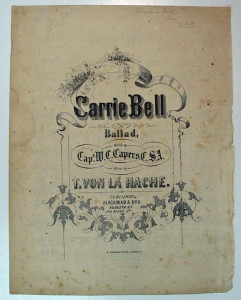
Carrie_Bell_Confederate_Sheet_MusicCaptain WC Capers, who wrote the words to “Carrie Bell,” was formerly of the “Macon Volunteers” and had served in the Florida Indian Wars (1836). During the Civil War, he commanded Company G, 1st LA Heavy Artillery Regiment of the CSA. In July 1863, Capers was promoted to Major. He saw service at Vicksburg and elsewhere in the South. Confederate sheet music such as “Carrie Bell” was much more frequently published via lithography instead of engraved plates because metal was such an important commodity during the war–it simply wasn’t available for making engraved plates.

“The Ivy Green”

Ivy-Green-Charles-DickensThough “The Ivy Green” makes its first appearance in Chapter Six of The Pickwick Papers, Kitton informs us that the piece wasn’t written expressly for the novel. The favorite setting for the piece was by veteran Henry Russell, who said he received the whopping sum of ten shillings for the composition. Dickens frequently incorporated popular music into his works. He also occasionally wrote his own pieces, such as the satirical ballad “The Fine Old English Gentlemen,” which he penned for The Examiner and said should be sung at all conservative dinners. Meanwhile, Dickens’ extraordinary popularity meant that his novels often took on lives of their own, and people also composed their own musical pieces based on Dickens’ works.

Share

Looking Back at 2013, and Looking Forward to 2014!

Happy_New_Year

This year has been a terrific one here at Tavistock Books, and we have you to thank for that! We appreciate your being a part of our community, and we look forward to building that community with you in the coming year. To that end, here’s a look back at the ten most popular blog articles of 2013. It came as no surprise that Charles Dickens was a favorite, as were William Shakespeare and articles about collecting rare books:

  1. Why Did Dickens Write Ghost Stories for Christmas?
  2. Happy Birthday, William Shakespeare!
  3. The Two Endings of Charles Dickens’ Great Expectations
  4. Meet Dr. Erin Blake, Curator of Art and Special Collections at the Folger Library!
  5. Alexander Pope’s Legacy of Satire and Scholarship
  6. Edgar Allan Poe: Creator of Enduring Terror and Literary Masterpieces
  7. A Brief History of True Crime Literature
  8. A Brief History of Broadsides
  9. Charles Dickens Does Boston
  10. The Benefits of Bibliography

Other favorites were recaps of events in the antiquarian world, such as intrepid assistant and Tavistock Books’ scholarship recipient Travis Low’s recap of Rare Book School. We’ll be sure to keep the updates coming, starting with with the two California book fairs: San Francisco (February 1-2) and Pasadena (February 7-9). Watch our website and blog for more information.

What’s Ahead for 2014

Many of you have graciously and thoughtfully offered blog article suggestions and other feedback. Therefore you’ll soon be seeing articles about a wide variety of bookish topics, from early American bindings to the history of nursing, from tips on collecting sheet music to a look back at Mark Twain’s Adventures of Huckleberry Finn.

Have an idea for a blog post or a question about rare books? We can’t wait to hear it! You’re invited to share it in the “Comments” section of any blog or to contact us via phone or email. You’ll also find us on Facebook and Twitter.

Share