Category Archives: History

Charles Dickens and the Impenitent Prostitute

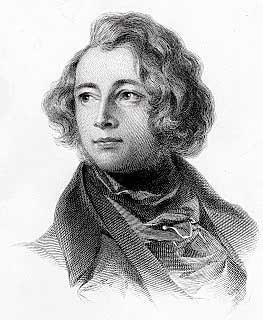
Charles Dickens, in many ways, stands for Victorianism; indeed it’s impossible to think of the era without him, and he defined the period in many ways. Yet we cannot assume that Dickens represents his contemporaries in all things. His own upbringing shaped his sense of social justice in ways that did not always reflect the common views of the era. One such topic on which Dickens thought differently than his contemporaries was that of prostitution. Dickens firmly believed that women could (and should want to) reform. Not everyone agreed—including a few women who were prostitutes themselves!

An Ambitious New Endeavor

Angela_Burdett_Coutts

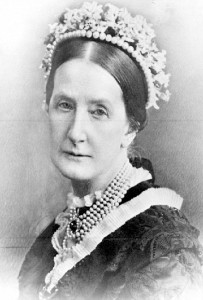
Angela Burdett-Coutts

In May 1846, Angela Burdett-Coutts approached Dickens about starting a home for the redemption of prostitutes. Coutts came into her wealth unexpectedly and resolved to use it for the common good. She’d gotten Dickens’ council before on her Ragged School and believed that they had similar perspectives. Coutts, the daughter of radical MP Sir Frances Burdett, had been raised to take a pragmatic approach to philanthropy. She was liberal with others, but held herself to high standards of performance—much like Dickens.

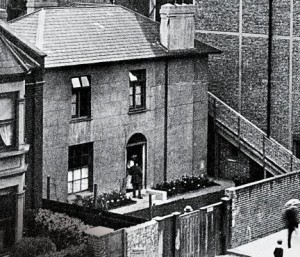
Dickens did not immediately embrace the idea of an “asylum” for prostitutes, and he initially tried to dissuade Coutts from the idea. But eventually he warmed up to the concept and jumped directly into logistical planning. In a letter to Coutts on May 23, 1846, Dickens discusses the layout of the house, suggesting that the interior be divided into two portions, with one for new residents on probation, and another for residents who had already proven their capacity for and willingness to reform. He found Urania Cottage, in Lime Grove, that same month. The home was “retired, but cheerful,” he said, and the taxes were low.

Dickens was quite emphatic that the women not be constantly reminded of their sin, arguing that “she is degraded and fallen, but not lost, having the shelter; and that the means of Return to Happiness.” He also proposed the use of Captain Maconnochi’s Mark System, which rewarded marks for positive behaviors and deducted them for inappropriate ones. Dickens noted that “the goal of this institution should be ‘the formation of habits of firmness and self-restraint.’”

Urania_Cottage

Urania Cottage

Coutts agreed with Dickens on all these counts, though the two could not reach consensus on whether the women should be given colorful garments—Coutts believed that all aspects of the women’s appearance should be somber and reserved, while Dickens didn’t see the damage that could be caused by cheerfully colored dresses. Despite this tiny matter, they moved forward with the project, planning gardens and determining that there should be a piano for the ladies in the parlor. The idea of entertainments for fallen women shocked the literary community, and Dickens responded by satirically announcing that there would actually be a piano for every woman in her quarters!

Dickens Closely Monitors His Social Project

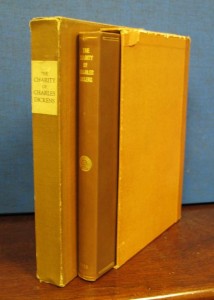
Charity_Charles_Dickens

Published by the Bibliophile Society, this edition of ‘The Charity of Charles Dickens’ was limited to only 425 copies. It details his involvement with Urania Cottage.

Meanwhile the issue of prostitution seemed to worsen daily. That summer, famine struck Ireland, sparking migration to England and a new wave of women entering the oldest profession. Numerous other reformatories sprung up. However, the vast majority were harsh places, where women were treated stringently and often reminded of their “fallen” status. Many believed that these women would only be “reformed” through rigorous discipline. Coutts and Dickens on the other hand, thought that these women could be rehabilitated, and they ambitiously predicted a full return to society…though not in England. After the women were deemed ready, they would be sent off to the Colonies to find domestic work and, with any luck, find husbands who had no inkling of their sordid past.

In 1849, Dickens wrote “An Appeal to Fallen Women.” Distributed in the prisons, the pamphlet was intended to recruit women to be residents. It worked to some extent, and Urania Cottage (known euphemistically as a “Home for Homeless Women”) was rarely short on prospective inmates, whom Dickens often interviewed himself. Indeed, he remained incredibly active in the daily operations of Urania Cottage. He closely supervised the staff and monitored finances.

Coutts and Dickens were generally pleased with their work. In 1853, Dickens wrote positively of the home in Household Words: “Of these fifty-six cases, seven went away by their own desire during their probation; ten were sent away for misconduct in the home; seven ran away; three migrated and relapsed on the passage out; thirty (of whom seven are now married) on their arrival to Australia or elsewhere, entered into good service, acquired a good character and have done so well every since to establish a strong prepossession in favor of others sent out from the same quarter.”

A Mortifying Letter to the The Times

One such woman who was sent away was Sesina Bullard, whom Dickens called “the most deceitful minx in this town—I never saw such a draggled piece of fringe on the skirts of all that is bad. She would corrupt a Nunnery in a fortnight.” Bullard’s friend Isabella Gordon was not much better. After fabricating a story about a house matron, Gordon was given a half-crown and directions to another charity. While awaiting her punishment, Gordon reportedly sashayed up the stairs with her skirts up, mocking the gentility of house staff and Coutts herself. Still another woman, Jemima Hiscock, broke into the beer cellar and got herself “dead drunk.”

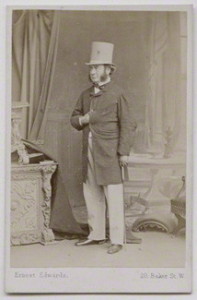
John_Thadeus_Delane

Albumen Print of John Thadeus Delane by Ernest Edwards (National Portrait Gallery)

By February 1858, there were approximately 80,000 sex workers in London alone, and prostitution qualified as a pandemic problem. Always on the lookout for women to help, Coutts was excited to read a column in The Times that month. It was penned by an “Unfortunate” who had become a prostitute. Coutts wanted the woman’s name, so Dickens wrote to Times editor John Thadeus Delane to solicit the letter writer’s identity and explain his benevolent motive. Delane clearly thought highly of the letter writer, exclaiming, “What an admirable letter it was! Except Currer Bell [Charlotte Bronte] and Mrs. Gaskell, I know of no woman who could have sustained such a tone through nearly two columns.”

Neither Dickens nor Coutts, unfortunately, had bothered to read all the way to the end of those two columns. The child of drunks, the author had entered the profession of her own accord at the age of fifteen. She made a good living, educating herself and sending her brothers to apprenticeships. She paid her debts and even had enough income to be “charitable to her fellow-creatures.” Often such a tale of success would end with a sudden fall, reinforcing popular notions that prostitution could never really pay. In this case, however, the author takes a different tack: she castigates the public for looking down on her. “You, the pious, the moral, the respectable, as you call yourselves,” she writes, “Why stand you on your eminence shouting that we should be ashamed of ourselves? What have we to be ashamed of, we who know not what shame is?”

The letter writer differentiated between “born prostitutes” like she was, and had entered the profession of their own volition, and “poor women toiling on starvation wages, while penury, misery, and famine clutch them by the throat and say ‘Render up your body or die.’” The author went on to blame immigrants for London’s prostitution epidemic, pointing out the growing number of French prostitutes on the street. She also reminds readers that while prostitution is itself a social ill, its antecedents rest in other social ills: “If I am a hideous cancer in society, are not the causes of the disease to be sought in the rottenness of the carcass?”

When Coutts finally read the end of the column, she was absolutely mortified. Dickens again wrote to Delane on Coutts’ behalf, admitting that Coutts is “immensely staggered and discomfited by the latter part [of the column], and is even troubled by its being seen by the people in her household. Therefore I think the writer should had best remain unknown to her.” Dickens himself suspected that Delane or another Times writer had actually penned the letter, and he wasn’t alone. The Times had to publish a note that the letter was not a “cunningly executed literary imposture,” and Delane continued to insist that the letter was authentic.

The scandal of Dickens’ affair with Ellen Tiernan and the subsequent estrangement between Dickens and his family caused a rift between Coutts and Dickens. Like Elizabeth Gaskell and William Makepeace Thackeray, Coutts thought that such public display of one’s personal problems was just as horrible as the separation itself. Coutts stopped funding Urania Cottage, and it was finally closed down in 1862.

Share

Charles I and the Undoing of the Vintner’s Company

On September 29, 1639, the Red Bull players found themselves on the wrong side of the law. They’d recently performed The Whore New Vamped, whose author has since faded into obscurity. The play satirically alluded to the new duties on wine, which were instigated by Charles I but supported by few members of the Vintner’s Company of London. In a government statement, the players were accused of having “in a libellous manner traduced and personated some persons of quality and scandalised and defamed the whole procession of proctors belonging to the court of the civil law.”

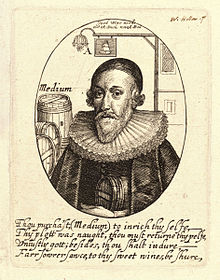
William_Abell

Willam Abell

The New Whore Vamped pokes fun at William Abell, an alderman of London and Master of the Vintner’s Company of London. Abell spearheaded the effort to move the Vintner’s Company from an autonomous, self-governing entity to a royal monopoly. The move rankled not only Vintner’s members, but also members of the general public. This play would not be the first to call Abell to task; indeed, the war against Abell and his co-conspirators raged in print even before the infamous Long Parliament took up the issue.

An Influential and Privileged Organization

Though the exact date of the first English guild’s establishment is unknown, a number of livery companies had been established in London by the medieval period. People who practiced the same trade lived in the same area, and they often organized themselves to influence the market for their products and services. These groups had immense power: they influenced not only the economy and politics, but also social institutions and even religion. It’s no wonder, then, that the groups came to be known as guilds, a word that derives from the Anglo-Saxon word for “to pay.”

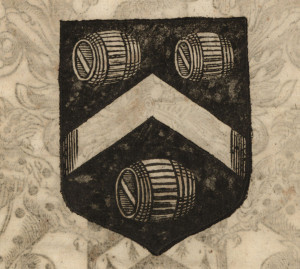
Vintners_Coat_Arms_1633

The Vintner’s Coat of Arms, circa 1633

The vintner’s guild seems to have been well established by the 1200’s; there was already record of “lawful merchants of London” fixing the price of wine. The Vintner’s Company received its first official charter on July 15, 1363. The charter was actually more like a grant of monopoly on trade with Gascony. A far-reaching document, the charter gave the guild duties of search and the right to buy cloth and herring to trade with the Gascons. Over the next century, wine would become vital to England’s economy. From 1446 to 1448, wine comprised almost a third of England’s entire import trade, and the Vintner’s Company was the eleventh most important of livery companies in London.

In the sixteenth century, the Vintner’s Company lost some of its prestige, along with its duties. Edward VI drastically limited the company’s country-wide right to sell wine in 1553. The company managed to regain some of its previous favor with the early Stuarts. Unfortunately a fateful alliance with Charles I would tarnish the Vintner Company’s reputation.

An Unsavory Arrangement with the King

When Abell took office as Master of the Vintner’s Company, the organization was a self-governing organization whose members oversaw all aspects of the wine business in London. But in June 1638, Willam Abell struck a deal with the king. He used the organization’s seal to sign a four-part indenture that transformed the Vintner’s Company into a royal monopoly. Under the contract, any profit or power derived from the wine trade went into a common “farm” that the company would purchase from Charles’ courtiers each year for the not-so-paltry sum of £57,000. While the arrangement might have been profitable for the company—and certainly for the king—many members saw it as far from ideal. As a royal monopoly, the organization was now much more susceptible to the whims of a monarch—and to transitions of power.

Then thanks to the Bishops’ Wars, Charles was forced to call Parliament to meet in 1640. He needed them to pass finance legislation to fund his war. But the MP’s hardly bent to the monarch’s wishes. They passed an act stating that the session of Parliament could not be dissolved until the members agreed to do so. They would not officially end the session until twenty years later, earning the nickname the Long Parliament. The Parliament moved to strip Charles I of the powers he’d accrued since ascending the throne, effectively ensuring that he would never again be an absolute ruler. They also freed everyone held in the Star Chamber and passed the Triennial Act of 1641, sometimes called the Dissolution Act, which stipulated that no more than three years would elapse between sessions of Parliament.

The Long Parliament also launched an investigation of Abell’s agreement with the king. They swiftly threw Abell and his co-conspirators in jail, but it took them ten months to work through the rest of the affair. In August 1641, Parliament took aggressive action, declaring forty importers delinquent for taking part in the wine contract. These merchants, too, were thrown in prison. Clearly Parliament stood not with the Crown-supported merchants, but with the city shopkeepers.

A War Waged with Pamphlets

Meanwhile on April 21, 1640, members of the Vintner’s Company had formed a committee to consider the wine sellers’ grievances with Abell’s contract. They made less than satisfactory progress, however, as the members could agree on little. Around this time, many vintners started refusing to pay tax on wine. And when Parliament convened, they delivered a petition without approval from company leaders.

All this time, a war was being waged with the printing press. From 1640 to 1642, countless pamphlets were printed by both Abell’s defenders and the Vintner’s Company. The Abell contingent claimed that the deal struck between Abell and the court represented the apotheosis of two years’ discussion among Vintner’s Company members. They said that the decision to become a royal monopoly had the full support of the membership, and had even passed when put to a vote.

Abell’s opponents claimed that Abell had achieved agreement only by threatening members with “many promises and persuasions,” some of which took the form of “divers and fearful threatenings.” By 1642, eminent parliamentary pamphlet printer Henry Parker had taken up the vintners’ cause, rushing to defend the company’s “own Reputation to the World.”

Cromwell Undermines the Company

The Long Parliament would sit from 1640 to 1648, when the membership was purged by the New Model Army. Remaining members were called the Rump Parliament. When Oliver Cromwell effectively took complete control of England in 1653, he sent all the MP’s home. A Puritan, Cromwell believed that extraneous entertainments should be eliminated. Women could no longer wear make-up or colorful dresses. The theaters were shut down. Cromwell even outlawed Christmas.

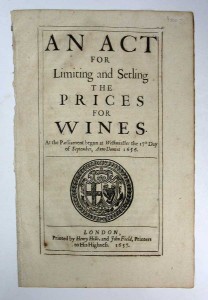
Act_Limiting_Prices_Wines_CromwellThough Cromwell’s rules were stringent, he did facilitate a number of important improvements, including stimulating the British economy. On September 17, 1656, Cromwell issued an Act for Limiting and Setling (sic) the Prices for Wines limiting the prices of Spanish and French wines. The act was a direct hit to the Vintner’s Company. Such a move from Cromwell should hardly surprise anyone; he actively and loudly supported the execution of Charles I and sought to undo as much damage from the former monarch as he possibly could. Charles II and James II similarly restricted the company’s influence. The Vintner’s Company took another hit with the Great Fire of London in 1666, when Company Hall and other properties were destroyed.

William and Mary restored some of the privileges that had been stripped away by their predecessors, but the Vintner’s Company would never regain its former dominance in the British wine trade. In 1725, the duty of search was finally abandoned, and membership dropped off. Yet the Vintner’s Company has survived to this day, a testament to the evolution of the wine trade.

The Abell-Kilvert controversy is merely one episode in the rich history of grape cultivation and wine making. Today there is little controversy over the statement that California has become one of the premier producers of quality wines. Next Tuesday Tavistock Books will issue a 40+ item FS list, with wine as its focus, and California looming large in this offering. Please watch for it.

Related Posts:
Au Paris: Food, Wine, and Rare Books!
Temperance, Prohibition, and the WCTU
George Cruikshank: “Modern Hogarth,” Teetotaler, and Philanderer

Thanks for reading! Love our blog? Subscribe via email (right sidebar) or sign up for our newsletter--you’ll never miss a post.

Share

William Page, Dandified Highwayman

William_Page_Narrative

We’ve long been fascinated with the exploits of criminals, so much so that an entire genre of literature has blossomed out of our curiosity. In the eighteenth century, a staple of true-crime literature was the confession, in which a convicted criminal shared his life story, detailed the sordid details of his crimes, and repented of his sins. These stories were often published as broadsides or pamphlets—and distributed to the audience who gathered to witness the criminal’s execution. Longer accounts sometimes appeared after the fact.

Henry_Fielding

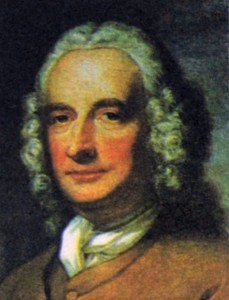
Henry Fielding

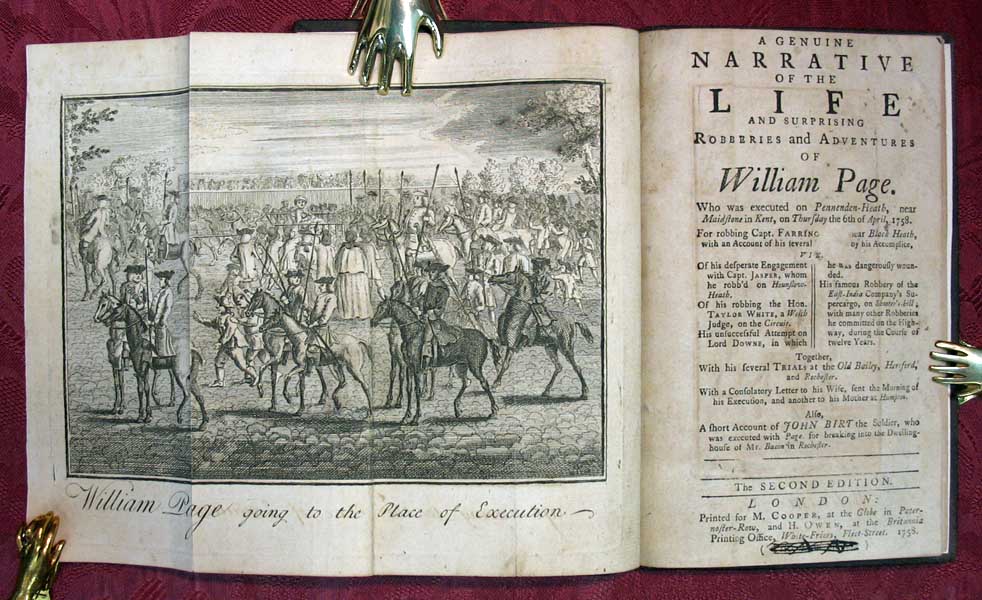
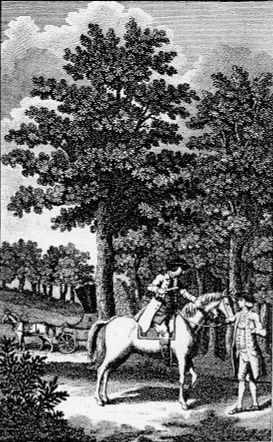
One criminal who shared his story has an interesting connection to none other than Henry Fielding. Also a magistrate, Fielding sentenced famous highwayman William Page to death for his crimes. Page was hanged in 1758, but an account of his life survives in A Genuine Narrative of the Life and Surprising Robberies and Adventures of William Page. Page has often been likened to Fielding’s character Tom Jones, though Fielding penned that eponymous novel before ever encountering Page.

Page was born in 1730 to a working class family. His father died early, so his mother sent him to be an apprentice to a relative, who was a haberdasher. Page hardly had a taste for the work, but he did develop a penchant for fashion and frippery. Alas, a haberdasher’s apprentice hardly earned much income. To fund the fashionable lifestyle he desired, Page undertook his first crime: he robbed his own employer. Likely because of the family connection, Page faced no criminal charges.

Next Page managed to secure a position as a footman to a gentleman, no easy feat given that he had no references. The position gave Page another taste of society life. One day while Page was traveling with his master, the carriage was ambushed by highwaymen. No one was injured, but the robbers made off with a small fortune in a matter of minutes. Page resolved to seek his fortune as a “gentleman of the road.”

After acquiring a horse and pistols, Page immediately committed a series of robberies at Highgate Hill and Hampton Court. Then he held up a Canterbury stage coach on the road from London to Kent. Aware that this early success was thanks to luck, Page decided to take some time and plan future robberies. Posing as a law student, he took lodgings at Lincoln Inn. He traveled extensively around London, creating intricate road maps and scoping out ideal spots for future robberies. Page found a number of suitable locations within about twenty miles of London.

Page also decided that he should assume a disguise to reduce suspicion. He would set off from London dressed as a gentleman driving a phaeton and a pair. Page would find an isolated spot near his intended ambush point, shed his fine attire, and put on old clothes and a wig. After perpetrating his heist, Page would then return to the phaeton and change back into his everyday clothes.

William_Page_Highway_Robbery

In one instance, Page’s plot went awry. While Page was holding up a carriage, a couple of haymakers stumbled upon his phaeton. Assuming it was abandoned, they took it to the closest village. Page returned to find his carriage—and his fine clothing—had disappeared. He correctly assumed that the thieves would go to the next town and immediately headed there. Page found his phaeton parked outside the local inn. Thinking quickly, Page stripped down to his underwear and threw his clothes down a well. He burst into the inn and announced that he’d been robbed of his carriage and clothes and thrown into a ditch. The innkeeper helped to detain the haymakers till the authorities. Later, Page simply refused to testify against the men.

Over the course of the next three years, Page would commit approximately 300 robberies. All the while, he enjoyed a life of luxury and privilege. Then his accomplice and childhood friend John Darwell made a fatal error. Darwell held up a carriage on his own, and the majority of the men inside were armed. They easily captured Darwell, who then offered to give up Page in exchange for his own release.

Page was apprehended at the Golden Lion in Grosvenor Square. Despite having been captured with a black wig and a detailed map of London in his possession, Page was acquitted due to lack of evidence, but found himself immediately sent to Maidstone Gaol on other charges. Fielding presided over the case and sentenced Page to death. He was hanged on April 6, 1758.

A Genuine Narrative of the Life and Surprising Robberies and Adventures of William Page was originally sold for one shilling. Today it’s a much more valuable record of the era’s attitudes toward crime, punishment, and justice.


Related Posts:
A Brief History of True Crime Literature
Charles Dickens’ Debt to Henry Fielding
Charles Dickens and Capital Punishment


Thanks for reading! Love our blog? Subscribe via email (right sidebar) or sign up for our newsletter--you’ll never miss a post.

Share

John Barnard Davis, Skull Collector

After John Barnard Davis passed away on May 19, 1881, his obituary appeared in the British Medical Journal.  Davis was lauded as a “venerable practitioner and eminent anthropologist.” But today, what most people remember about Davis is his extensive collection of human skulls.

An Incredible Collection of Crania

By 1867, Davis had amassed a collection of 1,474 skulls from various parts of the world. Truly, Davis’ collecting of skulls was quite obsessive (though we suspect many a collector of antiquarian books can empathize with his mania). Davis used his political connections and wealth to obtain skulls that were highly coveted in Britain. For example, he managed to amass a great number of skulls from Tanzania, which were quite difficult to procure. And though Davis had never been to New Zealand himself, he invested heavily there and used his financial sway to get more specimens.

Davis_Thurnam_Crania_Britannica

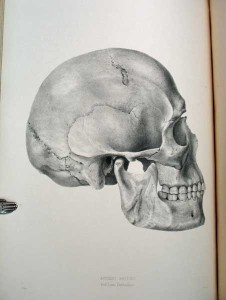
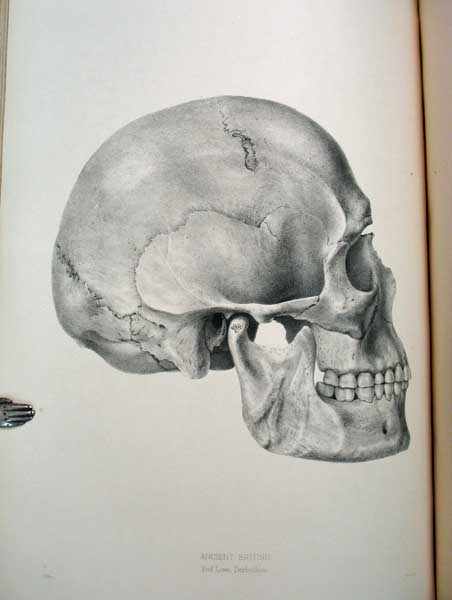
A plate from ‘Crania Britannica’

Why such an obsession with crania? Davis firmly believed that one could glean extensive racial information, including the degree of an individual’s racial hybridity, from the measurements of the individual’s skull. Davis wrote extensively on the topic, and his works were soon used as central texts for craniologists and racial scholars. Davis primarily focused on comparing “aboriginal” skulls from Britain with “aboriginal” skulls in other parts of the world.

In 1865, Davis produced his magnum opus with fellow physician John Thurnam. Crania Britannica is an absolutely exhaustive work, including over 60 plates. The work would later receive a rather glowing recommendation in Anthropological Review (Vol 6, No 20, 1868): “Never before, certainly, had representations of skulls been produced that would vie, in beauty and accuracy, with the sixty that form the text on which the authors so lovingly and learnedly discourse.” The reviewer also noted that Davis and Thurnam had a few significant differences of opinion, and that Davis clung too tightly to the accidental variations among skulls.

The Evolution of Craniometry

Yet Davis was hardly an outlier in the scientific community; the nineteenth century saw a veritable explosion of interest in human measurement, and especially in craniometry. In 1812, the Edinburgh Encyclopedia defined craniometry as “the art of measuring the skulls of animals so as to discover their specific differences.” The concept itself was not altogether new; doctors and scientists had long paid attention to variations in physical form. Hippocrates, considered a pioneer in physical anthropology, made multitudinous descriptions of different skulls, though he never actually measured them.

That began in the fifteenth century. Leonardo da Vinci  is probably one of the earliest people of note to apply a theory of skull measurement; he used a number of lines related to specific structures in the head to study the human form  more closely. Albrecht Durer’s 1528 treatise on cranial measurements represented the first published attempt to apply anthropometry to aesthetics. Adrian van der Spigel made the first truly scientific attempt at measuring the cranium, defining four lines: the frontal, sinciptal, facial, and occipital. Spigel also argued that the lines of well-proportioned skulls would all be the same length.

Then in 1699, a Cambridge doctor took measurements of a chimpanzee skull.  His data prompted Edward Tyson to suggest that there was an intermediate animal between humans and monkeys. Tyson called this animal a “pygmy.” Unfortunately for Tyson, his “pygmy” skull later turned out to be…another chimpanzee skull. Nevertheless, the idea of an intermediate animal persisted.  From that time on, the practice of craniometry blossomed. Countless systems of skull analysis emerged, each with its own idiosyncrasies.

Camper_Facial_Angles

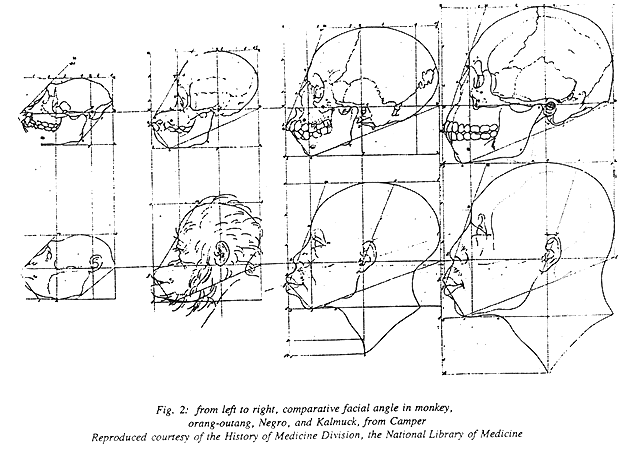
As the eighteenth century unfolded, practitioners of craniometry became increasingly interested in correlations between various physical measurements and intelligence. It was quite common to use these measurements to “demonstrate” that people of their own race were intellectually superior to others. Pieter Camper introduced the concept of “facial angle” in his Dissertation sur les varietes naturelles de la physionomie, published posthumously in 1791. He noted that the ideal facial angle was the same as that used by famous Greek sculptors. Though Camper’s survey was limited to a very small number of skulls, his idea fascinated physicians and scientists. They applied it to skulls from people of both European and African descent, attributing the differences in facial angle to natural superiority of Europeans.

Craniometry to Justify Racism

Camper’s chief opponent, Johann Friedrich Blumenbach, rejected the theory of lines and angles. He argued for much closer examination of the skull, particularly the maxillary and frontal bones.  In 1795, Blumenbach also suggested a standardized method of positioning the skull so that measurements could be standardized and reproduced. But it was Paul Broca who would institute an accurate, precise technique for measuring skulls. His goal was to obtain sufficient data to be able to authoritatively determine the race of a skull’s owner by its measurements, thereby creating a set of racial “types” for skulls.

Meanwhile, there was a marked shift from using skulls to determine only racial identity, to using skulls to determine supposedly innate differences between the moral and mental capacities of various races. In addition to skull measurements, scientists also relied on a given race’s technological advancements and ability to master Western tools as further gauges of intellect. This paradigm began to shift a bit in the early nineteenth century; whereas the eighteenth-century view of race was more fixed in terms of racial attributes and divisions; the new century viewed race as more fluid.

This was especially true as theories of evolution emerged. Yet the skull remained a central focus, and researchers continued to seek ways to quantify intellectual capacity. The actual capacity of the skull even became a focus; Samuel Morton first filled skulls with white peppers, and later with lead gunshot, to measure how much it would hold. Friedrich Tiedemann used millet seed.  Camper’s angle came under fire as anatomists like Anders Retzius and George Combe proposed closer examination of the proportions of different parts of the brain and skull.

George Combe’s Theory of Phrenology would prove incredibly influential—and pernicious. Though the practice of phrenology was often mocked, it also heavily influenced any number of policies and institutions during the nineteenth century, from education to criminal reform. Leading thinkers like GWF Hegel and Thomas Edison were attracted to the pseudoscience, as were illustrious authors like George Eliot, Honore de Balzac, and the Bronte sisters. Even Queen Victoria dabbled in phrenology.

By the time Davis and Thurnam published  Crania Britannica in 1865, phrenology had already fallen out of scholarly favor, though it remained in the public’s consciousness as a popular fad. Craniometry remained a strong interest in the medical and scientific community, not least because it reinforced racist ideology. However, toward the end of the 1800’s, even these theories wore thin. Today, craniometry still has some applications, though it’s practiced much differently than it was in Davis’ day. While Davis’ theories have been discarded, his incredible skull collection survives relatively intact, and his Crania Britannica offers an incredible window into the attitudes, knowledge, and methodology of his time.

Related Books and Ephemera

Crania Britannica

Davis_Thurnam_Crania_Britannica

Davis and Thurnam’s work bears the drop title “Delineations and Descriptions of the Skulls of the Aboriginal and Early Inhabitants of the British Islands: with Notices of Their Other Remains.” Volume I contains the text, while Volume II includes plates and descriptions. It’s bound with “Osteological Contributions to the Natural History of the Chimpanzees (Troglodytes) and Orangs (Pithecus). No. IV. Description of the Cranium of an Adult Male Gorilla from the River Danger, West Coast of Africa, … ” by Professor Owen (1851). This work was published for subscribers and contains 67 lithographic plates, while this particular copy includes five additional plates illustrating the Owen article. It bears unobtrusive ex-lib markings. Though the joints are rubbed, this is overall a solid Very Good copy. Details>>

Phrenology Exemplified and Illustrated, with Upwards of Forty Etchings

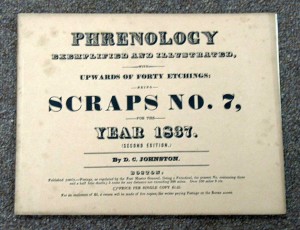
Johnson_Phrenology_Exemplified_IllustratedDavid Claypoole Johnson was known as “the American Hogarth,” and this work, in Scraps No 7 (1837) offers a satirical look, both textually and graphically, at the “science”of phrenology.” By this time, phrenology had fallen out of favor–though it would eventually reemerge as a sort of parlor entertainment in the 1860’s and 1870’s. This is the second edition, which doesn’t appear in American Imprints. It’s bound in buff paper wrappers. With light extremity wear and minor foxing, it’s withal a Very Good+ copy. Details>>

A Glance at Philosophy, Mental, Moral, and Social

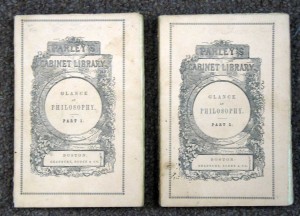
Parley_Glance_PhilosophyAmerican author Samuel Griswold Goodrich was better known by his pseudonym, Peter Parley. His Peter Parley Cabinet Library was quite popular at the time, and this title, published in 1845, was #14 in the series. The first part begins with a discussion of phrenology. It’s uncommon to find this title as presented here, in the original pink printed wrappers with a series advertisement on the rear wrapper. Overall, this is a Very Good set. Details>>

Phrenology Known by Its Fruits Being a Brief Overview of Doctor’s Brigham’s Late Work, Entitled “Observations on the Influence of Religion Upon the Health and Physical Welfare of Mankind”

Reese_Phrenology_Known_FruitsPsychiatrist Amariah Brigham was one of the founding members of the professional organization that was the precursor to the American Psychiatric Association and served as the first director o the Utica Psyciatric Center. Brigham and others in the psychiatric community used phrenology to justify exempting the mentally ill from criminal punishment, and he ardently campaigned to excuse William Freeman from the gallows after he was convicted of murdering John G Van Nest. Prior to that incident, however, David Meredith Reese published Phrenology Known by its Fruits, an exploration of Brigham’s philosophy. Reese, himself a physician, served as physician-in-chief at Bellevue Hospital and published a number of works. Square and tight, this volume was professionally rebacked, with about 90% of the original spine cloth laid-down. It displays the usual bit of foxing but is overall a Very Good to Very Good+ copy. Details>>

Share

Temperance, Prohibition, and the WCTU

Nast_Harpers_Bar_Destruction

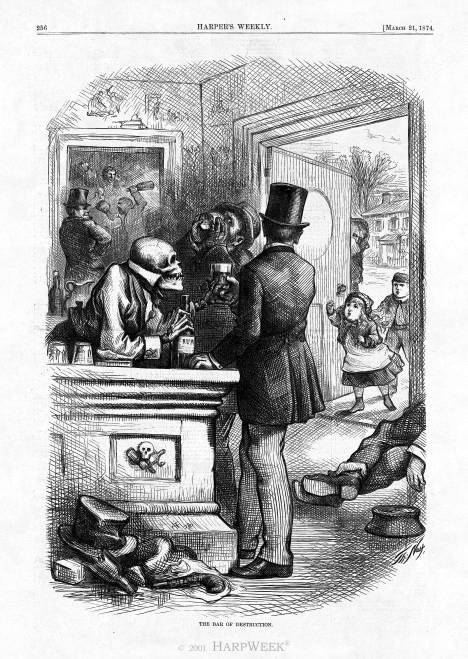
The above cartoon by Thomas Nast appeared in Harper’s Weekly on March 21, 1874. The following page bore another temperance cartoon by Michael Angelo Woolf called “The Social Juggernaut.” The issue also included a story of a temperance demonstration at a New York bar and an illustrated poem called “Like Father, Like Son,” which tells the story of a father and son who both fall into alcoholism. The back page cartoon depicts a bottle of rum in prison for “manslaughter in the greatest degree.”

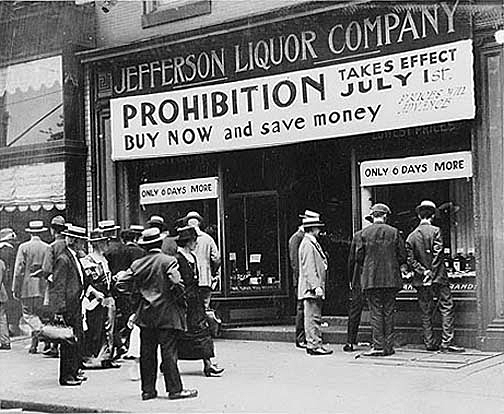
Interest in temperance and prohibition continued to grow over the next several decades, culminating in the ratification of the 18th Amendment on January 16, 1919. By this time, the temperance movement had been around for over a century. In 1784, Benjamin Rush wrote An Inquiry into the Effects of Ardent Spirits Upon the Human Body and Mind. His treatise blamed alcohol for a wide range of physical and psychological problems. By 1789, a group of Connecticut farmers formed a temperance association and applied Rush’s work, banning the production of whiskey in their county. By 1800, Virginia also had a temperance association, and New York followed in 1808.

Most activists at this time supported moderation, rather than complete abstinence. But as the movement grew, leaders tried to use their increased audience to promote other issues like attending church on Sundays. That approach backfired. The movement splintered and fell apart completely by 1820. Despite a lack of cohesive support, the idea of temperance had taken hold. Many states, counties, and cities were dry. That didn’t mean that alcohol consumption had waned; in fact, from 1800 to 1830, per capita alcohol consumption reached its highest level in American history. It was three times today’s rate, and most of that consumption was hard liquor drunk undiluted. One historian actually labeled the US at this time the “alcoholic republic.”

To garner support, temperance leaders modeled their rallies after religious revivals. They primarily relied on moral and religious arguments, and some began lobbying for the regulation and/or prohibition of alcohol. In 1826, the American Temperance Society was founded, lending the movement new momentum. By 1838, the organization had over one million members and more than 8,000 local groups. This time, there was a definitive split between moderates (who supported drinking in moderation) and radicals (who believed in complete prohibition of all alcohol).

The radicals were, predictably, much more vocal and soon dominated the movement. By the early 1850’s, thirteen states had banned the manufacture and sale of alcohol. Alcohol consumption had fallen significantly, and more people were opting for beer instead of hard liquor–a preference that some culinary historians attribute in large part to the influx of German immigrants.

But the Civil War derailed the temperance movement completely. Both the North and the South struggled to fund the war, and they turned to distillers and brewers for financial support. Drinking also became a sort of bonding activity for soldiers, who were away from their wives and families. Support for temperance and prohibition dried up.

After the war ended, the nation experienced an explosion in the retail liquor industry. The number of dealers went up 17% between 1864 and 1873…even though the population grew only 2.6%. It wasn’t until the end of the Reconstruction that prohibitionism gained steam again. First, it took root in the South; the ideals of prohibition and protecting the home dovetailed with “traditional Southern values,” such as traditional gender roles and even racial stereotypes.

Soon prohibitionism had entered politics. Most temperance advocates were Republicans, but leaders of both parties tried to distance themselves from the most divisive issues. Ultimately prohibition advocates decided that neither political party adequately represented their interests, and the Prohibition Party was born. The party still exists today and has nominated a presidential candidate for every election since 1872. Though it faded into obscurity with the repeal of Prohibition in 1933, the Prohibition Party is the oldest third political party in the United States.

Unfortunately, women were still excluded from politics, so they sought other ways to support the movement. The Women’s Christian Temperance Union all began with Dr. Dio Lewis. A prominent proponent of temperance, Dr. Lewis traveled the country for decades, telling a story about how his mother and other women had inspired local business owners to turn away from alcohol sales with prayer and scripture.

Inspired by Dr. Lewis in December 1873, a group of women banded together to take direct action against saloons and liquor sales in what came to be known as the Women’s Crusade of 1873-1874. At first, women would gather at saloons and drop to their knees-for pray ins. They would sing hymns and demand that the establishment stop serving alcohol. With these grassroots demonstrations, they managed to halt alcohol sales in 250 communities. Then in the summer of 1874 at a pre-organizational meeting in Chautauqua, members decided to hold a national convention in Cleveland, Ohio.

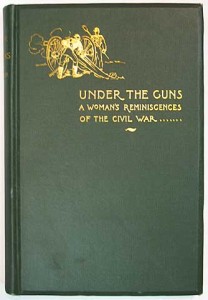
Wittenmyer_Under_GunsIn Cleveland, Annie Wittenmyer was elected the first president of the WCTU. Wittenmyer had been a nurse during the Civil War and would go on to author Under the Guns about her experience. Under her guidance, the WCTU took up temperance as a “protection of the home.” The organization’s watchwords were “Agitate-Educate-Legislate.” Local chapters were called unions, and they were largely autonomous. The WCTU quickly became the largest women’s organization in the country.

The WCTU’s protest against alcohol was ultimately much more than that: it was a means of protesting women’s lack of civil rights. At the time, women couldn’t vote. Domestic abuse and rape cases almost never found their way to prosecution. Women had no right to property or custody of their children if they got divorced. And in some states, the age of consent was still as low as seven. Meanwhile, most political meetings were held in saloons, which informally excluded women from participation in politics.

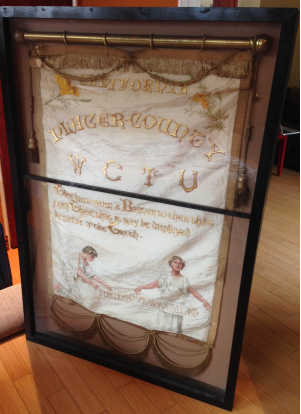
WCTU_Banner_Placer_County_California

A banner from the now defunct Placer County, California chapter of the WCTU

In 1879, Frances Willard became president of the WCTU. Her personal motto was “Do everything,” and she believed that the organization should expand its scope to address a full range of social problems, which were, after all, interconnected. Use of substances like drugs and alcohol was really just a symptom of greater societal ills. By 1894, the WCTU had taken up the cause of women’s suffrage and had become one of the first organizations to keep a professional lobbyist in Washington, DC.

The WCTU undertook a number of initiatives to promote temperance. People often opted to drink beer or liquor because there was no access to clean drinking water. So the WCTU advocated the installation of public drinking fountains. And in cooperation with Mary Hunt, the WCTU established a curriculum for formal temperance instruction in classrooms across the nation. Their goal: “teach that alcohol is a dangerous and seductive poison; that fermentation turns beer and wine and cider from a food into poison; that a little liquor creates by its nature the appetite for more; and that degradation and crime result from alcohol.”

When the 18th Amendment was finally ratified, the WCTU continued to advocate temperance, but shifted its focus to other social issues. The repeal of the amendment sparked another shift in focus. Today, the WCTU addresses the abuse of alcohol, drugs, and tobacco, along with gambling and pornography.

Related Books

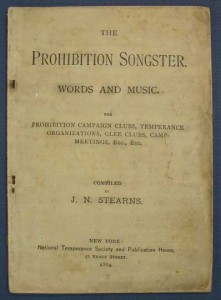
The Prohibition Songster
Stearns_Prohibition_SongsterCompiled by John Newton Stearns, The Prohibition Songster was intended for “Prohibition Campaign Clubs, Temperance Organizations, Glee Clubs, Camp  Meetings, Etc, Etc.” It was first published in 1884 by the National Temperance Society and Publication House. Such items were frequently produced for use during political campaigns, and the National Temperance Society says of this particular publication, “This is a new collection of words and music for Temperance Gatherings, with some of the most soul-stirring songs ever published. Music by some of the best composers, and words by our best poets.” One hundred copies could be purchased for $12. OCLC records five institutional copies. Details>>

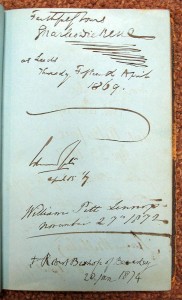
Autograph Album-Leeds Town Hall (1861-1895)
Leeds_Town_Hall_AutographThis rare album contains the autographs of visitors to the Leeds Town Hall. The album was owned by a J. (or F.) N. Dickinson who has signed the ffep and added the date Oct 9th 1861. Each of the 59 pages (beginning on the verso of the ffep) contain numerous autographs, primarily of musicians who we assume were performing there on the dates noted. Among the dignitaries to sign the autography book are Charles Dickens, Charles Stratton (aka, Tom Thumb), Scottish explorer John MacGregor (better known as Rob Roy). Lady Isabella Somerset, former president of the British Women’s Temperance Association, also signed. All in all it’s a truly fascinating artifact. Details>>

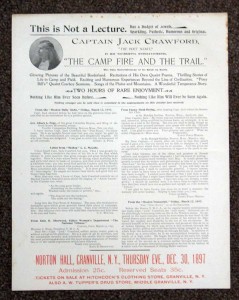
Captain Jack Crawford, “The Poet Scout,” in His Wonderful Entertainments, “The Camp Fire and the Trail” 
Captain_Jack_CrawfordJohn Wallace “Jack” Crawford was an American adventurer, educator, and author known as one of the most popular performers in the late nineteenth century. His daring actions to carry the news the 350 miles to Ft. Laramie in six days of General George Crook’s victory in the Battle of Slim Buttes during the Great Sioux War made him instantly famous. After his stints in Buffalo Bill’s Wild West Show and “General Crook’s Horsemeat March,” Crawford served as a special agent for the US Department of Justice, spending four years investigating illegal liquor traffic and fighting alcoholism on Indian reservations. During his work for the US Government, he began his career as an entertainer in 1893 which continued until 1898. He wrote poetry and held “lectures” across the United States where he told of his many adventures in the Wild West, and where he asked his audiences to be careful and foreswear liquor in order to lead a more fulfilled life. He was a prolific writer and published seven books of poetry, wrote more than one hundred short stories and copyrighted four plays. In fact, his poem “Only a Miner Killed” has been said to be the basis for Bob Dylan’s song “Only a Hobo”. Only one institutional holding is found on OCLC. Details>>
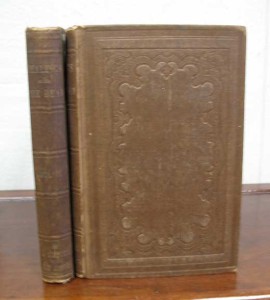
Dealings with the Dead
Sargent_Dealings_DeadThis volume includes collected commentary by noted antiquary and temperance advocate Lucius Manlius Sargent on Boston society (among other things), as was initially published in a series of Boston Evening Transcript articles. Per the DAB, “though he showed enthusiasm for the past, his efforts were generally directed towards blasting something offensive to him out of existence.” This, the first book edition, was published in two volumes in 1856. OCLC records just four copies of this work in institutional hands. Details>>

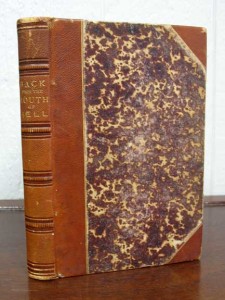
Back from the Mouth of Hell
Abbe_Back_Mouth_HellThis book’s drop title reads “Or The Rescue from Drunkenness. The Causes, Progress and Results of Intemperance, with the Possibility and Effectual Methods of Accomplishing Permanent Reform.” It was published anonymously in 1878 “By a Former Inebriate.” But this copy bears the an inscription on the ffep from the author, James E. Abbe. The title does not appear in Amerine & Borg. It’s still bound in the publisher’s original half-sheep binding with marbled paper boards and pale peach colored endpapers. Though it has some modest binding wear, mostly to the extremities, it’s withal a Very Good+ copy. Details>>

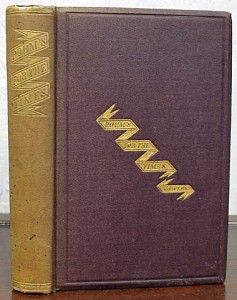
Poems for the Times: Devoted to Woman’s Rights, Temperance, Etc
Rowley_Poems_Times_SuffrageThe author, Frances A Rowley, notes that her purpose is to “touch upon the most, if not all of the great evils of the day, and have placed the language in the poetic form, thinking that perhaps in this way I might reach the minds of those of my sex that would not be as well pleased with the practicabilities in prose…” Poems for the Times is a somewhat uncommon work addressing women’s suffrage, etc. It was first published in 1871. This first edition is bound in the original publisher’s purple cloth with gilt stamping and bevelled edges. The spine is sunned, but otherwise this is a square and tight Very Good+ volume. Details>>

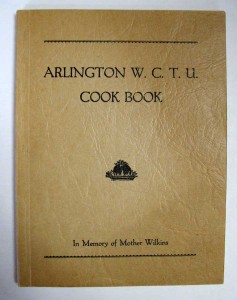
Arlington WCTU Cookbook, in Memory of Mother Wilkins
Arlington_WCTU_CookbookThe last page of this cookbook concludes with a recipe for ‘Husbands’: “One of the lectures before the Baltimore Cooking School recently gave this recipe for cooking husbands. A good many husbands are utterly spirited by mismanagements. Some women go about it as if their husbands were bladders, and blow them up. Others keep them constantly in hot water. Others let them freeze by their carelessness and indifference… Tie him in the kettle by a strong silk cord called Comfort, as the one called Duty is apt to be weak. Make a clear, steady fire out of Love, Neatness and Cheerfulness. Set him as near this as seems to agree with him. If he sputters and fizzes, do not be anxious – some husbands do this till they are quite done… Do not stick any sharp instrument into him to see if he is becoming tender. Stir him gently, watching the while, lest he lie to flat and close to the kettle; and so become useless. If thus treated you will find him very relishable, agreeing nicely with you and the children: and he will keep as long as you want, unless you become careless, and set him in too cold a place.” This item is rare in the trade; OCLC records five institutional holdings. Details>>

Related Posts:
Three Pioneering Authors Who Used Pseudonyms
George Cruikshank: “Modern Hogarth,” Teetotaler, and Philanderer

Thanks for reading! Love our blog? Subscribe via email (right sidebar) or sign up for our newsletter--you’ll never miss a post.

Share

Why California Isn’t Called “Nova Albion”

On June 17, 1579, Francis Drake claimed California for England. He anchored his ship, the Golden Hind, just north of present-day San Francisco and named the new territory “Nova Albion.” But despite Drake’s claim in the name of Queen Elizabeth I, he was not the first European to explore California.

Drake Lays Claim to California

Drake set out from England on December 13, 1577 with five ships. His mission was to raid Spanish holdings along the Pacific coast in the New World. Drake was forced to abandon two ships during the Atlantic crossing. Then the expedition encountered a series of storms in the Strait of Magellan. One ship was destroyed, and the other returned to England. Only the Golden Hind reached the Pacific. Drake raided Spanish settlements and captured a heavy-laden Spanish treasure ship.

Drake continued up the West Coast of North America in search of the fabled Northwest passage. He got as far north as present-day Washington, stopping near the San Francisco Bay in June 1579. In July, Drake’s expedition set off across the Pacific, eventually rounding the Cape of Good Hope and returning to England. Drake returned to Plymouth, England on September 26, 1580. Queen Elizabeth I knighted him the following year on a visit to his ship.

A Portuguese Explorer for the Spanish Crown

California gets its name from a mythical island populated by Amazon women who use golden tools and weapons. It appeared in a popular romance novel called Las Sergas de Esplandian by Garci Rodriguez de Montalvo. The book went through several editions, though the earliest extant copy dates from 1510. When Spanish settlers explored what’s now Baja California, they believed that they’d discovered the mythical island.

It was Portuguese adventurer Joao Rodruigues Cabrilho, better known as Jose Rodriguez Cabrillo, who disabused the Spaniards of the notion that California was an island. Little is known of Cabrillo’s life before 1519, when his name first appears in the ranks of those serving conquistador Hernan Cortes. Cabrillo participated in the conquests of both Mexico and Guatemala. He was also involved in military expeditions to southern Mexico, Guatemala, and San Salvador.

Cabrillo eventually settled in Guatemala and by 1530 had established himself as a leader of Santiago, Guatemala. He returned to Spain briefly to find a wife, marrying Beatriz Sanchez de Ortega. The couple would have two sons. Then in 1540, a major earthquake destroyed Santiago. Cabrillo’s report to Spain on the devastation is considered the first piece of secular journalism published in the New World.

Soon Spain was looking to expand northward. Francisco de Ulloa had recently explored the Gulf of California and proven that California was not an island after all (though the misconception persisted back in Spain). Now, Guatemala governor Pedro de Alvarado commissioned Cabrillo to lead a mission up the coast. He believed that Cabrillo and his men would find the fabled wealthy cities of Cibola, which were thought to be somewhere along the Pacific coast north of New Spain. The explorers also held out hope of discovering the “Straits of Arain,” rumored to connect the North Pacific and the North Atlantic.

Cabrillo Travels up the California Coast

On June 24, 1542, Cabrillo sailed out of the port of Navidad (modern-day Manzanillo). He took with him a crew of soldiers and sailors, along with merchants, a priest, slaves, livestock, and enough provisions to last two years. By September 28, 1542, Cabrillo had reached a “very good enclosed port,” now known as San Diego Bay. He and his crew stayed there for several days before heading up the coast. They visited a number of islands before turning around due to adverse weather conditions.

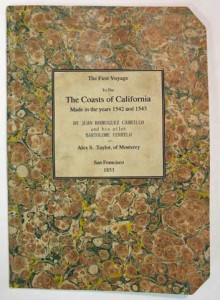
Taylor_First_Voyage_California_CabrilloCabrillo died of complications from a broken leg on January 3, 1543. His exploration helped to dispel geographical misconceptions and to expand the Spanish empire. Over three centuries later, Alex S Taylor, a resident of Monterey, California, wrote the history of Cabrillo’s expedition. First published separately in 1853, The First Voyage to the Coasts of California is considered an important work, indeed; it was the first work of California history actually published within California.

Other Works of Californiana

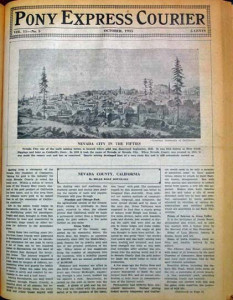
The Pony Express Courier 
Pony_Express_CourierIn 1860, countless men responded to advertisements for riders in the new Pony Express. At any one time, only about eighty men would actually be riders, though another 400 employees supported the operation. The Pony Express was a truly ambitious project, connecting the East coast with California. Mark Twain was lucky enough to witness the Pony Express in action, observing that the rider was “usually a little bit of a man.” The Pony Express Courier, published in Placerville, first appeared in 1934. It’s a wonderful resource for students of Western America, full of interviews, reminiscences, and more. This set includes 16 of 18 total issues, bound in eight books. They are custom bound in blue “marbled” cloth with gilt stamped lettering to the spine and front board. Details>>

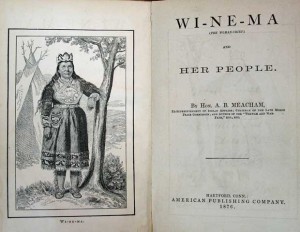
Wi-Ne-Ma (The Woman Chief) and Her People
Meacham_Wi_Ne_Ma_PeopleAlso known as the Lava Beds War, the Modoc War began in 1872, making it the last of the Indian Wars to occur in California and Oregon. Wi-Ne-Man acted as interpreted for the peace commission during the conflict. Her efforts saved the life of Alfred Benjamin Meachum, Indian Superintendent of Oregon, Meachum would go on to write an account of the chieftainess called Wi-Ne-Man (The Woman Chief) and Her People. The first edition was published in 1876. APBC shows this title at auction last in 1997, with only one prior occurrence in 1991. Details>>

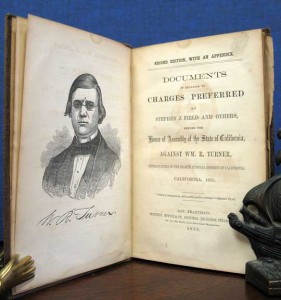
Documents in Relation to Charges Preferred by Stephen J Field and Others…
Field_Turner_Documents_Charges_PreferredThe Field-Turner feud is renowned in the annals of California history. Judge William R Turner had Field, an attorney, disbarred; Field ultimately got his revenge by, on election to the California Assembly, arranging Turner’s banishment, via judicial reorganization, to a remote “region in the northern part of the state.” [DAB]. This second edition includes testimonial and affidavits in Judge Turner’s defense from a host of local officials as well as a few national notables, including Andrew Jackson & Henry Clay. Furthermore, this copy contains rare associated ephemera: a handbill reprinting a contemporaneous review of the book entitled, “Judge Turner’s Book,” as published in the San Francisco Herald of Dec. 30, 1856; as well as a legal circular containing a statement by Judge Turner relating to his candidacy for re-election to the office of District Judge for the 8th District, dated Arcata, July 14, 1863. Additionally, contained within the circular are reprinted two letters with respect to Turner’s case before the Supreme Court, the latter advising Judge Turner “of the favorable and final decision of the Supreme Court in your case.” Details>>

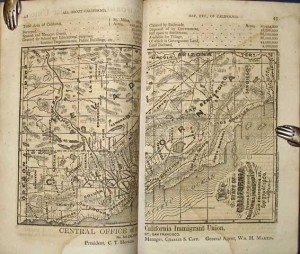
All About California and the Inducements to Settle There
All_About_CaliforniaAttributed to JS Hittel, All About California includes the drop title “For Gratuitous Circulation.” The propaganda piece was designed to encourage settlement in California, and it’s full of pertinent data and factoids of the era. This, the second edition, was issued in 1870 just like the first. It includes a folding map of the railroad route for the “Chicago, Rock Island, and Pacific RR Line,” along with a two-page map of California, a full-page wood engraving of the Grand Hotel, and a two-page map of “JT Little’s San Joaquin Valley.” This copy bears the stamp of the California Immigrant Union in the upper right corner of the front wrapper. There’s a small bit of bio-predation on the top pages of the last eight pages, but no text is affected. Details>>

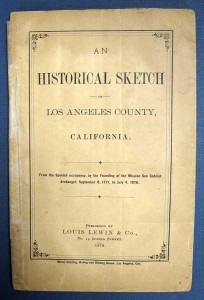
An Historical Sketch of Los Angeles County, California
Historical_Sketch_Los_Angeles_CountyThis account of California history stretches from the Spanish Occupancy, by the founding of the Mission San Gabriel Archangel, September 8, 1771, to July 4, 1876. This copy is a first edition, second issue, published in 1876. The volume is in its original printed paper wrappers. The wrapper edges chipped, with the upper corner lacking from front wrapper. A Japanese paper repair has been made to the spine. There’s occasional pencil marginalia. Overall, this is an about very good copy. Details>>


Related Posts:
The California Gold Rush, Slavery, and the Civil War
L Frank Baum’s Forgotten Foray into Theatre
Elias Samuel Cooper: Renowned and Controversial Surgeon

Thanks for reading! Love our blog? Subscribe via email (right sidebar) or sign up for our newsletter--you’ll never miss a post.

Share

Charles Dickens’ Fraught Relationship with Harriet Beecher Stowe

Harriet_Beecher_Stowe

One hundred years after Harriet Beecher Stowe’s Uncle Tom’s Cabin was published, Langston Hughes called the novel “the most cussed and discussed book of its time.” Hughes’ failure to comment on the literary merits of Uncle Tom’s Cabin hints at the persistent disagreement among writers, critics, and the reading public about the novel’s actual quality. Stowe’s contemporaries who found the book overly sentimental, extreme, or otherwise objectionable could not avoid discussing the book–on either side of the Atlantic. That included Charles Dickens, who initially endorsed Uncle Tom’s Cabin but came to resent the less than complimentary comparisons made between his own views and works and Stowe’s.

A Fortuitously Timed Publication

It seemed that Stowe had chosen precisely the right moment to publish an anti-slavery novel. The Fugitive Slave Act had passed in 1850, and the divisive legislation directly affected the Stowe household. Stowe had thought that one of her servants was a freed slave, but the girl had actually run away from a Kentucky plantation. When Stowe learned that the girl’s former owner was looking for her, Stowe immediately set out to find a safe hiding place for the girl. The episode would be one of many that inspired Stowe to undertake an abolitionist novel (though she would later claim that God himself was guiding her pen).

Stowe_Uncle_Toms_CabinSuch events happened all over the country, and the nation was ripe for just such a work as Uncle Tom’s Cabin. On May 8, 1851, the first installment of appeared in Washington DC’s National Era, which was owned by abolitionist Gamaliel Bailey. The piece was immediately popular; sales and readership of the National Era jumped from 17,000 to 28,000 while the story ran. Before the last installment had even appeared, Stowe already had an offer from John J Jewett & Co. to publish Uncle Tom’s Cabin in a single volume.

That edition was published on March 20, 1852. Over 100,000 copies had sold by the end of the summer, and over 300,000 copies had sold by March 1853. Dramatic versions of the novel appeared within months, and George L Aiken’s stage production remained among the most popular plays in England and America for the next 75 years.

Not everyone was quite so enthusiastic. Southerner William Gilmore Simms considered the novel both libelous and poorly researched. Reverend Joel Parker threatened to sue Stowe for her “dastardly attack” on his character. And Uncle Tom’s Cabin has been banned in the South at numerous points in history. The negative publicity induced Stowe to write The Key to Uncle Tom’s Cabin (1853) to defend herself. Either way, all the attention only served to increase Stowe’s fame.

An American Novel Goes Abroad

To expand her readership, Stowe sent presentation copies to a number of illustrious personages, from Prince Albert to the Reverend Charles Kingsley. Among the recipients was Charles Dickens, who received a little lavender-bound volume with a letter from Stowe. The American novelist evoked their shared mission, stating that “The Author of the following sketches offers them to your notice as the first writer in our day who turned the attention of the high to the joys and sorrows of the lowly.”

Dickens responded with guarded praise, complimenting Stowe’s noble cause. He was less restrained in expressing his opinion of the book later that year. Dickens reportedly told Sara Jane Clarke, a young American visiting Tavistock House, “Mrs. Stowe hardly gives the Anglo-Saxon fair play. I liked what I saw of the colored people in the States. I found them singularly polite and amiable, and in some instances decidedly clever; but then I have no prejudice against white people.” Clarke wrote, “Uncle Tom evidently struck him as an impossible piece of ebony perfection…and other African characters in the book as too highly seasoned with the virtues.” She noted that Dickens argued Uncle Tom’s Cabin was “scarcely a work of art.”

Stowe Proves Impossible to Ignore

Collier_Elizas_Flight_Sheet_Music

This piece of music published the same year as the novel – most likely due to the intense popularity Stowe’s work enjoyed right from the beginning. OCLC records nine institutional holdings.

By mid-1852, Uncle Tom’s Cabin was selling quickly in both America and England. Dickens simply couldn’t avoid talking and writing about the novel because it was simply what everyone wanted to discuss and read about. Thus he and Henry Morley wrote an article for the September 18, 1852 issue of Household Words called “North American Slavery.” The article opened with a critique of Uncle Tom’s Cabin. Dickens called the novel a “noble work,” before pointing out its “overstraining conclusions and violent extremes.” But then Dickens turned his pen to the author: “Harriet Beecher Stowe is an honor to the time that has produced her, and will take her place among the best writers of fiction.”

Before the article ran, however, Dickens was dragged into a most unpleasant controversy. On September 13, 1852, Lord Denmon, the former Lord Chief Justice of England and a friend of Dickens, launched a rather vicious attack against Dickens. He published an article in the London Standard critiquing both Uncle Tom’s Cabin and the first seven numbers of Bleak House. A staunch abolitionist, Denmon castigated Dickens for obstructing the abolitionist cause. He brought up the character of Mrs. Jellyby, “a disgusting picture of a woman who pretends zeal for the happiness of Africa…if it means to represent a class, we believe that no representation was ever more false.”

Denmon went on to publish five more columns in the Standard, which were subsequently republished for circulation in pamphlet form. In the third, Denmon satirized Dickens’ initial praise of Stowe, saying “Mrs. Stowe might have learned a more judicious mode of treating a subject from the pictures of Mrs. Dombey and Carker, of Lady Dedlock and Joe [sic]. Uncle Tom ought not to have come to his death by flogging. A railway collision, such as disposed conveniently of Mr. Carker, would have been much more artistic.” By the fifth piece, Denmon finally abandons Dickens to heap praises on Stowe’s “graphic skill and pathetic power in which she has so far surpassed all living writers.”

Dickens Tries to Quash the Controversy

Dickens didn’t publicly respond to Denmon right away. He probably would have preferred to avoid all discourse on Stowe and Uncle Tom’s Cabin altogether, but that was impossible. Indeed, he gets drawn into talking about the novel in his correspondence on more than one occasion, most notably with the Duke of Devonshire (October 29, 1852) and three weeks later with Mrs. Watson.

Soran_Aunt_Harriet_Becha_Stowe_Nightingale

“Aunt Harriet Becha (sic) Stowe” was written for Kunkel’s Nightingale Opera Troupe. OCLC records five institutional holdings.

Mrs. Cropper, Denmon’s daughter, wrote Dickens a letter of apology toward the end of 1852. She said that her father had suffered a severe paralytic stroke on December 2, 1852 and was not himself. Indeed, he had been forced to resign his post as Lord Chief Justice because of similar strokes. Dickens’ response indicates his growing resentment toward Stowe, who was now receiving praise at Dickens’ expense from a host of critics. Dickens argued that the best means to further the cause of abolition was not exaggerated emotional appeals and painting slave owners in the worst possible light, but rather reason and rational argument.

Dickens also felt that Stowe’s novel was being used as an “angry weapon” against him. He observed that the “exactly four words of objection to Uncle Tom’s Cabin (amidst the most ardent praise of it)” had resulted in unjust attacks on him. Cropper had her brother George draft a response to Dickens, but Dickens replied on January 21, 1853 with an aim of ending the matter completely. He sent back Cropper’s letter unopened.

An Unexpected Encounter

Unfortunately for Dickens, he couldn’t end his exposure to Stowe quite so easily. Now famous on both continents, Stowe embarked on a tour of the United Kingdom, and Dickens was to meet her. Her travel schedule proved unpredictable, so Dickens had virtually no time to prepare. Stowe and her husband arrived in London on May 2, 1853, which happened to be the day that the Lord Mayor was hosting a large banquet. Eager to show Stowe the proper hospitality, the Mayor immediately extended an invitation. He seated the Stowes directly across from Dickens and his wife, Catherine.

Unaware that Dickens harbored a grudge, Stowe was thrilled to be in Dickens’ company. She was impressed with him and his wife, noting later that they were “people that one couldn’t know a little of without desiring to know more.” Once the crowd had had several rounds of alcohol, Thomas Noon Talfourd proposed a toast to the literature of England and America. He noted how both Dickens and Stowe “employed fiction as a means of awakening the attention of their respective countries to the condition of the oppressed and suffering classes.” Then Talfourd made a toast to Dickens. Dickens stood and offered kind words to Stowe. Thus the evening appeared to go pleasantly enough. A few days later, Dickens took Catherine to call on Stowe and her husband at Walworth. Stowe returned the visit, only to find that Dickens was ill and Catherine was busy ministering to him.

In 1854, Stowe published Sunny Memories of Foreign Lands, recounting her visit to England. She specifically mentioned her meeting with Catherine Dickens, calling her a “good specimen of a truly English woman: tall, large, and well-developed, with fine, healthy color, and an air of frankness, cheerfulness, and reliability.” Perhaps Stowe was already predisposed to like Catherine. After all, she had championed an anti-slavery appeal, helping to collect about 500,000 signatures. The document, titled “An Affectionate and Christian Address from Many Thousands of Women of Great Britain and Ireland to Their Sisters, the Women of the United States of America.” The document was bound in 26 huge volumes and sent to Stowe.

By this time, however, Dickens had a very different view of his wife’s character. Thus Stowe’s lavish praise rankled him. He was sure to mention to others that Stowe had called Catherine “large.” Dickens also found Sunny Memories quite trite and dubbed the book “Moony Memories.” He wrote to a friend, “the Moony Memories are very silly I am afraid. Some of the people remembered most moonily are terrible humbugs–mortal, deadly incarnations of Cant and Quackery.”

Stowe Returns for a British Copyright

Stowe made a second visit to England in 1856, but she would not again encounter Dickens. This time, she met Robert Browning and Elizabeth Barrett Browning, along with Lord Byron and his wife Anne Isabella Milbanke, Lady Byron. The visit came on the heels of Dred: A Tale of the Great Dismal Swamp, another anti-slavery novel that was successful but not wildly popular like Uncle Tom’s Cabin.

During this second trip to England, Stowe and Dickens may have found common ground: Stowe’s primary purpose was to get a British copyright on her new book. She hadn’t held one for Uncle Tom’s Cabin, losing untold profit on all the copies sold abroad. Dickens, a long-time proponent of international copyright law, might have empathized with Stowe, given that he’d lost major sums thanks to pirated editions of his books in America.

A New Offense

For the next several years, there’s no evidence that Dickens discussed Stowe or Uncle Tom’s Cabin either in print or in correspondence. That changed in September 1869. That year, James T Fields, Dickens’ friend and American publisher, decided to run Stowe’s The True Story of Lady Byron’s Life in Atlantic Monthly. The piece delved into the Byrons’ private lives, unabashedly addressing the incestuous relationship between Lord Byron and his half-sister Augusta Leigh. Stowe intended to vindicate Lady Byron by exposing her husband’s depravity.

Dickens found such a work unconscionable. He’d always been vehemently opposed to prying into the lives of private figures; Dickens even called James Boswell an “unconscious coxcomb” for having written his biography of Samuel Johnson. Dickens was even sensitive once his own marriage fell apart and he started an affair with Ellen Ternan. Indeed, a simple indiscreet comment from William Makepeace Thackeray was among the first in a series of events that destroyed Thackeray and Dickens’ friendship. To protect his own privacy, Dickens even went to far as to make a bonfire at Gads Hill in September 1860, with the sole purpose of burning his own papers and correspondence.

Thus it should come as no surprise that on October 6, 1869 Dickens wrote to Fields, “Wish you had nothing to do with that Byron matter. Wish Mrs. Stowe was in the pillory.” And on October 18, 1869, he wrote to the actor Macready, “May you be as disgusted with Mrs. Stowe as I am.” He argued, “It seems to me that to knock Mrs. Beecher Stowe on the head, and confiscate everything about [the Byron affair] in a great international bonfire to be simultaneously lighted over the whole civilized earth, would be the only pleasant way of putting an end to the business.”

Yet Stowe’s brief foray into celebrity scandal would hardly remain a memorable part of her career. As she got older, she increasingly turned to more domestic subjects. None of her subsequent works would come close to reaching the popularity of Uncle Tom’s Cabin. Regardless of the book’s literary merits (or lack thereof), Uncle Tom’s Cabin has proven an incredibly powerful piece of literature. That’s evident in President Abraham Lincoln’s apocryphal greeting to Stowe, “So you’re the little woman who wrote the book that started the Great War!” Whether that’s true or not, the fact that it could be true aptly demonstrates the incredible impact of Uncle Tom’s Cabin.

Related Posts:
Charles Dickens the Copyright Confederate
How the “Dickens Controversy” Changed American Publishing
The California Gold Rush, Slavery, and the Civil War
Thanks for reading! Love our blog? Subscribe via email (right sidebar) or sign up for our newsletter--you’ll never miss a post.


Share

William Lambarde, Queen Elizabeth, and the Essex Rebellion

“I am Richard II. Know ye not that?”

So spoke Queen Elizabeth I to William Lambarde in August 1601–or so the story goes. The queen’s allusion to Shakespeare’s Richard II has long served as an illustration of the intense connection between arts and politics in Elizabethan England.

A Trusted Record Keeper

Lambarde_Perambulation_KentBorn in London, William Lambarde was a noted antiquarian, barrister, and politician who likely served in Parliament. Lord Chancellor Sir Thomas Egerton appointed Lambarde Keeper of the Rolls in 1597, and Queen Elizabeth appointed him Keeper of the Records of the Tower in 1601. By this time, Lambarde was already quite well known for his Perambulation of Kent. This volume, known as the first county history, was circulated in manuscript before it was printed in 1576. It was popular enough to go through several editions. Indeed, the last edition was published in 1656, some eighty years after its first appearance.

So how did the author of such a charming and innocuous work come to be at the center of political intrigue? Lambarde’s role as the Keeper of the Records of the Tower gave him unique access to records that spanned Elizabeth’s entire reign–and before. Early in August 1601, Lambarde presented Elizabeth with a book of “pandects,” the broad name for a compendium on virtually any subject. This book of pandects was a special compilation of records that Lambarde had prepared especially for Elizabeth.

Questions of Provenance and Authenticity

The ensuing dialogue between Lambarde and Queen Elizabeth I was recounted in a document titled “That which passed from the Excellent Majestie of Queen ELIZABETH, in her Privie Chamber at East Greenwich, 4 August, 1601, 43 reg. sui, towards William LAMBARDE.” Elizabeth supposedly told Lambarde, “I am Richard II. Know ye not that?” as she perused–and praised–Lambarde’s gift. The comment shows that Elizabeth knew that she, like Richard II, sat in a precarious position, in danger of losing her power at any moment.

At least, that was the conventional interpretation. But in recent years, scholars have questioned both the veracity of the document and the real implications of the statement. The document itself is first extant in 1780, where it’s included as an appendix to John Nichol’s biographical sketch of Lambarde in Bibliotheca Topographica Britannica. It was reprinted in 1788 in Progresses and Public Processions of Queen Elizabeth. Nichols added a note in a later edition that it was “communicated from the original, by Thomas Lambarde of Sevenoak, Esq.”

But the original author of the statement has been difficult to determine. The account drops to first person at the end, indicating that Lambarde may have written the account himself. He remained a competent and enthusiastic writer to the end of his life, and the manuscript could plausibly have passed down through multiple generations. Meanwhile, Queen Elizabeth was indeed on Greenwich on the date in question. Lambarde’s post as record keeper and independent interest in antiquities lend further support to the document’s authenticity. Thus it seems likely that the conversation happened as reported, even if we cannot readily identify the reporter.

Uncertain Succession

Elizabeth’s comment was certainly a pregnant one. She knew that her hold on the throne was loosening against her will. For years, there had been whispers about who would succeed her since she had no direct descendents. Many favored the succession of James VI of Scotland. Alternatives were Isabella of Spain, the sister of Spanish king Phillip III; and Arabella Stuart, the granddaughter of Margaret Tudor.

The majority of Elizabeth’s subjects were religiously moderate and would accept a monarch of either Catholic or Protestant persuasion, so long as tolerance was extended to observers of the other denomination. Elizabeth herself refused to discuss the matter and was careful not to show favor to any single heir. The entire situation invited intrigue upon intrigue, as various factions sought to assure the succession of their preferred candidates.

Essex Proves a Royal Disappointment

Robert_Devereux,_2nd_Earl_of_Essex_by_Marcus_Gheeraerts_the_Younger

Robert Devereux, 2nd Earl of Essex

One such schemer was Robert Devereux, Earl of Essex. Elizabeth thoroughly enjoyed Essex at court but never deigned to admit him to her confidence; she knew that Essex was not to be trusted. In 1598, the English sent a large force to Ireland to oppose Hugh O’Neill, Earl of Tyrone. Essex was put in charge of the effort and granted sweeping administrative power in Ireland.

However, Essex failed miserably, refusing to engage O’Neill and his men even under direct orders from the queen. When pushed harder, Essex struck an accord with O’Neill. Although the exact details of their agreement are unknown, scholars generally agree that they probably pledged their mutual support of James VI of Scotland.

The queen, none too pleased with this arrangement, reproached Essex–who responded by deserting his post, sailing for England, riding to Greenwich, and bursting in on the queen to beg her mercy. Queen Elizabeth was unconvinced. She banished Essex from her presence, and he was arrested later that day. Essex served a year of house arrest and emerged to discover that support for his cause had evaporated. All the while, his rival Robert Cecil had continued his own efforts to ingratiate himself to the queen.

A Failed Rebellion

Essex was sure that he’d still be able to garner support. His first move was to sponsor a performance of Shakespeare’s Richard II. He believed that the parallels would be quite clear: like Richard II, Queen Elizabeth had availed herself of malevolent advisors (ie, Cecil) and would invariably and imminently lose the throne. Such a move might seem ridiculously subtle by today’s standards, but the comparison would not have been lost on Essex’s contemporaries.

Essex then gathered about 300 followers and tried to persuade his replacement in Ireland, Lord Mountjoy, to bring his troops back to support Essex. Cecil already knew what Essex was planning, and Queen Elizabeth sent four advisors to Essex’s home. Essex locked them in his library and took to the streets, presuming that he’d be able to raise a supportive mob. He also hoped that the Sheriff of London, Sir Thomas Smyth, would support his cause.

Yet Smythe blew him off, and the mob failed to materialize. The Earl of Nottingham led a force of men to Essex house and forced Essex to surrender. He was tried and found guilty of treason alongside the Earl of Southampton (a patron of Shakespeare and the dedicatee of Venus and Adonis and The Rape of Lucrece). While Southampton was thrown into the Tower of London, Essex was sentenced to death. He hoped that Queen Elizabeth would intercede. She did not, and Essex was executed on February 25, 1601.

Seditious Shakespeare

The performance of Richard II was considered so treacherous that the Chamberlain’s Men also came under suspicion of sedition. On February 8, 1601, spokesman Augustine Philips testified, eager to distance the players from the performance. He emphasized that none of the players had wanted to perform such an outdated play, but that Essex had paid them 40 shillings above the usual fee. The players were exonerated and even performed for Elizabeth at Whitehall on the eve of Essex’s execution.

Some experts argue that the speed with which the investigate against the players was dropped shows how politically insignificant Shakespeare’s play really was. Others believe the play a sort of anthem for the Essex camp; it addresses issues of chivalry, pragmatism, and the divine right of monarchs. And it’s also possible that Essex didn’t intend treason at all, but that he was merely desperate to alert the queen of Cecil’s intentions. At any rate, the fact that Shakespeare’s imagined rebellion was implicated in a real one exemplifies the interplay between arts and literature in Elizabethan England.

Though William Lambarde was a trusted advisor to Queen Elizabeth I, his influence would not extend to the end of her reign. Lambarde passed away only a few months after his apocryphal exchange with Elizabeth. The episode elucidates Lambarde’s unique place in Elizabethan history, as much more than an author of a quaint county history.

Related Posts:
Happy Birthday, William Shakespeare! 
Meet Dr. Erin Blake, Curator of Art and Special Collections at the Folger! 

Thanks for reading! Love our blog? Subscribe via email (right sidebar) or sign up for our newsletter--you’ll never miss a post.

Share

Lydia Francis Child, Tenacious Abolitionist Author

Lydia_Maria_Child

Lydia Maria Francis Child established herself as a respected novelist before her rational approach to abolitionism cost her career. An influential thinker, Child managed to rebuild her reputation and became one of the most respected abolitionists of the time.

Child was born on February 11, 1802 in Medford, Massachusetts. Her father, David Convers Francis, was a successful businessman and sent her older brother, Convers, to Harvard. The same educational opportunity was not available to Child, but Convers supervised her education. When Child’s mother died in 1814, she was sent to live with her sister Mary Francis Preston in Norridgewock, Maine Territory. Child would stay there until 1820 and study at the local academy, which Convers supplemented with the works of Milton, Homer, and other classics.

In 1821, Child moved back to Massachusetts to live with Convers, who was by now a minister at the Unitarian church in Watertown. Just outside of Boston, Watertown was a veritable hotbed for progressive thought, and it was there that Child met such illustrious figures as John Greenleaf Whittier, Theodore Parker, and Ralph Waldo Emerson. Child also befriended Margaret Fuller.

By this time, Child had opened up her own girls’ school, but she still found time to write her first novel. Hobonok, a Tale of the Times (1824) was published when Child was only 22 years old. It recounted the story of Mary Conant, who is forbidden to marry her Episcopalian lover. Instead, she marries Hobonok, a member of the Pequod tribe and bears his child. While the literary community found the book scandalous, the novel became quite popular. Encouraged, Child published The Rebels; or, Boston Before the Revolution (1825), a novel about the events leading up to the Boston Tea Party. This book was popular among critics and readers alike.

In 1826, Child started Juvenile Miscellany, the first periodical in the United States that was solely devoted to children. She filled the journal with her own poems and stories, along with plenty of educational material. The venture proved more profitable than Child had anticipated, and it provided her a nice living for the next eight years.

Child met David Lee Child in 1828. He was a Harvard educated lawyer who practiced in Boston and had served in the state legislature. He also edited the Massachusetts Whig Journal. The couple soon married, and David introduced his wife to a new side of issues like Indian rights and abolition, including the radical ideas of William Lloyd Garrison.

Despite David’s education and credentials, he proved a poor breadwinner. Child supported them both with her writing. In 1829, she published The Frugal Housewife. The manual included tips on saving money, preparing home remedies, and educating girls. The book proved a success, and Child followed up with The Mother’s Book and The Little Girl’s Own Book in 1831. These volumes earned Child international renown.

Child_Appeal_Favor_Class_AfricansIn 1833, Child made a decidedly bold move. She published An Appeal in Favor of That Class of Americans Called Africans. The abolitionist book represented a significant departure from abolitionist literature of the era: rather than making religious or scriptural arguments, Child appeals to reason and makes a political case for abolition. Child also went a step further than most abolitionists, presenting a case not just for eliminating slavery, but also for ending discrimination against freed African Americans. Child advocated immediate emancipation–without compensating slave owners for their “lost property” and spoke out against the colonization of Africa. The book is considered a tour-de-force in abolitionist literature, and it influenced leaders like Wendell Phillips, William Ellery Channing, and Charles Sumner.

Child faced immediate repercussions for her Appeal. The Boston Athenaeum revoked her free reading privileges. Book sales plummeted. People rushed to cancel their subscriptions to Juvenile Miscellany, and Child was forced to shut it down. Meanwhile her husband had opted to raise sugar beets instead of slave-produced sugar cane, which was a complete failure. Their savings slowly dwindled.

In 1841, Child accepted editorship of the National Anti-Slavery Standard, the New York newspaper of the American Anti-Slavery Society. But she couldn’t agree with the use of violence and other extreme measures to further the cause and left the publication in 1843. Her departure caused a significant rift in the abolition movement. Her husband stepped up as editor after her, but was equally unable to stomach the society’s agenda.

That year, Child separated her finances from her husband’s, and the couple would remain estranged for a decade. Child turned to journalism to support herself, writing prolifically for newspapers and other periodicals. With Letters from New York (1843-1845), she managed to reestablish her reputation as an author. Child also took up the cause of gender equality, but she was reluctant to officially align herself with either suffrage or abolitionist movements after her break with the American Anti-Slavery Society.

Child and her husband reconciled in 1852 and moved to Weyland, Massachusetts. Though they were no longer at the center of public affairs, they nevertheless stayed engaged. The couple sheltered runaway slaves in their home and closely followed the affair of their good friend Charles Sumner. Senator Preston Brooks had caned Sumner senseless for his “Crime Against Kansas” speech, and Sumner retaliated with a poem called “The Kansas Emigrants.”

When John Brown staged his rebellion at Harper’s Ferry in 1859, Child was compelled to action. Though she didn’t agree with Brown’s violent approach, she admired his courage. When Child learned that Brown had been injured, she immediately wrote to Virginia Governor Henry Wise to offer her nursing services at Brown’s bedside.

Brown declined the offer, but it nevertheless rankled the pro-slavery camp. Mrs. James Mason, the wife of the author of the Fugitive Slave Act, stepped in. She, too, wrote to Governor Wise, denouncing Child for offering her services to a murderer. Mason made an ill-advised appeal, noting that Southern women aided slave women during child birth. Child immediately responded, pointing out that Northern women, too, assisted in the childbirth of African Americans, but “after we have helped the mothers, we don’t sell the babies.” The Child-Wise-Mason correspondence was packaged as a pamphlet by abolitionist leaders and distributed all over the North. At one point, 30,000 copies were circulating.

Thus ironically it was the same outspoken abolitionism that had cost Child her reputation that would again make her a celebrated figure. Child continued to speak for equal treatment of African Americans. In 1861, she gladly accepted an invitation to edit former slave Harriet Jacob’s novel Incidents in the Life of a Slave Girl. She followed in 1865 with The Freedman’s Book, a collection of sketches, poetry, and essays designed to be inspirational to newly freed blacks. Child’s last publication would be an anthologies of her works, Aspirations of the World: A Chain of Opals (1878).

Child passed away on October 20, 1880. A central figure in the abolitionist movement, her works are considered highly collectible by both historians and literature lovers alike.

Share

Top Ten Blog Posts of All Time

This month has been a big one here at Tavistock Books! We celebrate our 25th anniversary, along with the one-year anniversary of fearless Aide-de-Camp Margueritte Peterson. We’re also proud that this month we hit the 10,000-visitor mark for our blog. To recognize this occasion, we humbly present the top ten blog articles of all time. Hope you enjoy reading!

Dickens_Great_Expectations_Confederate_Edition1. The Two Endings of Charles Dickens’ Great Expectations

When Charles Dickens finished Great Expectations and sent it off to his publishers, he was quite pleased with himself. Then he showed a copy to friend and fellow author Edward Bulwer-Lytton, who, according to Dickens, “was so very anxious that I should alter the end…and stated his reasons so well, that I have resumed the wheel, and taken another turn at it.” The book’s dual endings present complications for critics and collectors alike. Read More>>

2. Why Did Charles Dickens Write Ghost Stories for Christmas? 

For the Victorians, Christmas wasn’t complete without a great ghost story! Charles Dickens certainly catered to this preference with his beloved Christmas Carol and a number of other Christmas tales. But why ghost stories? The holiday–once forbidden by Oliver Cromwell–has its roots in pagan rituals, which included telling “winter’s tales,” that is, ghost stories. Read More>>

Edith_Cavell_Crime_Des_Barbares3. Edith Cavell: Nurse, Humanitarian, and…Traitor?

Edith Cavell quickly earned a reputation as an excellent nurse, and during World War I she found herself with another set of duties. Along with other nurses, Cavell was recruited by the British Secret Intelligence Service to collect information about the Germans. She eventually put that mission aside, preferring to funnel British and French soldiers to neutral Holland. Cavell raised suspicion, and the Germans arrested her for treason. Cavell was convicted and executed, a move that provided plenty of fodder for British and American propaganda machines. Read More>>

4. Alexander Pope’s Legacy of Satire and Scholarship

History has not always been kind to Alexander Pope, and neither were his contemporary critics. The poet published his earliest extant work at only twelve years old and went on to found the Scriblerus Club alongside celebrated authors John Gay and Jonathan Swift. Thanks to the guidance and support of Swift, Pope was able to do what few authors of the era managed to accomplish: he made a comfortable living with the pen, mostly due to his ingenious translation of Homer’s Iliad. Read More>>

5. A Brief History of Propaganda

Propaganda has existed for ages; the Behistun Inscription, written around 515 BCE details King Darius I’s glorious victory. But the Catholic Church gave us the word itself and formalized the use of propaganda, most notably when Pope Urban II needed to bolster support for the Crusades. The literacy boom of the nineteenth century actually drove the production of more propaganda, as politicians had to sway the opinions of a more informed public. World War I saw the first large-scale propaganda production. Britain even enlisted its best authors, like AA Milne, to create pro-war propaganda. Read More>>

6. Charles Dickens Does Boston

Charles Dickens’ first trip to America began promisingly enough; he was immediately mobbed by adoring fans. Dickens fell in love with Boston, declaring the city “what I would like the whole United States to be.” But the trip turned sour when the young author insisted on addressing the issue of international copyright law at every turn. He was also appalled by the way slavery was practiced in the South and by Americans’ lack of social graces. Dickens documented his impressions of the United States in American Notes, which immediately alienated his Continental readers. Read More>>

Beardsley-Salome-Wilde7. Oscar Wilde, Dickens Detractor and “Inventor” of Aubrey Beardsley 

We remember Oscar Wilde just as much for his oversize personality as we do for his authorial excellence. Wilde’s ego often led to strange relationships with fellow authors, most notably Bram Stoker, Charles Dickens, and Aubrey Beardsley. Wilde lost a love to Stoker, railed against Dickens’ sentimentality, and claimed that Beardsley had Wilde to thank for his career. For rare book collectors, Oscar Wilde epitomizes the way that single-author collections can (and should) include works by other authors. Read More>>

8. The Six Hoaxes of Edgar Allan Poe

Edgar Allan Poe called his time “the epoch of the hoax,” and the horror writer couldn’t have been happier about it. Poe was a great lover of hoaxes, even attempting several himself. He forged a note from a supposed lunar inhabitant and penned a fake journal from an explorer. Poe even undertook one hoax to dissuade people from going West during the Gold Rush. But Poe’s efforts only proved that he should have stuck to poetry and fiction; he hardly convinced anyone that his hoaxes were real. Read More>>

George-Isaac-Robert-Cruikshank

From ‘The Cruikshankian Momus’ by Isaac, Robert, and George Cruikshank

9. George Cruikshank: “Modern Hogarth,” Teetotaler, and Philanderer

George Cruikshank followed in his father’s footsteps, building a reputation as a preeminent illustrator of his time. Political from the beginning of his career, Cruikshank was openly racist and patriotic. He adopted an incredibly moralistic tone about drinking. That uncompromising campaign for temperance ultimately became a wedge between Cruikshank and Charles Dickens. After Cruikshank’s death, however, his wife discovered that he’d been leading a secret life–and had fathered eleven children with the family’s former servant. Read More>>

10. The Millerites an the Great Disappointment

The Seventh-Day Adventist Church arose from a great failure. The nineteenth century saw a revival in millinarianism, the belief that a drastic event or movement would suddenly change the course of society as outlined in the book of Revelation. William Miller stepped forward as a sort of prophet, arguing that Jesus would certainly return in 1843 or 1844. His followers, called the Millerites, embraced his predictions–until the days passed and nothing happened. They broke into a number of different sects, one of which developed into the Seventh-Day Adventist Church. Read More>>


Share