The Ins and Outs of Collecting Serial Fiction for Children

By the 1890’s, dime novels were all the rage. They sold millions of copies each year. Teens and young adults were hardly immune to the allure of the often sensational stories. An ambitious author, Edward Stratemeyer saw an opportunity in publishing inexpensive novels especially for children and young adults. Stratemeyer had been around the publishing industry for years as both an author and an editor. He’d printed his first story at only fourteen years old, and was devoted to the industry from that moment on.

Judy_Bolton_Ghost_ParadeIn 1898, Stratemeyer got his big break: famous author Horatio Alger, Jr was ailing. Alger had already penned more than one hundred novels for boys, but he had a number of unfinished manuscripts. He invited Stratemeyer to complete one of the novels. Stratemeyer went a step further, negotiating for the copyright to four unpublished manuscripts, which he published under Alger’s name.

Stratemeyer published The Rover Boys at School in 1899 under the pseudonym Arthur Winfield. The book was so successful, it became the first of a thirty-book series that sold millions of copies. Stratemeyer founded the Stratemeyer Syndicate expressly to produce new series like The Rover Boys. He would pay writers fixed fees to write books based on his outlines. By the end of the twentieth century, Stratemeyer’s books had sold billions of copies and spawned multiple imitators.

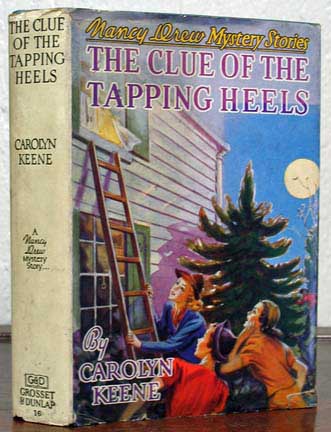
Keene_Nancy_Drew_Tapping_HeelsThe Bobbsey Twins debuted in 1904. Written under the pseudonym Laura Lee Hope, the series was a runaway hit. Stratemeyer followed up with Tom Swift (1910), written under the pen name Victor Appleton. By the time The Hardy Boys series began in 1926 (written under the name Franklin Dixon), about 98% of children named a Stratemeyer Syndicate series book as their favorite. Stratemeyer had truly established a publishing empire. Nancy Drew debuted four years later–and originally outsold The Hardy Boys.

Many of Stratemeyer’s series remain popular among children even today. They’re also favorites among collectors of children’s books because they evoke such nostalgia. Because the books were so popular, they were frequently reissued, but without changes to the copyright or edition information. Some were even updated to keep up with technological advances–again, often without any updated edition information. It’s difficult, then, to identify true first editions. While there are detailed bibliographies for Hardy Boys, Nancy Drew, and Judy Bolton, little information is available on most other series. Collectors should only purchase books from these kinds of series if the seller cites the appropriate bibliography in the description.

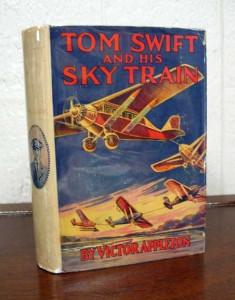
Appleton_Tom_Swift_Sky_TrainIf you’re interested in collecting a particular series, don’t let the lack of bibliographic information dissuade you! Enthusiasts find collecting serial fiction particularly satisfying because the ideal contents of the collection are already well defined; the pursuit especially appeals to completists, who are often interested in building a collection whose value as a whole is more than merely the sum of its parts. A common approach is to assemble an entire set without regard to edition. Then you can work toward replacing less desirable editions as you become more confident and knowledgeable.

Share

A Brief History of Propaganda

The term “propaganda” has come to have a negative connotation in much of the English-speaking world. But in some places, the word is neutral or even positive. Why this difference? The reasons can be traced through the word’s etymology and the way that this strategy of communication has evolved over the centuries.

Roots in the Catholic Church

The use of propaganda began much earlier than most people would imagine. The Behistun Inscription, from around 515 BCE, details Darius I’s ascent to the Persian throne and is considered an early example of propaganda. And ancient Greek commander Themistocles used propaganda to delay the action of–and defeat–his enemy, Xerxes, in 480 BCE. Meanwhile, Alexander put his image on coins, monuments, and statues as a form of propaganda. Roman emperor Julius Caesar was considered quite adept at propaganda, as were many prominent Roman writers like Livy.

But it was the Catholic Church that both formalized the use of propaganda and gave us the word itself. Pope Urban II used propaganda to generate support for the Crusades. Later, propaganda would become a powerful tool for both Catholics and Protestants during the Reformation. Thanks to the printing press, propaganda could be disseminated to a much wider audience.

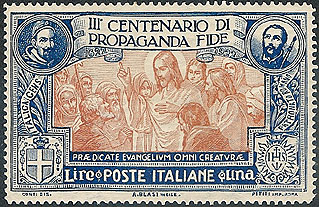
Centenario_Propaganda_Fide

The 300th anniversary of the Congregatio de Propaganda Fide was commemorated on Italian currency.

In 1622, Pope Gregory XV established the Congregatio de Propaganda Fide (Congregation for Propagating the Faith) for the purpose of promoting the faith in non-Catholic countries. The group’s name was often informally shortened to “propaganda,” and the name stuck. As literacy rates grew in subsequent centuries, propaganda became a more and more useful tool around the world. Thomas Jefferson and Benjamin Franklin were both considered adept propagandists during the American Revolution.

Literacy Propagates…Propaganda

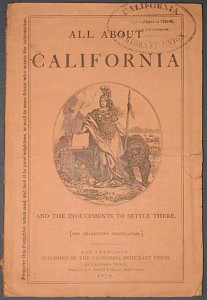
All_About_California_1870

“All About California” is a propaganda piece designed to encourage settlement in the state.

By the nineteenth century, propaganda had finally emerged in the form we think of it today. Because most people were literate and had more than passing interest in government affairs, politicians found it necessary to sway public opinion. They turned to (sometimes unscrupulous) propaganda to get the job done.

A notorious propaganda campaign of the 1800’s was that of the Indian Rebellion in 1851. Indian sepoys rebelled against the British East India Company’s rule. The British grossly exaggerated–and sometimes completely fabricated–tales of Indian men raping English women and girls. The stories were intended to illustrate the savagery of the Indian people and reinforce the notion of “the white man’s burden” to rule, induce order, and instill culture in less civilized peoples who could not be trusted to rule themselves.

Abolitionists in both the US and Britain also aggressively used propaganda to support their cause. Certainly the conditions of slavery were heinous, but they often exaggerated or eroticized transgressions, making them more lurid. These efforts were complemented by freed slaves who traveled to speak at public events. The speakers generally made arguments against slavery based on moral, economic, and political grounds. The combination of emotional and rational arguments proved an excellent combination for winning supporters to the abolitionist cause.

Meanwhile another powerful form of communication was emerging in the nineteenth century: the political cartoon. Though illustrated propaganda had been used in the past, the form of the political cartoon was significantly refined during the second half of the century. Thomas Nast is considered one of the forerunners of this format.

Global Conflict Gives Propaganda New Power

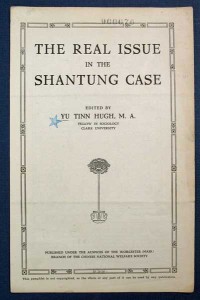
Real_Issue_Shantung_Case

This 1919 propaganda publication assails the Shantung settlement incorporated in the Treaty of Versailles.

World War I saw the first large-scale, formalized propaganda production. Emperor Wilhelm of Germany immediately established an unofficial propaganda machine with the creation of the Central Office for Foreign Services. One of the office’s primary duties was to distribute propaganda to neutral countries.

After the war broke out, however, Britain immediately severed the undersea cables that connected Germany to the rest of the world; Germany was limited to using a powerful wireless transmitter to broadcast pro-German news to other nations. The country also set up mobile cinemas, which would be sent to the troops at the front lines. The films emphasized the power, history, and inevitable victory of the German Volk.

Meanwhile, the British propaganda machine was regarded as an “impressive exercise in improvisation.” It was rapidly brought under government control as the War Propaganda Bureau. Journalist Charles Masterson led the organization. On September 2, 1914, Masterson invited Britain’s leading writers to a meeting to discuss potential messaging. Attendees included Sir Arthur Conan Doyle, GK Chesterton, Ford Madox Ford, Thomas Hardy, Rudyard Kipling, and HG Wells. Winnie-the-Pooh author AA Milne would later be recruited to covertly write propaganda.

The propaganda of World War I was frequently based on complete exaggeration or misinformation. For example, nurse Edith Cavell was executed for treason after using her position as a nurse to help soldiers escape from behind German lines. The episode was used to exaggerate German atrocities, and it was even made into a movie. (Read more here.) Indeed, by the end of the war, people had begun to tire of propaganda.

Yet the British propaganda machine was quite effective. It is frequently credited with persuading the United States to enter the war in the first place. Adolf Hitler actually studied British propaganda after the war, declaring it both brilliant and effective. He would later enlist Joseph Goebbels to help with propaganda during World War II, and the two proved an indomitable team. They masterminded multiple campaigns to justify eugenics programs, extermination of target populations, and other atrocities. The Allies countered with propaganda that vilified the Germans.

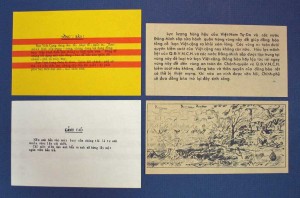
South_Vietnam_GVN_Propaganda

This collection of South Vietnamese GVN propaganda were probably air drop leaflets. Though usually dropped in mass quantities, few survive.

When the true horrors of Nazi Germany came to light, the extreme power of propaganda was terribly apparent. The word “propaganda” soon developed a negative connotation, one that it still carries to this day in the English-speaking world. Airdrop leaflet campaigns during unpopular engagements like the Korean War and Vietnam War often brought the communication even lower.

Now it’s common for a government authority to regulate propaganda, and it may be used for more innocuous purposes like public health and safety campaigns. But in non-democratic countries, propaganda continues to flourish as a means for indoctrinating citizens, and this practice is unlikely to cease in the future.

Related Posts:
Edith Cavell: Nurse, Humanitarian, and Traitor? 
AA Milne: Legendary Author and Ambivalent Pacifist

Thanks for reading! Love our blog? Subscribe via email (right sidebar) or sign up for our newsletter--you’ll never miss a post.

Share

The Magic Ring: A Forgotten Inspiration for JRR Tolkien

When The Magic Ring was published in 1813, it met with instant success. Its author, Friedrich Heinrich Karl Freiherr de la Motte Fouqué, has largely faded from popular awareness, remembered occasionally for Undine (1811). But JRR Tolkien owes an extraordinary debt to Fouqué for his portrayal of the One Ring and his pioneering work in fantastic fiction.

A Soldier Author

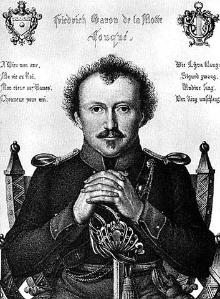
friedrich_baron_de_la_motte_fouquetBorn on February 12, 1777, Fouqué was a descendent of French Huguenots. His grandfather was a general for Frederick the Great, and his father was a Prussian officer. Fouqué himself didn’t intend to have a military career. Instead, he went to Halles. But in 1794, he left school to join the army and participate in the Rhine campaign. Fouqué would again see battle in 1813, during the uprising against Napoleon. By this time, nationalism had taken deep root in Germany, and these sentiments came to influence Fouqué’s writing.

Following that first stint of military service, Fouqué decided to pursue his literary interests, which were split between medieval romance and northern mythology. In 1806 he versified a sixteenth-century medieval romance. Fouqué was also the first to dramatize the Nibelung legend, combining both Icelandic sources (such as the Volsunga Saga) with Middle High German legend. This play and its sequels were published as a single volume in 1811 and immediately brought Fouqué public attention.

The following year, Fouqué published Undine. The novel includes elements not only of fantasy, but also of religious allegory, Gothic horror, and historical romance, so it appealed to a wide audience. The book has also received praise from critics in all corners. In “The Fantastic Imagination,” George MacDonald says, “Were I asked, what is a fairytale? I should reply, Read Undine: that is a fairytale….of all the fairytales I know, I think Undine the most beautiful.” MacDonald’s love of Fouqué was clear in both his fiction and non-fiction, which would later inspire both CS Lewis and Tolkien.

From 1810 to 1815, Fouqué managed to churn out plays, novels, and epics at an incredible pace. But by 1820, his reputation had faltered; unable to adapt to changing times and tastes, Fouqué still clung to Romanticism. His rivals dubbed him the “Don Quixote of Romanticism.” Fortunately Frederick William IV of Prussia granted Fouqué a pension, so he passed his last years in relative comfort.

Fouqué’s Invisible Influence

Fouqué influenced multiple authors, from Robert Louis Stevenson and Louisa May Alcott, to Edgar Allan Poe and HP Lovecraft. But the most important of these were undoubtedly William Morris and JRR Tolkien. Morris, widely regarded as the father of modern fantasy, opened the door for Tolkien later on.

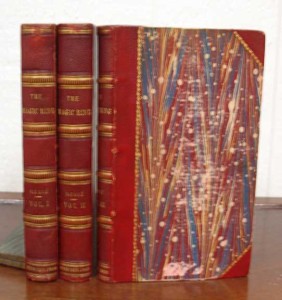
Motte_Fouque_Magic_RingTolkien scholar Amy H Sturgis notes that The Magic Ring (1813) is a sort of “missing link in the story of Tolkien’s One Ring.” The legend began several centuries ago with the Siegfried story of Norse legend. It also appears in the Nordic Sagas and Eddas, along with the Middle High German Nibelundenlied. Over time the legend evolved, but Fouqué’s adaptation proved incredibly influential. It was taken up by Richard Wagner in his Ring Cycle and by JRR Tolkien in the Lord of the Ring series.

So why has Fouqué fallen by the wayside? His work was tossed aside during his own lifetime as preferences changed. That alone is often enough to relegate an author to the sidelines of history. But as Tolkien has again gained more attention. readers and collectors are rediscovering figures like Fouqué. Which authors have you been most excited to (re)discover?


Thanks for reading! Love our blog? Subscribe via email (right sidebar) or sign up for our newsletter--you’ll never miss a post.

Share

A Look Back at Long-Lost Manuscripts

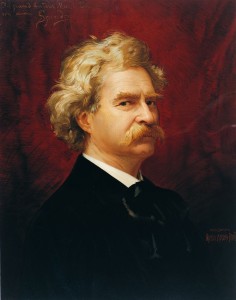
MarkTwainOn February 13, 1991, Sotheby’s made an incredible announcement: the auction house had Mark Twain’s long-lost manuscript of The Adventures of Huckleberry Finn. The manuscript bore edits in Twain’s own hand and had scenes not included in the published novel. The discovery and subsequent authentication sparked an argument over who had rights to the manuscript.

The recovered manuscript was unearthed in a set of trunks sent to a Los Angeles librarian after her aunt, a resident of upstate New York where Twain once lived, passed away. It constitutes the first half of the Huckleberry Finn manuscript. The second half had been in the possession of the librarian’s grandfather James Gluck. Gluck had solicited the manuscript directly from Twain for the Buffalo and Erie Library. At the time, Twain had been unable to find the first half of the manuscript, and it was presumed lost.

A “custody battle” ensued among the librarian and her sister; the library; and the Mark Twain Papers Project in Berkeley, California. They finally agreed that the library would take the papers, but that all three would share publication rights. The manuscript was published by Random House in 1995.

The discovery of such a document generates excitement among scholars and rare book collectors alike. The Huckleberry Finn manuscript was but one of many such documents to turn up unexpectedly.

Corroborating Robert Hooke’s Claim to an Invention

Robert_HookeRevered scientist Robert Hooke was one of the original fellows of the Royal Society and the curator of the group’s experiments. He was also responsible for recording the organization’s minutes from 1661 to 1682. The minutes make for fascinating reading, not least because of Hooke’s own asides and commentary. They recount many seminal moments in science, including the earliest work with a microscope and the first sightings of sperm and micro-organisms. This fascinating 500-page document didn’t show up until 2006, when it was discovered in a dusty cabinet.

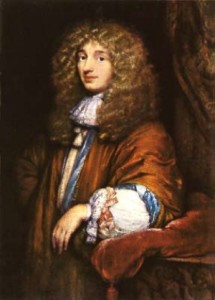
The minutes from December 1679 detail correspondence between Hooke and Sir Isaac Newton regarding the design of an experiment to confirm the rotation of the earth. Hooke recorded a suggestion from Sir Christopher Wren, which required shooting bullets into the air at precise angles to see if they fell in a circle. But perhaps even more interesting is that the document finally elucidates a feud between Hooke and Dutch physicist Chistiaan Huygens.

Huygens announced that he’d invented a watch that would keep its own time for several days and would make it possible to measure longitude, which infuriated Hooke. He claimed that he’d showed the Royal Society the same invention five years earlier, and that someone must have leaked the design. Hooke embarked on a mission to prove he’d invented the watch first. He painstakingly combed through years of Royal Society minutes, looking for proof of his own invention. Ironically, he’d ripped out the notes about the invention itself and taken them home for safekeeping–only to misplace them. In this newly discovered document, Hooke exonerates himself: he records a quote from his predecessor, Henry Oldenberg, about Hooke’s presentation of the invention–five years earlier than Huygens, just as Hooke had alleged.

A First Look at Yellowstone

Diamond_City_1870

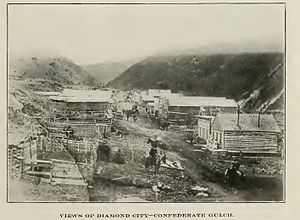
Diamond City ca 1870

By 1869, prospectors’ accounts of their finds at the Diamond City gold camp were both outlandish and persistent. Incredulous, thirty-year-old mining engineer David E Folsom decided to investigate for himself. In September of 1869, he undertook a treacherous expedition with friends Charles Cook and William Peterson. The group’s military envoy had canceled, and other would-be adventurers backed out, unwilling to venture into hostile territory unescorted.

During the four-week expedition, the group witnessed and documented the natural wonders of the area. They also took numerous measurements of the land, even using a rock on a string to measure the height of waterfalls. Folsom recorded their experiences and tried to sell his account to a number of prominent national magazines. They all turned him down because the tales seemed too fantastic to be real. Finally a small Chicago paper called Western Monthly ran the story. Folsom’s account contributed to the deployment of both the Washburn-Doane-Langford expedition (1870) and the Hayden expedition (1871)–which subsequently led Congress to make Yellowstone the first national park.

Folsom’s great-grandson David A Folsom found the original manuscript, written in pencil on lined paper. Two other manuscript copies had been destroyed in two separate fires, and had previously been the only extant copies. The younger Folsom gave the manuscript to Montana State University’s Renne Library Special Collections, where it still resides today.

Truman Capote, Kathryn Graham, and a Little Hashish

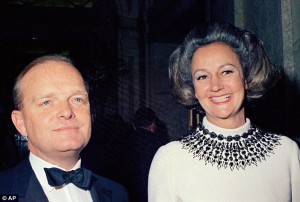
Ever the journalist, Truman Capote wasn’t known for glossing over his acquaintances’ secrets (or character flaws). Many a New York socialite fell victim to his pen–with one notable exception. Kathryn Graham never seemed to appear in Capote’s work. That all changed with the discovery of an unpublished story, “Yachts and Things” among Capote’s papers at the New York Public Library.

Capote_Graham

In the story, the narrator (presumably Capote) recounts a cruise along the Turkish coast with a “distinguished” and “intellectual” woman called Mrs. Williams. Their hosts have been called away due to a death in the family, and another guest has just passed away. One evening, the two invite some Turks aboard and smoke hashish for the first time. Though the hosts aren’t named, the deceased companion is named Adlai Stevenson.The researchers who discovered the story conjectured that the woman in the story was actually Graham because of her well-documented relationship with Stevenson, and they didn’t do much further research.

But a look at Graham’s own autobiography, Personal History, yields a more definitive answer. Graham, Capote, and Stevenson were invited on the trip by Gianna and Marcella Agnelli, who were unable to join their guests because of a death in the family. Graham and Capote stopped in London, and Graham coyly tells how Stevenson stayed with her (and forgot his tie and glasses in the morning). Stevenson died of a heart attack the next day. Graham and Capote decided to go on the cruise anyway, and Graham says they passed the time discussing Capote’s soon-to-be-published In Cold Blood.

Manuscripts like these will always be beloved because they seem to offer us a greater intimacy with the author. They illustrate the author’s own writing process, essentially illuminating the process of creating great history and literature.

Related Posts:
Three Pioneering Authors Who Used Pseudonyms

Thanks for reading! Love our blog? Subscribe via email (right sidebar) or sign up for our newsletter--you’ll never miss a post.

Share

The Rare Books of Valentine’s Day

Valentine’s Day is upon us. If this day of hearts, candy, and warm fuzzies isn’t exactly your cup of tea, you’re not alone! Here’s a look at our three best less-than-romantic rare books for the holiday.

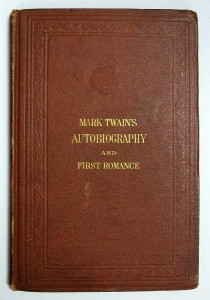
Mark Twain’s (Burlesque) Autobiography and First Romance

Twain_Autobiography_First_RomanceThe title of this work is quite misleading; the events have no relevance to Twain’s life. The book, published by Sheldon & Co in 1871, contains two separate stories: “A Burlesque Autobiography,” which first appeared in Twain’s Memoranda contributions to The Galaxy; and “First Romance,” which was originally published in The Express in 1870. They were not Twain’s favorites; indeed, two years after the book was published, he bought the printing plates and destroyed them.

The short stories do feature characters who are supposedly related to Twain. Twain ends the story abruptly, saying only “The truth is, I have got my hero (or heroine) into such a particularly close place, that I do not see how I am ever going to get him (or her) out of it again—and therefore I will wash my hands of the whole business, and leave that person to get out the best way that offers—or else stay there. I thought it was going to be easy enough to straighten out that little difficulty, but it looks different now.”

Just as the story has no real connection to Twain’s life, the illustrations also have no connection to the text. They use illustrations of the children’s poem The House that Jack Built to criticize the Erie Railroad Ring and its participants.

Revi-Lona: A Romance of Love in a Marvelous Land

Cowan_Revi_LonaWhere romance and science fiction intersect, you’ll find Revi-Lona: A Romance of Love in a Marvelous Land by Frank Cowan. The novel is set in Antarctica and includes all the expected elements, such as prehistoric creatures and super science. Though Bleiler dates the novel’s publication to 1879, other sources simply place the novel “circa 1880’s.”

Though Cowan published a number of works, he’s probably better known for being Andrew Jackson’s personal secretary for managing land patents. Cowan was appointed to the position in 1867 and remained in the post until Jackson was succeeded by Ulysses S Grant. That same year, Cowan perpetrated a major literary hoax with his friend Thomas Birch Florence, who owned a failing Georgetown newspaper.

In an effort to bolster sales, Cowan and Florence came up with a fantastic story; they reported that the body of an Icelandic Christian woman who’d supposedly died in 1051 had been found under the Great Falls of the Potomac River. The body proved that other settlers had reached America a full five centuries before Christopher Columbus. Though the story did bolster sales, Cowan and Florence were eventually found out.

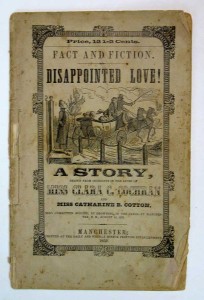
Fact and Fiction! Disappointed Love! A Story

Disappointed_Love_Cochran_CottonThe drop title of this work is “Drawn from the lives of Miss Clara C Cochran and Miss Catherine B Cotton, Who Committed Suicide, By Drowning, in the Canal at Manchester, N. H., August 14, 1853.” The two young women worked and roomed together at the Manchester Corporation and had “frequently expressed a purpose to drown themselves.” But their housemates thought little of it and paid the girls no heed.

Then on August 14, 1853, Cochran and Cotton “proceeded hand-in-hand, with great apparent cheerfulness, to the bridge crossing the upper canal…and together leapt into the water.” A few people witnessed the event. The women had obviously premeditated their demise, as both left letters to loved ones and put their affairs in order. Cochran, only nineteen years old at the time of her suicide, stood to inherit a large sum on her 21st birthday, which made her motives even more inscrutable to her contemporaries.

What are your favorite obscure or eccentric tales of love? And what rare book would you most like to receive for Valentine’s Day yourself?

Related Posts:
A Look Back at Long-Lost Manuscripts
Courtship, Romance, and Love…Antiquarian Style

Thanks for reading! Love our blog? Subscribe via email (right sidebar) or sign up for our newsletter--you’ll never miss a post.

Share

Jane Bigelow, the First Celebrity Stalker?

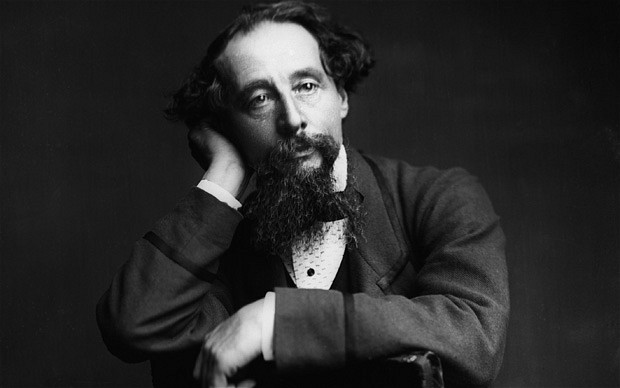
Charles_Dickens

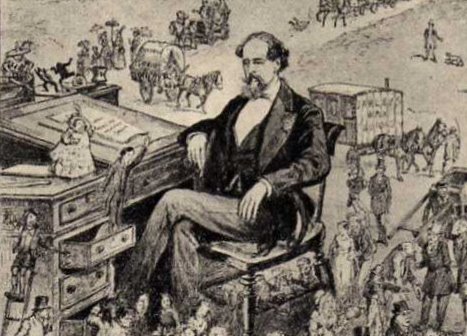
Can we really blame Bigelow for being obsessed with this guy? We are!

When Charles Dickens arrived in Boston for the first time, he was greeted with incredible fanfare. He would fall in love with the city and be lured back there in 1867. By this time, Dickens had established himself as a preeminent author of the age, and he undertook a whirlwind reading tour. His fans’ adulation had not abated in the past decades, and Dickens found himself once again the center of attention.

One woman gave Dickens a bit too much attention–Jane Bigelow. Jane was a descendent of the Poultney family of England, a lineage that included a three-time mayor of London and an Earl of Bath. When she married John Bigelow on June 11, 1850, she was 21 years old and he was 33. The couple would have nine children together. John Bigelow was already managing editor and co-owner of the New York Evening Post, and he had a promising political career ahead of him. He would eventually serve as President Lincoln’s consul general and later as the minister to France.

Although John took well to political life, his wife was not quite so suited for it. She managed to offend the Prince of Wales by slapping him on the back, and she sent her servants to sit in the imperial opera box in Germany. It’s rumored that John was denied further diplomatic posts because of his wife’s crass behavior, to which Charles Dickens would unfortunately find himself privy.

A Chance Acquaintance at the Parker House

November, 1867 found both the Bigelows and Dickens at the Parker House. Dickens had made the hotel his home base during this second American tour, and he often dined there with publisher James T. Fields. The Bigelows dined with Fields, Dickens, and his manager George Dolby. The group played parlor games together, as was common for genteel hotel guests at the time. Jane Bigelow soon proved herself a rather tiresome companion; she frequently showed herself to have little grasp for polite manners or common courtesies.

Dickens’ own wife had proven unequal to the task of running a household–let alone keeping up with Dickens’ tireless publicity and authorial efforts, and Dickens could empathize with John Bigelow’s plight. Fields’ wife, Anne observed in her journal that Dickens had “deepest sympathy for men who were unfitly married and has really taken an especial fancy I think to John Bigelow…because his wife is such an incubus.” Jane Bigelow figured in Anne’s journal frequently enough that Anne took to calling her “Mrs. Bigs.” When the Bigelows finally returned to New York, Dickens was likely grateful to escape Jane’s irksome company.

An Unexpected Encounter Turns Violent

But then he traveled to New York himself and encountered Jane under more peculiar circumstances. Dickens was doing a reading at the Westminster Hotel, and the hotel manager asked him to meet with “a little widow” named Mrs. Hertz. She was a great admirer of Dickens and was thrilled to meet him privately. But when Mrs. Hertz left Dickens’ rooms, she found herself face to face with none other than Jane Bigelow! Jane attacked Mrs. Hertz and berated her for being “daring” enough to enter Dickens’ rooms alone. For the rest of the tour. Dolby had to place guards outside Dickens’ quarters to prevent interlocutors, most notably Jane, who tried to see Dickens on several subsequent occasions.

Dickens took the whole incident in stride, but he was struck with the oddity of the situation. He wrote to a friend, “How queer it is that I should be perpetually having things happen to me with regard to people that nobody else in the world can be made to believe.” Though a few other literary figures like Oliver Wendell Holmes had achieved celebrity status as authorial rock starts, such status was still relatively uncommon. It was certainly unusual for an adoring, possibly crazy fan to attack an old widow outside one’s hotel room!

Though Dickens’ encounter with Jane Bigelow was out of the ordinary, it illustrates the magnitude of his fame. Beloved in his time, Charles Dickens remains a major figure in world literature and a favorite among rare book collectors.

Related Posts:
How the “Dickens Controversy” Changed American Publishing
Charles Dickens Does Boston
Irving and Dickens: The Authors Who Saved Christmas
Why Did Charles Dickens Write Ghost Stories for Christmas?
The Two Endings of Charles Dickens’ ‘Great Expectations
Oscar Wilde: Dickens Detractor and “Inventor” of Aubrey Beardsley

Thanks for reading! Love our blog? Subscribe via email (right sidebar) or sign up for our newsletter--you’ll never miss a post.

Share

How the “Dickens Controversy” Changed American Publishing

Charles_Dickens

“Is it tolerable that besides being robbed and rifled, an author should be forced to appear in any form – in any vulgar dress – in any atrocious company – that he should have no choice of his audience – no controul [sic?] over his distorted text – and that he should be compelled to jostle out of the course, the best men in this country who only ask to live, by writing?”

-Charles Dickens, to Henry Austin (May 1, 1842)

By the time Charles Dickens made his first visit to America, the country was deeply embroiled in a publishing battle with Britain. His repeated pleas for international copyright law would eventually spark the “Dickens Controversy” and bring new accountability to the world of American publishing.

A Legal Loophole

In Dickens’ day, American copyright law provided no protection for non-citizens’ intellectual property. The result hit both British and American authors in the pocketbook: British authors received no royalties on pirated editions of their works, and their authorized editions were hardly appealing at many times to price of the pirated copies. Meanwhile, American authors like Edgar Allan Poe, Washington Irving, and Walt Whitman lost money because American readers would purchase 25-cent pirated British literature instead of one-dollar American books.

While such a publishing problem might seem inconsequential in the grand scheme of foreign relations, it actually caused significant tension. American publishers sent employees to scour the docks of Boston, Philadelphia, and New York, in hopes of intercepting manuscripts from popular authors that were bound for pirated editions. Meanwhile, British officials frequently confiscated as contraband American pirated copies of British books.

Thus Dickens faced quite a copyright conundrum. The pirated editions severely cut into his profits, but they also increased his circulation and popularity, leading to more demand for his work. But ultimately Dickens knew that more rigorous copyright laws would benefit authors on both sides of the Atlantic. He began openly advocating international copyright law. By the time Dickens arrived in the United States for the first time on January 22, 1842, he already planned to enlist American authors to support his cause.

 A Triumphant Arrival in Boston

Dickens’ fans in Boston greeted him like a rock star. He later wrote to a friend, “there never was a king or Emperor upon the Earth, so cheered, and followed by crowds.” Thanks to all those pirated copies of Dickens’ novels, the author had an incredible fan base in the United States. Dickens clearly loved the attention and adulation. He could also identify with the American ideals of democracy, liberalism, and equality. He’d pulled himself from poverty to become a celebrated author, personifying those ideals. And the American press glommed on to Dickens’ story. One paper called him “Boz, the gay personification of youthful genius on a glorious holiday.”

Report_Dinner_Given_Charles_Dickens_Boston

“Report of the Dinner Given to Charles Dickens in Boston, February 1, 1842”

Dickens was received by preeminent scholars and authors of Boston, including Oliver Wendell Holmes, Richard Henry Dana, and Daniel Webster. On February 1, 1842, Dickens was the guest of honor at a “Young Men of Boston” dinner. He used the event to give his first speech to an American audience on the subject of international copyright law. This move proved poorly calculated; while Dickens had expected to receive support from fellow authors, he instead encountered resistance. America’s economy was flagging, and authors were reluctant to come across as demanding more money from the reading public.

Public Opinion Turns for the Worse
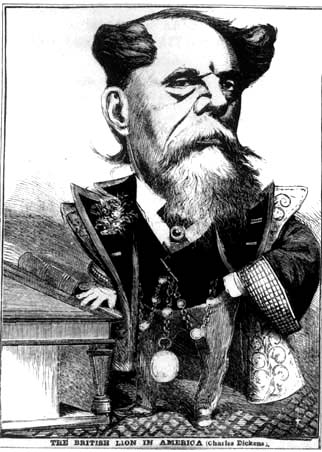
British_Lion_America_Nast_Dickens

This caricature, often attributed to Thomas Nast, illustrates the reaction of the American press.

Dickens had also underestimated the power and priorities of the American press. Countless newspapers filled their pages with free British content, so international copyright law posed a significant threat to their profits. The newspapers immediately accused Dickens of being a “hired agent” for Britain, a mercenary out to fleece the American public. Dickens’ reputation was quickly tarnished.

Even Walt Whitman, who’d always been fascinated with Dickens, got in on the action, publishing “Boz’s Opinion of Us” in the New York Evening Tattler, where he was the editor. The paper ran a forged letter, supposedly from Dickens, outlining the “dark spots of American character.” Even though Whitman actually defended Dickens’ words, praising passages of the letter, the whole episode deeply damaged Dickens’ image. The editor of one New York newspaper reprinted the letter and said, “it will ruin Mr. Dickens’ personal popularity altogether with us.”

Dickens Strikes Back

Dickens_American_Notes

“American Notes for General Circulation”

Although Dickens was initially quite taken with the United States, his account of the trip, “American Notes,” was relatively dry. He was harsh, however about slavery and the “abject state” of the American press. It was with Martin Chuzzlewit that Dickens really lashed out. The eponymous protagonist, a young man, travels to America to seek his fortune, only to be disappointed with American customs, manners, and publishing. Martin Chuzzlewit was published (unauthorized, of course) by the very papers that Dickens insulted in the novel.

Soon after, Dickens gave up lobbying for international copyright law. He realized it was a lost cause. But he didn’t give up his position entirely. Dickens stopped negotiating with American publishers for advance sheets of his novels, effectively removing their advantage of printing his books first. While this refusal wasn’t controversial, it was extremely unusual for the time period.

Finances Spur a Return

By the 1860’s, Dickens was an established celebrity. By all accounts, he should have been quite comfortable financially. But after much marital strife, Dickens’ wife, Catherine had been removed from the Dickens’ Rochester estate. A divorce would have sullied Dickens’ image, so he settled for relocating his wife to London and giving her a monthly stipend. And Dickens was still supporting his adult children–all six of his surviving sons were still receiving support from him by the mid-1860’s, despite being of age to support themselves.

Dickens’ resources were stretched thin. He wrote to his sister-in-law Georgiana, “Expenses are so enormous, that I begin to feel myself drawn towards America, as Charles Darnay in Tale of Two Cities is drawn toward Loadstone Rock, Paris. He believed enough time had passed that the American public would have forgotten about the publicity debacle of his first visit to the States.

Meanwhile, Dickens had perfected his readings, and British audiences flocked to see him perform. American theatre managers promised a second American tour would be even more lucrative than the first. They were correct. Dickens made £38,000 for 76 readings. His managers strutted around with paper bags full of cash. When Dickens passed away, the profits from this American tour constituted a full twenty percent of his estate.

An Unexpected Move

Mystery_Edwin_Drood_Charles_Dickens

‘The Mystery of Edwin Drood’

In 1867, Dickens made a bold proclamation. He announced that Fields, Osgood, and Co, the publishers who’d sponsored his tour, would have exclusive rights to his next novel, The Mystery of Edwin Drood. This was a truly unprecedented maneuver, and it spurred discussions that have since become known as the “Dickens Controversy.” Dickens knew that he would never stop piracy of his works altogether, but he made an impassioned moral plea to the American public to buy authorized editions.

The tactic–perhaps surprisingly–worked quite well. Even the most notorious pirating firms were forced to reconsider their practices in light of Dickens’ campaign. Alas, Dickens passed away before finishing The Mystery of Edwin Drood, and the changes he promoted for international copyright law weren’t adopted until 1891. But Dickens contributed to a new era of cultural balance between Britain and the United States.

Related Posts:
Charles Dickens Does Boston
Irving and Dickens: The Authors Who Saved Christmas
Why Did Charles Dickens Write Ghost Stories for Christmas?
The Two Endings of Charles Dickens’ ‘Great Expectations
Oscar Wilde: Dickens Detractor and “Inventor” of Aubrey Beardsley

Thanks for reading! Love our blog? Subscribe via email (right sidebar) or sign up for our newsletter--you’ll never miss a post.

Share

Collecting Antiquarian Diaries, Journals, and Correspondence

In this age of electronic communication, the practice of keeping a journal or diary has largely fallen by the wayside, as has the art of letter writing. But in past centuries, keeping a diary was the only means of creating a written record of one’s life, the only way to look back at one’s personal past. In bygone days, farmers may have recorded observations about crops, livestock, and weather in a journal. Soldiers recorded strife,while ordinary men and women simply recorded the simple details of their daily lives. And written correspondence was the primary method for maintaining long-distance relationships.

Looking back at these documents can give us tremendous insight into the aspects of life that history books often omit. They may reveal facts about the diet, customs, or etiquette of the time period. They sometimes shed light on genealogy and local history. Journals and correspondence may even reveal the real motivations behind historic events or explain the nuanced relationships among important individuals.

Tips for Collecting Diaries, Journals, and Correspondence

For many collectors, diaries and journals are appealing because each volume is an absolutely unique manuscript. Such a document is quite a treasure, indeed. Collectors should keep a few tips and hints in mind.

  • Look for complete sets, rather than individual volumes of journals and diaries. Faithful diarists will often have produced a number of volumes over the course of their lifetimes. Stay away from individual volumes that have most likely been removed from a set.
  • Decide whether you’ll digitize your collection. This will require the assistance of a skilled archivist or conservator. Digitizing these items is an investment, but it will enhance your ability to enjoy the content of your collection–and to share it with scholars if the content proves significant.
  • Be gentle! Old paper can be quite brittle, while covers may be fragile. Handle them with care, and consider professional conservation or preservation to extend the life of your collection.
  • Don’t overlook ephemera. Journals frequently contain extra items, which can range from dried flowers to vacation souvenirs. These items damage the pages on either side. A conservator may recommend carefully documenting each item’s location and storing it separately in an archival envelope.
  • If correspondence is still contained in the original envelopes, consult a conservator about the best means to preserve both the envelopes and the letters inside. Chemical interactions between materials–even between two sheets of the same or similar papers–can hasten breakdown.

A Selection of Diaries and Journals

Journal Across the Atlantic

Journal_Across_AtlanticOriginal mss journals such as this are quite rare in commerce. An unidentified male passenger recorded the details of his 1785 transatlantic journey from London to Philadelphia. He records the names and nationalities of the crew and passengers, along with the daily minutiae of life aboard the ship. Events include the sighting of a “grampus whale,” an encounter with a Spanish ship, and a lively debate over how moths and butterflies came to be aboard the ship. Details>>

Notes from Lectures of Professor Alonzo Clarke for 1848-1849

Almon Mitchell Orcutt attended the College of Physicians and Surgeons in New York. The first 136 pages of his journal consist of notes he took during the lectures of Alonzo Clarke, a noted physician and professor at the college. Clarke was often quoted in medical journals and association reports. He famously said, “All of our curative agents are poisons; and, as a consequence, every dose diminishes the vitality.” He was correct, indeed, given the “medicines” and treatments commonly used at the time. John Harvey Kellogg quotes Clarke in his Home Hand-Book of Domestic Hygiene (volume 2, 1880) in a discussion of the smallpox vaccination. Orcutt’s notes include the semester’s lectures, while the last 68 pages contain financial records. Details>>

Department of the Interior, US Geological Survey

US_Geological_Survey_Notes_JournalThis workbook started out as a record of levels and other data, kept by Allen T Paine, the survey crew levelman. But Paine also used the book as a photo journal. Many of the photographs are captioned. While many show family, friends, and colleagues, a good number also document the buildings of Concord, New Hampshire, along with the survey crew’s work and environs. Details>>

Family Trip Photo Diary/Journal

This period photo journal of a visit to the 1915 Panama Pacific Exposition in San Francisco begins in Albuquerque, New Mexico. It includes 45 images, eight of which clearly depict portions of the journey to San Francisco. One image, for example, shows part of the Salt Lake; another, the Grand Canyon. Fourteen of the images have handwritten captions. Details>>

 Archive of Shuman Family Letter Correspondence, August 1862-September 1866

Shuman_Family_Correspondence_Civil_WarJohn Shuman was in his early twenties when he volunteered for service in the 88th Regiment of the Indiana Volunteers to fight for the Union in the American Civil War. His letters illustrate his confidence in the decision and that he believed the war would be short-lived. It lasted longer than Shuman expected, and he lost his life in battle, not due to wounds, but due to dysentery. The Shumans’ correspondence offers a unique snapshot of a soldier’s life during the war. Details>>

Eleven Manuscript Diaries

Manuscript_DiariesThe author of these diaries, William Antrim Flowers, was born on March 21, 1832 in Champaign County, Ohio. He begins his memoir with his birth and then goes back to the birth of his father in 1804. The memoir is a rich storehouse of family genealogy and history, following his family and relatives as they moved abou tthe Midwest in the early nineteenth century. Flowers also documents his own life, during which he worked variously as a teamster, a wagon driver, a teacher, and a dairy farmer. He saw the first McCormick reaper in 1855 and enlisted to serve in the Civil War. Flowers records descriptions of his own experiences in the war, along with a description of the 114th Colored Regiment Infantry and the 44th Colored Regiment; and the death of Abraham Lincoln. Details>>

Related Posts:
Flights of Fancy: Collecting Vintage Airline Posters
Of Sammelbands and Sheet Music
A Brief History of Broadsides


Thanks for reading! Love our blog? Subscribe via email (right sidebar) or sign up for our newsletter--you’ll never miss a post.
Share

Randolph Caldecott, Legend of Children’s Literature

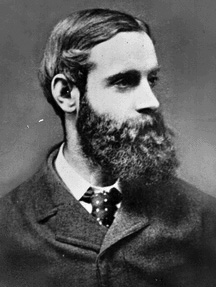
Randolph_CaldecottYesterday the winners of this year’s Newbery and Caldecott Awards were announced. The latter was named for Randolph Caldecott, an accomplished painter and sculptor whose various attainments are often eclipsed by his brilliant carer as an illustrator. Along with figures like Kate Greenaway and Walter Crane, Randolph Caldecott was truly one of the most gifted illustrators of the Victorian era.

Caldecott was born in Chester on March 22, 1846. He was third child by his father’s second wife and would eventually be one of thirteen children. From the time he was young, Caldecott frequently spent his free time sketching and modeling his surroundings. But when Caldecott left school at fifteen years old, it wasn’t to pursue a career in art. He took a position at the Whitchurch branch of the Whitchurch & Ellesmere Bank. Caldecott settled in a nearby village, and he often took time to capture the country scenes that stretched out before him as he traveled to visit clients.

A lover of riding, Caldecott naturally took up hunting. His collected works include, therefore, a huge number of hunting scenes, along with myriad sketches of animals. Caldecott’s first published drawing was of neither; it was of a disastrous fire at the Queen Railway Hotel. Caldecott wrote an account of the blaze for the Illustrated London News. When Caldecott moved to Manchester six years later to work at the Manchester & Salford Bank, he took the opportunity to take night classes at the Manchester School of Art. Soon after, his drawings began appearing in local and London periodicals.

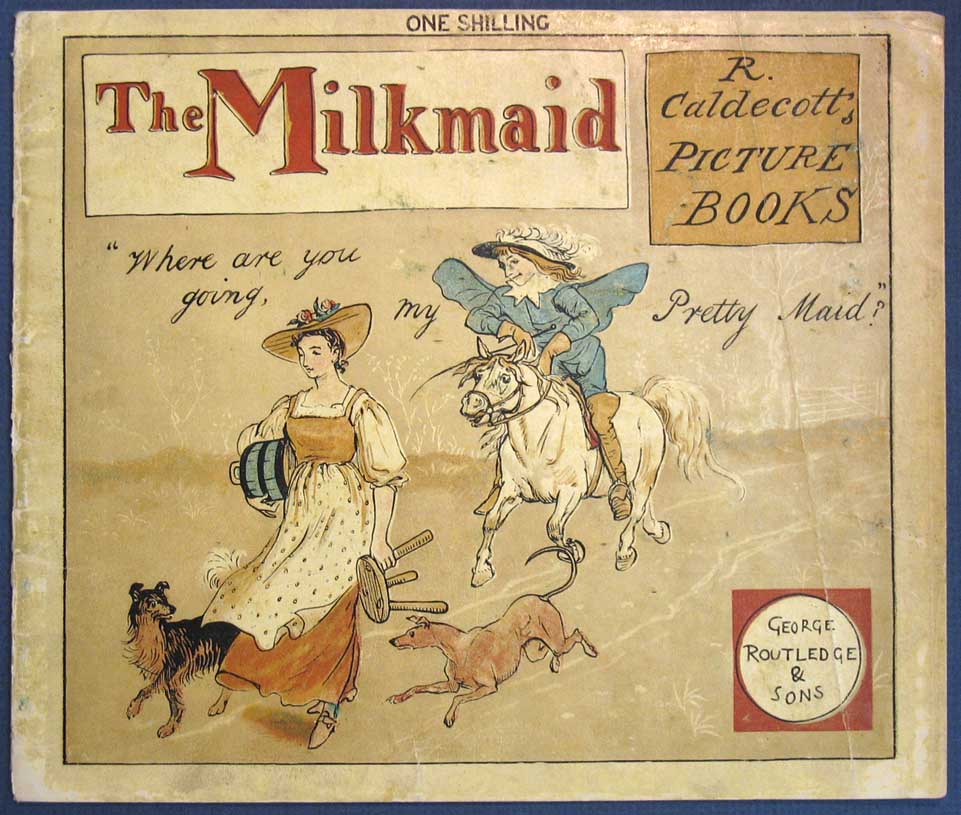
Randolph_Caldecott_MilkmaidThen in 1870, Caldecott’s friend Thomas Armstrong, a painter in London, introduced Caldecott to Henry Blackburn of London Society. Blackburn and Caldecott got along famously, eventually traveling together. For a time, Caldecott even lived in a cottage at Blackburn’s estate. Blackburn published a number of Caldecott’s illustrations in the magazine, and in 1872 Caldecott decided to move to London and pursue illustration full time. He was 26 years old.

Within two years, Caldecott found himself a prominent magazine illustrator working on commission. His opus is varied, ranging from children’s books to travel illustrations and caricatures. His illustrations for Washington Irving’s Old Christmas and Bracebridge Hall (1875) had made his name in the illustration world. Caldecott also illustrated works by Oliver Goldsmith, notably Elegy on the Death of a Mad Dog. Caldecott’s illustration of the poem would be used in a World War I parody, in which the head in his original illustration was replaced by the head of the Kaiser of Germany.

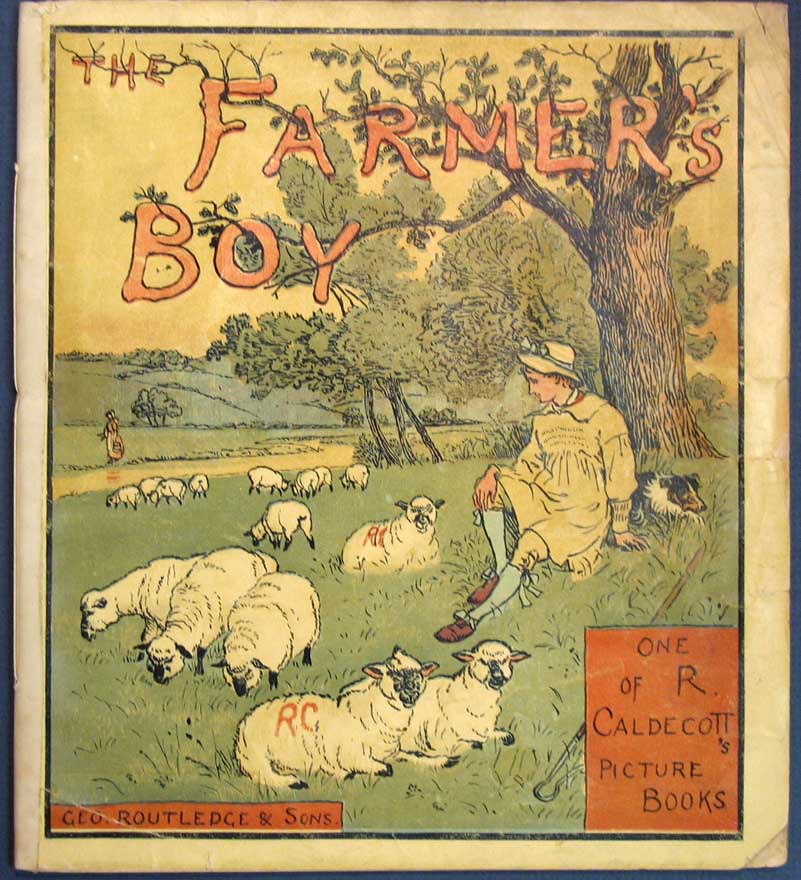
Caldecott_Farmer_BoyCaldecott settled in the heart of Bloomsbury. He was surrounded by artists and literati, regularly encountering figures like Dante Rosetti, George du Maurier, and Frederic Leighton. Lord Leighton would go on to hire Caldecott to design four peacock capitals for the Asia room of Leighton House in Kensington; Walter Crane would design a peacock frieze for the same room.

In 1877, accomplished engraver Edmund Evans ended his relationship with illustrator Walter Crane. Evans found Caldecott’s illustrations “racy and spontaneous,” so he invited Caldecott to replace Crane. The first project: two Christmas books. Caldecott took on the work, illustrating The House that Jack Built and the William Cowper poem The Diverting History of John Gilpin. These books were so successful that Caldecott produced two more each Christmas for the rest of his life. Caldecott chose all the stories and rhymes, sometimes even composing them himself.

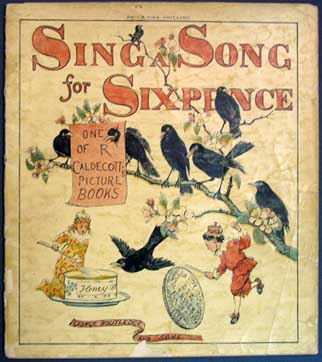
Caldecott_Song_SixpenceCombined sales of the Christmas books hit 867,000 during Caldecott’s lifetime. The artist was internationally famous. Caldecott’s publisher, George Routledge & Sons, took Caldecott’s works quite seriously. They took great pains to reproduce the colors exactly as Caldecott had intended. When the books were reissued by Frederick Warner & Co after Caldcott died, they brightened the colors but lost much of the subtlety imbued by Caldecott.

Not all Caldecott’s works, however, were commercially successful. In 1883, he undertook an edition of Aesop’s fables. He invited his brother Alfred to translate the tales from the original Greek, but later overruled Alfred’s accuracy. Caldecott’s goal was to make Aesop’s fables, which were often used for instruction, more accessible to children. He illustrated each of the tales he selected with Victorian human behavior. Usually comical, the illustrations illuminated the veracity of Aesop’s teachings. But the book was still too complicated for children, and it did not sell well.

Caldecott’s 1885 edition of The Great Panjandrum Himself fared much better. The nonsense poem by Samuel Foote had become quite the rage among university students, who would try to memorize the lines and recite them to one another. (Generations later, students would take up Winnie-the-Pooh, by AA Milne, with the same fervor; the story was even translated into Latin by one undergraduate.)

Meanwhile, Caldecott’s health was ever precarious. He frequently traveled to warmer climates. It was on one of these trips, in 1886, that he passed away. Caldecott and his wife had arrived in St. Augustine, Florida during a particularly cold February. Caldecott succumbed to the cold, and his memorial still stands in St. Augustine.

Related Posts:
AA Milne: Legendary Children’s Author and Ambivalent Pacifist
Kate Greenaway: Legendary Illustrator of Children’s Books
Maurice Moutet de Monvel and His Ingenious ‘Jeanne d’Arc’

Thanks for reading! Love our blog? Subscribe via email (right sidebar) or sign up for our newsletter--you’ll never miss a post.

Share

Famous Figures in the History of Nursing (Part Two)

The history of nursing is filled with illustrious figures like Florence Nightingale and Clara Barton. But there are plenty of women whose contributions to this noble vocation are overlooked.

Elizabeth Fry

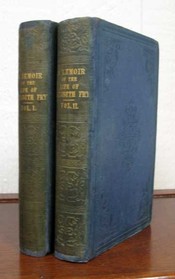
Memoirs_Life_Elizabeth_FryA Quaker and Christian philanthropist, Elizabeth Fry came to be known as the “angel of prisons.” At eighteen years old, Fry was moved by the sermons of American Quaker William Savey. She immediately took an interest in caring for the poor, sick, and incarcerated. Her efforts led her to Newgate Prison, where she was horrified to find the women’s prison crowded with both women and their children. She soon became an outspoken advocate for improving prison conditions, even spending the night in prisons occasionally herself and inviting members of nobility to do the same.

In 1840, Fry established a training school for nurses. Florence Nightingale later took a group of Fry’s nurses to assist wounded soldiers in the Crimean War, and her experience working with them inspired her to start a similar program. By this time, Fry was quite well known throughout England; even Queen Victoria was an admirer of her work. The monarch granted Fry a few audiences and donated to her causes.

Anna Morris Holstein

Anna_Ellis_Holstein

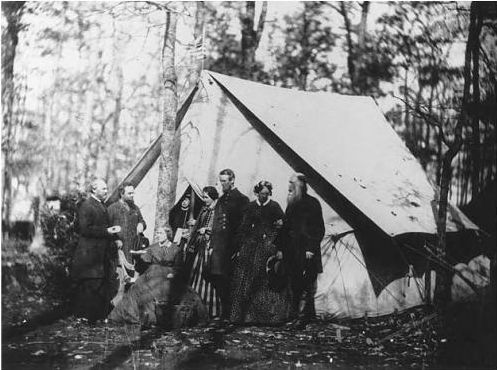
The Holsteins (center) on site at a field hospital

Anna Morris Holstein may have been the last person you’d expect to see traveling with soldiers. She and her husband, William H. Holstein, were quite wealthy. But they still had a strong sense of duty. William had served in the Pennsylvania militia during Lee’s 1862 invasion. And when the couple witnessed the carnage at Antietam, they felt called to serve. Anna noted, “we have no right to the comforts of our home, while so many of the noblest of our land renounce theirs.”

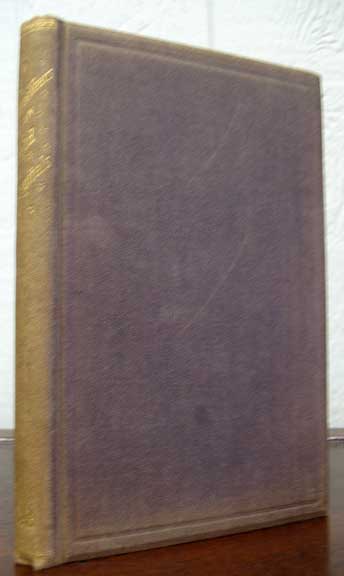
Three_Years_Field_Hospital_Army_PotomacThe couple enlisted with the US Sanitation Commission. Anna struggled with the grisly realities of war and later admitted that she was of little use till she could gain control of her composure and stop crying. Even after she was more experienced, Anna would succumb to emotion when she received “earnest thanks” from a soldier. After the war, publisher JB Lippincott capitalized on the hunger for war stories, first with Hospital Sketches, then less successfully with Notes of Hospital Life (1864). Anna’s Three Years in Field Hospitals of the Army of the Potomac fit the bill to continue the trend.

Alice Fisher

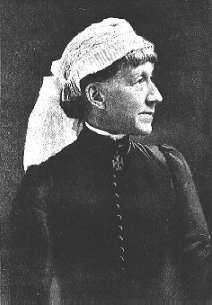
Alice_FisherAlice Fisher didn’t immediately embark on a career in nursing. She started out as an author. Fisher penned Too Bright to Last in 1873, and the three-volume His Queen in 1875. But her father, an astronomer and priest, took ill and soon passed away, leaving Fisher to make her own way. She decided to pursue nursing, and went to school at the Nightingale Training School and Home for Nurses, where her mentor was none other than the founder herself. The two corresponded, but no letters are extant.

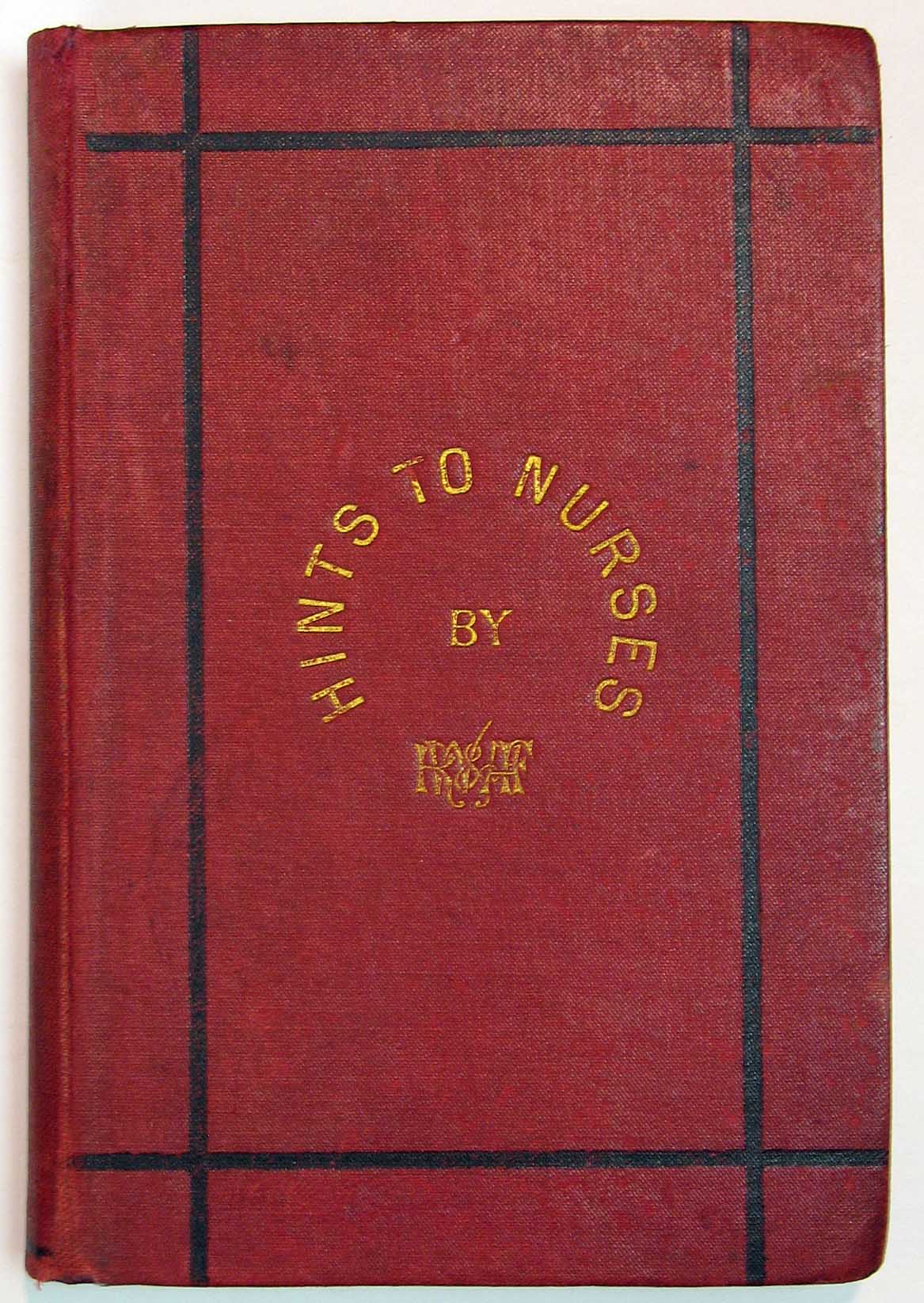
Hints_Nurses_Fisher_WilliamsFisher came to the US in 1884 as the superintendent of Philadelphia General Hospital (PGH), then more commonly known as Buckley Hospital. Fisher made sweeping changes to the hospital. Her approach was a sterling example of the benefits of standardized training for nurses. Along with fellow Nightingale nurse Rachel Williams, Fisher edited Hints for Hospital Nurses (1877).

Lavinia Dock

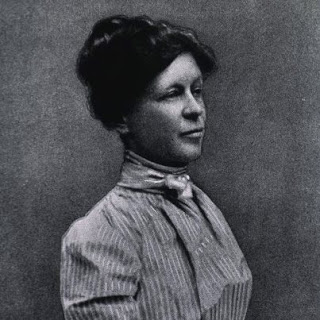
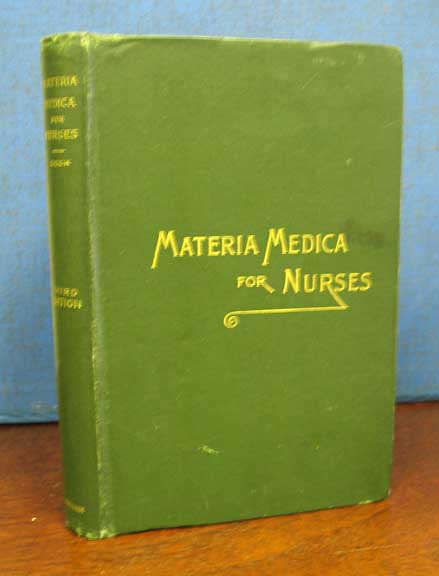
Lavinia_DockLavinia Dock graduated from the Bellevue Hospital School of Nursing in 1886. Two years later, she was in Florida during a yellow fever outbreak. Dock served alongside Jane Delano, who went on to found the American Red Cross Nursing Service. Dock was a contributing editor to American Journal of Nursing and authored a number of books on the subject, including a four-volume history of nursing and a nurse’s drug manual that was the standard reference for years. Dock served as the assistant superintendent of Johns Hopkins School of Nursing under Isabel Hampton Robb. Dock, Robb, and Mary Adelaide Nutting would go onto found to organization that evolved into the National League for Nursing.

Materia_Medica_Nurses_Lavinia_DockAfter Dock retired from nursing, she turned her attention more fully to the issue of women’s rights. She became active in the National Woman’s Party, leading numerous protests–including a picket of the White House. Dock was actually arrested on three separate occasions for militant protesting. But her efforts paid off, and she was instrumental in the passage of the 19th Amendment. This wasn’t Dock’s only political concern; she also lobbied for legislation that would allow nurses to control their own profession, rather than being overseen by doctors.

This month we’re pleased to offer works by these four women, along with a number of other select acquisitions on nursing. We invite you to peruse the entire list. Should you have a question about an item, please don’t hesitate to contact us!


Related Posts:
Edith Cavell: Nurse, Historian, and Traitor? 
Famous Figures in the History of Nursing (Part One)
Clara Barton: Heroine of Civil War Nursing and Record Keeping

Thanks for reading! Love our blog? Subscribe via email (right sidebar) or sign up for our newsletter--you’ll never miss a post.

Share