Charles Dickens, Sir Arthur Conan Doyle, and Victorian Spiritualism

On April 1, 1848, modern Spiritualism was born in Hydesville, New York. That day, teenage sisters Margaret and Kate Fox announced that they had communicated with the spirit of a man who had been murdered in their house years before. A report of the incident first appeared in the New York Tribune, and it was reprinted soon after in both American and European newspapers.

Spiritualism Takes Hold in England

Fox_Sisters

The Fox Sisters

The roots of Spiritualism stretch back to the eighteenth-century works of Emmanuel Swedenborg. But the incident with the Fox sisters ignited unprecedented interest in the phenomenon of communicating with the dead. Spiritualism would enrapture leading thinkers of the day, along with celebrated authors like Elizabeth Barrett Browning and Sir Arthur Conan Doyle. Meanwhile, Charles Dickens came out as a staunch opponent–despite his own interest in the also-questionable practice of mesmerism.

Spiritualism in its modern form emerged in Britain in 1852. That year, Maria Hayden traveled to London and offered her services as a medium. She conducted seances, complete with table rappings and automatic writing. But Spiritualism was far from new in England; Queen Victoria herself had subscribed to the belief as early as 1846. By the 1860’s Spiritualism had exploded into a full-fledged counterculture; it had its own newspapers, societies, treatises, and pamphlets. Seances–complete with table tapping, table tipping, automatic writing and levitation–were conducted in even the most genteel social circles.

Victorian England was ripe for just such a movement. Though it was an era of great scientific discovery, it was also an era of turning away from organized religion and confronting uncertainty. To fill the void, many Victorians turned to the supernatural, mesmerism, electro-biology, Spiritualism, and other relatively new pursuits. These new practices thoroughly blurred the lines between religion and science, and even proponents of Spiritualism were divided about how to characterize it.

From Fiction Writer to Leading Spiritualist

Doyle_McCabePublic_Debate_SpiritualismElizabeth Barrett Browning famously subscribed to Spiritualism, much to the chagrin of her skeptical husband, Robert Browning, who was dragged to seances with her on multiple occasions. But the Brownings were far from the only authors at the seance tables; Christina Rosetti, John Ruskin, William Makepeace Thackeray, and Rudyard Kipling participated in seances. But it was Sir Arthur Conan Doyle who would delve so deeply into Spiritualism, he would turn away from fiction almost altogether.

Conan Doyle encountered Spiritualism as early as 1866, thanks to a book by US High Courts Judge John Worth Edmonds. The judge, who claimed he’d communicated with his wife after she died, was one of the most influential Spiritualists in America. Conan Doyle was by now already famous as the creator of Sherlock Holmes. But he hoped to be remembered for something entirely different, so he turned away from his famous protagonist to study Spiritualism. Conan Doyle presented his first public lecture on Spiritualism in 1917, and he would eventually travel throughout Great Britain, Europe, and America educating audiences about the practice. He even trekked to Australia, New Zealand, and South Africa in the name of Spiritualism.

Fairy_PicturesWhile Conan Doyle was respected in Spiritualist circles, his blind devotion led him headlong into ridicule on more than one occasion. He was taken in by Frances Griffith and Elsie Wright’s forged photographs of fairies. Conan Doyle, accepting the photographs as authentic, wrote a few pamphlets and The Coming of Fairies (1922), which made him a bit of a laughingstock. Later, Conan Doyle invited his friend Harry Houdini to attend a seance,with his wife Jean, acting as medium. Jean claimed to have contacted Houdini’s mother and “automatically” wrote a long letter in English. Unfortunately Houdini’s mother had known little English. Consequently the famous magician publicly declared Conan Doyle a fraud.

Perhaps unsurprisingly, Conan Doyle persisted, remaining an avid Spiritualist until his death. Once he passed away, claims surfaced that he and his wife had arranged for communication from beyond the grave. On July 7, 1930, five days after Conan Doyle’s death, a seance was held at Royal Albert Hall. The presiding medium, Estelle Roberts, claimed that she’d relayed a message from Conan Doyle to his wife…but was drowned out by the overzealous organ player.

Dickens Ridicules Spiritualists

Although Conan Doyle was devoted to Spiritualism, he was careful not to sully Sherlock Holmes with such a controversial ideology. Thus whenever Holmes encounters potentially supernatural phenomena, he remains nonplussed and seeks a rational explanation. After all, as the famed detective says in “The Adventure of the Sussex Vampire,” “This agency stands flat-footed upon the ground, and there it must remain. The world is big enough for us. No ghosts need apply.” Charles Dickens would surely have agreed.

Dickens grew up reading penny weeklies like The Terrific Register, which he said “frightened the very wits out of [his] head.” The register’s pages brimmed with tales of ghosts, murder, incest, and cannibalism. Meanwhile, the English tradition of telling ghost stories at Christmas–coupled with Dickens’ own (lucrative) habit of publishing new stories at Christmas resulted in Dickens’ publishing plenty of ghost stories of his own.


Dickens_Mesmerism

Dickens called Eliotson “one of my most intimate and valuable friends” in this letter to ‘The Boston Morning Post.’

That didn’t stop the Inimitable from openly dismissing Spiritualism as unmitigated quackery. He frequently attacked Spiritualists in both Household Words and All the Year Round. In “Well Authenticated Rappings,” (Household Words, 1858), Dickens questions why spirits would return to communicate with the living, only to make idiots of themselves by tapping out banal messages rife with orthographical mistakes.

Yet even Dickens got pulled into a movement of highly questionable validity: mesmerism. Named for its creator, Anton Mesmer, mesmerism was the belief that the universe was full of an invisible magnetic fluid, which influenced all life and could be manipulated more easily with magnets. Prominent doctor John Eliotson was one of the leading proponents of mesmerism (also known as magnetism and animal magnetism). Eliotson was eventually shunned from the medical establishment as a result.

Dickens actually became a practicing mesmeric doctor, successfully putting both his wife and sister-in-law into a trance. During his family’s trip to Italy in 1844, Dickens also mesmerized the alluring Augusta de la Rue, who suffered from, as she called it, a “burning and raging” in her head. The attention he lavished on M. de la Rue was sufficient to evoke jealousy from Dickens’ wife, Catherine. Meanwhile, Dickens was less successful in his attempt to mesmerize his friend Charles Macready.

Dickens_Edwin_DroodDickens and his fellow mesmerists believed, as Eliotson did, that the practice represented a genuine improvement in the field of medicine–unlike Spiritualism, which served no such therapeutic function. Thus he felt perfectly justified in lambasting Spiritualism while simultaneously espousing a practice that, as modern readers, we might find laughable. 

Ironically enough, Dickens was a frequent target of mediums. His final, unfinished novel, The Mystery of Edwin Drood has inspired many an author to attempt its end. But in 1873, printer Thomas James penned an ending for the book. He claimed that Dickens had dictated the ending from beyond the grave, calling the book The Mystery of Edwin Drood (Complete). Part second of The Mystery of Edwin Drood. By the spirit-pen of Charles Dickens, through a medium.

Ultimately both Sir Arthur Conan Doyle and Charles Dickens illustrate the Victorian predilection for the supernatural and strange. 

Related Posts:
Why Did Charles Dickens Write Ghost Stories for Christmas?
The Six Hoaxes of Edgar Allan Poe
All Posts-Charles Dickens


Thanks for reading! Love our blog? Subscribe via email (right sidebar) or sign up for our newsletter--you’ll never miss a post.

Share

25 Books Celebrating 25 Years in Business

Tavistock_Books_Catalogue_25_Years

25 years ago this month, in May 1989, Tavistock Books came into being-  without capital, without business plan, without significant inventory.  A rather inauspicious debut… and to be honest, one I never really expected to survive 25 months, much less 25 years.  But here we are, in May of 2014, a surviving, if not actually thriving, antiquarian book shop, on Webster Street in Alameda, with a [sometimes] open door, and a decidely lazy shop dog one must step over to browse the shelves.

Also one year ago this month, the firm hired Margueritte Peterson, its first full-time employee, who, by accepting our modest job offer, fulfilled a personal desire to join our quaint trade, and so journeyed from Florida to California to take-on the not-inconsiderable tasks as my Aide-de-Camp.

With these thoughts in mind then, we issue our first full-color pdf catalogue, comprised of 25 items, selected from stock, which represent the firm’s subject specialities, as well as the overall eclectic & diverse nature of the Tavistock Books inventory.

Should you have queries regarding any of these 25, or other items you may find on our site, please don’t hesitate to contact us. We thank you for your attention, and we hope you enjoy browsing our catalogue, and/or the other listings found here on the website.

Share

A Quick Look at Revolutionary Quakers

The early English Quaker movement emerged in the wake of King Charles I’s regicide, between the English Civil Wars and the Restoration. Multiple sects emerged between 1640 and 1660, and the word “Quaker” had yet to have a definitive meaning; in the media, the word was applied to people with quite divergent beliefs. Even among people who called themselves Quakers, views greatly varied. For instance, George Fox believed in the “Dwelling Spirit.” Meanwhile, a militant wing of the group advocated the use of violence to achieve its goals for the Second Coming and even attempted to assassinate Oliver Cromwell.

Following Venner’s Uprising in 1660, King Charles II and his government kept a close eye on the Quakers; the group had demonstrated its volatility, and some members were even suspected of murdering King Charles I. The king urged moderate Quakers to subdue its more radical members. The result: the group turned more of its attention to addressing England’s social problems, returning to its English Seeker roots. Meanwhile, the group increasingly turned to the pen, rather than the sword. Thus the history of the Quakers is one that we can trace through a rich body of literature, written by some of the sect’s most prominent (and sometimes controversial) figures.

George Whitehead

Born in Westmoreland, George Whitehead discovered the Quaker philosophy at age fourteen. He began preaching in a limited capacity only two years later. Shortly thereafter, Whitehead joined the Valiant Sixty, a group of itinerant preachers that started in northern England and gradually traveled south. He was one of the group’s youngest members: only he, James Parnell (age 16) and Edward Burrough (age 18) joined the group before they were “of age.” The seventeenth century was a time of religious intolerance in England, and the Quakers often had brushes with the law. Whitehead was thrown in jail on multiple occasions and was once publicly whipped. He spoke out against the Act of Uniformity in 1660 and was influential in the Bill of Rights of 1689 and the Royal Declaration of Indulgence.

Whitehead_Antidote-Venom_SnakeWhitehead published his journal, The Christian Progress of George Whitehead. He also wrote An Antidote Against the Venome of the Snake in the Grass, a rebuttal directed at Irish clergyman Charles Leslie the author of The Snake in the GrassSatan Disrob’d, and A Discourse Proving the Divine Institution of Water Baptism. Most notably, Whitehead defended women’s ability to preach if they were so inspired, saying “we do not institute Women’s Preaching as [Leslie] saith, but leave them free to the Gift and Call of God.” The volume also includes an early mention of Quakers in America, including William Penn’s Pennsylvania colony. Whitehead’s views ultimately proved too liberal; by the 1800’s, his philosophy and works had passed out of favor in the Quaker community.

Elias Hicks

Born in Hempstead, New York in 1748, Elias Hicks was a carpenter who became a Quaker in his early twenties. In 1778, Hicks helped to construct the Friends Meeting House in Jericho, New York, where he’d settled with his wife. By this time, Hicks was already preaching extensively. That same years, Walt Whitman heard Hicks preach at Morrison’s Hotel in Brooklyn. The famed poet, then still quite young, would later recall the preacher’s “resonant, grave, melodious voice.”

In 1799, Hicks and his neighbor Phebe Dodge manumitted their slaves. They were the first Quakers to do so in their community, and soon after all the families of Westbury meeting had followed suit. Hicks also campaigned for a boycott of all goods produced by slaves, which mostly included cotton and products that contained sugar. In 1811, he wrote Observations on the Slavery of Africans and Their Descendants, which outlines the economic reasons for continuing slavery and points to war as a primary cause of slavery. The book gave the free produce movement a firm foundation. Although the movement wasn’t meant to be religious in nature, the majority of its proponents were indeed Quakers. The first person to open a free produce store was Benjamin Lundy, a Quaker who opened up a free produce mercantile in 1826. Lundy advocated helping freed slaves emigrate to Haiti and raising mone to buy slaves and settle them as free citizens in the territories out West. Hicks was a key figure in abolishing slavery in New York.

Hicks_Testimony_ReviewWhile Hicks’ abolitionism certainly fit with Quaker tenets, the same was not so with his theological stance. Hicks believed that following the “Inner Light” was the most important aspect of worship. He also denied Jesus’ complete divinity and the virgin birth. Furthermore, Hicks argued that the Devil was not at the root of human failings and sin, but that urges were simply part of human nature–and created by God. Thanks to the Great Awakening and other factors, the Quaker community was ripe for a schism, and Hicks’ controversial philosophy provided the reason. Hicks engaged with fellow Quaker Anne Braithewaite in a debate that produced a flurry of publications. Eventually, in 1828, after Hicks actually stood a sort of trial, the Quakers decided a separation was necessary. Those who followed Hicks were mostly rural poor and came to be called Hicksites. His critics called themselves the Orthodox Friends. Each group considered itself to be the rightful bearers of the legacy begun by Friends founder George Fox. The two groups would not be the only factions to develop among the American Quaker community.

Joseph John Gurney

Born in 1788, Joseph John Gurney was a banker in Norwich, England. Raised in the Quaker faith, he joined the sect and became an evangelical minister in the Religious Society of Friends. Because he was a member of a non-conformist religious group, Gurney was ineligible to study at English universities, so he was educated by a private tutor at Oxford. Gurney’s sister Elizabeth Fry was a social reformer, and in 1817 the siblings partnered to protest the death penalty and to improve conditions in prisons. They had little success, but Gurney would remain committed to the cause.

Joseph_John_GurneyFinally Home Secretary Robert Peel introduced the Gaols Act of 1823, which required that wardens be paid salaries–rather than being supported by the prisoners themselves. The Act also placed female wardens in charge of female prisoners and outlawed the use of manacles and irons. Meanwhile, Gurney and Fry visited prisons all over Great Britain. They published their findings in Prisons in Scotland and the North of England.

In 1837, Gurney began a journey to America and the West Indies, where he promoted abolitionism. He also preached at local Meeting houses in America and grew concerned about the prevalence of the “Inner Light” philosophy. Gurney felt that the American Quakers did not give sufficient weight to the Bible and the New Testament in their theology. This created a yet another splinter, between those who followed Gurney and those who followed his opponent, John Wilbur. Their respective disciples, predictably enough, were called Gurneyites and Wilburites, respectively.

The literature of the Quakers offers considerable insight into colonial history, and it is full of fascinating personalities who shaped approaches to social issues in the Western World.

Related Posts:
Charles Dickens and Capital Punishment
The California Gold Rush, Slavery, and the Civil War

Thanks for reading! Love our blog? Subscribe via email (right sidebar) or sign up for our newsletter--you’ll never miss a post.

Share

L Frank Baum and the Hub City Nine


L_Frank_BaumL Frank Baum is best remembered as the author of The Wonderful Wizard of Oz (1900), but writing was certainly not his first occupation. Baum was, like many men of his generation, a jack of all trades and a master of none; he’d pursued a number of careers–all with little success. He went to Aberdeen, South Dakota looking for a fresh start…only to find himself running a new baseball club, the Hub City Nine.

A Nascent Metropolis

When Baum arrived in Aberdeen in 1888, the town was rapidly growing, and it wasn’t much like the stereotypical frontier town. Founded in 1881, Aberdeen was populated not with farmers and cowboys, but with college educated citizens who’d come West for cheap land. They arrived by train and immediately set about reestablishing life as they’d known it back East. Aberdeen’s citizens went to local events in full dinner dress. They enjoyed champagne and other delicacies. By 1885, assessment reports show that there were 135 pianos for a town of 2,500 people. Electric lights were available the following year.

Baum and his family moved to Aberdeen because Baum’s wife, Maud desperately missed her family. Her brother, TC Gage, had already settled in Aberdeen, and her sisters lived relatively close by. Baum had read reports of the town’s burgeoning prosperity in the June 2, 1888 edition of the Aberdeen Daily News. Overly impressed, he wrote to his brother-in-law, “In your country, there is an opportunity to be somebody, to take a good position, and opportunities are constantly arising where an intelligent man may profit.” He confided that he planned to open a novelty store, “not a 5¢ store, but a Bazaar on the same style as the ‘Fair’ in Chicago…and keeping a line of goods especially saleable in that locality.”

Baums_Bazaar

Baum’s Bazaar

Baum opened up Baum’s Bazaar on October 1, 1888. Over 1,000 people attended the grand opening. He’d stocked up on all kinds of luxury goods, from amateur photography equipment to sporting goods. There was no shortage of interest in his wares: the Christmas crowd numbered over 1,200. On December 3, 1888, the Aberdeen Daily News reported, “Baum’s Bazaar is an [Aladdin’s] chamber of wonders and beauty.”

Aberdeen Gets a Baseball Club

As far as Baum was concerned, Aberdeen lacked only one important thing: a baseball team. Though Baum had never been a great athlete, he’d undoubtedly played the sport casually and watched local club teams play in upstate New York. However he encountered the game, Baum was an enthusiastic “crank,” as baseball fans were then called. As soon as he settled into Aberdeen, he went about rallying support to start a club team.

Baums_Bazaar_Advert

From the June 14, 1889 edition of ‘Aberdeen Daily News’

Baum reasoned that the sport would be great for the community and for his business; he hoped to sell plenty of Spalding sporting equipment during the baseball season. Meanwhile, larger cities like Omaha, St. Paul, Minneapolis, Des Moines, and Sioux City already had baseball teams. Getting a baseball club could put Aberdeen on the map in a new way. The Aberdeen Daily News spoke positively, saying “Nothing creates enthusiasm like base ball, and nothing will draw a crowd so continuously as the national game closely contested and honorably played.”

Baum convinced a group of Aberdeen businessmen that the city needed a baseball club. Baum so impressed the men with his enthusiasm, they named him secretary of the club and appointed him to the constitution and by-laws committee. They named the club the Hub City Nine, a reference to Aberdeen’s nickname as the Hub City because seven rail lines converged there. The first 210 shares sold at at $10 each in three days, and the remaining 90 sold shortly thereafter. Baum also spearheaded an effort to sell advertising space on the baseball field’s back fence.

The group was so industrious and successful in their fundraising, it drew the attention of nearby communities. In the Fargo Daily Argus, baseball club manager Con. Walker complained, “The citizens of Aberdeen contributed $3,000 to their base ball team this season. The Fargo people have done nothing for the club in the last two years.” Walker entreated the town to support the home team if they wanted the club to continue and flourish.

A Promising Start

Spalding_League_Ball_1889

Even an “official” baseball size was new in 1889!

Baum and the other board members believed that organizing a league was critical to their success, so Baum headed up efforts to organize the South Dakota League. When the league was formalized on June 7, 1889, all the participating teams contributed $100. The Hub City Nine also strove to legitimize itself further by adopting the National League Rules. At the time, the rules of baseball had yet to be normalized, and the National League, Western Association, and American Association all had different rules. The National League, founded in 1876, was the oldest and most powerful of these organizations.

When it came time to recruit players, the Hub City Nine offered $50 per month, plus room and board. To sweeten the pot, club president Jewett offered a box of cigars to the first man to hit a ball over the center field fence. Baum threw in another box for the player who hit the first home run. And local grocers Thompson and Kearney promised $25 to anyone who hit a ball into the “Hit Me for $25” box on the fence where they advertised.

The National League forbade gambling or selling liquor on the premises, along with holding games on Sundays. The Hub City Nine took these rules a step further because they wanted the games to be family- and (more importantly) female-friendly. Profanity was prohibited. Both players and spectators were to treat the opposing team with the utmost respect, and “no unseemly or ungentlemanly conduct [was] allowed on the ball grounds.”

On May 29, 1889, the Hub City Nine players gathered for their first practice. The event was free to attend, and a healthy number of spectators showed up to observe the proceedings. The first game, a warm-up against Redfield, sold over 1,000 tickets. There was not enough room in the stands to hold them all! Baum later managed to get the St. Paul Indians to come to town for a game. The club raised admission to 50 cents, from 25, and though people grumbled, they still purchased tickets for the game. The Milwaukee railroad ran three extra trains to bring the fans into town. The game brought sorely needed funds back to the club.

A Baseball Feud

Indeed, the Hub City Nine games were so popular, “half as many people perched on the fence and on buildings and elevations surrounding as there were in the enclosure,” according to the Aberdeen Daily News. The paper called this a “detestable practice.” Lester J. Ives, in particular, drew the ire of the paper’s editors. Ives’ house was directly across the street from the baseball field, and he would sell rooftop seats for a dime each. Ives was vilified in the local paper: “The antics of this individual…have thoroughly disgusted the people without exception. He is evidently a baseball crank–but of the hog species–without shame or self-respect.”

These interloping spectators robbed the club of vital revenue. So the club installed latticework on top of the fence. Ives responded by outfitting his roof with higher chairs. Infuriated, team manager Henry Marple threatened to turn the stream of a railroad hose on the unauthorized spectators. Finally, the club had to hang canvas over the latticework.Yet Baum came to Ives’ defense. In an article for the newspaper, he argued that “Mr. Ives is not so black as he has been painted” and said that he didn’t deserve insult. Thanks to Baum’s conciliatory efforts, the conflict was resolved by July 25, 1889: Ives agreed to give the club jurisdiction over his property during baseball games.

Short-Lived Success

That inaugural season, the Hub City Nine were the unofficial champions of the Dakotas; they defeated every team in North Dakota and South Dakota. Unfortunately the players still struggled to work as a team, and fans failed to show up in sufficient numbers. Although some of the Ives fans came and bought full-price tickets, the Hub City Nine games didn’t draw enough fans to keep their coffers full. The first season, the club lost about $1,000. Baum was perhaps most disappointed with the season’s outcome; he’d been convinced that Aberdeen could easily support a baseball club. Dejected, he said, “If we are to have a baseball team next year, I am of the opinion that someone else will have to do the work.”

Baum’s Bazaar suffered the same fate. After scarcely a year in business, Baum suffered the “temporary embarrassment” of handing his business over to his creditors. He purchased a newspaper and renamed it the Saturday Pioneer. While the citizens of Aberdeen enjoyed Baum’s writing, the newspaper also folded after only a year. Baum could not handle the stress of being a business owner, and his health suffered. He took a job in Chicago working for a newspaper. The move would set in motion a series of events that resulted in one of the most iconic and beloved stories of the twentieth century, The Wonderful Wizard of Oz.


Related Posts:
L Frank Baum’s Forgotten Foray into Theatre
Rare Books about Baseball Are a Home Run! 
The Rare Books of Baseball
Irwin and Erastus Beadle, Innovators in Publishing Popular Literature


Thanks for reading! Love our blog? Subscribe via email (right sidebar) or sign up for our newsletter--you’ll never miss a post.
Share

Why Did Florence Nightingale Oppose the British Nurses’ Association?

Florence-Nightingale_Engraving

Florence Nightingale devoted her life to administering exceptional medical care and to furthering the profession of nursing. So it seems counterintuitive that the luminary would have opposed the formation of an organization like the British Nursing Association; after all, the organization’s aim was to bring some standardization to nursing. But Nightingale vehemently opposed the BNA, doing everything in her power to stymie its progress.

Nursing Emerges as a Profession

Nightingale entered nursing at a time when women had few respectable employment options. The few women of the upper class who chose the occupation did it out of duty or a sense of service, rather than the desire for a paycheck. Nurses often came from the working class and had little formal education outside their nursing training, which was more hands-on training during a probationary period than book- or lecture-based instruction. It’s also important to note that the wealthy still mostly received their medical care at home, resorting to hospital care only in dire emergencies. Hospitals were used for administering care to the poor and, during wartime, to soldiers.

Thus nursing fell short of being considered a true profession; some even thought of nursing as being only slightly better than prostitution! Behavior like stealing food from patients or demanding bribes for administering care was not uncommon; nor was inappropriate fraternization between female nurses and male patients. One of Nightingale’s first priorities was to establish standards for nursing as an “art” or “calling.” Nightingale placed considerable emphasis on nurses’ morality, noting that the best nurses were kind, moral, and decent. She strongly believed that lack of formal education did not preclude a woman from making an excellent nurse, so long as she possessed these other qualities.

Nightingale spoke positively about making nursing a profession early in her career. She also took substantial steps to remove opportunities for amoral behavior on her wards. For example, during the Crimean War, Nightingale did not allow any other female nurses to stay in the ward past 8:00 pm; during the night, male patients received care from male orderlies. This practice is what earned Nightingale the nickname “Lady of the Lamp.” She would pace the ward by lamplight virtually all night long, resting only briefly, intent on ensuring that her patients got exceptional care around the clock.

The BNA Moves Toward Exclusion

British_Nurses_Association_First_Annual_Report

The First Annual Report of the BNA

The British Nurses’ Association (BNA) was founded in 1887 through the efforts of Ethel Bedford-Fenwick, Catherine J Wood, Isla Stewart, and a number of prominent male physicians. Princess Christian, Queen Victoria’s daughter was the BNA’s royal patron. The organization changed its name to the Royal British Nursing Association in 1891 and received its royal charter two years later. Its primary aim from the beginning was to establish a national registry of nurses. To be included in the registry, nurses would have to complete their training and pass a written examination.

With the written examination, the founders’ tacit goal was to exclude working-class women from nursing–thereby raising the social status of the profession. Nightingale didn’t deny that higher social status had its merits for administrators in nursing, but she argued that working-class nurses could provide equally excellent care despite their lack of formal education. She also pointed out that nurses weren’t “dictionaries,” and that passing a written exam did not necessarily indicate that someone would make a good nurse: “Some of our best could not pass an examination with credit, while some of our worst could gain the most credible place.” Nightingale’s fundamental opposition to the BNA stemmed from their efforts toward exclusion. She advocated improving the overall quality of nursing care through better training instead.

An Immediately Outdated Registry

The BNA wanted to create a registry listing all the nurses who had completed training and passed a written exam. Hospital administrators could then use the registry as a resource to ensure that they were hiring qualified nurses. Nightingale objected to the registry for multiple reasons. First, the registry would be out of date almost from the moment of publication, as new nurses constantly entered the profession; some nurses would not even be included for years after they completed training, when a new registry was finally printed.

But the registry had an even greater flaw, in Nightingale’s eyes: no mechanism existed for removing the names of nurses who were subsequently found to be unfit for the profession. Nightingale said that it often proved difficult to fire nurses even in extreme cases, such as drunkenness on the job or egregious amoral behavior. If a fired nurse had her name printed in the registry, that would give her undue legitimacy when she sought new employment in the profession. Nightingale asked the BNA how a nurse’s name would be removed from the registry, outside of death or criminal conviction, but she never received a satisfactory answer.

Nightingale_Notes_NursingFurthermore, as it was conceived by the BNA, the registry would not indicate where or when a nurse had received her training. Nor would it list any additional advanced training she may have completed. Nightingale saw this lumping together of all nurses, regardless of training qualifications, as a fatal flaw. Training programs varied widely in technique, quality, and duration. And a nurse trained during wartime, or under a leading physician, for instance, were often better equipped to handle the demands of specific nursing positions. Nightingale argued that omitting such information from the registry made the document virtually useless.

Some opponents of the BNA proposed an alternative: issuing nurses certificates when they completed training. The certificate would indicate the date the nurse completed training and the training institution. Each nurse would bear responsibility for her own certificate, and the certificate could be confiscated if she were fired for negligence or misconduct. But the prospects of forgery and the onus of replacing lost certificates made this system less appealing to Nightingale and other leaders in the field.

Too Much Control for Doctors

Nightingale sought to make nursing an autonomous endeavor, not under the jurisdiction of physicians. She believed in creating a separate hierarchy within nursing, so that doctors did not have the power to hire, fire, or discipline nurses. Nurses would still take medical orders from doctors, but only because doctors had more knowledge and expertise in determining the best treatment for patients.

Yet the BNA intended to give one half of its seats to doctors. Nightingale saw this as directly undermining its stated mission to make nursing into a true profession. This point of contention proved one that Nightingale had to handle delicately, as she had important alliances with plenty of prominent physicians.

Nightingale Combats the BNA’s Inception

Nightingale was not fundamentally opposed to the idea of a registry. Indeed, she saw merit in the small, organization-based registries that hospitals like St. Thomas already kept. Regularly updated with dismissal information, nurse obituaries, and notices of criminal conviction, these registries escaped some of the problems presented by a national registry. (Contemporary researchers also point out that they contained a healthy amount of gossip.)

But Nightingale did object to the view that nursing was strictly a profession. She was very attached to the morality of nursing, and later in her career actually used the term “profession” pejoratively in regard to nursing. In an 1888 address to probationers, Nightingale referred to the “low sense” of the nursing profession as the “book-and-examination business.”

Nightingale went to considerably lengths to prohibit the BNA’s progress. She and her supporters launched numerous campaigns to draw attention to the organization’s shortcomings. They also pointed out that the BNA claimed to have more support than it actually did; in some cases, the BNA alleged that prominent doctors and nurses supported the organization–when they had already publicly expressed the opposite stance.

The registration issue emerged in 1887 and gathered momentum the following year. In 1889, the founder of the Hospitals’ Association and editor of The Hospital, Henry Burdett proposed the National Pension Fund as an alternative. Nightingale saw the competitiveness between the two plans as highly distasteful and opposed them both. In 1889, she helped to organize a “memorial” opposing the BNA’s receipt of a royal charter.

The House of Lords committee did not meet on the matter until 1891. William Rathbone spoke against the BNA using information supplied by Nightingale. His presentation was so thorough and so convincing that the BNA was forced to drastically revise its proposal. When the organization finally received its royal charter in 1893, the BNA had much less power than its founders had hoped.

Though Nightingale’s staunch opposition to the BNA may seem strange today, her reservations were grounded in a genuine love for nursing and desire for improvement in the field. Today we remember Nightingale as a visionary of nursing whose contributions ranged from improving quality of care, to shaping the laws that governed the profession.

Related Posts:
Louisa May Alcott: Abolitionist, Suffragette, Mercenary 
Edith Cavell, Nurse, Humanitarian, and Traitor? 
Famous Figures in the History of Nursing (Part One)
Famous Figures in the History of Nursing (Part Two)

Thanks for reading! Love our blog? Subscribe via email (right sidebar) or sign up for our newsletter--you’ll never miss a post.
Share

George Alfred Henty, Controversial Author of Juvenile Fiction

George_Alfred_HentyThe late nineteenth century was truly a golden age in children’s literature. As the concept of childhood evolved, didacticism fell out of style and children’s authors focused more on stimulating their readers’ imaginations with exciting, engaging tales. George Alfred Henty was one of the most popular figures of the era. His historical adventure stories appealed to both children and young adults, but Henty was a controversial figure even in his own time.

From Soldier to Special Correspondent

Henty was born on December 8, 1832 in Trumpington, outside Cambridge. A sickly child, he entertained himself by diving into books and remained an avid reader all his life. Henty attended Westminster School, and then Gonville and Caius College, Cambridge, where he distinguished himself as a sportsman. But Henty left school before earning a degree; he and his brother decided to volunteer for the Army when the Crimean War began. Henty was assigned to the Army Hospital Commissariat. Conditions at the front were horrible, and Henty sent his father detailed letters about the appalling state of affairs. His father submitted the letters to the Morning Advertiser, which published them enthusiastically.

Henty_Rujub_JugglerSeeing little promise of promotion, Henty resigned from the Army in 1859. He married Elizabeth Finucane shortly thereafter, but the union would be a short one; Elizabeth died in 1865 after a long illness. Left with children and unsure of his career path, Henty decided to begin writing for the Standard newspaper. By 1866, he was working as a special correspondent. During his career, Henty would cover the Franco-Prussian War; the Carlist Rebellion in Spain; the Turco-Serbian War; the opening of the Suez Canal; and the Dreyfus Trial.

Meanwhile Henty loved to regale his children with adventure stories at dinnertime. He decided to put the tales on paper and wrote his first children’s novel, Out of the Pampas, in 1868, naming the main characters after his children. Griffith & Farran published the book in 1870 (though the title page lists the year as 1871). Henty went on to write over 100 books, not only children’s fiction, but also adult novels and non-fiction. However, his children’s fiction was most popular, even inspiring other authors to emulate him. Captain Frederick Sadlier, Percy F. Westerman, and Herbert Strang (the pseudonym for George Herbert Ely and Charles James L’Estrange) all tried their hand at juvenile adventure tales in the “Henty style.”

Overt Racism and Imperialism

To research his books, Henty would check out numerous books from his local library. His protagonists were usually intelligent, plucky, and modest young men–and occasionally women who were living through historically difficult times. The books were full of action and drama, appealing to young readers. But they also raised ire among many of Henty’s Victorian contemporaries–after all, Henty was hardly an unbiased author.

Henty_Frederick_Great_Seven_Years_WarDuring his own lifetime Henty was frequently accused of being xenophobic and racist. An enthusiastic imperialist, Henty also drew criticism for glorifying British imperialism. His In the Reign of Terror (1888) and No Surrender! A Tale of the Rising in La Vendee (1900) were decidedly hostile toward the patriots of the French Revolution, and in True to the Old Flag (1885), Henty took a Loyalist stance regarding the American Revolutionary War. With Lee in Virginia (1890) also raised eyebrows for supporting the “aristocratic” Confederacy of the Civil War.

In the 1990’s, Henty’s books were taken up by conservative Christians and home-schoolers because of their wholesome protagonists. But these stories are also frequently criticized for being jingoist and promoting racism. A Roving Commission,or Through the Black Insurrection at Hayti (1900) is overtly racist, making it an inappropriate text from which to teach that period of history.

Collecting George Alfred Henty Books

Henty has remained a popular figure among book collectors because his stories are so captivating and his works were so prodigious; in total, Henty penned 144 books, myriad short stories, and numerous pieces for several periodicals. Collectors usually rely on the second edition of Peter Newbolt’s GA Henty, 1832-1902 for bibliographic guidance. George Manville Fenn published a biography of Henty in 1907, but the work is generally considered too dispassionate. Thus the Henty Society is publishing a new biography, due out this year.

Henty’s books often have intricately designed bindings, often appealing to collectors in their own right. It’s quite rare to find these books in their original dust jackets, so most collectors settle for jacket-less copies in the best condition possible.

Though George Alfred Henty never became a household name in children’s literature, he nevertheless left an indelible mark on the genre. Henty’s books will continue to delight readers and collectors alike for ages to come.


Share

Charles Dickens as Social Commentator

Karl Marx deeply admired his contemporary Charles Dickens, which should surprise no one familiar with the works of the Inimitable. Dickens used his novels to address the social ills of Victorian society, from the poor conditions in factories to the deplorable treatment of orphans. Some of Dickens’ incredible popularity can certainly be attributed to his overt empathy for the common man, but that same popularity also gave him an unprecedented platform for promoting reform. Dickens took up social causes early in his career and, after the success of Oliver Twist, resolved to use the novel as a vehicle for social commentary.

Sunday Under Three Heads

Dickens_Sunday_Under_Three_HeadsBy 1836, England’s social classes were not only divided by economics; they also observed religion differently. For the middle and upper classes, the Sabbath remained a sacred day, free from feasting, visiting, and indulgences. But for members of the lower class, Sunday was usually the only day off and therefore the only day available to make merry. Thus the streets of London were often full of drunkards and revelers on Sundays. Sir Andrew Agnew despised the lower classes to such a degree that he went out of his way to end Sunday festivities with a Sabbath Observances bill. The bill would have put an end to the usual freedoms and entertainments that the lower class usually enjoyed on Sundays. Dickens found the bill draconian and discriminatory. In 1836, he published “Sunday Under Three Heads” under the pseudonym Timothy Sparks. The cartoon illustrates the fact that there could–and should–be some middle ground between reckless revelry and puritanical observance. Dickens would go on to criticize not only Agnew’s bill (which failed to pass in four different permutations, leading Agnew to resign from Parliament), but also his character.

Oliver Twist

Completed in 1839, Dickens_Oliver_TwistOliver Twist vaunted Dickens to celebrity status in England. The novel was Dickens’ first to carry over social commentary, and its success galvanized his resolve to use his fiction to address social injustice. Two years prior, in 1837, six members of Parliament and six working men had banded together to publish the People’s Charter (1838). Their aim was to empower working-class men with voting rights and the ability to be elected to the House of Commons. While these demands weren’t new, they were made at just the right time, and the People’s Charter is often regarded as the most famous political manifesto of the nineteenth century. The Chartist movement rapidly emerged, drawing attention to the plight of the working class. Thus Oliver Twist likely could not have been published to a more sympathetic audience. Dickens’ criticism of the Poor Law of 1834 and the horrible conditions of orphanages fell on eager ears.

A Christmas Carol

Dickens_Christmas_CarolRobert Malthus published An Essay on the Principle of Population pseudonymously in 1798. He argued that overpopulation would necessarily right itself through famine, disease, war or other means. The work was highly influential and immediately raised concerns about the population of Great Britain. In 1800, the Census Act was passed, enabling a census count every ten years. In ensuing decades, the population of cities, and of London in particular, grew astronomically. Malthus’ theory became an excuse to ignore the spread of contagious disease and the lack of proper care for orphans. Dickens personified Malthus in Ebenezer Scrooge, who says, “If they would rather die…they had better do it, and decrease the surplus population.” By this time, another concept dovetailed conveniently with Malthusianism: the “deserving poor.” Victorians commonly believed that people were poor because they deserved to be. In A Christmas Carol, Dickens refutes both ideas wholeheartedly.

Bleak House

Critic Terry Eagleton notesDickens_Bleak_House that by 1852, Dickens saw Victorian England as “rotting, unravelling, so freighted with meaningless matter that it [was] sinking back into primeval slime.” Bleak House, which Dickens completed in 1853, is widely regarded as England’s first contribution to the tradition of the modern detective novel. But the book still usually gets short shrift among readers and critics. Nevertheless, Bleak House is one of Dickens’ best–and one of his most ambitious in terms of social commentary. Dickens takes on issues of electoral corruption, class division, slum housing, overcrowded urban cemeteries, and the neglect of contagious diseases. More importantly, he draws attention to England’s faulty legal system, as exemplified in the Chancery Court. Prior to his career as an author, Dickens had been a court reporter. The post gave him an inside look at the inconsistencies, inefficiencies, and iniquities of the British court system, and he drew on this experience in Bleak House.

Hard Times

Dickens_Hard_TimesThe Anti-Corn Law League was founded in 1836 with the sole purpose of abolishing the Corn Laws, which levied taxes on imported wheat and inflated the price of food at a time when factory owners were attempting to cut wages. After a decade, the movement was successful, and the league disbanded. The movement (known as Manchester capitalism or Manchester liberalism)  was based on the principles of laissez-faire capitalism as promoted by Adam Smith, and its members believed that free trade would ultimately lead to a more equitable society. Although Dickens would likely have agreed with the school on other issues like slavery, he vehemently disagreed with laissez-faire capitalism. In Hard Times, we encounter characters whose personal relationships have been tainted by economics and face the cruel living conditions of the urban working class. Dickens also paints a picture of the greedy excesses enabled by unregulated capitalism. Meanwhile, he also addresses contemporary reforms to divorce law, the lack of education for the poor, and the working class’ right to amusement.

Dickens is often criticized for failing to offer any solutions to Victorian England’s social issues. Criticism also sways with political trends; in the 1960’s and 1970’s, for instance, Dickens was simply “not Marxist enough.” But ultimately Dickens renders an important service by bringing attention to such a wide range of social concerns, and one must ask whether we should really expect solutions to social problems in our literature.

Related Posts:
Charles Dickens and Capital Punishment
Andersen’s Visit with Dickens Less than a Fairy Tale
Charles Dickens the Copyright Confederate
Why Did Charles Dickens Write Ghost Stories for Christmas?
Jane Bigelow, the First Celebrity Stalker? 


Thanks for reading! Love our blog? Subscribe via email (right sidebar) or sign up for our newsletter--you’ll never miss a post.
Share

Californiana: A List for April

The 1848 California Gold Rush represented one of the largest migrations in the history of the Americas. Over 300,000 people flocked to the state, both from elsewhere in North America and from overseas. The population swelled; San Francisco, for example, went from a sleepy town of 200 in 1846, to a bustling port city of over 30,000 in 1852. Meanwhile California would not officially become a state until September 9, 1850, following much heated debate from Congress.

Given the state’s rich history, it’s no wonder that California invites so much fascination from book collectors. The Book Club of California, founded in 1912, published over 100 works, most with some collection to the state. Its first publication was indeed California-centric: Robert Cowan’s A Bibliography of the History of California and the Pacific West (1914, with a second edition in 1933). Robert Greenwood was integral to the publication of two other bibliographies, California Imprints, 1833-1862 and An Annotated Bibliography of California Fictions, 1664-1970, published in 1961 and 1971 respectively. Numerous others come to mind, but we’d be remiss not to mention Gary Kurutz’ The California Gold Rush: A Descriptive Bibliography, 1848-1953. Published in 1997, this is a work of truly enviable scholarship. No other state seems to have garnered so much bibliographic attention.

With this in mind, Tavistock Books presents a list of Californiana, with 100 items related to this state anchoring the “left coast.” While the list has many titles that will cite the bibliographies noted above, this isn’t the list focus. Rather, the list offers printed and visual evidence that California is indeed a state that has long fascinated not only book collectors, but the American populace in general.

Items on the list range from the eighteenth to the 21st century. While many are historical in nature, you’ll also find original art, promotional travel pieces, the first California-published miniature, California fiction, and even on of the first California cookbooks. Prices range from $15 to $3,250.

We invite you to browse the entire list! Should you have queries regarding any of the listings, or other offerings you may find on our site, please contact us.

Selected Californiana

Discovery of California and Northwest America
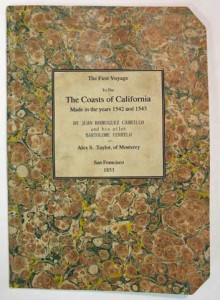
Cabrillo_First_Voyage_Coasts_CaliforniaJuan Rodriguez Cabrillo and his pilot, Bartolome Ferrelo reached what is now San Diego in September, 1540. Cabrillo explored the entire outer coast of the peninsula before heading north to the Channel Islands, Monterey Bay, and Point Reyes. Published in San Francisco in 1853, Discovery of California and Northwest America was the first true work of California history to be published in California. This volume has early marbled paper wrappers (recently added) with a printed title label affixed to the front wrapper. It’s chemised and housed in a custom quarter-leather slipcase. Details>>

A Trans-Continental Newspaper
Trans-Continental_PullmanTranscontinental was “Published Daily in the Pullman Hotel Express between Boston and San Francisco.” The twelve issues of Volume I were printed over six weeks, from May 24 to July 4, 1870, while the Boston Board of Trade made the 3,000-mile trek to meet with the San Francisco Chamber of Commerce. They were printed on a Gordon Press in the baggage car, while the newspaper office was in the second car. The paper reported the normal business of the train, along with tidbits such as the Philadelphia Athletics’ victory over the Harvard Baseball Club. The Trans-Continental is generally regarded as the first newspaper printed on a moving train. Details>>

Business Directory of Oakland, Alameda, and Berkeley
Directory_Oakland_Alameda_BerkeleyPublished in Oakland in 1877, Business Directory of Oakland, Alameda, and Berkeley is not listed in either Norris or Welsh. Extremely rare, this California miniature has the distinction of being the “only known California directory in this format, the first East Bay directory, and the first Berkeley directory of any kind,” according to Quebedeaux, who calls this volume the “first California volume of any kind.” Bradbury refutes this claim, pointing out that Diamond History was also published in 1877 and comprises the latter portion of this volume. OCLC records only three institutional holdings, and there is only one sale record for this item, from PBA earlier this year, of an imperfect copy missing its title page. Details>>

California Recipe Book by Ladies of California
California_Recipe_BookThe first edition thus and the fourth edition overall, this copy of California Recipe Book was published in San Francisco in 1879. It was first issued in 1872. The fourth edition bears a note that the “compiler has added largely to the original edition, and our patrons will find many new and choice recipes.” Indeed, the fourth edition includes sixty recipes not found in the first. OCLC records only three institutional holdings, making this a very scarce edition of a seminal California cookery book. California Recipe Book is regarded as the second cookbook written by Californians and published in the state, vying for the title with How to Keep a Husband; Or, Culinary Tactics, also published in San Francisco in 1872. Details>>

Annual Report of the Inspectors of the State Prison
San_Quentin_Annual_Report_Inspectors_State_PrisonMade to the legislature of California on February 15, 1855, this report offers an interesting look at the early days of San Quentin, when the prison was not quite impregnable. It includes sections entitled “Register and Descriptive List of Convicts Under Sentence” and “Transcript of Received, Escaped, and Returned Prisoners Since the Inspection of State Prison Books.” The previous year, 75 of the 250 prisoners in San Quentin had escaped without recapture. The statistic alarmed Governor John Bigler, to write in a letter to the prison staff, “These escapes, permit me to remark, give great force to allegations, daily and publicly made, that the prison building is insecure, and that its management is not such as to fully accomplish the object of its erection, in prevention and punishment of crime.” This work is rare, not being listed in Cowan, Greenwood, or the Library of Congress online catalogue. OCLC and Melvyl record only one copy, and no copies have come to auction in at least 25 years. Details>>

Twelve Years in the Mines of California
Patterson_Twelve_Years_Mines_CaliforniaLawson B Patterson arrived in California in 1849 during the Gold Rush and was one of the few who stuck around after the rush ended. Patterson stayed to work the mines for a total of twelve years. Kurutz tells us that in addition to recounting Patterson’s own experiences, “much of this book is devoted to the discovery of gold, the gold region, its geology, advice to new miners, and the weather in 1853. Wheat goes a step further, saying that Patterson’s book contains “observations of permanent import.” This volume’s previous owners include JR Knowland of Oakland Tribune fame, and the ffep bears his PO signature. The book itself is square and tight, with bright gilt. Details>>

Banquet in Honor of the Hotel Men’s Mutual Benefit Association
Banquet_HMMBAThis 1910 West Coast journey of HMMBA members was well documented by George Wharton James in his commissioned work, “The 1910 TRIP Of The H.M.M.B.A. To CALIFORNIA And The PACIFIC COAST.” Herein, he remarks this dinner at the Palace was “the most unique and costly dinner ever devised for the HMMBA.” The hotel’s banquet room was presented as a “Mandarin garden decorated with a wealth of Chinese articles of art [loaned by the Sing Chow Co. the menu informs us], and enlivened with … the only Chinese actress in America .. a Chinese theatre and thirty pretty Chinese children with their mothers, a full Chinese orchestra, and a bill of fare as distinctively Chinese as the rest of the function, all aided and abetted by the wealthy Chinese merchants of San Francisco.” As to this souvenir menu, James praises it as “the most elaborate affair ever devised fro the association.” No copy of this item is listed in OCLC; it’s certainly rare. Details>>

Album of Hotel Del Monte
Hotel_Del_MonteHotel Del Monte was part of a luxury 20,000-acre resort established by railroad magnate Charles Crocker. The first hotel was completed in 1880, with the entire resort including the hotel, polo grounds, race track, tennis courts, parkland and golf course. Immediately popular, the hotel had to deny 3,000 potential guests its first six weeks of operation. Falling on hard times after WWI, the grounds were eventually sold to Samuel Morse, who eventually led to the development of the present day Pebble Beach facility, among others. The hotel itself now serves as an administration building for the Naval Postgraduate School. This album offers a rare photo-view book depicting the original hotel structure (destroyed by fire in 1887) and diverse associated resort grounds and buildings. Details>>

Browny the Golden Beaver
Browny_Golden_BeaverA rare WPA production, Browny the Golden Beaver was published in San Diego in 1938. Belle Baranceanu, who created the cover art, was to achieve some fame as an artist; she painted murals in the La Jolla Post Office and Roosevelt Jr. High School as part of the Public Works of Art Project during the Depression. Baranceanu’s work has been exhibited at the Art Institute of Chicago, Carnegie Institute, Los Angeles County Museum of Art, Denver Art Musuem, among other locations. The book was illustrated with drawings by Beatrice Buckley. Details>>


Related Posts:
The California Gold Rush, Slavery, and the Civil War
Elias Samuel Cooper: Renowned and Controversial Surgeon


Thanks for reading! Love our blog? Subscribe via email (right sidebar) or sign up for our newsletter--you’ll never miss a post.
Share

Au Paris: Food, Wine, and Rare Books!

This month marked the 100th anniversary of Syndicat Nationale de la Librairie Ancienne et Moderne, better known to the rare book world as SLAM. In conjunction with this momentous occasion, SLAM not only hosted the International Antiquarian Book Fair at Paris’ Grand Palais but also followed this by coordinating the 2014 ILAB Congress, April 13 to 16, whereat over 100 colleagues from around the globe gathered to celebrate not only their vocation, but also their avocation. Both the book fair and the Congress were fantastic events where numerous bibliophilic treasures were seen by all that attended. These bookish wonders aside, the collegiality alone would have made the trip worthwhile–though the exceptional food and wine cannot be discounted!

In honor of our Parisian adventure, Tavistock Books is pleased to present a list of books connected to France and French. Should you have a question about any item, please don’t hesitate to contact us.

Voyage en Californie par Edouard Auger

Auger_Voyage_CalifornieEdouard Auger spent 1852 and 1853 in California for the Gold Rush. This first edition, published by Librarie Hachette in 1854, is inscribed by the author on the title page. It has a modern green quarter calf binding with marbled paper boards and endpapers. The original green printed wrappers are bound in. Details>>

Jeanne d’Arc

Monvel_Jeanne_DArcMaurice Boutet de Monvel published Jeanne d’Arc in 1896. It is his masterpiece, and Silvie calls the work “beautifully printed and exquisitely composed” in Children’s Books and Their Creators. Monvel is considered a leading figure in the Golden Age of children’s literature, alongside Caldecott and Greenaway. It is quite rare to find the book in its original dust jacket, as it is offered here. Details>>

Geschichte der Grossen Revolution en Frankreich

Schultz_Geschichte_Grossen_Revolution_FrankreichPublished in Berlin in 1790, this edition of Geschichte der Grossen Revolution en Frankreich features a hand-colored frontispiece and has the period dark brown plain paper wrappers. There’s a hand-inked title label to the spine. Details>>

Splendide Californie!

Splendide_CaliforniePublished by the Book Club of California in 2001, Splendide Californie! is truly a stunning item. It features impressions of the Golden State from French artists, ranging from 1786 to 1900. The book was designed and supervised by the Yolla Bolly Press. Details>>

Traite de la Gonorrhee et des Maladies des Voies Urinaires

TeyaudSexually transmitted diseases proved formidable opponents to medical professionals in the eighteenth century. Teyaud’s Traite de la Gonorrhee et des Maladies des Voies Urinaires offers a look at how these conditions were treated at the end of the century. Paris would later become a center for medical study, and American doctors frequently went there to study. Details>>

Theatre des Dames

Theatre_des_DamesA compilation of diverse theatrical pieces from 1792 to 1815, Theatre des Dames is bound in beautiful color printed silk onlays affixed to gold boards, with a floral motif panel on the spine. It includes eight copperplate engravings. OCLC records only four copies worldwide, and KVC adds a fifth. Details>>

Almanach de Kate Greenaway

Almanach_Kate_GreenawayA scarce French edition of this popular publication Almanach de Kate Greenaway was published in 1891. It features white glazed paper-wrapped color-pictorial boards with a yellow cloth spine. Color illustrations are by Kate Greenaway, printed by Edmund Evans. KVK shows no holdings at the expected institutions, and OCLC records only two holdings in the US. Details>>

Des Guerres d’Alexandre

Arrian_Guerres_AlexandreArrian was a public servant, military commander, and philosopher from the second-century Roman period. His account of Alexander’s life is arguably the most complete and most widely read, likely because he was able to use sources that have since been lost. This 1652 edition (the second edition thus) appears to be rather scarce; OCLC records one copy in Germany, and KVK notes another at the Bibliotheque Nationale. Details>>


Share

A Panoply of Primers

For centuries, children’s literature consisted almost exclusively of didactic texts designed to teach basic skills like reading and writing or to impart religious lessons. During the Middle Ages, the vast majority of these texts were still written in Latin. Hornbooks with the Lord’s Prayer and the alphabet were the most common forms of children’s literature in the 1400’s, and alphabet books began showing up in Russia, Denmark, and Italy during the following century.

In the 1600’s, the concept of childhood shifted: children were no longer thought of as miniature adults, but as separate beings with their own juvenile needs and preferences. Publishers began printing books exclusively for children, though these, too, were often didactic. The seventeenth century also saw the rise of Puritanism, which again shaped people’s views of children. They were viewed not as young innocents, but as moral savages who needed stringent moral instruction.

It was not until the eighteenth and nineteenth centuries that children’s literature came into its own as a genre. A Little Pretty Pocket Book (1744) by John Newbery is considered the first book published for children’s pleasure reading. As technologies improved and it got cheaper to produce books, the industry blossomed. Even as pleasure reading became popular, the publication of educational materials maintained its momentum. Literacy rates began to improve, increasing the demand for, and interest in, primers and similar educational pieces.

Today, collectors can build quite extensive collections around educational materials printed for children. The broadest category of these is the primer. The first known use of the word “primer” was in the fourteenth century. The term derives from the Latin primarium, meaning “primary,” and was the name for a layperson’s prayerbook. At the time, literacy was relatively uncommon, but people did need to read their prayers. This book was often the only one in a home, so it was used to teach children to read. Eventually the term broadened and referred to any small book intended to teach reading. Today a “primer” may refer to a short, introductory piece about a specific topic or to a brief, informative piece of writing.

A Selection of Primers

We’re delighted to offer a selection of primers in a variety of subjects and time periods. Should you have a question about an item, please don’t hesitate to contact us!

The London Vocabulary

Greenwood_London_VocabularyGrammarian James Greenwood published the first edition of The London Vocabularly, English and Latin in 1713. After working for years at the Hackney Academy, Greenwood opened up his own boarding school in Essex in 1711 and was later appointed surmaster of St. Paul’s School in London. He’s best known for his An Essay on Practical Grammar (1711), which received much positive praise from a number of scholars and critics, including Isaac Watts.  The London Vocabulary went through a number of editions, both English and American, of which this is the seventeenth English edition. Details>>

The Instructor

Fisher_InstructorA quite popular primer, George Fisher’sThe Instructor  appeared in numerous editions, both throughout the United Kingdom and in America. Like many educational books at the time, it purportedly offered an easier method of learning than other primers. And also like many educational books at the time, it reminds us of just how little people really knew about geography at the time, and that this truly was an age of exploration and discovery. In this Glasgow edition, printed in 1786, California is still an enigma: “Northward, on the Pacific Ocean, is New Mexico, and the island of California; but of these we know but little.” ESTC records five holdings of this edition. Details>>

The Young Child’s ABC

Anderson_Young_Childs_ABCWritten by Alexander Anderson and illustrated by Samuel Wood, The Young Child’s ABC (1806) contains a horn book-style alphabet and a syllabary. Letters are illustrated with objects in alphabetical order. This children’s chapbook was the first item published by Wood, who would go on to have an illustrious and prolific career in the trade. He had thousands of titles under his imprint. Although four copies of later editions have come to auction in the last three decades or so, none of this first edition have come to market. It’s quite rare in the trade. Details>>

A Book Explaining the Ranks and Dignities of British Society

Lamb_Ranks_Dignities_British_SocietyCharles Lamb is best remembered for his collaboration with his sister, Mary Lamb, on Tales from Shakespeare. But he also anonymously published A Book Explaining the Ranks and Dignities of British Society in 1805. The charmingly illustrated children’s book delineates the hierarchy of the nobility, clergy, army, navy, government & professions; with their history & origins, forms of address, order of precedence, honors, with their coronets & coronation robes described, etc.This is the second edition, published in 1809. The book has been occasionally at auction these last 30+ years, though not since 2003. It’s scarce in the trade. Details>>

Le Livre des Enfans

Livre_EnfansLe Livre des Enfans was published in Quebec in 1834. Illustrated with woodcuts, the work begins with two alphabets, which are followed by the usual primer material. The cover features a short verse by Racine. Le Livre des Enfans also includes thirteen pages of animal descriptions, such as Le Zebre, Le Cheval, and Le Hibou. It’s scarce in the trade. Details>>

The New England Primer

Howland_New_England_PrimerPublished around 1840, The New England Primer bears quite a drop title: Containing the Assembly’s Catechism; The Account of the Burning of John Rogers; A Dialogue Between Christ, A Youth, and the Devil; and Various Other Useful and Instructive Matter. With a Historical Introduction, by Rev. H. Humphrey, D.D. Rogers was a biblical translator and commentator, and the first English Protestant martyr under Mary I. He was burned at the stake for heresy in February 1555. This primer bears a frontis of Isaac Watts. Though this copy has some wear to its wrappers, it’s in good condition. Details>>

Girls’ and Boys’ Primer, Part II

Girls_Boys_PrimerGirls’ and Boys’ Primer, Part II was published around 1850 by Rufus Merrill in Concord, New Hampshire. The alphabet is illustrated with woodcuts. The primer features the usual material: alphabet, poems, and lessons in spelling and writing. This copy is in the publisher’s original buff paper wrappers with ornamental border to front and rear wrappers and the signature of “Eastman & Bogart.” Though there’s light wear and soiling to the wrappers, this is a very good copy. Details>>

A Farewell Present to a Female Scholar, on Going to Service

Farewell_Present_Female_ScholarsThanks to the Enabling Act of 1799, dissenters could teach without subscription to the Church of England. The London Sunday-School Union was formed in 1803 with the aim of educating poor children and became a very active publishing organization. One of its publications was A Farewell Present to a Female Scholar, on Going to Service (ca 1828). An apparently unrecorded little work, it offers counseling a young lady regarding her pending move to the world of ‘service,’ “a useful and important station in society ” and  outlines a number of ‘rules to live by’ follow, including “Fifthly- Always observe a respectful and obliging behaviour towards those with whom you live, and endeavor to go about your work with a cheerful air, as a pleasure rather than a burden to you.” It appears to have served as a sort of primer for young women entering domestic service. Details>>

Fleet Fact Book

Fleet_Fact_BookFleet Fact Book (ca 1906-1910) is separated into four sections: The “Dreadnaught” (2 text pages & 1 photographic image); Submarines (1 text page & 5 photographic images); Torpedo Boat Destroyers (1 text page & 2 photographic images); and The Fleet / Dreadnaught Types (1 text page summarizing the fleet strength, including ship types/numbers & 5 color postcard-type images of diverse dreadnaught types). In short, the volume offers a custom ‘primer’ for the Royal English Navy, ca 1910, with all indications the book created for the use of a senior Naval official, or senior political figure associated with the Royal Navy. Details>>

Puff and Dick

Puff_DickPictured are the main characters from this famous primary reader: Dick, Jane, Spot, Puff & Baby. This is a rare unused printed sheet of a tale from the highly-collected Dick & Jane reader series, published in the 1950’s. Details>>


Related Posts:
Chapbooks: Short Books with Long History
The Ins and Outs of Collecting Serial Fiction for Children
Randolph Caldecott: Legend in Children’s Literature


Thanks for reading! Love our blog? Subscribe via email (right sidebar) or sign up for our newsletter--you’ll never miss a post.

Share