Category Archives: History

Charles Dickens, Sir Arthur Conan Doyle, and Victorian Spiritualism

On April 1, 1848, modern Spiritualism was born in Hydesville, New York. That day, teenage sisters Margaret and Kate Fox announced that they had communicated with the spirit of a man who had been murdered in their house years before. A report of the incident first appeared in the New York Tribune, and it was reprinted soon after in both American and European newspapers.

Spiritualism Takes Hold in England

Fox_Sisters

The Fox Sisters

The roots of Spiritualism stretch back to the eighteenth-century works of Emmanuel Swedenborg. But the incident with the Fox sisters ignited unprecedented interest in the phenomenon of communicating with the dead. Spiritualism would enrapture leading thinkers of the day, along with celebrated authors like Elizabeth Barrett Browning and Sir Arthur Conan Doyle. Meanwhile, Charles Dickens came out as a staunch opponent–despite his own interest in the also-questionable practice of mesmerism.

Spiritualism in its modern form emerged in Britain in 1852. That year, Maria Hayden traveled to London and offered her services as a medium. She conducted seances, complete with table rappings and automatic writing. But Spiritualism was far from new in England; Queen Victoria herself had subscribed to the belief as early as 1846. By the 1860’s Spiritualism had exploded into a full-fledged counterculture; it had its own newspapers, societies, treatises, and pamphlets. Seances–complete with table tapping, table tipping, automatic writing and levitation–were conducted in even the most genteel social circles.

Victorian England was ripe for just such a movement. Though it was an era of great scientific discovery, it was also an era of turning away from organized religion and confronting uncertainty. To fill the void, many Victorians turned to the supernatural, mesmerism, electro-biology, Spiritualism, and other relatively new pursuits. These new practices thoroughly blurred the lines between religion and science, and even proponents of Spiritualism were divided about how to characterize it.

From Fiction Writer to Leading Spiritualist

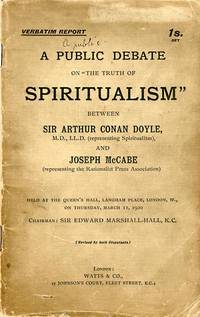
Doyle_McCabePublic_Debate_SpiritualismElizabeth Barrett Browning famously subscribed to Spiritualism, much to the chagrin of her skeptical husband, Robert Browning, who was dragged to seances with her on multiple occasions. But the Brownings were far from the only authors at the seance tables; Christina Rosetti, John Ruskin, William Makepeace Thackeray, and Rudyard Kipling participated in seances. But it was Sir Arthur Conan Doyle who would delve so deeply into Spiritualism, he would turn away from fiction almost altogether.

Conan Doyle encountered Spiritualism as early as 1866, thanks to a book by US High Courts Judge John Worth Edmonds. The judge, who claimed he’d communicated with his wife after she died, was one of the most influential Spiritualists in America. Conan Doyle was by now already famous as the creator of Sherlock Holmes. But he hoped to be remembered for something entirely different, so he turned away from his famous protagonist to study Spiritualism. Conan Doyle presented his first public lecture on Spiritualism in 1917, and he would eventually travel throughout Great Britain, Europe, and America educating audiences about the practice. He even trekked to Australia, New Zealand, and South Africa in the name of Spiritualism.

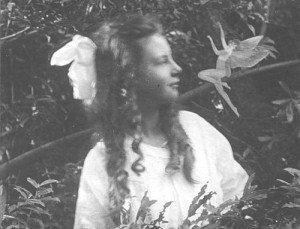
Fairy_PicturesWhile Conan Doyle was respected in Spiritualist circles, his blind devotion led him headlong into ridicule on more than one occasion. He was taken in by Frances Griffith and Elsie Wright’s forged photographs of fairies. Conan Doyle, accepting the photographs as authentic, wrote a few pamphlets and The Coming of Fairies (1922), which made him a bit of a laughingstock. Later, Conan Doyle invited his friend Harry Houdini to attend a seance,with his wife Jean, acting as medium. Jean claimed to have contacted Houdini’s mother and “automatically” wrote a long letter in English. Unfortunately Houdini’s mother had known little English. Consequently the famous magician publicly declared Conan Doyle a fraud.

Perhaps unsurprisingly, Conan Doyle persisted, remaining an avid Spiritualist until his death. Once he passed away, claims surfaced that he and his wife had arranged for communication from beyond the grave. On July 7, 1930, five days after Conan Doyle’s death, a seance was held at Royal Albert Hall. The presiding medium, Estelle Roberts, claimed that she’d relayed a message from Conan Doyle to his wife…but was drowned out by the overzealous organ player.

Dickens Ridicules Spiritualists

Although Conan Doyle was devoted to Spiritualism, he was careful not to sully Sherlock Holmes with such a controversial ideology. Thus whenever Holmes encounters potentially supernatural phenomena, he remains nonplussed and seeks a rational explanation. After all, as the famed detective says in “The Adventure of the Sussex Vampire,” “This agency stands flat-footed upon the ground, and there it must remain. The world is big enough for us. No ghosts need apply.” Charles Dickens would surely have agreed.

Dickens grew up reading penny weeklies like The Terrific Register, which he said “frightened the very wits out of [his] head.” The register’s pages brimmed with tales of ghosts, murder, incest, and cannibalism. Meanwhile, the English tradition of telling ghost stories at Christmas–coupled with Dickens’ own (lucrative) habit of publishing new stories at Christmas resulted in Dickens’ publishing plenty of ghost stories of his own.


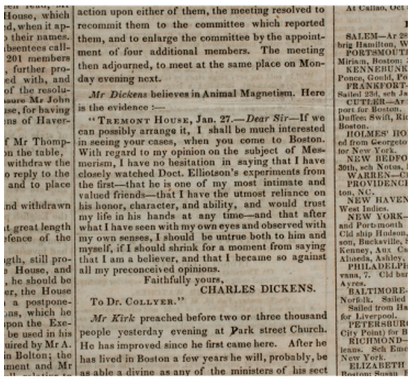
Dickens_Mesmerism

Dickens called Eliotson “one of my most intimate and valuable friends” in this letter to ‘The Boston Morning Post.’

That didn’t stop the Inimitable from openly dismissing Spiritualism as unmitigated quackery. He frequently attacked Spiritualists in both Household Words and All the Year Round. In “Well Authenticated Rappings,” (Household Words, 1858), Dickens questions why spirits would return to communicate with the living, only to make idiots of themselves by tapping out banal messages rife with orthographical mistakes.

Yet even Dickens got pulled into a movement of highly questionable validity: mesmerism. Named for its creator, Anton Mesmer, mesmerism was the belief that the universe was full of an invisible magnetic fluid, which influenced all life and could be manipulated more easily with magnets. Prominent doctor John Eliotson was one of the leading proponents of mesmerism (also known as magnetism and animal magnetism). Eliotson was eventually shunned from the medical establishment as a result.

Dickens actually became a practicing mesmeric doctor, successfully putting both his wife and sister-in-law into a trance. During his family’s trip to Italy in 1844, Dickens also mesmerized the alluring Augusta de la Rue, who suffered from, as she called it, a “burning and raging” in her head. The attention he lavished on M. de la Rue was sufficient to evoke jealousy from Dickens’ wife, Catherine. Meanwhile, Dickens was less successful in his attempt to mesmerize his friend Charles Macready.

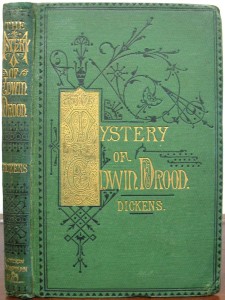
Dickens_Edwin_DroodDickens and his fellow mesmerists believed, as Eliotson did, that the practice represented a genuine improvement in the field of medicine–unlike Spiritualism, which served no such therapeutic function. Thus he felt perfectly justified in lambasting Spiritualism while simultaneously espousing a practice that, as modern readers, we might find laughable. 

Ironically enough, Dickens was a frequent target of mediums. His final, unfinished novel, The Mystery of Edwin Drood has inspired many an author to attempt its end. But in 1873, printer Thomas James penned an ending for the book. He claimed that Dickens had dictated the ending from beyond the grave, calling the book The Mystery of Edwin Drood (Complete). Part second of The Mystery of Edwin Drood. By the spirit-pen of Charles Dickens, through a medium.

Ultimately both Sir Arthur Conan Doyle and Charles Dickens illustrate the Victorian predilection for the supernatural and strange. 

Related Posts:
Why Did Charles Dickens Write Ghost Stories for Christmas?
The Six Hoaxes of Edgar Allan Poe
All Posts-Charles Dickens


Thanks for reading! Love our blog? Subscribe via email (right sidebar) or sign up for our newsletter--you’ll never miss a post.

Share

A Quick Look at Revolutionary Quakers

The early English Quaker movement emerged in the wake of King Charles I’s regicide, between the English Civil Wars and the Restoration. Multiple sects emerged between 1640 and 1660, and the word “Quaker” had yet to have a definitive meaning; in the media, the word was applied to people with quite divergent beliefs. Even among people who called themselves Quakers, views greatly varied. For instance, George Fox believed in the “Dwelling Spirit.” Meanwhile, a militant wing of the group advocated the use of violence to achieve its goals for the Second Coming and even attempted to assassinate Oliver Cromwell.

Following Venner’s Uprising in 1660, King Charles II and his government kept a close eye on the Quakers; the group had demonstrated its volatility, and some members were even suspected of murdering King Charles I. The king urged moderate Quakers to subdue its more radical members. The result: the group turned more of its attention to addressing England’s social problems, returning to its English Seeker roots. Meanwhile, the group increasingly turned to the pen, rather than the sword. Thus the history of the Quakers is one that we can trace through a rich body of literature, written by some of the sect’s most prominent (and sometimes controversial) figures.

George Whitehead

Born in Westmoreland, George Whitehead discovered the Quaker philosophy at age fourteen. He began preaching in a limited capacity only two years later. Shortly thereafter, Whitehead joined the Valiant Sixty, a group of itinerant preachers that started in northern England and gradually traveled south. He was one of the group’s youngest members: only he, James Parnell (age 16) and Edward Burrough (age 18) joined the group before they were “of age.” The seventeenth century was a time of religious intolerance in England, and the Quakers often had brushes with the law. Whitehead was thrown in jail on multiple occasions and was once publicly whipped. He spoke out against the Act of Uniformity in 1660 and was influential in the Bill of Rights of 1689 and the Royal Declaration of Indulgence.

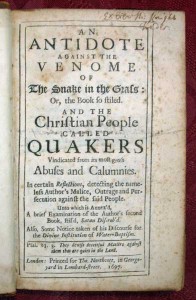
Whitehead_Antidote-Venom_SnakeWhitehead published his journal, The Christian Progress of George Whitehead. He also wrote An Antidote Against the Venome of the Snake in the Grass, a rebuttal directed at Irish clergyman Charles Leslie the author of The Snake in the GrassSatan Disrob’d, and A Discourse Proving the Divine Institution of Water Baptism. Most notably, Whitehead defended women’s ability to preach if they were so inspired, saying “we do not institute Women’s Preaching as [Leslie] saith, but leave them free to the Gift and Call of God.” The volume also includes an early mention of Quakers in America, including William Penn’s Pennsylvania colony. Whitehead’s views ultimately proved too liberal; by the 1800’s, his philosophy and works had passed out of favor in the Quaker community.

Elias Hicks

Born in Hempstead, New York in 1748, Elias Hicks was a carpenter who became a Quaker in his early twenties. In 1778, Hicks helped to construct the Friends Meeting House in Jericho, New York, where he’d settled with his wife. By this time, Hicks was already preaching extensively. That same years, Walt Whitman heard Hicks preach at Morrison’s Hotel in Brooklyn. The famed poet, then still quite young, would later recall the preacher’s “resonant, grave, melodious voice.”

In 1799, Hicks and his neighbor Phebe Dodge manumitted their slaves. They were the first Quakers to do so in their community, and soon after all the families of Westbury meeting had followed suit. Hicks also campaigned for a boycott of all goods produced by slaves, which mostly included cotton and products that contained sugar. In 1811, he wrote Observations on the Slavery of Africans and Their Descendants, which outlines the economic reasons for continuing slavery and points to war as a primary cause of slavery. The book gave the free produce movement a firm foundation. Although the movement wasn’t meant to be religious in nature, the majority of its proponents were indeed Quakers. The first person to open a free produce store was Benjamin Lundy, a Quaker who opened up a free produce mercantile in 1826. Lundy advocated helping freed slaves emigrate to Haiti and raising mone to buy slaves and settle them as free citizens in the territories out West. Hicks was a key figure in abolishing slavery in New York.

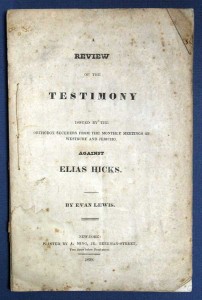
Hicks_Testimony_ReviewWhile Hicks’ abolitionism certainly fit with Quaker tenets, the same was not so with his theological stance. Hicks believed that following the “Inner Light” was the most important aspect of worship. He also denied Jesus’ complete divinity and the virgin birth. Furthermore, Hicks argued that the Devil was not at the root of human failings and sin, but that urges were simply part of human nature–and created by God. Thanks to the Great Awakening and other factors, the Quaker community was ripe for a schism, and Hicks’ controversial philosophy provided the reason. Hicks engaged with fellow Quaker Anne Braithewaite in a debate that produced a flurry of publications. Eventually, in 1828, after Hicks actually stood a sort of trial, the Quakers decided a separation was necessary. Those who followed Hicks were mostly rural poor and came to be called Hicksites. His critics called themselves the Orthodox Friends. Each group considered itself to be the rightful bearers of the legacy begun by Friends founder George Fox. The two groups would not be the only factions to develop among the American Quaker community.

Joseph John Gurney

Born in 1788, Joseph John Gurney was a banker in Norwich, England. Raised in the Quaker faith, he joined the sect and became an evangelical minister in the Religious Society of Friends. Because he was a member of a non-conformist religious group, Gurney was ineligible to study at English universities, so he was educated by a private tutor at Oxford. Gurney’s sister Elizabeth Fry was a social reformer, and in 1817 the siblings partnered to protest the death penalty and to improve conditions in prisons. They had little success, but Gurney would remain committed to the cause.

Joseph_John_GurneyFinally Home Secretary Robert Peel introduced the Gaols Act of 1823, which required that wardens be paid salaries–rather than being supported by the prisoners themselves. The Act also placed female wardens in charge of female prisoners and outlawed the use of manacles and irons. Meanwhile, Gurney and Fry visited prisons all over Great Britain. They published their findings in Prisons in Scotland and the North of England.

In 1837, Gurney began a journey to America and the West Indies, where he promoted abolitionism. He also preached at local Meeting houses in America and grew concerned about the prevalence of the “Inner Light” philosophy. Gurney felt that the American Quakers did not give sufficient weight to the Bible and the New Testament in their theology. This created a yet another splinter, between those who followed Gurney and those who followed his opponent, John Wilbur. Their respective disciples, predictably enough, were called Gurneyites and Wilburites, respectively.

The literature of the Quakers offers considerable insight into colonial history, and it is full of fascinating personalities who shaped approaches to social issues in the Western World.

Related Posts:
Charles Dickens and Capital Punishment
The California Gold Rush, Slavery, and the Civil War

Thanks for reading! Love our blog? Subscribe via email (right sidebar) or sign up for our newsletter--you’ll never miss a post.
Share

Why Did Florence Nightingale Oppose the British Nurses’ Association?

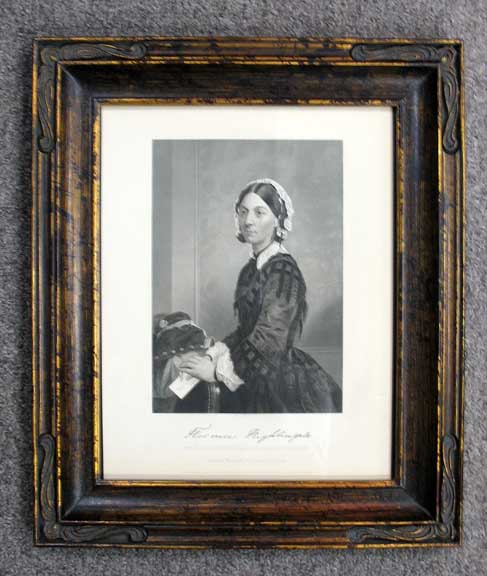
Florence-Nightingale_Engraving

Florence Nightingale devoted her life to administering exceptional medical care and to furthering the profession of nursing. So it seems counterintuitive that the luminary would have opposed the formation of an organization like the British Nursing Association; after all, the organization’s aim was to bring some standardization to nursing. But Nightingale vehemently opposed the BNA, doing everything in her power to stymie its progress.

Nursing Emerges as a Profession

Nightingale entered nursing at a time when women had few respectable employment options. The few women of the upper class who chose the occupation did it out of duty or a sense of service, rather than the desire for a paycheck. Nurses often came from the working class and had little formal education outside their nursing training, which was more hands-on training during a probationary period than book- or lecture-based instruction. It’s also important to note that the wealthy still mostly received their medical care at home, resorting to hospital care only in dire emergencies. Hospitals were used for administering care to the poor and, during wartime, to soldiers.

Thus nursing fell short of being considered a true profession; some even thought of nursing as being only slightly better than prostitution! Behavior like stealing food from patients or demanding bribes for administering care was not uncommon; nor was inappropriate fraternization between female nurses and male patients. One of Nightingale’s first priorities was to establish standards for nursing as an “art” or “calling.” Nightingale placed considerable emphasis on nurses’ morality, noting that the best nurses were kind, moral, and decent. She strongly believed that lack of formal education did not preclude a woman from making an excellent nurse, so long as she possessed these other qualities.

Nightingale spoke positively about making nursing a profession early in her career. She also took substantial steps to remove opportunities for amoral behavior on her wards. For example, during the Crimean War, Nightingale did not allow any other female nurses to stay in the ward past 8:00 pm; during the night, male patients received care from male orderlies. This practice is what earned Nightingale the nickname “Lady of the Lamp.” She would pace the ward by lamplight virtually all night long, resting only briefly, intent on ensuring that her patients got exceptional care around the clock.

The BNA Moves Toward Exclusion

British_Nurses_Association_First_Annual_Report

The First Annual Report of the BNA

The British Nurses’ Association (BNA) was founded in 1887 through the efforts of Ethel Bedford-Fenwick, Catherine J Wood, Isla Stewart, and a number of prominent male physicians. Princess Christian, Queen Victoria’s daughter was the BNA’s royal patron. The organization changed its name to the Royal British Nursing Association in 1891 and received its royal charter two years later. Its primary aim from the beginning was to establish a national registry of nurses. To be included in the registry, nurses would have to complete their training and pass a written examination.

With the written examination, the founders’ tacit goal was to exclude working-class women from nursing–thereby raising the social status of the profession. Nightingale didn’t deny that higher social status had its merits for administrators in nursing, but she argued that working-class nurses could provide equally excellent care despite their lack of formal education. She also pointed out that nurses weren’t “dictionaries,” and that passing a written exam did not necessarily indicate that someone would make a good nurse: “Some of our best could not pass an examination with credit, while some of our worst could gain the most credible place.” Nightingale’s fundamental opposition to the BNA stemmed from their efforts toward exclusion. She advocated improving the overall quality of nursing care through better training instead.

An Immediately Outdated Registry

The BNA wanted to create a registry listing all the nurses who had completed training and passed a written exam. Hospital administrators could then use the registry as a resource to ensure that they were hiring qualified nurses. Nightingale objected to the registry for multiple reasons. First, the registry would be out of date almost from the moment of publication, as new nurses constantly entered the profession; some nurses would not even be included for years after they completed training, when a new registry was finally printed.

But the registry had an even greater flaw, in Nightingale’s eyes: no mechanism existed for removing the names of nurses who were subsequently found to be unfit for the profession. Nightingale said that it often proved difficult to fire nurses even in extreme cases, such as drunkenness on the job or egregious amoral behavior. If a fired nurse had her name printed in the registry, that would give her undue legitimacy when she sought new employment in the profession. Nightingale asked the BNA how a nurse’s name would be removed from the registry, outside of death or criminal conviction, but she never received a satisfactory answer.

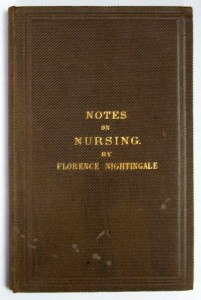
Nightingale_Notes_NursingFurthermore, as it was conceived by the BNA, the registry would not indicate where or when a nurse had received her training. Nor would it list any additional advanced training she may have completed. Nightingale saw this lumping together of all nurses, regardless of training qualifications, as a fatal flaw. Training programs varied widely in technique, quality, and duration. And a nurse trained during wartime, or under a leading physician, for instance, were often better equipped to handle the demands of specific nursing positions. Nightingale argued that omitting such information from the registry made the document virtually useless.

Some opponents of the BNA proposed an alternative: issuing nurses certificates when they completed training. The certificate would indicate the date the nurse completed training and the training institution. Each nurse would bear responsibility for her own certificate, and the certificate could be confiscated if she were fired for negligence or misconduct. But the prospects of forgery and the onus of replacing lost certificates made this system less appealing to Nightingale and other leaders in the field.

Too Much Control for Doctors

Nightingale sought to make nursing an autonomous endeavor, not under the jurisdiction of physicians. She believed in creating a separate hierarchy within nursing, so that doctors did not have the power to hire, fire, or discipline nurses. Nurses would still take medical orders from doctors, but only because doctors had more knowledge and expertise in determining the best treatment for patients.

Yet the BNA intended to give one half of its seats to doctors. Nightingale saw this as directly undermining its stated mission to make nursing into a true profession. This point of contention proved one that Nightingale had to handle delicately, as she had important alliances with plenty of prominent physicians.

Nightingale Combats the BNA’s Inception

Nightingale was not fundamentally opposed to the idea of a registry. Indeed, she saw merit in the small, organization-based registries that hospitals like St. Thomas already kept. Regularly updated with dismissal information, nurse obituaries, and notices of criminal conviction, these registries escaped some of the problems presented by a national registry. (Contemporary researchers also point out that they contained a healthy amount of gossip.)

But Nightingale did object to the view that nursing was strictly a profession. She was very attached to the morality of nursing, and later in her career actually used the term “profession” pejoratively in regard to nursing. In an 1888 address to probationers, Nightingale referred to the “low sense” of the nursing profession as the “book-and-examination business.”

Nightingale went to considerably lengths to prohibit the BNA’s progress. She and her supporters launched numerous campaigns to draw attention to the organization’s shortcomings. They also pointed out that the BNA claimed to have more support than it actually did; in some cases, the BNA alleged that prominent doctors and nurses supported the organization–when they had already publicly expressed the opposite stance.

The registration issue emerged in 1887 and gathered momentum the following year. In 1889, the founder of the Hospitals’ Association and editor of The Hospital, Henry Burdett proposed the National Pension Fund as an alternative. Nightingale saw the competitiveness between the two plans as highly distasteful and opposed them both. In 1889, she helped to organize a “memorial” opposing the BNA’s receipt of a royal charter.

The House of Lords committee did not meet on the matter until 1891. William Rathbone spoke against the BNA using information supplied by Nightingale. His presentation was so thorough and so convincing that the BNA was forced to drastically revise its proposal. When the organization finally received its royal charter in 1893, the BNA had much less power than its founders had hoped.

Though Nightingale’s staunch opposition to the BNA may seem strange today, her reservations were grounded in a genuine love for nursing and desire for improvement in the field. Today we remember Nightingale as a visionary of nursing whose contributions ranged from improving quality of care, to shaping the laws that governed the profession.

Related Posts:
Louisa May Alcott: Abolitionist, Suffragette, Mercenary 
Edith Cavell, Nurse, Humanitarian, and Traitor? 
Famous Figures in the History of Nursing (Part One)
Famous Figures in the History of Nursing (Part Two)

Thanks for reading! Love our blog? Subscribe via email (right sidebar) or sign up for our newsletter--you’ll never miss a post.
Share

Charles Dickens as Social Commentator

Karl Marx deeply admired his contemporary Charles Dickens, which should surprise no one familiar with the works of the Inimitable. Dickens used his novels to address the social ills of Victorian society, from the poor conditions in factories to the deplorable treatment of orphans. Some of Dickens’ incredible popularity can certainly be attributed to his overt empathy for the common man, but that same popularity also gave him an unprecedented platform for promoting reform. Dickens took up social causes early in his career and, after the success of Oliver Twist, resolved to use the novel as a vehicle for social commentary.

Sunday Under Three Heads

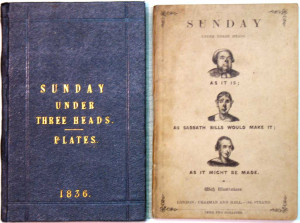
Dickens_Sunday_Under_Three_HeadsBy 1836, England’s social classes were not only divided by economics; they also observed religion differently. For the middle and upper classes, the Sabbath remained a sacred day, free from feasting, visiting, and indulgences. But for members of the lower class, Sunday was usually the only day off and therefore the only day available to make merry. Thus the streets of London were often full of drunkards and revelers on Sundays. Sir Andrew Agnew despised the lower classes to such a degree that he went out of his way to end Sunday festivities with a Sabbath Observances bill. The bill would have put an end to the usual freedoms and entertainments that the lower class usually enjoyed on Sundays. Dickens found the bill draconian and discriminatory. In 1836, he published “Sunday Under Three Heads” under the pseudonym Timothy Sparks. The cartoon illustrates the fact that there could–and should–be some middle ground between reckless revelry and puritanical observance. Dickens would go on to criticize not only Agnew’s bill (which failed to pass in four different permutations, leading Agnew to resign from Parliament), but also his character.

Oliver Twist

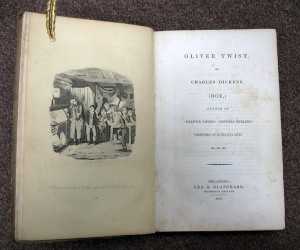
Completed in 1839, Dickens_Oliver_TwistOliver Twist vaunted Dickens to celebrity status in England. The novel was Dickens’ first to carry over social commentary, and its success galvanized his resolve to use his fiction to address social injustice. Two years prior, in 1837, six members of Parliament and six working men had banded together to publish the People’s Charter (1838). Their aim was to empower working-class men with voting rights and the ability to be elected to the House of Commons. While these demands weren’t new, they were made at just the right time, and the People’s Charter is often regarded as the most famous political manifesto of the nineteenth century. The Chartist movement rapidly emerged, drawing attention to the plight of the working class. Thus Oliver Twist likely could not have been published to a more sympathetic audience. Dickens’ criticism of the Poor Law of 1834 and the horrible conditions of orphanages fell on eager ears.

A Christmas Carol

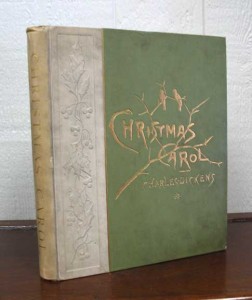
Dickens_Christmas_CarolRobert Malthus published An Essay on the Principle of Population pseudonymously in 1798. He argued that overpopulation would necessarily right itself through famine, disease, war or other means. The work was highly influential and immediately raised concerns about the population of Great Britain. In 1800, the Census Act was passed, enabling a census count every ten years. In ensuing decades, the population of cities, and of London in particular, grew astronomically. Malthus’ theory became an excuse to ignore the spread of contagious disease and the lack of proper care for orphans. Dickens personified Malthus in Ebenezer Scrooge, who says, “If they would rather die…they had better do it, and decrease the surplus population.” By this time, another concept dovetailed conveniently with Malthusianism: the “deserving poor.” Victorians commonly believed that people were poor because they deserved to be. In A Christmas Carol, Dickens refutes both ideas wholeheartedly.

Bleak House

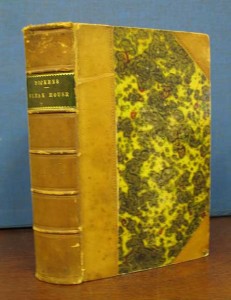
Critic Terry Eagleton notesDickens_Bleak_House that by 1852, Dickens saw Victorian England as “rotting, unravelling, so freighted with meaningless matter that it [was] sinking back into primeval slime.” Bleak House, which Dickens completed in 1853, is widely regarded as England’s first contribution to the tradition of the modern detective novel. But the book still usually gets short shrift among readers and critics. Nevertheless, Bleak House is one of Dickens’ best–and one of his most ambitious in terms of social commentary. Dickens takes on issues of electoral corruption, class division, slum housing, overcrowded urban cemeteries, and the neglect of contagious diseases. More importantly, he draws attention to England’s faulty legal system, as exemplified in the Chancery Court. Prior to his career as an author, Dickens had been a court reporter. The post gave him an inside look at the inconsistencies, inefficiencies, and iniquities of the British court system, and he drew on this experience in Bleak House.

Hard Times

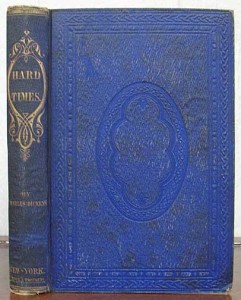
Dickens_Hard_TimesThe Anti-Corn Law League was founded in 1836 with the sole purpose of abolishing the Corn Laws, which levied taxes on imported wheat and inflated the price of food at a time when factory owners were attempting to cut wages. After a decade, the movement was successful, and the league disbanded. The movement (known as Manchester capitalism or Manchester liberalism)  was based on the principles of laissez-faire capitalism as promoted by Adam Smith, and its members believed that free trade would ultimately lead to a more equitable society. Although Dickens would likely have agreed with the school on other issues like slavery, he vehemently disagreed with laissez-faire capitalism. In Hard Times, we encounter characters whose personal relationships have been tainted by economics and face the cruel living conditions of the urban working class. Dickens also paints a picture of the greedy excesses enabled by unregulated capitalism. Meanwhile, he also addresses contemporary reforms to divorce law, the lack of education for the poor, and the working class’ right to amusement.

Dickens is often criticized for failing to offer any solutions to Victorian England’s social issues. Criticism also sways with political trends; in the 1960’s and 1970’s, for instance, Dickens was simply “not Marxist enough.” But ultimately Dickens renders an important service by bringing attention to such a wide range of social concerns, and one must ask whether we should really expect solutions to social problems in our literature.

Related Posts:
Charles Dickens and Capital Punishment
Andersen’s Visit with Dickens Less than a Fairy Tale
Charles Dickens the Copyright Confederate
Why Did Charles Dickens Write Ghost Stories for Christmas?
Jane Bigelow, the First Celebrity Stalker? 


Thanks for reading! Love our blog? Subscribe via email (right sidebar) or sign up for our newsletter--you’ll never miss a post.
Share

Charles Dickens and Capital Punishment

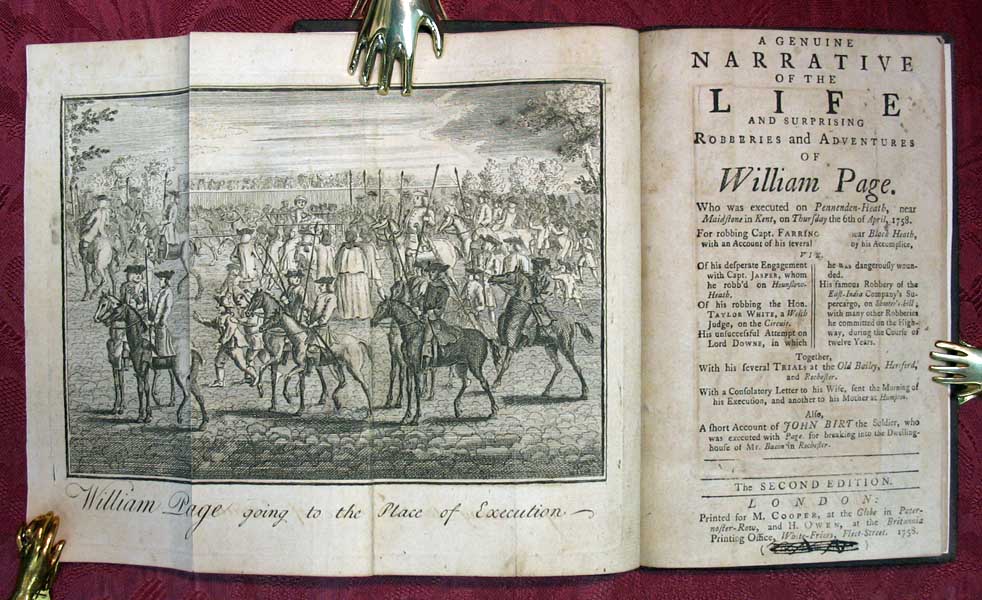
William_Page_Execution

The sensationalization of public executions was a long-standing tradition by Dickens’ day. This account of William Page’s “robberies and adventures” dates to 1758.

On February 24, 1807, three convicted murderers were to be executed at Newgate: Owen Haggerty, John Holloway, and Elizabeth Godfrey. The fact that three people were going to be executed (and one of them a woman) was extremely unusual. The event drew a huge and rowdy crowd. The crowd reached a point of hysteria, and authorities could not even penetrate the throngs to help those caught in the melee. In the end, 27 people died and 70 were sent to the hospital with serious injuries.

Though that magnitude of injury was unusual, the excitement over public executions certainly was not. By the time Charles Dickens was born five years later, execution as entertainment was firmly entrenched in British culture. Though Dickens, too, would be morbidly fascinated with public executions, he would eventually argue for private executions.

Broadsides Outsell Even Dickens

By the 1840’s, Dickens was the most popular novelist in England. His monthly shilling numbers consistently sold in the 10,000’s–quite an impressive figure at the time. But the cheap penny broadsides advertising “popular” murderers regularly outsold Dickens by 100 to one. These accounts often included lurid details of the crimes, partially or completely fabricated by the printers. They were undoubtedly the most widely read material in England and had been for decades.

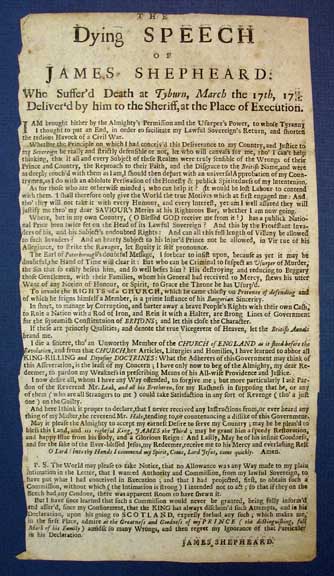
James_Shepheard_Dying_Speech

“The Dying Speech of James Shepheard” is known in five different editions. Only four other copies of this one are recorded.

The broadsides fueled a long-standing obsession with death and criminality. Following execution, it was quite common for Madame Tussaud’s to make wax figures of the deceased. Sometimes Tussaud would even buy clothing and other artifacts from the hangman to make the wax figure more realistic. Death masks were also sometimes made. In the case of William Corder, who was hanged on August 11, 1828 for the “Red Barn Murder” of Maria Marten, a cast was taken of Corder’s face and a copy of a book about the trial was bound in Corder’s own skin. William Burke’s death mask, taken on January 28, 1829 clearly shows an indentation from the noose on Burke’s neck. Phrenology, the study of the skull’s shape as a guide to one’s personality, was all the rage in the nineteenth century, and people were enthusiastically interested in studying the skulls of criminals.

But undoubtedly the most prurient and popular entertainment was attending the execution itself. Ordinary citizens would walk miles to attend executions. In smaller towns, executions would be held on market days to facilitate attendance. By the 1850’s, special trains had actually been laid on to transport people to executions. School groups were even made to attend executions as morality lessons; the rationale was that watching such a brutal punishment would deter spectators from committing the same crimes.

Dickens Attends His First Execution

Dickens worked as a court reporter from 1829 to 1833, a position that exposed him to the world of criminals and capital punishment. This experience likely had a significant impact on Dickens’ attitude toward crime, punishment, and justice. But the first execution that we know Dickens attended was that of Francois Benjamin Courvoisier, on July 6, 1840. By this time, it was not fashionable for nobility to attend executions, but Courvoisier’s case was an exception: he’d been convicted of murdering Lord William Russell. Over 40,000 people attended the execution, including William Makepeace Thackeray. Profoundly disgusted by the experience, Thackeray would later describe the experience in great detail in “Going to See a Man Hanged.”

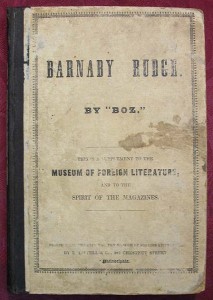
Dickens_Barnaby_RudgeDickens seemed more inured to the event, but he later said in a letter that he witnessed “No sorrow, no salutary terror, no abhorrence, no seriousness; nothing by ribaldry, debauchery, levity, drunkenness, and flaunting vice in fifty other shapes.” Experts hypothesize that seeing this execution influenced Dickens’ portrayal of the bloodthirsty hangman Ned Dennis in Barnaby Rudge, published in 1841.

That same year, Dickens tried to reach an agreement with Mackey Napier, editor at the Edinburgh Review. The two had met during Dickens’ visit to Scotland, and Napier had invited Dickens to write a piece for the journal. Such invitations were difficult to come by; the Review was the premier intellectual publication at the time. But the Review was also definitively a definitively conservative, Whig publication, quite at odds with Dickens’ own politics. He proposed a number of ideas, including a piece about the sordid state of public executions, even conducting substantial research on the topic.

Ultimately Dickens decided that the Edinburgh Review wasn’t a great fit for him. Five years later, he published a series of letters in the Daily News, a periodical dedicated to “free trade” politics. Dickens remained editor of the paper for only twenty days, but he published five letters on capital punishment during and after his tenure. Critics argue that it’s the best-researched and -written non-fiction that Dickens ever wrote. He addresses Courvoisier’s execution in the second letter. In the Daily News letters, Dickens speaks out against the death penalty altogether.

The Manning Executions

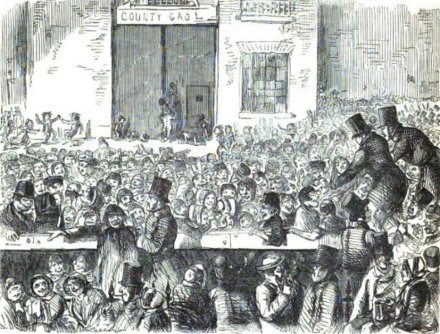
But Dickens managed to attend yet another sensational execution on November 13, 1849. Maria and Frederick Manning were executed at Horsemonger Lane Gaol in front of a crowd that numbered between 30,000 and 50,000. Executions at Horsemonger Lane were particularly popular spectacles; the gallows were on the rooftop. It was said that on execution days, local tenants could let the rooms with windows facing the gaol. Dickens rented such quarters and held a late dinner party there on the night before the execution. He walked around and observed the crowd afterward.

Punch_Great_Moral_Lesson_Leech

John Leech’s “Great Moral Lesson at Horsemonger Lane Gaol” appeared in ‘Punch’ magazine after the Manning execution and turned a critical eye not to the gallows, but to the crowd below. Leech, who had illustrated ‘A Christmas Carol,’ attended the execution with Dickens.

Tormented by the thought of a mad crowd, Maria Manning tried to stab herself in the throat with her own fingernails the day before her execution. Thwarted, she appeared before the mob in an elegant black satin gown and veil. Her outfit merited mention from countless spectators, including Dickens, and black satin remained out of style for the next thirty years. Dickens shares his recollections of the public hanging in an 1852 essay called “Lying Awake,” which appeared in Household Words. And he evokes Maria Manning in Bleak House’s Mademoiselle Hortense. Dickens also wrote a letter to The Times about the appalling scene at the execution. His letter did much to raise interest in the abolitionist cause. Meanwhile, abolitionist George Jacob Holyoake wrote an ironic commentary in his journal The Reasoner, decrying the unchecked crowding at executions.

But opponents defended the execution circus, arguing that it was a public duty to make the criminals’ last moments as miserable as possible. One proponent wrote, “The merciful object of ever punishment which the law inflicts is not so much to revenge past crime as to prevent its recurrence”; that is, capital punishment was necessary because it deterred spectators from committing the same crimes. Such a mindset was hardly contained among the uneducated. Even clergymen could get overzealous. One inflicted serious burns on a female inmate after holding her hand over a candle to simulate the fires of Hell that awaited if she didn’t repent.

Grisly Executions Sway Public Opinion

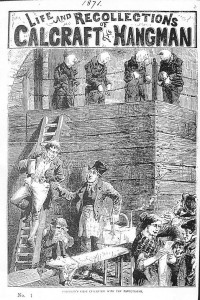
William-Calcraft_Hangman

The most famous hangman of the 19th century, William Calcraft completed around 450 executions. An illustrated account of his life was published in 1871.

While Dickens consistently comments on the horrors of executions, that didn’t dissuade him from attending more. In Pictures from Italy (1846), Dickens describes in graphic detail a guillotining he watched in Rome. He observed that the “ugly, filthy, careless, sickening spectacle” showcased the very worse of humanity. And he recounts another beheading, this time in Switzerlandin Household WordsThese passages certainly made a mark on public opinion.

So did the grisly execution of John Gleeson Wilson on September 15, 1849. Around 100,000 people came to Kirkdale to witness the spectacle. The case had received so much attention, broadside publishers had changed the name of the street where the crime occurred to curb publicity. Unfortunately or both Wilson and the spectators, accomplished executioner William Calcraft was indisposed. He’d been replaced by a seventy year old with little experience. Calcraft’s substitute made the drop too short, and he didn’t pull the cape down far enough; Wilson’s face was exposed to the crowd. Rather than having his neck immediately broken, Wilson strangled to death–and it took a full fifteen minutes. Spectators watched in horror as his eyes bulged and his face turned purple. Numerous individuals fainted at the sight.

Abolitionists Gain Considerable Traction

Throughout the 1850’s, the abolitionists gained more sympathy. It fell completely out of fashion for both nobility and the upper middle classes to attend executions. But while more and more people were coming to believe that the death penalty should be eliminated, Dickens’ sentiments were swinging the opposite way. He’d lobbied for complete abolition of the death penalty in the late 1840’s. But in 1859, upon hearing about the potential reprieve of convicted murderer Thomas Smeghurst, Dickens wrote “I would hang any home secretary, Whig, Tory, Radical, or otherwise, who would step in between so black a scoundrel and the gallows.”

He confirmed this stance in 1864, admitting, “I should be glad to abolish both [public executions and capital punishment] if I knew what to do with the Savages of civilization. As I do not, I would rid Society of them, when they shed blood, in a very solemn manner but would bar out the present audience.” Thus Dickens came to support the death penalty in cases of violent crime, which was concurrent with English law at the time. In 1861, the Criminal Law Consolidation Act reduced capital offenses to murder, high treason, piracy, and arson in a Royal Dockyard. Other than one case of attempted murder, no one had been executed for any other offenses since 1837, so the law finally caught up to common practice.

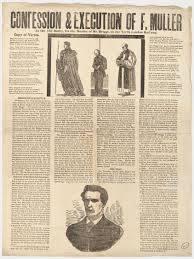
Execution_Franz_Muller

As Britain’s first “railway murderer,” Franz Muller drew considerable attention.

On November 14, 1864, over 100,000 people gathered to watch the execution of Franz Muller. The King of Prussia had written a letter to Queen Elizabeth on Muller’s behalf, but to no avail. The German tailor had been convicted of killing banker Thomas Brigg. Brigg’s colleagues had discovered bloody clothing and hat in Brigg’s compartment, and the man was found on the railroad tracks shortly thereafter. He was still carrying a considerable amount of money, but his pocket watch and chain had been stolen.

The bloody hat had been traced directly back to Muller, while the pocket watch turned up at a local pawn shop. The proprietor said that a man with a German accent had brought it. By this time, Muller had already boarded a steamship for New York. The inspector boarded a faster ship, intercepted Muller in New York, and returned him to England. Muller was found guilty in less than fifteen minutes.

At the time, people were especially preoccupied with the safety of rail travel. The crowd was boisterous on execution day. Multiple people were violently trampled to death, including a woman and her infant. By this time, public opinion had shifted; Victorians were more evenly divided over the efficacy of public executions. Abolitionists pointed out all the crime that occurred in the very shadow of the gallows. They commonly quote a chaplain’s report that of 167 criminals he’d interviewed on execution day, only three had never witnessed a public execution. Clearly this form of punishment did not deter future criminal behavior.

Legendary Authors Influence Legislation

Along with the Quakers, both Thackeray and Dickens would be credited with changing public opinion on capital punishment. The 1864 Royal Commission on Capital Punishment spent two years deliberating on the issue and finally ruled that there was no case for ending the death penalty altogether. But they did decide to make executions private. On May 11, 1868, the Capital Punishment Amendment was read into Parliament.

A number of factors led to changes in England’s capital punishment laws, but we shouldn’t underestimate Dickens’ role in changing public opinion. The Inimitable One consistently exerted an uncanny influence over his contemporary readers.

Related Posts:
A Brief History of True Crime Literature
Charles Dickens the Copyright Confederate
Andersen’s Visit with Dickens Less Than a Fairy Tale


Thanks for reading! Love our blog? Subscribe via email (right sidebar) or sign up for our newsletter--you’ll never miss a post.
Share

The California Gold Rush, Slavery, and the Civil War

California_Gold_Rush

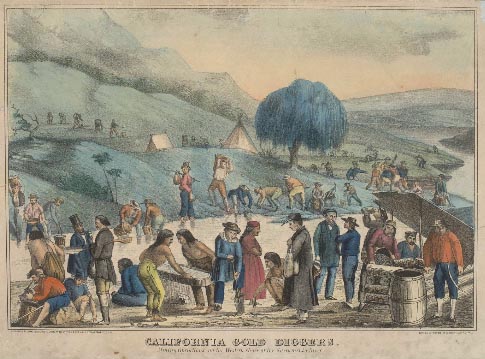
On January 24, 1848, Swiss immigrant John Sutter’s employee James Wilson Marshall found gold at the Sutter Mill. The result was the largest migration in American history, along with bitter debate over the issue of slavery. California would eventually enter the Union as a free state, but not because its delegates thought slavery an abomination. Figures like Hinton R Helper, himself a failed prospector, only exacerbated strained relations between the North and South.

Territory of Untold Value

When the US and Mexico went to war over California in 1846, the region’s population included about 6,500 Californios of Mexican or Spanish descent; 700 mostly American foreigners; and about 150,000 native Americans (whose population had been cut in half since the arrival of Spanish conquistadors). The war

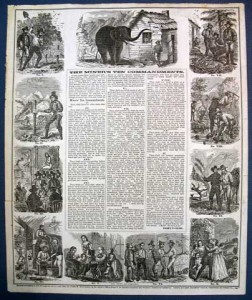
Miners_Ten_Commandments

Published pseudonymously, “The Miner’s Ten Commandments” reminds miners to respect the Sabbath–a rule that had fallen out of practice in many a mining town.

was ended in favor of America on February 2, 1848, with the ratification of the Treaty of Guadelupe Hildago. Neither side was aware of Sutter’s discovery, so the incredible value of the territory was not yet completely clear.

Indeed, people as close as San Francisco were quite skeptical until entrepreneur Sam Brannen marched through the city waving around a vial of gold. By the middle of June, San Francisco was a ghost town; most men had gone south to the mines. Military governor Colonel Richard B Mason took a tour of the gold fields shortly thereafter. IN his report, he noted that two miners had found $17,000 in gold in three days at Weber Creek. A team of six miners and fifty Native Americans had mined 273 pounds of gold. Sales at Sam Brannen’s mercantile exceeded $36,000 in May, June, and early July combined. Mason sent the report to Washington, DC with a tin of gold as additional proof. It wouldn’t arrive for months.

Word arrived sooner in places that were accessible by ship from San Francisco. Immigrants immediately began arriving in droves from the Sandwich Islands (Hawaii), Peru, Chile, China, and Mexico. Europeans followed. When the first accounts of newfound wealth appeared in East Coast newspapers in the summer of 1848, they invited much incredulity. It wasn’t until December 5, 1848, when President James K Polk announced Mason’s report in his State of the Union address, that Easterners began to take the Gold Rush seriously. The exodus began almost immediately. Men headed West in record numbers, hoping to escape the wage labor economy and strike it rich. Women were mostly left at home to raise families, tend farms, and run businesses on their own. Countless families took out loans or spent their life savings in pursuit of their dream.

The Gold Rush Undoes Many a Prospector

By 1849, the non-native population of California had reached almost 100,000. Prospectors soon learned that mining was grueling, dangerous work. It wasn’t uncommon for them to die of disease, accident, or even malnutrition. Hiram Pierce held a funeral for one young man who died of gangrene after accidentally shooting himself in the leg. Despite these conditions, miners continued pouring into California. And how could they resist? In 1849, mined gold was valued at $10 million. The following year, that figure was $41 million. In 1852, $81 million worth of gold was mined in California. (Not everyone was convinced that this westward migration was worth the risk; in 1849 Edgar Allan Poe even undertook a bizarre hoax to dissuade people from going.)

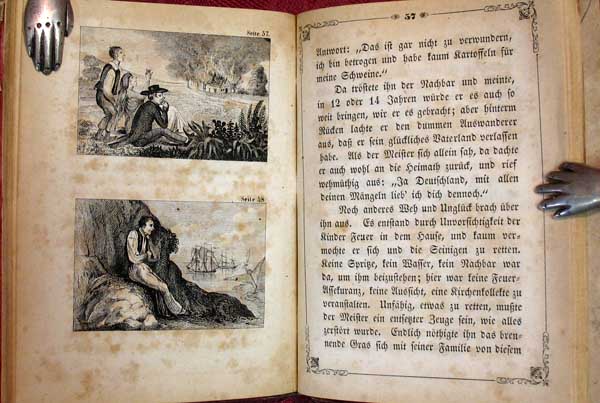
Das_Goldland_Californien

‘Das Goldland Californien’ (1850) includes the sad tale of one German emigrant who lost his fortune in his quest to strike it rich.

Competition grew increasingly fierce, and soon Anglo-American miners were growing territorial. They often resorted to violence, forcing others of different nationalities from their land. As the surface gold disappeared, miners found themselves with no option but to work for larger mining corporations with the technology to mine gold deeper underground. A wage labor economy had again emerged, and after 1852, revenue from gold fell steadily until 1857, when it held at about $45 million per year.

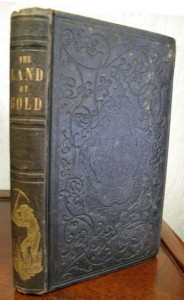
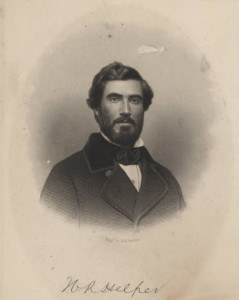
Helper_Land_GoldThe vast majority of men who went in search of gold failed to strike it rich. One such failed prospector was Hinton Rowan Helper. Born on December 27, 1829 outside Mockville, North Carolina, Helper was apprenticed to a printer. He went to the gold fields in 1850 and returned after only a matter of months. Helper said that after working the same claim for three months, he’d made less than 94 cents Though Helper didn’t find gold, the experience did give him material for Land of Gold: Reality vs Fiction (1855).

Helper’s account was hardly reality; he garbled and fabricated statistics to support his argument. Gary F Kurutz, Director of the Special Collections Branch at the California State Library and author of a descriptive bibliography on the Gold Rush, calls Land of Gold “one of the most famous, oft-quoted, and entertaining books of the Gold Rush.”

California Slavery Divides Congress

Helper also took up another hot-button national issue: slavery. He advocated the expansion of slavery to California, scolding the “meddling abolitionists” who interfered with whites’ ability to exploit blacks to work the mines. Racism ran deep in California, and one would think that Helper was not alone in his pro-slavery sentiment. Such was not the case; the issue was much more complicated. White southerners had first brought slaves to California mines in 1849, but that practice wasn’t popular. However, no laws banned slavery in the early days of the Gold Rush.

After the US won California, a bitter dispute ensued over whether the state should be a free or slave state. There were fifteen states in each category, and California would tip the scales. By September 1849,

1849_Monterey_Convention_Spanish_Edition

Details of the 1849 Monterey convention are among of the most important documents in California history. This is a Spanish translation.

California delegates were tired of waiting. They gathered in Monterey and voted to enter the Union as a free state. This wasn’t because they supported the abolition of slavery. On the contrary, many delegates were miners who hailed from the South. The majority felt that slaves actually had an unfair advantage in mining work because they were more accustomed to heavy labor. Thus, they voted against slavery for their own financial gain.

However, in Washington, DC, the North and South were deadlocked. Debate raged on for six months, and in one instance one senator even pulled a pistol on another. Finally Congress reached the Compromise of 1850: California would enter the Union under the state delegates’ terms, as a free state; New Mexico and Utah would become territories, and the legality of slavery there was undecided; the slave trade was banned in Washington, DC; and the Fugitive Slave Law was strengthened. California would ratify its own version of the Fugitive Slave Law in 1852.

A Racist Abolitionist

By this time, Hinton Helper had moved to New York. The issue of slavery remained at the forefront of US politics, and Helper didn’t help matters when he published The Impending Crisis of the South: How to Meet It in 1857. Helper’s thesis was that slavery impeded the economic development of the South because it Helper_Hinton_Rowanhelped to concentrate wealth in the landed class. He wrote in defense of non-slave owning Whites, whom he saw as economically disadvantaged, and who comprised about 75% of the white population of the South. But Helper’s publication had unintended consequences; it was adopted as an abolitionist work and helped to get Abraham Lincoln elected in 1860. Some experts even place The Impending Crisis of the South alongside Harriet Beecher Stowe’s Uncle Tom’s Cabin in terms of its influence as abolitionist literature.

The Impending Crisis of the South includes about 150 pages of statistics from the 1850 census, which Helper had hoped would illustrate the economic disadvantage of the slave states. These had little influence. But what did stick with readers was Helper’s branding Southern slaveholders as “robbers, thieves, ruffians, and murderers” and his exhortations that slaves should escape from their owners by violence if necessary. The summer after the book was published, New York Herald editor James Gordon Bennett gave President Buchanan a copy and warned him that “There is gunpowder enough in that book to blow the Union to the devil.”

A Help for the Republican and Abolitionist Cause

Conflict over slavery again reached a fever pitch, as it had when California entered the Union. Then Republican party leaders moved to print a compendium of The Impending Conflict of the South to distribute in the 1860 presidential campaign. The “Speakership Fight” in the House of Representatives resulted, lasting from December 5, 1859 to February 1, 1860. The battle gave Helper’s book far more national attention than it really deserved, as did the resulting endorsement from the Republican party.

Lincoln won the election, even though he wasn’t necessarily the most popular candidate. For example, California citizens increasingly sympathized with the South as farming overtook gold mining. Yet Lincoln won in California because Democratic votes were divided between Northern candidate Steven Douglas and Southern candidate John Breckenridge, while Republicans were unified in their vote for Lincoln.

In January 1861, the Herald declared that Lincoln’s victory had been due to “this very work of Mr. Helper, and kindred speeches and documents.” Much later, historian James Ford Rhodes would note that the book “proved a potent Republican document, especially in the doubtful states of New Jersey, Pennsylvania, Indiana, and Illinois, where it was easier to arouse sympathy for the degraded white than for the oppressed Negro.” Helper’s screed had had unintended consequences. The author found himself suspect in the South and scorned in the North. He couldn’t find employment, faced public ridicule, and feared physical violence. Helper turned to Abraham Lincoln for a consular appointment, which Lincoln granted. In November 1861, Helper went to Buenos Aires as the consul to Argentina. While there, he married Maria Louisa Rodriguez.

When Helper returned from Argentina, he settled in Asheville, North Carolina. He would later live in New York and St. Louis. He wrote five other books, three of which were extremely racist. By 1890, Helper’s grip on reality had all but evaporated. His wife had gone blind and returned to South America with the couple’s only son. Alone, Helper grew more and more unstable. He committed suicide and was buried in a donated, unmarked grave. The Authors Society of New York paid his funeral expenses.

Hinton Rowan Helper made a mark on history that he never could have predicted. His own history shows how inextricably the events of regional and national history are so often intertwined. Helper’s work proved a malignantly divisive one, exacerbating the conflicts that pushed the nation to the brink of Civil War.

Related Reading: 
The Six Hoaxes of Edgar Allan Poe
Louisa May Alcott: Abolitionist, Suffragette, and Mercenary 
Charles Dickens the Copyright Confederate
A Collection of Confederate Literature
Clara Barton: Heroine of Civil War Nursing and Record Keeping

Thanks for reading! Love our blog? Subscribe via email (right sidebar) or sign up for our newsletter--you’ll never miss a post.
Share

Richard Morton, Dissenting Minister Turned Legendary Physician

The history of medicine is rich with fascinating stories and personalities. One of these was Richard Morton, an ousted minister who turned to medicine as a second career. The source of Morton’s medical education remains somewhat mysterious, but he nevertheless managed to distinguish himself in the profession, even rising to be the physician-in-ordinary to the king. Today Morton is remembered primarily for his contribution to the study of phthisis, more commonly known today as pulmonary tuberculosis.

Eight Missing Years of Medical Training?

The son of a minister, Morton was baptized in 1637. As a young man he resolved to follow in his father’s footsteps, and after earning a BA at Oxford took a position as the Vicar of Kinver at Staffordshire. The post was a comfortable one, and Morton would likely have remained in it indefinitely–were it not for the Richard_MortonRestoration. A dissenter, Morton could not comply with the requirements of the Act of Uniformity. In 1662 he was ousted from his living and forbidden from reentering the ministry, along with 2,000 other ministers would could not give “unfeigned consent and assent” to everything contained in the Prayer Book.

For the next eight years, there is no record of Morton’s activities. Scholars guess that he went to Holland to study at the University of Leyden, which was then the most famous medical university in Europe. Morton’s expertise in phthisis would suggest that he studied under Silvius, the leading medical professor at the University of Leyden. And his subsequent patronage from Prince William of Orange also suggests a strong connection to the Netherlands.

The fact that there are no records of Morton’s medical training have led some experts to postulate that Morton was entirely self-taught. Indeed many clergymen of the era taught themselves medicine to serve their congregants. Meanwhile, Morton also mentions, “My dear Father, who was himself a very skilful Physician.” It’s possible that Morton first discovered medicine through the books in his father’s library and, being interested in the subject, turned to medicine when the ministry was no longer an option. But his advanced knowledge of anatomy simply could not have been acquired in books.

Wherever Morton got his training, he had no trouble establishing a practice in London in 1670. Here, he had some help from Prince William of Orange, who nominated him for a medical degree from Oxford. William attended Morton’s nomination ceremony while visiting England to collect on a debt owed by Charles II. By 1670, Morton had established his own practice in London. Only eight years later, Morton was elected a Fellow in the Royal College of Physicians.

In 1686, Morton’s politics again got him into a bit of trouble: his was one of four names omitted from the list of renewals to the College charter. James II thought that Morton might be politically unreliable because he’d accepted patronage from William of Orange. Morton was barred from participating in College activities and debates for the next three years. But with the accession of William and Mary in 1689, Morton was restored to the Fellowship and eventually rose to the rank of physician-in-ordinary to the king.

A Landmark Publication in Medical History

But it’s for his Phthisiologica that Morton is remembered in the history of medicine. The book, dedicated to William of Orange, was perhaps inspired by William’s own respiratory problems. When the book was first published in London in 1689, it was presented in Latin. The first English edition appeared in 1694, with at least two subsequent editions in 1719 and 1720. Multiple continental editions followed in Frankfurt (1690); Ulm (1714); and Helmstad (1780). Thus Phthisiologica maintained prominence for about a century.

Morton_Phthisologia

Morton was certainly not the first to address phthisis, which at the time was defined rather broadly as any wasting disease (and is now defined only as pulmonary tuberculosis, mainly because our powers of differential diagnosis are superior). In seventeenth-century England, tuberculosis always loomed a specter. John Locke addressed the illness in De Phthysi (1685) and estimated that the ailment caused about 20% of the deaths in England.

Before Locke, Christopher Bennett (1617-1655) had explored phthisis, though his explanations for the disease were hardly based on facts. Bennett suffered from phthisis himself and argued that this fact made him the authority on the condition. But many of his statements were anecdotal, and he frequently ignored evidence that contradicted his claims. Next was Thomas Willis (1617-1675). Willis was appointed Sedlian Professor of Natural Philosophy at Oxford in June 1660. His Practice of Physick, published posthumously, included an entire chapter on phthisis. And Thomas Sydenham (1624-1689) illustrates how little seventeenth-century physicians really knew. He enthusiastically advocated horseback riding as a treatment for phthisis.

What set Morton apart from his predecessors and contemporaries, at least in terms of diagnostic observation, is that Morton presented evidence that lungs affected by phthisis would often have both ulcers and tubercles. He saw these tubercles as glandular parts that were ordinarily too small to be detected with the naked eye, and which grew inflamed with infection. Such an observation could be made only through post-mortem observation of patients who had died of phthisis. The idea of desecrating a body in such a way was hardly popular at the time. It was common practice in Europe–and later in the United States–to threaten dissection as punishment for wrongdoing, as a punishment even worse than death.

Another fascinating aspect of Phthisiologia is that it contains virtually no references to other medical texts. Though Morton incorporates a few aphorisms of Hippocrates, he doesn’t allude to any pre-existing or contemporary medical theory. It’s clear that his conclusions are all drawn from his own firsthand observations and experiences. Morton’s case studies demonstrate that he was an able physician, especially given the lack of medical tools and knowledge available at the time. His work even predates Auenbrugger’s discovery of percussion as a diagnostic tool. Thus Morton worked only with his own power of clinical observation and deduction, along with the occasional palpation.

Richard Morton’s Phthisiologia is truly a seminal work in the histories of science and medical literature. Though Morton obscured the antecedents of his medical knowledge, he left behind a work that perfectly captures both his own aptitude as a physician and the contemporary approach to medical practice.

Related Posts:
Elias Samuel Cooper: Renowned and Controversial Surgeon
Edith Cavell, Nurse, Humanitarian, and Traitor?
Famous Figures in the History of Nursing (Part One)
Famous Figures in the History of Nursing (Part Two)

Thanks for reading! Love our blog? Subscribe via email (right sidebar) or sign up for our newsletter--you’ll never miss a post.
Share

Famous Figures in Culinary History: Hannah Glasse, Susannah Carter, and Amelia Simmons

At first, cookbooks were largely written by men. Their intended audience were the individuals who ran restaurants and the households of the wealthy. It wasn’t until the eighteenth century that this trend began to shift. Perhaps the most notable cookbook of the century is Hannah Glasse’s The Art of Cookery (1747), which Glasse wrote for “the lower sort,” that is, domestic servants. Unlike her predecessors, Glasse used a conversational tone and an expository approach that appealed to an incredibly broad audience.

Glasse_Art_CookeryGlasse could not claim all the delicious recipes in The Art of Cookery as her own; she had borrowed thoroughly from other cookbooks. Meanwhile, her own book would be pirated and plagiarized plenty of times. Even during her lifetime, Glasse discovered “new editions” of her book that contained sections she had not even written! Her publishers were to blame for some of that; they wanted to update the book to fit with changing tastes. The tactic worked; The Art of Cookery would become the definitive English cookbook for the remainder of the century, and now the various editions an incredibly thorough representation of the foodways of eighteenth-century Britain.

Glasse is undoubtedly a major figure in culinary history, but it was a lesser known personage whose cookbook would successfully “cross the pond” from Britain to the New World. Susannah Carter, author of The Frugal Housewife (c 1765) takes that honor. Carters work was significant because it was overtly aimed at housewives, rather than servants and chefs, and because it was one of the earliest printed American cookbooks–and certainly the most successful.

Unfortunately we know little about Carter, save that she hailed from Clerkenwell, in London. We know much more about the publishing history of The Frugal Housewife, which is interesting unto itself. In London, the book was published by Francis Newbery (the nephew of John Newbery) in the printing enclave near St. Paul’s Cathedral. The same year, the book appeared in Dublin. The Frugal Housewife didn’t make its way to the colonies until 1772. It was published by Benjamin Edes and John Gil and illustrated with prints by Paul Revere. Edes and Gil were known for publishing the works of Revolutionary writers, and they played a significant role in instigating the Boston Tea Party.

Carter_Frugal_HousewifeAs colonial booksellers, Edes and Gil had little bargaining power with British publishers. They desperately needed British titles to stay in business, and they couldn’t offer many interesting colonial works in return. Thus British booksellers would often force their colonial counterparts to buy less desirable works–such as a cookbook–in order to acquire more literary titles.

Cookbooks were a burgeoning field at the time, so Newbery may not have predicted that colonial publication of The Frugal Housewife would be profitable. Thus it’s quite possible that Newbery essentially forced the American publication of The Frugal Housewife, unwittingly created something of an American cookery phenomenon.

One of the earliest cookbooks printed in America, The Frugal Housewife made no mention of colonial cooking or American ingredients, and it presumed access to cooking tools and technologies that were all but impossible to acquire in the colonies. Despite these obvious shortcomings in the colonial market, The Frugal Housewife sold quite well. The book remained in print in 1803. That year, an appendix was added that contained American recipes like Indian pudding, buckwheat cakes, and pumpkin pie.

Carter certainly did not write these; it appears that they were borrowed from a Swedish cookbook called Rural Oeconomy. (The exact same appendix showed up in the 1805 edition of Glasse’s The Art of Cookery! It’s likely that publishers decided this supplement would make both cookbooks more appealing to American audiences.) In 1832, Lydia Marie Child republished the cookbook as The American Frugal Housewife, and it would be reprinted multiple times over the next two decades.

Thanks to Carter, a number of traditional English dishes made their way into American foodways. But she didn’t do it on her own; she remains in debt to Amelia Simmons, who wrote the first truly American cookbook, American Cookery, in 1796. Simmons was heavily influenced by Carter and borrowed entire passages verbatim from The Frugal Housewife.

The interplay of culinary texts from Glasse, Carter, and Simmons superbly illustrates the rich history–and interaction–of global foodways. Each of these women’s cookbooks significantly impacted colonial cookery.


Thanks for reading! Love our blog? Subscribe via email (right sidebar) or sign up for our newsletter--you’ll never miss a post.
Share

The Six Hoaxes of Edgar Allan Poe

The origins of April Fools’ Day are unclear. Some experts suggest that when the French shifted the New Year to January to correspond with the Roman calendar, rural residents still kept celebrating with the beginning of spring, which often fell around the start of April. They came to be known as “April fools.” This theory, however, doesn’t take into account that the new year would have been celebrated around Easter–which isn’t associated with April first. It’s more probable that our April Fools traditions grew from age-old pagan celebrations of spring, which included adopting disguises and playing pranks on one another.

But some pranksters simply aren’t satisfied to confine their exploits to a single day. One of these was Edgar Allan Poe, who was unabashedly fond of hoaxes. He approvingly called his time the “epoch of the hoax.” During his lifetime Poe would attempt a total of six different hoaxes. Most modern anthologies fail to acknowledge that these stories were originally published as non-fiction.

A “Tone of Mere Banter”

In June 1835, “The Unparalleled Adventures of One Hans Pfaall” appeared in the Southern Literary Messenger. It was purportedly the text of an odd note that had been dropped from a hot air balloon over Rotterdam. The note, supposedly written by Hans Pfaall, recounted his journey to the moon, which he undertook to escape creditors on Earth. Pfaall claimed that he had spent five years living on the moon with its native inhabitants. He’d sent a lunar inhabitant back down to Earth with a promise that he’d tell his story if his creditors would forgive his debts. But the lunar inhabitant had been spooked; he dropped the note and fled back to the moon.

Yan Dargent's illustration about Poe's 'The Unparalleled Adventure of One Hans Pfaall' for Jules Verne's 'Edgar Poe et ses œuvres ' (1864)

Yan Dargent’s illustration about Poe’s ‘The Unparalleled Adventure of One Hans Pfaall’ for Jules Verne’s ‘Edgar Poe et ses œuvres ‘ (1864)

Poe’s first attempt at a hoax hardly fooled anyone; even Poe himself admitted that the article’s “tone of mere banter” rendered it less than credible. Then a similar–but much better executed–version of same hoax appeared in the New York Sun. It was such a successful ruse, Poe decided to abandon his own effort altogether.

“The Garb of Fiction”

The Narrative of Arthur Gordon Pym was inspired by the spirit of exploration that gripped America in the early- to mid-1800’s. The US Navy had recently organized the Wilkes Expedition to South Africa and Antarctica. Poe played to America’s great interest in such expeditions with The Narrative of Arthur Gordon Pym.

Poe published the story serially in Southern Literary Messenger in January and February 1837. Though the serial edition was written “under the garb of fiction,” he added a preface to the novel, claiming the tale was faction. That device was certainly not uncommon; indeed, eighteenth-century authors were in the habit of self-conscious narration, whereby the author would step in to assert the veracity of the story.

Poe based his tale on the theory of John Cleves Symmes, who believed not only that the earth was hollow, but also that it was inhabited. He was constantly trying to raise money for a polar expedition to prove his theory. Poe’s take on the story was so odd, most readers immediately recognized that it was fictional.

A Hoax Fit for a Senator

The Journal of Julius Rodman appeared from January to June 1840 in Burton’s Gentlemen’s Magazine. It detailed the adventures of the eponymous explorer as he made his way up the Missouri River and into the Far North. The journal was dated 1792, which would have made Rodman the first European to cross the Rocky Mountains. To lend the journal authenticity, Poe actually penned the entire thing. He also borrowed details from Washington Irving’s Astoria and Lewis and Clark’s History of the Expedition.

This time, Poe managed to fool at least one person. US Senator Robert Greenhow specifically mentioned the journal. That chance mention obviously made others believe that the journal could actually be real–but not for long. Poe’s motives for this hoax are unknown.

“Bought Up at Almost Any Price”

The Great Balloon Hoax was almost certainly Poe’s best work as a prankster. A broadside appeared in the midday issue of the New York Sun on April 13, 1844. It included an announcement that the famed European balloonist Thomas Munck Mason had just completed a transatlantic journey in his balloon, the Victoria. The advertisement stated that Mason had departed from England, bound for Paris. But a propellor accident had pushed him off course. An illustration of the balloon accompanied the text.

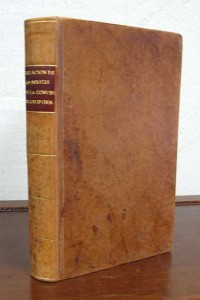
Mason was a real person, and he had flown a balloon from London to Weilburg, Germany in 1836. He’d documented the trip in Account of the Late Aeronautical Expedition from London to Weilburg. Poe borrowed the illustration from the frontispiece of a pamphlet that was published anonymously and generally accepted as Mason’s, called Remarks on the Ellipsoidal Balloon, Propelled by the Archimedean Screw, Described as the New Aerial Machine (1843).

1844_Sun_newspaper_story (1)

On the day of publication, Poe stood on the steps of the Sun’s office and revealed his own hoax to the crowd. But that did little to quell their clamoring for the paper. He reported, “I have never witnessed more intense excitement to get possession of a newspaper. As soon as the first copies made their way into the streets, they were bought up, at almost any price.” Poe couldn’t even get a copy of the paper for himself. Despite this furor, the Great Balloon Hoax was quickly revealed to be false. Nevertheless, it likely inspired Jules Verne to write Five Weeks in a Balloon and Around the World in Eighty Days. Vern was a great fan of Poe and even published a study of his work.

“Hoax Is Precisely the Word”

The December 1845 edition of American Whig Review included “The Facts in the Case of M. Valdemar,” an account of an unusual experiment to test whether hypnotism could stave off death. A terminally ill patient with only hours to live, one M. Ernest Valdemar, was placed under the care of a hypnotist. Valdemar slipped into a hypnotic trance, his pulse stopped, and his breathing ceased. Yet somehow he was still able to gurgle short responses to questions. After a full seven months, Valdemar’s doctors decided the experiment had run its course. The hypnotist brought the patient out of his trance. His body immediately collapsed and became “detestably putrid.”

Valdemar’s case was reprinted all over Europe and the United States. Robert Collyer, a prominent hypnotist, even corroborated the story. He claimed that he’d once revived a man who had died from overdrinking. When a Scottish correspondent wrote to inquire about the case, Poe openly admitted, “Hoax is precisely the word suited to M. Valdemar’s case.”

A “Check to the Gold Fever”

News of “Von Kempelen and His Discovery” appeared in The Flag of Our Union on April 14, 1849. German scientist Von Kempelen claimed that he’d discovered the alchemical process to turn lead into gold. Few fell for the ploy, much to Poe’s chagrin. He had wanted to dissuade people from migrating west in the California Gold Rush. Poe wrote to Evert A Duyckinck, “My sincere opinion is that nine persons out of ten (even among the best informed) will believe the quiz (provided the design does not leak before publication) and that thus, acting as a sudden, although of course a very temporary, check to the gold fever, it will create a stir to some purpose.”

Even though Poe’s motives may seem odd or obscure, his hoaxes live on as a quirky and fascinating part of literary history.

Related Reading:
Edgar Allan Poe: Creator of Enduring Terror and Literary Masterpieces
George Steevens: Bibliophile, Scholar, and Prankster


Thanks for reading! Love our blog? Subscribe via email (right sidebar) or sign up for our newsletter--you’ll never miss a post.
Share

A Look Back at Book Censorship

On March 25, 1955, US Customs Department officials seized 520 copies of Allen Ginsberg’s Howl. Printed in England, the book had been deemed obscene by the US government. Poet Lawrence Ferlinghetti, who owned the publishing house and book store City Lights in San Francisco, decided to publish Howl in the autumn of 1956. He was almost immediately arrested on charges of obscenity. The ACLU bailed him out and took the lead in his defense. Nine literary experts testified at Ferlinghetti’s trial, and he was found not guilty. Unfortunately, this episode is only one of many in the history of book censorship.

Areopagitica (1644)

Milton_AeropagiticaBy 1644, John Milton had already successfully teamed up with Presbyterians to abolish the Star Chamber. That year, the activist poet turned his attention to the Licensing Act of 1643, which prohibited publication without the permission from the government. In Areopagitica, Milton makes an incredibly eloquent and impassioned plea for an end to government censorship. But he didn’t receive support from Presbyterians, so essentially stood alone in his campaign. The work was banned, and England would not attain freedom of the press until 1695.

 Fanny Hill (1748)

Fanny_Hill_1910_coverConsidered the first pornographic novel published in English, Fanny Hill is every bit as lurid as one would expect from the fictional memoir of a Georgian prostitute. Even more scandalous: the eponymous protagonist enjoys the work of earning “profit by pleasing.” Author John Cleland and the book’s original publisher were immediately thrown into jail after the book was published. And in America, Fanny Hill was the subject of the country’s very first obscenity trial: in 1821, two men were charged with printing an illustrated version. That edition and subsequent contraband editions became hot collector’s items; even Benjamin Franklin was said to have a copy. The book found its way back to the US Supreme Court in 1963 after Massachusetts banned the book. The Supreme Court found the book lewd–and ruled that it was protected by the First Amendment.

Candide (1759)

Candide_BannedThanks to the book’s catchphrase “Let us eat the Jesuit, let us eat him up” and myriad other irreverences, Voltaire’s Candide was banned by the Great Council of Geneva and the Parisian government just after the book’s release. But 30,000 copies still sold within a year.–much to the delight of Voltaire. The Comstock Law of 1873, later renamed the Federal Anti-Obscenity Act, forbade the sending of obscene materials by US mail. Under this law, the US Customs Department seized Harvard-bound copies of the book in 1930. In 1944, the US Post Office demanded that Candide be dropped from Concord Books’ catalogue. Chaucer’s Canterbury Tales, Boccaccio’s Decameron (1350-1353) and a host of other literary works would fall prey to the Comstock Law.

The Rights of Man (1791)

Paine_Rights_ManThomas Paine had already made a name for himself as a dissident with Common Sense (1776) and The American Crisis (1776). In The Rights of Man, Paine vociferously objects to the divine right of kings the inherent right of any family or social class to govern. He also argues that governments should be guided by the will of the people, pointing to France and America as prime examples. The English crown found Paine’s latest work downright treasonous and issued a warrant for his arrest. Paine fled to France, but was found guilty of libel and treason in absentia. He was sentenced to death should he ever enter England again. All copies of The Rights of Man were regularly seized and burned for many years after.

Alice’s Adventures in Wonderland (1865)

Alices_Adventures_in_Wonderland_CarrollWhat could possibly be offensive about Lewis Carroll’s classic Alice’s Adventures in Wonderland? In 1931, General Ho Chein, governer of the Hunan province of China, decided that the book should be banned because its characters included anthropomorphic animals. The general argued that it was “disastrous to put animals and human beings on the same level.” Surprisingly enough, similar arguments have been used in the United States to justify banning Charlotte’s Web (EB White, 1952) and Winnie-the-Pooh (Milne, 1926).

Grapes of Wrath (1939)

Grapes_Wrath-BurnedOften considered John Steinbeck’s greatest work, The Grapes of Wrath was published to heated outcry. Steinbeck was accused of exaggerating the plight of the poor and unfairly vilifying the wealthy. This reaction was, to some extent, Steinbeck’s intention: he wrote that he wanted to “put a tag of shame on the greedy bastards who are responsible for the Great Depression.” Those who denounced Steinbeck most enthusiastically were the Associated Farmers of California, who called the novel a “pack of lies” and “communist propaganda.” The novel was temporarily banned in parts of the United States–and even burned publicly in some places. The censorship of Grapes of Wrath was pivotal in the creation of the Library Bill of Rights.

Animal Farm (1945)

George_OrwellAfter George Orwell finished Animal Farm in 1943, it took him two years to find a publisher. The book openly criticized political leadership in the USSR, an important British ally during World War II. After the book was published, it was banned in the USSR and other Communist countries. In 1991, Kenya banned a theatrical adaptation of Animal Farm because it criticizes corrupt leadership. The book was also banned in the United Arab Emirates for containing scenarios and ideas (namely, a talking pig) that conflict with Islamic values. Animal Farm is still banned in Cuba and North Korea, and censored in China.

Green Eggs and Ham (1960)

Geisel_SeussTheodore Seuss Geisel, better known as Dr. Seuss, admitted that he was “subversive as hell” and had no desire to write children’s books that simply modeled good behavior. His books show kids how to question their surroundings and explore new things. Green Eggs and Ham is one of Seuss’ best known works…and it was banned in Maoist China in 1965. According to the Chinese government, the book was a portrayal of Marxism. The ban was not lifted until after Geisel passed away. Meanwhile Yertle the Tertle (1958) was removed from schools in British Columbia in April 2012 because of a single line that carries a political message. And The Lorax (1972) earned a ban from a California community for its negative depiction of loggers.

Many of these banned books have become beloved classics for the very reason they were originally banned–they push us to consider uncomfortable ideas that challenge the status quo. Their place in the literary canon has bolstered their desirability among rare book collectors, especially in cases where early editions were frequently confiscated and destroyed.

Related Reading:
AA Milne: Legendary Children’s Author and Ambivalent Pacifist
Fra Paolo Sarpi, Scholar, Priest, and Heretic

Thanks for reading! Love our blog? Subscribe via email (right sidebar) or sign up for our newsletter--you’ll never miss a post.
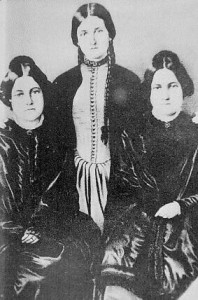
Share