Category Archives: Antiquarian Books

Top Ten Blog Posts of All Time

This month has been a big one here at Tavistock Books! We celebrate our 25th anniversary, along with the one-year anniversary of fearless Aide-de-Camp Margueritte Peterson. We’re also proud that this month we hit the 10,000-visitor mark for our blog. To recognize this occasion, we humbly present the top ten blog articles of all time. Hope you enjoy reading!

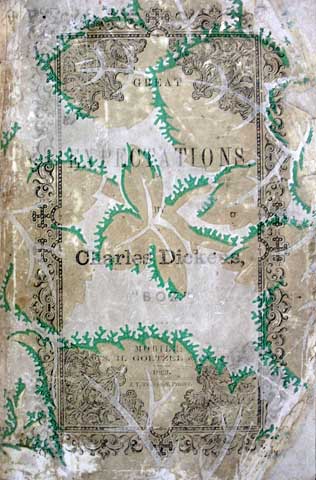
Dickens_Great_Expectations_Confederate_Edition1. The Two Endings of Charles Dickens’ Great Expectations

When Charles Dickens finished Great Expectations and sent it off to his publishers, he was quite pleased with himself. Then he showed a copy to friend and fellow author Edward Bulwer-Lytton, who, according to Dickens, “was so very anxious that I should alter the end…and stated his reasons so well, that I have resumed the wheel, and taken another turn at it.” The book’s dual endings present complications for critics and collectors alike. Read More>>

2. Why Did Charles Dickens Write Ghost Stories for Christmas? 

For the Victorians, Christmas wasn’t complete without a great ghost story! Charles Dickens certainly catered to this preference with his beloved Christmas Carol and a number of other Christmas tales. But why ghost stories? The holiday–once forbidden by Oliver Cromwell–has its roots in pagan rituals, which included telling “winter’s tales,” that is, ghost stories. Read More>>

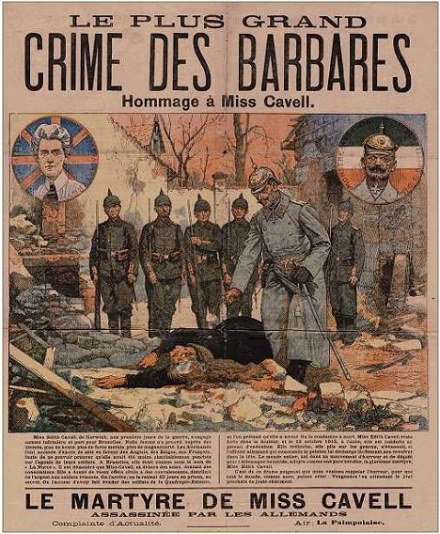
Edith_Cavell_Crime_Des_Barbares3. Edith Cavell: Nurse, Humanitarian, and…Traitor?

Edith Cavell quickly earned a reputation as an excellent nurse, and during World War I she found herself with another set of duties. Along with other nurses, Cavell was recruited by the British Secret Intelligence Service to collect information about the Germans. She eventually put that mission aside, preferring to funnel British and French soldiers to neutral Holland. Cavell raised suspicion, and the Germans arrested her for treason. Cavell was convicted and executed, a move that provided plenty of fodder for British and American propaganda machines. Read More>>

4. Alexander Pope’s Legacy of Satire and Scholarship

History has not always been kind to Alexander Pope, and neither were his contemporary critics. The poet published his earliest extant work at only twelve years old and went on to found the Scriblerus Club alongside celebrated authors John Gay and Jonathan Swift. Thanks to the guidance and support of Swift, Pope was able to do what few authors of the era managed to accomplish: he made a comfortable living with the pen, mostly due to his ingenious translation of Homer’s Iliad. Read More>>

5. A Brief History of Propaganda

Propaganda has existed for ages; the Behistun Inscription, written around 515 BCE details King Darius I’s glorious victory. But the Catholic Church gave us the word itself and formalized the use of propaganda, most notably when Pope Urban II needed to bolster support for the Crusades. The literacy boom of the nineteenth century actually drove the production of more propaganda, as politicians had to sway the opinions of a more informed public. World War I saw the first large-scale propaganda production. Britain even enlisted its best authors, like AA Milne, to create pro-war propaganda. Read More>>

6. Charles Dickens Does Boston

Charles Dickens’ first trip to America began promisingly enough; he was immediately mobbed by adoring fans. Dickens fell in love with Boston, declaring the city “what I would like the whole United States to be.” But the trip turned sour when the young author insisted on addressing the issue of international copyright law at every turn. He was also appalled by the way slavery was practiced in the South and by Americans’ lack of social graces. Dickens documented his impressions of the United States in American Notes, which immediately alienated his Continental readers. Read More>>

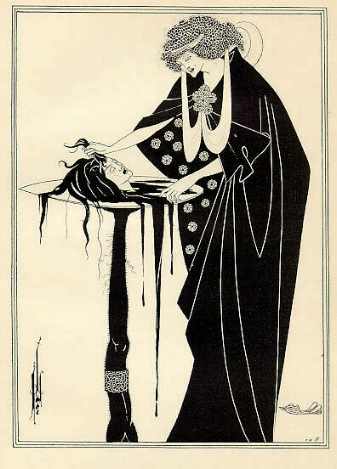
Beardsley-Salome-Wilde7. Oscar Wilde, Dickens Detractor and “Inventor” of Aubrey Beardsley 

We remember Oscar Wilde just as much for his oversize personality as we do for his authorial excellence. Wilde’s ego often led to strange relationships with fellow authors, most notably Bram Stoker, Charles Dickens, and Aubrey Beardsley. Wilde lost a love to Stoker, railed against Dickens’ sentimentality, and claimed that Beardsley had Wilde to thank for his career. For rare book collectors, Oscar Wilde epitomizes the way that single-author collections can (and should) include works by other authors. Read More>>

8. The Six Hoaxes of Edgar Allan Poe

Edgar Allan Poe called his time “the epoch of the hoax,” and the horror writer couldn’t have been happier about it. Poe was a great lover of hoaxes, even attempting several himself. He forged a note from a supposed lunar inhabitant and penned a fake journal from an explorer. Poe even undertook one hoax to dissuade people from going West during the Gold Rush. But Poe’s efforts only proved that he should have stuck to poetry and fiction; he hardly convinced anyone that his hoaxes were real. Read More>>

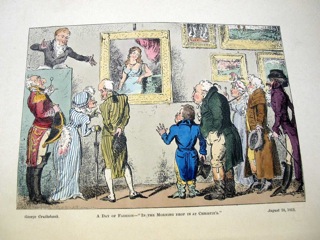
George-Isaac-Robert-Cruikshank

From ‘The Cruikshankian Momus’ by Isaac, Robert, and George Cruikshank

9. George Cruikshank: “Modern Hogarth,” Teetotaler, and Philanderer

George Cruikshank followed in his father’s footsteps, building a reputation as a preeminent illustrator of his time. Political from the beginning of his career, Cruikshank was openly racist and patriotic. He adopted an incredibly moralistic tone about drinking. That uncompromising campaign for temperance ultimately became a wedge between Cruikshank and Charles Dickens. After Cruikshank’s death, however, his wife discovered that he’d been leading a secret life–and had fathered eleven children with the family’s former servant. Read More>>

10. The Millerites an the Great Disappointment

The Seventh-Day Adventist Church arose from a great failure. The nineteenth century saw a revival in millinarianism, the belief that a drastic event or movement would suddenly change the course of society as outlined in the book of Revelation. William Miller stepped forward as a sort of prophet, arguing that Jesus would certainly return in 1843 or 1844. His followers, called the Millerites, embraced his predictions–until the days passed and nothing happened. They broke into a number of different sects, one of which developed into the Seventh-Day Adventist Church. Read More>>


Share

Charles Dickens as Social Commentator

Karl Marx deeply admired his contemporary Charles Dickens, which should surprise no one familiar with the works of the Inimitable. Dickens used his novels to address the social ills of Victorian society, from the poor conditions in factories to the deplorable treatment of orphans. Some of Dickens’ incredible popularity can certainly be attributed to his overt empathy for the common man, but that same popularity also gave him an unprecedented platform for promoting reform. Dickens took up social causes early in his career and, after the success of Oliver Twist, resolved to use the novel as a vehicle for social commentary.

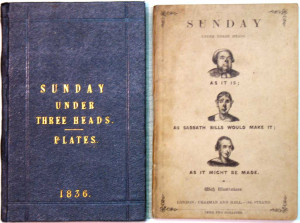
Sunday Under Three Heads

Dickens_Sunday_Under_Three_HeadsBy 1836, England’s social classes were not only divided by economics; they also observed religion differently. For the middle and upper classes, the Sabbath remained a sacred day, free from feasting, visiting, and indulgences. But for members of the lower class, Sunday was usually the only day off and therefore the only day available to make merry. Thus the streets of London were often full of drunkards and revelers on Sundays. Sir Andrew Agnew despised the lower classes to such a degree that he went out of his way to end Sunday festivities with a Sabbath Observances bill. The bill would have put an end to the usual freedoms and entertainments that the lower class usually enjoyed on Sundays. Dickens found the bill draconian and discriminatory. In 1836, he published “Sunday Under Three Heads” under the pseudonym Timothy Sparks. The cartoon illustrates the fact that there could–and should–be some middle ground between reckless revelry and puritanical observance. Dickens would go on to criticize not only Agnew’s bill (which failed to pass in four different permutations, leading Agnew to resign from Parliament), but also his character.

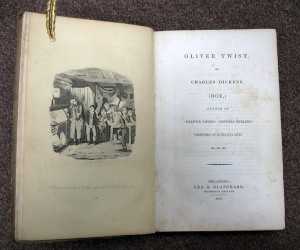
Oliver Twist

Completed in 1839, Dickens_Oliver_TwistOliver Twist vaunted Dickens to celebrity status in England. The novel was Dickens’ first to carry over social commentary, and its success galvanized his resolve to use his fiction to address social injustice. Two years prior, in 1837, six members of Parliament and six working men had banded together to publish the People’s Charter (1838). Their aim was to empower working-class men with voting rights and the ability to be elected to the House of Commons. While these demands weren’t new, they were made at just the right time, and the People’s Charter is often regarded as the most famous political manifesto of the nineteenth century. The Chartist movement rapidly emerged, drawing attention to the plight of the working class. Thus Oliver Twist likely could not have been published to a more sympathetic audience. Dickens’ criticism of the Poor Law of 1834 and the horrible conditions of orphanages fell on eager ears.

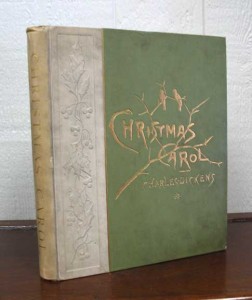
A Christmas Carol

Dickens_Christmas_CarolRobert Malthus published An Essay on the Principle of Population pseudonymously in 1798. He argued that overpopulation would necessarily right itself through famine, disease, war or other means. The work was highly influential and immediately raised concerns about the population of Great Britain. In 1800, the Census Act was passed, enabling a census count every ten years. In ensuing decades, the population of cities, and of London in particular, grew astronomically. Malthus’ theory became an excuse to ignore the spread of contagious disease and the lack of proper care for orphans. Dickens personified Malthus in Ebenezer Scrooge, who says, “If they would rather die…they had better do it, and decrease the surplus population.” By this time, another concept dovetailed conveniently with Malthusianism: the “deserving poor.” Victorians commonly believed that people were poor because they deserved to be. In A Christmas Carol, Dickens refutes both ideas wholeheartedly.

Bleak House

Critic Terry Eagleton notesDickens_Bleak_House that by 1852, Dickens saw Victorian England as “rotting, unravelling, so freighted with meaningless matter that it [was] sinking back into primeval slime.” Bleak House, which Dickens completed in 1853, is widely regarded as England’s first contribution to the tradition of the modern detective novel. But the book still usually gets short shrift among readers and critics. Nevertheless, Bleak House is one of Dickens’ best–and one of his most ambitious in terms of social commentary. Dickens takes on issues of electoral corruption, class division, slum housing, overcrowded urban cemeteries, and the neglect of contagious diseases. More importantly, he draws attention to England’s faulty legal system, as exemplified in the Chancery Court. Prior to his career as an author, Dickens had been a court reporter. The post gave him an inside look at the inconsistencies, inefficiencies, and iniquities of the British court system, and he drew on this experience in Bleak House.

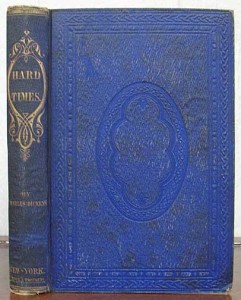
Hard Times

Dickens_Hard_TimesThe Anti-Corn Law League was founded in 1836 with the sole purpose of abolishing the Corn Laws, which levied taxes on imported wheat and inflated the price of food at a time when factory owners were attempting to cut wages. After a decade, the movement was successful, and the league disbanded. The movement (known as Manchester capitalism or Manchester liberalism)  was based on the principles of laissez-faire capitalism as promoted by Adam Smith, and its members believed that free trade would ultimately lead to a more equitable society. Although Dickens would likely have agreed with the school on other issues like slavery, he vehemently disagreed with laissez-faire capitalism. In Hard Times, we encounter characters whose personal relationships have been tainted by economics and face the cruel living conditions of the urban working class. Dickens also paints a picture of the greedy excesses enabled by unregulated capitalism. Meanwhile, he also addresses contemporary reforms to divorce law, the lack of education for the poor, and the working class’ right to amusement.

Dickens is often criticized for failing to offer any solutions to Victorian England’s social issues. Criticism also sways with political trends; in the 1960’s and 1970’s, for instance, Dickens was simply “not Marxist enough.” But ultimately Dickens renders an important service by bringing attention to such a wide range of social concerns, and one must ask whether we should really expect solutions to social problems in our literature.

Related Posts:
Charles Dickens and Capital Punishment
Andersen’s Visit with Dickens Less than a Fairy Tale
Charles Dickens the Copyright Confederate
Why Did Charles Dickens Write Ghost Stories for Christmas?
Jane Bigelow, the First Celebrity Stalker? 


Thanks for reading! Love our blog? Subscribe via email (right sidebar) or sign up for our newsletter--you’ll never miss a post.

Share

Au Paris: Food, Wine, and Rare Books!

This month marked the 100th anniversary of Syndicat Nationale de la Librairie Ancienne et Moderne, better known to the rare book world as SLAM. In conjunction with this momentous occasion, SLAM not only hosted the International Antiquarian Book Fair at Paris’ Grand Palais but also followed this by coordinating the 2014 ILAB Congress, April 13 to 16, whereat over 100 colleagues from around the globe gathered to celebrate not only their vocation, but also their avocation. Both the book fair and the Congress were fantastic events where numerous bibliophilic treasures were seen by all that attended. These bookish wonders aside, the collegiality alone would have made the trip worthwhile–though the exceptional food and wine cannot be discounted!

In honor of our Parisian adventure, Tavistock Books is pleased to present a list of books connected to France and French. Should you have a question about any item, please don’t hesitate to contact us.

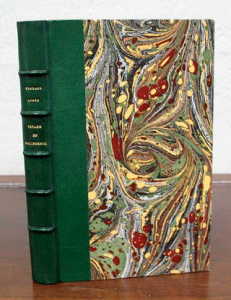
Voyage en Californie par Edouard Auger

Auger_Voyage_CalifornieEdouard Auger spent 1852 and 1853 in California for the Gold Rush. This first edition, published by Librarie Hachette in 1854, is inscribed by the author on the title page. It has a modern green quarter calf binding with marbled paper boards and endpapers. The original green printed wrappers are bound in. Details>>

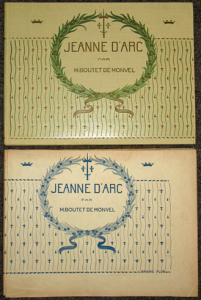
Jeanne d’Arc

Monvel_Jeanne_DArcMaurice Boutet de Monvel published Jeanne d’Arc in 1896. It is his masterpiece, and Silvie calls the work “beautifully printed and exquisitely composed” in Children’s Books and Their Creators. Monvel is considered a leading figure in the Golden Age of children’s literature, alongside Caldecott and Greenaway. It is quite rare to find the book in its original dust jacket, as it is offered here. Details>>

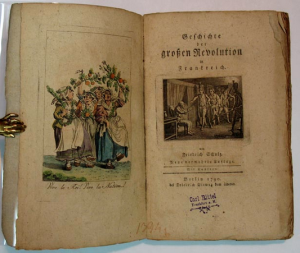
Geschichte der Grossen Revolution en Frankreich

Schultz_Geschichte_Grossen_Revolution_FrankreichPublished in Berlin in 1790, this edition of Geschichte der Grossen Revolution en Frankreich features a hand-colored frontispiece and has the period dark brown plain paper wrappers. There’s a hand-inked title label to the spine. Details>>

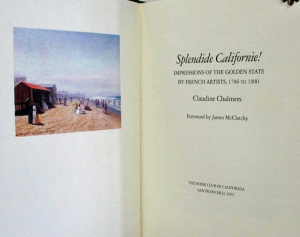
Splendide Californie!

Splendide_CaliforniePublished by the Book Club of California in 2001, Splendide Californie! is truly a stunning item. It features impressions of the Golden State from French artists, ranging from 1786 to 1900. The book was designed and supervised by the Yolla Bolly Press. Details>>

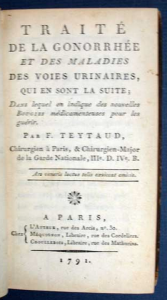
Traite de la Gonorrhee et des Maladies des Voies Urinaires

TeyaudSexually transmitted diseases proved formidable opponents to medical professionals in the eighteenth century. Teyaud’s Traite de la Gonorrhee et des Maladies des Voies Urinaires offers a look at how these conditions were treated at the end of the century. Paris would later become a center for medical study, and American doctors frequently went there to study. Details>>

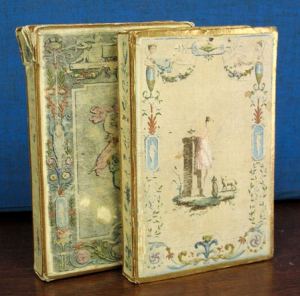
Theatre des Dames

Theatre_des_DamesA compilation of diverse theatrical pieces from 1792 to 1815, Theatre des Dames is bound in beautiful color printed silk onlays affixed to gold boards, with a floral motif panel on the spine. It includes eight copperplate engravings. OCLC records only four copies worldwide, and KVC adds a fifth. Details>>

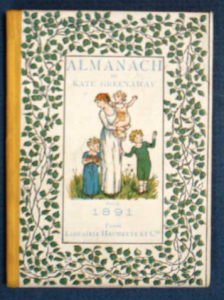
Almanach de Kate Greenaway

Almanach_Kate_GreenawayA scarce French edition of this popular publication Almanach de Kate Greenaway was published in 1891. It features white glazed paper-wrapped color-pictorial boards with a yellow cloth spine. Color illustrations are by Kate Greenaway, printed by Edmund Evans. KVK shows no holdings at the expected institutions, and OCLC records only two holdings in the US. Details>>

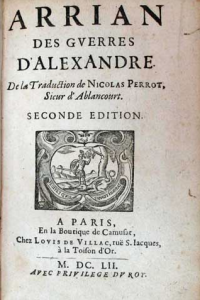
Des Guerres d’Alexandre

Arrian_Guerres_AlexandreArrian was a public servant, military commander, and philosopher from the second-century Roman period. His account of Alexander’s life is arguably the most complete and most widely read, likely because he was able to use sources that have since been lost. This 1652 edition (the second edition thus) appears to be rather scarce; OCLC records one copy in Germany, and KVK notes another at the Bibliotheque Nationale. Details>>


Share

A Panoply of Primers

For centuries, children’s literature consisted almost exclusively of didactic texts designed to teach basic skills like reading and writing or to impart religious lessons. During the Middle Ages, the vast majority of these texts were still written in Latin. Hornbooks with the Lord’s Prayer and the alphabet were the most common forms of children’s literature in the 1400’s, and alphabet books began showing up in Russia, Denmark, and Italy during the following century.

In the 1600’s, the concept of childhood shifted: children were no longer thought of as miniature adults, but as separate beings with their own juvenile needs and preferences. Publishers began printing books exclusively for children, though these, too, were often didactic. The seventeenth century also saw the rise of Puritanism, which again shaped people’s views of children. They were viewed not as young innocents, but as moral savages who needed stringent moral instruction.

It was not until the eighteenth and nineteenth centuries that children’s literature came into its own as a genre. A Little Pretty Pocket Book (1744) by John Newbery is considered the first book published for children’s pleasure reading. As technologies improved and it got cheaper to produce books, the industry blossomed. Even as pleasure reading became popular, the publication of educational materials maintained its momentum. Literacy rates began to improve, increasing the demand for, and interest in, primers and similar educational pieces.

Today, collectors can build quite extensive collections around educational materials printed for children. The broadest category of these is the primer. The first known use of the word “primer” was in the fourteenth century. The term derives from the Latin primarium, meaning “primary,” and was the name for a layperson’s prayerbook. At the time, literacy was relatively uncommon, but people did need to read their prayers. This book was often the only one in a home, so it was used to teach children to read. Eventually the term broadened and referred to any small book intended to teach reading. Today a “primer” may refer to a short, introductory piece about a specific topic or to a brief, informative piece of writing.

A Selection of Primers

We’re delighted to offer a selection of primers in a variety of subjects and time periods. Should you have a question about an item, please don’t hesitate to contact us!

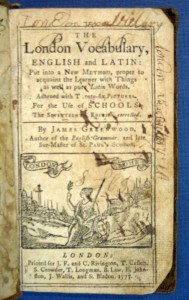
The London Vocabulary

Greenwood_London_VocabularyGrammarian James Greenwood published the first edition of The London Vocabularly, English and Latin in 1713. After working for years at the Hackney Academy, Greenwood opened up his own boarding school in Essex in 1711 and was later appointed surmaster of St. Paul’s School in London. He’s best known for his An Essay on Practical Grammar (1711), which received much positive praise from a number of scholars and critics, including Isaac Watts.  The London Vocabulary went through a number of editions, both English and American, of which this is the seventeenth English edition. Details>>

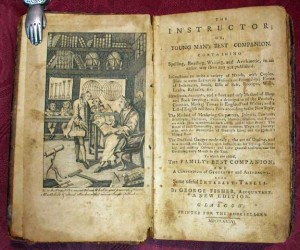
The Instructor

Fisher_InstructorA quite popular primer, George Fisher’sThe Instructor  appeared in numerous editions, both throughout the United Kingdom and in America. Like many educational books at the time, it purportedly offered an easier method of learning than other primers. And also like many educational books at the time, it reminds us of just how little people really knew about geography at the time, and that this truly was an age of exploration and discovery. In this Glasgow edition, printed in 1786, California is still an enigma: “Northward, on the Pacific Ocean, is New Mexico, and the island of California; but of these we know but little.” ESTC records five holdings of this edition. Details>>

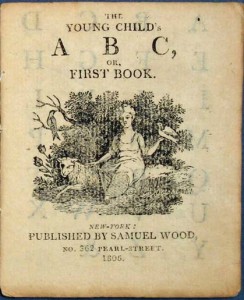
The Young Child’s ABC

Anderson_Young_Childs_ABCWritten by Alexander Anderson and illustrated by Samuel Wood, The Young Child’s ABC (1806) contains a horn book-style alphabet and a syllabary. Letters are illustrated with objects in alphabetical order. This children’s chapbook was the first item published by Wood, who would go on to have an illustrious and prolific career in the trade. He had thousands of titles under his imprint. Although four copies of later editions have come to auction in the last three decades or so, none of this first edition have come to market. It’s quite rare in the trade. Details>>

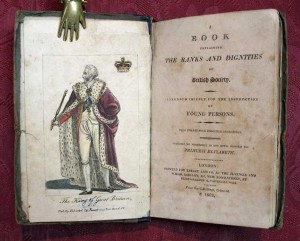
A Book Explaining the Ranks and Dignities of British Society

Lamb_Ranks_Dignities_British_SocietyCharles Lamb is best remembered for his collaboration with his sister, Mary Lamb, on Tales from Shakespeare. But he also anonymously published A Book Explaining the Ranks and Dignities of British Society in 1805. The charmingly illustrated children’s book delineates the hierarchy of the nobility, clergy, army, navy, government & professions; with their history & origins, forms of address, order of precedence, honors, with their coronets & coronation robes described, etc.This is the second edition, published in 1809. The book has been occasionally at auction these last 30+ years, though not since 2003. It’s scarce in the trade. Details>>

Le Livre des Enfans

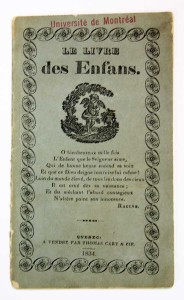
Livre_EnfansLe Livre des Enfans was published in Quebec in 1834. Illustrated with woodcuts, the work begins with two alphabets, which are followed by the usual primer material. The cover features a short verse by Racine. Le Livre des Enfans also includes thirteen pages of animal descriptions, such as Le Zebre, Le Cheval, and Le Hibou. It’s scarce in the trade. Details>>

The New England Primer

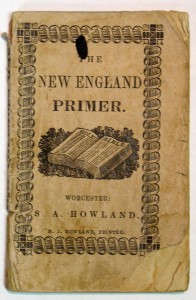
Howland_New_England_PrimerPublished around 1840, The New England Primer bears quite a drop title: Containing the Assembly’s Catechism; The Account of the Burning of John Rogers; A Dialogue Between Christ, A Youth, and the Devil; and Various Other Useful and Instructive Matter. With a Historical Introduction, by Rev. H. Humphrey, D.D. Rogers was a biblical translator and commentator, and the first English Protestant martyr under Mary I. He was burned at the stake for heresy in February 1555. This primer bears a frontis of Isaac Watts. Though this copy has some wear to its wrappers, it’s in good condition. Details>>

Girls’ and Boys’ Primer, Part II

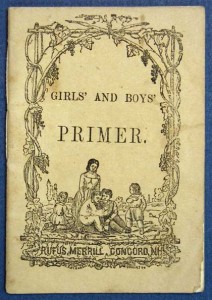
Girls_Boys_PrimerGirls’ and Boys’ Primer, Part II was published around 1850 by Rufus Merrill in Concord, New Hampshire. The alphabet is illustrated with woodcuts. The primer features the usual material: alphabet, poems, and lessons in spelling and writing. This copy is in the publisher’s original buff paper wrappers with ornamental border to front and rear wrappers and the signature of “Eastman & Bogart.” Though there’s light wear and soiling to the wrappers, this is a very good copy. Details>>

A Farewell Present to a Female Scholar, on Going to Service

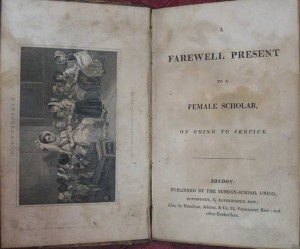
Farewell_Present_Female_ScholarsThanks to the Enabling Act of 1799, dissenters could teach without subscription to the Church of England. The London Sunday-School Union was formed in 1803 with the aim of educating poor children and became a very active publishing organization. One of its publications was A Farewell Present to a Female Scholar, on Going to Service (ca 1828). An apparently unrecorded little work, it offers counseling a young lady regarding her pending move to the world of ‘service,’ “a useful and important station in society ” and  outlines a number of ‘rules to live by’ follow, including “Fifthly- Always observe a respectful and obliging behaviour towards those with whom you live, and endeavor to go about your work with a cheerful air, as a pleasure rather than a burden to you.” It appears to have served as a sort of primer for young women entering domestic service. Details>>

Fleet Fact Book

Fleet_Fact_BookFleet Fact Book (ca 1906-1910) is separated into four sections: The “Dreadnaught” (2 text pages & 1 photographic image); Submarines (1 text page & 5 photographic images); Torpedo Boat Destroyers (1 text page & 2 photographic images); and The Fleet / Dreadnaught Types (1 text page summarizing the fleet strength, including ship types/numbers & 5 color postcard-type images of diverse dreadnaught types). In short, the volume offers a custom ‘primer’ for the Royal English Navy, ca 1910, with all indications the book created for the use of a senior Naval official, or senior political figure associated with the Royal Navy. Details>>

Puff and Dick

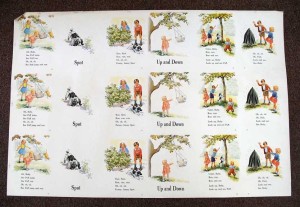
Puff_DickPictured are the main characters from this famous primary reader: Dick, Jane, Spot, Puff & Baby. This is a rare unused printed sheet of a tale from the highly-collected Dick & Jane reader series, published in the 1950’s. Details>>


Related Posts:
Chapbooks: Short Books with Long History
The Ins and Outs of Collecting Serial Fiction for Children
Randolph Caldecott: Legend in Children’s Literature


Thanks for reading! Love our blog? Subscribe via email (right sidebar) or sign up for our newsletter--you’ll never miss a post.
Share

The California Gold Rush, Slavery, and the Civil War

California_Gold_Rush

On January 24, 1848, Swiss immigrant John Sutter’s employee James Wilson Marshall found gold at the Sutter Mill. The result was the largest migration in American history, along with bitter debate over the issue of slavery. California would eventually enter the Union as a free state, but not because its delegates thought slavery an abomination. Figures like Hinton R Helper, himself a failed prospector, only exacerbated strained relations between the North and South.

Territory of Untold Value

When the US and Mexico went to war over California in 1846, the region’s population included about 6,500 Californios of Mexican or Spanish descent; 700 mostly American foreigners; and about 150,000 native Americans (whose population had been cut in half since the arrival of Spanish conquistadors). The war

Miners_Ten_Commandments

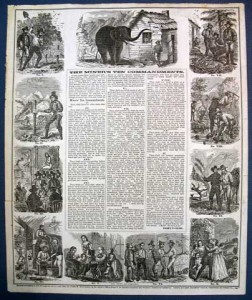
Published pseudonymously, “The Miner’s Ten Commandments” reminds miners to respect the Sabbath–a rule that had fallen out of practice in many a mining town.

was ended in favor of America on February 2, 1848, with the ratification of the Treaty of Guadelupe Hildago. Neither side was aware of Sutter’s discovery, so the incredible value of the territory was not yet completely clear.

Indeed, people as close as San Francisco were quite skeptical until entrepreneur Sam Brannen marched through the city waving around a vial of gold. By the middle of June, San Francisco was a ghost town; most men had gone south to the mines. Military governor Colonel Richard B Mason took a tour of the gold fields shortly thereafter. IN his report, he noted that two miners had found $17,000 in gold in three days at Weber Creek. A team of six miners and fifty Native Americans had mined 273 pounds of gold. Sales at Sam Brannen’s mercantile exceeded $36,000 in May, June, and early July combined. Mason sent the report to Washington, DC with a tin of gold as additional proof. It wouldn’t arrive for months.

Word arrived sooner in places that were accessible by ship from San Francisco. Immigrants immediately began arriving in droves from the Sandwich Islands (Hawaii), Peru, Chile, China, and Mexico. Europeans followed. When the first accounts of newfound wealth appeared in East Coast newspapers in the summer of 1848, they invited much incredulity. It wasn’t until December 5, 1848, when President James K Polk announced Mason’s report in his State of the Union address, that Easterners began to take the Gold Rush seriously. The exodus began almost immediately. Men headed West in record numbers, hoping to escape the wage labor economy and strike it rich. Women were mostly left at home to raise families, tend farms, and run businesses on their own. Countless families took out loans or spent their life savings in pursuit of their dream.

The Gold Rush Undoes Many a Prospector

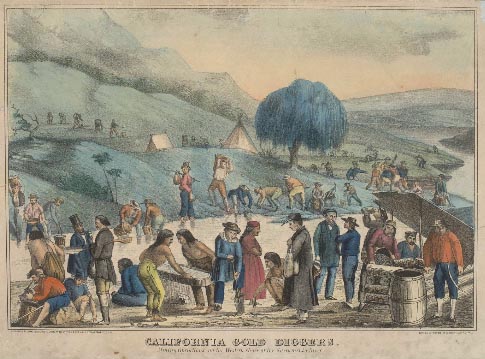
By 1849, the non-native population of California had reached almost 100,000. Prospectors soon learned that mining was grueling, dangerous work. It wasn’t uncommon for them to die of disease, accident, or even malnutrition. Hiram Pierce held a funeral for one young man who died of gangrene after accidentally shooting himself in the leg. Despite these conditions, miners continued pouring into California. And how could they resist? In 1849, mined gold was valued at $10 million. The following year, that figure was $41 million. In 1852, $81 million worth of gold was mined in California. (Not everyone was convinced that this westward migration was worth the risk; in 1849 Edgar Allan Poe even undertook a bizarre hoax to dissuade people from going.)

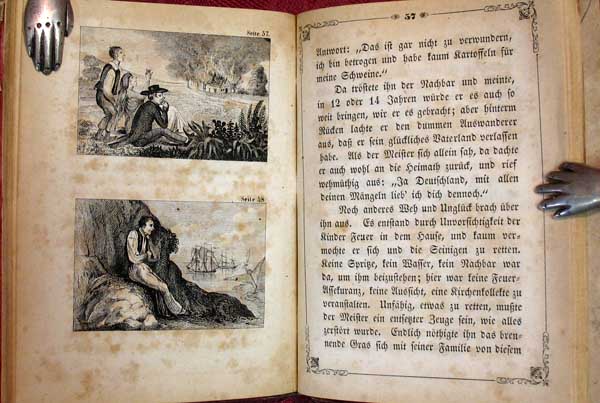
Das_Goldland_Californien

‘Das Goldland Californien’ (1850) includes the sad tale of one German emigrant who lost his fortune in his quest to strike it rich.

Competition grew increasingly fierce, and soon Anglo-American miners were growing territorial. They often resorted to violence, forcing others of different nationalities from their land. As the surface gold disappeared, miners found themselves with no option but to work for larger mining corporations with the technology to mine gold deeper underground. A wage labor economy had again emerged, and after 1852, revenue from gold fell steadily until 1857, when it held at about $45 million per year.

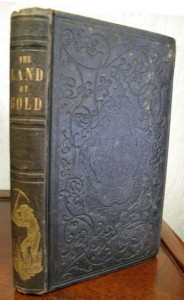
Helper_Land_GoldThe vast majority of men who went in search of gold failed to strike it rich. One such failed prospector was Hinton Rowan Helper. Born on December 27, 1829 outside Mockville, North Carolina, Helper was apprenticed to a printer. He went to the gold fields in 1850 and returned after only a matter of months. Helper said that after working the same claim for three months, he’d made less than 94 cents Though Helper didn’t find gold, the experience did give him material for Land of Gold: Reality vs Fiction (1855).

Helper’s account was hardly reality; he garbled and fabricated statistics to support his argument. Gary F Kurutz, Director of the Special Collections Branch at the California State Library and author of a descriptive bibliography on the Gold Rush, calls Land of Gold “one of the most famous, oft-quoted, and entertaining books of the Gold Rush.”

California Slavery Divides Congress

Helper also took up another hot-button national issue: slavery. He advocated the expansion of slavery to California, scolding the “meddling abolitionists” who interfered with whites’ ability to exploit blacks to work the mines. Racism ran deep in California, and one would think that Helper was not alone in his pro-slavery sentiment. Such was not the case; the issue was much more complicated. White southerners had first brought slaves to California mines in 1849, but that practice wasn’t popular. However, no laws banned slavery in the early days of the Gold Rush.

After the US won California, a bitter dispute ensued over whether the state should be a free or slave state. There were fifteen states in each category, and California would tip the scales. By September 1849,

1849_Monterey_Convention_Spanish_Edition

Details of the 1849 Monterey convention are among of the most important documents in California history. This is a Spanish translation.

California delegates were tired of waiting. They gathered in Monterey and voted to enter the Union as a free state. This wasn’t because they supported the abolition of slavery. On the contrary, many delegates were miners who hailed from the South. The majority felt that slaves actually had an unfair advantage in mining work because they were more accustomed to heavy labor. Thus, they voted against slavery for their own financial gain.

However, in Washington, DC, the North and South were deadlocked. Debate raged on for six months, and in one instance one senator even pulled a pistol on another. Finally Congress reached the Compromise of 1850: California would enter the Union under the state delegates’ terms, as a free state; New Mexico and Utah would become territories, and the legality of slavery there was undecided; the slave trade was banned in Washington, DC; and the Fugitive Slave Law was strengthened. California would ratify its own version of the Fugitive Slave Law in 1852.

A Racist Abolitionist

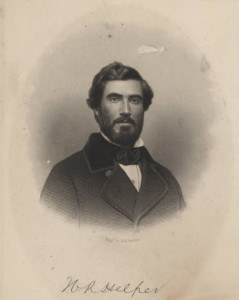
By this time, Hinton Helper had moved to New York. The issue of slavery remained at the forefront of US politics, and Helper didn’t help matters when he published The Impending Crisis of the South: How to Meet It in 1857. Helper’s thesis was that slavery impeded the economic development of the South because it Helper_Hinton_Rowanhelped to concentrate wealth in the landed class. He wrote in defense of non-slave owning Whites, whom he saw as economically disadvantaged, and who comprised about 75% of the white population of the South. But Helper’s publication had unintended consequences; it was adopted as an abolitionist work and helped to get Abraham Lincoln elected in 1860. Some experts even place The Impending Crisis of the South alongside Harriet Beecher Stowe’s Uncle Tom’s Cabin in terms of its influence as abolitionist literature.

The Impending Crisis of the South includes about 150 pages of statistics from the 1850 census, which Helper had hoped would illustrate the economic disadvantage of the slave states. These had little influence. But what did stick with readers was Helper’s branding Southern slaveholders as “robbers, thieves, ruffians, and murderers” and his exhortations that slaves should escape from their owners by violence if necessary. The summer after the book was published, New York Herald editor James Gordon Bennett gave President Buchanan a copy and warned him that “There is gunpowder enough in that book to blow the Union to the devil.”

A Help for the Republican and Abolitionist Cause

Conflict over slavery again reached a fever pitch, as it had when California entered the Union. Then Republican party leaders moved to print a compendium of The Impending Conflict of the South to distribute in the 1860 presidential campaign. The “Speakership Fight” in the House of Representatives resulted, lasting from December 5, 1859 to February 1, 1860. The battle gave Helper’s book far more national attention than it really deserved, as did the resulting endorsement from the Republican party.

Lincoln won the election, even though he wasn’t necessarily the most popular candidate. For example, California citizens increasingly sympathized with the South as farming overtook gold mining. Yet Lincoln won in California because Democratic votes were divided between Northern candidate Steven Douglas and Southern candidate John Breckenridge, while Republicans were unified in their vote for Lincoln.

In January 1861, the Herald declared that Lincoln’s victory had been due to “this very work of Mr. Helper, and kindred speeches and documents.” Much later, historian James Ford Rhodes would note that the book “proved a potent Republican document, especially in the doubtful states of New Jersey, Pennsylvania, Indiana, and Illinois, where it was easier to arouse sympathy for the degraded white than for the oppressed Negro.” Helper’s screed had had unintended consequences. The author found himself suspect in the South and scorned in the North. He couldn’t find employment, faced public ridicule, and feared physical violence. Helper turned to Abraham Lincoln for a consular appointment, which Lincoln granted. In November 1861, Helper went to Buenos Aires as the consul to Argentina. While there, he married Maria Louisa Rodriguez.

When Helper returned from Argentina, he settled in Asheville, North Carolina. He would later live in New York and St. Louis. He wrote five other books, three of which were extremely racist. By 1890, Helper’s grip on reality had all but evaporated. His wife had gone blind and returned to South America with the couple’s only son. Alone, Helper grew more and more unstable. He committed suicide and was buried in a donated, unmarked grave. The Authors Society of New York paid his funeral expenses.

Hinton Rowan Helper made a mark on history that he never could have predicted. His own history shows how inextricably the events of regional and national history are so often intertwined. Helper’s work proved a malignantly divisive one, exacerbating the conflicts that pushed the nation to the brink of Civil War.

Related Reading: 
The Six Hoaxes of Edgar Allan Poe
Louisa May Alcott: Abolitionist, Suffragette, and Mercenary 
Charles Dickens the Copyright Confederate
A Collection of Confederate Literature
Clara Barton: Heroine of Civil War Nursing and Record Keeping

Thanks for reading! Love our blog? Subscribe via email (right sidebar) or sign up for our newsletter--you’ll never miss a post.
Share

Famous Figures in Culinary History: Hannah Glasse, Susannah Carter, and Amelia Simmons

At first, cookbooks were largely written by men. Their intended audience were the individuals who ran restaurants and the households of the wealthy. It wasn’t until the eighteenth century that this trend began to shift. Perhaps the most notable cookbook of the century is Hannah Glasse’s The Art of Cookery (1747), which Glasse wrote for “the lower sort,” that is, domestic servants. Unlike her predecessors, Glasse used a conversational tone and an expository approach that appealed to an incredibly broad audience.

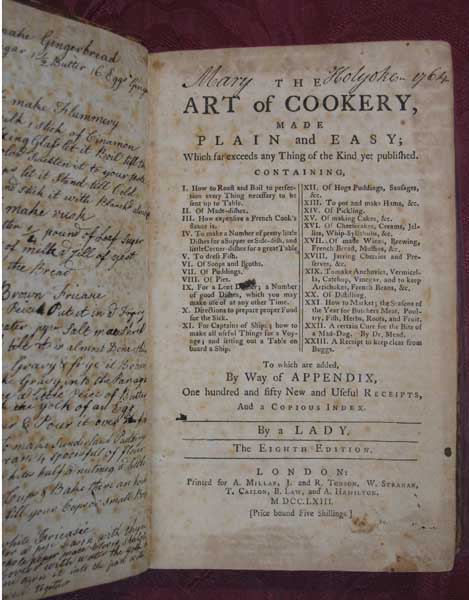
Glasse_Art_CookeryGlasse could not claim all the delicious recipes in The Art of Cookery as her own; she had borrowed thoroughly from other cookbooks. Meanwhile, her own book would be pirated and plagiarized plenty of times. Even during her lifetime, Glasse discovered “new editions” of her book that contained sections she had not even written! Her publishers were to blame for some of that; they wanted to update the book to fit with changing tastes. The tactic worked; The Art of Cookery would become the definitive English cookbook for the remainder of the century, and now the various editions an incredibly thorough representation of the foodways of eighteenth-century Britain.

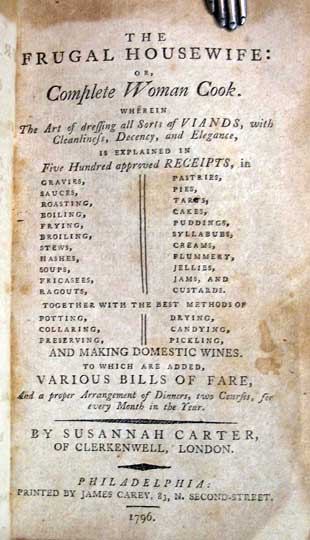
Glasse is undoubtedly a major figure in culinary history, but it was a lesser known personage whose cookbook would successfully “cross the pond” from Britain to the New World. Susannah Carter, author of The Frugal Housewife (c 1765) takes that honor. Carters work was significant because it was overtly aimed at housewives, rather than servants and chefs, and because it was one of the earliest printed American cookbooks–and certainly the most successful.

Unfortunately we know little about Carter, save that she hailed from Clerkenwell, in London. We know much more about the publishing history of The Frugal Housewife, which is interesting unto itself. In London, the book was published by Francis Newbery (the nephew of John Newbery) in the printing enclave near St. Paul’s Cathedral. The same year, the book appeared in Dublin. The Frugal Housewife didn’t make its way to the colonies until 1772. It was published by Benjamin Edes and John Gil and illustrated with prints by Paul Revere. Edes and Gil were known for publishing the works of Revolutionary writers, and they played a significant role in instigating the Boston Tea Party.

Carter_Frugal_HousewifeAs colonial booksellers, Edes and Gil had little bargaining power with British publishers. They desperately needed British titles to stay in business, and they couldn’t offer many interesting colonial works in return. Thus British booksellers would often force their colonial counterparts to buy less desirable works–such as a cookbook–in order to acquire more literary titles.

Cookbooks were a burgeoning field at the time, so Newbery may not have predicted that colonial publication of The Frugal Housewife would be profitable. Thus it’s quite possible that Newbery essentially forced the American publication of The Frugal Housewife, unwittingly created something of an American cookery phenomenon.

One of the earliest cookbooks printed in America, The Frugal Housewife made no mention of colonial cooking or American ingredients, and it presumed access to cooking tools and technologies that were all but impossible to acquire in the colonies. Despite these obvious shortcomings in the colonial market, The Frugal Housewife sold quite well. The book remained in print in 1803. That year, an appendix was added that contained American recipes like Indian pudding, buckwheat cakes, and pumpkin pie.

Carter certainly did not write these; it appears that they were borrowed from a Swedish cookbook called Rural Oeconomy. (The exact same appendix showed up in the 1805 edition of Glasse’s The Art of Cookery! It’s likely that publishers decided this supplement would make both cookbooks more appealing to American audiences.) In 1832, Lydia Marie Child republished the cookbook as The American Frugal Housewife, and it would be reprinted multiple times over the next two decades.

Thanks to Carter, a number of traditional English dishes made their way into American foodways. But she didn’t do it on her own; she remains in debt to Amelia Simmons, who wrote the first truly American cookbook, American Cookery, in 1796. Simmons was heavily influenced by Carter and borrowed entire passages verbatim from The Frugal Housewife.

The interplay of culinary texts from Glasse, Carter, and Simmons superbly illustrates the rich history–and interaction–of global foodways. Each of these women’s cookbooks significantly impacted colonial cookery.


Thanks for reading! Love our blog? Subscribe via email (right sidebar) or sign up for our newsletter--you’ll never miss a post.
Share

Portrait of a Bluestocking: Hannah More

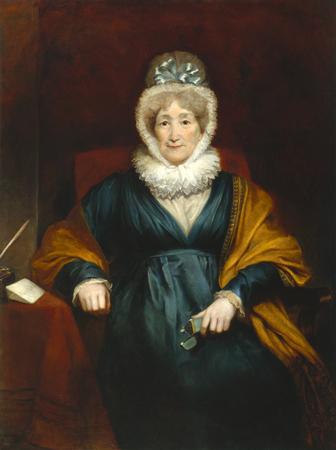
Hannah_MoreProlific author Hannah More made her way to the most prestigious literary circles of eighteenth-century England, establishing herself as a true Bluestocking. But she’s better known for her moralist writings.

Hannah More was born on February 2, 1745. Her father, who’d been raised Presbyterian, had turned to the Church of England. He’d aspired to a career in the church and raised all his daughters with a particularly strong religious foundation, even for the time. More and her sisters were educated at home. Her father taught mathematics and Latin. Later, her elder sisters would teach her French.

In 1758, her father established a girls’ boarding school. More eventually began teaching there. Her first literary endeavors were pastoral plays that would be appropriate for her students to perform. When she published In Search After Happiness (1762), the work proved a success. Within about twenty years, it had sold over 10,000 copies.

More gave up her position at the school in 1767 because she got engaged to William Turner. But six years later, the two still hadn’t gotten married–and Turner exhibited no sense of urgency. In 1773, the engagement ended. More suffered a nervous breakdown, and Turner agreed to pay £200 a year to More as compensation. That sum was enough that More could live modestly while she pursued a literary career.

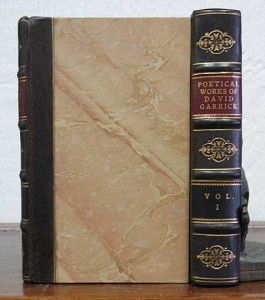
Garrick-Poetical_WorksThat same year, More made a pilgrimage to London with two of her sisters, a trip she would repeat annually. Thanks to the lyrics she’d written about David Garrick’s version of King Lear, the legendary actor and playwright took notice of More. The acquaintance proved a fortuitous one for More: not only did Garrick help her gain entry into London’s literary circles, but he also collaborated with her on the tragedy Percy (1777), writing both the prologue and epilogue. The association ensured that when the play was performed at Convent Garden that December, it was a smashing success.

But when More followed up with The Fatal Falsehood in 1779, she was on her own. Garrick had passed away. The new play foundered, and More decided to turn away from theatre and pursue other genres. By this time, she’d become thoroughly ensconced with London’s literati. More befriended luminaries like Joshua Reynolds, Samuel Johnson, and Edmund Burke. In 1781, More met Horace Walpole, and the two occasionally corresponded thereafter.

More also frequented Lady Elizabeth Montagu’s salon and came to be closely affiliated with the Bluestockings, befriending Hester Capone, Elizabeth Carter, Frances Boscawen, and Elizabeth Vesey. In 1782, More wrote a witty poem in tribute to her friends called The Bas-Bleu, but it wouldn’t be published until two years later. That year also marked a turning point in More’s career. With Sacred Dramas (1782), she began turning toward more serious subjects. She followed up with works like An Estimate of the Religion of the Fashionable World (1788) and Strictures on the Modern System of Female Education (1809).

More also began to engage in the abolitionist movement. She had become close with Beilby Porteus, the Bishop of London, along with evangelical leaders like Zachary Macaulay and William Wilberforce. More also found herself drawn into a circle of prominent anti-slavery activists like James Ramsay and Charles Middleton.

While back in Bristol, More discovered the poetry of Ann Yearsley. She took the young poetess under her wing, even organizing a benefit to raise money when Yearsley faced dire financial straits. Yearsley, who was known as Lactilia, published Poems, on Several Occasions and earned £600. Wishing to protect Yearsley’s earnings from her greedy husband, More and Montagu put the money in trust. Yearsley demanded the capital, but her mentors refused. Finally, Yearsley publicly insinuated that More had stolen the money. They were left with no choice but to turn over the money to Yearsley. Meanwhile, her reputation destroyed, More was forced to slink away from the London social scene.

Though More left London, she didn’t stop writing. She retired to the country with her sister Martha in 1785 and devoted her time to writing religious books and tracts. More’s long friendship with Porteus would come to significantly shape this period of More’s authorial career. At Porteus’ urging, More undertook a number of lively rhymes and prose stories–all didactic, naturally. They started in 1792 with Village Politics, by Will Chip, with the intent to refute the doctrines of Thomas Paine and undermine the influence of the French Revolution.Village Politics was a publishing phenomenon.

More_Carpenter_Dangers_Evil_Company

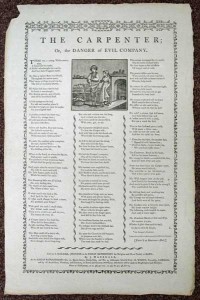
“The Carpenter,” a broadside from the Cheap Repository series

Encouraged, More and Porteus embarked on a more ambitious endeavor. They began the Cheap Repository Series, which ran from 1795 until 1797. Already a prolific author, More managed to write three pieces for the series each month. The most famous of these, The Shepherd of Salisbury Plain, was even translated into multiple languages. The tracts promoted Christian virtues like sobriety, frugality, and industry. But they also encouraged respect for the British Constitution and a trust in the benevolence of the gentry. Two million copies circulated in one year.

Meanwhile, More and her sister Martha had been busy setting up a dozen schools where children could learn to read and get lessons on the Bible and the catechism. Their noble cause had met with considerable resistance from local farmers, who feared that education would prove the downfall of agriculture. More also had some unlikely detractors: local church leaders, who considered More’s approach and doctrine too Methodist.

More remained quite active and productive until the last years of her life. She’s remembered today for her tireless work for education, and for her religious writing. Because her doctrine has fallen out of fashion, More’s works aren’t often taught, and she’s fallen from our collective conscience. But her works encapsulate the zeitgeist of late eighteenth- and early nineteenth-century Britain.

Share

The Magic Ring: A Forgotten Inspiration for JRR Tolkien

When The Magic Ring was published in 1813, it met with instant success. Its author, Friedrich Heinrich Karl Freiherr de la Motte Fouqué, has largely faded from popular awareness, remembered occasionally for Undine (1811). But JRR Tolkien owes an extraordinary debt to Fouqué for his portrayal of the One Ring and his pioneering work in fantastic fiction.

A Soldier Author

friedrich_baron_de_la_motte_fouquetBorn on February 12, 1777, Fouqué was a descendent of French Huguenots. His grandfather was a general for Frederick the Great, and his father was a Prussian officer. Fouqué himself didn’t intend to have a military career. Instead, he went to Halles. But in 1794, he left school to join the army and participate in the Rhine campaign. Fouqué would again see battle in 1813, during the uprising against Napoleon. By this time, nationalism had taken deep root in Germany, and these sentiments came to influence Fouqué’s writing.

Following that first stint of military service, Fouqué decided to pursue his literary interests, which were split between medieval romance and northern mythology. In 1806 he versified a sixteenth-century medieval romance. Fouqué was also the first to dramatize the Nibelung legend, combining both Icelandic sources (such as the Volsunga Saga) with Middle High German legend. This play and its sequels were published as a single volume in 1811 and immediately brought Fouqué public attention.

The following year, Fouqué published Undine. The novel includes elements not only of fantasy, but also of religious allegory, Gothic horror, and historical romance, so it appealed to a wide audience. The book has also received praise from critics in all corners. In “The Fantastic Imagination,” George MacDonald says, “Were I asked, what is a fairytale? I should reply, Read Undine: that is a fairytale….of all the fairytales I know, I think Undine the most beautiful.” MacDonald’s love of Fouqué was clear in both his fiction and non-fiction, which would later inspire both CS Lewis and Tolkien.

From 1810 to 1815, Fouqué managed to churn out plays, novels, and epics at an incredible pace. But by 1820, his reputation had faltered; unable to adapt to changing times and tastes, Fouqué still clung to Romanticism. His rivals dubbed him the “Don Quixote of Romanticism.” Fortunately Frederick William IV of Prussia granted Fouqué a pension, so he passed his last years in relative comfort.

Fouqué’s Invisible Influence

Fouqué influenced multiple authors, from Robert Louis Stevenson and Louisa May Alcott, to Edgar Allan Poe and HP Lovecraft. But the most important of these were undoubtedly William Morris and JRR Tolkien. Morris, widely regarded as the father of modern fantasy, opened the door for Tolkien later on.

Motte_Fouque_Magic_RingTolkien scholar Amy H Sturgis notes that The Magic Ring (1813) is a sort of “missing link in the story of Tolkien’s One Ring.” The legend began several centuries ago with the Siegfried story of Norse legend. It also appears in the Nordic Sagas and Eddas, along with the Middle High German Nibelundenlied. Over time the legend evolved, but Fouqué’s adaptation proved incredibly influential. It was taken up by Richard Wagner in his Ring Cycle and by JRR Tolkien in the Lord of the Ring series.

So why has Fouqué fallen by the wayside? His work was tossed aside during his own lifetime as preferences changed. That alone is often enough to relegate an author to the sidelines of history. But as Tolkien has again gained more attention. readers and collectors are rediscovering figures like Fouqué. Which authors have you been most excited to (re)discover?


Thanks for reading! Love our blog? Subscribe via email (right sidebar) or sign up for our newsletter--you’ll never miss a post.
Share

The Rare Books of Valentine’s Day

Valentine’s Day is upon us. If this day of hearts, candy, and warm fuzzies isn’t exactly your cup of tea, you’re not alone! Here’s a look at our three best less-than-romantic rare books for the holiday.

Mark Twain’s (Burlesque) Autobiography and First Romance

Twain_Autobiography_First_RomanceThe title of this work is quite misleading; the events have no relevance to Twain’s life. The book, published by Sheldon & Co in 1871, contains two separate stories: “A Burlesque Autobiography,” which first appeared in Twain’s Memoranda contributions to The Galaxy; and “First Romance,” which was originally published in The Express in 1870. They were not Twain’s favorites; indeed, two years after the book was published, he bought the printing plates and destroyed them.

The short stories do feature characters who are supposedly related to Twain. Twain ends the story abruptly, saying only “The truth is, I have got my hero (or heroine) into such a particularly close place, that I do not see how I am ever going to get him (or her) out of it again—and therefore I will wash my hands of the whole business, and leave that person to get out the best way that offers—or else stay there. I thought it was going to be easy enough to straighten out that little difficulty, but it looks different now.”

Just as the story has no real connection to Twain’s life, the illustrations also have no connection to the text. They use illustrations of the children’s poem The House that Jack Built to criticize the Erie Railroad Ring and its participants.

Revi-Lona: A Romance of Love in a Marvelous Land

Cowan_Revi_LonaWhere romance and science fiction intersect, you’ll find Revi-Lona: A Romance of Love in a Marvelous Land by Frank Cowan. The novel is set in Antarctica and includes all the expected elements, such as prehistoric creatures and super science. Though Bleiler dates the novel’s publication to 1879, other sources simply place the novel “circa 1880’s.”

Though Cowan published a number of works, he’s probably better known for being Andrew Jackson’s personal secretary for managing land patents. Cowan was appointed to the position in 1867 and remained in the post until Jackson was succeeded by Ulysses S Grant. That same year, Cowan perpetrated a major literary hoax with his friend Thomas Birch Florence, who owned a failing Georgetown newspaper.

In an effort to bolster sales, Cowan and Florence came up with a fantastic story; they reported that the body of an Icelandic Christian woman who’d supposedly died in 1051 had been found under the Great Falls of the Potomac River. The body proved that other settlers had reached America a full five centuries before Christopher Columbus. Though the story did bolster sales, Cowan and Florence were eventually found out.

Fact and Fiction! Disappointed Love! A Story

Disappointed_Love_Cochran_CottonThe drop title of this work is “Drawn from the lives of Miss Clara C Cochran and Miss Catherine B Cotton, Who Committed Suicide, By Drowning, in the Canal at Manchester, N. H., August 14, 1853.” The two young women worked and roomed together at the Manchester Corporation and had “frequently expressed a purpose to drown themselves.” But their housemates thought little of it and paid the girls no heed.

Then on August 14, 1853, Cochran and Cotton “proceeded hand-in-hand, with great apparent cheerfulness, to the bridge crossing the upper canal…and together leapt into the water.” A few people witnessed the event. The women had obviously premeditated their demise, as both left letters to loved ones and put their affairs in order. Cochran, only nineteen years old at the time of her suicide, stood to inherit a large sum on her 21st birthday, which made her motives even more inscrutable to her contemporaries.

What are your favorite obscure or eccentric tales of love? And what rare book would you most like to receive for Valentine’s Day yourself?

Related Posts:
A Look Back at Long-Lost Manuscripts
Courtship, Romance, and Love…Antiquarian Style

Thanks for reading! Love our blog? Subscribe via email (right sidebar) or sign up for our newsletter--you’ll never miss a post.
Share

Collecting Antiquarian Diaries, Journals, and Correspondence

In this age of electronic communication, the practice of keeping a journal or diary has largely fallen by the wayside, as has the art of letter writing. But in past centuries, keeping a diary was the only means of creating a written record of one’s life, the only way to look back at one’s personal past. In bygone days, farmers may have recorded observations about crops, livestock, and weather in a journal. Soldiers recorded strife,while ordinary men and women simply recorded the simple details of their daily lives. And written correspondence was the primary method for maintaining long-distance relationships.

Looking back at these documents can give us tremendous insight into the aspects of life that history books often omit. They may reveal facts about the diet, customs, or etiquette of the time period. They sometimes shed light on genealogy and local history. Journals and correspondence may even reveal the real motivations behind historic events or explain the nuanced relationships among important individuals.

Tips for Collecting Diaries, Journals, and Correspondence

For many collectors, diaries and journals are appealing because each volume is an absolutely unique manuscript. Such a document is quite a treasure, indeed. Collectors should keep a few tips and hints in mind.

  • Look for complete sets, rather than individual volumes of journals and diaries. Faithful diarists will often have produced a number of volumes over the course of their lifetimes. Stay away from individual volumes that have most likely been removed from a set.
  • Decide whether you’ll digitize your collection. This will require the assistance of a skilled archivist or conservator. Digitizing these items is an investment, but it will enhance your ability to enjoy the content of your collection–and to share it with scholars if the content proves significant.
  • Be gentle! Old paper can be quite brittle, while covers may be fragile. Handle them with care, and consider professional conservation or preservation to extend the life of your collection.
  • Don’t overlook ephemera. Journals frequently contain extra items, which can range from dried flowers to vacation souvenirs. These items damage the pages on either side. A conservator may recommend carefully documenting each item’s location and storing it separately in an archival envelope.
  • If correspondence is still contained in the original envelopes, consult a conservator about the best means to preserve both the envelopes and the letters inside. Chemical interactions between materials–even between two sheets of the same or similar papers–can hasten breakdown.

A Selection of Diaries and Journals

Journal Across the Atlantic

Journal_Across_AtlanticOriginal mss journals such as this are quite rare in commerce. An unidentified male passenger recorded the details of his 1785 transatlantic journey from London to Philadelphia. He records the names and nationalities of the crew and passengers, along with the daily minutiae of life aboard the ship. Events include the sighting of a “grampus whale,” an encounter with a Spanish ship, and a lively debate over how moths and butterflies came to be aboard the ship. Details>>

Notes from Lectures of Professor Alonzo Clarke for 1848-1849

Almon Mitchell Orcutt attended the College of Physicians and Surgeons in New York. The first 136 pages of his journal consist of notes he took during the lectures of Alonzo Clarke, a noted physician and professor at the college. Clarke was often quoted in medical journals and association reports. He famously said, “All of our curative agents are poisons; and, as a consequence, every dose diminishes the vitality.” He was correct, indeed, given the “medicines” and treatments commonly used at the time. John Harvey Kellogg quotes Clarke in his Home Hand-Book of Domestic Hygiene (volume 2, 1880) in a discussion of the smallpox vaccination. Orcutt’s notes include the semester’s lectures, while the last 68 pages contain financial records. Details>>

Department of the Interior, US Geological Survey

US_Geological_Survey_Notes_JournalThis workbook started out as a record of levels and other data, kept by Allen T Paine, the survey crew levelman. But Paine also used the book as a photo journal. Many of the photographs are captioned. While many show family, friends, and colleagues, a good number also document the buildings of Concord, New Hampshire, along with the survey crew’s work and environs. Details>>

Family Trip Photo Diary/Journal

This period photo journal of a visit to the 1915 Panama Pacific Exposition in San Francisco begins in Albuquerque, New Mexico. It includes 45 images, eight of which clearly depict portions of the journey to San Francisco. One image, for example, shows part of the Salt Lake; another, the Grand Canyon. Fourteen of the images have handwritten captions. Details>>

 Archive of Shuman Family Letter Correspondence, August 1862-September 1866

Shuman_Family_Correspondence_Civil_WarJohn Shuman was in his early twenties when he volunteered for service in the 88th Regiment of the Indiana Volunteers to fight for the Union in the American Civil War. His letters illustrate his confidence in the decision and that he believed the war would be short-lived. It lasted longer than Shuman expected, and he lost his life in battle, not due to wounds, but due to dysentery. The Shumans’ correspondence offers a unique snapshot of a soldier’s life during the war. Details>>

Eleven Manuscript Diaries

Manuscript_DiariesThe author of these diaries, William Antrim Flowers, was born on March 21, 1832 in Champaign County, Ohio. He begins his memoir with his birth and then goes back to the birth of his father in 1804. The memoir is a rich storehouse of family genealogy and history, following his family and relatives as they moved abou tthe Midwest in the early nineteenth century. Flowers also documents his own life, during which he worked variously as a teamster, a wagon driver, a teacher, and a dairy farmer. He saw the first McCormick reaper in 1855 and enlisted to serve in the Civil War. Flowers records descriptions of his own experiences in the war, along with a description of the 114th Colored Regiment Infantry and the 44th Colored Regiment; and the death of Abraham Lincoln. Details>>

Related Posts:
Flights of Fancy: Collecting Vintage Airline Posters
Of Sammelbands and Sheet Music
A Brief History of Broadsides


Thanks for reading! Love our blog? Subscribe via email (right sidebar) or sign up for our newsletter--you’ll never miss a post.
Share